Monthly Archives: February 2019

The Return of the King “Lighting the Beacons” (2003)

Beacons_of_War.png

The Return of the King “Lighting the Beacons” Film Scene (2003)

While there have been many criticisms leveled at the final entry in the Lord of the Rings film trilogy, you can’t deny that the film possesses some awesome musical moments. One of my particular favorites is “Lighting the Beacons,” when Gandalf dispatches Pippin to secretly light the city beacon so that Rohan can be notified that Gondor needs help. While it is a deviation from the book (in the original story Denethor ordered the beacons lit before Gandalf and Pippin even arrived at Minas Tirith), it’s one I don’t mind because the music that goes with this scene is just wonderful.

The Return of the King “Lighting the Beacons” Film Score (2003)

The cue starts with a tentative motif in the strings, matching Pippin’s secret climb up to the beacon while Gandalf observes from below. Despite the two guards sitting nearby, there’s never any real sense that Pippin is in danger of being caught or falling. As soon as the guards notice the beacon is lit, the music quickly jumps up into a “burning” melody that matches the leaping flames shining for all to see. As the next beacon in the sequence is lit, the music “ignites” again, flourishing higher and higher as the message is passed on with each new beacon.

The next segment in this scene is a montage showing beacons being lit all across the mountains. There’s actually far more than the seven beacons mentioned in the book, but it makes for a great filler scene so I don’t mind. The music heard during this scene is a fast reprise of Gondor’s theme. I’ve always loved the power in this theme, which is dominated by the brass. The theme slowly fades as the final beacon is lit and observed by Aragorn at Edoras. The music trails off on a note of suspense because, in the following moment, Aragorn dashes to inform the king that Gondor is calling for aid (the music for that can be found in another cue, that’s why it trails off to silence).

If you compare the film version to the soundtrack version, you’ll notice there are some musical differences. While they sound very similar to each other, I think the soundtrack version of this piece comes from an alternate take that didn’t make it into the final soundtrack.

What do you think of the music for “Lighting the Beacons”? Let me know your thoughts in the comments below and have a great day!

See also:

Become a Patron of the blog at patreon.com/musicgamer460

Check out the YouTube channel (and consider hitting the subscribe button)

Don’t forget to like Film Music Central on Facebook 🙂

The Fellowship of the Ring “The Shire” (2001)

The Fellowship of the Ring “Shadow of the Past” (2001)

The Fellowship of the Ring “The Wood Elves/Passing of the Elves” (2001)

The Fellowship of the Ring “The Treason of Isengard” (2001)

The Fellowship of the Ring “A Knife in the Dark” (2001)

The Fellowship of the Ring “Flight to the Ford” (2001)

The Fellowship of the Ring “The Bridge of Khazad-Dum” (2001)

The Fellowship of the Ring “Many Meetings” (2001)

The Fellowship of the Ring “The Ring Goes South/Fellowship Main Theme” (2001)

The Fellowship of the Ring “In Dreams” (2001)

The Two Towers “Lament for Theodred” (2002)

The Two Towers “Last March of the Ents” (2002)


My Thoughts on: Tiny Toon Adventures (1990-1992)

Tinytoons.jpg

Tiny Toon Adventures Intro

If you grew up in the 90s (like me), then you know it was a great time to be alive in terms of animation. The Disney Renaissance was in full swing and the airwaves were full of amazing cartoons! In this decade television animation experienced a surge of quality and created a host of memorable shows (like Batman: The Animated Series). One of my favorites growing up was Tiny Toon Adventures, a sort-of next generation take on Looney Tunes, just updated to the 90s. Contrary to popular belief, the Tiny Toons characters are NOT the children of the classic stars (except for Gogo Dodo). Rather, they’re young toons who take after particular characters. For example:

Buster Bunny/Babs Bunny: These rabbits are both inspired by Bugs Bunny. Buster represents Bugs playing the “straight man” during the 1950s while Babs represents Bugs’ more wacky side as seen in the 1940s.

Plucky Duck: Plucky is almost a carbon copy of Daffy Duck (except that he’s green), right down to his greed and resentment of Buster and Babs.

TinyToonsGang.jpg

Hamton Pig: Supposed to be inspired by Porky, but honestly I don’t see it.

Elmyra: It might not be clear, but Elmyra (feminine of Elmer) is a take-off on Elmer Fudd. Except instead of hunting animals with a gun, Elmyra “hunts” animals to be her unwilling pets. She LOVES animals, any kind of animal, in fact she’s been known to chase after several of the characters. A running gag is everyone being terrified by the mere mention of her name.

Montana Max: a spoiled millionaire brat inspired by Yosemite Sam (he gets his comeuppance frequently throughout the series).

Sweetie Pie: Picture Tweetie Pie as a girl and the instigator of conflict instead of the victim. That’s Sweetie in a nutshell.

Fifi: If Pepe le Pew were a girl and could control his scent at will, that’s Fifi.

Calamity Coyote/Little Beeper: The younger versions of Wile E. Coyote and Road Runner. Sadly you don’t see these two very often (from what I read, Chuck Jones, who created Coyote and Road Runner in the first place, was not amused by their appearance and made his displeasure known).

Gogo Dodo: The only character confirmed to be the son of an original character, Gogo lives in Wackyland and acts just like the original Dodo.

1633.jpg

A lot of Tiny Toon episodes were parodies of famous TV show or movies, or whatever happened to be popular at the time. For instance, the 2nd episode “A Quack in the Quarks” is a shameless parody of Star Wars (Duck Vader anyone?). There’s also “The Acme Acre Zone” (The Twilight Zone, where Charlie Adler (voice of Buster) does a pretty good impression of Rod Serling), “Citizen Max” (Citizen Kane) and “Duck Trek” (Star Trek), just to name a few. There are also too many Disney parodies to count, but my particular favorite is the rip-off of Night on Bald Mountain (from Fantasia) in “Stuff That Goes Bump in the Night.” Many episodes also center around Acme Looniversity where the toons learn how to be proper cartoon characters.

The series is understandably a little dated especially when technology comes up (some of the characters brag about owning a VCR) but most of the humor still works (though there are some quips about Donald Trump (not many but they are in there) that might rub you the wrong way).

Tiny Toon Adventures paved the way for several spin-off series, including Animaniacs, Pinky and the Brain, and the very short-lived Pinky, Elmyra & the Brain. Currently the entire series is available to stream on Hulu (and is also available on DVD if Hulu isn’t an option). I hope you’ve enjoyed reading about this cartoon series. Thanks for stopping by and have a great day!

See also:

Animated Film Reviews

Become a patron of the blog at: patreon.com/musicgamer460

Check out the YouTube channel (and consider hitting the subscribe button)

Don’t forget to like Film Music Central on Facebook

All Dogs Go to Heaven “You Can’t Keep a Good Dog Down” (1989)

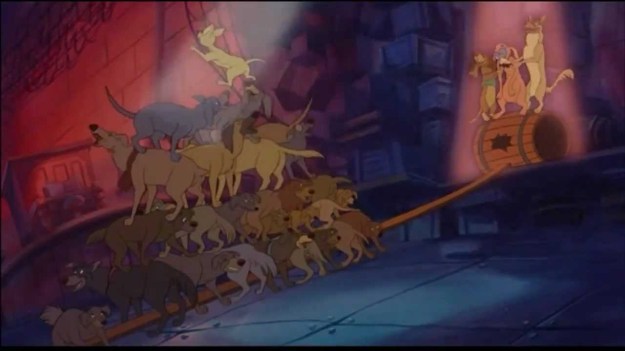
After literally digging his way out of the city pound (the canine equivalent of prison), Charlie (Burt Reynolds) and his long-suffering best friend Itchy (Dom DeLuise) make their way back to the casino that Charlie used to run with Carface (Charlie’s name is conspicuously scratched out on all the signs). All of the dogs are shocked to see Charlie, since apparently he was meant to be “on death row” (scheduled to be euthanized if I had to take a guess). Charlie doesn’t have a clue that it was Carface who set him up to be taken away in the first place, he’s too busy enjoying his freedom. As Charlie explains (with Itchy’s help), nothing is ever going to keep this dog down!


Why settle for a couple of bones when you can have the whole bank?”
Oh you can’t keep a good dog down (No sir)
No you can’t keep a good dog down
I’ve seen pain and hurt, I’ve eaten dirt (That’s true)
It’s hard to buy but even I have been jilted by a skirt (He lies)
But look out, I’m still around
Cause you can’t keep a good dog down

Ya can’t keep a good dog down (No you can’t)
No no no no, you can’t keep a good dog down
I’ve been bought and sold
He’s been warm and cold
But ten to one I’ll still be runnin’ rackets when I’m old
Not in some cage in the city pound
Cause you can’t keep a good dog
Can’t keep a good, I say you can’t keep a good dog down

In him’s the luck of the Irish
The pride of the German
And even a bit of Siam
Siam? You see the come of the English
The charm of the Spanish
A pedigree certainly ain’t what I am
So call me a mixed up pup
(You’re a mixed up pup)
But the only way this pup knows is up
Ya can’t keep a good dog down

maxresdefault (4).jpg

I need to talk about this verse before we move on to the rest of the song. I nearly fell over in shock when Itchy did the line “And even a bit of Siam” complete with a bowl on his head and a faux Asian face (granted it’s not as extreme as older Asian stereotypes, but still!) The reference to Siam is not a problem in and of itself as the film takes place about 4 months before Siam became Thailand (while only the year 1939 is given, Carface later mentions Mardi Gras which takes place in February). No, my problem is that in a film made in the late 1980s, they thought it was okay to include a racist, Asian stereotype. That is not okay!

This concludes my rant, now back to the song:

He’s been fat and thin
I’ve been out and in
He tried a life of virtue
But prefer a life of sin
So tonight when we own this town
I’ve known hunger, I’ve known thirst
Lived the best and seen the worst
But the only way I know to finish best to finish first
So watch out when you hear this sound
Cause you can’t keep a good dog, no ya
Can’t keep a good, I say you can’t keep a good dog down
You can’t keep a good dog down!

Burt Reynolds and Dom DeLuise were friends for many years and you can really feel a solid dynamic between them as they perform this song. The song makes it clear that Charlie is popular, charismatic and a confirmed crook (the last verse even mentions “He tried a life of virtue but prefer a life of sin” It’s not wonder Charlie is so nervous about judgement once he arrives in Heaven). I also noticed that despite being a dog, Charlie acts remarkably human during this scene (in that he stands and performs on two legs). Most of the time Charlie gets around like a regular dog, but this is a noticeable exception (sometimes I wonder if Bluth originally meant to make the dogs more anthropomorphic and then changed his mind).

The Siam moment aside (do let me know what you think about that in the comments), “You Can’t Keep a Good Dog Down” provides a rousing musical start to the film. Which is good because the story only gets darker from here (at some point I’ll write some articles pointing out all the Nightmare Fuel aspects of this film). In the meantime, let me know what you think about “You Can’t Keep a Good Dog Down” in the comments below and have a great day! Thanks for helping the blog reach 650 followers!

See also:

All Dogs Go to Heaven “Let Me Be Surprised” (1989)

All Dogs Go to Heaven 2 “It Feels so Good to be Bad!” (1996)

Disney/Dreamworks/Pixar/etc. Soundtracks A-Z

Become a patron of the blog at: patreon.com/musicgamer460

Check out the YouTube channel (and consider hitting the subscribe button)

Don’t forget to like Film Music Central on Facebook

The Hunchback of Notre Dame “Out There” (1996)

Quasimodo has one of the most dysfunctional and abusive upbringings in the Disney canon (even worse than Rapunzel’s, because while it’s true Mother Gothel kidnapped the princess and mentally abused her so she’d stay in the tower, she didn’t kill either of Rapunzel’s parents). After causing the death of Quasimodo’s mother, Judge Frollo (Tony Jay) nearly drowns her baby before the Archdeacon of Notre Dame stops him and orders him to raise the child as his own as penance for what he has done. Frollo translates this to keeping Quasimodo (Tom Hulce) locked up in the bell tower for the next twenty years, raising him to believe he is a monster that his mother abandoned.


As a young man, Quasimodo spends most of his days observing the residents of Paris (when not ringing the church bells) as they go about their daily lives, longing to walk among them. He especially wants to participate in the annual Feast of Fools and his friends the stone gargoyles encourage him to go. When Frollo learns that the bell-ringer tried to leave (again), he reminds Quasimodo that he is a monster and if he goes outside he’ll be reviled as such. The only way he can remain safe is to stay in the tower and do exactly as Frollo says. While Quasimodo acquiesces to his master’s wishes, his desire to experience life outside the cathedral remains and this is the theme for “Out There.”

maxresdefault (2).jpg

Safe behind these windows and these parapets of stone
Gazing at the people down below me
All my life, I watch them as I hide up here alone
Hungry for the histories they show me
All my life, I memorize their faces
Knowing them as they will never know me
All my life, I wonder how it feels to pass a day
Not above them
But part of them

And out there, living in the sun
Give me one day out there, all I ask is one
To hold forever
Out there, where they all live unaware
What I’d give
What I’d dare
Just to live one day out there

Out there among the millers and the weavers and their wives
Through the roofs and gables I can see them
Every day they shout and scold and go about their lives
Heedless of the gift it is to be them

If I was in their skin
I’d treasure every instant

Out there, strolling by the Seine
Taste a morning out there, like ordinary men
Who freely walk about there
Just one day and then, I swear
I’ll be content
With my share

Won’t resent
Won’t despair
Old and bent
I won’t care
I’ll have spent one day out there!

maxresdefault (3).jpg

Quasimodo expresses the wish of many Disney heroes and heroines: “I don’t like how my life currently is, but if I can just do this one thing I will be happy forever.” The song is practically a staple in Disney musicals but that isn’t a bad thing if it’s done properly and “Out There” is one of my favorite Disney songs. During the scene, Quasimodo clambers all over Notre Dame, letting you see the beautiful sculptures and architecture that make the cathedral so famous. The animators took a special trip to Paris to sketch the building and it really shows throughout the film.

Of course, if you’ve been keeping up with Disturbing Disney then you know Quasimodo’s first trip into the outside world will end badly. Despite that, it’s so easy to feel for the bell-ringer as he sings; to be that close to a bustling medieval city that you’re not allowed to visit would leave anyone feeling lonely and depressed (it’s amazing that Quasimodo grows up relatively well-adjusted).

What do you think about “Out There”? Let me know your thoughts in the comments below and have a great day!

See also:

The Hunchback of Notre Dame “The Bells of Notre Dame” (1996)

The Hunchback of Notre Dame “Topsy Turvy” (1996)

The Hunchback of Notre Dame “God Help the Outcasts” (1996)

The Hunchback of Notre Dame “Heaven’s Light/Hellfire” (1996)

The Hunchback of Notre Dame “The Court of Miracles” (1996)

Disney/Dreamworks/Pixar/etc. Soundtracks A-Z

Become a patron of the blog at: patreon.com/musicgamer460

Check out the YouTube channel (and consider hitting the subscribe button)

Don’t forget to like Film Music Central on Facebook