Tag Archives: Disney

The Jungle Book “Trust in Me” (1967)

Wow, there certainly are a LOT of songs in this film, but we’ve come at last to the final one, Kaa’s immortal song “Trust in Me.”

Mowgli is feeling pretty down at this point in the story. He’s just run away from Baloo after finding out his “papa bear” wants to take him to the Man-Village as well (never mind that it’s for his own safety). He runs off and ends up straight in the coils of Kaa, the incredibly long python with bad sinuses (and brought to life by Sterling Holloway, aka Winnie the Pooh).

This isn’t the first time Mowgli and Kaa have met. Their first encounter comes just after Bagheera announces that he’s taking the man-cub away. It almost doesn’t end well for Mowgli then and there, but thankfully Bagheera stepped in. Now though, it’s just Kaa and Mowgli. The latter rightfully doesn’t trust Kaa, which seemingly hurts the snake’s feelings. He says that if Mowgli would only trust him, then he could stay in the jungle forever. Of course it’s all a trick to get Mowgli hypnotized so he can be Kaa’s afternoon snack.


Trust in me
Just in me
Shut your eyes
and trust in me

You can sleep
Safe and sound
Knowing I
Am around

Slip into silent slumber
Sail on a silver mist
Slowly and surely your senses
Will cease to resist

Trust in me
And just in me
Shut your eyes
And trust in me…

The entire song is full of double meanings. While on the surface it sounds like a friend reassuring another friend of his trustworthiness, it also has a deeper meaning of “all this will be true because I’ll have eaten you.”

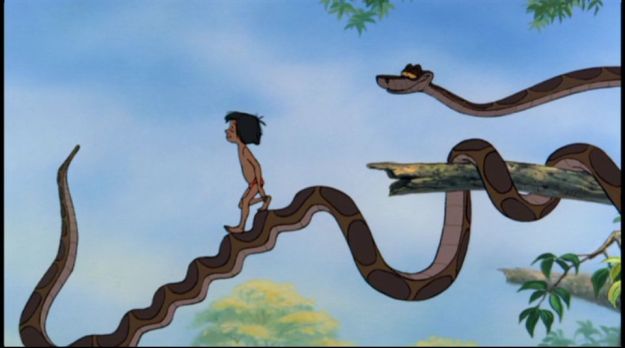
For example “You can sleep, safe and sound, knowing I am around.” Yeah, Mowgli will sleep alright, he’ll sleep eternally. Mowgli is oblivious to this for pretty much the entire song and is blissfully sleepwalking in and around Kaa’s neverending coils.
The Jungle Book “Trust in Me”

Junglebook488

Kaa assumes a wide variety of shapes throughout the song

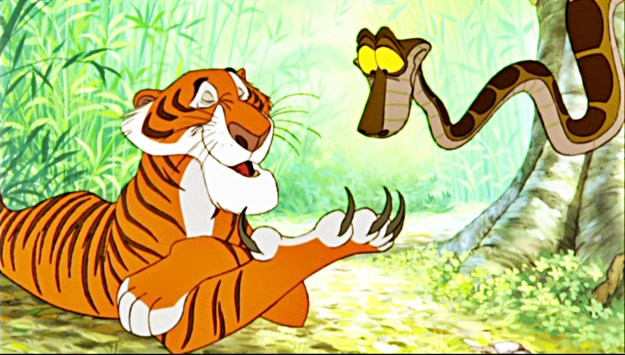
Once again though, Kaa is foiled. Just as he has Mowgli right where he wants him, who should come by but Shere Khan!! I absolutely love how the tiger pulls on Kaa’s tail like it’s a doorbell (brilliant!) If Kaa hadn’t wasted all that time playing with his “food” he might have gotten away with it.
Walt-Disney-Screencaps-Shere-Khan-Kaa-walt-disney-characters-31443684-2560-1458

I had to share this last picture by the way, those claws and the look on Kaa’s face!!

Now I haven’t seen the new version of this film yet, and I’m sure Scarlett Johansson did a great job, but for me, Kaa will always be Sterling Holloway. And that’s The Jungle Book! Let me know your thoughts in the comments below!

*all images are the property of Walt Disney Studios

Become a Patron of the blog at patreon.com/musicgamer460

Check out the YouTube channel (and consider hitting the subscribe button)

For earlier entries in The Jungle Book, see:

The Jungle Book “Colonel Hathi’s March”

The Jungle Book “The Bear Necessities”

The Jungle Book “I Wanna Be Like You”

The Jungle Book “My Own Home”

The Jungle Book “That’s What Friends Are For/The Vulture Song”

For more great Disney songs, check out the main page here: Disney A-Z

Don’t forget to like Film Music Central on Facebook 🙂


The Jungle Book “Colonel Hathi’s March” (1967)

In The Jungle Book, “Colonel” Hathi is one of those characters you can’t help but love because they’re so funny! For this version of the story, Hathi the elephant is transformed into an ex-military soldier obsessed with leading his brigade of elephants around the jungle in perfect formation. And as they march along, they sing a song, the “Colonel Hathi March.”

Of course the underlying joke here is that Colonel Hathi shouldn’t be leading at all, elephants are by nature a matriarchal society (the gag comes to a head when Winifred threatens to take over command and Hathi exclaims “WHAT! A female leading my herd???”)

Hup two three four
Keep it up, two three four
Hup two three four
Keep it up, two three four
Company, sound off!

Oh, the aim of our patrol
Is a question rather droll
For to march and drill
Over field and hill [all trumpet]
Is a military goal
Is a military goal

Hup two three four
Dress it up, two three four

By the ranks or single file
Over ev’ry jungle mile
Oh, we stamp and crush
Through the underbrush
In a military style
In a military style

As a by-the-by, the little elephant is voiced by a rather young Clint Howard (the brother to Ron Howard, the famous movie director).

This one is rather short, but then again there’s not a lot to say about this particular song. Tomorrow, the series concludes with “Trust in Me” and there will be a lot to say then.

*all images are the property of Walt Disney Studios

Become a Patron of the blog at patreon.com/musicgamer460

Check out the YouTube channel (and consider hitting the subscribe button)

For more great Disney songs, check out the main page here: Disney A-Z

For more of The Jungle Book, see also:

The Jungle Book “The Bear Necessities”

The Jungle Book “I Wanna Be Like You” (1967)

The Jungle Book “Trust in Me” (1967)

The Jungle Book “That’s What Friends Are For/The Vulture Song”

The Jungle Book “My Own Home”

Don’t forget to like Film Music Central on Facebook 🙂

The Jungle Book “My Own Home” (1967)

Continuing the look through the songs of The Jungle Book, “My Own Home” comes at the very end of the film. All is well, Shere Khan has been chased away, never to return (I refuse to count The Jungle Book 2 as canon), Baloo is (thankfully) alive and well, and there seems to be no reason why Mowgli can’t live with his friends in the jungle forever. But then…Mowgli hears singing….and it’s a girl!

tumblr_mrrablKb0k1rcb0d2o1_500

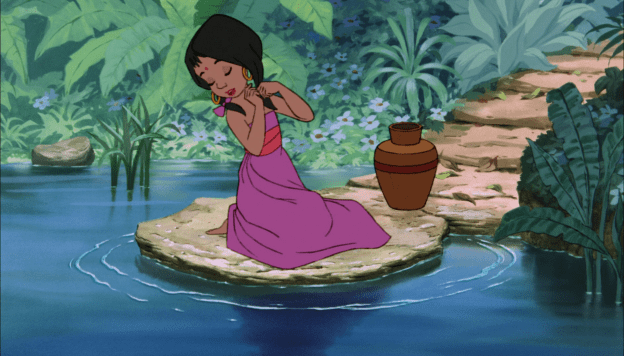
The ending of the film employs one of the oldest tropes known to storytelling: boy meets girl, boy falls head over heels in love with girl, and the girl feels likewise. In this case, Mowgli has overheard a young girl singing as she goes out to fill her water jug. The song is simple, but very beautiful (I confess, when I was young I tried to sing along, pretending I was carrying a jug on my head too).

My own home,
My own home,
My own home,
My own home

Father’s hunting in the forest,
Mother’s cooking in the home,
I must go to fetch the water,
Till the day that I am grown.

Till I’m grown,
Till I’m grown.
I must go to fetch the water,
Till the day that I am grown.

The song tells of how she goes every day to fetch water while her father is out hunting and her mother is cooking, and she’ll do this until she is grown. Entranced by this “creature” that he has never seen before, Mowgli creeps closer and closer (to Baloo’s despair and Bagheera’s delight) until he’s perched right above where the girl is kneeling. Of course she sees him, just in time to also witness Mowgli tumble unceremoniously into the water.

With the water jug full, the girl makes ready to return home, and the song has noticeably changed. Now she sings about how (when she’s grown) she’ll have a handsome husband, and she’ll send her own daughter to fetch water, and just as this verse ends, she “accidentally” drops the jug and the water spills everywhere.

Mowgli obligingly picks the jug up and fills it for her, but the girl only smiles and starts walking back home singing a new verse about how she’ll have a handsome husband someday. It’s clear what she’s trying to do, but the only thing that bothers me is that Mowgli is supposed to be about 10 years old, and presumably the girl is not much older than that. Aren’t they a little young to be engaging in playing hard-to-get?

Then I will have a handsome husband,
And a daughter of my own.
Then I’ll send her to fetch the water,
I’ll be cooking in the home.

Hmmm…
Ooooh…
Then I’ll send her to fetch the water,
I’ll be cooking in my home.

Regardless, Mowgli, in Baloo’s words, is “hooked” and the Man-Village is his home now, which is probably for the best.

It was actually a complete accident that Darleen Carr was chosen to sing the song at all. The story goes that someone from the studio overheard her singing to herself, loved the sound, brought in her in, had her sing “My Own Home” in the studio, and that was that. Talk about a whirlwind experience!

*all images are the property of Walt Disney Studios

Become a Patron of the blog at patreon.com/musicgamer460

Check out the YouTube channel (and consider hitting the subscribe button)

For earlier entries in The Jungle Book, see:

The Jungle Book “Colonel Hathi’s March”

The Jungle Book “The Bear Necessities”

The Jungle Book “I Wanna Be Like You”

The Jungle Book “Trust in Me”

The Jungle Book “That’s What Friends Are For/The Vulture Song”

For more great Disney songs, check out the main page here: Disney A-Z

Don’t forget to like Film Music Central on Facebook 🙂
The Jungle Book “That’s What Friends Are For/The Vulture Song” (1967)

“That’s What Friends are For”, also known as “The Vulture Song” is another funny Disney song, and a great addition to The Jungle Book film, not just because of the music, but also because of the story behind what ALMOST happened with it. Allow me to explain. As you hear the song in the film, it is presented in the style of a barbershop quartet (four-part harmony, traditionally performed with male voices). But it wasn’t always going to be that way. The original plan was for the song to be a rock ‘n roll style featuring…*drumroll please*…..the BEATLES!!

Yes, THOSE Beatles: Paul, John, Ringo and George, aka one of the most popular bands to ever exist. The plan was for each vulture to be modeled after a member of the band, and they would perform this rock number for Mowgli. How cool would that have been? Unfortunately for all of us, negotiations between Disney and the band ultimately fell through. When told the band couldn’t do it, the writers changed the song from a rock piece to a simple song in four-part harmony, resulting in the song we hear today. But according to a story I heard in the “Making Of” featurette on my DVD copy of the film, one or two of the vultures are still modeled after the Beatles.

“The Vulture Song” is really the last major song of the film (there is “My Own Home” still to come but that’s much simpler than this). By this point, Mowgli feels abandoned by everyone he’s ever cared about (Baloo let it slip that he wants Mowgli to go to the Man Village too) and has run away to a desolate area that’s apparently outside the jungle altogether. Here, a depressed Mowgli comes to the attention of four bored-out-of-their-minds vultures, who continually ask each other “So what we gonna do?” Since most people/things that come their way are um…well, dead, they’re surprised to see someone still alive so they go over to talk. Poor Mowgli doesn’t want to talk though, and the vultures see he needs cheering up, so the vultures decide to be his new friends.

We’re your friends
We’re your friends
We’re your friends to the bitter end (the bitter end)

When you’re alone (when you’re alone)
Who comes around (who comes around)
To pluck you up (To pluck you up)
When you are down (When you are down)

And when you’re outside, looking in
Who’s there to open the door

That’s what friends are for

As they sing and dance with Mowgli however…Shere Khan comes waltzing into the picture. No one sees the tiger, but he certainly sees THEM. Shere Khan’s addition to the song is one of my favorites ever.

Who’s always eager to extend
A friendly claw
That’s what friends are for
And when you’re lost in dire need

Who’s at your side at lightning speed
We’re friends of every creature
Comin’ down the pike
In fact we never met an animal we didn’t like

So you can see
We’re friends in need
And friends in need
Are friends indeed
We’ll keep you safe
In the jungle forevermore

(Shere Khan) That’s what friends are for!

This is the one moment of the film where George Sanders (voicing Shere Khan) doesn’t perform the voice. Instead, this one moment is done by legendary voice actor Thurl Ravenscroft (the voice behind “You’re a Mean one, Mr. Grinch”). The moment at the end where his voice drops incredibly low always fascinated me as a kid, and laugh if you like, but I used to try and follow along, even though I knew my voice couldn’t go anywhere near that low.

At any rate, please enjoy listening to “The Vulture Song” and stay tuned for more Jungle Book songs to come!

*all images are the property of Walt Disney Studios

Become a Patron of the blog at patreon.com/musicgamer460

Check out the YouTube channel (and consider hitting the subscribe button)

For earlier entries in The Jungle Book, see:

The Jungle Book “Colonel Hathi’s March”

The Jungle Book “The Bear Necessities”

The Jungle Book “I Wanna Be Like You”

The Jungle Book “Trust in Me”

The Jungle Book “My Own Home”

For more great Disney songs and films, check out the main page here: Disney Films & Soundtracks A-Z

Don’t forget to like Film Music Central on Facebook 🙂

The Jungle Book “The Bear Necessities” (1967)

“The Bear Necessities” is quite likely the most recognizable song from this film, and certainly one of the most famous Disney songs of all time. We’ve actually gone backwards in the story, as this song precedes “I Wanna be like You.”

Mowgli, determined to NOT go to the “Man village” has run off from Bagheera the panther, and while sulking in the jungle, hears a strange creature approaching….only instead of the dangerous tiger Shere Khan, it turns out to be only Baloo the bear, brought to life by the one and only Phil Harris (working most of his career in radio, this was his first turn at voice acting, he would also be Thomas O’Malley in The Aristocats (1970), Little John in Robin Hood (1973) and finally Patou the dog in Rock-a-Doodle (1991, his final role).

After teasing Mowgli for a while (even engaging in a mock sparring fight), Baloo decides that he really likes Mowgli (or “l’il britches”, as he calls him), and decides that he’ll raise him as a bear in the jungle (ignoring/dismissing Bagheera’s objections to this turn of events). To that end, “The Bear Necessities” consists of Baloo teaching Mowgli how bears, like himself, live in the jungle, which is to say, they don’t really work, they just eat whatever is around them, because the jungle provides food EVERYWHERE! If you understand this, then you get “the bear necessities of life.”

The Jungle Book “The Bear Necessities”

Look for the bare necessities
The simple bare necessities
Forget about your worries and your strife
I mean the bare necessities
Old Mother Nature’s recipes
That brings the bare necessities of life

Wherever I wander, wherever I roam
I couldn’t be fonder of my big home
The bees are buzzin’ in the tree
To make some honey just for me
When you look under the rocks and plants
And take a glance at the fancy ants
Then maybe try a few
The bare necessities of life will come to you
They’ll come to you!

A running gag throughout the first part of the song involves Mowgli attempting to emulate Baloo in gathering food, but failing miserably every time (can’t break a coconut with his head, sticks his finger on a prickly pear, almost gets crushed by a rock AND gets buried in an avalanche of bananas).

Look for the bare necessities
The simple bare necessities
Forget about your worries and your strife
I mean the bare necessities
That’s why a bear can rest at ease
With just the bare necessities of life

Now when you pick a pawpaw
Or a prickly pear
And you prick a raw paw
Next time beware
Don’t pick the prickly pear by the paw
When you pick a pear
Try to use the claw
But you don’t need to use the claw
When you pick a pear of the big pawpaw
Have I given you a clue?

The bare necessities of life will come to you
They’ll come to you!

The Sherman brothers (who wrote all the songs in this film, amongst many other Disney films) wanted the music of The Jungle Book to have a “big band era” feel to it, so the music is full of swinging trumpets, saxophones and other jazzy instruments. This song in particular, always makes me want to get up and dance, no matter how tired I feel, and that’s a good type of song.

So just try and relax, yeah cool it
Fall apart in my backyard
‘Cause let me tell you something little britches
If you act like that bee acts, uh uh
You’re working too hard

And don’t spend your time lookin’ around
For something you want that can’t be found
When you find out you can live without it
And go along not thinkin’ about it
I’ll tell you something true
The bare necessities of life will come to you

I hope you enjoyed this look at “The Bear Necessities.”  Tomorrow will see a look at another classic song, “That’s What Friends Are For” aka “The Vulture Song” (I LOVE those vultures!!)

P.S. If you’re interested, I found a neat clip of Phil Harris on The Ed Sullivan Show singing a three song medley (sadly “The Bear Necessities” was not one of them), but it gives you a look at him singing in person. Enjoy!

Phil Harris on The Ed Sullivan Show

*all images are the property of Walt Disney Studios

Become a Patron of the blog at patreon.com/musicgamer460

Check out the YouTube channel (and consider hitting the subscribe button)

For earlier entries of The Jungle Book, see:

The Jungle Book “Trust in Me” (1967)

The Jungle Book “My Own Home”

The Jungle Book “I Wanna Be Like You” (1967)

The Jungle Book “That’s What Friends Are For/The Vulture Song”

The Jungle Book “Colonel Hathi’s March”

For more great Disney songs and films, check out the main page here: Disney Films & Soundtracks A-Z

Don’t forget to like Film Music Central on Facebook 🙂


The Jungle Book “I Wanna Be Like You” (1967)

The Jungle Book is one of those movies where every song is my favorite (they’re just that good). “I Wanna Be Like You” takes place close to the halfway point of the story. Mowgli, having run off from Bagheera, finds himself in the company of Baloo. The unlikely pair hit it off straight-away and Bagheera grudgingly lets them go off together. Not long after the panther leaves, Mowgli is swiped by a troop of monkeys and taken away to a ruined city where King Louie, a large orangutan, holds court.

Now I’m the king of the swingers, hooo–
The jungle VIP
I’ve reached the top and had to stop
And that’s what botherin’ me
I wanna be a man, mancub
And stroll right into town
And be just like the other men
I’m tired of monkeyin’ around!

Oh, ooh-bee-doo, (Oop-dee-wee)
I wanna be like you-hu-hu (Hop-dee-doo-bee-do-bow)
I wanna walk like you (Cheep)
Talk like you (Cheep)
To-o-oo! (Wee-bee-dee-bee-dee-boo)
You’ll see it’s tru-u-ue (Shoo-be-dee-doo)
An ape like me-e-e (Scooby-doo-bee-doo-bee)
Can learn to be
Hu-u-uman
To-o-oo!

“I Wanna Be Like You” spells out the “plan” that King Louie wants to put into action (I put in quotation marks because it’s not really explained all that well. King Louie isn’t as bright as he thinks he is). The gist of the song is this: King Louie, while being king of the monkeys in the jungle, is not content with being a monkey anymore, he wants to be a MAN, like Mowgli.

d32cd92d1252408fabb6998079b105c4

To accomplish this, Louie has come to the conclusion that he needs “Man’s Red Flower” (what the jungle animals call fire) and he wants Mowgli to make it for him, or at least reveal how it is done. If Mowgli can do this, then Louie will let Mowgli stay in the jungle forever. Unfortunately, having been raised by wolves his whole life, Mowgli has no idea how fire is made.

Now don’t try to kid me, mancub
I made a deal with you
What I desire is man’s red fire
To make my dream come true!
Now give me the secret, mancub
Come on, clue me what to do
Give me the power of man’s red flower
So I can be like you!

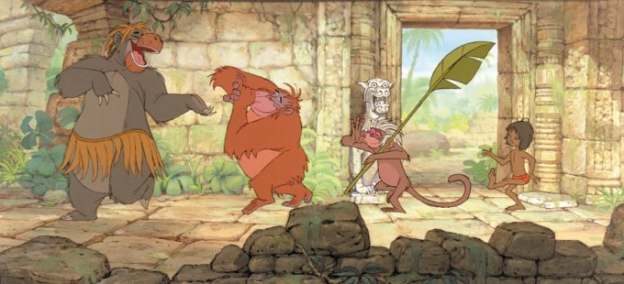
For years growing up, I believed that King Louie was voiced by Louis Armstrong, since he played the trumpet during the song. Actually, the orangutan is brought to life by the voice of Louis Prima (1910-1978) and was originally accompanied by his backup band, Sam Butera and The Witnesses, but their instrumental work was replaced later by music composed by George Bruns. A good portion of the song involves King Louie and his band of monkeys parading around the ruined courtyard while Louie “plays the trumpet.” The story I once heard is that Louis Prima and his band did the exact same thing while recording the song and the animators were standing by to sketch the details and incorporate them into the animation.

Behind the scenes of “I Wanna Be Like You”

For the last section, Louie’s song becomes a duet when Baloo (clumsily disguised as a giant monkey) crashes the party to serve as a distraction while Bagheera tries to rescue an oblivious Mowgli. The pair end up “scat singing” with each other. Scat singing is when a vocal artist sings using nonsense syllables that have no real meaning, they just sound good. Believe it or not, Louis Prima and Phil Harris (the voice of Baloo) recorded their lines at two completely different times (as Harris was unavailable when Prima recorded the song). The original plan was for Harris to parrot back the same scat syllables that Prima used, but when the latter arrived, he refused to do it and made up his own on the spot.

I hope you enjoy “I Wanna Be Like You.” Tomorrow (promise!!) will be “The Bear Necessities.” Have a great day!

*all images are the property of Walt Disney Studios

Become a Patron of the blog at patreon.com/musicgamer460

Check out the YouTube channel (and consider hitting the subscribe button)

For more of The Jungle Book, see:

The Jungle Book “Colonel Hathi’s March”

The Jungle Book “The Bear Necessities”

The Jungle Book “Trust in Me” (1967)

The Jungle Book “That’s What Friends Are For/The Vulture Song”

The Jungle Book “My Own Home”

For more great Disney songs, check out the main page here: Disney A-Z

Don’t forget to like Film Music Central on Facebook 🙂

Michael Giacchino talks Ratatouille (2007)

Michael Giacchino talks Ratatouille (2007)

In 2007, a lot was happening in my life, I graduated high school, got accepted to a university, and in the film world, Pixar released its eighth animated feature: Ratatouille. The film tells the story of a French rat named Remy who absolutely loves to cook, and who desperately wants to be a chef (despite the fact that he’s, you know, a rat). Remy ends up crossing paths with the son of his cooking idol and together Remy attempts to realize his dreams.


Director Brad Bird had already worked with composer Michael Giacchino for The Incredibles (2004) and they’d gotten along so well that Bird decided to bring him back for this film as well. Giacchino and Bird have become a rather reliable duo over the years, and to date they have worked together on: The Incredibles, Ratatouille, Mission Impossible: Ghost Protocol and Tomorrowland, with Giacchino slated to score The Incredibles 2.


For Ratatouille, Giacchino created two themes for Remy: the first theme describing his life as a thief (which, for the other rats, is what life is meant to be about), and the other theme describes Remy’s hopes and dreams. The score was so well-received that it gave Giacchino his first Academy Award nomination for Best Original Score (losing out to Atonement. He would finally win with his score for Up.)

781641294_4586ed9892

In the interview clip found above, Giacchino takes us through the process of scoring the film, and as always, there are some wonderful shots of the orchestra in the process of recording, while the director and composer watch a rough cut of the film (I would love to sit in on the scoring process, and with my career aspirations, maybe I will some day!) Enjoy an inside look at Ratatouille!

See also:

Michael Giacchino talks The Incredibles (2004)

Michael Giacchino talks Mission: Impossible 3 (2006)

Michael Giacchino talks Up (2009)

Michael Giacchino talks Star Trek (2009)

Michael Giacchino talks Super 8 (2011)

Michael Giacchino talks John Carter (2012)

Michael Giacchino talks Star Trek: Into Darkness (2013)

Michael Giacchino talks Jupiter Ascending (2015)

Michael Giacchino talks Jurassic World (2015)

Michael Giacchino scoring Rogue One: A Star Wars Story (2016)

Michael Giacchino talks Zootopia (2016)

Michael Giacchino talks Jurassic World: Fallen Kingdom (2018)

Film Composer Interviews A-H

Film Composer Interviews K-Z

Become a patron of the blog at: patreon.com/musicgamer460

Check out the YouTube channel (and consider hitting the subscribe button)

Don’t forget to like Film Music Central on Facebook 🙂

Michael Giacchino talks Up (2009)

So, I have a confession. It took me WAY too long to see Up (2009). All of my friends were raving about it when it came out, but for some reason I was not into the movie at all, so it was years later before I saw it. And then there’s that crazy huge bird, the talking dogs, a half-crazed explorer, etc. etc. But, I digress….

980x

Michael Giacchino talks Up (2009)

Up tells the story of retired widower Carl Fredrickson (Ed Asner), who turns his old house into a flying machine via thousands of balloons so that he can fulfill the last dream of his deceased wife: to visit Paradise Falls in South America. Almost immediately he picks up a stowaway: a young “Wilderness Explorer” named Russell (Jordan Nagai) who needs to earn his final merit badge for assisting the elderly.

Russell_dug_carl_fredricksen_in_pixars_up-wide

The journey is full of surprises, including an unexpected encounter with Charles F. Muntz (Christopher Plummer), a legendary explorer that Carl idolized as a child. Decades ago, he returned from an expedition claiming he’d discovered a new type of flightless bird, but was ridiculed by the scientific community as a liar. He departed, vowing to bring back a live specimen, and had never returned. As it turns out, Carl and Russell end up encountering a certain flightless bird (dubbed “Kevin” by Russell) which inevitably brings them to Muntz’s attention.

The music for this whimsical (and at the same time, deeply touching) film was composed by Michael Giacchino, whose prior work includes such films as Mission Impossible III, Star Trek and the sequel Into Darkness, The Incredibles, Dawn of the Planet of the Apes and Jurassic World.

The opening of the film is what always sticks with me the most. In it, we see a montage of Carl’s life, from meeting Ellie as a young boy, to falling in love with her, to sadly discovering they can’t have children of their own, to the pair growing old. Over time, they continually save up to make that trip to Paradise Falls, but something always happens to stop them. Finally, Carl has the tickets purchased, but as he prepares to surprise his wife, she collapses and has to go to the hospital. That’s why Carl is so determined to make the trip, he knows it’s what Ellie would have wanted him to do. This part still makes me cry every single time I see it.

In this interview segment, Giacchino, along with the director, discuss how the score came together, and inbetween the moments of talking, there are wonderful scenes showing the orchestra in the recording studio (I love watching moments like these). Giacchino is an immensely talented composer, and Up is a great addition to both film and film music.

Become a Patron of the blog at patreon.com/musicgamer460
Check out the YouTube channel (and consider hitting the subscribe button)

See also:

Michael Giacchino talks The Incredibles (2004)

Michael Giacchino talks Mission: Impossible 3 (2006)

Michael Giacchino talks Ratatouille (2007)

Michael Giacchino talks Star Trek (2009)

Michael Giacchino talks Super 8 (2011)

Michael Giacchino talks John Carter (2012)

Michael Giacchino talks Star Trek: Into Darkness (2013)

Michael Giacchino talks Jupiter Ascending (2015)

Michael Giacchino talks Jurassic World (2015)

Michael Giacchino scoring Rogue One: A Star Wars Story (2016)

Michael Giacchino talks Zootopia (2016)

Michael Giacchino talks Jurassic World: Fallen Kingdom (2018)

Film Composer Interviews A-H

Film Composer Interviews K-Z

Don’t forget to like Film Music Central on Facebook 🙂

*all images are the property of Walt Disney Studios

Film Music 101: “Test” Lyrics

When a film needs to have a song written for it, the composer (or group of composers) will create what are known as “test” lyrics while the melody is being put together.

As a general rule, test lyrics bear little to no resemblance to the final version, they’re really intended as a tool to help guide the song writers in putting the verses together (in a sense, test lyrics are similar to the temp track created for a film, see The Temp Track for details).

Once the final lyrics are completed, the test lyrics are thrown out and never seen by the public…not usually. There is one notable exception, where the test lyrics became so popular that the writers kept them as the final version.

I’m talking about the song “Gaston” from Disney’s Beauty and the Beast (1991)

gbzymisjno0x2gvbvqv9

There’s a reason those lyrics are particularly silly…

It turns out that when the writers for this movie were putting the songs together, the song that turned out to be “Gaston” was originally planned to be completely different. What it was supposed to be we will never know, because the writers became so attached to the test lyrics, that they decided to just keep them and thus, “Gaston” was born.


“Gaston” – Beauty and the Beast

Please enjoy the wonderful silliness that is this song. It’ll be interesting to see if the live remake contains a song like this one (or if it will have any songs at all!). Enjoy! Thank you for all of the likes and comments, you guys are awesome!

You can become a patron of the blog at patreon.com/musicgamer460

Check out the YouTube channel (and consider hitting the subscribe button)

For more Film Music 101, see also: Film Music 101

See also:

Film Music 101: The First Film Score

Film Music 101: Borrowing

Film Music 101: Arranger

Film Music 101: Anempathetic sound

Film Music 101: Empathetic Sound

Film Music 101: Foley

Film Music 101: Montage

Film Music 101: Compilation Score

Film Music 101: “Stinger” Chords

Film Music 101: Dubbing

Film Music 101: Diegetic vs. Non-Diegetic Music

Film Music 101: Underscore

Film Music 101: Sidelining

Film Music 101: Orchestration and cues

Film Music 101: Leitmotif

Don’t forget to like Film Music Central on Facebook 🙂
In memory of Brian Bedford: A look at Disney’s Robin Hood

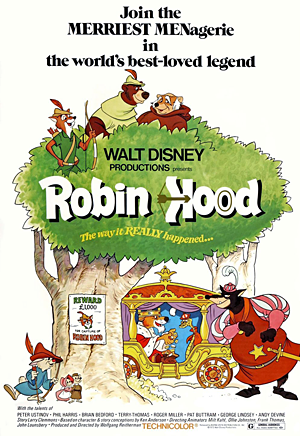
Last night I learned of the passing of Brian Bedford, the voice behind the title character of Disney’s animated film Robin Hood (1973). In his memory, I want to spend some time looking at this film today.

Robinhood_1973_poster

Image property of Walt Disney Co.

Robin Hood is an often overlooked gem in the Disney collection because it came out after the Golden Age of Animation (which ended around 1959) and well before the Disney Renaissance which began in 1989 with The Little Mermaid.

Disney’s version of the classic tale depicts all the characters as animals, with many of the chosen species’ representing their characters particularly well:

Robin Hood (Brian Bedford) is a fox, as is his love Maid Marian (Monica Evans)

robin-hood-and-maid-marian

Little John (Phil Harris) is a bear and Friar Tuck (Andy Devine) is a badger

3

Prince John (Peter Ustinov) is a lion and Sir Hiss (Terry-Thomas) is a snake

Robin-hood-disneyscreencaps_com-629

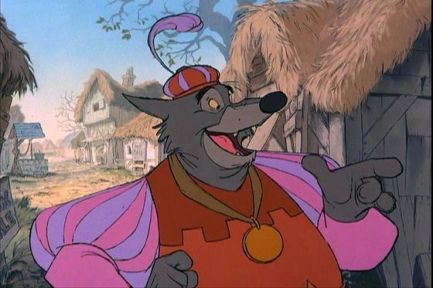
And the reprehensible Sheriff of Nottingham (Pat Buttram) is a wolf, among many other characters

Disney_76470_4

The film features some of my favorite Disney songs, several brought to life by the late Roger Miller (who also stars as Alan-a-Dale, the rooster minstrel who narrates a generous portion of the movie). My favorite by far though, is the song “The Phony King of England,” written by Johnny Mercer and performed by the incomparable Phil Harris. A full performance can be found on Youtube here: The Phony King of England (on a funny note, this song is a cleaned up version of an actual song sung during the time of the real Robin Hood. Only they didn’t call Prince John “phony,” they called him….something else (I’m sure you can take a guess).

Another favorite song is the sad ballad “Not in Nottingham.” Prince John, fed up with being humiliated one time too many, has lowered the hammer on the whole town of Nottingham, taxing the people so ruthlessly that everyone has been placed in jail because they can’t pay the outrageous amounts of money demanded. The full song can be listened to here: Not in Nottingham

Here’s the funny thing about Alan-a-dale by the way: throughout the film he is seen holding a lute, a medieval instrument that is appropriate to the era, however, it is being played (and sounds) exactly like a guitar! These two instruments are not the same thing, so it always cracks me up a little to see that.

321fcccd371a57fb955ca9efb0c31fe5

I do give Disney credit for giving him a lute though, E for Effort Disney!!

In closing, Bedford and the entire cast delivered a wonderful performance that makes this movie something truly special. Rest in Peace Brian Bedford, you will always be remembered.