Before I go back to my regular series, I thought I would share with you a theme that I recently re-discovered: the main theme from Das Boot (1981), a German epic war film that recounts the (fictional) exploits of the (fictional) U-96, a German U-Boat patrolling the Atlantic during World War II. (Though *this* boat is fictional, some of the exploits were inspired by the actions of the REAL U-96).
The film shows every aspect of life in the submarine: unrelenting boredom, the sudden excitement of battle and the dangers that faced submarines at every turn. A climactic moment comes when the U-96 has been damaged by depth charges so badly that it sinks to the bottom of the ocean near Gibraltar. After a harrowing 16 hours spent making repairs, the ship is able to surface and the engines are successfully restarted.
But (MASSIVE spoilers ahead), there is no happy ending for the U-96. Despite everything they have gone through, shortly after limping into the dock at La Rochelle, the entire area is strafed by American fighters. Most of the crew is injured or killed (including the captain) and the U-96 sinks into the ocean.
The music was composed by Klaus Doldinger and his main theme for Das Boot is one of those pieces of film music that you HAVE to hear, even if you never see the film. There is a haunting quality to this piece that makes it irresistible to me. The full track actually begins with the faint sound of sonar (but most versions I find cut this moment out) and then the cello begins the main theme, starting very low and steadily rising up. It seems to me that Doldinger purposefully modeled the theme after the rising and falling swells of the ocean, where the U-Boats patrolled (and which also served as the tomb for tens of thousands of German sailors).
As sad as this music sounds, I actually find it rather soothing to listen to. The theme is very symmetrical in the way it rises and falls (it’s actually a good kind of music to get stuck in your head).
If you get the chance, I highly recommend watching this film at least once. The film was dubbed into English by the original cast so you wouldn’t have to worry about watching a subtitled film. Doldinger’s score makes the film worthwhile, along with an amazing performance by the entire cast (Jurgen Prochnow, who plays the captain, also starred as Paul’s father in Dune (1984))
I hope you enjoy this brief look at the main theme of Das Boot, and if you’ve seen the film, let me know what you thought about it in the comments below 🙂
(I know that Rogue One isn’t scheduled to be released until December, but I couldn’t hold my thoughts in any longer!)
When Disney announced their plans to release a new Star Wars film every single year, I was understandably skeptical. The release of a Star Wars film was meant to be a special event, and if a new film came out every year there would be a huge risk of over-exposing the product and subsequently ruining it. As a result, when the first images for Rogue One were announced, I initially didn’t pay any attention.
Then the first teaser trailer for Rogue One was released. And that changed EVERYTHING for me.
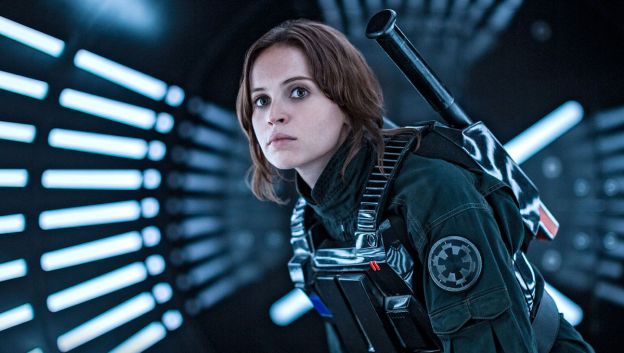
I’d decided to watch the teaser out of curiosity and before I knew it, there I was, back on the edge of my seat, just like with The Force Awakens. In case you don’t know, here is the gist of Rogue One: The story follows Jyn Erso, a woman recently recruited into the Rebel Alliance, who is tasked with leading a team that will steal the plans for the soon-to-be-completed Death Star. These are the same Rebel spies alluded to in the opening crawl of Episode IV, placing the events of Rogue One just before the start of A New Hope.
When the full trailer finally released during the recent Olympic Games in Rio, excitement for the film exploded all over again, and it will be interesting to see how Disney continues to build the excitement in the final months leading up to the premiere.
So far, the visuals for this film look absolutely STUNNING. I love the look of Scarif (the tropical planet with the AT-ATs seen in the previews). The film (judging from the previews) has the look and feel of the original trilogy. And that’s a good thing: the over CGI-d look of the prequel trilogy is part of the reason it was so badly received. One of my favorite shots so far is the brief image of the Death Star orbiting over a large planet (I believe it’s been identified as Jedha). The following shot of the Death Star blocking out the sun gave me goosebumps (and probably doesn’t bode well for the planet if I had to take a wild guess).
The casting looks phenomenal as well: according to imdb.com, Rogue One includes a number of actors who have already appeared in Star Wars. Jimmy Smits is reprising his role of Bail Organa (Leia’s adoptive father); Genevieve O’Reilly reprises her role as a younger Mon Mothma (a role that would’ve appeared in Episode III except those scenes were cut); Warwick Davis (the Ewok Wicket in Return of the Jedi) is returning in another role and in the biggest news of all, James Earl Jones is returning to voice Darth Vader. That’s right, the Dark Lord of the Sith is going to be making an appearance. What exactly this will look like has been the topic of endless speculation, but we have been assured that Vader will show up at a “critical moment.”
Now musically, Rogue One will be very different, because this is the first Star Wars film to be scored by anyone other than John Williams. I’m not terribly worried because Alexandre Desplat (The Grand Budapest Hotel; Argo; The Imitation Game) is a wonderful composer, but it will still be odd to have a score created by someone other than Williams. I have no doubt that Desplat’s score will be heavily influenced by the themes already created for the Star Wars universe (as it would be utter madness to not musically link Rogue One to the other films).
One detail that concerns me is that the film will (allegedly) have no opening crawl. I feel like that’s wrong, as it would set Rogue One apart from the other seven Star Wars films. I understand that the anthology films are considered stand-alones, but I think they should still have an opening crawl, to maintain a sense of visual continuity (these films do all take place in the same universe after all). But this is really a small concern in the big scheme of things: I have a feeling that Rogue One is going to impress just as much as The Force Awakens did last year, if not more.
Are you also excited about the upcoming release of Rogue One? Do you think it might do even better than The Force Awakens? Feel free to leave a comment and let me know what you think 🙂
I put it off for as long as I could, but now it’s time to discuss the scene everyone remembers from The Lion King: the wildebeest stampede. For as long as I live I will never forget watching this scene play out in the movie theater. After Scar had laid out his devious plan in “Be Prepared,” I was thoroughly convinced that Mufasa was somehow going to stop this from happening, because Scar is the bad guy and he can’t possibly succeed (oh how naive I was!!)
There is an air of tension from the moment we are taken to a canyon where Scar is telling Simba that his father has “a marvelous surprise” planned for him. Simba is begging his Uncle Scar to tell him what the surprise is, but Scar refuses to tell. The devious lion encourages his young nephew to work on his “little roar.” Before leaving to get Mufasa, Simba has one last question:
“Hey Uncle Scar, will I like the surprise?”
*pause, Scar smiles*
“Simba, it’s to DIE for!”
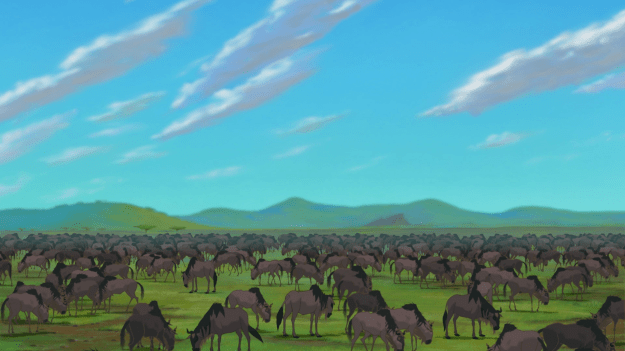
What Simba doesn’t know is that about a hundred feet above him is an enormous herd of wildebeest. The herd is revealed with a rather ominous chord from the orchestra. While the herd quietly grazes, Shenzi, Banzai and Ed wait in the shadows for a signal from Scar. Banzai is going crazy from the temptation of having so much food so close at hand, but Shenzi prevents him from blowing their cover too soon. At a glance from Scar, the three hyenas frighten the herd into stampeding into their only avenue of escape: the canyon, where Simba is still waiting.
Moments before the music starts, Simba is indeed practicing his roar, and is pleased when his extra-loud “RAWR!!” startles a lizard and echoes off the canyon walls. But then…something happens. The pebbles begin to shake, a weird thundering noise is heard, and then hundreds of wildebeest begin pouring down the side of the canyon!!
For years as a child, the opening of “To Die For” sent me into a state of near panic. The eerie introduction is achieved by a chorus that quickly layers one voice after another until there is a cacophany of sound (imitating the build-up of the stampede). If you listen to the soundtrack version, you can hear the female voices enter first, followed by the lower male voices.
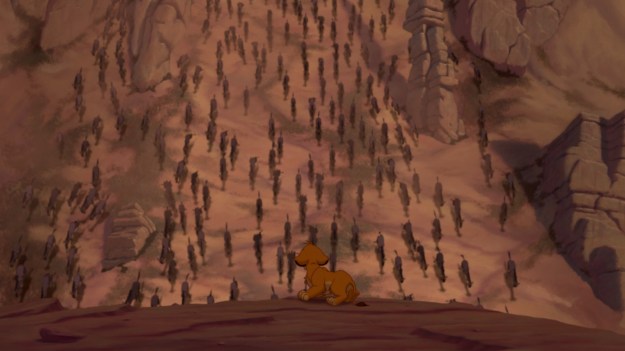
Simba, seeing all of this, is rightfully terrified and begins running for his life, but a small lion has no chance of outrunning a stampede and Simba is soon forced to climb a tree in the middle of the canyon to avoid being trampled to death.
After the initial choral opening, the music is divided between the chorus, woodwinds and a wide selection of timpani, but it’s really the chorus that dominates this piece.
So far Scar’s evil plan is working, but Mufasa is about to be made aware of the situation by his brother (who is rather good at faking concern for his nephew). The two lions race to the scene and Zazu flies down to locate Simba, who is growing more and more panicked. Mufasa doesn’t hesitate to throw himself into the stampede, working his way to where his son is clinging on for dear life. Scar watches events with cool detachment (but he does make sure to knock a frantic Zazu out before he can fly back to Pride Rock and bring more help; the last thing Scar needs/wants is more witnesses to what’s about to happen).
Seeing this in theaters, I remember being scared out of my mind by the charging wildebeests. I was also confused: Mufasa was their king, why wasn’t his presence stopping them? (I had no concept of how a stampede mentality works, once a herd that big gets going, nothing can stop them.) Still, as I watched through my fingers, I was cheering when Mufasa managed to save Simba and (after several mishaps) safely deposit him on the side of the cliff. For a few perilous moments, Mufasa disappeared, having been dragged back down by the wildebeests, but Simba’s father is a powerful lion and with a mighty jump he begins dragging himself up to the nearby ledge (where Scar has been patiently waiting). Simba, believing the danger is over, begins to climb up another way and doesn’t see most of what happens next.
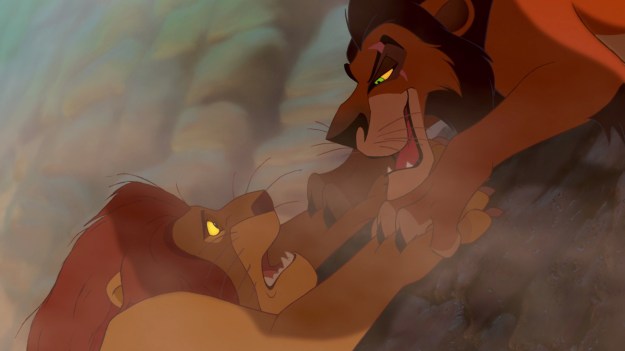
Mufasa is barely holding on; he can’t pull himself all the way up without Scar’s help. Naturally, he calls for Scar to help him. And then…the moment I lost my innocence arrives: Scar slams his claws down into Mufasa’s paws, pulls him close and whispers “Long live the King…” The look of horror right before Scar throws Mufasa to his death stayed with me for a very long time, as did Simba’s scream of terror at seeing his father falling to his death.
And the music for this moment is just haunting too; that “oooooOOOOOO” in the chorus just reinforces what a tragic moment this is.
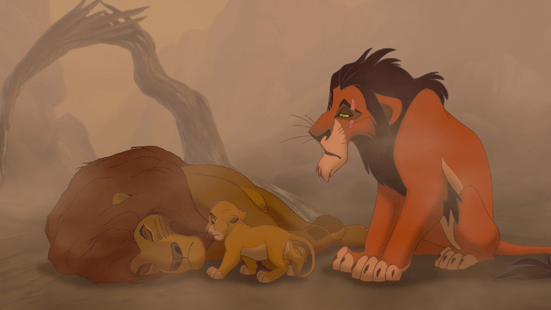
Of course I was in denial about Mufasa being dead, but the mournful music combined with the visual evidence…it practically destroyed me. And poor Simba, his world as he knows it is gone forever; his dad is gone, he has no idea what he’s going to do. And then it gets worse…Scar appears out of nowhere and plays his last card: guilt.
“Simba….what have *you* done?”
“…the king is dead. And if it weren’t for you, he would still be alive.Oh, what would your mother think!!”
It took me years to understand what Scar was doing; this is textbook emotional abuse, shifting the blame onto the victim, making them think THEY are at fault. Simba is already traumatized by witnessing his father’s death. Scar’s (false) allegations that this is HIS fault will further screw him up mentally for years to come.
Now, what happens next ultimately proves to be Scar’s undoing. Scar is bigger and much more powerful than Simba: he could easily kill him with a single blow, and no one would be around to dispute his version of events. But for some reason, Scar doesn’t kill Simba and instead commands him to “run far away and never return.”
Instead of killing Simba himself, Scar plans on having the hyenas finish the job. This is the eternal weakness of the Disney villain: sending incompetent henchmen to do their dirty work for them. And despite their success in stampeding the wildebeest, Shenzi, Banzai and Ed ARE incompetent, especially when it comes to killing young lion cubs. Against all odds, Simba manages to get away and sets out across the desert. The hyenas COULD give chase, but Shenzi thinks it over and decides that Simba is as good as dead anyhow and IF he ever came back, THEN they could kill him.
Scar may think he has won, but someday he’s going to wish he’d simply killed Simba himself…
Now that I’m older I love listening to the soundtrack version of this scene. Hans Zimmer does an incredible job layering the melodies to simulate the chaos of a wild stampede. And the sad music after Mufasa is discovered dead still puts an ache in my chest. But I will never forget the first time I saw this scene in the theater, literally cowering in terror as the wildebeest rushed by.






 Film Music Central