I can’t help but feel that I need to apologize for taking so long with this, even though I promised ages ago that it would be starting soon (life has been a little crazy since then). Nevertheless, here I go with a brief overview of the first film in this sister series to Disturbing Disney: The Secret of NIMH (1982)
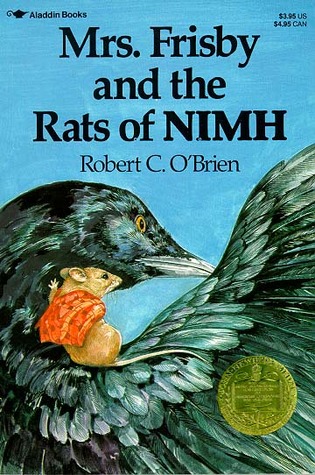
The film was based on the 1971 children’s book Mrs. Frisby and the Rats of NIMH, by Robert C. O’Brien. In broad strokes the plot is largely the same as the film: the widowed mother of a family of mice must figure out how to keep her home safe from the farmer’s plow while her youngest son recovers from pneumonia. She is advised to ask for help from a colony of rats living in the nearby rosebush and discover that they (along with her late husband Jonathan) are actually escaped laboratory rats experimented on by the National Institute of Mental Health (NIMH).
For the movie, Mrs. Frisby becomes Mrs. Brisby to avoid being sued by Wham-O (the company who makes Frisbees) over a similar sounding name. The thing is, by the time the decision was made to change the name to Brisby, all of the actors had already recorded their lines. So…the editors manually edited the voice track to make it sound like Brisby and not Frisby. However, it is not completely perfect: listen closely to The Great Owl’s lines, you can almost hear the original pronunciation of the name.
The voice cast contains some acting greats. The previously mentioned Great Owl was voiced by the legendary actor John Carradine (the father of David, Keith and Robert Carradine). The cranky Auntie Shrew was voiced by Hermione Baddely, better known as Madame in The Aristocats (1970). Derek Jacobi (whose film accomplishments are too many to count) is the voice of Nicodemus, the elderly leader of the rats. Dom DeLuise (aka Tiger the cat in An American Tail) is Jeremy the crow. Wil Wheaton (in his film debut) plays Martin, Mrs. Brisby’s oldest son. And Shannen Doherty (of Charmed fame) is also making her debut as the voice of Teresa, the oldest daughter.
This series will break down the more disturbing scenes (and characters) in the film, and I’m looking forward to sharing it with you.
Check out the YouTube channel (and consider hitting the subscribe button)
*note: I’m only covering the “Night on Bald Mountain” segment, not the “Ave Maria” that follows
When I originally conceived of the Disturbing Disney series, I always planned on including Night on Bald Mountain from the finale of Fantasia (1940). It is well known that this segment is considered to be one of the darkest pieces of animation that Disney ever produced. But, and this might surprise you, it is also one of the few “disturbing” pieces that didn’t scare me as a child.
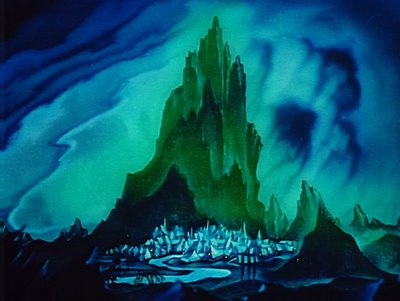
Let me explain: if you haven’t seen the original Fantasia film, Night on Bald Mountain is based on the symphonic poem of the same name (and earlier referred to as St. John’s Eve on Bald Mountain) by Modest Mussorgsky, with an arrangement created by his friend Nikolay Rimsky-Korsakov. The segment takes place one night in an unnamed country village surrounded by mountains. The highest peak is revealed to actually be the massive body of Chernabog, a terrifyingly huge black winged demon, who uses his evil powers to summon all the dead spirits, witches and other lesser demons to attend him and perform for his pleasure. After wreaking havoc all night long, Chernabog goes toward the village itself, only to be stopped by the distant church bells chiming for Matins, signalling the arrival of dawn, and the end of Chernabog’s power for the night.
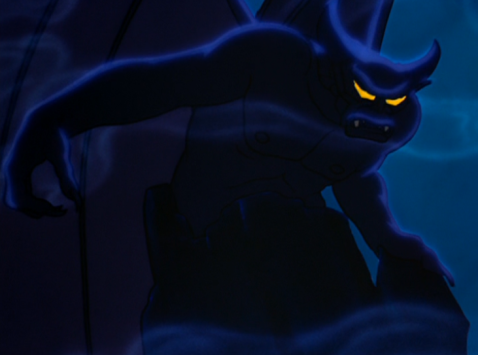
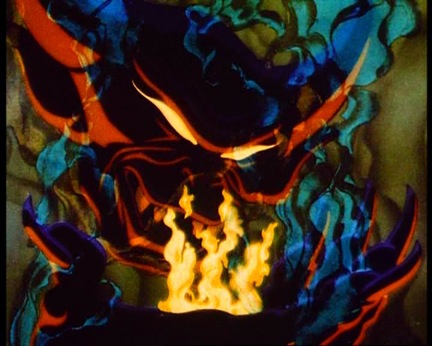
As I mentioned earlier, Night on Bald Mountain did not scare me as a child. I thought long and hard about it, trying to remember how I felt watching Chernabog reveal himself, but I cannot find a single memory where I quivered in terror. If anything, I was almost in awe of what I was seeing. I mean just look at the creature below:
Chernabog is rightly considered a masterpiece of Disney animation. He’s a perfect example of the intensive labor that went into Golden Age Disney animation. In the opening minute, when Chernabog shrugs his wings open, you can feel the weight behind the motion, even though he’s nothing more than a drawing on the screen.
Now, on to the disturbing elements of this piece (and they are many). First of all, as I said before, this is considered to be one of the darkest (if not THE darkest) animations that Disney ever produced, because never before has such raw evil been depicted. In fact, in the earliest stages, Chernabog was intended to be Satan himself (and referred to as such) but such a blatant religious statement was deemed….unwise (that’s my assumption anyway). Even though he’s named differently, it’s not hard to view Chernabog as the Devil (he’s got horns, wings, big glowing eyes, if he were red instead of black he’d be a perfect likeness to traditional images of Satan).
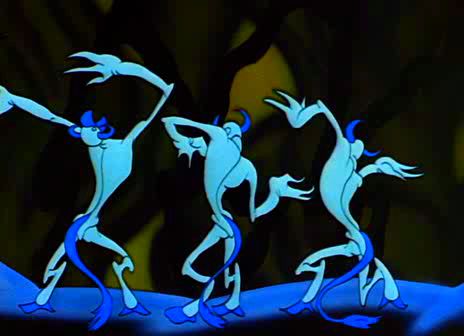
Aside from being pure evil, what also makes Chernabog himself disturbing is his sheer size: he’s so large that his wings are viewed as a literal mountain top! Full size humans (I would assume) could stand on his palm with plenty of room to spare. Not that you would WANT to of course, at one point, the demon creates fire dancers that dance on his palms before being cruelly twisted into barnyard animals and finally morphed into blue demons that frantically dance to please their master.
Other disturbing elements include the various ghouls and skeletons that fly through the air when summoned. There are skeletons riding skeletal horses (a reference to the Danse Macabre), ghouls with glowing eyes, witches on brooms and other strange figures. By the final chaotic minutes of the piece, the disturbing factor is ramped up: there are harpies flying straight up to the screen (revealing they were topless in a blink-and-you’ll-miss-it moment), skulls and weird masks, all moving in a frantic blur.
Funnily enough, even though Fantasia was released almost 80 years ago, Disney still receives complaints from parents of children traumatized by this particular segment. If you have young children, I would definitely be wary of letting them see this segment too soon, but don’t hide it forever either.
And that’s just a glimpse of my thoughts on Chernabog and Night on Bald Mountain, I hope you enjoy watching the segment in the above link. Let me know YOUR thoughts in the comments below.
The pitch black comedy Dr. Strangelove (Or How I Learned To Stop Worrying and Love the Bomb) is one of those films you frequently see on lists of “Movies you must see before you die” . I’ve known of this film for years, but would you believe I only saw it for the first time several days ago? It’s true! Allow me to explain: twice a year Barnes & Noble has a 50% off sale for their Criterion film collection. And twice a year I look through the list to find one or two films (sometimes three) to pick up (I don’t have a choice anymore since Criterion pulled their collection from Hulu and I can’t afford the streaming service they started). For this sale, I added Kurosawa’s The Hidden Fortress (bringing me closer to collecting all of his jidaigeki films) and, of course, Dr. Strangelove. I wasn’t going to pick it originally, as my thoughts going in were to pick up Kurosawa’s work only (I nearly bought Kagemusha instead). But then I saw Dr. Strangelove and I decided it would be good to keep collecting films besides Kurosawa. So I brought it home, put the disc in and started watching.
My first thought? Well this is…..different. I knew going in that Dr. Strangelove is a black comedy (that is, it makes fun of very serious subject matter, in this case nuclear war) but that still didn’t quite prepare me for everything I heard.
The plot is as follows: General Jack D. Ripper (Jack the Ripper, get it?) goes rogue and orders the 843rd Bomb Wing of the Strategic Air Command to attack using “Wing Attack Plan R” a plan that is to be used by a general when a prior nuclear strike has taken out his superiors. But in reality, no such strike has taken place and General Ripper is using this plan to conduct a pre-emptive strike on the Soviet Union, betting that once the Pentagon finds out, they will have no choice but to proceed with an all-out attack to prevent the Soviets from retaliating.
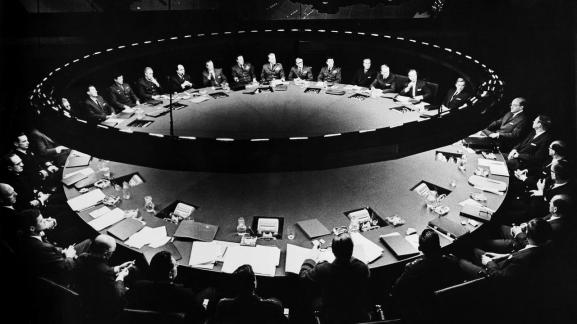
Instead, the members of the War Room (including the President) meet with the Soviet Ambassador to figure out a way to either recall the planes or shoot them down to prevent them from firing on their targets. To make a long story short: all of the planes are eventually recalled but one (because that plane’s radio was damaged by a missile so they can’t receive the recall order).
Choosing a closer target because they are low on fuel, a bomb is launched (with the pilot riding it down like a bronco) and the mushroom cloud is viewed from a distance. This triggers a hitherto unknwon “doomsday device” that the Soviet Ambassador has revealed to the War Room. Once triggered, the device detonates a large amount of nuclear bombs in various locations, bombs that have been tainted with a radioactive element that will encircle the Earth with deadly radiation for 93 years. Vague plans are made to move several hundred thousand people into deep mine shafts (where the radiation can’t reach) to ensure the survival of the human race, but before any firm conclusion is reached, there is a series of nuclear bomb explosions, leaving the fate of the world up in the air.
(Personally, I think the implication is that the Earth is destroyed)
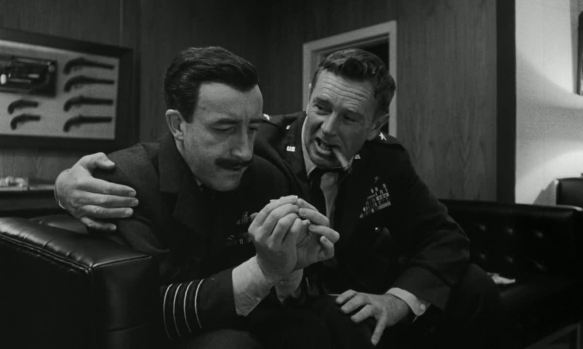
One of the standout performances in this film is Peter Sellers (perhaps best known as Inspector Clouseau in The Pink Panther) who plays no less than three parts in this film, each one with a different accent. His roles are:
Group Captain Lionel Mandrake: an exchange officer from the RAF (British accent)
Merkin Muffley, the President of the United States (a role played completely straight I should add) (perfect American accent)
The titular Dr. Strangelove, a former Nazi and expert on nuclear war (German accent)
Sellers was originally meant to play a fourth role, that of Major Kong, the pilot who ultimately rides a nuclear bomb down to the ground, but with three roles already on his plate, Sellers found himself unable to fully immerse into the Southern-accented role and Slim Pickens (yes that’s really his name) replaced him. Sellers delivers the performance of a lifetime, each character is fully realized and unique, in fact his performance of the President is so different that I had to double-check the credits to reassure myself that it was in fact Sellers playing the role!
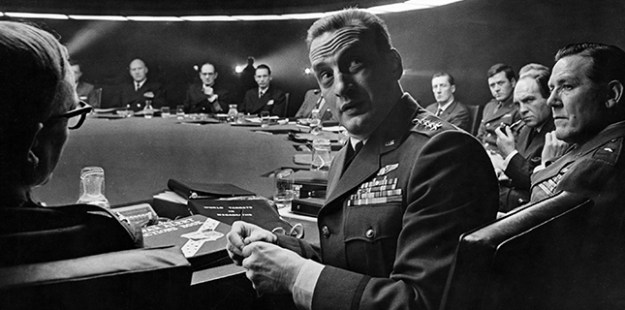
Even though he got tricked into it, I love George C. Scott’s performance as the over-the-top General Turgidson. I say he got tricked into it because Scott wasn’t comfortable acting too over-the-top but director Stanley Kubrick got him to do it by telling him the first few takes were “practice takes” that didn’t count. When Scott found out the truth he was furious with Kubrick for a very long time and swore he’d never work with him again (though in later years he admitted this performance was among his favorites).
If you haven’t seen Dr. Strangelove, it is definitely worth the time to grab a copy and give it a look. If you HAVE seen Dr. Strangelove already, let me know what you thought of it in the comments below.
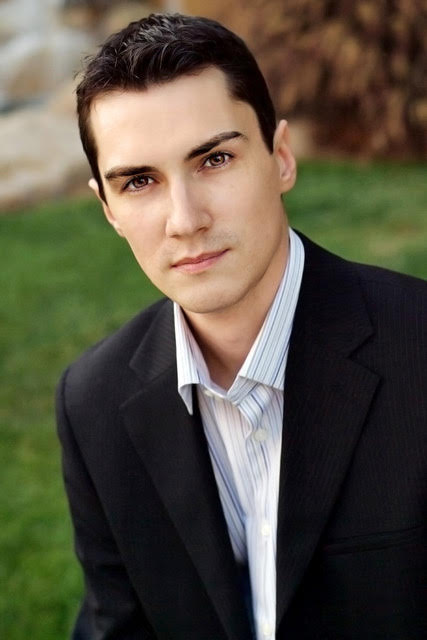
Last month I was privileged to conduct an interview with composer Paul Henning where we discussed (in part) his work in orchestrating Star Wars: The Force Awakens, his work as a performer in film orchestras and the ongoing work of the legendary John Williams. I was fascinated to learn about the process that goes into recording a film score and how the process of orchestrating a score actually works. If you follow the link below, you can check out the audio interview I conducted with Mr. Henning. I hope you enjoy!
Film composer and musician Paul Henning’s most recent project was writing the score for the Tribeca Film Festival opening night documentary ‘Clive Davis: The Soundtrack of Our Lives’. The film premiered at Radio City Music Hall in New York. Paul had a somewhat unconventional role writing music for this project. While the focus was the cadre of huge music artists Clive has worked with, Paul scored key moments of conflict, loss or emotional gravity that were vital to the story.
Paul also recently released his debut album, ‘BREAKING THROUGH’. The album was crafted with a nostalgic, Americana vibe drawn from Paul’s love of the expanses of the Western US and his love of American History. The album features piano solos performed by the Paul and recorded live with a 48-piece studio orchestra. Here is a link to selections of the album for your review: http://www.paulhenning.com/breaking-through.
Paul has served as Concertmaster for the Golden State Pops Orchestra since 2004. He’s also worked on the score orchestrations for over 50 feature films, including ‘Star Wars: The Force Awakens, ‘The BFG’, ‘Night at the Museum: Secret of the Tomb’ and ‘Chocolat’. In addition to his film writing, he also works on orchestral arrangements that have been performed by the Los Angeles Philharmonic, Chicago Symphony, Hollywood Bowl Orchestra, and London Symphony.
An accomplished pianist and violinist, Henning has performed with the Hollywood Studio Symphony on the soundtracks to ‘Frozen’, ‘X-Men: Days of Future Past’, ‘The Maze Runner’, ‘Furious 7’, ‘Moana’, ‘Storks’, ‘Monsters University’ and ‘Alice in Wonderland’, among many others. He has also played violin for artists including Barbra Streisand, Michael Bublé, Neil Young, Aretha Franklin, Andrea Bocelli and Josh Groban. Henning has served as Concertmaster for the Golden State Pops Orchestra since 2004.






 Film Music Central