
Of all the components that go into creating a film score, few are more important than orchestration.
Orchestration is the process whereby a musical theme is transformed into a full-fledged orchestral score. When a composer is hired to create a score for a specific film (like John Williams for Star Wars) they begin the process by watching rough cuts of the film (or storyboards, depending upon how far along the film is in production) and getting a sense of the story the director wants to be told. From there, the composer will go to the studio, sit at the piano and begin to sketch out various musical themes.
The musical themes of a film score are organized into cues. So if you looked at the score for Star Wars you might see “Cue 1: Main Title, Cue 2: Princess Leia, etc.” A film will tend to have about 20-80 cues.
Once the main draft of the score is finished, it is written in what musicians call a piano score, meaning everything is written (for now) for the piano. So, the Imperial March (which has been discussed before on this blog), would look something like this:


Film Music 101: “Stinger” Chords
Film Music 101: Diegetic vs. Non-Diegetic Music
Film Music 101: The First Film Score
Film Music 101: Anempathetic sound
Film Music 101: Empathetic Sound
Film Music 101: Compilation Score
Check out the YouTube channel (and consider hitting the subscribe button)
Share this Post

Film Music 101: Empathetic Sound
The term I’d like to discuss today is empathetic sound
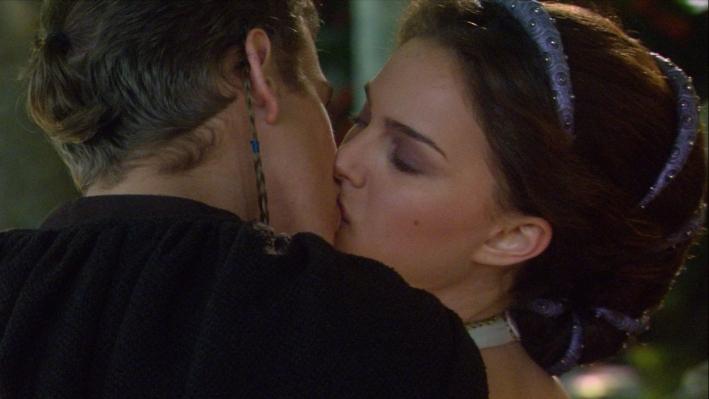
Empathetic sound occurs when the music or sound effects in a film create a mood that matches the action taking place on the screen.
So an easy example of this would be in any love scene ever created for Hollywood. You’ve probably seen the set up at least a hundred times: the guy or the girl has just said something deeply meaningful; they turn and slowly look into each others eyes; and just as they lean in to kiss…the strings in the orchestra swell up and create this deeply romantic moment as they finally kiss and acknowledge their love! (Don’t believe me? Just go to Youtube and look up famous love scenes from movies, I dare you.)

Picture the scene during the battle in New York when all the Avengers are standing back to back in a circle and the camera pans around to look at each of them. The music is clearly projecting “hero mode” because the stars are basically in what i like to call their “heroic pose moment.”

Become a Patron of the blog at patreon.com/musicgamer460
Check out the YouTube channel (and consider hitting the subscribe button)
Don’t forget to like Film Music Central on Facebook 🙂
See also:
Film Music 101: “Stinger” Chords
Film Music 101: Diegetic vs. Non-Diegetic Music
Film Music 101: The First Film Score
Film Music 101: Anempathetic sound
Film Music 101: Compilation Score
Film Music 101: Orchestration and cues
Share this Post


The Empire Strikes Back Part Two!: Han and Leia in Love and Yoda!!
*All music shown is the property of Disney and Lucasfilm, I own nothing.

“I love you….I know…” One of the most remembered lines from the Star Wars universe came moments before Han Solo was frozen in carbonite by the evil Darth Vader. Leia finally realizes that she loves the scoundrel of an ex-smuggler and he reveals that he’s known it pretty much all along.
(On a side note, Han’s response was a complete ad-lib by Harrison Ford, as they had tried numerous takes using the generic “I love you too” and it just wasn’t working out.)
The music heard immediately before this line (when Han and Leia share a brief kiss) is the culmination of a theme that has been building since early in the film when the two are seen arguing in the ice caverns of Hoth.

Musically, this love theme is remarkably similar to Leia’s original theme (as heard in the first film):

Notice that both begin with large leaps from the first note to the second, using a pickup note. Both can also be divided into two sections, with the second section featuring a leap as well. The primary difference is that whereas the love theme drops down a whole step after the initial leap, the original Leia theme keeps going up. It’s almost like an inversion of the original theme, where the music now moves downward instead of up.
Of course Empire Strikes Back is also where we get to meet Yoda, the diminutive (size matters not!) and slightly eccentric Jedi Master who reluctantly agrees to train Luke in the ways of the Force. Yoda’s theme, a quiet melody for woodwinds, is first heard after Yoda is walking back to his hut and inviting Luke to follow. Of course at this point we have no idea that this is actually Yoda (or maybe we do, but Luke certainly doesn’t).
The theme is a perfect match for the ancient Jedi Master. It exudes a quiet confidence, the exact opposite in fact of the “Imperial March.” This theme really comes out in full when Yoda demonstrates what the Force can do when he successfully raises Luke’s sunken X-Wing from the swamp.

Share this Post

The Empire Strikes Back: “The Imperial March” by John Williams
The famous Imperial March a.k.a Darth Vader’s theme. This music never fails to send a chill down my spine. What’s interesting is the contrast between the main “Imperial March” that everyone knows and the softer “B” melody, that’s played in the middle. The woodwinds create an unbelievable sense of tension that sets the listener up for the return of the primary “A” melody which quickly modulates into a different key.



See also: Film Soundtracks A-W
Become a Patron of the blog at patreon.com/musicgamer460
Check out the YouTube channel (and consider hitting the subscribe button)
Don’t forget to like Film Music Central on Facebook 🙂

 Film Music Central