Monthly Archives: January 2016

Film Music 101: Mickey Mousing

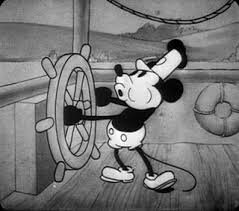
In the world of film and animation music, “Mickey Mousing” is the affectionate (and occasionally derogatory) nickname given to a technique whereby the music and the action on the screen are completely in sync with each other. The reason this technique is called “Mickey Mousing” is because it first appeared in the 1928 cartoon Steamboat Willie starring Mickey Mouse!

Incidentally, Mickey was originally voiced by Walt Disney himself!
The reason “Mickey Mousing” occurred at all is because, after film studios learned the trick of making sound film, they all wanted to show off the fact that their films had sound. To that end, the soundtracks of many, MANY films, were overly synchronized with the actin on the screen, and this happened a lot in the early Disney cartoons as well.
For instance, the 1929 cartoon Skeleton Dance is a 5 1/2 minute example of “Mickey Mousing.” Take a few minutes to watch it and I believe you’ll see what I mean.

My favorite moment in “Skeleton Dance” comes when the one skeleton is sneaking around, taking first three long strides and then quick stepping (and how the music matches his movement, it’s a trick seen more than once in cartoons).
While “Mickey Mousing” has decreased greatly over the years, it is still being used. A more recent example can be found in the first Spider-Man movie in 2002. In the scene where Peter (Tobey Maguire) discovers he has the ability to climb walls, listen to what the music does when his hand first touches the brick wall and then begins to climb up, it’s mimicking his actions! Pretty cool right? Have a look here below:

Hope you enjoyed another look at the world of film music, have a great day!

Become a Patron of the blog at patreon.com/musicgamer460

Check out the YouTube channel (and consider hitting the subscribe button)

For more Film Music 101: see here

See also:

Film Music 101: “Stinger” Chords

Film Music 101: Dubbing

Film Music 101: Diegetic vs. Non-Diegetic Music

Film Music 101: Underscore

Film Music 101: Music Editor

Film Music 101: Sidelining

Film Music 101: “Test” Lyrics

Film Music 101: The First Film Score

Film Music 101: Borrowing

Film Music 101: Arranger

Film Music 101: Anempathetic sound

Film Music 101: Empathetic Sound

Film Music 101: Foley

Film Music 101: Montage

Film Music 101: Compilation Score

Film Music 101: Leitmotif

Film Music 101: Orchestration and cues

Don’t forget to like Film Music Central on Facebook 🙂

Film Music 101: Arranger

Another individual (or group of individuals) who serve an important function in getting a film score put together is the arranger.

An arranger should not be confused with an orchestrator. An orchestrator takes the composer’s piano score and fleshes it out into a full-bodied orchestral score. Arrangement, by contrast, takes a pre-existing musical work and re-arranges it by adding new musical themes, new transitions or whatever is necessary to make an old work fit in a new context.

Take for example the main theme from the Mission Impossible film series. The title theme (featuring a lighted fuse) was taken from the original theme written for the television series in the 1960s.

The Mission Impossible film series now contains five films: Mission Impossible (1996), Mission Impossible II (2000), Mission Impossible III (2006), Mission Impossible: Ghost Protocol (2011) and Mission Impossible: Rogue Nation (2015), with Mission Impossible: Fallout (2018) coming out later this summer. For each film’s title sequence, the music has been arranged to fit the context of the new film, though the core of the music remains intact. Listen to the examples below and you’ll see what I mean (the biggest contrast, in my opinion, comes in the title sequence for Mission Impossible II, it has a definitive 2000-era vibe).

You can thank the arranger for the different sound of the music in each title sequence. So hard to believe that the first Mission Impossible movie opened TWENTY YEARS AGO!! Hope you enjoyed!

You can become a patron of the blog at patreon.com/musicgamer460

Check out the YouTube channel (and consider hitting the subscribe button)

For more Film Music 101: see here

See also:

Film Music 101: Anempathetic sound

Film Music 101: Empathetic Sound

Film Music 101: Foley

Film Music 101: Montage

Film Music 101: Compilation Score

Film Music 101: “Stinger” Chords

Film Music 101: Dubbing

Film Music 101: Diegetic vs. Non-Diegetic Music

Film Music 101: Underscore

Film Music 101: Sidelining

Film Music 101: “Test” Lyrics

Film Music 101: The First Film Score

Film Music 101: Borrowing

Don’t forget to like Film Music Central on Facebook 🙂

Film Music 101: The Temp Track

Occasionally, while putting a film together, the director might wish for the composer to emulate a specific style of music. To that end, a temp track will be assembled to go with the rough cut of the film, to give the composer an idea of what the director wants.

A temp track is essentially a temporary soundtrack, someone in the technical department has found sound recordings that match the style the director wants and they’ve paired it up with the film. To give a few examples, part of the soundtrack from Ben-Hur (1959) was used as a temp track for Star Wars (1977), excerpts from a Howard Shore piece were used for Gangs of New York (2002) and, most (in)famously, 2001: A Space Odyssey used a temp track assembled from Strauss waltzes, Also Sprach Zarathustra by Richard Strauss and Atmospheres by Ligeti.

2001: A Space Odyssey is so notable because director Stanley Kubrick actually REJECTED the score composer Alex North had created in favor of the temp track! Think about it, many of the scenes in that film are iconic because of the selections of classical music, but we (the audience) were never meant to hear it like that!

Interesting to consider what might have been…
Become a Patron of the blog at patreon.com/musicgamer460
Check out the YouTube channel (and consider hitting the subscribe button)

See also:

Film Music 101: Foley

Film Music 101: Montage

Film Music 101: Mickey Mousing

Film Music 101: Compilation Score

Film Music 101: Leitmotif

Film Music 101: Orchestration and cues

Film Music 101: “Stinger” Chords

Film Music 101: Dubbing

Film Music 101: Diegetic vs. Non-Diegetic Music

Film Music 101: Who owns the music?

Film Music 101: Underscore

Film Music 101: Sidelining

Film Music 101: “Test” Lyrics

Film Music 101: The First Film Score

Film Music 101: Borrowing

Film Music 101: Arranger

Don’t forget to like Film Music Central on Facebook 🙂

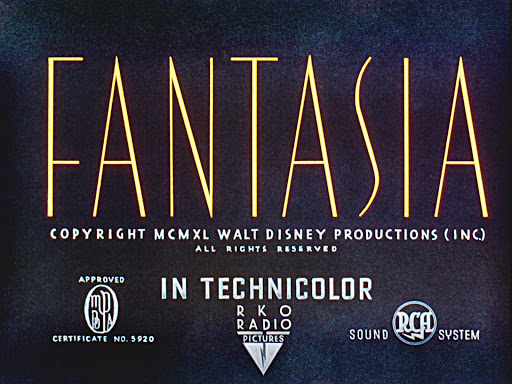
Fantasia: Disney’s strange experiment with music and animation

January 6th, 1942: Disney’s Fantasia opens in theaters (not to be confused with its official New York premiere in 1940)

Seventy-four years ago, a strange movie opened in American cinemas. Fantasia was far from the typical feature film, beacause rather than telling a unified story, it was separated into a series of musical segments, some told stories, others consisted of abstract images. Disney originally intended for Fantasia to be the first in a recurring series of films that would continuously update itself by including old segments and adding in new portions as time went on. Although Fantasia 2000 attempted to follow this model, the plan ultimately fell through. Nonetheless, Fantasia is nowadays considered a masterpiece of animation and of musical talent.

The film is divided into eight musical segments and they are as follows:

Of all the segments in Fantasia, the Toccata and Fugue is by far the most abstract segment of them all. The Toccata consists of the camera panning through the orchestra, with occasional shots of conductor Leopold Stokowski’s back (seen in the picture above). The Fugue section is when things get interesting (or weird, depending upon how you feel about classical music). The viewer is taken through a medley of rolling red and purple hills, endless staircases and fantastical landscapes, all before plummeting back to earth and the orchestra as the piece finally comes to an end.

Despite it’s name (and the host informs the audience as well), the titular Nutcracker does not appear in this segment. What does appear are a number of dances from the ballet, namely: “The Dance of the Sugar Plum Fairy”; “Chinese Dance”; “Dance of the Flutes”; “Arabian Dance”; “Russian Dance”; and “Waltz of the Flowers.”

This is the only segment to be brought back in Fantasia 2000 and one of the most famous, mostly because of its famous star: Mickey Mouse is the titular apprentice, who works tirelessly for the wizard Yen Sid (Disney spelled backwards). Once the wizard departs for bed, Mickey decides to create some “help” to get his chores done quicker, but things quickly get out of hand…

  • The Rite of Spring by Igor Stravinsky

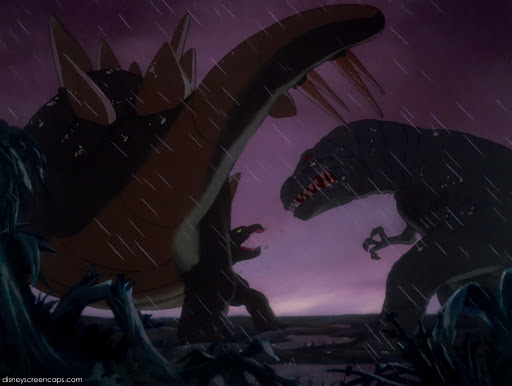
This segment is usually the one kids remember because this is “the dinosaur segment” (at least that’s how I always remembered it when I was growing up). Disney took Stravinsky’s ballet about a group of primitives performing ritual sacrifice (not kidding about this) and transformed it into a story about evolution, starting with the primitive Earth boiling in lava, through the creation of microbes up until the mighty dinosaurs themselves. The climax of the segment (before the extinction anyway), is a terrifying segment where a T-Rex attacks a group of peaceful dinosaurs and the T-Rex squares off against the Stegosaurus (keep in mind that T-Rex was viewed primarily as a hunter in those days, and not believed to be the scavenger we now suspect he might have been).

The two square off, but you just know Stegosaurus doesn’t stand a chance
  • Intermission/Meet the Soundtrack

Now comes an interlude where first, we see the musicians having an impromptu jam session and then our host introduces us to the soundtrack, personified as an animated string standing in the center of the stage. This animated string is used to demonstrate the different sounds the orchestra makes. Below is just one example (it’s really funny to watch):

  • The Pastoral Symphony (Symphony No. 6) by Ludwig van Beethoven

Now into the second half of the program, we see Beethoven’s Symphony No. 6 (also called the Pastoral Symphony). Beethoven wrote this symphony as his deafness was progressively getting worse and so he deliberately evoked the landscape of the country in his musical writing and the Disney animators took these sounds and created a fantastical Greek world where all the creatures of mythology live. For instance you have (in no particular order):

The whole program revolves around a day in the life in this little paradise. We see the life of a Pegasus family, courtship among the centaurs, a huge wine party hosted by Dionysus, a gigantic thunderstorm created by Zeus (apparently because he can), the aftermath and a spectacular sunset (with a brief cameo by Apollo no less!)
2b76d-fantasia-disneyscreencaps-com-7648
Apollo waving goodbye
  • Dance of the Hours by Amilcare Ponchielli

Next comes the ever hilarious Dance of the Hours, an allegory of the progression from Day to Night. The segment starts with Madame Upanova waking up her ostrich dancers (they represent the Morning)
0214e-dance-of-the-hours-159

Truthfully? I did NOT know these characters had names
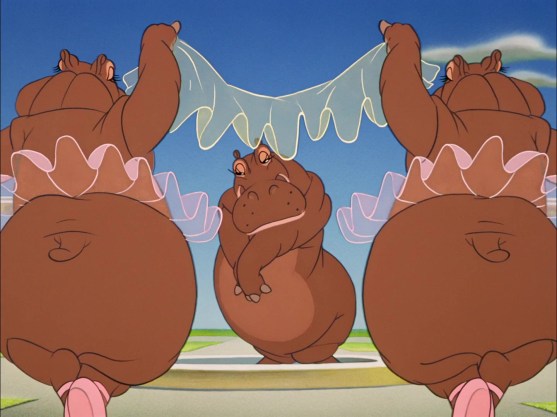
The ostriches are frightened away by Hyacinth Hippo and her servants (and they represent the Afternoon)
While Hyacinth takes a nap, several elephants (led by Elephanchine) come in and do a bubble dance (and they represent the Evening)
Finally, the Elephants are (literally) blown away by the evening wind and Hyacinth remains asleep, unaware that Night has now fallen and she is being observed by Ben Ali Gator (get it?) and his troop of gators. Somehow, Ali Gator falls hopelessly in love with Hyacinth and she seems to reciprocate (an alligator and a hippo?!?!) and they share a brief dance together before Hyacinth gives a brief glance of “come and get me if you want me” and Ali Gator gladly gives chase, leading to the wild finale where the other alligators chase throughout the palace, pulling out ostriches, Hippos and Elephants, all while Hyacinth and Ali Gator dance oblivious. The finale is SO tremendous in fact, that it literally brings the palace crashing down at the very end.
  • Night on Bald Mountain/Ave Maria by Modest Mussorgsky and Franz Schubert respectively
The climax of the program now comes with Night on Bald Mountain. On a distant mountain in the Eastern European countryside, the black demon Chernabog awakens at midnight and begins his devilish plan of wreaking havoc upon the world below.
40b76-film8_1
This scared me so much when i was a kid!!
Chernabog summons ghosts, witches, lesser demons and who knows what else and all converge in a riotous dance of death on the mountain top.
But just as Chernabog has gathered his full power and is about to attack, a bell rings and the demon stops. The bell continues to ring, and each time a white flash appears to blind him. It is the early hour and a nearby church is calling the monks to prayer. It is the holy power of prayer that stops Chernabog and forces him to go back to sleep for another night. Meanwhile, the monks continue to pray, and the segment gives way to Schubert’s Ave Maria
And that is how Fantasia ends. After the segment ends, we see the musicians departing the same way we came in, but there’s no more narration, no more music.
*all images are the property and copyright of Walt Disney Studios

Become a Patron of the blog at patreon.com/musicgamer460
Check out the YouTube channel (and consider hitting the subscribe button)


Don’t forget to like Film Music Central on Facebook 🙂
 

Film Music 101: Orchestration and cues

Of all the components that go into creating a film score, few are more important than orchestration.

Orchestration is the process whereby a musical theme is transformed into a full-fledged orchestral score. When a composer is hired to create a score for a specific film (like John Williams for Star Wars) they begin the process by watching rough cuts of the film (or storyboards, depending upon how far along the film is in production) and getting a sense of the story the director wants to be told. From there, the composer will go to the studio, sit at the piano and begin to sketch out various musical themes.

The musical themes of a film score are organized into cues. So if you looked at the score for Star Wars you might see “Cue 1: Main Title, Cue 2: Princess Leia, etc.” A film will tend to have about 20-80 cues.

Once the main draft of the score is finished, it is written in what musicians call a piano score, meaning everything is written (for now) for the piano. So, the Imperial March (which has been discussed before on this blog), would look something like this:

It looks like the theme you know, and on the piano it would even sound like the theme you know from The Empire Strikes Back, but your ears would tell you it’s not quite the same, the depth of the orchestra is still missing. So, the next step is to send the piano score off to an orchestrator (or sometimes a team of orchestrators): musicians/composers who are tasked with fleshing out the piano score into a full sized orchestral piece. Generally the composer will leave notes for when certain instruments should have certain themes, for example there might be a note saying “Horns should have main theme at measure 20” or something of that nature. Some composers (for example the late Jerry Goldsmith or even further back Bernard Herrmann) did the composing AND the orchestration all on their own. But with all the demands on a composer’s time, it is now far more common for the music to be orchestrated by someone else.
Once the process is completed, the final score now resembles something like this:
Quite a difference, isn’t it? It’s amazing how complex the world of film music really is, hope you enjoyed it!
Become a Patron of the blog at patreon.com/musicgamer460
See also:

Film Music 101: Anempathetic sound

Since yesterday I talked about empathetic sound in movies, today I thought it was only fitting to talk about the opposite: anempathetic sound.

As one might guess, anempathetic sound is when the music or sound effects in a movie stand in direct contrast to what is actually happening on the screen. For example, say you’re watching a horror movie and the upcoming victim is going about their day and say they turn on some music and a bright, chipper song is now playing (this would be diegetic music, see the first Film Music 101 post for the definition). Suddenly, the killer/monster strikes! While the victim dies a horrible, gruesome death, the happy song keeps playing on and on, indifferent to the plight of the victim.

Anempathetic sound does not have to occur solely with music however. In Hitchcock’s immortal classic Psycho, the famous shower scene takes place with the sound of running water playing continuously throughout. Even after the character is dead, the sound of water continues to play, also indifferent to the fact that a young woman was just murdered.

Never saw it coming, poor thing….

Become a Patron of the blog at patreon.com/musicgamer460

Check out the YouTube channel (and consider hitting the subscribe button)

Don’t forget to like Film Music Central on Facebook 🙂

See also:

Film Music 101: Foley

Film Music 101: Montage

Film Music 101: Compilation Score

Film Music 101: Leitmotif

Film Music 101: Orchestration and cues

Film Music 101: “Stinger” Chords

Film Music 101: Dubbing

Film Music 101: Diegetic vs. Non-Diegetic Music

Film Music 101: Underscore

Film Music 101: Sidelining

Film Music 101: “Test” Lyrics

Film Music 101: The First Film Score

Film Music 101: Borrowing

Film Music 101: Arranger

Film Music 101: Empathetic Sound

The term I’d like to discuss today is empathetic sound

Empathetic sound occurs when the music or sound effects in a film create a mood that matches the action taking place on the screen.
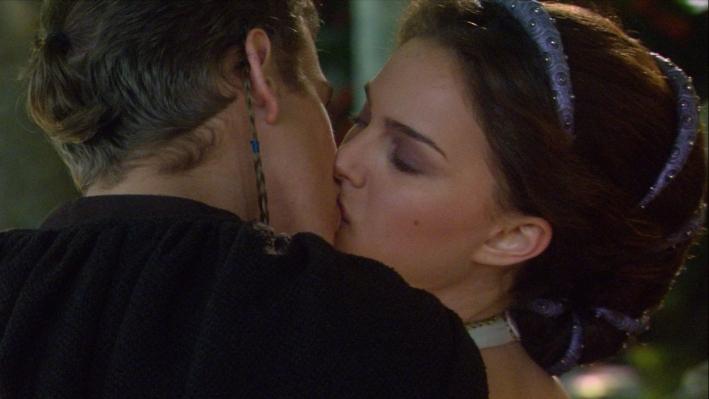
So an easy example of this would be in any love scene ever created for Hollywood. You’ve probably seen the set up at least a hundred times: the guy or the girl has just said something deeply meaningful; they turn and slowly look into each others eyes; and just as they lean in to kiss…the strings in the orchestra swell up and create this deeply romantic moment as they finally kiss and acknowledge their love! (Don’t believe me? Just go to Youtube and look up famous love scenes from movies, I dare you.)

From The Adventures of Robin Hood (1937)…
to Attack of the Clones (2002) and beyond…it’s always the same!
Another good example is action sequences. For the music to be empathetic, the music needs to be fast paced, frenetic, and truthfully rather choppy to match up to the action. The Marvel movies tend to have great examples of empathetic sound in their fight scenes (and also good examples of anempathetic sound, but that’s a post for another day). A really good example comes from Marvel’s The Avengers (2012).

Picture the scene during the battle in New York when all the Avengers are standing back to back in a circle and the camera pans around to look at each of them. The music is clearly projecting “hero mode” because the stars are basically in what i like to call their “heroic pose moment.”

All the heroes in one shot!


Become a Patron of the blog at patreon.com/musicgamer460

Check out the YouTube channel (and consider hitting the subscribe button)

Don’t forget to like Film Music Central on Facebook 🙂

See also:

Film Music 101: “Stinger” Chords

Film Music 101: Dubbing

Film Music 101: Diegetic vs. Non-Diegetic Music

Film Music 101: Underscore

Film Music 101: Sidelining

Film Music 101: “Test” Lyrics

Film Music 101: The First Film Score

Film Music 101: Borrowing

Film Music 101: Arranger

Film Music 101: Anempathetic sound

Film Music 101: Foley

Film Music 101: Montage

Film Music 101: Compilation Score

Film Music 101: Leitmotif

Film Music 101: Orchestration and cues