Monthly Archives: March 2016

When the music says everything: The “Lepers!” scene from Ben-Hur (1959)

(yes I do indeed have Ben-Hur on the brain still)

Film music serves many purposes: it can set the scene, influence the audience, dictate the flow of an action sequence and so on. Occasionally, composers will even use no music at all simply to make a point. On the flip side, however, composers will also use film music when a visual is simply not possible.

A good case in point is the “Lepers!” scene in Ben-Hur. For those not familiar, I’ll explain. In the 1959 version of the film, after Ben-Hur’s mother and sister were unjustly arrested and imprisoned for over three years, the titular character makes his miraculous return to Jerusalem and demands their release (or he’ll have his former best friend’s head on a platter). The order is given to retrieve them, but once the cell is opened, a horrifying discovery is made…

Even before the dreaded word is uttered, you KNOW something terrible has happened, the music and the jailkeeper’s expression say everything. This was a moment that HAD to rely on a combination of music and expression to carry the severity of what was going on, because leprosy was (and still is) a very awful disease.

While leprosy is treatable today, back in the ancient world, contracting leprosy was a slow death sentence, and those who suffered from the disease were condemned to live out their lives in isolation, shunned by the world. We could not see Ben-Hur’s mother and sister because the images would have been too graphic for late 1950s cinema (Google pictures of leprosy and you’ll see what I’m talking about).

I love Rozsa’s music for this scene. The shock chord that coincides with the jailer’s face being illuminated gets me every time. The underlying tone set by the music is “they have leprosy, this changes EVERYTHING.”

Don’t forget to like Film Music Central on Facebook 🙂

You can become a patron of the blog at patreon.com/musicgamer460

Check out the YouTube channel (and consider hitting the subscribe button)

See also:

Soundtrack Review: Ben-Hur (1959)

When silence speaks volumes: The chariot race in Ben-Hur (1959)

Miklos Rozsa conducts Ben-Hur suite (1979)

I confess, I still have Ben-Hur on the brain (if you read my little tirade from yesterday then you understand why). And since I can’t stop thinking about the 1959 epic, I thought I would share a concert clip I discovered several years ago. At the time I was studying the different film composers of the Golden Age of Hollywood and I was learning all I could in particular about Miklos Rozsa (1907-1995), the last composer of that era to pass away.

Having lived so long, I was curious to see if there were any film clips of him giving interviews or, even better, conducting some of his work. That’s when I discovered a clip from a 1979 television program that was looking at film music. In this excerpt, Rozsa himself is conducting a suite from his most famous work, Ben-Hur.

Miklos Rozsa conducts Ben-Hur Suite (1979)

The suite is divided into three sections:

  1. Overture and Main Theme(s) (for more on the overture to Ben-Hur, see “Overture” from Ben-Hur by Miklos Rozsa )
  2. Judah and Esther (The Love Theme): One of the many subplots of the film is the love building between Judah (initially a prince of Jerusalem) and Esther (the only daughter of Judah’s steward and technically a slave as a result, though she’s given her freedom early in the story). The theme is first heard when Esther is about to leave for an arranged marriage (that ultimately never takes place) and returns poignantly when Esther and Judah meet again after almost five years have passed.
  3. Parade of the Charioteers: Actually, this piece wasn’t written for Ben-Hur at all. The music that became this piece was originally composed for Quo Vadis, a 1951 Biblical epic that many credit with launching the Biblical epic obsession of the 1950s. The music comes at the end of the film as Gratus, the new emperor, makes a triumphal entry into Rome. 8 years later in Ben-Hur, Rozsa turns the music into a fanfare as the charioteers ceremonially circle the track before the race begins.

I believe that if you ever have the opportunity, you should always listen to the film score as conducted by the composer, because that will give you the best idea of what the music SHOULD sound like (for example, listen to the overture in this clip and then search YouTube for more performances of the same piece, you’ll hear it a slightly different way each time.)

Enjoy the music of Ben-Hur, composed and conducted by Miklos Rozsa and brought to life by the Pittsburgh Symphony Orchestra-Bex

Don’t forget to like Film Music Central on Facebook 🙂

A Random Thought on The Ten Commandments (1956)

Yesterday I got the chance to do something I thought I would never get to do: I got to see the 1956 epic The Ten Commandments on the big screen at my local theater (it’s a program that Turner Classic Movies runs every year where each month select classic films are run in theaters for a very limited time). While this movie was made long before my time, I grew up watching classic cinema, and watching The Ten Commandments and Ben-Hur (1959) was an annual tradition at our house.

yul-brynner-rameses-and-anne-baxter-nefretiri

How was it? In a word, INCREDIBLE! I’m not sure what excited me more: seeing the film in a theater or hearing Elmer Bernstein’s standout score in surround sound (probably both). This is the film that made Elmer Bernstein (no relation to Leonard by the way) famous, as it was his first major film score.

2

My favorite moment (and I knew it would be going in) was the incredible “parting of the Red Sea.” They could completely recreate this scene in CGI and the original would STILL look better, simply because it feels REAL, there’s a reality to the special effects in this film that CGI could never touch. When the moment began and the music swelled, I tell you, I was covered in goosebumps from head to toe.

Watching this classic film in the theater brought it home to me that Hollywood does NOT make movies like this anymore. Think about it, of all the movies coming out since the year 2000, how many can you honestly say you would watch 60 years from now?

This was an amazing experience, and I can’t wait for the chance to see another classic film in the theater!

See also:

Film/TV Reviews

Become a Patron of the blog at patreon.com/musicgamer460

Check out the YouTube channel (and consider hitting the subscribe button)

Like Film Music Central on Facebook at www.facebook.com/filmmusiccentral

Ex Machina “Ava”

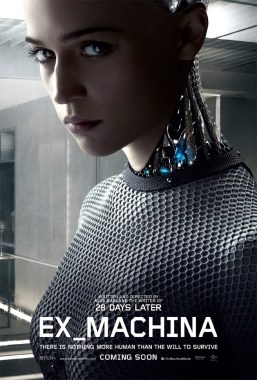
posters-image-4

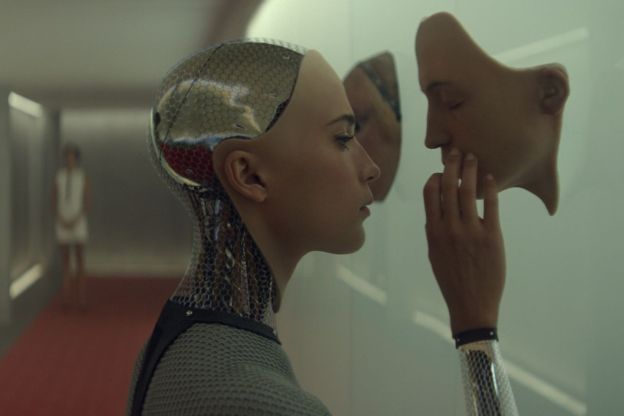
Compared to other films, Ex Machina features a fairly light score (light as in there’s not much music to listen to). But what IS there…ahhh, that’s what really drew me in when I watched the movie the first time. Very often the simplest film score is one of the best, and this is true in Ex Machina.

The music was composed by the duo of Ben Salisbury and Geoff Barrow (they’d previously collaborated on Dredd (2012)) and though I love the entire soundtrack, my favorite piece by far is “Ava,” the theme of the robot played by Alicia Vikander (she should’ve gotten an Oscar for that performance, just saying).

The theme of “Ava” first appears when Caleb (Domhnall Gleeson) sees Ava for the first time. It begins the moment Ava steps into view. The melody is simple, and most likely played on a metallophone (think of a xylophone but with metal bars). And if the music sounds familiar…there’s a very good reason.

Ex Machina – Meet Ava

Remember the famous 5 tone theme from Close Encounters of the Third Kind (1977)? If that doesn’t ring a bell, look it up, give it a listen, then come back to “Ava” and listen to that again.

…….

Do you hear it? I nearly fell over when I recognized “Ava” contained the 5 tone theme (slightly modified, but recognizable). The question I want to answer now is….why did the composers choose THAT particular theme to insert into Ava’s theme? I’m not sure yet, but it’ll be fun to find out why!

Become a Patron of the blog at patreon.com/musicgamer460

Check out the YouTube channel (and consider hitting the subscribe button)

See also: Film Soundtracks A-W

A 21st-century Pygmalion in Ex Machina

Don’t forget to like Film Music Central on Facebook  🙂

*poster image is the property of Universal Pictures

Michael Giacchino talks Mission: Impossible 3 (2006)

I have greatly enjoyed all five Mission Impossible movies (1996-ongoing) but even I will admit that Mission Impossible 2 was not as good as the rest. So, I was so happy to get to Mission Impossible 3 and be like “Wow! This is insane (and fascinating too).” Though I will admit, the opening of the film (with the flash forward sort of thing) threw me for a few minutes. The late Philip Seymour Hoffman plays what is probably the most evil villain Ethan Hunt has ever faced.

Mission Impossible 3 was also Michael Giacchino’s first foray into this franchise (he also composed the score for Ghost Protocol), and I really hope that he can return in the future as this series shows no signs of slowing down. In the meantime, enjoy this interview that looks into the scoring of Mission Impossible 3! Have a good day!

See also:

Michael Giacchino talks The Incredibles (2004)

Michael Giacchino talks Ratatouille (2007)

Michael Giacchino talks Up (2009)

Michael Giacchino talks Star Trek (2009)

Michael Giacchino talks Super 8 (2011)

Michael Giacchino talks John Carter (2012)

Michael Giacchino talks Star Trek: Into Darkness (2013)

Michael Giacchino talks Jupiter Ascending (2015)

Michael Giacchino talks Jurassic World (2015)

Michael Giacchino scoring Rogue One: A Star Wars Story (2016)

Michael Giacchino talks Zootopia (2016)

Michael Giacchino talks Jurassic World: Fallen Kingdom (2018)

Film Composer Interviews A-H

Film Composer Interviews K-Z

Become a patron of the blog at: patreon.com/musicgamer460

Check out the YouTube channel (and consider hitting the subscribe button)

Don’t forget to like Film Music Central on Facebook 🙂

Michael Giacchino talks Ratatouille (2007)

Michael Giacchino talks Ratatouille (2007)

In 2007, a lot was happening in my life, I graduated high school, got accepted to a university, and in the film world, Pixar released its eighth animated feature: Ratatouille. The film tells the story of a French rat named Remy who absolutely loves to cook, and who desperately wants to be a chef (despite the fact that he’s, you know, a rat). Remy ends up crossing paths with the son of his cooking idol and together Remy attempts to realize his dreams.


Director Brad Bird had already worked with composer Michael Giacchino for The Incredibles (2004) and they’d gotten along so well that Bird decided to bring him back for this film as well. Giacchino and Bird have become a rather reliable duo over the years, and to date they have worked together on: The Incredibles, Ratatouille, Mission Impossible: Ghost Protocol and Tomorrowland, with Giacchino slated to score The Incredibles 2.


For Ratatouille, Giacchino created two themes for Remy: the first theme describing his life as a thief (which, for the other rats, is what life is meant to be about), and the other theme describes Remy’s hopes and dreams. The score was so well-received that it gave Giacchino his first Academy Award nomination for Best Original Score (losing out to Atonement. He would finally win with his score for Up.)

781641294_4586ed9892

In the interview clip found above, Giacchino takes us through the process of scoring the film, and as always, there are some wonderful shots of the orchestra in the process of recording, while the director and composer watch a rough cut of the film (I would love to sit in on the scoring process, and with my career aspirations, maybe I will some day!) Enjoy an inside look at Ratatouille!

See also:

Michael Giacchino talks The Incredibles (2004)

Michael Giacchino talks Mission: Impossible 3 (2006)

Michael Giacchino talks Up (2009)

Michael Giacchino talks Star Trek (2009)

Michael Giacchino talks Super 8 (2011)

Michael Giacchino talks John Carter (2012)

Michael Giacchino talks Star Trek: Into Darkness (2013)

Michael Giacchino talks Jupiter Ascending (2015)

Michael Giacchino talks Jurassic World (2015)

Michael Giacchino scoring Rogue One: A Star Wars Story (2016)

Michael Giacchino talks Zootopia (2016)

Michael Giacchino talks Jurassic World: Fallen Kingdom (2018)

Film Composer Interviews A-H

Film Composer Interviews K-Z

Become a patron of the blog at: patreon.com/musicgamer460

Check out the YouTube channel (and consider hitting the subscribe button)

Don’t forget to like Film Music Central on Facebook 🙂

Michael Giacchino talks Up (2009)

So, I have a confession. It took me WAY too long to see Up (2009). All of my friends were raving about it when it came out, but for some reason I was not into the movie at all, so it was years later before I saw it. And then there’s that crazy huge bird, the talking dogs, a half-crazed explorer, etc. etc. But, I digress….

980x

Michael Giacchino talks Up (2009)

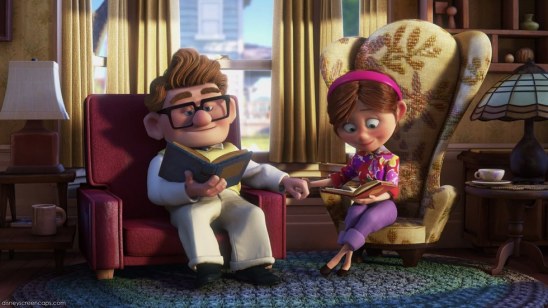
Up tells the story of retired widower Carl Fredrickson (Ed Asner), who turns his old house into a flying machine via thousands of balloons so that he can fulfill the last dream of his deceased wife: to visit Paradise Falls in South America. Almost immediately he picks up a stowaway: a young “Wilderness Explorer” named Russell (Jordan Nagai) who needs to earn his final merit badge for assisting the elderly.

Russell_dug_carl_fredricksen_in_pixars_up-wide

The journey is full of surprises, including an unexpected encounter with Charles F. Muntz (Christopher Plummer), a legendary explorer that Carl idolized as a child. Decades ago, he returned from an expedition claiming he’d discovered a new type of flightless bird, but was ridiculed by the scientific community as a liar. He departed, vowing to bring back a live specimen, and had never returned. As it turns out, Carl and Russell end up encountering a certain flightless bird (dubbed “Kevin” by Russell) which inevitably brings them to Muntz’s attention.

The music for this whimsical (and at the same time, deeply touching) film was composed by Michael Giacchino, whose prior work includes such films as Mission Impossible III, Star Trek and the sequel Into Darkness, The Incredibles, Dawn of the Planet of the Apes and Jurassic World.

The opening of the film is what always sticks with me the most. In it, we see a montage of Carl’s life, from meeting Ellie as a young boy, to falling in love with her, to sadly discovering they can’t have children of their own, to the pair growing old. Over time, they continually save up to make that trip to Paradise Falls, but something always happens to stop them. Finally, Carl has the tickets purchased, but as he prepares to surprise his wife, she collapses and has to go to the hospital. That’s why Carl is so determined to make the trip, he knows it’s what Ellie would have wanted him to do. This part still makes me cry every single time I see it.

In this interview segment, Giacchino, along with the director, discuss how the score came together, and inbetween the moments of talking, there are wonderful scenes showing the orchestra in the recording studio (I love watching moments like these). Giacchino is an immensely talented composer, and Up is a great addition to both film and film music.

Become a Patron of the blog at patreon.com/musicgamer460
Check out the YouTube channel (and consider hitting the subscribe button)

See also:

Michael Giacchino talks The Incredibles (2004)

Michael Giacchino talks Mission: Impossible 3 (2006)

Michael Giacchino talks Ratatouille (2007)

Michael Giacchino talks Star Trek (2009)

Michael Giacchino talks Super 8 (2011)

Michael Giacchino talks John Carter (2012)

Michael Giacchino talks Star Trek: Into Darkness (2013)

Michael Giacchino talks Jupiter Ascending (2015)

Michael Giacchino talks Jurassic World (2015)

Michael Giacchino scoring Rogue One: A Star Wars Story (2016)

Michael Giacchino talks Zootopia (2016)

Michael Giacchino talks Jurassic World: Fallen Kingdom (2018)

Film Composer Interviews A-H

Film Composer Interviews K-Z

Don’t forget to like Film Music Central on Facebook 🙂

*all images are the property of Walt Disney Studios