Monthly Archives: July 2018

My thoughts on: Othello (1965)

When I was in high school, I had to read several of Shakespeare’s plays for class. We read Romeo and Juliet; Hamlet; Macbeth; Julius Caesar and my favorite was Othello. This is one of Shakespeare’s tragedies and follows the ill-fated story of the titular character, a Moorish general serving the Duke of Venice who elopes with the beautiful Desdemona. Iago, a soldier who is bitter that Othello did not name him as his lieutenant, conspires to bring about the general’s downfall.

Of the Shakespeare works I’ve read, Othello is one of my favorites. Iago is a truly despicable villain, made more so by the fact that up until the final moments of the play, nobody realizes what he’s done and calls him “honest Iago.” The play has been adapted to film in English several times, but I think the best example is the 1965 film starring Laurence Olivier in the title role. The main cast is as follows:

  • Othello: Laurence Olivier
  • Desdemona: Maggie Smith (aka Professor McGonagall in Harry Potter)
  • Iago: Frank Finlay
  • Emilia (Iago’s wife): Joyce Redman
  • Michael Cassio, Othello’s lieutenant: Derek Jacobi (in his screen debut)
  • Robert Lang: Roderigo, a Venetian nobleman who wants to marry Desdemona even though her father already said no several times.

image-w1280.jpg

The first thing we must talk about in this version of the play is Olivier’s portrayal of the character. Controversially, remember this was the mid-1960s and the Civil Rights era was in full swing in the United States, Olivier plays the character in blackface from head to toe and also adopts a deep, booming voice. It seems shocking that an actor as well regarded as Laurence Olivier would do this, but in truth no offense was intended (though it would certainly not happen if the film were being made today). Actually, up until the 1990s, there was a long tradition (going back to the 1600s) of actors “blacking up” in order to play the Moorish general (this is because most interpreted “Moorish” to mean African and therefore dark skinned). This is not like some blackface that mocks Africans; Olivier plays it completely straight. Please don’t let this turn you off from watching this version of the play, Olivier’s performance is one for the ages (he earned an Oscar nomination for it).

In the story, after it’s revealed that Othello and Desdemona have eloped (to the shame and outrage of her father Brabantio), the Duke sends the general to Cyprus in order to deal with a Turkish fleet that is threatening the area. Desdemona accompanies him, as does Iago, Emilia and Michael Cassio, whom the aforementioned Iago is determined to ruin so that he might be lieutenant instead.

article-2412397-1BA8CB33000005DC-74_634x430

Manipulation is a big part of the story, particularly how Iago manipulates Othello to believe things that the audience knows are simply not true. For example, Iago begins by getting Cassio drunk and then has him purposefully provoked, knowing how the lieutenant will retaliate. He then spreads a lie that Cassio is like this often, and given the spectacle Cassio makes, Othello dismisses him from his service. But it gets worse: Iago then contrives to have his wife steal one of Desdemona’s handkerchiefs (one that her husband gave her) and ensures that it finds its way to Cassio’s hands. He ends up giving it to his mistress Bianca, but Iago tells Othello that it came straight from Desdemona’s hands, leading the general to believe that his faithful wife is sleeping with Cassio!

Iago is completely sure of himself for most of the story; he actually reminds me of Littlefinger in Game of Thrones. He manipulates everyone so well that no one realizes his connection to what has happened until the very end, when his wife puts two and two together and realizes Iago started everything. You will love Frank Finlay’s performance as Iago, he seems to be everywhere throughout the story (only Olivier has more screen time than he does).

2be7470868e4086cd76aaa26229db8a6.jpg

This being a tragedy, it is no surprise when I say that Othello, Desdemona and Emilia end up dead. Having been whipped into a jealous frenzy, Othello smothers his wife and later commits suicide when the truth has been revealed to him. Emilia on the other hand, is murdered by Iago when she blurts out the truth to several witnesses (Iago tried to have Cassio murdered, but he survived albeit with a bad leg injury). Othello’s last scene is mesmerizing: this is a man who knows he’s killed a woman who was nothing but faithful to him and the guilt is eating him alive. Olivier pours all of his ethos into this performance.

The film is shot with minimal sets which are expanded from the sets used for a 1964 stage version of the play staged by the National Theatre Company. This is the first English-language version of the play to be filmed in color and also, of all Olivier’s Shakespeare films, the one with the least music. Except for one scene where the soldiers sing some drinking songs and some instruments are played, there is no music at all (contrast this with Richard III (1955) which has a HUGE score).

To conclude, if you want to see a masterful rendition of Othello, please check out this film. I don’t think anyone has done the story more justice than Laurence Olivier. If you’ve seen Olivier’s Othello, what did you think about it? Let me know your thoughts in the comments below and have a great day!

See also:

Film/TV Reviews

Become a patron of the blog at: patreon.com/musicgamer460

Check out the YouTube channel (and consider hitting the subscribe button)

Don’t forget to like Film Music Central on Facebook 🙂

My thoughts on: Island of Lost Souls (1932)

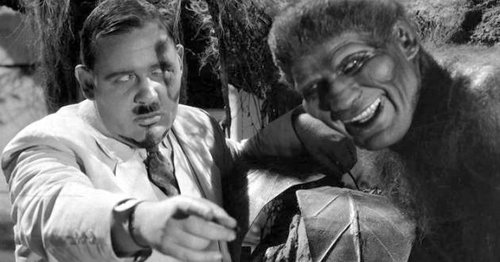
H.G. Wells 1896 novel The Island of Dr. Moreau has been adapted to film multiple times in the course of film history, but the first was a pre-Code film entitled Island of Lost Souls (1932). When I say “pre-Code” I mean it was a film released before the Motion Picture Production Code (better known as the “Hays Code”) took effect. The Code, which regulated film content in the decades before modern film ratings existed, was in place from 1934 to 1968 and made sure films didn’t contain such unsavory details as scantily clad women or other such content they deemed “inappropriate” for film. Being pre-Code then, Island of Lost Souls contains a number of elements that wouldn’t reappear in cinema for several decades (more on those details later).

The film stars Charles Laughton as the infamous Dr. Moreau, a brilliant doctor and scientist with a keen interest in the evolution of life (both plant and animal). Richard Arlen plays Edward Parker, a shipwrecked traveler who ends up stranded on Moreau’s island; the famed Bela Lugosi is the Sayer of the Law and Kathleen Burke is Lota, the mysterious “panther woman.”

23KEHR1-jumbo.jpg

From the moment Parker arrives on the island (even before when he’s rescued by a ship headed to Moreau’s island), it’s clear there’s something strange going on. Moreau’s manservant M’ling (Tetsu Komai) has strange features, including fur tipped ears under his hair. On the island itself, the “natives” possess a variety of animal-like features. Though they wear clothes and walk on two legs, they seem barely human, despite Moreau’s assurances that nothing is amiss. Laughton’s performance as Moreau is spine-chilling: he presents himself as an amiable scientist, a man of culture, but the truth is he sees himself as a god, a being capable of terrifying things. Actually I see a great similarity between Laughton’s Moreau and Colin Clive’s Frankenstein (which only came out the year before this film). In that earlier film, after the Monster comes to life, Frankenstein proclaims “Oh God, now I know what it’s like to BE God!!” Really the only difference between the two is Frankenstein worked with deceased bodies to craft his monster, while Moreau worked on living animals. And while the latter’s look slightly more human, they’re no less monstrous.

Island-Of-Lost-Souls.jpg

Parker eventually stumbles onto the horrifying truth: these “men” of the island were made this way by Moreau. He’d started by forcibly evolving plant life into strange and exotic forms, but that hadn’t been enough. He’d begun to experiment on animals in London, relocating to the island when a dog got loose and revealed his work too soon. Moreau is obsessed with evolving animals into human form and develops a set of laws to keep them in line. As pronounced by the Sayer of the Law, the law is as follows:

“Not to go on all fours, that is the Law. Are we not men?”

“Not to eat meat, that is the Law. Are we not men?”

“Not to spill blood, that is the Law. Are we not men?”

Originally, Parker was to be allowed to leave the next day, but after meeting Lota, a mysterious woman (the only one on the island and Moreau’s greatest creation), the doctor notes that Lota is responding to Parker the way a real woman would, so he conspires to keep Parker on the island to see if Lota is capable of doing everything a woman can, up to and including getting pregnant (never mind that Parker has a fiancee waiting for him). Lota is an interesting character: she looks completely human (and is presented as such by Moreau), but if you watch her carefully, you can see she still moves in an animal like manner in the way she holds her head and her body. They also used faint makeup around her eyes to give the impression of feline eyes.

912eHFzLEgL._SL1500_.jpg

However, there’s a flaw in Moreau’s work: Lota begins to revert to her original form as claws replace her fingernails. Presumably, the other beast men of the island are also reverting, however slowly, for it partially explains what happens at the end of the film.

In the climax, Parker’s fiancee has gone looking for him and gets another captain to bring her to the island. Moreau doesn’t want his “guests” to leave, so he orders one of the beast men to kill the ship captain before he can bring more of his crew onto the island. The beast man does as he is asked, but now there’s a problem, a big problem. By ordering the beast man to kill and thus “spill blood,” one of the laws has been broken. When the Sayer of the Law confronts him about this, the beast man replies “He TOLD me to spill blood.” Moreau did his experiments a little too well and doesn’t realize his beast men have an ability (however basic) to reason things out. Thus, led by the Sayer of the Law, the beast men reason that: Moreau told one of them to spill blood, which breaks the law, which means there is NO law. Also, the Sayer confirms that Moreau is a man like the dead ship’s captain…which means Moreau, their creator and tormentor, can die as well. When this realization is reached, all hell breaks loose. Having lost all authority, Moreau is dragged to the experimentation room and torn apart by his own instruments while the island goes up in flames. Parker, his fiancee and Moreau’s assistant Montgomery get away, but Lota sacrifices her life to stop a beast man from pursuing them.

Island-of-Lost-Souls (1).jpg

The film is a good example of early horror, the beast man makeups are particularly well done. Bela Lugosi is practically unrecognizable as the Sayer of the Law (in fact if I hadn’t known he was in this film I’d have never guessed it was him). If you’re a fan of H.G. Wells, I highly recommend this film to you.

If you’ve seen Island of Lost Souls what did you think of it? Let me know your thoughts in the comments below and have a great day!

See also:

Film/TV Reviews

Become a patron of the blog at: patreon.com/musicgamer460

Check out the YouTube channel (and consider hitting the subscribe button)

Don’t forget to like Film Music Central on Facebook 🙂

My thoughts on: Watership Down (1978)

MPW-54085.jpg

For a long time the only thing I knew about Watership Down was the book written by Richard Adams in 1972. I did my best to read my mom’s battered copy, but it was a very long story and I quickly lost interest. Fast forward a number of years and I was delighted to discover a movie version of the story existed! The film simplified the story considerably and it’s remained a favorite of mine for many years.

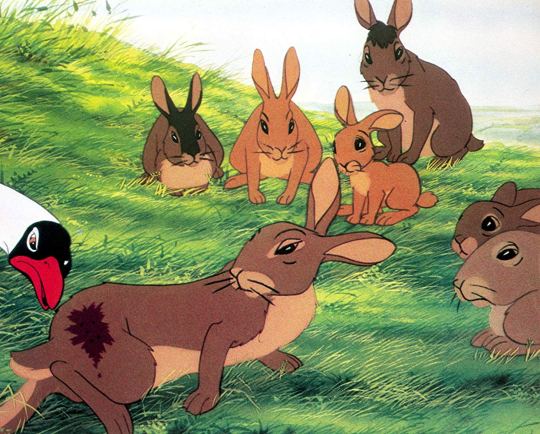
Watership Down, to put it simply, is a story about rabbits. Author Richard Adams created an entire rabbit language and culture and it’s so thoroughly put together that by the end of the story you kind of believe that these things about rabbits are really true, but I digress…in the story, we primarily follow a group of rabbits led by Hazel and his runt brother Fiver. The latter has this gift of seeing things before they happen, and one evening he has a vision that something terrible will happen to their warren. While most of the rabbits don’t believe a word Fiver says, Hazel believes his brother and convinces a small group to leave the warren and find a new home.

maxresdefault.jpg

Finding a new home (the titular Watership Down as it becomes known in the book) takes up most of the story and it’s far from easy. The rabbits travel across the countryside, evading dogs, busy roads, a weird warren of rabbits led by Cowslip and most importantly, the overcrowded warren of Efrafa led by General Woundwort. The film, though animated, does not shy away from revealing how graphically dangerous the journey is. For example, one female rabbit is snatched by a hawk; Bigwig is nearly strangled to death in bloody fashion by a snare; and in Efrafa, we see numerous examples of how rabbits are punished for breaking the rules (getting scratched up and having their ears torn up). Watership Down is one of those films that on the outside looks like an ordinary children’s film but it really deals with some extremely adult topics (lucky for me I didn’t see the film until I was in my teens).

The story isn’t ALL dark, some wonderful comic relief is provided by the seagull Kehaar (Zero Mostel in his final role). The rabbits befriend him when they discover him by their new warren with a damaged wing. He helps them rescue a lot of rabbits from Efrafa in the climax of the story before returning to his “big water” (the ocean).

MV5BNDA5MzA2MjIxOV5BMl5BanBnXkFtZTgwNDI2OTI4NDE@._V1_SY1000_CR0,0,1244,1000_AL_.jpg

Another character I must talk about is the fearsome General Woundwort. He’s the biggest rabbit you’ll ever see (in fact the book implies he’s more hare than rabbit, and yes there is a difference). Woundwort rules Efrafa with an iron paw and won’t allow any rabbits to leave, despite legitimate complaints that there is simply no room for kittens (baby rabbits) to be born. When the Watership Down rabbits successfully rescue a large group of Efrafans, Woundwort goes on the warpath and leads his rabbit soldiers to take ‘his’ rabbits back. The depths of Woundwort’s madness can be seen in his final moments: Hazel has contrived to lead a dog to the down, knowing that it will hunt down or chase away all the Efrafans (his people are safely underground in the burrows where the dog can’t get to them). As the Efrafans run for their lives, Woundwort appears and shouts “Come back you fools, come back and fight, dogs aren’t dangerous!” Any rabbit with common sense would know that dogs are very dangerous and should be avoided at all costs. Not only does Woundwort claim this ISN’T the case but his last act is to charge straight at the dog!

2016_WatershipDown_Press_290316-920x610.jpg

While I wouldn’t recommend showing this film to children under the age of 10, it is a good film to watch if you like stories about adventure with a touch of the supernatural thrown in for good measure. There’s a wonderful song, “Bright Eyes” sung by Art Garfunkel halfway through the story while Fiver searches for Hazel after an expedition to add female rabbits to the warren goes wrong. It’s a great interlude in the action.

All in all, Watership Down is a great film and one that everyone should see at least once. What did you think of Watership Down? Let me know your thoughts in the comments below and have a great day!

See also:

Animated Film Reviews

Become a patron of the blog at: patreon.com/musicgamer460

Check out the YouTube channel (and consider hitting the subscribe button)

Don’t forget to like Film Music Central on Facebook 🙂


My thoughts on: Won’t You Be My Neighbor? (2018)

neighborposter

I was beginning to think I’d never get to see this amazing documentary about the late Fred Rogers. First, I didn’t think it was showing anywhere close to where I lived. And then, when I did find it, things kept coming up to prevent me from going. But finally I was able to go and I’m so glad I did. Won’t You Be My Neighbor loosely tells the story of Fred Rogers and how he created Mister Roger’s Neighborhood (1968-2001).

While billed as a documentary, Won’t You Be My Neighbor? doesn’t feel like one in the traditional sense. There’s no overarching narrative where a voice intones “In 1968 this happened and in 1969 that happened…” Instead, the story is related via many clips of Fred Rogers and is supplemented by many people who worked with him and lived with him, including his widow and his two sons.

Many of these clips will be familiar if you’ve ever searched for Fred Rogers on YouTube. For instance, they show the clip of Mister Rogers speaking before Congress, a video that makes the rounds on social media about once a month. There’s also the special video he made after 9/11, that reappears on Facebook every once in a while. What’s really fascinating is in-between these clips are all the stories about the show: how it tackled pretty adult issues for a children’s show. For instance, in June of 1968 (shortly after RFK’s assassination) there was a show where Daniel Tiger asks Lady Aberlin (Betty Aberlin) “What does assassination mean?” This was interspersed with footage from the night of the assassination. Part of what made Mister Rogers so extraordinary was his understanding of what children really needed, as one person explains, he never forgot what it was like to be a child.

I told myself going in that I wouldn’t cry but…towards the end of the story, I couldn’t help myself. See, towards the end, the story shifts to the present day and there are hints about the current situation and what Fred might have said were he still here. And as they kept sharing his message of love and compassion and just helping others, the tears came and I could not stop them. In this messed up world, we need Mister Roger’s message, now more than ever.

If you need a break, however briefly, from the madness, go see Won’t You Be My Neighbor?. It’s only around 90 minutes, but it’s a really fascinating look back at an extraordinary man.

What did you think of this documentary? Let me know your thoughts in the comments below and have a great day!

See also:

Film/TV Reviews

Become a patron of the blog at: patreon.com/musicgamer460

Check out the YouTube channel (and consider hitting the subscribe button)

Don’t forget to like Film Music Central on Facebook 🙂