
Category Archives: History

Film Music 101: The First Film Score

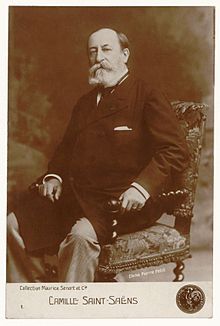
Camille_Saint-Saëns_in_1900_by_Pierre_Petit

Now when I say the “First” film score, I really mean the first “original” film score. Silent films had been given musical accompaniment from the very beginning, from simple tunes played on the piano, to full length arrangements of various classical works (which is in itself a huge topic of discussion, but I digress). An original film score then, is a score that was composed for a specific film, and not taken from a pre-existing source. The first score to meet this criteria was the score for La mort du duc de Guise/The Assassination of the Duke of Guise, released in 1908 and composed by the great French composer Camille Saint-Saens (1835-1921).

Saint-Saens was 73 years old when he composed this score, as he already possessed great experience in composing music for the theatre. While details on the exact process Saint-Saens used to compose the score are few and far between, his biographer Bonnerot stated that Saint-Saens wrote the music “scene by scene before the screen” and this is why the score took so long to write. Assuming this is accurate, it sounds like Saint-Saens used a process rather like the one modern film composers use. In modern cinema, film composers still to this day will write and record the music while the appropriate scenes are playing on a large screen.
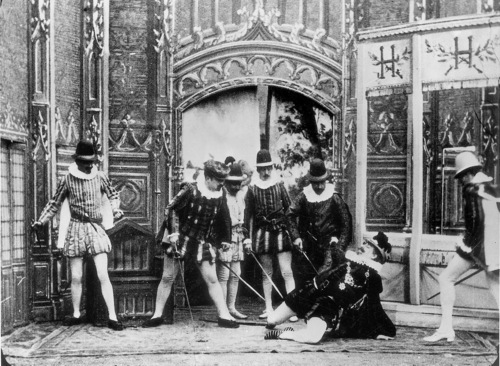
L'Assassinat_du_Duc_de_Guise

A still image from the film: The Duke is being murdered

The film itself was considered rather long for its day (at an astounding fifteen minutes in length) and tells the story of the day in 1588 when King Henri III summons his rival the Duke of Guise to his chambers and has him brutally murdered.

If you wish to view the film, it has long since fallen into the public domain and is readily available online. As you listen and watch the film, note how the music plays unceasingly. This is an example of “wall-to wall” music, where the score continuously plays from beginning to end. Silent films originally took up this practice to cover up the sound of the film projector, and the habit was so ingrained by the dawn of sound film that (after the process of sound film was perfected), wall-to-wall scoring returned during the Golden era of Hollywood cinema in the 1930s through the early 1950s.

You can become a patron of the blog at patreon.com/musicgamer460

For more Film Music 101, see here

Don’t forget to like Film Music Central on Facebook 🙂


Film Music 101: Arranger

Another individual (or group of individuals) who serve an important function in getting a film score put together is the arranger.

An arranger should not be confused with an orchestrator. An orchestrator takes the composer’s piano score and fleshes it out into a full-bodied orchestral score. Arrangement, by contrast, takes a pre-existing musical work and re-arranges it by adding new musical themes, new transitions or whatever is necessary to make an old work fit in a new context.

Take for example the main theme from the Mission Impossible film series. The title theme (featuring a lighted fuse) was taken from the original theme written for the television series in the 1960s.

The Mission Impossible film series now contains five films: Mission Impossible (1996), Mission Impossible II (2000), Mission Impossible III (2006), Mission Impossible: Ghost Protocol (2011) and Mission Impossible: Rogue Nation (2015), with Mission Impossible: Fallout (2018) coming out later this summer. For each film’s title sequence, the music has been arranged to fit the context of the new film, though the core of the music remains intact. Listen to the examples below and you’ll see what I mean (the biggest contrast, in my opinion, comes in the title sequence for Mission Impossible II, it has a definitive 2000-era vibe).

You can thank the arranger for the different sound of the music in each title sequence. So hard to believe that the first Mission Impossible movie opened TWENTY YEARS AGO!! Hope you enjoyed!

You can become a patron of the blog at patreon.com/musicgamer460

Check out the YouTube channel (and consider hitting the subscribe button)

For more Film Music 101: see here

See also:

Film Music 101: Anempathetic sound

Film Music 101: Empathetic Sound

Film Music 101: Foley

Film Music 101: Montage

Film Music 101: Compilation Score

Film Music 101: “Stinger” Chords

Film Music 101: Dubbing

Film Music 101: Diegetic vs. Non-Diegetic Music

Film Music 101: Underscore

Film Music 101: Sidelining

Film Music 101: “Test” Lyrics

Film Music 101: The First Film Score

Film Music 101: Borrowing

Don’t forget to like Film Music Central on Facebook 🙂

Film Music 101: The Temp Track

Occasionally, while putting a film together, the director might wish for the composer to emulate a specific style of music. To that end, a temp track will be assembled to go with the rough cut of the film, to give the composer an idea of what the director wants.

A temp track is essentially a temporary soundtrack, someone in the technical department has found sound recordings that match the style the director wants and they’ve paired it up with the film. To give a few examples, part of the soundtrack from Ben-Hur (1959) was used as a temp track for Star Wars (1977), excerpts from a Howard Shore piece were used for Gangs of New York (2002) and, most (in)famously, 2001: A Space Odyssey used a temp track assembled from Strauss waltzes, Also Sprach Zarathustra by Richard Strauss and Atmospheres by Ligeti.

2001: A Space Odyssey is so notable because director Stanley Kubrick actually REJECTED the score composer Alex North had created in favor of the temp track! Think about it, many of the scenes in that film are iconic because of the selections of classical music, but we (the audience) were never meant to hear it like that!

Interesting to consider what might have been…
Become a Patron of the blog at patreon.com/musicgamer460
Check out the YouTube channel (and consider hitting the subscribe button)

See also:

Film Music 101: Foley

Film Music 101: Montage

Film Music 101: Mickey Mousing

Film Music 101: Compilation Score

Film Music 101: Leitmotif

Film Music 101: Orchestration and cues

Film Music 101: “Stinger” Chords

Film Music 101: Dubbing

Film Music 101: Diegetic vs. Non-Diegetic Music

Film Music 101: Who owns the music?

Film Music 101: Underscore

Film Music 101: Sidelining

Film Music 101: “Test” Lyrics

Film Music 101: The First Film Score

Film Music 101: Borrowing

Film Music 101: Arranger

Don’t forget to like Film Music Central on Facebook 🙂

Film Music 101: Orchestration and cues

Of all the components that go into creating a film score, few are more important than orchestration.

Orchestration is the process whereby a musical theme is transformed into a full-fledged orchestral score. When a composer is hired to create a score for a specific film (like John Williams for Star Wars) they begin the process by watching rough cuts of the film (or storyboards, depending upon how far along the film is in production) and getting a sense of the story the director wants to be told. From there, the composer will go to the studio, sit at the piano and begin to sketch out various musical themes.

The musical themes of a film score are organized into cues. So if you looked at the score for Star Wars you might see “Cue 1: Main Title, Cue 2: Princess Leia, etc.” A film will tend to have about 20-80 cues.

Once the main draft of the score is finished, it is written in what musicians call a piano score, meaning everything is written (for now) for the piano. So, the Imperial March (which has been discussed before on this blog), would look something like this:

It looks like the theme you know, and on the piano it would even sound like the theme you know from The Empire Strikes Back, but your ears would tell you it’s not quite the same, the depth of the orchestra is still missing. So, the next step is to send the piano score off to an orchestrator (or sometimes a team of orchestrators): musicians/composers who are tasked with fleshing out the piano score into a full sized orchestral piece. Generally the composer will leave notes for when certain instruments should have certain themes, for example there might be a note saying “Horns should have main theme at measure 20” or something of that nature. Some composers (for example the late Jerry Goldsmith or even further back Bernard Herrmann) did the composing AND the orchestration all on their own. But with all the demands on a composer’s time, it is now far more common for the music to be orchestrated by someone else.
Once the process is completed, the final score now resembles something like this:
Quite a difference, isn’t it? It’s amazing how complex the world of film music really is, hope you enjoyed it!
Become a Patron of the blog at patreon.com/musicgamer460
See also: