My Thoughts on: The Ballad of Narayama (1958)

The Ballad of Narayama (1958) is a film I’d not heard of before yesterday, but as I was searching for Criterion films to add to my collection, the film’s plot caught my attention. The film, directed by Keisuke Kinoshita, is modeled after a kabuki play (classic Japanese dance-drama) and tells the story of a remote village where anyone who reaches the age of 70 must be taken to Narayama (a distant mountain) and left there to die of exposure. Orin (Kinuyo Tanaka) is a 69 year old grandmother who has resolved to make the journey to Narayama when the new year comes, but first she wants to make sure her family’s affairs are in order.

MV5BMGUwNTZkOGMtNjQ4ZS00ZjViLWE5NmYtYWZjZDljNDIxOTQ2XkEyXkFqcGdeQXVyNDU0ODY2MzM@._V1_.jpg

From the start the film looks like it’s a stage play: a narrator introduces the story and narrates various sections through song. I was worried at first that I would find a narrator distracting, but it flows in and out of the film so seamlessly that after a while you don’t even notice. I also like how there’s not even a pretense of realism: the action is clearly taking place on a stage and when a scene is done, the background will literally fall away to reveal the next scene.


While the film shows various aspects of village life throughout the year, I feel that most of all the film displays the contrast between Orin, who happily accepts her fate, and Mata  (Seiji Miyaguchi), a man past 70 who refuses to journey to Narayama, even though he shames his family (and himself) by refusing to go. The difference in how they meet their ends couldn’t be more different: while Orin is left serenely awaiting death on the mountain, Mata is dragged kicking and screaming by his son, and finally resists so much that he falls off a cliff. The message couldn’t be more clear: not following tradition only leads to heartbreak and pain. You’re also left feeling nothing but contempt for Mata after seeing how calmly Orin accepts what must be done.

81su9XAfi5L._SL1500_.jpg

The one thing about this film that confuses me however, is the ending. After Orin is left on Narayama, her son returns to his new wife and she consoles him with the knowledge that they can travel to Narayama together someday (as they are the same age). The scene abruptly cuts to a black and white shot of a train pulling in at a station, presumably where the old village used to stand. I’m sure we’re meant to gather something from this transition to the present, but I’m not sure what that message is supposed to be.

The Ballad of Narayama is a beautiful film that tells a very sad story. You’ll definitely be in tears by the end. Let me know what you think about this film in the comments below and have a great day!

See also:

Film/TV Reviews

Become a Patron of the blog at patreon.com/musicgamer460

Check out the YouTube channel (and consider hitting the subscribe button)

Don’t forget to like Film Music Central on Facebook 🙂


Peter Pan “Following the Leader” (1953)

*note, this song refers to Native Americans as Indians and “Injuns” which is politically incorrect now, but was considered okay then.

Peterpan-disneyscreencaps-3374.jpg

Now that Wendy and her brothers have safely arrived in Neverland and met the Lost Boys, it’s time to set off on the adventures Peter promised them. While Peter takes Wendy to meet the mermaids, John and Michael and the Lost Boys set off to locate the Indian tribe (with John assuming the role of leader). As the Lost Boys march off, they sing a song about “following the leader.”

Following the leader, the leader, the leader
We’re following the leader
Wherever he may go

Tee dum, tee dee, a teedle ee do tee day
Tee dum, tee dee it’s part of the game we play
Tee dum, tee dee, the words are easy to say
Just a teedle ee dum a teedle ee do tee day

Tee dum, tee dee, a teedle ee do tee dum
We’re one for all, and all of us out for fun
We march in line and follow the other one
With a teedle ee do a teedle ee do tee dum

vlcsnap-204945.png

Following the leader, the leader, the leader
We’re following the leader
Wherever he may go
We’re out to fight the Injuns, the Injuns, the Injuns
We’re out to fight the Injuns
Because he told us so

Tee dum, tee dee a teedle ee do tee day
We march along and these are the words we say:
Tee dum, tee dee, a teedle de dum dee-day
Oh, a teedle ee dum a teedle ee do tee day

Oh, a teedle ee dum a teedle ee-do-tee-day

hqdefault.jpg

The boys traveling through Neverland is like any adventure you ever dreamed of having as a child. They cross rivers, swing down vines and unwittingly pass by several animals (a hippo, monkeys, a rhinoceros and even a large bear). Neverland is full of all kinds of terrain, from the jungle, to the savannah and ending in a forest filled with pine trees.

The song comes to an abrupt end when John discovers a pair of “Indian tracks” in the middle of a clearing. Looking back, it seems obvious that this was a trap for the Lost Boys from the start because how else could their be two footprints side-by-side? If someone is walking normally, one footprint should be in front of the other. But instead they’re next to each other like someone was just standing still. Clearly this is meant to be a trap to delay the Lost Boys until the tribe can close in and capture them (which they do).

I’ve always liked “Following the Leader,” it’s a fun interlude before the drama with Captain Hook and Tiger Lily. What do you think of this song? Let me know your thoughts in the comments below and have a great day!

See also:

My Thoughts on: Peter Pan (1953)

Peter Pan “You Can Fly!” (1953)

Peter Pan “What Made the Red Man red?” (1953)

Peter Pan “The Elegant Captain Hook” (1953)

Disney/Dreamworks/Pixar/etc. Soundtracks A-Z

Become a Patron of the blog at patreon.com/musicgamer460

Check out the YouTube channel (and consider hitting the subscribe button)

Don’t forget to like Film Music Central on Facebook 🙂

The Legend of Sleepy Hollow “Katrina” (1949)

In The Legend of Sleepy Hollow, Ichabod Crane is the awkward yet likable enough school teacher in the village of Sleepy Hollow. He leads a contented life teaching the children while shamelessly flirting with most of the women in town when, one day…he happens to notice the beautiful Katrina van Tassel. Katrina is described as the most beautiful woman in town and she has every unmarried man in Sleepy Hollow wrapped around her finger (without even trying). Naturally Ichabod promptly falls head over heels for the young heiress (though the narrator states he’s equally interested in her fortune as much as her looks), but the short song about Katrina indicates that she’s not as innocent as she looks:


Oo oo oo oo
Ah ah ah ah ah ah ah
Once you have met that little coquette Katrina
You won’t forget Katrina
But nobody yet has ever upset Katrina
That cute coquette Katrina
You can do more with Margaret or Helena
Or Anne or Angelina
But Katrina will kiss and run
To her a romance is fun
With always another one to start
And then when you’ve met that little coquette Katrina
You’ve lost your heart

130.jpg

Katrina is described as “that little coquette,” meaning she loves to flirt. There’s nothing wrong with that, but a later line forebodes that Ichabod’s quest for Katrina’s hand will end badly: “but Katrina will kiss and run/To her a romance is fun/With always another one to start…” I take this line to mean that Katrina has no problem playing with men’s feelings and doesn’t take declarations of love seriously, which can be hurtful if the person expressing those feelings is genuine. And believe me Katrina is taking full advantage of men’s feelings for her, like having them assemble a picnic or carrying all of her packages. It IS funny though to see how quickly Ichabod is smitten by Katrina: one look and he puts a chicken on his head and starts eating his hat!

What do you think of “Katrina”? Let me know your thoughts in the comments below and have a great day!

See also:

The Legend of Sleepy Hollow “Headless Horseman” (1949)

The Adventures of Ichabod and Mr. Toad (1949)

Disney/Dreamworks/Pixar/etc. Soundtracks A-Z

Become a Patron of the blog at patreon.com/musicgamer460

Check out the YouTube channel (and consider hitting the subscribe button)

Don’t forget to like Film Music Central on Facebook 🙂

The Legend of Sleepy Hollow “Headless Horseman” (1949)


In Disney’s The Legend of Sleepy Hollow (sometimes billed as The Adventures of Ichabod), the story follows lanky schoolmaster Ichabod Crane as he attempts to woo the beautiful (and very rich) Katrina van Tassel, to the increasing chagrin of Brom Bones, the town hero. In truth, Katrina is only paying attention to Ichabod to make Brom work harder to secure her affections, but neither man knows this.


Things come to a head when a Halloween party is held at the van Tassel residence. After being upstaged by Ichabod most of the evening, Brom notices that Ichabod is superstitious (he throws salt over his shoulder after spilling some) and decides to use this knowledge to his advantage. He gathers the company around and begins to sing the story of the Headless Horseman, a terrifying ghost reputed to wander Sleepy Hollow.

Just gather ’round
and I’ll elucidate
on what goes on outside when it gets late.
Long about midnight,
The ghosts and banshees,
They get together for their nightly jamboree. 
There’s things with horns and saucer eyes
some with fangs about this size.

Oh When the spooks have a midnight jamboree,
they break it up with fiendish glee.
Ghosts are bad,
but the one that’s cursed
is the Headless Horseman,
he’s the worst.

ich37.jpg

Ichabod pays rapt attention to the song, his terror growing with every verse. “Headless Horseman” is considered one of the darkest songs ever created for a Disney film (right up there with “Hellfire” from The Hunchback of Notre Dame). According to Brom (performed by Bing Crosby), the Headless Horseman rides one night each year to search for a new head. However, if you can cross the bridge at the end of the Hollow, you’ll be safe from the Horseman’s power.

Now, if you doubt this tale is so,
I met that spook just a year ago.
Now, I didn’t stop for a second look,
but made for the bridge that spans the brook.
For once you cross that bridge, my friends,

The ghost is through, his power ends.

So, when you’re riding home tonight,
make for the bridge with all your might.
He’ll be down in the Hollow there.
He needs your head.
Look out! Beware!

Of course we’re meant to find Ichabod’s terror funny because, so far as we know, Brom is making this story up. After all, there’s no such thing as ghosts…or is there? Given how Ichabod’s encounter with the Horseman plays out, it seems possible that Brom might have been telling the truth after all (but that’s a story for another time).

Personally, I don’t remember being scared by this song as a kid (though I don’t think I saw this particular film very often), but I can see how it would be scary for some. Brom can look quite menacing when he chooses and he brings all his talent to bear on scaring Ichabod before he leaves the party. If I heard a song like that, I’d be nervous about riding home in the dark too.

What do you think of the song “Headless Horseman”? Let me know your thoughts in the comments below and have a great day!

See also:

The Legend of Sleepy Hollow “Katrina” (1949)

The Adventures of Ichabod and Mr. Toad (1949)

Disney/Dreamworks/Pixar/etc. Soundtracks A-Z

Become a Patron of the blog at patreon.com/musicgamer460

Check out the YouTube channel (and consider hitting the subscribe button)

Don’t forget to like Film Music Central on Facebook 🙂

My Thoughts on: The Hollow Crown ‘Richard III’ (2016)

I’ve said before that Richard III is my favorite Shakespearean play and I’ve done my best to see each major film adaptation of it (thus far I’ve seen three: this one, Olivier’s 1955 version and Ian McKellen’s 1995 version). When I heard that The Hollow Crown: The Wars of the Roses would feature Benedict Cumberbatch as the last Plantagenet king, I knew I could not afford to miss this performance. And let me tell you, Cumberbatch plays the role so well that I feel it is at least equal to Olivier’s performance (and that is saying something!)

Comparing it to the 1955 version, it’s clear right away that there are some major differences. In the earlier version, the role of Queen Margaret (Henry VI’s widow) is eliminated entirely, but in this version she’s one of the major characters and it completely changes the tone of the play, especially in a pivotal scene when Margaret curses Richard, Buckingham, Queen Elizabeth and the queen’s relatives. Sophie Okonedo is brilliant as the aging Margaret, who has by now lost her husband, her status and her only son. And while she sounds like a raving madwoman (and Richard tries to play her off as such), it’s made clear that everyone believes her words, even if they don’t say so.

Speaking of Richard, from the moment Cumberbatch appears on the screen, you cannot look away from him. This version of Richard III does something new, in that for the first time we see Richard shirtless, exposing his twisted hump for all to see. Cumberbatch turns in a masterful performance as the ultimate deceiver, putting on a kind face for most of the court, and only revealing his true self to the audience. Margaret is the only one to see Richard for what he truly is, and by the time the others realize the danger, it’s too late.

p03t20k9.jpg

Going back to differences in versions, this iteration of Richard III cuts out several soliloquies that I’ve come to enjoy in other versions. Most notably, Clarence’s speech about drowning (right before his murder) is all but eliminated, which is a shame as hearing Clarence describe the feeling of drowning right before he is murdered BY drowning only increases the horror of the situation.

The other scene I must highlight comes towards the end of the play, right before Richard rides into battle against Henry Tudor (the future Henry VII). Richard is drawn into a nightmare where he is brought face to face with the ghosts of everyone he has killed to get to the throne: his nephews, Henry VI, his wife Anne, Buckingham; all of these ghosts mock Richard and bid him “despair and die.” It’s a chilling scene and one that almost brings Richard to his senses, but the villain is unrepentant to the last.

I highly recommend The Hollow Crown: Richard III to anyone who hasn’t seen a Shakespeare play on film before and is curious about starting. It’s a wonderful performance from the entire cast and you will love it. If you have seen this version of Richard III, let me know your thoughts on it in the comments below and have a great day 🙂

See also:

My Thoughts on: The Hollow Crown ‘Richard II’ (2012)

My thoughts on: Richard III (1955)

Film/TV Reviews

Become a Patron of the blog at patreon.com/musicgamer460

Check out the YouTube channel (and consider hitting the subscribe button)

Don’t forget to like Film Music Central on Facebook 🙂

My Thoughts on: Assassination Classroom (2015-2016)

I have loved anime ever since I saw my first episodes of Sailor Moon and Dragon Ball Z in the 90s and I’m always on the hunt for (relatively speaking) new series to watch, which is easy to do as Hulu contains a wealth of anime. That’s how, last year, I stumbled across the magnificence that is Assassination Classroom.

Assassination-Classroom-Grand-Siege-on-Koro-Sensei-2014-12-29-1.jpg

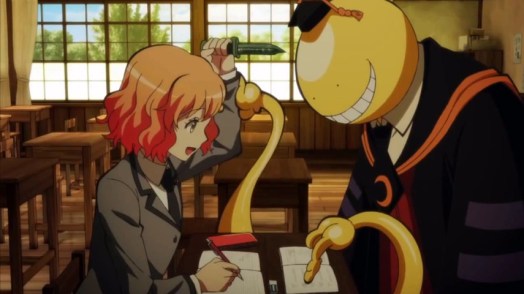
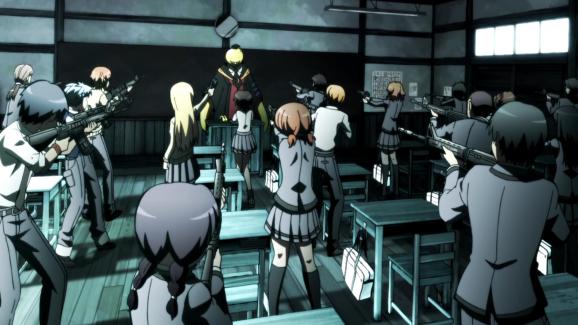
Based on the manga by Yūsei Matsui, Assassination Classroom follows the “end class” (full of academic and social misfits) of Kunugigaoka Junior High School who are given the task of killing their new teacher, a strange yellow octopus (with a smiley face for a head) before he explodes and wipes out the Earth the following March. To this end, the students are trained in various assassination techniques by Mr. Karasuma and Irina Jelavić (dubbed “Professor Bitch” by the class), all with the aim of taking their teacher, Koro Sensei, out.

Assassination Classroom Opening (2015)

One of the best parts of the series is watching how the assassination plans evolve over time. This culminates (in my opinion), in an arc where the class attempts to assassinate Koro Sensei on a remote island during summer vacation. The plan is so intricate that it nearly succeeds…but it still falls short. In fact, none of the students plans work out, but that doesn’t hurt the series at all because every attempt brings with it a new lesson about life. While strange looking, Koro Sensei is a grade-A teacher who genuinely wants his students to succeed in life (as well as killing him). In fact, as I watched the series through the first time, it slowly dawned on me that many of Koro Sensei’s tips about assassination were actually skills and ideas you could apply in real life.

assassination-classroom-part-one-screenshot-02.jpg

There are some parts of the series that are really upsetting to me and I want to highlight a few of them. First of all, if bullying bothers you then several episodes will be difficult to watch. The rest of the school is trained to hate the End class on principle, with most events rigged to ensure that this class stays at the bottom. It’s really uncomfortable to watch but thankfully the series moves away from that aspect over time. Another episode that upsets me is one that introduces Mr. Takaoka, a (brief) replacement for Mr. Karasuma. Just the way this character is drawn is enough to set you on edge (I think they made his smile look fake on purpose) but what he does is even worse. It comes out that Takaoka employs sadistic training methods and rewards the smallest complaint with punches and slaps. However he does receive an epic comeuppance from Nagisa Shiota (a student who narrates most of the episodes), which partially makes up for what happened before.

Koro Sensei is by far the best part of the series; he has dozens of different quirks, facial expressions and quips that will leave you giggling more often than not. I love how his face changes to reflect his mood. He’s a character that grows on you very quickly.

I enjoy Assassination Classroom very much; I love the twists and turns the story takes and by the end of the series I was very much attached to the fates of each character. If you’d like to check out Assassination Classroom, the complete series is currently available on Hulu. If you’ve already watched the series, let me know what you think about it in the comments below and have a great day!

See also:

Animated Film Reviews

Become a Patron of the blog at patreon.com/musicgamer460

Check out the YouTube channel (and consider hitting the subscribe button)

Don’t forget to like Film Music Central on Facebook 🙂

The Hunt for Red October “Hymn to Red October” (1990)

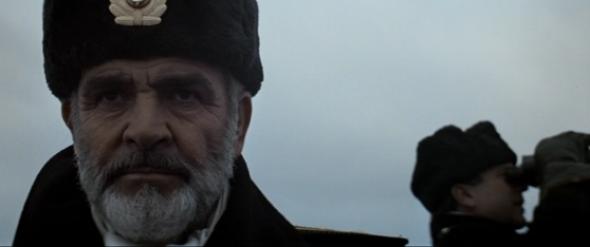
My favorite iteration of author Tom Clancy’s Jack Ryan character has always been Alec Baldwin’s portrayal in The Hunt for Red October (1990), in which the CIA analyst finds himself thrust into an escalating situation when a decorated Soviet submarine captain (Sean Connery) takes off with the Soviet Union’s newest submarine.

The Hunt for Red October Opening Credits (1990)

Besides the great performances from Baldwin and Connery, this has always been my favorite Tom Clancy film because of the score, composed by Basil Poledouris (1945-2006). His piece, “Hymn to Red October” is one of my favorite film pieces to listen to. The piece comes at the beginning of the film, just after an on-screen narration (in summary: what you are about to see, according to the government, never officially happened) sets the scene. It begins as the Red October submarine is heading out to see and Captain Ramius (Connery) agrees with his first officer (Sam Neill) that it is “Time indeed (for their plan to begin).”

redoctober.jpg.CROP.promovar-mediumlarge.jpg

The hymn is orchestral with a male Russian chorus that begins very softly, matching Ramius’ thoughts (“Cold and hard.”) As the chorus grows louder, the orchestra swells up with it, as we see a gorgeous shot of the submarine that morphs into the film’s title before the opening credits roll (it seems weird now but it used to be common for films to open with the title and main credits). As the lyrics reveal, the singers are bidding the Motherland (Russia) farewell and answering the call of the sea. With the power of Red October, nothing can stand in their way.

I find the first few lines of the hymn to be most interesting as they directly reflect a plot point in the film. The line: “Light that has left me/How could I know that you would die?” seems to reflect the untimely death of Ramius’ wife, the event which helped to spur on his defection to the West. The rest of the hymn is styled as typical Soviet propaganda (note the line about “Our Motherland’s victorious march”) that extols the greatness of the Soviet Union.

Cold, hard, empty.
Light that has left me,
How could I know that you would die?
Farewell again, our dear land.
So hard for us to imagine that it’s real, and not a dream.
Motherland, native home,
Farewell, our Motherland.
Let’s go; the sea is waiting for us.
The vastness of the sea is calling to us, and the tides!
Hail to our fathers and forefathers.
We are faithful to the covenant made with the past.
Now nothing can stop
Our Motherland’s victorious march.
Sail on fearlessly,
Pride of the Northern Seas.
Hope of the Revolution, you are the burst of faith of the people.
In October, in October,
We report our victories to you, our Revolution.
And to the heritage left by you for us

What do you think of “Hymn to Red October”? Let me know your thoughts in the comments below and have a great day!

See also:

Film Soundtracks A-W

Become a Patron of the blog at patreon.com/musicgamer460

Check out the YouTube channel (and consider hitting the subscribe button)

Don’t forget to like Film Music Central on Facebook 🙂

First Man “The Landing” (2018)

Ever since I finished watching First Man in the IMAX theater, one piece of music will not leave my mind: the music for “The Landing.” While a more thorough soundtrack review is likely coming in the near future, I’d like to highlight this piece in its own article because it is that good.


“The Landing” comes at what I feel is the true climax of the film; this is the moment we’ve been waiting for since the film started, watching Neil (Ryan Gosling) and Buzz (Corey Stoll) land on the moon. From the moment the LM (Lunar Module) detaches to head down to the surface, a melodic ostinato begins to play (an ostinato is a relatively brief melody that repeats over and over again). Remember in my review of the film how I said parts of First Man reminded me of Interstellar? This scene is one such example, as I saw a definite similarity to the docking scene in “No Time For Caution.” Both scenes have music with a repeating melody that also serves to ramp up the tension as the scene moves forward. In First Man, even though it’s the same notes, Justin Hurwitz subtly alters the theme by making it louder; emphasizing certain notes; interweaving horns and inserting an overlaying melody that comes and goes; with the effect that as the LM comes closer and closer to the surface, you are subconsciously inching to the edge of your seat, driven on by the music you’re hearing.

First Man “The Landing” (2018)

With the landing scene itself, I really like how, in the latter part, the camera flips back and forth between Neil, the surface and the gauge marking how much fuel is left. Working with the music, all of those elements together make for a riveting scene that is one of the best in the film.

What did you think of the landing scene in First Man? Let me know your thoughts in the comments below and have a great day!

See also:

Film Soundtracks A-W

Become a Patron of the blog at patreon.com/musicgamer460

Check out the YouTube channel (and consider hitting the subscribe button)

Don’t forget to like Film Music Central on Facebook 🙂

My Thoughts on: Aliens (1986)

There is, based on my experience, a long-running argument as to whether Alien or Aliens is the superior film. I’ve heard valid arguments for both films, but the fact is, you can’t compare them to each other. At the end of the day, Alien is first and foremost a horror film (albeit one set in space) while Aliens is firmly set in the action genre.

Aliens-inside.jpg

I have a confession to make about Aliens: I can’t watch the beginning of the film. Learning that Ripley has been in stasis for 57 years and no one believes her story about the alien is just too painful, for lack of a better word, to watch. I don’t know if it’s just subconscious frustration on my part (because we know Ripley’s telling the truth) but I just can’t watch the opening; I usually just skip to Burke’s visit to Ripley’s home.

Issues with the opening aside, I love Aliens; I love the set up, I love the characters and I love the various plot twists. In summary, Ripley unwillingly returns to LV-426 after a colony established there goes radio silent. She’s accompanied by a squad of colonial marines, Bishop (another android, but one more advanced than Ash) and Burke, an executive who is definitely as slimy as you think he is. In predictable fashion, everyone except Ripley completely underestimates the gravity of the situation, resulting in the marines walking straight into an alien nest (though granted they don’t realize that’s what it is at first). This is one of my favorite scenes in any science fiction film because you just know from the start that most of these characters are going to die, and since it’s an Alien movie, it’s not going to be pretty. After the initial massacre, the plot focuses on Ripley working with the survivors to escape back to their ship, while also bonding with Newt, the lone colony survivor.

The biggest difference between this film and the original is that the first film only had ONE Alien on the loose; Aliens has several hundred and it’s also responsible for introducing the Alien Queen to the story. And speaking of the queen….what a terrifying creature she is! Until Jurassic Park, the Alien Queen was the largest animatronic/puppet of its kind, requiring over a dozen people to operate at any given time. Technical details aside, the scene introducing the queen is terrifying, I love how the camera only shows bits and pieces before suddenly pulling back and showing the creature in all her scary glory.

Another sub-plot I want to highlight is Ripley’s relationship with Bishop. Given that the last android she knew tried to kill her, Ripley understandably wants nothing to do with Bishop at first. But as time goes on and Bishop proves himself time and again, Ripley comes to respect the android and the feeling is mutual.

James Horner’s score is a big part of why Aliens is so great: there are hints of the horror/suspense that Goldsmith created in the original film, but also moments of full blown action (notable example: when Ripley charges in to rescue the surviving marines, the score goes into overdrive).

Few more random thoughts:

-Burke’s comeuppance is one of the greatest things you will ever see. My only regret is we don’t get to see more (a lot of it is left to the imagination).

-Since it is the 80s, if you look carefully you can see the wires manipulating some of the Alien puppets (the most obvious one comes when an Alien surfaces out of the water right behind Newt, you can see it attached to the tail).

-That scene where the facehuggers are loose in the medical lab is downright terrifying, but they move so realistically you can’t really tell they’re puppets.

At the end of the day I highly recommend both Alien and Aliens as they’re both great films (just for their own reasons). Let me know what you think of Aliens in the comments below and have a great day!

See also:

My Thoughts on: Alien (1979)

Film Reviews

Become a Patron of the blog at patreon.com/musicgamer460

Check out the YouTube channel (and consider hitting the subscribe button)

Don’t forget to like Film Music Central on Facebook 🙂

My Thoughts on: First Man (2018)

I knew from the moment I saw the first trailer that I would enjoy First Man, a film based on First Man: the Life of Neil A. Armstrong by James R. Hansen. Even knowing this, I was still blown away by what director Damien Chazelle created. I have to preface this by saying that this is, to my knowledge, the first film I ever watched on an IMAX screen. Being used to a regular movie screen, it took me a little while to adjust to having so much more to look a. But by the end of the film, I have to say, IMAX format is definitely the way to go with this film if you have that option.

First Man covers an 8 year period from 1961 all the way through the Apollo 11 mission in 1969. It tells the story of how Neil Armstrong (Ryan Gosling), went from being a test pilot and an engineer to a member of the astronaut corps working in the Gemini and Apollo missions, all while trying to balance a life with his wife Janet (Claire Foy) and children. If I had to compare this film to earlier works, I would say it’s a cross between The Right Stuff, Apollo 13 and Interstellar (several shots in First Man seem to be influenced by this last film). However, don’t let my allusion to Apollo 13 fool you; First Man is nothing like the Ron Howard epic. There is no sweeping score, no lush strings, in fact a lot of the film has no music at all. Far from being a negative, the relative lack of music in many scenes makes you appreciate the music all the more when it does appear.

1535789247365.jpg

Damien Chazelle does an amazing job showing the audience just how dangerous these missions really were. I noted that Gus Grissom (Shea Wigham), Ed White (Jason Clarke) and Roger Chaffee (Cory Michael Smith) (the crew of Apollo 1) were introduced early on, to let the audience build a connection with them (and see how Neil and his family were connected with them too, as the White’s were neighbors). I’ve read obsessively about NASA for years, so I had an idea of how the Apollo 1 testing scene would go and it delivered beyond all expectations. One detail I appreciated is Chazelle makes a point to show every single lock that is turned to seal the astronauts inside the capsule, foreshadowing one of many elements that leads to the crew’s horrific fate.

ClaireFoyFirstMan

By far, my favorite scene in the film has to be the Moon landing, including the descent to the lunar surface and what came afterward. I really feel that composer Justin Hurwitz was channeling Hans Zimmer’s work on Interstellar (“No Time for Caution” came to mind) during the descent. Even though you know that the crew is going to make it and come back safely, there’s still a believable tension present that has you on the edge of your seat. And as for that moment on the Moon (you know the one I mean), I’d like to think that Neil did do something like thatI will admit the ending of the film caught me off guard, but the more I thought about it on my way home, the more it made sense.

Final thoughts:

The Gemini 8 scene caught me off guard because I didn’t know about the incident. If you get motion sick easily, be forewarned, you might find this scene difficult to watch.

I really liked how film shows Neil’s POV in several scenes, it really puts you in that moment.

One trailer shows a scene where Neil’s house is on fire (a real life incident), but this scene does not appear in the film. Given how long the film is, it’s safe to say this scene was cut for time.

Claire Foy turns in a great performance as Janet Armstrong. There are many scenes where she doesn’t say a lot, but you can see the tension building up inside her until it finally bursts out in spectacular fashion.

First Man is definitely a must-see film and I think it’s bound to pick up multiple awards in the coming months. Let me know what you think about First Man in the comments below and have a great day!

See also:

Film/TV Reviews

First Man “The Landing” (2018)

Become a Patron of the blog at patreon.com/musicgamer460

Check out the YouTube channel (and consider hitting the subscribe button)

Don’t forget to like Film Music Central on Facebook 🙂