Yearly Archives: 2016

Beauty and the Beast “Belle” (1991)

The year was 1991. It had been two years since Disney successfully launched the Disney Renaissance with The Little Mermaid (1989), and now the time for their next animated classic had come: Beauty and the Beast (1991). The movie adapts the French fairy tale of a beautiful girl named Belle (which is French for “Beauty”) who slowly falls in love with a terrifying Beast, not knowing that he is actually a prince trapped in an enchantment. The score for this film was composed by Howard Ashman and Alan Menken. Ashman, suffering from AIDS, did not want to work on the film but was eventually persuaded to do so. His health took a turn for the worst during production and he died not long after work was completed on the film (though a few of his songs did appear in Aladdin.)

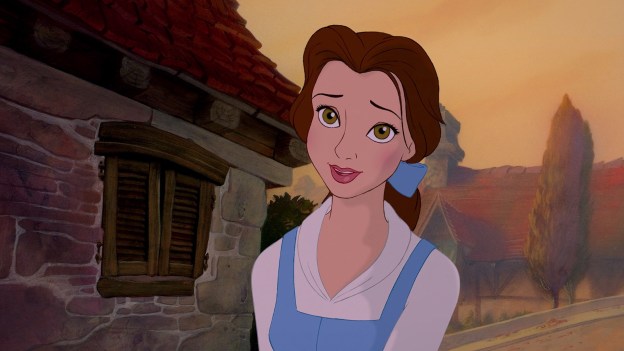
“Belle” is the opening number of the film and serves as our introduction to the book loving Belle, who is considered “a funny girl” by almost everyone in town. The exceptions to this are her father Maurice, the book-seller, and Gaston. The song begins with Belle walking into town, singing about how every day is the same (a fact that bores her immensely). As the townspeople sing “Bonjour!” (Good morning/Good day), Belle lists off all the familiar sights that she has memorized by heart. But Belle is dissatisfied and sings her refrain of “there must be more than this provincial life.” Having read all of these stories of adventure and romance, Belle dreams of finding her Prince Charming and being swept away to lands unknown.

 Little town, it’s a quiet village
Every day like the one before
Little town, full of little people
Waking up to say

Bonjour! Bonjour! Bonjour! Bonjour! Bonjour!

There goes the baker with his tray, like always
The same old bread and rolls to sell
Every morning just the same
Since the morning that we came
To this poor provincial town

no-longer-on-the-elliptical

Now, before I continue, there’s something that should be pointed out. The Disney animators wanted to emphasize how Belle is different from everyone else in the village. To that end, they color-coded her outfit to stand out. Look at the scene of “Belle.” See the blue pinafore she’s wearing? No one else in town is wearing blue! Automatically Belle stands out to the eye (and it’s very effective). But I digress, back to the music…

Unfortunately (for Belle), there is a “Prince Charming” who is very interested in her, the town hero Gaston. When you first meet him, Gaston appears to be the stereotypical Disney hero: perfect good looks and a great singing voice (though this was by design to serve as a contrast to what comes later).

Right from the moment when I met her, saw her
I said she’s gorgeous and I fell
Here in town there’s only she
Who is as beautiful as me
So I’m making plans to woo and marry Belle

For all his gifts, Gaston is a narcissist, who thinks that he (Gaston) can do whatever he wants, whenever he wants, BECAUSE he is Gaston! This includes marrying Belle, “the most beautiful girl in town” because he “deserves the best” (the fact that Belle might not WANT to marry him doesn’t seem to make a difference). Gaston attempts to sing his own verse about how he fell in love with Belle at first sight, but it’s interspersed with lines praising his own handsomeness (you just know this “romance” is not going to end well).

As Belle prepares to leave town to head back home, the entire community begins to sing about her and this last verse sums up how much the town doesn’t “get” Belle:

Look there she goes, the girl is strange but special, a most peculiar mademoiselle/

It’s a pity and a sin, she doesn’t quite fit in/but she really is a funny girl, a beauty but a funny girl, she really is a funny girl, that Belle!

Belle has always been my favorite Disney Princess ever since I first saw the film, because, like me, Belle is a bookworm, and she feels isolated because of this. Belle also dreams of adventure in far off places (and what young person doesn’t?) Interestingly, we never learn how old Belle is, or anything about her mother (we can presume she’s deceased, but when or how long ago is never broached). This is also one of my favorite Disney songs because, unlike Sleeping Beauty or Snow White, where the singer is a high soprano, Belle is a mezzo-soprano (which is my vocal range).

I admit, when I was younger (a lot younger) I used to wish that real life included people singing as they went about their daily lives, so sometimes I would pretend (as I was walking around) that people were singing the “Belle” song about me (ah, the power of imagination). That’s all for “Belle”, next time, as predicted, Gaston’s courting of Belle doesn’t exactly go as planned, and for that he’ll want revenge!!

*all images are the property of Walt Disney Studios

Become a patron of the blog at: patreon.com/musicgamer460

Check out the YouTube channel (and consider hitting the subscribe button)

See also:

Beauty and the Beast “Belle (reprise)” (1991)

Beauty and the Beast “Gaston” (1991)

Beauty and the Beast “Be Our Guest” (1991)

Beauty and the Beast “Something There” (1991)

Beauty and the Beast “Human Again” (1991)

Beauty and the Beast “Beauty and the Beast/Tale as Old as Time” (1991)

Beauty and the Beast “The Mob Song” (1991)

Beauty and the Beast “The West Wing” (1991)

Beauty and the Beast “Battle on the Tower” (1991)

Beauty and the Beast “Transformation” (1991)

For more great Disney songs and films, check out the main page here: Disney Films & Soundtracks A-Z

Don’t forget to like Film Music Central on Facebook 🙂

Introducing James Bond: Skyfall (2012)

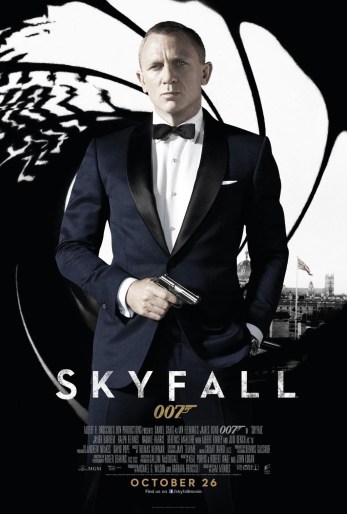
Thus far in the Daniel Craig era of James Bond, we’ve had one good and one not-quite-as-good film. Skyfall, the penultimate film thus far, is for me, the moment where the Daniel Craig Bond finally hit his stride. No more awkwardness, no immaturity, THIS is the Bond we’ve come to know and love over the decades.

skyfall-uk-poster

Skyfall begins with another mission in progress: Bond is in Istanbul accompanied by a female agent (and there’s a good reason we don’t know her name yet). The end of this scene (being the pre-credits) features Bond accidentally shot and presumed dead in the aftermath.

Skyfall-movie-image-daniel-craig

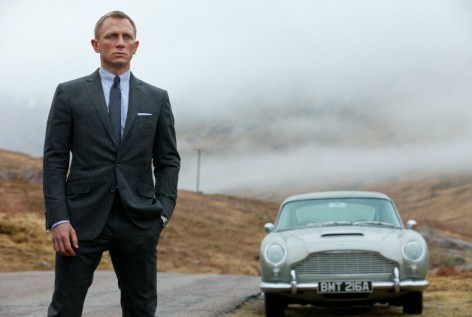
In reality, Bond is alive and well, he decided to use his presumed death as a way to take some much needed time away, but it doesn’t last. Back in London, M (Judi Dench) is facing considerable pressure from Gareth Mallory (Ralph Fiennes) over the continued existence of MI6 in the 21st century and she is being pushed to retire. Out of nowhere, the MI6 servers are hacked and the building is bombed, prompting Bond to return to the city.Bond is up against his most dangerous opponent yet, and not everyone is going to make it out alive.

Unlike the previous two Bond films, I was unable to catch Skyfall in the theater (something I deeply regretted once I did see the movie). If Goldfinger is the perfect classic Bond film, then Skyfall is the perfect Bond film of the new era, I can’t think of any flaws.

Ben Whishaw is PERFECT as the new Q by the way, I didn’t think anyone could ever replace Desmond Llewelyn in that role, but he is perfect (and Bond’s line during their introduction “You’ve still got spots!” always makes me laugh)

*warning: spoilers for the ending of Skyfall follow*

I did not see (or I didn’t want to see) the death of Judi Dench’s M coming, but I also understood her reasons for leaving (she had been playing the role since 1995 after all). Without a doubt, the series won’t be the same without her, but Ralph Fiennes makes a pretty great M too. And speaking of the new M, this is the first time in the cinematic Bond universe that we actually know M’s real name (Gareth Mallory). M’s real name IS mentioned in the books, but that’s a separate thing from the movies.

skyfall-2012-003-bond-in-national-gallery

And before I get to the music, I have to talk about that final scene, where Bond properly gets introduced to Eve Moneypenny (aka that female agent from the pre-title sequence): that was perfect!! I had this overwhelming feeling of: finally, everything is right with the Bond universe again (it just didn’t feel right without Q and Moneypenny, and both were reintroduced in this film). And the last scene where Bond faces the new M in his office, just that moment alone was an homage to classic Bond with the design of the office, Bond’s suit, M’s suit, the painting behind M’s head (go back to the Connery films and check out M’s office, you’ll see what I mean). And for the first time in a long time, when the screen went black, I instantly wanted more!

Skyfall_-_M_confronts_Raoul_Silva

Now on to the music! For the first time in quite a while, David Arnold did NOT return to compose the score to Skyfall; instead the score was written by Thomas Newman (a great film composer in his own right and a frequent collaborator with director Sam Mendes). (It should be noted that Arnold was also busy composing the music for the closing ceremony of the 2012 Olympic and Paralympic Games.) Newman’s score won the BAFTA for Best Film Music. It was also nominated for the Academy Award for Best Original Score (only the second Bond film score to be so honored).

Thomas Newman talks Skyfall (2012)

 Thomas Newman’s score contributed more than a little to the success of this film. In this short making-of segment, Newman talks about how the score was put together, along with a little behind-the-scenes action.

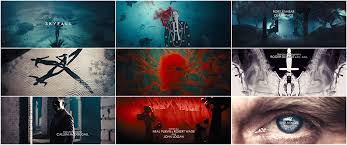
Skyfall Title Sequence (2012)

While the score for Skyfall was well-received, the title song turned the world upside down. “Skyfall” was performed by Adele and received instant critical acclaim from everyone, and is now considered one of the greatest Bond songs ever created. The song was nominated for and won the Academy Award for Best Original Song (the first Bond song to win an Oscar) and it also won a Brit Award for Best British Single (as well as a Critic’s Choice Award and a Golden Globe AND a Grammy Award.)

download

Credit to Art of the Title

I seriously doubt that any film will top Skyfall for quite some time, but Spectre certainly tried to (but more on that next time).

Become a Patron of the blog at patreon.com/musicgamer460

See also: Film/TV Reviews

Up next: Spectre (2015)

Don’t forget to like Film Music Central on Facebook 🙂

*poster and images are the property of Eon Productions

Atlantis: The Lost Empire “The Crystal Chamber” (2001)

I think there is no Disney film so underrated as Atlantis: The Lost Empire (2001). Released in the first few years after the Disney Renaissance (which most will say concluded with Tarzan in 1999), Atlantis featured an all-star voice cast and was also the first animated Disney film with no songs whatsoever. Despite gorgeous animation and a sublime musical score (more on that in a minute), the film under-performed at the box office, causing a planned animated series to be scrapped (it was reworked as Atlantis II: Milo’s Return), an Atlantis-themed ride at Disney World to be cancelled and furthermore, it led to Princess Kida NOT being recognized as an official “Disney Princess” (seriously, she has never appeared at the theme parks, any of them). (And on a further note, remember how everyone says Elsa from Frozen was the first Disney Princess to become a Queen onscreen? I hate to be the one to burst that bubble, but that honor actually belongs to Kida, who is QUEEN as the film ends!!) But I digress…

The music, as I said, is exceptional and was composed by James Newton Howard (he’s composed for many films, including the remake of King Kong in 2005).


“The Crystal Chamber” takes place about 2/3 of the way through the film and begins when bad guy Roarke (James Gardner) discovers that the powerful “Heart of Atlantis” crystal has literally been underneath their feet the entire time. But as hero Milo (Michael J. Fox) has been trying to tell everyone, the Crystal is not some giant diamond, it’s alive, it feels and it currently knows that it is in danger so it moves into “protection mode” by seeking out the closest person of royal blood, in this case: Princess Kida.

The music begins to move forward in earnest when the Crystal (speaking through Kida) reassures Milo that everything is going to be okay.

Howard has constructed a slowly building melody that begins with a single voice and builds to a huge orchestral moment as Kida (Cree Summer) begins walking on top of the bottomless lake to immediately below where the Crystal is hovering. A single beam of light converges on the princess and as it completely disappears the music vanishes for a moment. And then…Kida rises!!! And the music matches her ascent, this beautiful hovering melody that lifts you up in the air along with her!

Atlantis: The Crystal Chamber Soundtrack Version (2001)

The best part though, comes when Kida is joined with the Crystal. As the orbiting stones move around them, the music reflects this sense of motion. Listen to the same moment in the soundtrack version of this scene and you’ll hear what I’m talking about: the music “moves” closer and then farther away, giving the impression of movement.

As the scene ends, the music slowly winds down, allowing the audience to admire the Kida-Crystal that has now formed (I love the animation for that).

I remember seeing this in the theaters and being enraptured by this scene. This is the epitome of a good movie moment, the sound and visuals just work together to pull you in to the story. If you haven’t seen this movie, find a copy and don’t let it go, because it is worth it. (I secretly hope that Disney will include this in the list of live-action remakes so the story can FINALLY get the attention it deserves).

*poster image is the property of Walt Disney Studios

Become a patron of the blog at: patreon.com/musicgamer460

Check out the YouTube channel (and consider hitting the subscribe button)

For more great Disney songs and films, check out the main page here: Disney Films & Soundtracks A-Z

Don’t forget to like Film Music Central on Facebook 🙂
See also:

James Newton Howard talks Atlantis: The Lost Empire (2001)

Introducing James Bond: Quantum of Solace (2008)

Like many, I was excited to hear that Quantum of Solace would be coming out only two years after Casino Royale (2006). After the success of the first film in the rebooted series, everyone was excited to see where this new Bond would go next. Well…about that….


Quantum of Solace is (to my knowledge) a first for the Bond series. It is the only Bond film I know of to pick up exactly where the previous film left off. Think about it, with the exception of For Your Eyes Only (1981) which references Bond’s wife (as seen in On Her Majesty’s Secret Service (1969) (and a very small reference to Dr. No in From Russia With Love (1963)), no other Bond film refers to any of its predecessors, they can all be viewed in pretty much any order you like. This changes with Craig’s Bond; unlike all the others before him, this series of films retains the consequences of what happens in earlier films. A good case in point would be Vesper Lynd (Eva Green), Bond’s one-time love interest. Even though she (spoiler alert) dies in Casino Royale, her presence lingers all the way through Spectre (2015) in one form or another.

Quantum-Midnight-Suit-1024x499

The unusual title of the film comes from one of Fleming’s short stories collected under the umbrella title “For Your Eyes Only.” According to Fleming, the term “quantum” refers to the absolute minimum. Therefore, a “quantum of solace” would be the smallest amount of solace (read: consolation) that a person could feel. I believe this refers to Bond’s feelings regarding Vesper’s death and the circumstances behind it (he becomes obsessed tracking down the Quantum organization). Now on to the story…

The characters of Q and Moneypenny are still absent. As the film opens, we find Bond in the midst of a high-speed pursuit with a certain Mr. White (first seen in Casino Royale) unceremoniously tied up in his trunk, after Bond located him at the conclusion of the previous film. (This is the same Mr. White who later appears in Spectre). Bond successfully eludes or destroys his pursuers, and brings White in to M. But before they can question him, M’s bodyguard reveals he is a double agent and helps White to escape before Bond kills him in retaliation. It turns out this agent had a contact in Haiti, a hitman who is now contracted to kill the girlfriend of Dominic Greene, a known environmentalist entrepreneuer.

quantum-of-solace

Through a series of events, Bond realizes that Greene is actually working for the elusive “Quantum” organization, the unnamed group that employed Le Chiffre in the previous movie. Before the studio could reacquire the rights to the “Spectre” name, I believe “Quantum” was supposed to be a sort of replacement, the new arch-villain, as it were. But then he rights to SPECTRE were re-acquired and the point became moot (I could be wrong, but that’s my take on the situation).

Bond is obsessed with vengeance for a good portion of the film (even if he denies it), and wreaks bloody mayhem through a lot of the film (there are 250 distinct acts of violence in the film; by contrast Dr. No has only 109, making this the bloodiest film in the Bond series). I think partially because of the violence, and also because the plot was a little…blah…this film wasn’t as well-received as others, the reviews were decidedly mixed. Craig’s performance was praised, but the supporting details…not so much (I’m not saying ecology is unimportant, it’s just not the first thing you think of for a James Bond plot).

Before I get to the title sequence, I need to talk about my favorite musical sequence in this film. An important moment takes place at the Bregenzer Festspiele in Bregenz, Austria. The festival site features a floating stage on the shores of Lake Constance. During filming, the open-air amphitheatre was host to a performance of Tosca (an opera that centers around a plot of revenge, much like Quantum of Solace)

1224496955_bond

Quantum of Solace “Tosca” scene

I love how the music of the opera interweaves with the plot of the story in this scene; it is (for me) very much a predecessor of the opera scene in Mission Impossible: Rogue Nation (2015)

For Quantum of Solace, the music was again composed by David Arnold, his fifth entry in the series. As in Casino Royale, the classic “James Bond” theme is kept to a minimum (which really bugs me, because, I know this is a “new” Bond, but the theme partially defines the character as a whole, if you don’t have it, is he “really” Bond?)

quantum-of-solace (1)

Quantum of Solace Title Sequence (2008)

The song performed for the title sequence is a first: “Another Way to Die” is the first duet in the history of the Bond franchise, and features the voices of Jack White and Alicia Keys. The song was nominated for a Grammy, a Critics’ Choice Award and it won a Satellite Award for Best Original Song. That being said, reception was still mixed. On its own, the song is considered to be good. As a James Bond theme however…not so much (think of the arguments that came up when “Writing on the Wall” was announced as the Spectre theme).

To conclude, I think of the four Craig Bond films, this one is the weakest, especially when you look at what followed (Skyfall and Spectre).

quantum_of_solace_c-0-1080-0-0

Credit to Art of the Title

Random trivia: Agent Strawberry Fields (yes that is really her name) death is a direct homage to Jill’s death as seen in Goldfinger (1964).

That’s all for Quantum of Solace, next time: Skyfall (2012), arguably the best Bond film ever made. Until then!

Become a Patron of the blog at patreon.com/musicgamer460

See also: Film/TV Reviews

Don’t forget to like Film Music Central on Facebook 🙂
*the poster and images are property of Eon Productions

My thoughts on: Gladiator (2000)

A70-11370

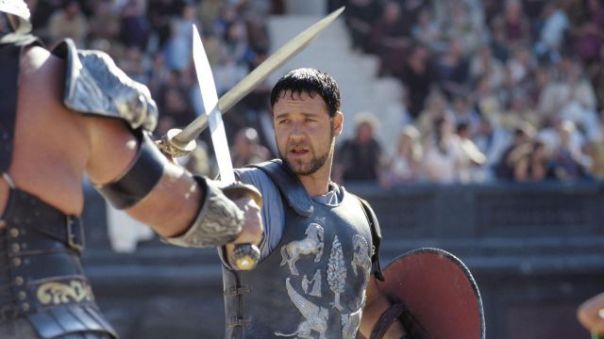
Set in the year 180 AD, the film follows the saga of General Maximus Decimus Meridius (Russell Crowe) as he is betrayed by Commodus (Joaquin Phoenix) after the latter murders his father, the Emperor Marcus Aurelius (when he revealed to Commodus that he was going to restore the Republic). Maximus is sent to be executed when he discovers what Commodus has done but he manages to escape and races back home, only to discover that his wife and son have been brutally murdered, his home burned to the ground.

11419

Maximus is subsequently captured by slavers and becomes a gladiator in a backwater town of the Empire. Meanwhile, Commodus has returned to Rome and proceeds to enjoy life as an Emperor, giving the people an unending stream of “bread and circuses” so that no one notices that he’s really a terrible ruler.

Phoenix’s performance as the slowly-going-mad Emperor is really spine-chilling at times. He comes off as slightly buffoonish in the beginning, but once he really begins to go mad (I’m thinking of the scene where he threatens to kill his nephew unless his sister does whatever he wants), he’s quite terrifying.

gladiator-3

Of course Maximus inevitably makes his way to Rome as a gladiator, to fight in the great Colosseum. He vainly attempts to hide his identity (fearing that he’ll be killed on the spot if recognized), but the Emperor demands to know who he is, leading to one of the greatest movie lines of all time:

My name is Maximus Decimus Meridius, commander of the Armies of the North, General of the Felix Legions and loyal servant to the TRUE emperor, Marcus Aurelius. Father to a murdered son, husband to a murdered wife. And I will have my vengeance, in this life or the next.

And vengeance he gets, though not without paying the ultimate price in return.

The score for this brilliant film was composed by the legendary Hans Zimmer. Some have noted that the music in many battle scenes bears a distinct resemblance to the music from “Mars: The Bringer of War” composed by Gustav Holst (so much so in fact that at one point the Holst Foundation sued Zimmer on the grounds that he had plagiarized Holst’s work). Also, Commodus’s triumphal entry into Rome contains music that seems to evoke two of Richard Wagner’s operas “The Rhine Gold” and “Twilight of the Gods.”

It’s been a while since I watched this movie, but it is indeed a modern classic that everyone should see at least once in their lives.

*poster is the property of DreamWorks Pictures

For more thoughts on live-action film, see also: Live-Action Films/TV

Check out the YouTube channel (and consider hitting the subscribe button)

Don’t forget to like Film Music Central on Facebook 🙂

Introducing James Bond: Casino Royale (2006)

Well, it took a little longer than expected, but we’ve finally arrived to the Daniel Craig era of James Bond. As I’ve stated before, 2006 is the year that the entire James Bond saga was rebooted. No longer was Bond that suave, experienced agent. Having reset the story, Bond is now a relatively young agent just earning his license to kill (a process seen in the prologue of this movie) and he is far from being sure of himself (however cocky he  may act throughout the film).

Casino Royale Poster 3

The only carryover from the original franchise is Judi Dench as an M who is (rightfully) frustrated with Bond’s seemingly overwhelming desire to kill everything in his path (as opposed to capturing suspects alive for questioning). She actually has a rather funny set of lines early on (after Bond has caused another scandal) where she declares “In the old days, an agent who screwed up that badly had the good sense to defect!” and then mutters “Christ I miss the Cold War” (the majority of the Bond films were set in the Cold War era).

Bond’s mission now is to engage the criminal known only as “Le Chiffre.” This mastermind is supposed to invest money on behalf of investors in the criminal underworld, but he also likes to make some money for himself by  playing that money on the stock market, engineering disasters that will cause a tremendous profit (for him and his clients). Unfortunately, Bond managed to halt his latest attempt, causing Le Chiffre to lose a large sum of money that he had just invested for an African warlord. Desperate to recoup his money before said warlord comes to kill him, Le Chiffre organizes a world-class poker game at the famous Casino Royale in Montenegro. (In the original novel, the game is actually baccarat, but poker is more recognizable in 2006). The prize would be large enough to cover all of Le Chiffre’s losses and save his neck. Bond’s job is to go in, ensure that Le Chiffre loses, which should then force him to surrender to the authorities and spill everything he knows about his employers.

Of course, this being a James Bond film, things don’t exactly go according to plan, and in the end Bond comes out of the chaos more hardened and cold than when he went in, and begins to bear a resemblance to the hardened assassin seen in the original novels.

I distinctly remember when it was announced that Brosnan was out as James Bond. I was outraged naturally (Brosnan was the only Bond I really knew at the time) and couldn’t imagine anyone else in the role. Then Daniel Craig was announced and I nearly went through the roof. Why? Well, look at a picture of Craig: he’s blonde. Look at ALL of the Bond actors who came before him: dark haired, every last one of them. And for the final proof, look at Fleming’s own description of Bond: dark-haired!!! The press continually derided Craig as the “Blonde Bond” and also “James Bland” because they really didn’t think he could pull it off. I didn’t think he could either…and then I watched the movie in the theater, the first Bond film I ever saw on the big screen.

Needless to say, I promptly took back every bad thing I’d ever said or thought about Craig being Bond. He surely wasn’t the SAME kind of Bond, but he was recognizable nonetheless.

Some things about the reboot still bothered me though. For example, the famous opening gunbarrel sequence was absent (though I believe it did appear at the end, it’s just not the same). Miss Moneypenny, M’s long-suffering secretary (and ever hopeful for James’ love) was absent as well, and there was no Q either.

Now then, on to the music. Once again David Arnold returned to score the film, though it was orchestrated and conducted by Nicholas Dodd. In a twist, the classic James Bond theme is completely absent. Instead, Arnold used a four note motif from the title song “You Know My Name” as Bond’s theme, his intention being to highlight Bond’s immaturity. The proper theme does not appear until the very end, implying that Bond has finally “grown up” as it were. Also, this is a rare example of a Bond title song where the song title “You Know My Name” does not match the title of the film “Casino Royale.”

“You Know My Name” was performed by Soundgarden member Chris Cornell and jointly written between him and David Arnold. The song received very positive reviews and won a Satellite Award and the World Soundtrack Award and also received a Grammy nomination. Cornell stated that the two biggest influences for this song were Tom Jones (who performed the Thunderball theme) and Paul McCartney (who performed the theme for Live and Let Die). The lyrics attempt to illustrate Bond’s state of mind at this point in his life. Since this film centers around a poker game, the title sequence features a lot of gambling and playing card motifs.

casino_royale_contact-0-1080-0-0

Credit to Art of the Title

While not the smoothest of transitions, Casino Royale turned out to be a relatively well-done movie that served to whet my appetite for what was to come.

Random trivia: this is actually the THIRD adaptation of the Casino Royale novel. First came an adaptation for television in 1954 starring Barry Nelson (an American Bond, oh the horror!); a “spy comedy” film in 1967 starring David Niven (it was more of a spoof film than a serious feature); and finally this film in 2006.

Next time: Quantum of Solace (2008) (I can hear the question already: What’s a Quantum of Solace? Well….)

Become a Patron of the blog at patreon.com/musicgamer460

Check out the YouTube channel (and consider hitting the subscribe button)

See also: Film/TV Reviews

Don’t forget to like Film Music Central on Facebook 🙂

*the poster and images are the property of Eon Productions

Hans Zimmer talks Sherlock Holmes (2009) and Sherlock Holmes: A Game of Shadows (2011)


With the wonderful news that Sherlock Holmes 3 is in fact happening (*still dancing for joy*) I thought I would find Hans Zimmer’s interviews on the scores he did for Sherlock Holmes (2009) and the sequel Sherlock Holmes: A Game of Shadows (2011).

Hans Zimmer talks Sherlock Holmes (2009)

I love these movies, I really do. Being a fan of the late Jeremy Brett’s interpretation of the famous detective (he played the role on the Granada television series in the 1980s), I wasn’t sure about Robert Downey Jr. playing the role initially. However, once I saw the movies, all my doubts fell away and I was in love!

And being a musicologist, the music jumped out to me almost immediately. That slightly off-tune piano melody does an amazing job of setting the scene for the entire story. My favorite part (one of many) has to be the climactic battle on the unfinished Tower Bridge. Also, the byplay between Irene and Holmes was spot-on perfection (music included, you can tell that Holmes still has rather strong feelings for her, even if he denies it).

The sequel is just as amazing and Hans Zimmer returns to deliver an exceptional score. What’s fascinating here is that for this score, Zimmer traveled to various countries to find musicians with that “ethnic” and “rustic” sound that matched the mood he was looking for.

Hans Zimmer talks Sherlock Holmes: A Game of Shadows (2011)

The big moment here, is when Holmes and Moriarty are playing out their own scenarios as to how this fight between them will go. The very end, when Holmes admits that the only way is for them BOTH to die….is just perfect. There’s a weird imbalance between the music and the scene here, but it works. The only one screaming is Moriarty; Holmes is perfectly serene. At first it would appear to be because he’s come to terms with his life and impending death, but of course, we find out at the end it’s probably because he had no intention of dying at all (I hope Watson slugs him in the next one for faking his death like that).

My biggest wish now is that Zimmer returns for Sherlock Holmes 3, what a pity it doesn’t come out until next year! Argh!!!

*both posters are the property of Warner Bros. Pictures

If you’d like to learn more about the film scores of Hans Zimmer, see here

Don’t forget to like Film Music Central on Facebook 🙂
Beyond the Cover: Goldfinger (1964)

I know this is extremely late, but I didn’t feel right not sharing this (even though i was really sick) so here is what I was going to share with the Beyond the Cover Blogathon hosted by Now Voyaging and Speakeasy

Book Banner

Like many movies adapted from books, I didn’t realize that Goldfinger was adapted from a novel until I’d already watched the movie many times. Goldfinger was released in 1964 as the third film in the James Bond franchise and is considered the film that really made James Bond a global phenomenon.

It was about two years ago when I read the Goldfinger novel itself for the first time. It was published in 1959 and was…interesting, to say the very least. To read any of Ian Fleming’s Bond novels, I always have to remind myself that he lived and wrote in a different era, when…certain words that I won’t repeat….were considered acceptable. That being said, it IS a good story.

As far as the general plot goes, the Goldfinger film is strikingly faithful to the book (I repeat, in general, not quite in all the specifics), but I thought I would list some of the differences.

Perhaps the biggest difference is that in the book, Bond identifies Goldfinger as being part of the sinister SPECTRE organization. The reason he travels around the continent in his fancy car is to drop off bars of gold at various locations so that SPECTRE agents can pick them up and use them to finance their evil deeds. In the film, by contrast, no relationship with SPECTRE is ever implied, and Goldfinger is made out to be an extremely greedy man who is only out for himself.

And then there’s Pussy Galore, one of the most memorable Bond girls to ever grace the silver screen. In the film, she is mysteriously “immune” to Bond’s charms for most of the story, but she finally “gives in” in a sequence that as become more uncomfortable to watch the older I’ve become. The film doesn’t give an explanation as to why Pussy is so adept at resisting Bond’s charms, but the book certainly does: in the original novel, Pussy Galore is the lesbian leader of a gang (explains a lot about her doesn’t it?) In fact, in the book, Pussy seemingly strikes up a relationship with a girl that Bond rescued earlier (Tilly Masterson, she dies in the film, but lives in the book).

Goldfinger’s lead henchman Odd Job also has an expanded role in the novel, which gives a complete description of his karate techniques (one scene shows Odd Job splitting a huge fireplace mantel in half, a technique that impresses Bond so much that he feels compelled to shake Odd Job’s hand, even though he is the enemy). Following that, there is a disturbing scene where Goldfinger discovers a cat has mysteriously messed up the hidden camera that had been filming Bond previously (this all takes place at Goldfinger’s country estate in England, a place the film refers to but never visits). Before Bond’s eyes, Goldfinger takes the cat, throws it to Odd Job and says “Here Odd Job, something for dinner!” (How gruesome!)

If you like the Goldfinger film, you will probably also like the Goldfinger book, just be aware that Ian Fleming can use some….let’s say vulgar language that wouldn’t be acceptable in today’s society.

Hope you enjoyed this,even though it’s so late!

Don’t forget to like Film Music Central on Facebook 🙂

The Jungle Book “Trust in Me” (1967)

Wow, there certainly are a LOT of songs in this film, but we’ve come at last to the final one, Kaa’s immortal song “Trust in Me.”

Mowgli is feeling pretty down at this point in the story. He’s just run away from Baloo after finding out his “papa bear” wants to take him to the Man-Village as well (never mind that it’s for his own safety). He runs off and ends up straight in the coils of Kaa, the incredibly long python with bad sinuses (and brought to life by Sterling Holloway, aka Winnie the Pooh).

This isn’t the first time Mowgli and Kaa have met. Their first encounter comes just after Bagheera announces that he’s taking the man-cub away. It almost doesn’t end well for Mowgli then and there, but thankfully Bagheera stepped in. Now though, it’s just Kaa and Mowgli. The latter rightfully doesn’t trust Kaa, which seemingly hurts the snake’s feelings. He says that if Mowgli would only trust him, then he could stay in the jungle forever. Of course it’s all a trick to get Mowgli hypnotized so he can be Kaa’s afternoon snack.


Trust in me
Just in me
Shut your eyes
and trust in me

You can sleep
Safe and sound
Knowing I
Am around

Slip into silent slumber
Sail on a silver mist
Slowly and surely your senses
Will cease to resist

Trust in me
And just in me
Shut your eyes
And trust in me…

The entire song is full of double meanings. While on the surface it sounds like a friend reassuring another friend of his trustworthiness, it also has a deeper meaning of “all this will be true because I’ll have eaten you.”

For example “You can sleep, safe and sound, knowing I am around.” Yeah, Mowgli will sleep alright, he’ll sleep eternally. Mowgli is oblivious to this for pretty much the entire song and is blissfully sleepwalking in and around Kaa’s neverending coils.

The Jungle Book “Trust in Me”

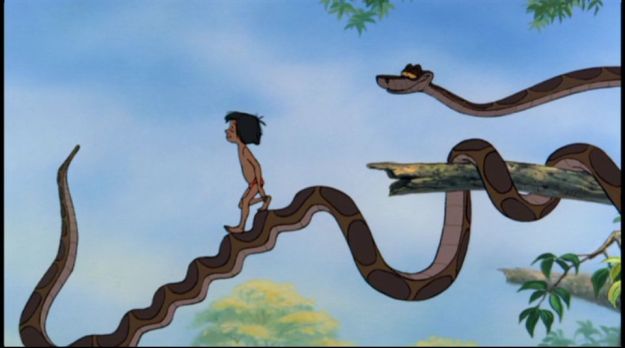
Junglebook488

Kaa assumes a wide variety of shapes throughout the song

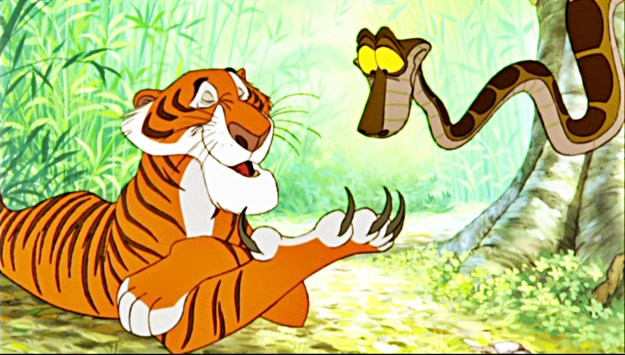
Once again though, Kaa is foiled. Just as he has Mowgli right where he wants him, who should come by but Shere Khan!! I absolutely love how the tiger pulls on Kaa’s tail like it’s a doorbell (brilliant!) If Kaa hadn’t wasted all that time playing with his “food” he might have gotten away with it.

Walt-Disney-Screencaps-Shere-Khan-Kaa-walt-disney-characters-31443684-2560-1458

I had to share this last picture by the way, those claws and the look on Kaa’s face!!

Now I haven’t seen the new version of this film yet, and I’m sure Scarlett Johansson did a great job, but for me, Kaa will always be Sterling Holloway. And that’s The Jungle Book! Let me know your thoughts in the comments below!

*all images are the property of Walt Disney Studios

Become a Patron of the blog at patreon.com/musicgamer460

Check out the YouTube channel (and consider hitting the subscribe button)

For earlier entries in The Jungle Book, see:

The Jungle Book “Colonel Hathi’s March”

The Jungle Book “The Bear Necessities”

The Jungle Book “I Wanna Be Like You”

The Jungle Book “My Own Home”

The Jungle Book “That’s What Friends Are For/The Vulture Song”

For more great Disney songs, check out the main page here: Disney A-Z

Don’t forget to like Film Music Central on Facebook 🙂


The Jungle Book “Colonel Hathi’s March” (1967)

In The Jungle Book, “Colonel” Hathi is one of those characters you can’t help but love because they’re so funny! For this version of the story, Hathi the elephant is transformed into an ex-military soldier obsessed with leading his brigade of elephants around the jungle in perfect formation. And as they march along, they sing a song, the “Colonel Hathi March.”

Of course the underlying joke here is that Colonel Hathi shouldn’t be leading at all, elephants are by nature a matriarchal society (the gag comes to a head when Winifred threatens to take over command and Hathi exclaims “WHAT! A female leading my herd???”)

Hup two three four
Keep it up, two three four
Hup two three four
Keep it up, two three four
Company, sound off!

Oh, the aim of our patrol
Is a question rather droll
For to march and drill
Over field and hill [all trumpet]
Is a military goal
Is a military goal

Hup two three four
Dress it up, two three four

By the ranks or single file
Over ev’ry jungle mile
Oh, we stamp and crush
Through the underbrush
In a military style
In a military style

As a by-the-by, the little elephant is voiced by a rather young Clint Howard (the brother to Ron Howard, the famous movie director).

This one is rather short, but then again there’s not a lot to say about this particular song. Tomorrow, the series concludes with “Trust in Me” and there will be a lot to say then.

*all images are the property of Walt Disney Studios

Become a Patron of the blog at patreon.com/musicgamer460

Check out the YouTube channel (and consider hitting the subscribe button)

For more great Disney songs, check out the main page here: Disney A-Z

For more of The Jungle Book, see also:

The Jungle Book “The Bear Necessities”

The Jungle Book “I Wanna Be Like You” (1967)

The Jungle Book “Trust in Me” (1967)

The Jungle Book “That’s What Friends Are For/The Vulture Song”

The Jungle Book “My Own Home”

Don’t forget to like Film Music Central on Facebook 🙂