Category Archives: Films

TCM Summer Under the Stars 2016: Anne Baxter as Nefretiri in The Ten Commandments (1956)

This post is part of the 2016 TCM Summer Under the Stars Blogathon hosted by Journeys in Classic Film

ANNE BAXTER

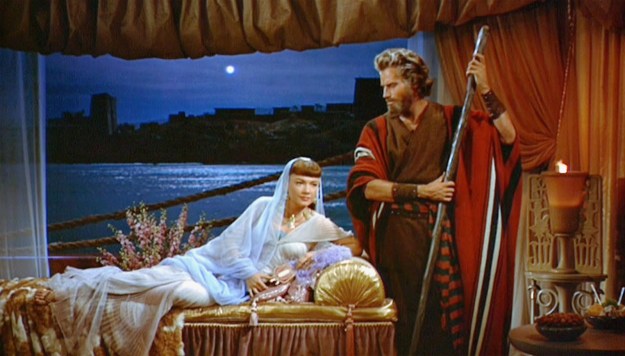
Nefretiri when we first meet her

Anne Baxter starred in many films, but the role I will always know her for is her portrayal of Nefretiri in The Ten Commandments (1956). She actually auditioned for the role of Sephora, Moses’ wife, but it was felt she was more suited to the role of the Egyptian throne princess.

Nefretiri is already head over heels in love with Prince Moses when we first meet her. As Moses is returning in triumph from yet another military victory (this time over the Ethiopians), Nefretiri feels that nothing will stop Seti, the Pharoah, from naming Moses his heir (and thus allowing the two to marry, because Nefretiri can only marry a future Pharaoh). She believes this in spite of the fact that Seti HAS a son, Rameses, and he would definitely prefer to be Pharaoh over Moses. But Nefretiri makes it clear from the start that she loves Moses, and could never love Rameses.

ten-commandments-11

Nefretiri is so beautiful and so determined to have what she wants, that she doesn’t really know when to let go. In fact, a large part of her role (especially in part 2 of the film) centers around the fact that she cannot let go of her love for Moses, not when he was outed as being a Hebrew and condemned to exile, not even after he returns to Egypt as a prophet for the Hebrew God of Israel. Even the revelation that Moses is married and a father himself doesn’t stop her. Either Moses comes to her whenever she wants, or she will make sure the Hebrews never leave Egypt.

TenCommand3_003Pyxurz

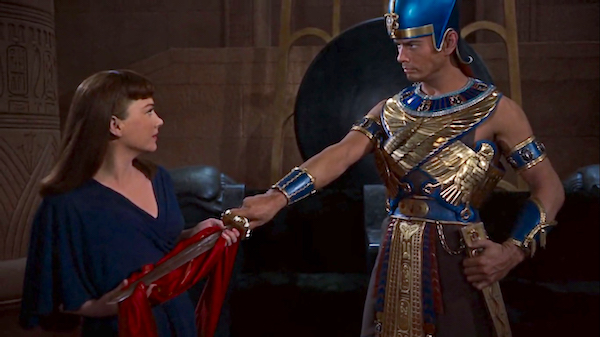
All those years later, though Moses has changed, Nefretiri has not

Nefretiri’s selfish desires prove to be her undoing, as it is her final plot to harden Rameses’s heart against letting the Hebrews go that leads to the final plague on Egypt: the death of every firstborn. Despite her pleas to Moses to stop it from happening, her son dies in her arms.


I loved watching Nefretiri growing up because of the beautiful gowns she wore. As I got older, and learned how to appreciate performances in film, I grew to love Baxter’s portrayal of Nefretiri even more, because she is something of a tragic figure, in a way. All those years living in the palace, Nefretiri is used to getting whatever she wants, whenever she wants. And if someone says no, all she has to do is smile and use her beauty, and all opposition melts away.

ten-stainedwithblood

She can never get over the fact that she had to marry Rameses instead of Moses. She wasn’t content to be Queen of Egypt either. When the opportunity presented itself, she HAD to be Moses’ again, one way or the other, even though this had now become impossible. And because of her narrow minded desire, she lost her son (who she clearly loved), her husband really hates her (he nearly killed her except he had to admit he was unable to kill Moses) and all she has left are bitter memories.

Anne Baxter used all of her skills to bring Nefretiri to life on the silver screen and it is a performance I continue to enjoy to this day. I hope you enjoyed reading about her role in The Ten Commandments. Have a good day!

Become a Patron of the blog at patreon.com/musicgamer460

*all images are the property of Paramount Pictures

Don’t forget to like Film Music Central on Facebook 🙂

John Barrymore in Beau Brummel (1924)

*This post is part of the Second Annual Barrymore Trilogy Blogathon hosted by In the Good Old Days of Classic Hollywood

beau_brummel_xlg

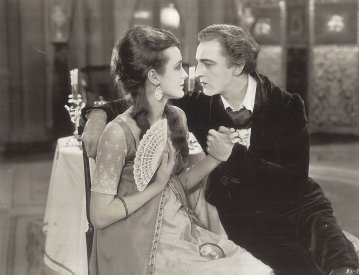
Beau Brummel is a 1924 silent film released by Warner Bros. Studios starring John Barrymore and Mary Astor. The film depicts the life of the British dandy Beau Brummell (1778-1840), an iconic figure in Regency England and at one time a friend of the Prince Regent, later King George IV. The film was a remake of a version released in 1913 and was then remade in 1954. The film’s story was based on an 1890 play written by Clyde Fitch.

As far as I know, Beau Brummel is the first silent film I ever watched. I’d grown interested in the genre after reading a history of cinema in college and was trying to find a way to watch some silent films on my own. Then I remembered that Turner Classic Movies (at that time) showed silent films late at night on the weekends. So one night I stayed up late and turned the TCM channel on and it just happened to be Beau Brummel. I was completely hooked: the music and the techniques of silent cinema were all fascinating to me. I’ve enjoyed silent films ever since.

005-john-barrymore-theredlist

John Barrymore and Mary Astor

Legendary actor John Barrymore (grandfather of Drew Barrymore) plays the title role and he played the role admirably (if not completely seriously). There’s one story that says that Barrymore and Willard Louis (who played the Prince of Wales) would tell dirty jokes instead of saying their lines, thinking that it wouldn’t matter since it was a silent film. However, they forgot to take deaf audience members into account that could read their lips and know what they were REALLY saying (oops!)

Beau Brummel (1924) -Full Film

As I said earlier, the film follows the life of Beau Brummell, who goes from being a regular soldier to one of the closest friends of the Prince Regent. This places him in the highest social circles in London and he quickly becomes THE person who decides what is fashionable. However, there’s a wrinkle. At the beginning of the story, Margaery (Mary Astor), who was in love with Beau, was forced by her family to marry Lord Alvanley. Beau decides he will seek revenge against society using his charm, wit and his good looks, and thus becomes a dandy.

john_barrymore

This all seems to work out relatively well until Beau oversteps himself and causes a tremendous quarrel with the Prince Regent, who promptly ends their friendship. Without the Prince’s support, Beau (heavily in debt from his high living) is forced to flee England and live in poverty with his one remaining servant. After Margaery’s husband dies, she comes and begs him to marry her, but an embittered Beau refuses (though he clearly loves her). When the servant attempts to make amends with the Prince Regent, who is now King George IV (behind his master’s back, so that they both could return to England), Beau dismisses him and some time later ends up in the hospital of a debtor’s prison, out of his mind with an illness and near death.

It was the ending of this film that I loved so much because it was very well done. As Beau lays dying, far away in England, Lady Margaery is also close to death. And as she dies, her youthful spirit rises from her body (using the double-exposure technique) and departs, appearing soon after in Beau’s chamber. Beau himself, seeing her spirit, dies soon afterward and their two spirits, now young again, are reunited for eternity!

I (unfortunately) haven’t seen much of John Barrymore’s work, so I can’t say for certain if Beau Brummel is among his better (or worse) performances, but I know I enjoyed it very much, so if you haven’t seen it, I recommend it.

Enjoy the Barrymore Trilogy Blogathon!!

Don’t forget to like Film Music Central on Facebook 🙂


The Fellowship of the Ring “The Treason of Isengard” (2001)

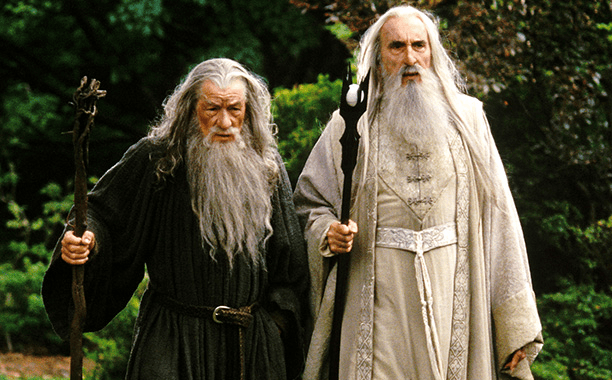
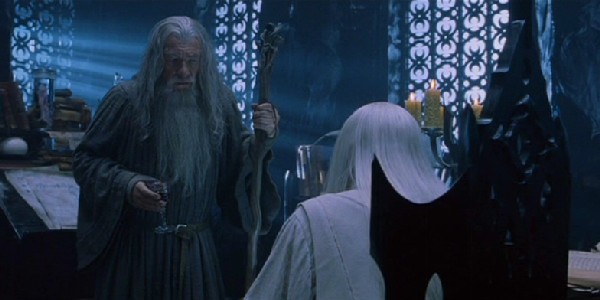
After confirming the terrible truth: that Frodo’s ring is none other than the One Ring that Sauron has been desperately seeking all these years, Gandalf rides as quick as he can to Isengard, to consult with Saruman the White (Christopher Lee), the head of the order of wizards and one who has studied Sauron and his works for several ages of history.

If there was one actor born to play Saruman, it was Christopher Lee. Years ago, he actually met and talked with Professor Tolkien himself. And according to the story I heard, Lee had Tolkien’s blessing to play Gandalf should a film adaptation ever be made and that (I think) is why he auditioned for at first for the role of Gandalf. However, Peter Jackson already had Ian McKellen in mind for the part and offered Lee the role of Saruman instead. I think it worked out just fine the way it did.

Saruman is a very complex character, one that can wear many masks. He’s had everyone believing for years that he still has the best interests of Middle Earth at heart, but in truth, he was corrupted a long time ago. The music we first hear as Gandalf rides into Isengard is already rather martial, full of trumpets and brass (perhaps a very early hint of the army Saruman is going to build and let loose in The Two Towers).

The Fellowship of the Ring “The Treason of Isengard” (Soundtrack only) (2001)

04_g_s

Now that he knows (from Gandalf) that the Ring of Power has been found, Saruman can spring his plans into motion. There has already been one big red flag: Gandalf learns that Saruman has been using the Palantir (a magical seeing stone) in the Tower of Isengard to spy on Sauron’s movements. This is very dangerous because not all of the seven Palantirs are accounted for, and when Gandalf’s hand brushing against the stone reveals an echo of Sauron, it confirms that the Dark Lord has at least one stone in his possession. But it gets worse…

The Fellowship of the Ring “Saruman the White” (Film Scene) (2001)

Saruman casually lets Gandalf know that the Nine Ringwraiths (initially known to us as the Black Riders) are on the move, and by this time have surely reached the Shire. A panicked Gandalf heads for the door, but Saruman blocks his way by commanding all the doors to shut. It then comes out that Saruman already knows of Gandalf’s plans to have Frodo take the Ring to a place of relative safety, and that he *knows* it cannot work. Just how far Saruman has fallen is demonstrated by this exchange:

“Against the power of Mordor, there can be no victory. We must join him him. We must join with Sauron, Gandalf. It would be wise, my friend.”

“Tell me, “friend,” when did Saruman the Wise abandon reason for madness??”

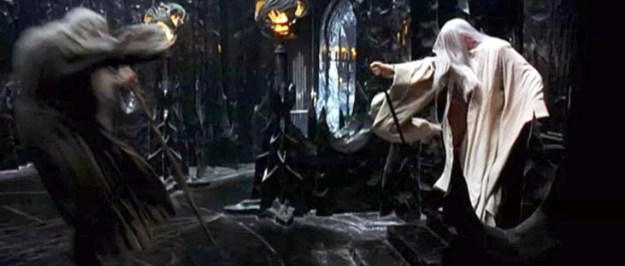
As expected, Gandalf completely rejects this despicable offer to turn traitor and join the forces of evil (did Saruman really think anything else would happen?) and the enraged wizard attacks with his magic staff. What follows is a brief battle between the two elderly wizards (a phenomenal fight considering the age of the actors at the time), but Saruman is able to wrest Gandalf’s staff away and uses both to pin the wizard to the ground. This is one scene where the music does not particularly stand out (as it does in “The Wood Elves” for instance). Rather, it functions more to highlight certain moments, like the fight between Gandalf and Saruman, or Gandalf’s initial approach to Isengard.

gandalf-vs-saruman

The music does becomes rather ominous at this point though, highlighting Gandalf’s dire situation, powerless in Saruman’s grasp:

“I gave you the chance to aid me willingly, but you have elected the way of PAIN!!”

With this, Gandalf is thrown up into the air, straight up the tower, and the music explodes upward with him. It is implied that Gandalf is being smashed against the high ceiling of the tower (given that the screen cuts to black immediately), but I suspect Saruman used a magic trick or spell to send Gandalf straight through the ceiling to the roof platform above, where we find him later.

“The Treason of Isengard” is a good introduction to Saruman the White, but this is only a preview of the larger role he will play in the next film. I hope you enjoyed it, have a great weekend!

See also: Film Soundtracks A-W

Become a patron of the blog at: patreon.com/musicgamer460

Check out the YouTube channel (and consider hitting the subscribe button)

See also:

The Fellowship of the Ring “The Shire” (2001)

The Fellowship of the Ring “Shadow of the Past” (2001)

The Fellowship of the Ring “The Wood Elves/Passing of the Elves” (2001)

The Fellowship of the Ring “A Knife in the Dark” (2001)

The Fellowship of the Ring “Flight to the Ford” (2001)

The Fellowship of the Ring “Many Meetings” (2001)

The Fellowship of the Ring “The Ring Goes South/Fellowship Main Theme” (2001)

The Fellowship of the Ring “The Bridge of Khazad-Dum” (2001)

The Fellowship of the Ring “Lothlorien” (2001)

The Fellowship of the Ring “In Dreams” (2001)

Don’t forget to like Film Music Central on Facebook  🙂

*all images are the property of New Line Cinema

The Fellowship of the Ring “The Bridge of Khazad-Dum” (2001)

“The Bridge of Khazad-Dum” begins in the depths of Moria, where the Fellowship has discovered what happened to Balin and his company of dwarves that tried to retake the former Dwarf kingdom. After repelling an attack by orcs (and one large cave troll), Gandalf hears more approaching and orders the group to run for the famed Bridge of Khazad-Dum, a bridge spanning an endless chasm (and also the only way to get out of the mines).

moria010612a

The Fellowship of the Ring “Gandalf vs Balrog” (2001)

As the group begins to run, the music is a double-timed reprise of the “Fellowship Theme” (that will be covered when I discuss “The Ring Goes South”). Despite hearing this theme that represents unity among the 9 members of the fellowship, things don’t look good right now: thousands of orcs are literally swarming out of every corner, until the group is surrounded on all sides.

I like to think of this moment as a colossal fake-out: the music has been building in tension all this time, and it seems to be building to another fight between the Fellowship and orcs. But then, just as the strings and brass build up to the highest possible point…the music drops out, replaced by a guttural roar at the far end of the corridor.

The Fellowship of the Ring “The Bridge of Khazad-Dum” (Soundtrack only) (2001)

BoFnNREIMAAIl6P

Given how the orcs are now quivering in terror themselves (not to mention running away as fast as they can), it seems the actual enemy is something else, something much, MUCH worse than mere orcs. Just how much worse can be summed up by this exchange between Boromir and Gandalf:

“What is this new devilry?”

“A Balrog. A demon of the ancient world. This foe is beyond any of you, RUN!!”

Okay, when a powerful wizard tells you to run, that’s a bad sign (because Gandalf isn’t one to just run away for no reason). This begins the second stage of “The Bridge of Khazad-Dum” as now the Fellowship must get out of the mines before the Balrog catches up to them. The Bridge itself is very close, but they still have to get over a ruined staircase, and THAT is quickly crumbling apart as the group is also being fired on by Orc archers. To help create even more tension, Howard Shore employs a Polynesian choir (introduced at the same time the Balrog is named by Gandalf). They add an almost primal feel to the moment, which is fitting because Balrogs are a very ancient type of monster, created by the first Dark Lord (Sauron was just his lieutenant).

Moria staircases

One tense moment that I love is when Frodo and Aragorn are caught on the remaining part of the stairwell just as a large boulder is pushed down (by the quickly approaching Balrog) and crashed through last remaining support, turning their part of the staircase into a free-standing pillar (that isn’t very stable). The chanting here is just amazing (sometimes I listen to this part over and over again). Thankfully, Aragorn employs a little momentum and they are reunited with the rest of the Fellowship.

Now comes stage three, the final dash for the bridge. But as Gandalf urges them on, time runs out. The massive Balrog comes soaring out of a fiery chasm, an infernal nightmare of flames and shadow (the animated Balrog from the first Lord of the Rings movie has NOTHING on this creature).

lord-of-the-rings-020

The rest of the Fellowship makes it safely across the bridge as the Balrog approaches. But Gandalf turns around in the middle of the bridge and forbids the monster from coming any closer (this is the famous “You shall not pass!” moment). The Balrog challenges the wizard, who responds by cracking down on the bridge with his staff, causing a rupture that drops the Balrog to what will presumably be his doom at the base of the mountain. But just as everyone breathes a sigh of relief, the Balrog’s flame-whip darts back up and grabs Gandalf by the legs. He tries to pull himself up, but too much damage has been done. With a last “Fly, you fools!” Gandalf is gone!!

I remember the first time I read this moment in the books, I literally shouted in horror because, in my mind, this is GANDALF we’re talking about, Gandalf can’t die, he’s a powerful wizard! This is definitely one of the biggest “shock moments” of the film.

The aftermath of this moment and the subsequent flight to Lothlorien will be covered in “Lothlorien.” I can’t wait to share something I discovered about the nature of Lothlorien’s main theme….

I have to apologize for something: though I was able to find the complete soundtrack for this part, I’m having trouble finding the corresponding film scenes for the entire sequence. For now I’ll leave you with the final section (Gandalf vs the Balrog) and as I find the rest I will upload it. Enjoy the terror and suspense of “The Bridge of Khazad-Dum.”

See also: Film Soundtracks A-W

Check out the YouTube channel (and consider hitting the subscribe button)

See also:

The Fellowship of the Ring “The Shire” (2001)

The Fellowship of the Ring “The Wood Elves/Passing of the Elves” (2001)

The Fellowship of the Ring “Flight to the Ford” (2001)

The Fellowship of the Ring “Shadow of the Past” (2001)

The Fellowship of the Ring “A Knife in the Dark” (2001)

The Fellowship of the Ring “Lothlorien” (2001)

The Fellowship of the Ring “Many Meetings” (2001)

The Fellowship of the Ring “The Treason of Isengard” (2001)

The Fellowship of the Ring “The Ring Goes South/Fellowship Main Theme” (2001)

The Fellowship of the Ring “In Dreams” (2001)

Don’t forget to like Film Music Central on Facebook 🙂

*all images are the property of New Line Cinema

The Fellowship of the Ring “The Wood Elves/Passing of the Elves” (2001)

Actually, if I’m totally honest, one of my favorite musical moments didn’t even make it into the theatrical cut of the film. “The Wood Elves/Passing of the Elves” is a brief scene that takes place during Frodo and Sam’s initial journey out of the Shire (before they meet up with Merry and Pippin). They’re making camp for the night when Frodo hears beautiful singing in the distance, and recognizes it as belonging to what he calls “wood elves.”

The Fellowship of the Ring “The Wood Elves/Passing of the Elves” (2001)

elves

Elves are my favorite fantasy race because of Tolkien (and these films)

The Fellowship of the Ring “Passing of the Elves” (Song only) (2001)

The song doesn’t even last a minute in the film, but the sound is downright haunting (as it is meant to be). The lyrics are from “A Elbereth Gilthoniel,” a song taken from the book and are in praise of one of the Valar (essentially a “god” of Middle Earth) named Varda, who is also called Elbereth by the Elves. The song has a mournful quality to it, which seems strange because all of the Elves are returning home to the Undying Lands, so you’d think it would be more happy. But I believe this moment is bittersweet (as Frodo and Sam see it) because while the Elves are going home, they’re also leaving Middle Earth, and they’re never coming back. And once the Elves are gone, the world will never quite be as ‘magical’ again.

I understand why this scene was initially cut (due to pacing and story reasons; in the theatrical cut, we go from Bilbo’s brief voice-over directly to Gandalf arriving at Isengard), but I feel the story is better with this detail re-inserted. It helps to emphasize that the time of Elves is ending (a point referenced more than once later on) and soon they will all be gone, one way or the other.

This is a little shorter piece today, but I wanted to share it because it’s so beautiful.

Become a Patron of the blog at patreon.com/musicgamer460

Check out the YouTube channel (and consider hitting the subscribe button)

See also: Film Soundtracks A-W

See Also:

The Fellowship of the Ring “The Shire” (2001)

The Fellowship of the Ring “Flight to the Ford” (2001)

The Fellowship of the Ring “Shadow of the Past” (2001)

The Fellowship of the Ring “A Knife in the Dark” (2001)

The Fellowship of the Ring “Lothlorien” (2001)

The Fellowship of the Ring “Many Meetings” (2001)

The Fellowship of the Ring “The Treason of Isengard” (2001)

The Fellowship of the Ring “The Ring Goes South/Fellowship Main Theme” (2001)

The Fellowship of the Ring “The Bridge of Khazad-Dum” (2001)

The Fellowship of the Ring “In Dreams” (2001)

Don’t forget to like Film Music Central on Facebook 🙂

*all images are the property of New Line Cinema

The Fellowship of the Ring “Flight to the Ford” (2001)

Having met up with “Strider” in Bree, Frodo and his friends had made it as far as the ancient tower of Amon Sul (also known as Weathertop). There, thanks to the thoughtlessness of those same friends, they’d been cornered by several Black Riders and Frodo had been stabbed by a Morgul blade (by none other than the Witch King of Angmar, but the hobbits won’t learn his name until the last film). It is imperative that they reach Rivendell quickly before the dark poison in the blade turns Frodo into a wraith.

The scene begins with the group making camp in the shadow of the three trolls that tried to eat Bilbo, Thorin and company in The Hobbit. Frodo is rapidly getting worse so Strider and Sam go to find some athelas to help slow the damage being done. And while doing so…Strider encounters a friend! It’s Arwen, Elrond’s daughter, who’s been out looking for them for several days. She tries to restore Frodo using her own Elven powers, but the damage is too great, only Elrond can help him now. Strider wants to be the one to ride with Frodo to Rivendell, but Arwen insists: SHE is the better rider, so she will go. Strider is clearly worried, but Arwen assures him that she has no fear of the Black Riders.

PDVD_007

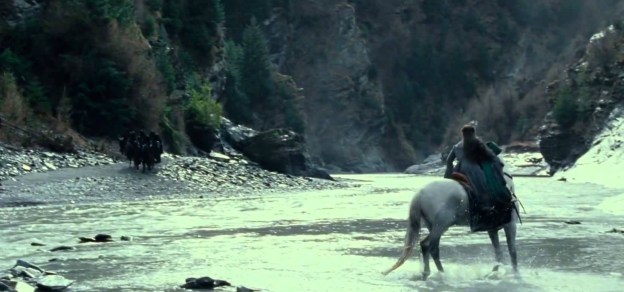
The long ride begins, and it’s here that the music really picks up and comes into play. The jump cut takes us to (presumably) the following day/afternoon where Arwen and Frodo are racing to Rivendell on the white stallion Asfaloth. The music keeps a steady beat in the background, highlighting the urgency of the moment. But then the music begins to intensify by degrees as several Black Riders become visible through the foliage, galloping along behind her. They know that this is their last chance to grab Frodo, because Rivendell is a place they can’t enter due to Elrond’s powers.


The chase is on as at least eight wraiths appear and stalk their quarry. There is a dramatic longshot of the group in a V-formation, slowly gaining ground on the lone rider in front of them. In fact, as the music echoes with themes of Mordor, one of the wraiths nearly manages to grab Frodo, but Arwen spurs her horse on and they begin a game of cat and mouse in the pine trees. Finally, with the wraiths only seconds behind them, Arwen crosses the Ford of Bruinen.

images

The wraiths won’t give up though: the leader demands that Frodo be turned over to them, to which Arwen replies “If you want him, come and claim him!” The wraiths draw their swords and advance, but it’s a trap! As they enter the river, Arwen begins a magical incantation that sparks a flood far upstream. The roaring flood is moving so fast that the riders have no time to escape before the floodwaters (in the shape of galloping horses) overtake them and send them far downriver (we’re led to believe they’re destroyed, but this will be proven otherwise in the next film).

Victory for the heroes! Frodo is safe…or is he? Just as all seems won, Frodo appears to succumb to his injuries at last and Arwen is moved to tears by his condition (it is here that she prays for Frodo to be allowed to journey across the sea in her place, even now she can see that that’s the only way Frodo will ever truly recover from this). Frodo is taken into Rivendell and after several days, he wakes up. He’s surprised to find Gandalf there with him, but that story will have to be picked up in “Many Meetings.”

“Flight to the Ford” is one of those soundtrack pieces that I love to listen to simply for its own sake. It’s full of tension, suspense, you can literally follow the chase simply by hearing the music. I love this scene so much, it’s actually a minor pet peeve of mine if someone starts talking during this scene, because I’m thinking “why aren’t you paying attention to this awesome moment??”

As far as Arwen being the rider that takes Frodo to Rivendell, I’m personally okay with that, even though I know the Arwen in the book does no such thing. I just wish they’d followed through with making her this badass Elven warrior/rider, instead of backtracking in the following films and removing her from the fighting (I do know that Arwen was supposed to sneak off to Helm’s Deep, but that was deemed one subplot too many and the scene was cut).

What do you think of “Flight to the Ford” ? Is it one of your favorite Lord of the Rings moments? Let me know what you think in the comments below 🙂

See also: Film Soundtracks A-W

You can become a patron of the blog at patreon.com/musicgamer460

Check out the YouTube channel (and consider hitting the subscribe button)

See also:

The Fellowship of the Ring “The Shire” (2001)

The Fellowship of the Ring “Shadow of the Past” (2001)

The Fellowship of the Ring “The Wood Elves/Passing of the Elves” (2001)

The Fellowship of the Ring “A Knife in the Dark” (2001)

The Fellowship of the Ring “The Treason of Isengard” (2001)

The Fellowship of the Ring “Lothlorien” (2001)

The Fellowship of the Ring “Many Meetings” (2001)

The Fellowship of the Ring “The Ring Goes South/Fellowship Main Theme” (2001)

The Fellowship of the Ring “The Bridge of Khazad-Dum” (2001)

The Fellowship of the Ring “In Dreams” (2001)

Don’t forget to like Film Music Central on Facebook 🙂

*all images are the property of New Line Cinema

The Fellowship of the Ring “The Shire” (2001)

Fellowship of the Ring “Concerning Hobbits” (Film Scene) (2001)

There are dozens of musical themes in The Lord of the Rings film trilogy, but very few are quite so dear to me as “The Shire,” one of the earliest themes we hear in The Fellowship of the Ring.

After the Prologue establishes how the story came to this point, we meet Frodo Baggins (Elijah Wood), who has been waiting for Gandalf (Ian McKellan) to arrive. Today is Bilbo Baggins’ 111th birthday and most of the Shire has been invited (with the rest turning up anyway).


Fellowship of the Ring- “The Shire” (Film Scene) (2001)

Most of this scene is a conversation between Frodo and Gandalf, talking about Bilbo’s party, how the reputation of the Baggins family never recovered after the “incident with the dragon” in which Gandalf was “barely involved”, and also how Bilbo has been acting more odd than usual in recent weeks.

Fellowship of the Ring “Concerning Hobbits/The Shire” (Soundtrack) (2001)

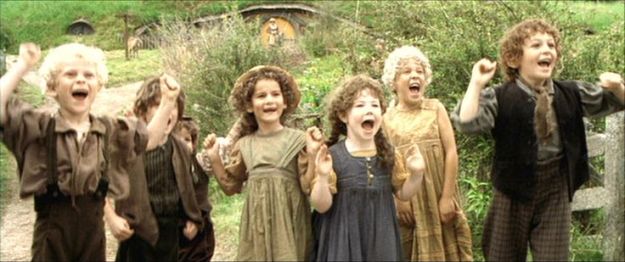
There’s a brief cut-scene here which shows Bilbo frantically searching Bag End for something (revealed to be the Ring, which had been sitting safe in Bilbo’s pocket the entire time). There is also a lovely moment when the Hobbit children come running up to Gandalf’s cart and beg for some fireworks. And just as they think they won’t get any, a small flurry of fireworks comes out of Gandalf’s cart, to the delight of the children.

4b3d3a6cddea830c04bb9716e122866f

A lot of the finer details of this theme are lost in the dialogue and rumble of Gandalf’s cart, so I’ll highlight some of my favorite parts:

  1. Underlying most of the theme (Before the well-known flute solo) is what sounds like a harpsichord, a keyboard instrument that plucks the strings instead of beating them with a hammer (like a piano does). There is an inherent rustic quality to a harpsichord that puts one in mind of the countryside and is a perfect instrument for describing the Shire musically.
  2. As Bilbo describes the different qualities of Hobbits, the music takes a rather quirky turn, with short bursts from the flutes and strings. This symbolizes both Bilbo’s good humor in describing his fellow Hobbits and the general innocence of the Shire’s residents.
  3. The music takes a more soothing turn as Bilbo describes what Hobbits really love (and it’s not food): peace, quiet and good-tilled earth. The strings really take over here, with the harpsichord fading back.
  4. Lastly (and this is the part most people love best), after Frodo jumps off the cart, we hear the enchanting flute solo as Gandalf rides his cart up to the gate of Bag End. Though the entire piece symbolizes the Shire, it is this flute solo that really encapsulates the peacefulness that exists here. This is what everyone imagines the countryside to be like, and if the Shire really existed, people would go there and never come back.

I love watching this scene, it always makes me smile, no matter how bad a mood I’m in at first. Howard Shore does a great job of using the music complement the scene and it just sounds amazing. I hope you enjoy listening to “Concerning Hobbits/The Shire.”

See also: Film Soundtracks A-W

You can become a patron of the blog at patreon.com/musicgamer460

Check out the YouTube channel (and consider hitting the subscribe button)

See also:

The Fellowship of the Ring “Shadow of the Past” (2001)

The Fellowship of the Ring “The Ring Goes South/Fellowship Main Theme” (2001)

The Fellowship of the Ring “Many Meetings” (2001)

The Fellowship of the Ring “A Knife in the Dark” (2001)

The Fellowship of the Ring “Lothlorien” (2001)

The Fellowship of the Ring “The Treason of Isengard” (2001)

The Fellowship of the Ring “The Wood Elves/Passing of the Elves” (2001)

The Fellowship of the Ring “The Bridge of Khazad-Dum” (2001)

The Fellowship of the Ring “Flight to the Ford” (2001)

The Fellowship of the Ring “In Dreams” (2001)

Don’t forget to Like Film Music Central on Facebook  🙂

*all images are the property of New Line Cinema

Random Thoughts on High-Rise (2015)

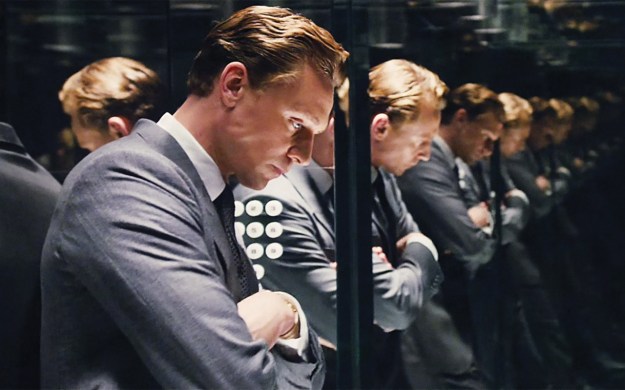
After waiting months and months, I finally got to watch Ben Wheatley’s High-Rise on Friday night. Starring Tom Hiddleston, the film centers around life in a brand new 40 story high-rise building (the first of a planned 5) located on the outskirts of London. The newest resident of the high-rise is Dr. Robert Laing (Hiddleston), a doctor specializing in physiology, with no family (it’s mentioned that his sister has recently died). Moving into Apartment 2505, Laing is over halfway up in the social order that exists in the building. He’s much higher than the families that live on the lowest floors, but not quite high enough to be “good enough” for the rich snobs that inhabit the very highest floors. On the floor above him lives single mother Charlotte and her smarter-than-average son Tobey (very unusual, since “proper” families all live on the lower floors). Laing also makes the acquaintance of filmmaker Richard Wilder (Luke Evans) and his heavily pregnant wife Helen. Floor 40, the penthouse, is inhabited by Anthony Royal (Jeremy Irons), the architect of the building, and his incredibly snobby wife (who has turned the roof into a fantastical country garden complete with a sheep, a horse and lots of trees).

2016_11_high_rise

This is one of my favorite images in the film

From the beginning, things seem “off” about the building (and Laing himself, if I’m honest). He openly admits at a party that he’s not very good at “this sort of thing” and seems to prefer keeping to himself. Though the building is brand new, nothing seems to work properly very long. The lights begin to flicker in the supermarket, and the food is seen to be going bad very quickly (with no one bothering to replace it). The trash disposal system doesn’t work very well either, with bags of refuse quickly piling up.

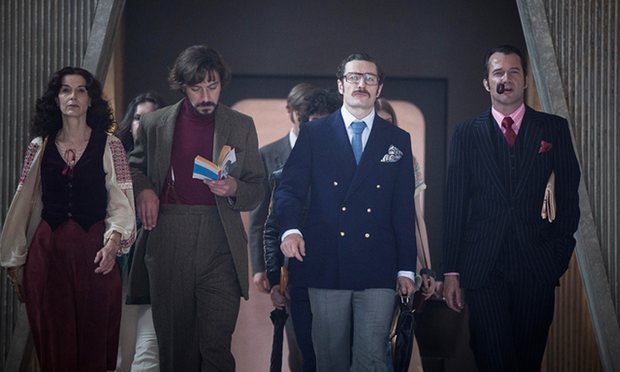
The building is meant to be a self-contained world in and of itself: there’s a school, a swimming pool, supermarket, squash court, every luxury imaginable. As mentioned before, the rich live on the upper floors, and residents become increasingly poorer the lower the floor becomes (even though everyone (according to Wilder) pays the same rates to stay in the building). Tensions are already thick between rich and poor when Laing moves in, and the disparity between the two is obvious as can be seen with two parties. The first, held in Charlotte’s apartment, is a relatively “normal” party with loud music, lots of drinking (implied sex) and casual “getting to know you” things. Then there’s a party given by Royal’s wife (Laing is invited by Royal) which turns out to be an 18th century costume party complete with a string quartet. Laing (who is unaware of it being a costume party and showing up in normal clothes) is unceremoniously thrown out and humiliated, especially by Munrow, a fellow colleague at the school they work at. Determined to get revenge, Laing lies and tells Munrow that a brain scan has revealed a mass in his brain (even though the scan is perfectly normal). Distraught, Munrow later commits suicide by jumping from the 39th floor and Laing is deeply guilt-ridden as a result.

5113

To think it all started so well…

From that point on, things get….weird (that’s the only word I have for it). How things go from tension-filled normal to post-apocalyptic, I’m still not quite sure, but what I do know is it happens very quickly (the film only covers a three month period of time). Events devolve into a class war between the rich (huddled in the penthouse) and the poor (the lower floors of the building). Most of the women end up joining a “harem” in the penthouse. The utilities (power, water, etc.) eventually stop working (the swimming pool is briefly seen as a place to wash clothes), and a lot of residents wind up dead. Laing spends a great deal of time holed up inside his apartment, having apparently lost whatever remained of his sanity. I think that because he spends so much time locked away from the fighting, this is partially what allows him to move so freely between the “rebels” on the lower floors and the rich up top.

One big secret comes out towards the end of the film: Tobey is actually the son of Anthony Royal because of an affair he had with Charlotte some years back. Royal himself ends up shot dead by Richard Wilder (who is in turn killed by the “harem” of women). By the end of the film, a weird sort of “normal” has taken over what remains of the building. The women have established order from the penthouse and Laing is content to wait with Charlotte until the same thing happens to the next completed high-rise tower (in which event he will be happy to welcome them to the “new world.”)

I think I would have understood the film a little better if I’d been able to read the source novel beforehand (I’d still like to read it at some point). Even though parts of the film were weird and slightly confusing, that didn’t stop me from enjoying the story. I loved the 70s vibe of the film (the original novel is set in the 1970s) and the look of the building was just wonderful.

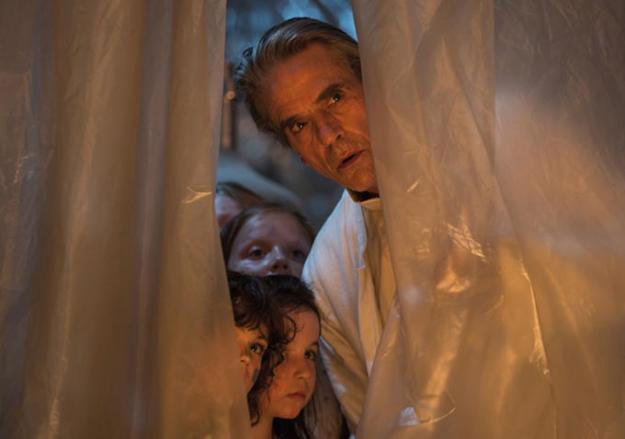
Everyone seemed well-cast, particularly Jeremy Irons as Anthony Royal. He’s so good at playing the “elder statesman” sort of role, and I enjoyed any scene he appeared in. Hiddleston….was good for the most part…but a few of the “awkward” scenes were almost too awkward, if that makes sense. I think Hiddleston might have been trying too hard at times. Luke Evans was believable as hot-headed Richard Wilder. His devolution into an enraged maniac is somewhat frightening (especially before a particular scene involving Charlotte) and a good example of what can happen to the “everyman” when they’re pushed too far.

download

Jeremy Irons is magnificent as always

I wish some of the characters had been more fleshed out. Many of the “rich” characters sort of blended together in my mind and I didn’t know much of anything about them (even the “famous actress” character became unrecognizable by the end of the film, I didn’t realize it was her until she said a line about giving her autograph). As for James Purefoy’s character, I’m pretty sure I couldn’t tell you his name, even though I know it was mentioned at least once.

These problems aside, I still enjoyed High-Rise very much and would happily watch it again.

See also: Film/TV Reviews

Check out the YouTube channel (and consider hitting the subscribe button)

Don’t forget to like Film Music Central on Facebook

*all images are the property of StudioCanal

Mulan “I’ve Heard a Great Deal About You Fa Mulan…” (1998)

So now we come to the conclusion of Mulan, hope everyone has enjoyed the ride! On to the finale!

First of all, there’s the good news: Mulan survives her injuries. The really bad news? In the course of saving her life, the doctor discovers what we’ve known all along: that “Ping” isn’t a man at all, he’s a girl!! Shang is in disbelief, but even he can’t deny the physical evidence. Chi-Fu (who has disliked “Ping” from the start) is enraged and begins howling about “high treason” and “ultimate dishonor” while Mulan attempts to explain that she only did what she did to save her father’s life.

Screen Shot 2013-06-23 at 1.51.35 PM

Things are pretty grim. By law, Mulan should die for what she has done, and as Shang comes forward with Mulan’s sword, it looks like that’s exactly what’s going to happen. However…Shang also can’t deny that Mulan did save his life. Therefore he spares Mulan’s life in return and orders the company to move out towards the Imperial City, leaving a devastated Mulan behind. Mulan and Mushu have a heart-to-heart about their motives, and Mushu finally confesses that he didn’t come on the orders of Mulan’s ancestors, but at least Mulan had good intentions with what she did. The two promise that whatever happens, they’ll get through it together. Which is good, because as it turns out, the adventure isn’t over just yet….as Shan Yu’s falcon flies over the carnage left by the avalanche, a giant hand breaks out of the snow: Shan Yu is still alive!! And he’s not alone, he has almost a dozen warriors who survived the avalanche and the only one who knows they’re headed for the Imperial City is Mulan!!!!

tumblr_inline_nmxfui6e2w1sk742m_540

Meanwhile, down in the city, Shang and his men are being treated to a hero’s welcome. But the only one enjoying the attention is Chi-Fu, the others are downcast because they know THEY didn’t win anything, it was Mulan who earned the victory. And speaking of, Mulan rides up and tries to tell Shang about the Huns, but now that Mulan is openly a woman again, Shang won’t listen to her (even though she’d earned his trust as “Ping” several hours ago). The parade winds its way to the Imperial Palace where the Emperor himself stands waiting to receive Shan Yu’s sword. As Shang climbs the palace steps, a great Chinese dragon follows, seeming to crouch down as the procession reaches a stop (that should’ve been the first red flag).

Ciudad_Imperial

Down in the crowd, Mulan tries to warn everyone about the danger, but again, because she’s a woman, no one listens. But soon everyone is going to believe her, because just as Shang hands the sword over, the falcon sweeps in and snatches it away, flying up to where Shan Yu has been hiding on the palace roof!!! I love the music in this short moment. The strings tremble in anticipation because we know what’s about to happen: out of nowhere, Shan Yu’s arm snaps out and he grabs the sword, a devilish grin on his face. A lot of things then happen very quickly: the rest of the Huns leap out of the dragon, knock Shang down and take the Emperor captive!!
Disguised-as-Women-yao-ling-and-chien-po-24835950-780-440

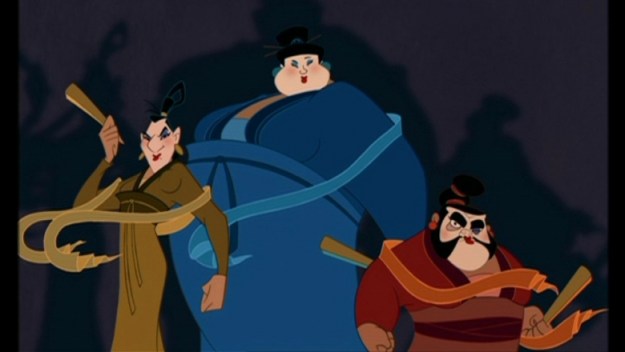
Yao: Does this dress make me look fat?

Time for Mulan to spring into action: while Shang’s men (futilely) try to batter the doors of the palace down with a large statue, Mulan realizes that there’s a better way to get inside. For the plan to work, Ling, Yao and Chien-Po must dress as women (to pass themselves off as royal concubines) and the quintet climb up into the palace using the pole-climbing technique that they learned in training. At the same time, up on the palace balcony, Shan Yu confronts the Emperor: the Hun leader believes he’s won, and he wants the Emperor to bow to him. Outside, the plan is working, Shan Yu’s men are fooled by the disguise just long enough to be taken out while Shang runs to rescue the Emperor.

With Chien-Po safely taking the Emperor away, the fight is briefly between Shang and Shan Yu, but the former is hopelessly outmatched by the furious Hun. Mulan (who is definitely in love with Shang) distracts Shan Yu and reveals that it was SHE who defeated him in the mountains (pulling back her hair to briefly resemble Ping). Enraged, Shan Yu gives chase and Mulan literally runs for her life, as the Hun will kill her if he catches her. While running, she notices a tower full of fireworks on the opposite side of the roof and briefly tells Mushu her improvised plan. The chase makes its way to the roof and before long Mulan is cornered by a vicious Shan Yu, who believes that Mulan is finally “out of ideas.”

Mulan-disneyscreencaps.com-8846

The technique of using a fan to wrench the sword away is a real martial arts technique

As it turns out, Mulan has one last trick up her sleeve: at the opposite end of the roof, Mushu is ready with the world’s largest fireworks rocket strapped to his back. Mulan uses Shan Yu’s own sword to pin him to the roof as the rocket races towards him, sending him flying into the rest of the fireworks as they all explode!! Mulan saves herself with a flying leap and crash lands onto Shang. The Emperor is saved, China is saved!! But Chi-Fu (naturally) is in a fury because Mulan got involved. But before Shang can finally give the snobby adviser a punch in the nose, the Emperor himself appears and wants to speak with Mulan.

At first it seems like the Emperor is berating Mulan by listing everything she’s done: running away from home, impersonating a soldier, deceiving everyone, destroying a sizable portion of the palace AND…saving everyone. As thanks, the Emperor bows (ever so slightly) to Mulan, prompting everyone in the square to fully bow as well (since no one stands higher than the Emperor). It’s one of the highest honors someone in China can receive, and that’s not all. The Emperor would like to give Mulan Chi-Fu’s job (which causes him to faint), but Mulan decides that she’s been away from home long enough, so she’s given Shan Yu’s sword and the Emperor’s personal crest as reminders of what she did for China. After Mulan leaves, the Emperor has a few words for Shang:

disney_quotes_mulan_shang_emperor

“The Flower that blooms in adversity, is the most rare and beautiful of all.” When Shang doesn’t get it, the Emperor gets blunt “You don’t meet a girl like THAT every dynasty!” (translation: go after her and marry her you idiot!)

Back home, Mulan’s father is watching the cherry blossoms fall, and he clearly misses his daughter very much. So when Mulan comes into the garden, loaded with gifts from the Emperor, he’s very much surprised! But her father doesn’t really care about honor, all he knows right now is that his daughter is home and he’s missed her very much. As it turns out, Shang DID follow Mulan home and is invited to stay for dinner by a pleased Mulan. And back in the ancestral temple, the Great Ancestor grudgingly lets Mushu be a guardian of the family again, much to Mushu’s delight. All is well, and as the saying goes: they all lived happily ever after!

Wow, I had a lot of fun working on Mulan, thanks for all your comments and likes, you guys are the best!

Become a Patron of the blog at patreon.com/musicgamer460

Check out the YouTube channel (and consider hitting the subscribe button)

For the rest of the Mulan series:

Mulan “Honor to Us All” (1998)

Mulan “Reflection” (1998)

Mulan “Mulan’s Decision” (1998)

Mulan “I’ll Make a Man Out of You” (1998)

Mulan “A Girl Worth Fighting For” (1998)

Mulan “The Huns Attack” (1998)

And for even more great Disney songs and films, check out the main page here: Disney Films & Soundtracks A-Z

Don’t forget to like Film Music Central on Facebook 🙂

*all images are the property of Walt Disney Studios