Category Archives: Films

Film Music 101: Dubbing

David-Prowse-as-Darth-Vader-in-Star-Wars-Episode-IV

Imagine Darth Vader with a thick Welsh accent…

In the world of films and film music, dubbing is the process whereby a new soundtrack is added to an already completed film. This could mean adding dialogue, sound effects or music.

Dialogue might have to be dubbed in if the original recording was deemed unsuitable. Most (in)famously, David Prowse’s performance as Darth Vader was dubbed over by James Earl Jones (allegedly without Prowse’s knowledge, though this has been disputed).
Sound effects can be dubbed in to create a desired mood in a particular scene. Screwball comedies often did this by dubbing in slapstick sound effects to emphasize comedic falls or double takes.

Music, both diegetic and non-diegetic, might have to be dubbed in if the original recording was damaged in some way or the director becomes unsatisfied with the initial result. For example, say a movie originally features a certain diegetic song playing on the radio. If the director changes their mind and wants a different song, the editors would go back and dub in a new song, so that the audience would never be able to tell that a new song was added in.

Become a Patron of the blog at patreon.com/musicgamer460

See also:

Film Music 101: Diegetic vs. Non-Diegetic Music

Film Music 101: Underscore

Film Music 101: Sidelining

Film Music 101: “Test” Lyrics

Film Music 101: The First Film Score

Film Music 101: Borrowing

Film Music 101: Arranger

Film Music 101: Anempathetic sound

Film Music 101: Empathetic Sound

Film Music 101: Foley

Film Music 101: Montage

Film Music 101: Compilation Score

Film Music 101: Leitmotif

Film Music 101: Orchestration and cues

Film Music 101: “Stinger” Chords

Don’t forget to like Film Music Central on Facebook 🙂

Gottfried Huppertz: The composer behind Metropolis

In the world of silent film, Metropolis is rightfully considered a masterwork. Released in 1927 by UFA, the film was directed by Fritz Lang and told the story of a great city called Metropolis, set in the distant year 2000. The film is notable for containing the earliest intact appearance of a robot on the silver screen (an earlier example from L’uomo meccanico (1921) does exist, but only in a 21 minute fragment.)

loozxtwoohktxqxovfhu

The “Machine Man” was invented by Rotwang (on the right) as a secret means to overthrow Joh Fredersen (on the far left).

The score for this amazing film was composed by Gottfried Huppertz, a composer who wrote the music for several of Fritz Lang’s films.

1918

Huppertz was born in Koln, Germany on March 11, 1887. His first composition was published in 1905 and the composer worked as an opera singer during the first World War. In 1922 while in Berlin, Huppertz met Thea von Harbou, a close friend of Fritz Lang, and the two became introduced. Huppertz first composed a score for Lang’s film Die Nibelungen (1924).

Metro

Huppertz on the set of Metropolis

The score for Metropolis, written and recorded in 1926, is seen today as Huppertz’s greatest work. During the filming process, Huppertz would actually visit the set and play music to help set the mood for a scene (this was very unusual at the time). At the film’s premiere, the score was performed by a 66 piece orchestra, and was very well received. Though the film was heavily cut shortly thereafter, with major chunks lost for decades (a situation that would not be resolved until 2010), Huppertz’s full score has always been available and has remained an invaluable source for outlining the pieces of the film that remain missing.

You can find a suite arrangement of Huppertz’s score here: Metropolis: Soundtrack Suite

After Metropolis, Huppertz continued to write film music, even composing for several sound films: Der Judas von Tirol (1933), Elisabeth und der Narr (1933), Hanneles Himmelfahrt (1934) and Le Domino Vert (1935).

The composer died of a heart attack on February 7, 1937 and became forgotten for over forty years, until Metropolis and Die Nibelungen came back to the attention of the cinematic and musical world.

Become a Patron of the blog at patreon.com/musicgamer460

Check out the YouTube channel (and consider hitting the subscribe button)

Don’t forget to like Film Music Central on Facebook 🙂

Film Music 101: Leitmotif

In film music (and classical music, especially opera), a leitmotif is “a short, constantly recurring musical phrase, that is associated with a particular person, place, or idea.”

The most famous user of leitmotif in 21st century Hollywood would have to be composer John Williams in the seven Star Wars scores (1977-ongoing)

(for more on the leitmotifs of Star Wars see: The Empire Strikes Back or, Everyone has a Theme! Part One: Leitmotif and “The Imperial March” and The Empire Strikes Back Part Two!: Han and Leia in Love and Yoda!! )

Leitmotifs can be found in many films, for example, in the Star Trek franchise there is a popular theme known as the “Enterprise motif,” this is the fanfare of rising fourths that occurs almost every time the Enterprise appears on the screen (this is especially true in the original series and in the Next Generation films).

The concept of leitmotif (which roughly translates to “leading motive”) predates the creation of film by several decades and is closely associated with the late-Romantic composer Richard Wagner (though Wagner did NOT invent the concept himself as some have claimed)

RichardWagner

Wagner’s operatic music had a HUGE influence on modern film music

In Wagner’s famous cycle of operas known as Der Ring des Nibelungen (The Ring of the Nibelungs, aka “The Ring Cycle”), Wagner created an entire series of leitmotifs to represent specific characters or themes in the story.

For example, the hero Siegfried is represented by a leitmotif known as “Siegfried’s Horn Call,” seen here below:

Siegfried_leitmotif

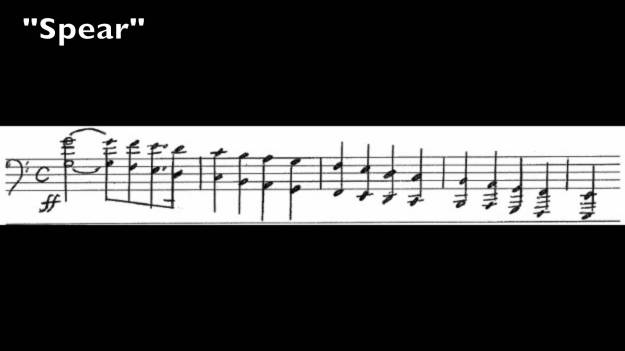
Another important motif represents the god Wotan’s spear:

maxresdefault

Other motifs represent: Fire, The Rhine, The Ring, and Sleep

Whatever the context, leitmotifs are an integral part of a film score (when they are used), and they provide an interesting connection to the world of 19th century opera.

Don’t forget to like Film Music Central on Facebook 🙂

Become a Patron of the blog at patreon.com/musicgamer460

Check out the YouTube channel (and consider hitting the subscribe button)

See also:

Film Music 101: “Stinger” Chords

Film Music 101: Dubbing

Film Music 101: Diegetic vs. Non-Diegetic Music

Film Music 101: Underscore

Film Music 101: Sidelining

Film Music 101: “Test” Lyrics

Film Music 101: The First Film Score

Film Music 101: Borrowing

Film Music 101: Arranger

Film Music 101: Anempathetic sound

Film Music 101: Empathetic Sound

Film Music 101: Foley

Film Music 101: Montage

Film Music 101: Compilation Score

Star Trek II “Surprise Attack”

I have something of an obsession with the music of Star Trek and James Horner’s score for The Wrath of Khan is one of my all time favorites.

“Surprise Attack” comes in Act II of the film, when the Enterprise is en route to space station Regula One to find out why someone is trying to usurp the Genesis Project from Dr. Carol Marcus (who happens to be a former love interest of Admiral Kirk). Unbeknownst to our heroes, the villain Khan (first introduced in the original episode “Space Seed” (1967)) has hijacked the starship Reliant and is on an intercept course to have his vengeance on Kirk for stranding him and his crew on the planet Ceti Alpha V over fifteen years ago.

You can listen to the soundtrack here: “Surprise Attack” Soundtrack Version

The film version can be found here: “Surprise Attack” Film Version

star-trek9

Khan and Kirk in their first meeting

The cue begins in the film when Kirk is informed that the Reliant is approaching their position. The music begins with a menacing horn tone that slowly builds in volume and intensity until it cuts off in a percussion burst.This repeats several times, growing faster until the camera cuts to a shot of Reliant approaching and Khan’s theme is heard for the first time.

USS_Reliant

Reliant is coming…

Composer James Horner stated that he wrote Khan’s theme to be a reflection of his increasingly unstable mind. That is why the theme (beginning at 0:20 in the soundtrack version) is full of quickly trilling horns and woodwinds: Khan is so hellbent on revenge that it is literally driving him mad.

Meanwhile, going back to the Enterprise, the crew still has no idea they’re about to be ambushed. And from this point on, Horner begins a musical back-and-forth where the music quickly switches from the Enterprise theme to Khan’s theme and each time Khan’s theme builds a little more until a sequence begins that I like to call “the final countdown.”

Beginning at the section where Khan orders his crew to lock phasers on target (2:11 in the soundtrack version), the music begins a very slow build, starting very soft but gradually growing louder and more frantic as the crew of the Enterprise realizes, a moment too late, that they are about to be attacked. Once the attack starts, something very interesting happens. In the film, the first attack is full of the sounds of explosions, yelling and other sound effects. But in the soundtrack version of this cue, it comes out that Horner has created what can only be described as “musical chaos,” which is perfectly fitting for the mayhem that follows (musical chaos begins at 2:28).

khan12

Khan might just succeed in his dastardly plan!!!

The music violently shifts back to Khan’s theme as the Reliant circles around for another attack. Caught off guard with a crew filled with cadets, the Enterprise doesn’t really stand a chance (especially since Khan knows all the vital areas of the ship from the last time he was there.)

Disarmed and stunned (Scotty informs Kirk that the phasers only have power for “a few short bursts”), everyone is shocked when the commander of the Reliant sends a message asking them to surrender (4:29) The strange “twang” sound heard at that moment comes from an electronic instrument called a Blaster Beam, a 12-18 foot long metal beam strung with several metallic wires. The music dies away as Khan finally reveals himself to Kirk.

I hope you enjoyed this look into the score of The Wrath of Khan!

See also:

 Film Soundtracks A-W

Star Trek II: “Inside Regula I” (1982)

Become a Patron of the blog at patreon.com/musicgamer460

Check out the YouTube channel (and consider hitting the subscribe button)

Don’t forget to like Film Music Central on Facebook 🙂



Pentatonic Music in Film and Cartoons: A look at musical stereotype

It is a sad and frequently overlooked truth that Hollywood is brutally guilty of portraying overtly racist behavior both on and off the silver screen. This includes the film music, as well as the films themselves. While musical stereotyping exists (and continues to exist) on several levels, today I will focus on two examples from one particular area: the use of the pentatonic scale to distinguish Asian characters.

The pentatonic scale is also known as the five-tone scale, because unlike the Western scale, which uses seven notes, the pentatonic scale only uses five (penta- means five, think pentagon, pentagram, etc.).

C_major_pentatonic_scale

This is the major pentatonic scale starting on C and it reads: C D E G A

To create the minor pentatonic scale, take the A and move it to the first position, so: A C D E G

A classic example of using the pentatonic scale to denote an Asian character comes in the 1955 Disney film Lady and the Tramp. The scene in question is when Lady is introduced to Aunt Sarah’s Siamese cats (named Si and Am).

Lady-and-the-Tramp-disneys-lady-and-the-tramp-9614616-720-480

As Lady walks by the basket, before seeing the cats, the music plucks out a descending pentatonic scale, which hints at the cats’ origin even before their song begins.

A live-action example can be heard in the first James Bond film Dr. No (1963). The titular character is the first villain Bond encounters. Dr. No claims to be the child of “a German missionary and a Chinese girl of good family.” Because he is half-Chinese (and most of his workers are seen to be Asian), Dr. No’s theme is delivered with a pentatonic sound. Actually, a hint of the theme appears long before the character himself. At the very beginning of the film when Dr. No’s assassin’s are removing the body of Cmdr. Strangways’ secretary; one of the killers is seen rifling through a file drawer and pulling out two files: one reads Crab Key and the other says Dr. No. When the second file plops down on the cabinet, there is a harsh upward pentatonic scale, alluding to the character’s Asian origin.

dr-no-james-bond-joseph-wiseman-sean-connery-ursula-andress-honey-ryder-spectre-movie-review-1962

The first Bond villain: Dr. Julius No

When Dr. No finally does appear (after Bond and Honey have been captured), the theme returns as the audience sees Dr. No’s feet walking in to take a look at Bond in person.

There is so much more to say on this topic, but I wanted to provide a short look for now.

Become a patron of the blog at: patreon.com/musicgamer460

Don’t forget to like Film Music Central on Facebook 🙂

Film Music 101: The First Film Score

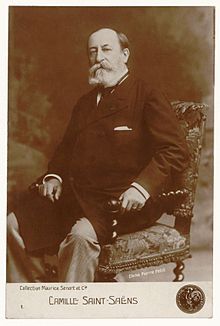
Camille_Saint-Saëns_in_1900_by_Pierre_Petit

Now when I say the “First” film score, I really mean the first “original” film score. Silent films had been given musical accompaniment from the very beginning, from simple tunes played on the piano, to full length arrangements of various classical works (which is in itself a huge topic of discussion, but I digress). An original film score then, is a score that was composed for a specific film, and not taken from a pre-existing source. The first score to meet this criteria was the score for La mort du duc de Guise/The Assassination of the Duke of Guise, released in 1908 and composed by the great French composer Camille Saint-Saens (1835-1921).

Saint-Saens was 73 years old when he composed this score, as he already possessed great experience in composing music for the theatre. While details on the exact process Saint-Saens used to compose the score are few and far between, his biographer Bonnerot stated that Saint-Saens wrote the music “scene by scene before the screen” and this is why the score took so long to write. Assuming this is accurate, it sounds like Saint-Saens used a process rather like the one modern film composers use. In modern cinema, film composers still to this day will write and record the music while the appropriate scenes are playing on a large screen.

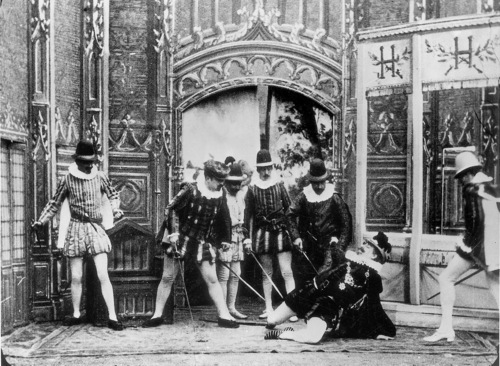
L'Assassinat_du_Duc_de_Guise

A still image from the film: The Duke is being murdered

The film itself was considered rather long for its day (at an astounding fifteen minutes in length) and tells the story of the day in 1588 when King Henri III summons his rival the Duke of Guise to his chambers and has him brutally murdered.

If you wish to view the film, it has long since fallen into the public domain and is readily available online. As you listen and watch the film, note how the music plays unceasingly. This is an example of “wall-to wall” music, where the score continuously plays from beginning to end. Silent films originally took up this practice to cover up the sound of the film projector, and the habit was so ingrained by the dawn of sound film that (after the process of sound film was perfected), wall-to-wall scoring returned during the Golden era of Hollywood cinema in the 1930s through the early 1950s.

You can become a patron of the blog at patreon.com/musicgamer460

For more Film Music 101, see here

Don’t forget to like Film Music Central on Facebook 🙂


The Empire Strikes Back or, Everyone has a Theme! Part One: Leitmotif and “The Imperial March”

Empire_strikes_back_old

The Empire Strikes Back
Released: May 21, 1980
Director: Irvin Kershner
Music by: John Williams
*All music is the property of Lucasfilm

The Empire Strikes Back is considered by many to be the greatest movie of the original Star Wars trilogy and it’s no wonder. The film contains battles both on land (Hoth) and in space (the Millennium Falcon vs. Star Destroyers), a terrifying villain (Darth Vader), moments of comedy (C3PO) and one of the biggest twists in the history of film. It also features a gorgeous score composed and conducted by John Williams, a film composer who has been working in Hollywood since the 1950s and is solely responsible for some of the greatest film scores of all time.


For his work on The Empire Strikes Back, Williams began with the musical themes he had established for the original Star Wars and used it as a starting point for the sequel. Two themes were already set in stone:

Luke’s Theme/The Force

Leia’s Theme

As the role of Darth Vader was being greatly expanded from his first appearance, Williams concluded that Vader would need a theme to match. This lead to the creation of “The Imperial March,” a theme that is now synonymous, not just with Star Wars and Darth Vader, but with anything evil in nature.

Darth Vader’s Theme/The Imperial March

These themes, and how they are used, derive from a technique created for opera, known as leitmotif. Leitmotif was made popular by the Romantic composer Richard Wagner in his famous series of “Ring” operas.

Leitmotifs, by nature, are meant to evoke a particular character and are played whenever a specific character is seen on stage OR when they are mentioned by another character. This happens a great deal with “The Imperial March”, and not just in The Empire Strikes Back.

Starting with The Phantom Menace, echoes of “The Imperial March” are heard towards the end of the film when Yoda (reluctantly) gives Obi-Wan permission to train Anakin. (specifically: when Yoda says “Nevertheless, grave danger do I feel in his training”)

The theme grows stronger in Attack of the Clones, but again is heard primarily at the end of the film when the Clone fleet is seen landing in Coruscant, announcing the start of the Clone Wars.

Finally, in Revenge of the Sith, the theme is finally heard in full when Anakin turns to the Dark Side and is dubbed Darth Vader by the new Emperor Palpatine. (The theme can be heard in snippets throughout the latter half of the film, but fully comes out when Vader is being placed into his armor, particularly when the mask slips into place).

Part Two will explore the theme of Han and Leia’s love and the theme of Yoda. Until next time!

Become a Patron of the blog at patreon.com/musicgamer460

Check out the YouTube channel (and consider hitting the subscribe button)

Don’t forget to like Film Music Central on Facebook 🙂

See also:

Film/TV Reviews

The Empire Strikes Back: “The Imperial March” by John Williams

Film Music 101: Mickey Mousing

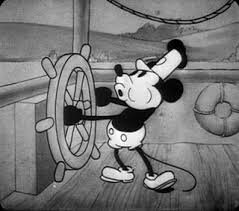
In the world of film and animation music, “Mickey Mousing” is the affectionate (and occasionally derogatory) nickname given to a technique whereby the music and the action on the screen are completely in sync with each other. The reason this technique is called “Mickey Mousing” is because it first appeared in the 1928 cartoon Steamboat Willie starring Mickey Mouse!

Incidentally, Mickey was originally voiced by Walt Disney himself!
The reason “Mickey Mousing” occurred at all is because, after film studios learned the trick of making sound film, they all wanted to show off the fact that their films had sound. To that end, the soundtracks of many, MANY films, were overly synchronized with the actin on the screen, and this happened a lot in the early Disney cartoons as well.
For instance, the 1929 cartoon Skeleton Dance is a 5 1/2 minute example of “Mickey Mousing.” Take a few minutes to watch it and I believe you’ll see what I mean.

My favorite moment in “Skeleton Dance” comes when the one skeleton is sneaking around, taking first three long strides and then quick stepping (and how the music matches his movement, it’s a trick seen more than once in cartoons).
While “Mickey Mousing” has decreased greatly over the years, it is still being used. A more recent example can be found in the first Spider-Man movie in 2002. In the scene where Peter (Tobey Maguire) discovers he has the ability to climb walls, listen to what the music does when his hand first touches the brick wall and then begins to climb up, it’s mimicking his actions! Pretty cool right? Have a look here below:

Hope you enjoyed another look at the world of film music, have a great day!

Become a Patron of the blog at patreon.com/musicgamer460

Check out the YouTube channel (and consider hitting the subscribe button)

For more Film Music 101: see here

See also:

Film Music 101: “Stinger” Chords

Film Music 101: Dubbing

Film Music 101: Diegetic vs. Non-Diegetic Music

Film Music 101: Underscore

Film Music 101: Music Editor

Film Music 101: Sidelining

Film Music 101: “Test” Lyrics

Film Music 101: The First Film Score

Film Music 101: Borrowing

Film Music 101: Arranger

Film Music 101: Anempathetic sound

Film Music 101: Empathetic Sound

Film Music 101: Foley

Film Music 101: Montage

Film Music 101: Compilation Score

Film Music 101: Leitmotif

Film Music 101: Orchestration and cues

Don’t forget to like Film Music Central on Facebook 🙂

Film Music 101: Arranger

Another individual (or group of individuals) who serve an important function in getting a film score put together is the arranger.

An arranger should not be confused with an orchestrator. An orchestrator takes the composer’s piano score and fleshes it out into a full-bodied orchestral score. Arrangement, by contrast, takes a pre-existing musical work and re-arranges it by adding new musical themes, new transitions or whatever is necessary to make an old work fit in a new context.

Take for example the main theme from the Mission Impossible film series. The title theme (featuring a lighted fuse) was taken from the original theme written for the television series in the 1960s.

The Mission Impossible film series now contains five films: Mission Impossible (1996), Mission Impossible II (2000), Mission Impossible III (2006), Mission Impossible: Ghost Protocol (2011) and Mission Impossible: Rogue Nation (2015), with Mission Impossible: Fallout (2018) coming out later this summer. For each film’s title sequence, the music has been arranged to fit the context of the new film, though the core of the music remains intact. Listen to the examples below and you’ll see what I mean (the biggest contrast, in my opinion, comes in the title sequence for Mission Impossible II, it has a definitive 2000-era vibe).

You can thank the arranger for the different sound of the music in each title sequence. So hard to believe that the first Mission Impossible movie opened TWENTY YEARS AGO!! Hope you enjoyed!

You can become a patron of the blog at patreon.com/musicgamer460

Check out the YouTube channel (and consider hitting the subscribe button)

For more Film Music 101: see here

See also:

Film Music 101: Anempathetic sound

Film Music 101: Empathetic Sound

Film Music 101: Foley

Film Music 101: Montage

Film Music 101: Compilation Score

Film Music 101: “Stinger” Chords

Film Music 101: Dubbing

Film Music 101: Diegetic vs. Non-Diegetic Music

Film Music 101: Underscore

Film Music 101: Sidelining

Film Music 101: “Test” Lyrics

Film Music 101: The First Film Score

Film Music 101: Borrowing

Don’t forget to like Film Music Central on Facebook 🙂

Film Music 101: The Temp Track

Occasionally, while putting a film together, the director might wish for the composer to emulate a specific style of music. To that end, a temp track will be assembled to go with the rough cut of the film, to give the composer an idea of what the director wants.

A temp track is essentially a temporary soundtrack, someone in the technical department has found sound recordings that match the style the director wants and they’ve paired it up with the film. To give a few examples, part of the soundtrack from Ben-Hur (1959) was used as a temp track for Star Wars (1977), excerpts from a Howard Shore piece were used for Gangs of New York (2002) and, most (in)famously, 2001: A Space Odyssey used a temp track assembled from Strauss waltzes, Also Sprach Zarathustra by Richard Strauss and Atmospheres by Ligeti.

2001: A Space Odyssey is so notable because director Stanley Kubrick actually REJECTED the score composer Alex North had created in favor of the temp track! Think about it, many of the scenes in that film are iconic because of the selections of classical music, but we (the audience) were never meant to hear it like that!

Interesting to consider what might have been…
Become a Patron of the blog at patreon.com/musicgamer460
Check out the YouTube channel (and consider hitting the subscribe button)

See also:

Film Music 101: Foley

Film Music 101: Montage

Film Music 101: Mickey Mousing

Film Music 101: Compilation Score

Film Music 101: Leitmotif

Film Music 101: Orchestration and cues

Film Music 101: “Stinger” Chords

Film Music 101: Dubbing

Film Music 101: Diegetic vs. Non-Diegetic Music

Film Music 101: Who owns the music?

Film Music 101: Underscore

Film Music 101: Sidelining

Film Music 101: “Test” Lyrics

Film Music 101: The First Film Score

Film Music 101: Borrowing

Film Music 101: Arranger

Don’t forget to like Film Music Central on Facebook 🙂