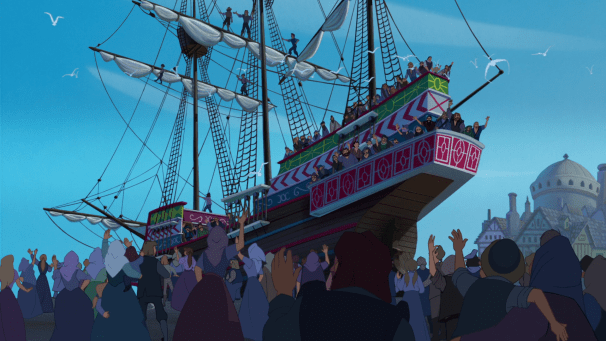
As the battered English ship continues on its way, the action zooms ahead to the tranquil shores of the New World, where life continues on, oblivious to the fact that it will soon change forever. We’re taken to a returning war party, led by Chief Powhatan, that is heading for home after engaging in a long fight with the Massawomecks.
One of the great things about Pocahontas is that it is one of the most realistic animated depictions of a Native American community ever created (as opposed to a more stereotypical representation like the one seen in Peter Pan). We’re given a sweeping overview of daily life: we see women picking corn, young boys playing lacrosse (I’m not sure what their name for the game was), people of all ages, from toddlers to the elderly all living in a fairly organized village.
Steady as the beating drum Singing to the cedar flute Seasons go and seasons come Bring the corn and bear the fruit.
The song tells about the regulated order of daily life; all has been the same for generations. The streams are full of fish, there is plenty of game in the woods, and all life is grounded by a firm belief in the Great Spirit and its power in their lives. All of this is provided to show that these people, while different from the arriving settlers, are hardly “savages” (as Ratcliffe continuously refers to them throughout the film).
By the waters sweet and clean Where the mighty sturgeon lives Plant the squash and reap the bean All the earth our mother gives O great spirit, hear our song Help us keep the ancient ways Keep the sacred fire strong Walk in balance all our days Seasons go and seasons come Steady as the beating drum Plum to seed to bud to plum. (Hega hega ya-hi-ye hega) Steady as the beating drum. Hega hega ya-hi-ye-hega. Ya-hi-ye-ne-he hega.
In an earlier version of this song, Kocuom (a warrior who would like to marry Pocahontas) had a verse of his own ( where he sang about how he would build Pocahontas “a sturdy house with sturdy walls” (a line referenced later in “Just Around the Riverbend”). Actually, it may have been an entire song in its own right (“Dancing to the Wedding Drum”, but in a behind the scenes feature playing the song, it has nearly the same melody as this song, so I consider them one and the same). I believe this song/verse was cut because Kocuom has a very different personality (he smiles!!!) from what we see in the final film. This is a shame because Kocuom gets very little character development overall and it would have been nice to see this moment between them.
As word spreads that the war party is nearly home, everyone begins to gather at the shore to welcome them. Clearly this is a greatly anticipated homecoming. Chief Powhatan is very happy to be home, but there is one face missing from the crowd…his own daughter Pocahontas! (Go figure the titular character is missing, a similar thing happens in The Little Mermaid, only Pocahontas isn’t in trouble for not being present).
After a treacherous sea voyage, John Smith and company have arrived on the shores of the New World (what is now part of the state of Virginia). Governor Ratcliffe dispatches Smith to scout the terrain and see if any Indians are about the area. Meanwhile, the rest of the settlers are going to start digging, wait…digging??
The gold of Cortes The jewels of Pizarro Will seem like mere trinkets By this time tomorrow The gold we find here Will dwarf them by far Oh, with all ya got in ya, boys Dig up Virginia, boys
Mine, boys, mine ev’ry mountain And dig, boys, dig ’til ya drop Grab a pick, boys Quick, boys Shove in a shovel Uncover those lovely Pebbles that sparkle and shine It’s gold and it’s mine, mine, mine
Yes, that’s right. Ratcliffe (the greedy lout) is convinced that Virginia, like the Spanish New World (Mexico) is full of gold and precious gems. Barely scratch the surface and they’ll all be rich as kings! Of course, Ratcliffe (David Ogden Stiers) has no intention of sharing any of this wealth; his plan (revealed in the following song) is to return to England filthy rich and be ennobled by King James, and then become the envy of the entire court.
My rivals back home It’s not that I’m bitter But think how they’ll squirm When they see how I glitter! The ladies at court Will be all a-twitter The king will reward me He’ll knight me… no, lord me!
It’s mine, mine, mine For the taking It’s mine, boys Mine me that gold! With those nuggets dug…
It’s glory they’ll gimme My dear friend, King Jimmy Will probably build me a shrine When all of the gold… is mine!
All of this is the basis for the song “Mine, Mine, Mine!” Ratcliffe draws a beautiful picture of the treasures that could be discovered, convincing the settlers to begin a digging and mining operation on a grand scale; leveling trees and digging deep pits in search of treasures that actually don’t exist (in real life, the natives of this area primarily had metal decorations made of copper). Ratcliffe is unwittingly sending the settler’s on a fool’s errand by having them dig up the land for something they’ll never find. The song (for the most part) perfectly highlights how greedy and selfish Ratcliffe really is.
Meanwhile, John Smith is out exploring the pristine countryside (while a curious Pocahontas follows at a distance). He’s a man of adventure, and he believes he’s finally found the perfect land to explore. Smith isn’t really interested in gold or treasure of any kind, he’s in this for the glory of the adventure. This leads to the rival statements of “mine”: Smith says, “the greatest adventure is mine” while Ratcliffe boasts “all of the gold is mine!”
All of my life, I have searched for a land Like this one A wilder, more challenging country I couldn’t design Hundreds of dangers await And I don’t plan to miss one In a land I can claim A land I can tame The greatest adventure is mine!
Two adventures have been started now: John Smith is out exploring (and soon to meet Pocahontas) while Ratcliffe supervises the settlers with their endless digging. So here begins my return to regular posts on Disney film music, I hope everyone had a good Thanksgiving 🙂 This post was relatively short but I think they’ll get longer as I get more comfortable writing again
I just realized it’s been forever since I actually covered a piece of film music, so I thought I’d ease myself back in with one of the less well-known pieces of Disney music: “The Siamese Cat Song” from Lady and the Tramp (1955). Sadly, Lady and the Tramp is not very high on the radar of kids today, which is a shame, as the film is a gem with its animation and songs.
“The Siamese Cat Song”, although one of my favorite pieces, is rather controversial, because it contains a blatant Asian stereotype in the form of Si and Am, the two Siamese cats introduced by Aunt Sarah (after Lady’s owners leave for a short vacation). In keeping with their Asian origins, the song is built around a pentatonic (five tone) melody and begins with the ominous ringing of a gong (also strongly associated with Asian cultures in general).
When Si and Am speak (in unison a lot of the time), they have visible buck teeth. And the way they talk/sing is overly formal with bad English (a parody of Asians speaking in English). For example, here is the first verse:
We are Siamese, if you please
We are Siamese if you *don’t* please
Now we lookin’ over our new domicile
If we like we stay for maybe quite a while
The language is overly formal (note the “if you please”), and the grammar…bad! But stereotypes aside, I really like this song, because while the cats remain very polite in tone throughout their song, their actions reveal that they are nothing but trouble!
Do you seeing that thing swimming round and round? Yes. Maybe we can reaching in and make it drown. If we sneaking up upon it carefully There will be a head for you, a tail for me.
Do you hear what I hear? A baby cry? Where we finding baby there be milk nearby.
If we look in baby buggy there could be Plenty milk for you and also some for me.
In short order, the two cats: topple a vase of flowers, shred the curtains, terrorize the goldfish (narrowly saved from being eaten by Lady), attempt to eat the pet bird, and in general make a huge mess. And then…the baby starts crying upstairs. Being clever cats, Si and Am deduce that there must be fresh milk nearby for the baby (and if so they will gladly help themselves). However, Lady has had enough of these two, and she makes a stand at the top of the stairs. Realizing they’ve gone too far, Si and Am run for it, and all three collide in a heap back in the sitting room, where the two devious felines make it look like Lady started it as soon as Aunt Sarah enters the room. I always hated this part because I knew none of this was Lady’s fault and yet here’s mean Aunt Sarah blaming everything on Lady.
I hope you liked this brief look at “The Siamese Cat Song”
In 1995, Disney released Pocahontas, their 33rd animated feature film, and the first Disney film to be based on a real historical person (that being Pocahontas, though the details have been heavily romanticized). To my surprise, I learned that this film received mixed reviews and is in fact considered the “beginning of the end” of the Disney Renaissance. I certainly didn’t get that impression when I saw the film in theaters, but I was only in the first grade at the time, and wasn’t exactly in a position to judge film quality.
Whether you like or dislike the film, there’s no denying Pocahontas has another great Disney score, with the songs once again being composed by Alan Menken. And the first song we hear is “The Virginia Company”, a short chorus that introduces the English settlers: Thomas (Christian Bale), the barely adult kid leaving home to make his fortune; Lon (Joe Baker) and Ben (Billy Connolly), two seasoned sailors who are well acquainted with the hero of the film, Captain John Smith (Mel Gibson), a man who’s traveled everywhere and doesn’t think this “New World” will be any different from the others he’s seen.
And last, but not least, there’s Governor Ratcliffe (David Ogden Stiers), his manservant Wiggins (also David Ogden Stiers) and his pompous pooch Percy. Ratcliffe is the nominal leader of the expedition and will be Governor of the new colony (but really, he’s just in it to get really rich so he can come back to England and worm his way into the aristocracy).
In “The Virginia Company”, the settlers sing about how this New World is a paradise full of gold and silver, and they’ll all become really rich:
In sixteen hundred seven We sailed the open sea For glory, God and gold And the Virginia Company
For the New World is like heaven And we’ll all be rich and free Or so we have been told By the Virginia Company
So we have been told By the Virginia Company For glory, God and gold And the Virginia Company
On the beaches of Virginny There’s diamonds like debris There’s silver rivers flow And gold you pick right off a tree
With a nugget for my Winnie And another one for me And all the rest’ll go To the Virginia Company It’s glory, God and gold And the Virginia Company
They have this view because of the enormous riches the Spanish found when they plundered the New World and discovered the treasures of the Aztecs, the Inca and so on. Still, it is a stirring song to hear, and a good introduction to the story.
“King of Pride Rock” takes place at the climax of the film. After a little persuasion from Rafiki (not to mention a spine-tingling heart to heart with his father’s ghost), Simba has returned to the Pride Lands…only to discover that his once beautiful home is practically a desert. When Scar allowed the hyenas to move en masse into the Pride Lands, it upset the delicate balance of life and now all the herds of elephants, antelope, giraffes, etc. have moved away, leaving the pride (not to mention a very large group of hyenas) close to starvation. Simba is quickly joined by Nala, Timon and Puumba, who are all willing to help Simba claim his rightful place as king.
And Simba hasn’t come home a moment too soon: Scar wants to have a word with Sarabi, Simba’s mother. He accuses the lionesses of not doing their jobs of hunting for food, despite Sarabi’s calm replies that there isn’t any food because the herds have all left. Scar vehemently denies the truth (he can’t accept that he’s a terrible king) and when Sarabi tells the delusional lion that they have to leave Pride Rock if they want to survive, the furious Scar explodes in rage, ultimately striking Sarabi across the face, provoking an enraged roar from Simba.
The music during all of this is mournful (the melody is led by an oboe and backed by a choir). Usually in a situation where the villain is in charge, there’s a theme that suggests “evil triumphant” but that doesn’t really happen here (unless you count the brief fanfare when Scar assumes the throne). Scar has mismanaged the Pride Lands so badly that there is nothing to be proud of. Deep down, he probably knows this, but his arrogance won’t let him admit he’s done all the wrong things.
Speaking of doing wrong…Scar almost betrays himself when Simba appears out of nowhere. For a brief moment, his nephew resembles his late brother so much that Scar whispers “Mufasa…no, you’re dead!” I don’t think anyone else heard him though, because doesn’t it sound awfully suspicious to be afraid of what you think is your brother’s ghost? Even Sarabi believes that this is her husband until Simba corrects her, much to Scar’s surprise:
“Why Simba…I’m so surprised to see you…alive” *angry glare at Shenzi, Banzai and Ed, who slink away for safety*
Simba is ready for war (“Give me one good reason why I shouldn’t rip you apart”) and the music backs up Simba’s anger. Listening to this part, Simba can be represented by trumpets and brass. Scar, on the other hand, is more in the woodwinds, and “his” music slinks and wiggles, while Simba’s is (initially) bold and confident. And I say “initially” because Scar has one last trump card to play: the “truth” about who really killed Mufasa. All these years Simba has believed this tragedy was his fault, and now he confesses it to everyone as the “truth” and Scar promptly denounces his nephew as a murderer
“If it weren’t for YOU Mufasa would still be alive, it’s YOUR fault he’s dead, do you deny it? “No” “Then you’re GUILTY!”
And while he distracts Simba with these accusations, Scar surreptitiously begins backing the young lion towards the ledge at the end of Pride Rock, ultimately trapping Simba as he nearly falls over the edge! At this point, the soundtrack skips to the aftermath of the final fight, but I’m going to keep going.
Now, history is about to repeat itself: Scar finds himself standing over Simba, in much the same way he stood over Mufasa right before his death. And at this moment, Scar makes one of his final mistakes (though not the one that gets him killed, that comes in a little bit): he leans down close to Simba and tells him the REAL truth: *I* killed Mufasa….this admission triggers an avalanche of pain and rage in Simba, who in one swoop jumps up and pins SCAR to the ground, demanding that everyone know what he just told them. Cornered, Scar finally admits to the entire pride that HE killed Mufasa and the war is on!! Well, I say war, but it wasn’t THAT big of a fight. At this point, most of Pride Rock is on fire from a lightning strike, and if you watch closely, most of the hyenas are running for their lives (from the flames as much as the wrath of the lion pride). Simba isn’t about to let Scar get away though, and when he spots his uncle trying to slink away, Simba chases him all the way to the top of Pride Rock. As the two lions begin to square off, neither notices that Shenzi, Banzai and Ed have crept in to listen.
Simba is ready to kill Scar where he stands and the desperate Scar is pleading any excuse he can think of to keep his nephew from cutting his throat. He pleads for mercy, he pleads blood relations, and finally, he pleads the excuse that the HYENAS are the real enemy here, that this entire scheme was their idea, not his (As Shenzi, Banzai and Ed hear this, they growl in anger and slink away, but they’re not done with Scar yet). Simba doesn’t believe a word, but he won’t kill Scar either (as that would lower him to Scar’s level). Instead (oh, the delicious irony!!) he tells his uncle to “Run, run away Scar, and NEVER return” (the exact words that Scar used to make Simba run away). The older lion seems like he will accept this and leave, but just as everything seems over, Scar swipes some coals into Simba’s face and one last fight ensues.
In the dramatic climax, Simba and Scar (in dramatic slow motion), tear and claw at each other, and Simba is ultimately knocked to the ground. But when Scar lunges for the kill, Simba takes a page from Nala and kicks upward, propelling his uncle over the edge of the cliff! But Scar isn’t dead, not yet anyways. He pulls himself up as Shenzi, Banzai and Ed come forward out of the flames.
“Ah…” he smiles “My friends….”
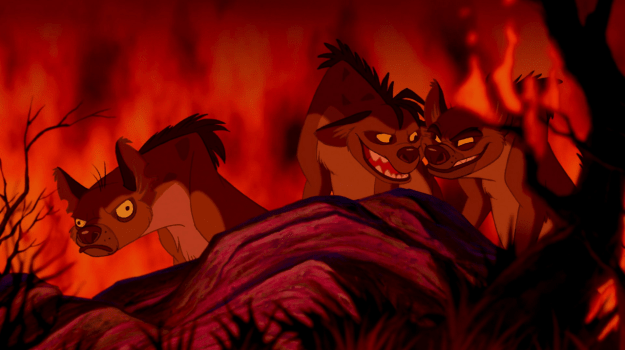
And Shenzi laughs “Friends?? I thought he said we were the enemy…Yea, that’s what I heard, Ed???” As this conversation goes on, Scar’s eyes become horror filled as he realized that he’s surrounded by a horde of angry hyenas who no longer trust him, and are very, very hungry!! Scar pleads for his life right until the very end, when the hyenas (and the flames) overwhelm him. As Disney villain deaths go, this one is pretty gruesome. As I noted in Beauty and the Beast, this ending was originally intended for Gaston (who was supposed to survive his fall from the tower and be cornered by a pack of wolves).
To be honest, I was going to keep going through Simba’s triumphant accession of the throne, but this has gone on really long so I’m going to split this post in two and post the rest later this week 🙂 The Lion King has a pretty awesome climax, proving why it is one of the greatest films of the Disney Renaissance.
Note: I was actually going to do “Riders of Rohan” today but my headphones are missing right now and I didn’t want to wait all day to do a post, so I picked this one instead 🙂
Theodred is a character that we, unfortunately, only “meet” after he has been mortally wounded by orcs at the Fords of the River Isen. (In the books we only learn of his death after the fact). He’s brought back to Edoras by his cousin Eomer, but he never recovers. In fact, a deleted scene was going to strongly hint that Wormtongue poisoned Theodred to make sure that he died.
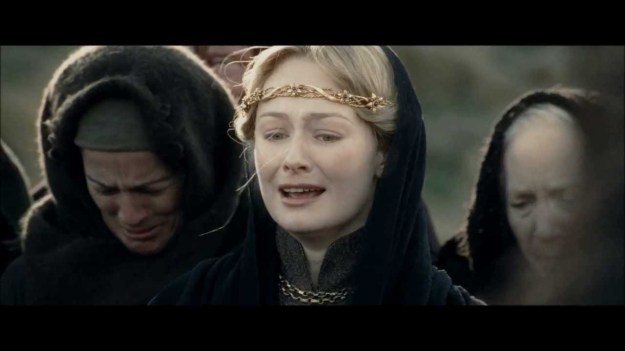
As King Theoden’s only son, the late prince is given a royal burial in the funeral mounds located outside the gates of Edoras, where all the kings of Rohan are buried. As the body is brought down to be interred into the mound, Eowyn (also Theodred’s cousin, being the sister of Eomer) leads a funeral dirge in Rohirric (the native language of Rohan).
As strange as the words sound, Tolkien (being an expert in ancient languages) based Rohirric on a dialect of Old English. This is why, if you listen carefully, the words sound almost familiar, even though they’re not understandable. The basic gist of the dirge is that: death has claimed this noble warrior, and all will wail his passing. He will return home to Meduseld (the house of the king) no longer. The words sound harsh to the ear, but the raw heartache behind them is palpable.
This is clearly a very emotional moment for Eowyn, who has already lost her parents, seen her brother exiled and now must watch her cousin be buried. I’m sure she never imagined that she would witness Theodred’s funeral. It always hurts to lose a family member, but Eowyn does her best to keep her emotions in check (she is a princess of Rohan after all, being a niece of the king).
While Theodred is a character we barely get to meet, his death has far-reaching consequences. For one, Theoden has lived to bury his children (thus affecting him for the rest of the story). For another, this makes Eomer, the king’s nephew, the heir to the throne of Rohan. The problem is: Eomer is currenly riding north and growing more distant by the hour. Unless he can somehow be recalled, Rohan is going to be in a lot of trouble very quickly.
For now, this is the conclusion of The Fellowship of the Ring. “In Dreams” is technically not part of the main soundtrack (you only hear it over the end credits) but it is still a gorgeous piece of music that I want to share with you.
“In Dreams” possesses the same melody as “The Shire” and adds lyrics to make a heartwrenching song about meeting those we have lost “in dreams.”
When the cold of Winter comes,
Starless Night will cover Day
In the veiling of the sun,
We will walk in bitter rain…
But in dreams…I can hear your name…
And in dreams…We will meet again
When the seas and mountains fall
And we come, to end of days
In the dark I hear a call, calling me there
I will go there…and back again…
The song is performed by a boy soprano (backed by a choir in various sections) and it is simply beautiful to listen to. And you’ll notice that the final line is a nod to the subtitle of The Hobbit (“There and back again”) which is really cool. A brief personal story, every time I watch The Fellowship of the Ring with my mom, she will not let the DVD be taken out until she’s heard this song (that’s how much she loves it).
Before I go back to my regular series, I thought I would share with you a theme that I recently re-discovered: the main theme from Das Boot (1981), a German epic war film that recounts the (fictional) exploits of the (fictional) U-96, a German U-Boat patrolling the Atlantic during World War II. (Though *this* boat is fictional, some of the exploits were inspired by the actions of the REAL U-96).
The film shows every aspect of life in the submarine: unrelenting boredom, the sudden excitement of battle and the dangers that faced submarines at every turn. A climactic moment comes when the U-96 has been damaged by depth charges so badly that it sinks to the bottom of the ocean near Gibraltar. After a harrowing 16 hours spent making repairs, the ship is able to surface and the engines are successfully restarted.
But (MASSIVE spoilers ahead), there is no happy ending for the U-96. Despite everything they have gone through, shortly after limping into the dock at La Rochelle, the entire area is strafed by American fighters. Most of the crew is injured or killed (including the captain) and the U-96 sinks into the ocean.
The music was composed by Klaus Doldinger and his main theme for Das Boot is one of those pieces of film music that you HAVE to hear, even if you never see the film. There is a haunting quality to this piece that makes it irresistible to me. The full track actually begins with the faint sound of sonar (but most versions I find cut this moment out) and then the cello begins the main theme, starting very low and steadily rising up. It seems to me that Doldinger purposefully modeled the theme after the rising and falling swells of the ocean, where the U-Boats patrolled (and which also served as the tomb for tens of thousands of German sailors).
As sad as this music sounds, I actually find it rather soothing to listen to. The theme is very symmetrical in the way it rises and falls (it’s actually a good kind of music to get stuck in your head).
If you get the chance, I highly recommend watching this film at least once. The film was dubbed into English by the original cast so you wouldn’t have to worry about watching a subtitled film. Doldinger’s score makes the film worthwhile, along with an amazing performance by the entire cast (Jurgen Prochnow, who plays the captain, also starred as Paul’s father in Dune (1984))
I hope you enjoy this brief look at the main theme of Das Boot, and if you’ve seen the film, let me know what you thought about it in the comments below 🙂
Before I get to the song (which I do actually like), a little backstory is needed:
Once upon a time an animator named Don Bluth had a dream: a dream to create an animation company that would rival (and hopefully surpass) Disney itself. To that end, Bluth created his own animation studio and early on produced an acclaimed classic: The Secret of NIMH. More success followed with The Land Before Time, An American Tail, and An American Tail: Fievel Goes West.
With all of these well-known films, one might ask the question: if they were doing so well, why did the studio eventually go bankrupt? Well…a lot of it had to do with films like Rock-a-Doodle (1991), films that looked good as far as animation went, but were really bad in all other areas. In fact, this film did so poorly that it was the beginning of the end for the studio (their final release was The Pebble and the Penguin in 1995).
Therefore, if you haven’t heard of Rock-A-Doodle, I’m not surprised. Viewing the film with adult eyes, I can’t believe how flawed the story is. The film follows a young kid named Edmond (Toby Scott Granger) who loves the story of Chanticleer (Glen Campbell), a rooster who sang every morning to make the sun rise. But when the Grand Duke of Owls sabotages the rooster to make it look like the sun comes up on its own, Chanticleer leaves for the city, humiliated. Constant rain has fallen ever since, and in the real world, Edmond’s home is in danger of being flooded too. Seeing his family (out battling the flood) close to being swept away, Edmond opens his bedroom window and begins yelling for Chanticleer. Instead, Edmond somehow summons the Duke, who decides to teach Edmond a lesson by turning him into a cat (somehow in all of this Edmond was sucked into Chanticleer’s animated world, I told you the plot was full of holes). Edmond encourages the remaining farm animals to band together and find Chanticleer in the big city.
There is one bright spot in the film and that is the casting of Christopher Plummer as the evil Duke (an Owl who plots to drive the rooster Chanticleer from the farm because if he leaves the sun won’t rise. Yes, really, that’s the basis of the plot.) How they got Plummer to do this role, I don’t know, but I’m glad he did because he absolutely rocks this part. One of my favorite moments is “Never Let Him Crow.”
To be technically correct, “Never Let Him Crow” is not so much a song as it is a spoken monologue (from the Duke) with sung commentary from a chorus of Owls. This monologue is also accompanied by a HUGE pipe organ that is playing a slightly abbreviated rendition of Bach’s Toccata and Fugue in D minor (aka that first song from Disney’s Fantasia). The infuriated Duke is relaying the story of how, earlier in the film, he got bit in the leg by a certain “flea-bitten cur” (the dog Patou, played by Phil Harris, aka the voice of Baloo. This was his final film role) and also how he got blasted in the face with a flashlight by Edmond (the kid who gets turned into a cat by aforementioned Duke, yes really! And in this film owls have an extreme dislike of light in any form and fashion, flashlights included).
So he turns on the duke? And with what do you suppose he turns on the duke?
What master?
A flashlight!
What a horrible thing to do! What a horrible thing to do! Thing to do!
But then, when my back is turned What four legged, flea-bitten louse comes sneaking through the window That has the nerve to bite me on the leg?
Who? Who? Who? Who? Who? Who?
Patou.
*Gasps* Yes!
Death to Patou!!
Destroy the farm! Destroy the cat! The dog! Or do you want the chicken back?
No! We hate the sun! The answer’s no!
And it’ll make my leg feel so much better… If that rooster never crows! Tahahaha!
We hate the sun, that much we know We hate the rooster, we’ll never let him crow (Never let him crow!) We hate the sun, from head to toe (From head to toe!) We hate the rooster, we’ll never let him crow Never let him crow!
Never let him crow.
I love the back and forth between the domineering Duke and his cowed subordinates (it doesn’t matter what the Duke says, he is their leader and therefore he is always right). I will also say again how much I like Christopher Plummer’s performance; he certainly sounds like he was enjoying himself.
While I can’t recommend the film as a whole, “Never Let Him Crow” is a relatively solid moment and I hope you enjoy watching it.
After Bilbo takes his leave of the Shire (leaving all Hobbiton in an uproar), Frodo finds himself the owner of Bag End and heir to almost all that Bilbo possessed, including a certain golden ring that he found once, deep in the Misty Mountains. Gandalf already has his suspicions about that ring, given that right before he gave it up, Bilbo had begun to act odd, almost violent towards his old friend.
But most alarming is what he called the ring: “My Precious,” a term that only Gollum had ever used up until now. Things might have turned ugly, but when Gandalf put some force behind his words, Bilbo found himself again and gave the ring up of his own free will (possibly the only person to ever do so).
Even though Frodo had a pretty good idea that Bilbo was leaving, it still hurt that the old hobbit was gone. But if he hoped to get any answers/help from the wizard, Frodo is going to be disappointed, because Gandalf is setting out immediately, where he won’t say, except that there are “questions, questions that need answering.” Before he leaves, he makes sure the Ring is sealed inside an envelope and placed “somewhere out of sight.”
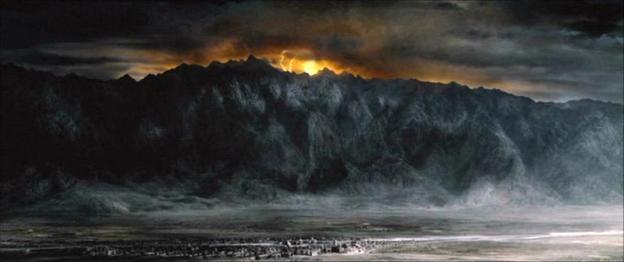
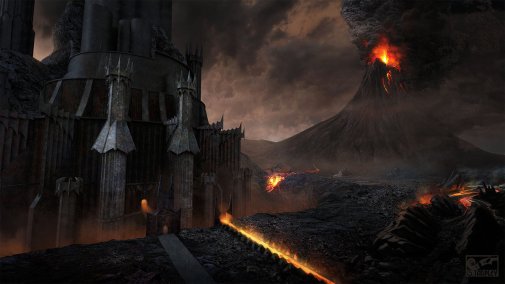
After Gandalf’s hasty departure, Frodo stares down at the envelope containing the Ring, wondering what on earth he’s actually inherited, when the music kicks up into a living nightmare (that’s how I’ve always thought the music sounded.) The scene abruptly shifts to Mordor, a hellish wasteland dominated by the mountain of fire, Mount Doom and the imposing tower of Barad-Dur, atop which sits the devilish Eye of Sauron (so far we’ve only had a fleeting glimpse of that, when Gandalf lightly brushed the Ring with his fingers).
The music twists and turns, harsh trumpets and other brass instruments dominating the theme. This is our first look at Mordor after the Prologue, and the music needs to quickly establish that this is a very bad place (and it succeeds). But there’s more: after we hear the screams of Gollum confessing what little information he knows (“Shire!” “Baggins!”), Mount Doom erupts and the 9 Black Riders are seen departing Minas Morgul, with a brief introduction of their theme.
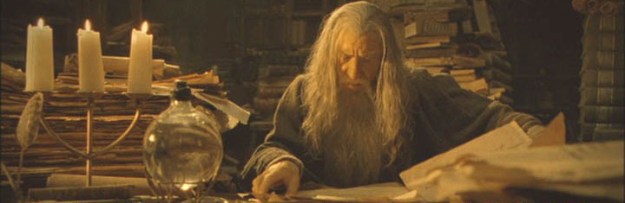
The scene shifts again: now we’re back to Gandalf, who has ridden out to the city of Minas Tirith in Gondor and observes the increased activity in Mordor. With no time to lose, he rides into the city and begins to scour the archives, pouring through old documents until he finds what he is looking for: a long-forgotten scroll written by Isildur, that describes how the Ring came into his possession (already the ring was “precious” to him) and what it looked like before it cooled and shrunk. Originally, there were letters of fire surrounding the band, and only extreme heat would be able to bring them to light again. This is what Gandalf has been seeking: a way to prove once and for all whether or not this mysterious Ring is THE Ring.
A quick note about this brief scene in Gondor: you’ll note that the short fanfare does not match up to the main Gondor theme (first introduced in The Council of Elrond, a story I’ll tell next time). This is because at the time Shore created this part of the score, he had not yet conceptualized what Gondor’s theme would sound like. This short fanfare that we do hear could be considered a musical “placeholder.” It quickly sets the scene, but is otherwise not that important.








 Film Music Central