
In movies there are two kinds of music: diegetic and non-diegetic.
Diegetic music refers to music that occurs onscreen, in the universe created by the movie. A great example is seen in Mission Impossible: Rogue Nation (which came out in the summer of 2015). Without spoiling too much, Ethan Hunt (Tom Cruise) ends up fighting some bad guys in the staging area of the Vienna Opera House while a performance of Puccini’s last opera Turandot is going on below (see the picture).
Throughout the fight, you can hear the performance going on and this serves as the “background music” to the drama happening onscreen.


Film Music 101: The First Film Score
Film Music 101: Anempathetic sound
Film Music 101: Empathetic Sound
Film Music 101: Compilation Score
Film Music 101: Orchestration and cues
Film Music 101: “Stinger” Chords
Share this Post


The Empire Strikes Back Part Two!: Han and Leia in Love and Yoda!!
*All music shown is the property of Disney and Lucasfilm, I own nothing.

“I love you….I know…” One of the most remembered lines from the Star Wars universe came moments before Han Solo was frozen in carbonite by the evil Darth Vader. Leia finally realizes that she loves the scoundrel of an ex-smuggler and he reveals that he’s known it pretty much all along.
(On a side note, Han’s response was a complete ad-lib by Harrison Ford, as they had tried numerous takes using the generic “I love you too” and it just wasn’t working out.)
The music heard immediately before this line (when Han and Leia share a brief kiss) is the culmination of a theme that has been building since early in the film when the two are seen arguing in the ice caverns of Hoth.

Musically, this love theme is remarkably similar to Leia’s original theme (as heard in the first film):

Notice that both begin with large leaps from the first note to the second, using a pickup note. Both can also be divided into two sections, with the second section featuring a leap as well. The primary difference is that whereas the love theme drops down a whole step after the initial leap, the original Leia theme keeps going up. It’s almost like an inversion of the original theme, where the music now moves downward instead of up.
Of course Empire Strikes Back is also where we get to meet Yoda, the diminutive (size matters not!) and slightly eccentric Jedi Master who reluctantly agrees to train Luke in the ways of the Force. Yoda’s theme, a quiet melody for woodwinds, is first heard after Yoda is walking back to his hut and inviting Luke to follow. Of course at this point we have no idea that this is actually Yoda (or maybe we do, but Luke certainly doesn’t).
The theme is a perfect match for the ancient Jedi Master. It exudes a quiet confidence, the exact opposite in fact of the “Imperial March.” This theme really comes out in full when Yoda demonstrates what the Force can do when he successfully raises Luke’s sunken X-Wing from the swamp.

Share this Post

“Overture” from Ben-Hur by Miklos Rozsa (1959)
One thing that must be understood about “classic” Hollywood films (usually anything made before 1960) is that in those days, the large epic films were constructed very much like an opera or a play would be. By this I mean, they would have separate screens labelled “overture” (as Ben-Hur does above), “Intermission” and also “Exit Music” (music that would play while the audience left the theatre).
This overture was composed by the Hungarian composer Miklos Rozsa for the 1959 epic Ben-Hur. He won the Academy Award for Best Score and many cite it as being one of the greatest film scores of all time. The image is an extreme close-up of the figures of Adam and God on the ceiling of the Sistine Chapel.

Above is the first eight measures from the beginning of the overture (from the original score)
I love this overture because of how it begins, with this attention-grabbing fanfare from the brass and woodwinds. The call repeats three times and swells at the last moment before the brass breaks through with the immortal “Hallelujah” motif (my term for it), the timpani thundering in the background. The motif repeats again, and again, building and swelling and then…dying away into the main love theme and other side themes that recur throughout the film. That’s a technique seen multiple times in film overtures: beginning with a brassy motif and transferring to strings (*cough* think of Star Wars *cough*)
The overture ends as it began, with the brass and woodwind trumpet call, more firm this time. This signals that the overture is ending and the main story is about to begin.
Become a Patron of the blog at patreon.com/musicgamer460
Don’t forget to like Film Music Central on Facebook 🙂
See also:
Miklos Rozsa conducts Ben-Hur suite (1979)
Share this Post

James Horner talks Star Trek II: The Wrath of Khan

It is always invaluable to hear a composer speak about why he created a film score in a certain way. Just imagine if it had been possible to videotape Beethoven or Mozart speaking about THEIR works.
Resources like this become all the more valuable (and poignant) when the composer passes away suddenly. While many of the greats (including James Horner) have passed on, at least we have a portion of their thoughts set down and recorded.
In this interview, James Horner (who is greatly missed) talks about his thought process behind writing the genius score for one of the greatest Star Trek films of all time. After the critical failure of Star Trek: The Motion Picture, director Nicholas Meyer wanted to create a totally different feel and sound for the sequel. The director had a particular vision of “Horatio Hornblower in space,” which inspired Horner to create a distinctly nautical sound in the music for The Wrath of Khan.

The score is also more heavily based on leitmotif’s, with very few “hummable” themes, a direct contrast to Goldsmith’s score for The Motion Picture (think of Ilia’s Theme or the Klingon’s Theme). There are a few subtle homages to Goldsmith’s score for The Motion Picture however: during Khan’s surprise attack, Horner employs the “blaster beam” which was used in the previous film as a notable sound effect for the V’Ger alien.
Horner’s score for The Wrath of Khan is widely considered to be the greatest score found in a Star Trek film, though some prefer Eidelman’s score for The Undiscovered Country. Again, I hope you enjoy listening to this interview from the late, great, James Horner.
See also:
James Horner talks Aliens (1986)
James Horner talks Field of Dreams (1989)
James Horner talks The Rocketeer (1991)
James Horner scoring Braveheart (1995)
James Horner talks The Perfect Storm (2000)
James Horner talks A Beautiful Mind (2001)
James Horner talks Windtalkers (2002)
James Horner talks Avatar (2009)
James Horner talks The Amazing Spider-Man (2012)
Become a Patron of the blog at patreon.com/musicgamer460
Check out the YouTube channel (and consider hitting the subscribe button)
Don’t forget to like Film Music Central on Facebook 🙂
Share this Post

Jerry Goldsmith talks Alien (1979)
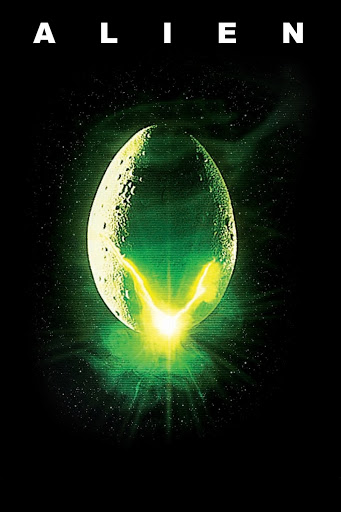
Jerry Goldsmith talks Alien (1979)
A look inside Goldsmith’s thought process when he created the score for the ever-terrifying Alien (for a sense of contrast, keep in mind that he composed Alien in the same year as Star Trek: The Motion Picture!!) In fact, if you listen closely, some say that you can hear some of the same minor themes in both films. Primarily listen to the music early in Alien when the camera is panning through the empty corridors of the Nostromo and compare to the music in the scene where Spock is stealing a thruster suit rather late in the film.
Become a Patron of the blog at patreon.com/musicgamer460
Check out the YouTube channel (and consider hitting the subscribe button)
Share this Post

A Tale of Two Spocks: Spock’s Theme in Wrath of Khan and The Undiscovered Country
Whenever a film franchise is fortunate enough to grow into a large series, it is very rare that each of the films can be scored by the same composer (Star Wars being a happy exception). Because most film franchises (i.e. James Bond, Mission Impossible, Star Trek) change film composers frequently, it is common for themes to differ from one film to the next. For example, if you listen to the themes of Mission Impossible and Mission Impossible 2, you would notice a huge difference in terms of style.
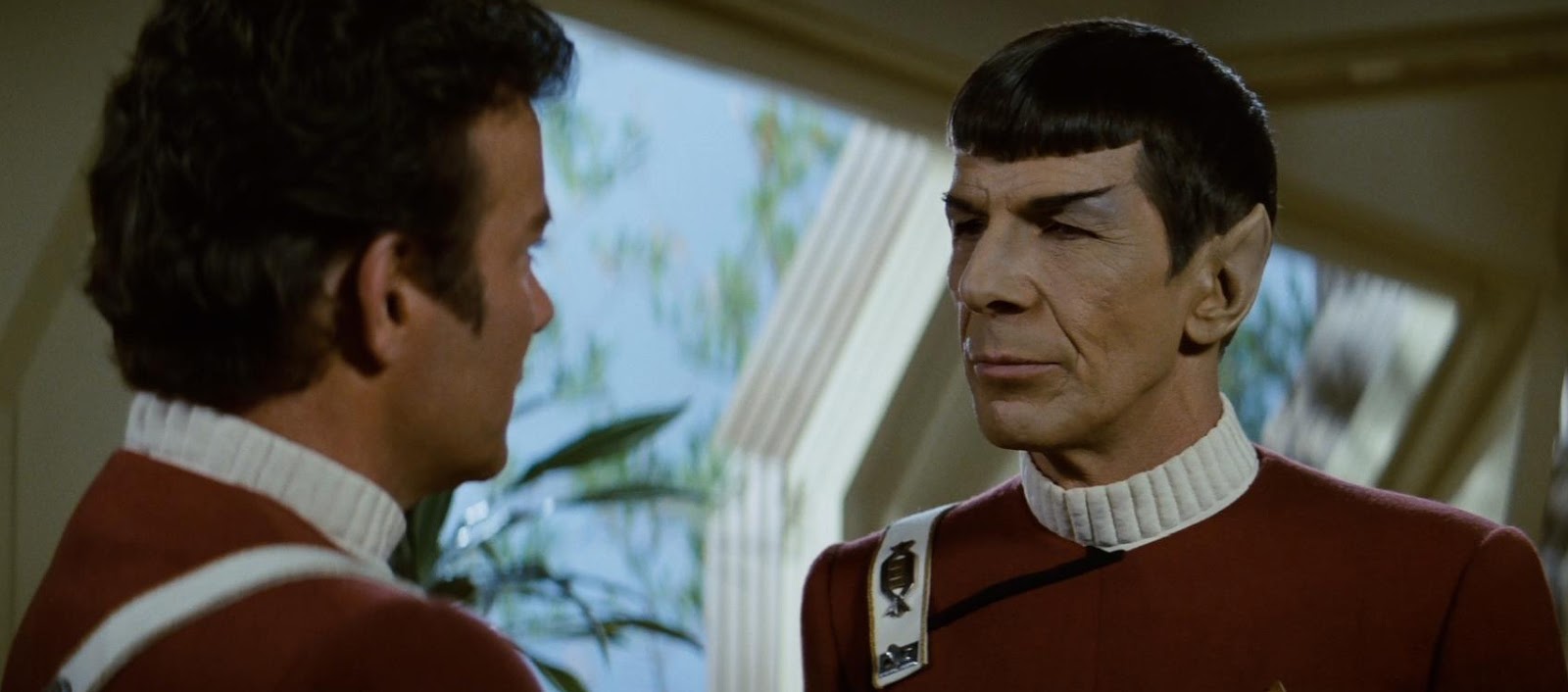
Occasionally though, themes created by different composers for the same character can sound very similar. In this case, I draw your attention to a set of themes, each created for the character of Spock from the original Star Trek series. The first theme was created by James Horner for Star Trek II: The Wrath of Khan in 1982.
The music begins with a soft glass-edged melody that gently drops down into the secondary theme (plucked out by the harp). This melody is a perfect characterization of Spock: he is Kirk’s rock, the perfect voice of reason. Kirk cannot conceive of a world where Spock is not by his side (which makes the ending of the film all the more upsetting).
The second theme was composed by Cliff Eidelman for Star Trek VI: The Undiscovered Country. I apologize if the quality of sound isn’t as good, I’m still looking for an audio-only clip of this theme and when I find it I will post it here. At any rate, listen to the theme below and note how similar it is to Horner’s theme (I find both to be exceptionally beautiful).
Star Trek VI: The Undiscovered Country “Spock and Valeris”
In fact, the two themes are so complementary to one another, that one wonders if Eidelman took direct inspiration from Horner’s theme when he put this score together (it’s no secret that they wanted James Horner to compose Star Trek VI, perhaps Eidelman was instructed to imitate Horner’s style. Of course it could just all be a coincidence, but i love to speculate on these things).
Become a Patron of the blog at patreon.com/musicgamer460
Don’t forget to like Film Music Central on Facebook 🙂
Share this Post

"Overture" from The Magnificent Seven by Elmer Bernstein

Many consider this 1960 film to be the greatest Western ever made. Adapted from The Seven Samurai by Akira Kurosawa, The Magnificent Seven tells the story of 7 gunfighters who join forces to protect a poor Mexican village from a gang of bandits led by the murderous Calvera (Eli Wallach). Led by Chris (Yul Brynner), the other gunfighters consist of:
- Vin Tanner (Steve McQueen)
- Bernardo O’Reilley (Charles Bronson)
- Lee (Robert Vaughn)
- Harry Luck (Brad Dexter)
- Britt (James Coburn)
- Chico (Horst Buchholz
The task is one step above thankless, as the only pay is a $20 gold piece and whatever food they eat while they’re in the village. And while the group barely tolerates each other at first (as they’re all in it for various reasons, be it money, fame or simply an excuse to relieve boredom), they slowly come together to help the villagers learn to defend themselves from Calvera’s gang.
Elmer Bernstein’s overture to the film has been praised for defining not only this film, but the Western genre as a whole. I posted this theme in particular because a remake of this film is due out next year (with a posthumous score by the late James Horner) and it will be interesting to see how the music has changed from 1960 to 2016. Until the remake comes out, enjoy a classic piece of film music!
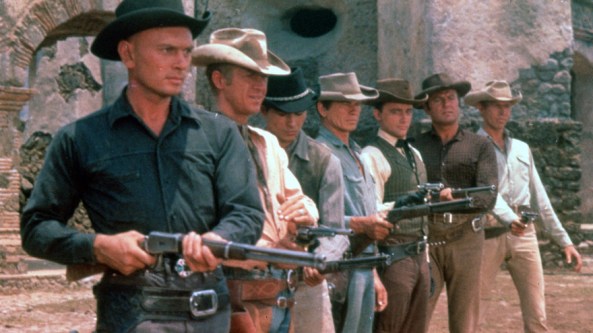
From left to right: Yul Brynner, Steve McQueen, Horst Buchholz, Charles Bronson, Robert Vaughn, Brad Dexter and James Coburn.
As a quick update: while Horner’s score does include the classic overture at the very end, the film itself does not live up to the high standard set by this 1960 classic. If given the choice, always go with this one.
See also: Film Soundtracks A-W
Don’t forget to like Film Music Central on Facebook 🙂
Share this Post

The Empire Strikes Back: “The Imperial March” by John Williams
The famous Imperial March a.k.a Darth Vader’s theme. This music never fails to send a chill down my spine. What’s interesting is the contrast between the main “Imperial March” that everyone knows and the softer “B” melody, that’s played in the middle. The woodwinds create an unbelievable sense of tension that sets the listener up for the return of the primary “A” melody which quickly modulates into a different key.


See also: Film Soundtracks A-W
Become a Patron of the blog at patreon.com/musicgamer460
Check out the YouTube channel (and consider hitting the subscribe button)
Don’t forget to like Film Music Central on Facebook 🙂
Share this Post

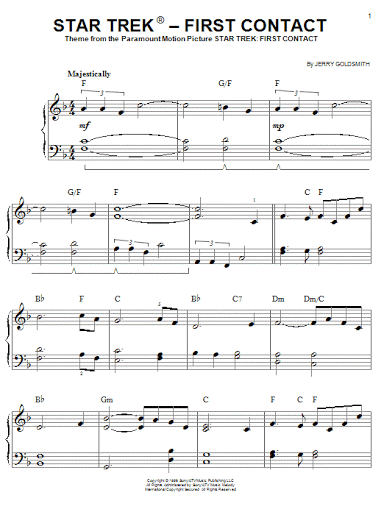
“Main Theme” from Star Trek First Contact by Jerry Goldsmith
This haunting theme is the main title from Star Trek: First Contact. This 1996 film is a continuation of a story begun in “The Best of Both Worlds Parts One and Two”, the third season finale and season four opener to Star Trek: The Next Generation. In those episodes, Captain Picard (Patrick Stewart) was kidnapped by the Borg and forcibly turned into a cyborg himself.
Now, six years later, the Borg have returned and Picard must confront his greatest enemy once and for all. I always found this theme to be incredibly beautiful. In fact, composer Jerry Goldsmith originally wrote this theme for the earlier film Star Trek V: The Final Frontier. In that earlier film, this theme represented “friendship,” namely the friendship that existed between Kirk, Spock and McCoy, who would literally do anything to help each other. To hear the theme in that movie, watch the opening scene when Kirk is climbing El Capitan, and you can hear a brief echo of the theme, which returns later in the campfire scene.
I hope you enjoy it.
Share this Post

Star Trek Insurrection:”Ba’Ku Village” (1998)
“Ba’Ku Village” is a beautiful piece from the opening of Star Trek: Insurrection (1998) by the late Jerry Goldsmith. Composed only two years after First Contact, Goldsmtih did a complete 180 degree turn in the feel of this score, opting for music that was more lyrical and Romantic in style (though still possessing plenty of action cues in the appropriate moments). This piece plays during the opening credits of the film (notably the last Star Trek film to feature credits at the beginning of the film) while the camera pans around the idyllic village of the Ba’Ku people.
As the primary melody ends, the music turns sinister, as it is revealed that the village is being secretly observed by Starfleet and their allies, the So’Nah (who have a secret connection to the Ba’Ku).
Feel free to share thoughts in the comments as well. If you like the music, check out the video below to see the opening credits of the movie (they built the set near Mammoth Lakes in California).
See also: Film Soundtracks A-W
Become a Patron of the blog at patreon.com/musicgamer460
Don’t forget to like Film Music Central on Facebook 🙂

 Film Music Central