The Aristocats “The Aristocats” (1970)

I often feel like the animated Disney films made during the 1970s get overlooked far too often as they’re made after the passing of Walt Disney and before the Disney Renaissance began. However, there were several animated gems made during this era and The Aristocats is one of them (it also has the distinction of being the last film project approved by Disney himself before his death in 1966). Set in Paris in the year 1910, The Aristocats follows a family of high-class felines that live with Madame, a retired opera singer. When Edgar, the family butler, learns that the cats will inherit the estate before he does, the disgruntled servant kidnaps the cats and abandons them in the French countryside, leading the cats into an adventure to get back to Paris and their home.

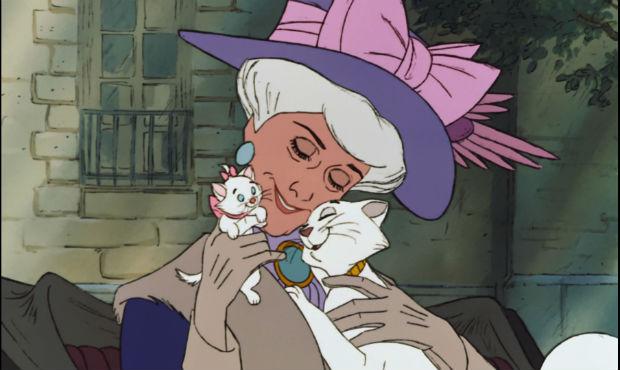
The titular song was performed by Maurice Chevalier, a legendary French singer and performer, who was actually talked out of retirement to do the song (his final contribution to the film industry as he died in 1972). The song describes all the advantages “aristocats” possess (‘aristocat’ being an obvious play on aristocrat) over ‘common’ cats and ends with the cats out with Madame on a carriage ride.

Which pet’s address
Is the finest in Paris?
Which pets possess
The longest pedigree?
Which pets get
To sleep on velvet mats?
Naturellement! The aristocats!

Which pets are blessed
With the fairest forms and faces?
Which pets know best
All the gentle social graces?
Which pets live
On cream and loving fats?
Naturellement! The aristocats!

The song plays out while we’re treated to the opening credits, as well as animations of the cats that will appear later in the film.
aristocats-disneyscreencaps.jpg

They show aristocratic bearing
When they’re seen
Upon an airing
And aristocratic flair
In what they do
And what they say!
Aristocats are never found
In alleyways or hanging around
The garbage cans where
Common kitties play, oh no!
Which pets are known
To never show their claws?
Which pets are prone
To hardly any flaws?
To which pets
Do the others tip their hats?
Naturellement! The aristocats!

I’ve always found it interesting that the film points out the year as 1910, as there aren’t many Disney films that specify a year. Perhaps I’m being morbid, but every time I see that date, I always remember that it was only a few years before the start of World War I, when the glitz and glamour of the 19th century disappeared. The year is also a reminder that this is a time of great change (even before the war began). For instance, while Madame is riding in a carriage, her lawyer drives up in a car (albeit a primitive one).

Also, fun piece of trivia: Hermione Baddeley, the voice of Madame, is also the voice of Auntie Shrew in The Secret of NIMH (1982) (another Disney credit includes Ellen in Mary Poppins (1964)).

I like “The Aristocats,” it’s a fun little song that provides a good opening to the film and I hope you enjoy listening to it. Let me know what you think of this song in the comments below and have a great day!

See also:

Disney/Dreamworks/Pixar/etc. Soundtracks A-Z

Become a Patron of the blog at patreon.com/musicgamer460

Check out the YouTube channel (and consider hitting the subscribe button)

Don’t forget to like Film Music Central on Facebook 🙂

Disturbing Bluth #6: Meeting Brutus in The Secret of NIMH (1982)

I couldn’t leave The Secret of NIMH without talking about this one moment in particular. To this day it never fails to make me jump in surprise (though thankfully not in fear like it used to), and that is the moment when Mrs. Brisby encounters Brutus the rat.

The Secret of NIMH (1982)- Into the Rosebush/Brutus

Up until this point, Brisby’s journey through the rose bush has only been mildly scary, but nothing close to disturbing (no mouse eating spiders this time). I’m still surprised that she got as far as she did without encountering any rats, but given we later learn that the rats are in a special meeting, it makes sense.

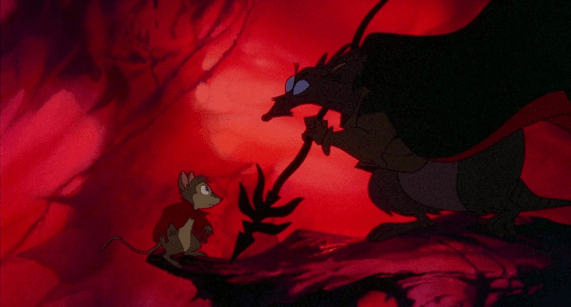
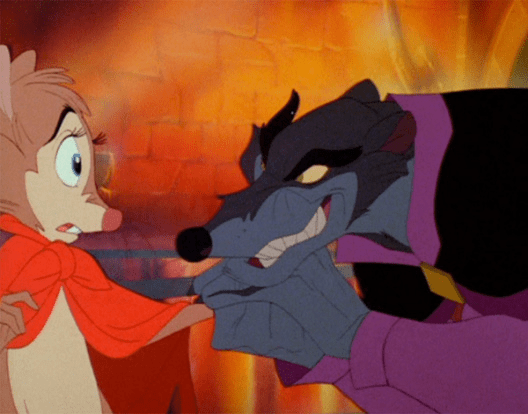
What makes the run-in with Brutus even more disturbing is, right before it happens, Mrs. Brisby discovers a beautiful garden (with awestruck music to highlight the moment). There are flowers everywhere and what looks like a jeweled brooch leading into the next part of the bush. But here is where Mrs. Brisby’s luck finally runs out. Just as she’s leaving this area, all the flowers around her close up and I’ve always taken this as a clue that something is about to happen because out of nowhere (literally, it’s a textbook jump scare) comes Brutus, a huge rat with a scary looking pike (that emits electricity when banged against the ground).

Secret-of-nimh-disneyscreencaps.com-4147.jpg

It doesn’t help any that the moment Brutus appears the background turns dark and red. Even worse, Brutus doesn’t say a word to the terrified mouse, even when she plainly states her purpose is to see Nicodemus and that the Great Owl sent her. If anything, the words seem to provoke Brutus into striking out with the pike again. It’s terrifying, disturbing, and for many years I did not watch this film because of this moment. The house sinking couldn’t keep me away, Jenner or the Great Owl couldn’t either, but Brutus? Oh yes, he scared me plenty, even though a closer examination of the scene reveals that the rat is only chasing her away and not actually trying to kill her.

The one thing about this scene that has always bothered me (besides its disturbing nature) is, why did Brutus stop chasing Mrs. Brisby? If he really wanted to make sure she was leaving, he should have chased her all the way back to the entrance. Instead he just…stopped. It just feels weird to me, especially since on the way back in with Mr. Ages, the pair of mice don’t encounter Brutus again (or if they do it’s not shown, but you’d think there’d be a scene where the older mouse would tell the rat “She’s with me.”)

That issue aside, what do you think of the scene where Mrs. Brisby encounters Brutus? Did it disturb you? Let me know your thoughts in the comments below and have a great day!

See also:

Become a Patron of the blog at patreon.com/musicgamer460

Check out the YouTube channel (and consider hitting the subscribe button)

Don’t forget to like Film Music Central on Facebook 🙂
Disturbing Bluth #1: The Secret of NIMH (Overview and Trivia)

Disturbing Bluth #2: The Secret of NIMH: Dragon the (Demon) Cat

Disturbing Bluth #3: The Great Owl in The Secret of NIMH (1982)

Disturbing Bluth #4: Jenner in The Secret of NIMH (1982)

Disturbing Bluth #5: The House is Sinking in The Secret of NIMH (1982)

Disturbing Bluth #5: The House is Sinking in The Secret of NIMH (1982)

*If you know anything about The Secret of NIMH then you KNEW this scene was going to be talked about eventually*

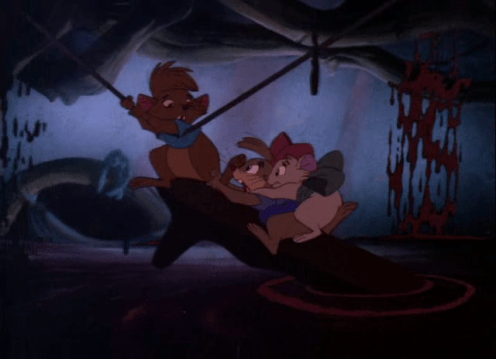
By far the most disturbing moment in The Secret of NIMH comes at the end of the film, though you don’t see it coming at first. This is because it appears that the big climax of the film has already happened: Jenner and Justin have just fought a huge duel that ended with Jenner dead (along with his associate Sullivan). With the rats now warned that NIMH is coming, Mrs. Brisby naturally heads back to the fallen house (which smacked into the ground rather hard when the machinery collapsed). The children are alright (WHY the rats didn’t take them out of the house before they started moving it I don’t know) and it seems like we’ve dodged a massive bullet….and then the music starts. This scene is a grade A example of why I study film music: even before the house starts sinking into the mud, the ominous suspenseful tone should tell you that something very bad is about to happen. Jerry Goldsmith, the composer for this film, put all his talents to work here and he did not disappoint.

84

The Secret of NIMH (1982): The House Sinking Scene

I should note, this was actually foreshadowed earlier in the film. When the rats and Mrs. Brisby are traveling on the boat, it’s revealed that much of the ground under the farm is hollow, with Justin muttering that it’s all going to collapse someday. The implication then, is that the force of the Brisby home smacking into the ground caused a partial collapse underground which is why the house is now sinking.

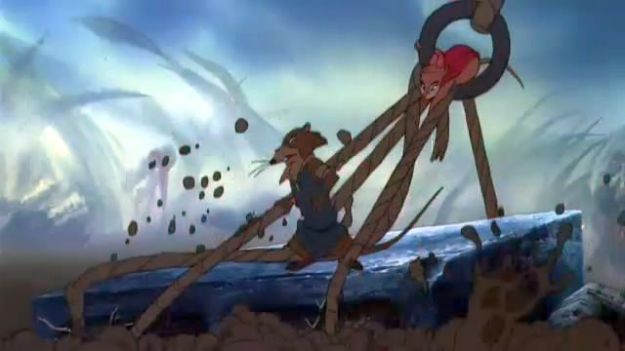
As the realization dawns that the house (with the children inside!!!) is sinking into the mud, the music rises quickly into a turmoil that reflects the panic of Mrs. Brisby and the surviving rats. After all, given the esteem they have for Jonathan Brisby, they couldn’t live with themselves if they let his children die. There’s a frantic race on to attach the house (built into a cement block) to any number of lines and stop it from sinking completely. Meanwhile, we actually get a look inside the house as it’s filling up with mud. There’s no sign of Timothy (who, I remind you, is bedridden) and the other children are shrieking “Get us out of here!!” This in itself is disturbing as you don’t normally see children (in animation or live-action) put into such direct peril. Oh it’s been implied before (such as the huntsman nearly stabbing Snow White) but it’s never been so immediate a danger as what we see now.

NIMH3569.png

The worst moment of the scene comes when the final line keeping the block up snaps and the home is pulled down into a whirlpool of mud while Mrs. Brisby is hauled to safety by Justin. The implications are downright macabre: according to what we just saw, all the children (and Auntie Shrew she’s still inside remember) are dead and Mrs. Brisby has now lost her entire family. It’s heart-wrenching, disturbing and once I fully grasped what was going on, this scene screwed me up in the head for years. Now, even though this is set right less than a minute later (in a spectacular piece of animation I might add), that doesn’t change the fact that we the audience had to go through this first.

This scene is the perfect example of Bluth’s belief that children can take just about anything so long as there is a happy ending afterward. Given my experience however, I don’t think this is true. But what do you think? Is the scene any less disturbing with the happy ending that follows? Please let me know your thoughts in the comments below and have a great day!

See also:

Disturbing Bluth #1: The Secret of NIMH (Overview and Trivia)

Disturbing Bluth #2: The Secret of NIMH: Dragon the (Demon) Cat

Disturbing Bluth #3: The Great Owl in The Secret of NIMH (1982)

Disturbing Bluth #4: Jenner in The Secret of NIMH (1982)

Become a Patron of the blog at patreon.com/musicgamer460

Check out the YouTube channel (and consider hitting the subscribe button)

Don’t forget to like Film Music Central on Facebook 🙂


Disturbing Bluth #4: Jenner in The Secret of NIMH (1982)

Given that The Secret of NIMH is 36 years old, I sometimes get the feeling that people have forgotten just how disturbing Jenner (the primary rat antagonist) really is. From the moment Mrs. Brisby arrives in the rats’ secret home under the rose bush, she hears about Jenner and how he keeps challenging Nicodemus for leadership of the rats. But there’s so much more to the villain that makes him deeply and truly disturbing.


The Secret of NIMH (1982): Jenner before the Council

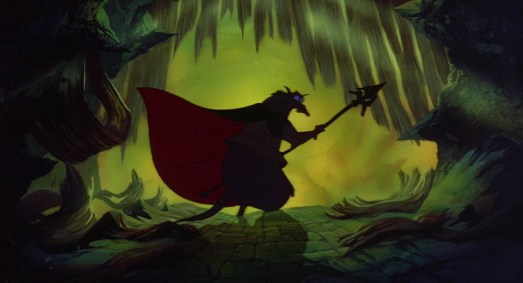
For starters, look at the picture above: this is when Jenner is putting on his ‘nice’ facade for Mrs. Brisby. Even when he’s trying to appear good he looks terrifying. Second, Paul Shenar, Jenner’s voice actor, gives the character a rich, deep voice. This makes Jenner a good speaker and also serves to partially hide how savage he can be. Part of what makes Jenner so disturbing is that he genuinely has no sense of long term consequences and his empathy is non-existent (making him something of a sociopath).

Even when confronted with the news that NIMH is coming to the rose bush in the morning (and deep down Jenner has to know there’s no reason for Mrs. Brisby to lie), Jenner decries her news as lies simply because it ruins his plans to stay in the rose bush. Third, Jenner is a master manipulator as can be seen in his interactions with Sullivan, a not-so-smart rat who finds himself roped into Jenner’s plans. Jenner openly mocks Sullivan, which is in itself cruel but not disturbing. He convinces the weak-willed rat to go along with him and that everything will be better once Nicodemus and Justin are dead (it’s implied that Jenner will kill the latter as well).

The Secret of NIMH (1982): Jenner’s Plan

Jenner: With Nicodemus out of the way, what’s to stop us from taking over?

Sullivan: Jenner, you can’t kill Nicodemus.

Jenner: No taste for blood, eh? They’ve taken the animal out of you.

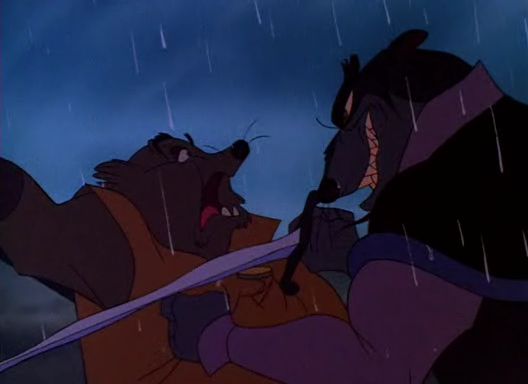
The disturbing part comes at the climax of the film when the Brisby home is being relocated by the rats using complex machinery. Jenner wants to sabotage the equipment so that Nicodemus will be killed in the ensuing collapse but Sullivan doesn’t want to do it. This prompts Jenner to hold Sullivan at sword point, implying that if he doesn’t go through with it, he’ll kill him.

Jenner: [Holding a sword to Sullivan’s throat] Don’t get any ideas, my friend. You’re in this up to your neck.

efa5c46c35baed4a7ffb3e8cd358e2e7--the-secret-of-nimh-art-gallery.jpg

The Secret of NIMH (1982): Jenner vs Justin

Despite this threat, it’s genuinely shocking when Jenner actually goes through with it in brutal fashion, slicing Sullivan’s throat with his sword when he throws Justin (Jenner’s rival) a weapon to defend himself. It’s one of the most graphic things I’ve ever seen happen to an animated character, but the best is saved for Jenner himself. After a lengthy sword fight, Jenner is wounded in the stomach by Justin, but not fatally. As Justin mobilizes the rats to get ready to leave, Jenner sneaks up from behind to deliver a killing blow…only to be literally stabbed in the back by a dying Sullivan, falling to his death in the mud.

Jenner is a character that gave me nightmares for years and he still remains one of the more disturbing aspects of The Secret of NIMH. What do you think of Jenner? Let me know your thoughts in the comments below and have a great day!

See also:

Disturbing Bluth #1: The Secret of NIMH (Overview and Trivia)

Disturbing Bluth #2: The Secret of NIMH: Dragon the (Demon) Cat

Disturbing Bluth #3: The Great Owl in The Secret of NIMH (1982)

Become a Patron of the blog at patreon.com/musicgamer460

Check out the YouTube channel (and consider hitting the subscribe button)

Don’t forget to like Film Music Central on Facebook 🙂

Disturbing Bluth #3: The Great Owl in The Secret of NIMH (1982)

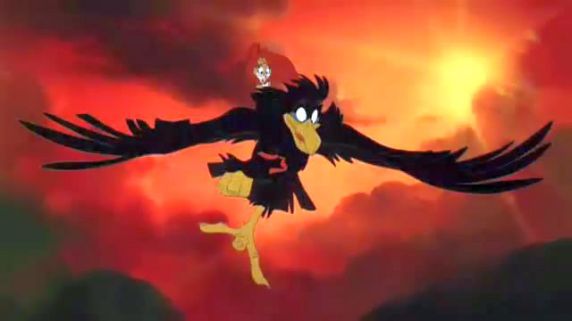
Early on in the story, the plot centers on Mrs. Brisby’s quest to speak to the Great Owl about how to keep her family safe from the farmer’s plow. Normally the family simply relocates, but the youngest son Timmy is sick with pneumonia and can’t go outside. Mrs. Brisby eventually agrees to be flown to the Great Owl’s tree by Jeremy (the talkative crow that she saved from Dragon).

Img-000415.png

The Great Owl in The Secret of NIMH (1982)

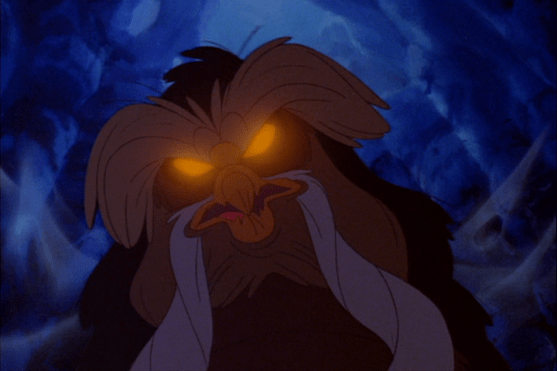
From the outset there’s already a minor level of disturbing to this scene. Even though the music is happy (as Jeremy is flying), the sky is bright red behind them (that’s not ominous at all). And the forest they approach doesn’t exactly look friendly either. Then there’s the matter of the owl’s tree itself. Go to the video of this scene and check out the entrance: it’s a dark, spooky tunnel filled with cobwebs (that image alone gave me nightmares) and then it gets worse! Just as Jeremy assumes there’s nobody home, you hear this unearthly sound come from inside, a loud rustling and then the deepest, most ominous voice intones “Step inside my house.” (I should mention the Great Owl was voiced by the legendary John Carradine). All of this is disturbing enough, the Great Owl doesn’t sound at all welcoming and, as Mrs. Brisby has pointed out several times, “owls EAT mice!”

34.jpg

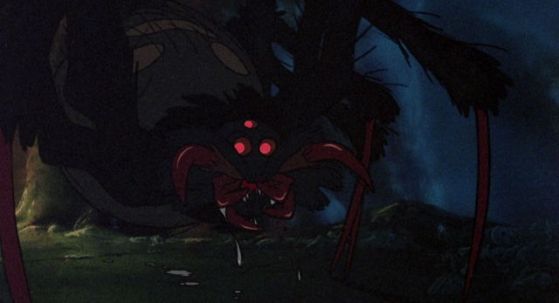
Regardless of her fear, Mrs. Brisby enters the tree and we swiftly come to the second most disturbing portion of this scene. As she unwittingly approaches the Great Owl (whom you can see on the right hand side if you look closely at a long shot of the inside of the tree), a terrifying spider descends behind her. As a lifelong arachnophobe, this moment has traumatized me for years (the ominous music doesn’t help in the slightest). But just as Mrs. Brisby notices the spider, out of nowhere a clawed foot reaches out and crushes it into a pile of goo. And that’s when you realize the owl is right there and he is TERRIFYING. His eyes are two glowing orbs and there’s a sickening moment when you realize his head is crooked upside down and he slowly wrenches it upright. Also he’s covered in cobwebs, which always spooked me for some reason.

Spider_(The_Secret_of_NIMH).jpg

Thankfully, as the scene progresses from here the level of disturbing falls dramatically as it comes out that the owl, for all his scariness, isn’t that bad (and he does give the best advice he can). That doesn’t change the fact that this scene with The Great Owl is highly disturbing (and there are worse examples to come in this film!)

What do you think of the Great Owl in The Secret of NIMH? Let me know your thoughts in the comments below and have a great day!

See also:

Disturbing Bluth #1: The Secret of NIMH (Overview and Trivia)

Disturbing Bluth #2: The Secret of NIMH: Dragon the (Demon) Cat

Become a Patron of the blog at patreon.com/musicgamer460

Check out the YouTube channel (and consider hitting the subscribe button)

Don’t forget to like Film Music Central on Facebook 🙂
The Hunchback of Notre Dame “Topsy Turvy” (1996)

I have mixed feelings about “Topsy Turvy.” While it’s a funny song to be sure, I can’t really get into it because I know what’s going to happen to Quasimodo at the end. Nevertheless, I should still look it over.

maxresdefault.jpg

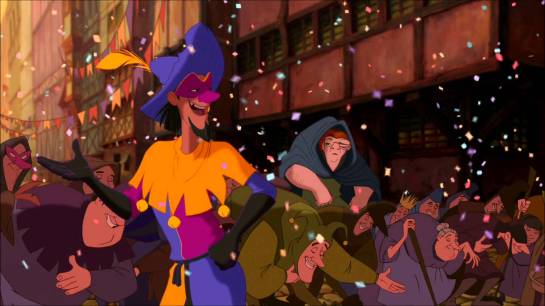
The song takes place during the Feast of Fools, based on a real-life yearly celebration held once a year during the Middle Ages (particularly in France). The Feast of Fools was held on around the Feast of the Circumcision (January 1st) and in fact the song lyrics even mention that the day of the feast is January 6th (“On the 6th of January”). Quasimodo has wanted to attend this event for years but of course Frollo, being the cruel man he is, won’t let him as he’s raised his ward to believe he’s nothing more than a monster who doesn’t belong among people (and letting him attend the celebration might reveal the lie). Now 20 years old, Quasimodo lets his gargoyle friends talk him into sneaking out to attend anyway just as the celebration is getting underway.

The festival starts with a seemingly solemn procession inviting all to attend:

Come one, come all
Leave your looms and milking stools, 
Coop the hens and pen the mules
Come one, come all
Close the churches and the schools 
It’s the day for breaking rules
Come and join the Feast of…FOOLS!!!

With the arrival of Clopin (the same Clopin we meet at the start of the film), the song goes from semi-serious to very silly and stays there for the rest of the song. Having never been around so many people in all his life, Quasimodo is immediately overwhelmed and unfortunately his discomfort draws the mischievous attention of Clopin (I don’t think there’s anything malicious in his behavior, he just wants to have some fun at Quasimodo’s expense).

maxresdefault (1).jpg

Once a year, we throw a party here in town
Once a year, we turn all Paris upside down
Every man’s a king and every king’s a clown 
Once again it’s Topsy Turvy Day

It’s the day the devil in us gets released (Good is bad and best is worst and west is east)
It’s the day we mock the prig and shock the priest (On the day we think the most of those with least)
Everything is topsy turvy
At the Feast of Fools

Topsy Turvy; Everything is upsy-daisy

Topsy Turvy; Everyone is acting crazy

Dross is gold and weeds are a bouquet
That’s the way on Topsy Turvy Day!

It’s while trying to get away from Clopin’s unwanted attention that Quasimodo accidentally stumbles into Esmeralda’s tent while she’s getting ready for her dance. Expecting to be reviled, Quasimodo is stunned when the beautiful gypsy simply shoos him away with a “No harm done” and a smile (and also complimenting his “mask” as she doesn’t realize that’s how he really looks).

Just before Esmeralda begins her dance, Frollo arrives in the most ominous looking carriage I’ve ever seen. Up until this point, you can almost enjoy the song but once he arrives that’s when you remember, oh yea, Quasimodo isn’t supposed to be out here, if Frollo catches him there’s going to be big trouble! But for now, Quasimodo is safely hidden and Clopin draws attention to the stage:

Come one, come all
Hurry, hurry; here’s your chance
See the mystery and romance 
Come one, come all
See the finest girl in France 
Make an entrance to entrance
Dance la Esmeralda…
Dance!

I have always loved this part of the scene when Esmeralda appears to dance in her beautiful red dress. Everyone is entranced with her, especially Quasimodo, Phoebus (who answers with an enthusiastic “Yes sir!” when Frollo mutters “Look at that disgusting display) and, though he hides it well, Frollo himself (ewwwww).

Technically the song continues after Esmeralda’s dance into the search for the new King of Fools but I’ve always regarded that scene as separate from the rest of the song (and I’ve already covered what happens in Disturbing Disney #20).

In conclusion, “Topsy Turvy” is a fun little song that serves to relax the audience before things get really twisted with the King of Fools incident. What do you think about this song? Let me know your thoughts in the comments below and have a great day!

See also:

Disney/Dreamworks/Pixar/etc. Soundtracks A-Z

The Hunchback of Notre Dame “The Bells of Notre Dame” (1996)

The Hunchback of Notre Dame “Out There” (1996)

The Hunchback of Notre Dame “God Help the Outcasts” (1996)

The Hunchback of Notre Dame “Heaven’s Light/Hellfire” (1996)

The Hunchback of Notre Dame “The Court of Miracles” (1996)

Become a Patron of the blog at patreon.com/musicgamer460

Check out the YouTube channel (and consider hitting the subscribe button)

Don’t forget to like Film Music Central on Facebook 🙂
Contenders for Best Original Score: a first look

It seems like the Oscars were only a short time ago but believe it or not it’s already time to start looking at contenders for next year. As always, the award that means the most to me is the Oscar for Best Original Score and while there’s still several months left in 2018 there are already several front-runners emerging.

qira-han-solo-a-star-wars-story

The first front-runner I have to talk about is Solo: A Star Wars Story. I know it doesn’t seem like a viable candidate but hear me out. First of all, the score was composed by John Powell, an accomplished composer perhaps best known for creating the Oscar-nominated score for How To Train Your Dragon (2011). Not only that, the main theme of Solo was composed by the legendary John Williams who has been nominated for an Oscar 51 times. While the film undoubtedly has problems, the score is not one of them and I would not be surprised if it received a nomination.

operation-finale

Another composer sure to get a nomination is Alexandre Desplat, the composer of Operation Finale, a Munich-esque film that recounts the hunt for Nazi war criminal Adolf Eichmann. And if that doesn’t garner an Oscar nod, his work on Wes Anderson’s Isle of Dogs just might. Desplat has collaborated several times with Anderson and two previous films, Fantastic Mr. Fox and The Grand Budapest Hotel both earned nominations for the composer.

However the odds-on favorite to win the Oscar, according to SportsBettingDime is Marco Beltrami for his work on The Quiet Place. As the plot of the film requires the main characters to evade vicious aliens by remaining completely silent, the music needs to do a lot of the storytelling. Beltrami’s score is a large part of why The Quiet Place was so successful.

In my opinion, any of these composers have a fair chance at winning Best Original Score next year, but what do you think? Do any of these composers stand a chance at winning the Oscar? Let me know your thoughts in the comments below and have a great day!

Become a Patron of the blog at patreon.com/musicgamer460

Check out the YouTube channel (and consider hitting the subscribe button)

Don’t forget to like Film Music Central on Facebook 🙂


The Hunchback of Notre Dame “Heaven’s Light/Hellfire” (1996)

d-hevaen-2

Beginning with Pocahontas in 1995, Disney films began to slowly put twists on the traditional “happily ever after” ending. In the case of The Hunchback of Notre Dame, while Quasimodo clearly has feelings for Esmeralda, she ultimately falls in love with Phoebus, the one-time captain of Frollo’s guards. Before that happens though, the idea that Quasimodo and Esmeralda might end up together is teased in “Heaven’s Light” which takes place after the bell ringer helps the beautiful gypsy escape the cathedral.

Under Frollo’s “instruction,” Quasimodo has grown up believing that he will never find love, that no one would ever want him. But Esmeralda has proven that to be not true, so for the first time in his life, he’s dreaming of love:

So many times out there
I’ve watched a happy pair
Of lovers walking in the night
They had a kind of glow around them
It almost looked like Heaven’s light

I knew I’d never know
That warm and loving glow
Though I might wish with all my might
No face as hideous as my face
Was ever meant for Heaven’s light

But suddenly an angel has smiled at me
And kissed my cheek without a trace of fright

I dare to dream that she
Might even care for me
And as I ring these bells tonight
My cold, dark tower seems so bright
I swear it must be Heaven’s light

Thus encouraged, Quasimodo returns to ringing the bells for the evening service and the scene transitions to Frollo in his chambers at the Palace of Justice. Accompanied by the strains of the Confiteor, a penitential prayer, Frollo addresses himself to the Virgin Mary in a prayer of his own. As pure as Quasimodo’s song of love was only moments ago, Frollo’s is the complete opposite. This is the prayer of a hypocrite, one of sees the faults in everyone but not his own.

d-hell-5.png

The Hunchback of Notre Dame “Hellfire” (1996)

Confiteor Deo Omnipotenti (I confess to God almighty)
Beatae Mariae semper Virgini (To blessed Mary ever Virgin)
Beato Michaeli archangelo (To the blessed archangel Michael)
Sanctis apostolis omnibus sanctis (To the holy apostles, to all the saints)

Beata Maria, You know I am a righteous man
Of my virtue I am justly proud

Beata Maria
You know I’m so much purer than
The common, vulgar, weak, licentious crowd

Then tell me, Maria
Why I see her dancing there
Why her smold’ring eyes still scorch my soul

I feel her, I see her
The sun caught in her raven hair
Is blazing in me out of all control

Like fire, Hellfire, This fire in my skin
This burning, Desire, Is turning me to sin

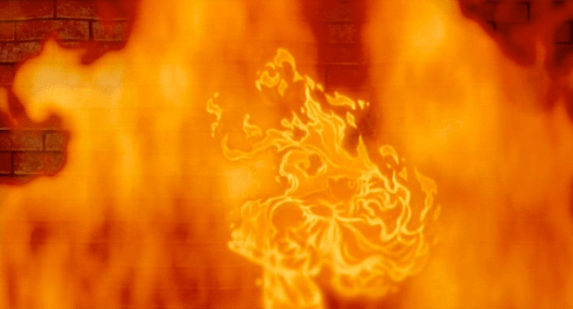
It took me so many years to understand everything that was happening in this sequence (I can tell you as a child the subtext went completely over my head). Basically, in the midst of his prayers, Frollo can’t get over the fact that he’s physically attracted to Esmeralda (a very beautiful woman). In his mind, he’s above this kind of desire (or at least he should be) and it’s driving him insane that he feels this way. Incidentally, the animation of Esmeralda dancing in the flames nearly didn’t make it into the film, as it initially appeared that she was nude (that’s why you can clearly see the outline of her dress in the fire).

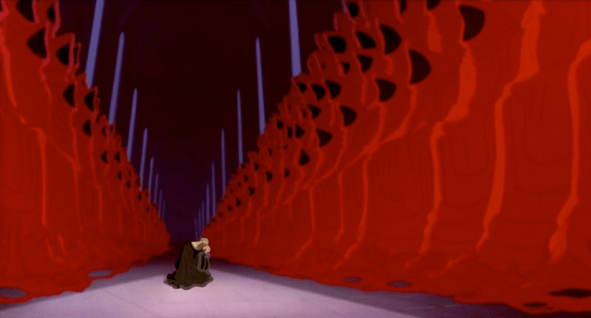
And having acknowledged his descent into sin, Frollo is seemingly confronted by a hall full of heavenly judges in red robes. Pleading these desires aren’t his fault, the judges answer back Mea Culpa (It IS my fault). Again, we have to remember Frollo’s one weakness: above all else he fears being condemned to Hell and in his mind the blame lies squarely on Esmeralda.

Protect me, Maria
Don’t let the siren cast her spell
Don’t let her fire sear my flesh and bone
Destroy Esmeralda
And let her taste the fires of Hell!
Or else let her be mine and mine alone

maxresdefault

This is one of the more twisted motivations any Disney villain has ever had. If Esmeralda can’t (or won’t) be his, he’ll destroy her. This is a messed up situation on any level and it gets even worse when a guard reports that Esmeralda has escaped the cathedral which is actually a really big deal. This means that Frollo likely sent the guard to fetch the gypsy and bring her back to his chambers to do who-knows-what to her!! Is it any wonder this is regarded as the darkest film of the Disney Renaissance?

“Hellfire” has gone down in history as the ultimate Disney Villain song and I don’t see any reason to disagree. But what do you think? Let me know your thoughts on “Heaven’s Light” and “Hellfire” in the comments below and have a great day!

See also:

Disney/Dreamworks/Pixar/etc. Soundtracks A-Z

The Hunchback of Notre Dame “The Bells of Notre Dame” (1996)

The Hunchback of Notre Dame “Out There” (1996)

The Hunchback of Notre Dame “Topsy Turvy” (1996)

The Hunchback of Notre Dame “God Help the Outcasts” (1996)

The Hunchback of Notre Dame “The Court of Miracles” (1996)

Become a Patron of the blog at patreon.com/musicgamer460

Check out the YouTube channel (and consider hitting the subscribe button)

Don’t forget to like Film Music Central on Facebook 🙂
The Hunchback of Notre Dame “The Bells of Notre Dame” (1996)

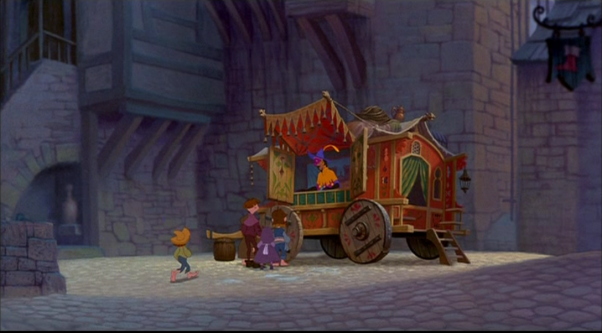
As far as openings of a Disney movie go, The Hunchback of Notre Dame is pretty dark from the beginning, though you initially don’t think so. The song begins with Clopin gathering children to his stall to tell them the story of the mysterious bell ringer who lives in the towers of the cathedral.


Morning in Paris, the city awakes
To the bells of Notre Dame
The fisherman fishes, the bakerman bakes
To the bells of Notre Dame
To the big bells as loud as the thunder
To the little bells soft as a psalm
And some say the soul of the city’s
The toll of the bells
The bells of Notre Dame

You know things are going to be interesting though, when Clopin begins his story with “It’s a tale, a tale of a man…and a monster…” The story then flashes back twenty years to a group of gypsies who are sneaking into Paris.

d-q-mom-3.png

Dark was the night when our tale was begun
On the docks near Notre Dame

Four frightened gypsies slid silently under
The docks near Notre Dame

But a trap had been laid for the gypsies
And they gazed up in fear and alarm
At a figure whose clutches
Were iron as much as the bells, the bells of Notre Dame

Judge Claude Frollo longed to purge the world of vice and sin,

And he saw corruption everywhere, except within

The verses here are interspersed with excerpts from the Latin mass, Kyrie Eleison (Lord have mercy) and Dies Irae (Day of Wrath). This is one detail that I’ve always loved about the score for The Hunchback of Notre Dame, the connection to the mass, which back in the time this film was set in was a big deal in people’s daily lives.

The story is already dark enough: the gypsies are captured and arrested for no other crime than being gypsies, but then it gets worse. A soldier notices the bundle the woman is carrying and Frollo assumes it’s stolen goods when a quick check would have revealed it’s just a baby. Instead, Frollo (the best example of a hypocrite you’ll find in any Disney film) callously demands the bundle be taken away which prompts the woman to run for her life with her baby with the strains of Dies Irae in the background. It’s a pulse-pounding sequence as the woman dodges and leaps through the snowy streets of Paris with Frollo close behind on his black horse (he’s the villain so naturally it’s a black horse).

This chase leads to one of the most shocking moments in any Disney film (so shocking that I’m still contemplating adding it to the Disturbing Disney series). First, at the steps of the cathedral, Frollo seizes the baby, causing the mother to fall back and hit her head on the stone steps, killing her instantly. Then, when Frollo realizes he’s holding a baby, one he deems a ‘monster’ because of its deformities, he spots a well in the square and rides over to drop the baby in!! Let me repeat that: the villain of the film was clearly attempting infanticide (in a Disney film) and was only stopped because the archdeacon intervened!

I love the interchange between the archdeacon (David Ogden Stiers) and Frollo. The latter obviously feels no guilt for what has happened and his callousness infuriates the priest.

Frollo_The_Bells_of_Notre_Dame.png

Archdeacon: (singing) See there the innocent blood you have spilt
On the steps of Notre Dame
Frollo: I am guiltless. She ran, I pursued.
Archdeacon: Now you would add this child’s blood to your guilt
On the steps of Notre Dame?
Frollo:  My conscience is clear
Archdeacon: You can lie to yourself and your minions
You can claim that you haven’t a qualm
But you never can run from nor hide what you’ve done from the eyes
The very eyes of Notre Dame

And for one time in his life of power and control, 

Frollo felt a twinge of fear for his immortal soul

There’s actually a double meaning in the archdeacon’s last line. “The eyes of Notre Dame” doesn’t just refer to the eyes of the sculptures covering the cathedral. It can also refer to Our Lady, meaning the Virgin Mary (who is greatly revered in Roman Catholicism). This last portion of the song sets up Frollo’s one weakness, if you can call it that. Above all else, he fears going to Hell when he dies. That’s why he accepts the punishment of raising Quasimodo for the rest of his days (though I’m sure keeping him locked up in the bell tower was not what the archdeacon had in mind).

“The Bells of Notre Dame” provides a beautifully crafted introduction to the film, one of the best in the Disney Renaissance. What do you think about it? Let me know your thoughts in the comments below and have a great day!

See also:

Disney/Dreamworks/Pixar/etc. Soundtracks A-Z

The Hunchback of Notre Dame “Out There” (1996)

The Hunchback of Notre Dame “Topsy Turvy” (1996)

The Hunchback of Notre Dame “God Help the Outcasts” (1996)

The Hunchback of Notre Dame “Heaven’s Light/Hellfire” (1996)

The Hunchback of Notre Dame “The Court of Miracles” (1996)

Become a Patron of the blog at patreon.com/musicgamer460

Check out the YouTube channel (and consider hitting the subscribe button)

Don’t forget to like Film Music Central on Facebook 🙂
The Emperor’s New Groove “Perfect World” (2000)

Emperor Kuzco from The Emperor’s New Groove might just be the most spoiled rotten Disney character ever created. This is exemplified by the opening song of the film in which we get to see a day in the life of the adolescent emperor.

There are despots and dictators
Political manipulators
There are blue bloods with the intellects of fleas
There are kings and petty tyrants
Who are so lacking in refinements
They’d be better suited swinging from the trees

He was born and raised to rule
No one has ever been this cool
In a thousand years of aristocracy
An enigma and a mystery
In Meso American History
The quintessence of perfection that is he

who-are-so-lacking-in-refinements.jpg

Kuzco literally has everything you can imagine done for him. Examples include: being carried in a throne up the stairs; having an entirely new hallway created on the spot when he wants to go a different way; a full course banquet delivered (and fed to him by servants) at the snap of his fingers; and of course, he has his own personal singer (Tom Jones) to perform his “theme song” which is what “Perfect World” is meant to be. The gist is simple: everything revolves around Kuzco and the emperor loves it. And really, who wouldn’t love being spoiled and pampered around the clock? I can’t think of another Disney character who comes close to being this indulged (if you think of an example please let me know in the comments below).

He’s the sovereign lord of the nation
He’s the hippest dude in creation
He’s a hep cat in the emperor’s new clothes
Years of such selective breeding
Generations have been leading
To this miracle of life that we all know

What’s his name?
Kuzco, Kuzco (That’s his name)
Kuzco (He’s the king of the world)
Kuzco, Kuzco (Is he hip or what?)
Kuzco (Ya)

1_Fotor-1.jpg

Even before the song is over, however, there are signs that having his every whim indulged from infancy has created a…less than healthy mindset shall we say? In one of my favorite comedic moments in any Disney film, the song is literally brought to a screeching halt when Kuzco bumps into an elderly man (who admittedly is trying to get out of the way when he sees the emperor coming). Instead of apologizing or just carrying on, Kuzco pouts and whines “You threw off my groove!” This prompts a guard to come by, grab the poor guy by the scruff of his neck and toss him out the window, before Kuzco glares at the singer and quips “You were saying?” The song resumes immediately and it becomes clear that all of this is happening, not because they want to do this, but because everyone wants to avoid being thrown out the window when the emperor gets upset!

He’s the sovereign lord of the nation
He’s the hippest cat in creation
He’s the alpha, the omega, a to z
And this perfect world will spin
Around his every little whim
‘Cos this perfect world begins and ends with (Kuzco: Me)

What’s his name?
Kuzco, Kuzco, Kuzco
Kuzco (That’s his name)
Kuzco, Kuzco (Is he hip or what)
kuzco (Don’t you know he’s the king of the world?)
Kuzco-(oh ya)-oooo (ow!)

Of course, Kuzco’s behavior during the song doesn’t come close to preparing the audience for the lengths he’s willing to go to get what he wants (like demolishing an entire village for a swimming pool with less than a day’s notice), but it still does an admirable job setting up the character.

One note I like to share about this song: the first verse makes reference to “Mesoamerican history” which sounds great except…the term refers to Mexico and Central America. The Emperor’s New Groove takes place in Peru which is firmly in South America. In the grand scheme of things it’s a minor nitpick, but I like to point it out when I get the chance.

What do you think of “Perfect World”? Let me know your thoughts in the comments below and have a great day!

See also:

Disney/Dreamworks/Pixar/etc. Soundtracks A-Z

Become a Patron of the blog at patreon.com/musicgamer460

Check out the YouTube channel (and consider hitting the subscribe button)

Don’t forget to like Film Music Central on Facebook 🙂