In 1991, Walt Disney Studios released The Rocketeer, a period film set in 1938, which told the story of how a stunt pilot named Cliff Secord discovered a prototype jetpack that could enable him to fly without a plane. He uses this device to become “The Rocketeer”, a hero and a media sensation. Before the story is over, Cliff will have to use all his skills to save the girl he loves from some Nazi spies, including one hidden right in their midst!
While the movie was favorably received, it didn’t perform well enough to justify continuing the story and plans for a set of sequels were cancelled (which is a shame, I remember enjoying this movie very much, though I found a hard time accepting Timothy Dalton as a villain).
James Horner was selected to compose and conduct the score for this film and the score is still highly praised as one of the stronger elements of the film. I think it’s interesting to listen to how he composed music before his big successes in 1995 and 1997 respectively. I hope you enjoy this all too brief interview with James Horner regarding his work on this film. Please enjoy!
In the grand scheme of Beauty and the Beast, “Be Our Guest” serves as Belle’s proper introduction to the various enchanted inhabitants of the castle under the elaborate guise of providing her with a forbidden dinner (since she refused to dine with the Beast, he had decided that she wouldn’t eat at all, unless it was with him). It’s a masterful production number and one of the visual highlights of the film. But it wasn’t always going to be Belle as the recipient.
Let me explain: it’s no secret that movie scripts often go through many revisions, with scenes (or songs) being moved around to different points in the movie before a final order is decided on. With Beauty and the Beast, the storyline was originally going to be somewhat different. According to an earlier draft, Maurice was going to be serenaded with “Be Our Guest” until the commotion attracted the Beast, who would break the party up by dragging the poor guy into the dungeon. The sequence was partially animated (with Maurice) until the writers realized that, story-wise, placing the song this early in would drag down the story and that it should be Belle receiving this introduction, not her father. So the song was moved to it’s current position and Maurice’s scene was changed to the “spot of tea” moment we know today.
When I was young, I always thought that the Beast would charge into the room at any moment and be furiously angry that the servants (and Belle) defied him. It kept me from properly enjoying this moment for a while.
The song is led by Lumiere (Jerry Orbach) who performs in the style of famed French singer Maurice Chevalier (1888-1972). Poor Cogsworth (David Ogden Stiers) spends most of the song trying to hush everything up, but even he’s swept up into it by the end. There’s a lot of food paraded past (and presumably Belle eats her fill, even though she’s not seen to eat a lot), a cabaret performed by the cutlery, dancing tea cups, singing kitchen pots, etc. and so on.
Ma cherie Mademoiselle, It is with deepest pride and greatest pleasure That we welcome you tonight. And now, we invite you to relax, Let us pull up a chair As the dining room proudly presents – Your dinner!
Be… our… guest!
Be our guest! Put our service to the test Tie your napkin ’round your neck, cherie And we’ll provide the rest
Soup du jour Hot hors d’oeuvres Why, we only live to serve Try the grey stuff It’s delicious! Don’t believe me? Ask the dishes
They can sing! They can dance! After all, Miss, this is France! And the dinner here is never second best!
Go on, unfold your menu Take a glance and then you’ll Be our guest Oui, our guest Be our guest!
There is a rather interesting interlude in the song, and for me it’s always created a bit of a problem. The music turns rather somber and Lumiere expresses how lonely and bored they’ve been without anyone to serve:
Life is so unnerving For a servant who’s not serving He’s not whole without a soul to wait upon Ah, those good old days when we were useful Suddenly those good old days are gone
Ten years we’ve been rusting Needing so much more than dusting Needing exercise, a chance to use our skills!
It’s interesting that Lumiere notes this state of affairs has existed for ten years. Remember in the prologue, it was stated that the rose would bloom until the Prince turned 21. In that case, wouldn’t that have made the Prince 11 when he was enchanted? Cause in those stained-glass pictures, he doesn’t look 11 years old, and that’s why it’s a problem, it’s something of a plot hole that you can’t really resolve.
Aside from “Belle” and “Tale as Old as Time,” “Be Our Guest” is one of the most recognizable Disney songs out there. Who wouldn’t love being sung to by a bunch of enchanted objects? That’s about it for “Be Our Guest” I hope you enjoyed it.
*all images are the property of Walt Disney Studios
I have a confession: knowing that Shrek is fifteen years old today makes me feel exceptionally old (and I’m only 27).
On this day in film history, Shrek was released by DreamWorks Pictures and established the studio as a competitor to Pixar in the world of computer animation (as the technology used in Shrek was state of the art at the time of release). The film is a combination of a parody film and a fractured fairy tale in that, at times the film openly mocks pop culture (Duloc is a parody of Disneyland) and it also twists the original fairy tales (princesses are supposed to be rescued by handsome princes and defended FROM the ogre, not vice versa).
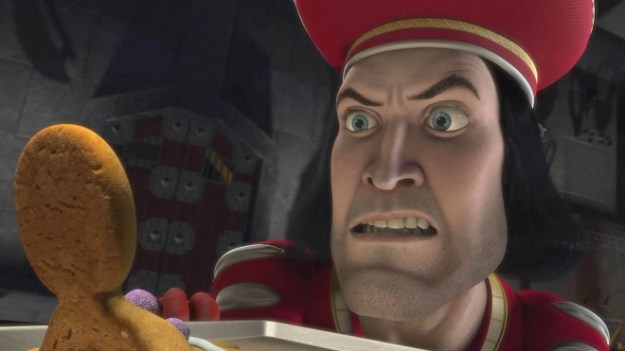
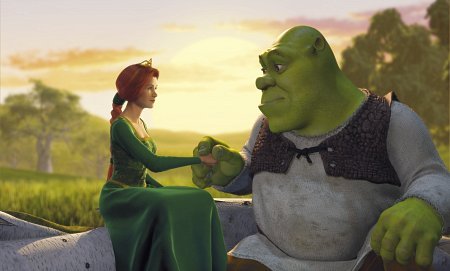
In this story, reclusive ogre Shrek (Mike Meyers) is forced into a quest to rescue Princess Fiona (Cameron Diaz) for the spineless Lord Farquad (John Lithgow) when his swamp home is overrun with fairy tale refugees driven out by Farquad (who desires perfection above all else, and fairy tale creatures don’t belong as far as he is concerned). Fiona appears to be a spoiled princess upon first meeting: she’s miffed that she’s been rescued by an ogre and not “Prince Charming”, she’s rude and demanding, but over time she, Shrek and Shrek’s annoying sidekick Donkey (Eddie Murphy) reach an understanding.
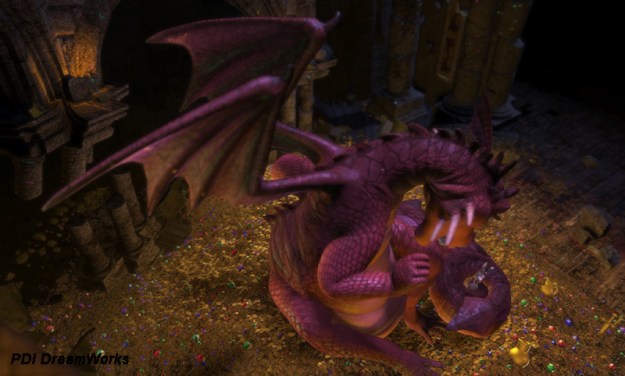
But Fiona has a BIG secret of her own. It turns out (*spoiler alert*) that she’s under a curse: by day she’s a gorgeous princess, but by night, she turns into an ogre (a female version of Shrek, to be precise). She tries to tell Shrek about it because she discovers she wants to go off with the ogre (and to heck with “happily ever after”) but due to a misunderstanding, Shrek thinks that Fiona hates him for being a “beast” (not realizing that Fiona was talking about herself). As a result, an unhappy Fiona ends up being led away by Lord Farquad (who also has no idea about his bride-to-be’s secret). Thankfully, due to some intervention by Donkey, Shrek comes to accept that he does love Fiona after all and saves her at the last minute from being wed to Farquad (who himself ends up as a dragon’s dinner in a particularly satisfying moment).
In one final twist, the curse is broken, but instead of remaining human (as you might expect in a traditional fairy tale film), Fiona remains an ogre (which makes her absolutely beautiful in Shrek’s eyes) and they get married and ride off in an onion carriage (a parody of Cinderella’s pumpkin carriage), but is it happily ever after? Shrek 2 might have something to say about that…
I remember going to see this movie in theaters and laughing hysterically for most of the story. The film does appear slightly dated fifteen years down the road (CGI has advanced by leaps and bounds since then) but it’s still a cute family film (that will hopefully be added to my collection someday).
Signs (2002) was actually the third collaboration between composer James Newton Howard and director M. Night Shyamalan (the others being The Sixth Sense (1999) and Unbreakable (2000)). For this film, in which a family is terrorized by mysterious aliens, Howard created a score that drips with tension almost from the start.
This musical trend is inspired by Shyamalan’s approach to telling the story, a story that keeps the audience hooked until that last moment (which I think is one of the biggest WTF? moments in all of cinema, let’s just say that the payoff to all this tension isn’t exactly what you’d expect).
It’s hard to believe this film is 14 years old already, I remember when all my classmates in school were talking about it. Please enjoy James Newton Howard’s discussion of the film score.
(prepare for a rant/tirade because I have some issues with this movie)
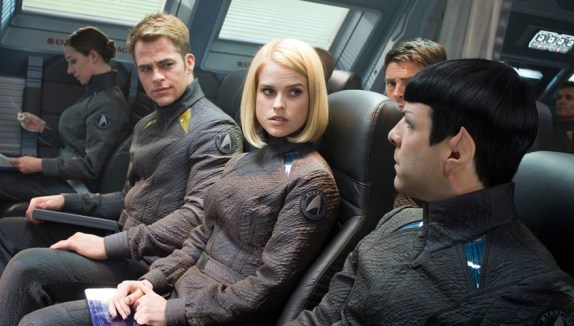
Oh the deja vu….like the first Star Trek film in the reboot era, I had high hopes for Into Darkness, especially once it was announced that Benedict Cumberbatch was cast as the villain. Everything looked great, the story details sounded good, the teaser was amazing, but then one little detail came to my attention: the name of Cumberbatch’s character was Khan.
Having seen every Star Trek film there is (and almost all of the TV series to boot), knowing the villain was named Khan meant only one thing: Into Darkness HAD to be a remake of Wrath of Khan (1984), the film which is considered by many to be the greatest in the series. Oh wait, that’s right, I’m sorry, it’s not a remake, it’s *clears throat” “How the events of Wrath of Khan MIGHT have occurred set in an alternate universe.” Which is a clever way of saying IT’S.A.REMAKE!!
I MIGHT have been able to come to terms with this if the story had been really good, but it’s not. Every plot detail begs for a comparison with the original film, and for me, the original comes out on top. I’m not saying Cumberbatch did a bad job per se, but compared to Ricardo Montalban’s epic performance? Nope, it’s not even close.
The only twist that got my attention is that they flip-flopped who sacrificed themselves to save the ship, that was the one twist I found believable. Of course, Kirk being as devoted to his ship and crew as he is, would surely have done what Spock did in Wrath of Khan, given half the opportunity.
The ending wasn’t half bad either. True, Khan is still alive at film’s end (which means he might pop up sometime in the future), and McCoy’s final line “Five years in space, God help me.” is pretty funny (and perfectly in character too), and yet, I don’t like it, I CAN’T like it. If you’re going to reboot a series, do what the James Bond writers did and keep coming up with original material, only set in a new context, don’t try to rehash the original films and use the “alternate universe” as an excuse.
For me, truly, Star Trek Beyond is the studio’s last chance to keep me as a fan of the new films. If this doesn’t blow me away, well, there’s always the original films to enjoy.
This concludes my rant. (I know I take a bit of a hard line when it comes to the remakes, it’s just that the original films are very special to me, and if you like the rebooted series, that’s ok! Promise!)
In case the audience had any doubts about Belle’s feelings following Gaston’s ill-fated marriage proposal, the reprise to “Belle” (which I’ve also heard called “Madame Gaston”) sets the record completely straight.
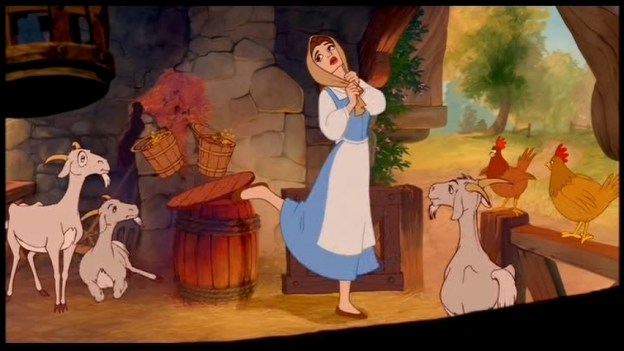
Once Gaston leaves (a furious, mud-soaked mess), Belle flies into a tirade as she sets about her chores feeding the farm animals, mocking the “cozy life” Gaston had propositioned her with only moments ago:
Can you imagine, he asked me to MARRY him/ME, the wife of that boorish, BRAINLESS…
Madame Gaston! Can’t you just see it? Madame, Gaston, his “little wife”!
No sir, not me, I guarantee it, I want much more than this provincial life!!!
I want adventure in the great wide somewhere, I want it more than I can tell…
And for once it might be grand, to have someone, understand…
I want so much more than they’ve got planned…
I can completely empathize with how Belle feels at this moment (and I know many others can too). It is downright maddening to have your dreams and aspirations be ignored (or worse, derided) by everybody you know, and the pressure to “be normal” can be overwhelming. But Belle isn’t going to give in, she’s going to have her adventure, whether the townspeople like it or not (you go Belle!)
This moment is really as close as Belle comes to making a wish about meeting her Prince Charming and getting out of the small village, and it seems this wish is granted too, because no sooner does the song end than a terrified Philippe (the family horse) comes running up to her without her father, which leads Belle to ride Philippe to look for him, which leads her to…the castle!!!
Next time: “Be Our Guest” (and I’ll tell you a secret, Belle wasn’t always the “guest” in question, but that’s for later. Until then!!!)
*all images are the property of Walt Disney Studios
Up first (in terms of dates): 14 years ago today, Episode II: Attack of the Clones, launched into theaters and (correct me if I’m wrong) is considered the weakest film in the prequel trilogy, largely due to the clunky, unnatural, and at times downright awkward “romantic” moments between a teenaged Anakin Skywalker (now played by Hayden Christensen) and an adult Padme Amidala (Natalie Portman).
I was happily oblivious to all of these flaws when I saw this movie in the theater (I was only thirteen at the time, what did I know about good or bad dialogue? I was just excited to see Star Wars in the movie theater). But now that I’m older, I (somewhat reluctantly) have to agree that this isn’t the best entry in the series (Hayden Christensen’s acting isn’t THAT bad though).
Episode II takes place about ten years after Episode I and the extremely Force-strong boy from Tatooine has grown up into an exceptionally moody Padawan, still mentored by the ever-exasperated Obi-Wan Kenobi (Ewan McGregor). A state of civil war is brewing in the Republic, as the Separatist movement, led by Count Dooku (Christopher Lee), threatens the peace. The Jedi are oblivious to the fact that Chancellor Palpatine (Ian McDiarmid) is actually the Sith Lord Darth Sidious, and that he has been manipulating galactic events for years. Anakin has grown to view the chancellor as a trusted advisor, and is also struggling with his growing feelings for the now-Senator Amidala.
For all the movie’s flaws, how cool is it that Christopher Lee plays a former Jedi?? And how awesome is it that Yoda is revealed as a bad-ass fighter! (It’s CGI-ed to death but it’s still pretty cool I think).
The Clone Wars themselves are only mentioned twice in the original Star Wars film (Luke: “You fought in the Clone Wars?” and in the Leia recording: “…Years ago you served my father in the Clone Wars…”) but we really knew nothing else about them. Now this movie was allegedly going to show us what the Clone Wars were all about, which excited many. Unfortunately, while there are some pretty impressive moments (the revelation that the clones are the predecessors of Storm troopers comes to mind, along with the impressive-as-always lightsaber battles), the story is really bogged down by way too much CGI, a weird as heck romance subplot, and a shade too much politics.
Musically though, the film is great. John Williams returned once again to score the film and I firmly believe his music made the film better than it might have been otherwise. One of my favorite moments comes at the end of the film (right before the scene showing Anakin and Padme getting married in secret): the Jedi are watching the clone troopers arrive on Coruscant and Yoda sternly reminds them all that the fight is far from over because “begun, the Clone Wars have” and then, you hear IT, a clear refrain of the Imperial March (aka “Darth Vader’s theme”). Williams only used a clear rendition of that theme once in The Phantom Menace (when Yoda tells Obi-Wan “grave danger do I fear in his training”), but Anakin’s “good” theme was otherwise built on a rendition of the March placed in a major key (the original is in minor). Now though, as the clone ships land (clearly an early version of Star Destroyers), the camera pans over the assembled troopers and a loud rendition of the Imperial March plays, and there is no mistaking it. The Jedi don’t know it yet, but the final seeds have been sown for their annihilation.
(Incidentally, if anyone was curious: Yoda trained Dooku, Dooku trained Qui-Gon, Qui-Gon trained Obi-Wan and Obi-Wan trained Anakin).
Have a good day!
*all images are the property of 20th Century Fox/Walt Disney Studios
Check out the YouTube channel (and consider hitting the subscribe button)
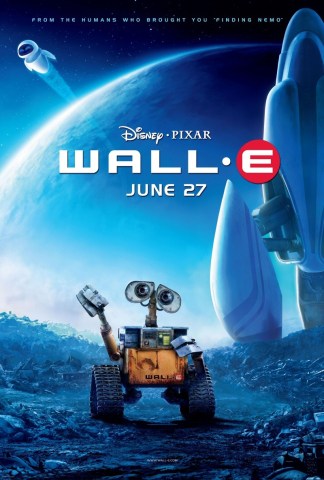
In 2008 Pixar made the leap into outer space and released a film named WALL-E, a touching tale about a waste-cleaning robot named WALL-E who works all alone on a garbage covered Earth in 2805. Having spent so many years alone (the other robots having long since broken down), WALL-E has developed an individual consciousness and identity of his own: he salvages items he deems “special” and keeps them in his “home” (such items include an ancient tape copy of Hello, Dolly). The monotony of WALL-E’s life changes dramatically when he discovers a plant seedling; not long afterward, a strange ship arrives bearing a feminine robot named EVE. WALL-E (being very lonely) falls in love and embarks on a huge adventure that, ultimately, will save the long absent human race once and for all.
Composer Thomas Newman had worked very well with director Andrew Stanton on Finding Nemo (2003) and began working on the score as early as 2005 (EVE’s theme was first arranged in 2007). Newman found the score to be a good challenge, as the first portion of the film is largely silent (with no dialogue in the traditional sense). Stanton had originally envisioned a purely orchestral score, but Newman eventually included electronic elements as well. Several scenes also include selections from previously composed works, most notably Hello Dolly! and La vie en rose (as performed by Louis Armstrong) during a sequence between EVE and WALL-E on Earth. Newman’s score was nominated at the Academy Awards for Best Original Score and Best Original Song, but it lost to Slumdog Millionaire (2008).
Interestingly, with the film making several references to Hello Dolly!, it’s cool to note that Thomas Newman’s uncle Lionel Newman (1916-1989) worked on that production.
WALL-E is such an adorable film, and it’s commentary on society (most notably how it deals with consumerism) makes it a must-see for all ages. Please enjoy this behind the scenes look at the score of this film.
Unbelievably, it’s been 15 years since A Beautiful Mind took the cinematic world by storm. Based on the real-life story of mathematician John Nash (1928-2015), the film follows Nash from his days at Princeton, through his diagnosis with paranoid schizophrenia and the struggles that came with dealing with an illness that was not well understood yet. It’s not even clear for a good portion of the film that Nash is seeing things that aren’t there. A good case in point comes with Nash’s roommate at Princeton Charles. He’s introduced the way any other character would be, he talks with Nash and even walks in public with him and later introduces his young niece. I remember being totally shocked when it was revealed that only Nash could see Charles (it put certain episodes at Princeton in a completely different light).
A Beautiful Mind took home four Academy Awards: Best Adapted Screenplay, Best Picture, Best Director and Best Supporting Actress. It also received four additional nominations for Best Actor, Best Film Editing, Best Makeup and Best Original Score.
I don’t remember exactly when I saw this movie for the first time, but I do remember it had something to do with school (we might have been learning about mental illness). I should also mention that I knew nothing about Nash before watching this film, so the revelation that so many of Nash’s “friends” were delusions came as a huge surprise to me, and it made me question every interaction Nash had for the rest of the film.
For this film, director Ron Howard called upon composer James Horner to assemble the musical score and oh did he ever! Horner gives an eloquent description of how he assembled the musical themes for this film and not only that, he also described his thought process for creating a film score in general (he compares it to painting, which is just beautiful!) Considering it’s been just under a year since he passed away, I felt a few tears come to my eyes, knowing that a talent like this was gone from the world.
Please enjoy listening to how the music for A Beautiful Mind was put together!
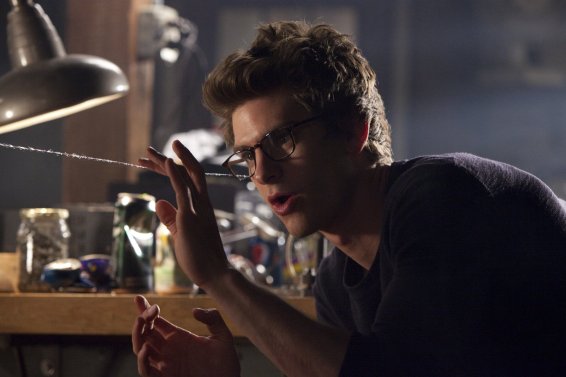
Beginning in 2010, Columbia Pictures decided to reboot the Spider-Man franchise (that had previously starred Tobey Maguire from 2002-2007) and recast the title role with Andrew Garfield. The film was very well received, with Garfield’s performance being highly praised.
The film, being a reboot, starts the story of Peter Parker over again, showing how he develops from a bullied teen into a superhero after a genetically modified spider bites him. Parker begins using his abilities to hunt down criminals, and eventually must stop a rampaging villain known as the Lizard (who has also discovered that Spider-Man is Peter Parker!) The story was continued in The Amazing Spider-Man 2 (2014).
James Horner was brought in to compose the musical score for the film. On that merit alone, I would recommend this soundtrack to anyone (because by this stage in his career, Horner had writing film music down to a fine art).
I admit I haven’t actually seen the reboot of Spider-Man, but the general consensus is that it is a good film worth seeing. Please enjoy this behind the scenes look at the scoring of The Amazing Spider-Man, featuring the one and only James Horner (it sends chills down my spine to see him conducting the orchestra, he was surely a master of his craft), enjoy!!












 Film Music Central