Tag Archives: film music

The Hunchback of Notre Dame “The Bells of Notre Dame” (1996)

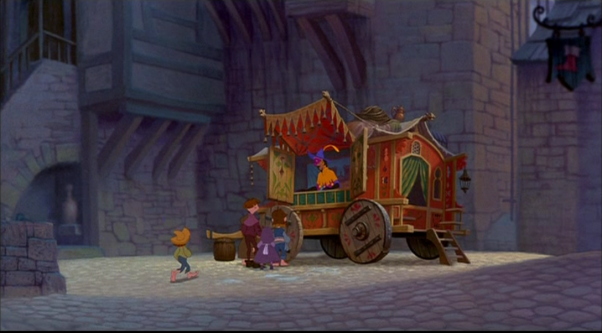
As far as openings of a Disney movie go, The Hunchback of Notre Dame is pretty dark from the beginning, though you initially don’t think so. The song begins with Clopin gathering children to his stall to tell them the story of the mysterious bell ringer who lives in the towers of the cathedral.


Morning in Paris, the city awakes
To the bells of Notre Dame
The fisherman fishes, the bakerman bakes
To the bells of Notre Dame
To the big bells as loud as the thunder
To the little bells soft as a psalm
And some say the soul of the city’s
The toll of the bells
The bells of Notre Dame

You know things are going to be interesting though, when Clopin begins his story with “It’s a tale, a tale of a man…and a monster…” The story then flashes back twenty years to a group of gypsies who are sneaking into Paris.

d-q-mom-3.png

Dark was the night when our tale was begun
On the docks near Notre Dame

Four frightened gypsies slid silently under
The docks near Notre Dame

But a trap had been laid for the gypsies
And they gazed up in fear and alarm
At a figure whose clutches
Were iron as much as the bells, the bells of Notre Dame

Judge Claude Frollo longed to purge the world of vice and sin,

And he saw corruption everywhere, except within

The verses here are interspersed with excerpts from the Latin mass, Kyrie Eleison (Lord have mercy) and Dies Irae (Day of Wrath). This is one detail that I’ve always loved about the score for The Hunchback of Notre Dame, the connection to the mass, which back in the time this film was set in was a big deal in people’s daily lives.

The story is already dark enough: the gypsies are captured and arrested for no other crime than being gypsies, but then it gets worse. A soldier notices the bundle the woman is carrying and Frollo assumes it’s stolen goods when a quick check would have revealed it’s just a baby. Instead, Frollo (the best example of a hypocrite you’ll find in any Disney film) callously demands the bundle be taken away which prompts the woman to run for her life with her baby with the strains of Dies Irae in the background. It’s a pulse-pounding sequence as the woman dodges and leaps through the snowy streets of Paris with Frollo close behind on his black horse (he’s the villain so naturally it’s a black horse).

This chase leads to one of the most shocking moments in any Disney film (so shocking that I’m still contemplating adding it to the Disturbing Disney series). First, at the steps of the cathedral, Frollo seizes the baby, causing the mother to fall back and hit her head on the stone steps, killing her instantly. Then, when Frollo realizes he’s holding a baby, one he deems a ‘monster’ because of its deformities, he spots a well in the square and rides over to drop the baby in!! Let me repeat that: the villain of the film was clearly attempting infanticide (in a Disney film) and was only stopped because the archdeacon intervened!

I love the interchange between the archdeacon (David Ogden Stiers) and Frollo. The latter obviously feels no guilt for what has happened and his callousness infuriates the priest.

Frollo_The_Bells_of_Notre_Dame.png

Archdeacon: (singing) See there the innocent blood you have spilt
On the steps of Notre Dame
Frollo: I am guiltless. She ran, I pursued.
Archdeacon: Now you would add this child’s blood to your guilt
On the steps of Notre Dame?
Frollo:  My conscience is clear
Archdeacon: You can lie to yourself and your minions
You can claim that you haven’t a qualm
But you never can run from nor hide what you’ve done from the eyes
The very eyes of Notre Dame

And for one time in his life of power and control, 

Frollo felt a twinge of fear for his immortal soul

There’s actually a double meaning in the archdeacon’s last line. “The eyes of Notre Dame” doesn’t just refer to the eyes of the sculptures covering the cathedral. It can also refer to Our Lady, meaning the Virgin Mary (who is greatly revered in Roman Catholicism). This last portion of the song sets up Frollo’s one weakness, if you can call it that. Above all else, he fears going to Hell when he dies. That’s why he accepts the punishment of raising Quasimodo for the rest of his days (though I’m sure keeping him locked up in the bell tower was not what the archdeacon had in mind).

“The Bells of Notre Dame” provides a beautifully crafted introduction to the film, one of the best in the Disney Renaissance. What do you think about it? Let me know your thoughts in the comments below and have a great day!

See also:

Disney/Dreamworks/Pixar/etc. Soundtracks A-Z

The Hunchback of Notre Dame “Out There” (1996)

The Hunchback of Notre Dame “Topsy Turvy” (1996)

The Hunchback of Notre Dame “God Help the Outcasts” (1996)

The Hunchback of Notre Dame “Heaven’s Light/Hellfire” (1996)

The Hunchback of Notre Dame “The Court of Miracles” (1996)

Become a Patron of the blog at patreon.com/musicgamer460

Check out the YouTube channel (and consider hitting the subscribe button)

Don’t forget to like Film Music Central on Facebook 🙂

Moana “You’re Welcome” (2016)

From the very first teaser, I knew I would like the character of Maui. He has everything that’s great about a Disney character: he’s funny, snarky, his tattoos have minds of their own, and he has an amazing magical accessory (in this case, a giant fish hook) that lets him change into different animals! And best of all, he’s brought to life by Dwayne “the Rock” Johnson. Maui, in my opinion, has one of the most awesome proper introductions for a character that I’ve ever seen.

You're_Welcome_Moana.jpg

See, Moana’s voyage to find Maui seems to end in disaster when her boat is caught in a storm. Moana begs the ocean for help and finds herself stranded on a desert island…but she isn’t alone! As it turns out, this is the island Maui’s been stranded on for the last thousand years (give or a take a decade) and is he ever surprised to find Moana on the island with him. Maui, shocked that Moana doesn’t know anything about him (besides the fact that he stole the Heart of Te Fiti and cursed the oceans), decides to introduce himself via a song where he says “You’re Welcome” for everything he’s ever done for the humans.

And as it turns out, Maui’s done a LOT over the last few thousand years: he made the sky, brought fire, the winds, created coconut trees, the tides, grass and he even pulled the sun closer to the Earth to make the days longer. Not only that, he’s covered in magical tattoos that represent all of his victories.

moana-youre-welcome-1024x427

Hearing all of this, Moana is in awe of Maui and delighted as she piles her arms full of presents. Which makes the next part rather funny: as the song winds down, Maui begins dropping hints that he’s about to do something sneaky, for instance:

Hey, it’s okay, it’s okay
You’re welcome!
Well, come to think of it, I gotta go
Hey, it’s your day to say you’re welcome
‘Cause I’m gonna need that boat
I’m sailing away, away
You’re welcome!
‘Cause Maui can do anything but float

It turns out that all this time Maui has been plotting to swipe Moana’s boat (well, he is a trickster god among other things, so this isn’t exactly unusual behavior) but first he needs to get Moana out of the way, so at the very end the song’s spell suddenly breaks and she finds herself stuck in a cave, her ‘presents’ nothing but seaweed and old coconuts and Maui covering the entrance with a boulder so she can’t get away!


As I said earlier, this is one of the best character introductions I’ve ever seen: listening to this song tells you everything you need to know about Maui. He’s full of himself, sly and also eager to please (to a point anyways). And honestly, the first time I saw this film I had no idea the Rock could sing this well! I mean I knew he could sing a little but wow he’s got a great voice! This scene also contains some great 2D animation, both in the background and with Maui’s tattoos

What do you think of “You’re Welcome” and Maui’s introduction? Let me know your thoughts in the comments below and have a great day!

Become a Patron of the blog at patreon.com/musicgamer460

Check out the YouTube channel (and consider hitting the subscribe button)

Don’t forget to like Film Music Central on Facebook 🙂

See also:

Moana “We Know the Way” (2016)

ae8ecdd0-820a-444d-be46-e1314cf504b8.jpg

Moana “We Know the Way” (2016)

After unsuccessfully attempting to sail beyond the reef, Moana’s grandmother Tala decides its time Moana learned about a secret. Hidden deep in a cave behind a waterfall is a fleet of huge ships, far bigger than anything used to fish in the lagoon. At Tala’s urging Moana explores the ships and beats the drum on the largest ship, somehow awakening the spirits of the ancestors who show Moana a vision from the distant past: these ships once sailed all over the ocean, traveling from one island to the next. This journey is narrated by “We Know the Way.”

We read the wind and the sky when the sun is high
We sail the length of the seas on the ocean breeze
At night, we name every star
We know where we are
We know who we are, who we are

Aue, aue
We set a course to find
A brand new island everywhere we roam
Aue, aue
We keep our island in our mind
And when it’s time to find home
We know the way

Aue, aue
We are explorers reading every sign
We tell the stories of our elders in a never-ending chain
Aue, aue
Te fenua, te mālie
Nā heko hakilia
We know the way

These ancient mariners lived for sailing the ocean, using the stars and the great ocean currents to chart their course. Everyone helps during the journey, in much the same way that everyone works together on Motonui. Their identity is completely bound with the ocean. After a certain length of time, the chief passes a special necklace (the same that Moana later wears) to a young warrior (possibly his son?) and the cycle of voyaging continues with that voyager building a new fleet of large ships.

The visual of the ships sailing on the ocean is a wonderfully rendered piece of animation. With the first shot of this massive catamaran coming over a wave, you can feel the weight of the ship in the water. Another favorite shot comes when the children watch dolphins jumping in front of the ships.

This is a part of her history that Moana has never heard, as her father has always maintained that her tribe has always lived on Motonui. She’s overwhelmed to learn that her ancestors were in fact voyagers (which means that her desire to travel on the ocean isn’t abnormal at all!), but this raises a whole new question: if they spent so long voyaging and were so happy doing it, why did they stop?

“We Know the Way” is a wonderful song that I always listen to when I need to feel better. It shows a people who find their identity in who they are as opposed to where they are (go back for example and listen to “Where You Are” and compare it to “We Know the Way.”)

What do you think of “We Know the Way?” Let me know your thoughts in the comments below and have a great day 🙂

Become a Patron of the blog at patreon.com/musicgamer460

Check out the YouTube channel (and consider hitting the subscribe button)

Don’t forget to like Film Music Central on Facebook 🙂

See also:

Moana “Where You Are” (2016)

Moana “How Far I’ll Go” (2016)

Moana “How Far I’ll Go (reprise)” (2016)

Moana “You’re Welcome” (2016)

Moana “Shiny” (2016)

Moana “I am Moana” (2016)

Moana “Know Who You Are” (2016)

Alice in Wonderland “Very Good Advice” (1951)

01

Alice in Wonderland “Very Good Advice” (1951)

After being tossed from one silly situation to the next and believing she’s forever lost the way to get home, Alice has had quite enough of Wonderland. Not only that, she finally understands that she’s only here through her own actions: if she hadn’t followed the White Rabbit AND crawled down the rabbit hole, she never would have entered Wonderland in the first place and this knowledge makes her very upset. Surrounded by the silly looking creatures, Alice plops down and begins to cry about how she never takes her own good advice (this is the set up for “Very Good Advice”).

I give myself very good advice
But I very seldom follow it
That explains the trouble that I’m always in
Be patient, is very good advice
But the waiting makes me curious
And I’d love the change
Should something strange begin
Well I went along my merry way
And I never stopped to reason
I should have know there’d be a price to pay
Someday, someday
I give myself very good advice
But I very seldom follow it
Will I ever learn to do the things I should

As Alice cries, her tears seem to shatter the illusion of Wonderland around her. One by one, the silly creatures listening to her song begin to cry and disappear, until Alice is alone. Even the landscape melts away into blackness. It has always seemed to me that Wonderland is a world that only exists so long as you deny certain realities. Once you give in to them, it begins to fade away. This is a pretty sad and subdued moment compared to what comes before and after, but that’s good because it also serves as a moment for the viewer to catch their breath and get ready for the story to reach its conclusion. I have to admit, as a kid I never liked this part because it felt too slow to me.

And those are my thoughts on “Very Good Advice.” What do you think about this song? Let me know your thoughts in the comments below and have a great day 🙂

Become a Patron of the blog at patreon.com/musicgamer460

Check out the YouTube channel (and consider hitting the subscribe button)

Don’t forget to like Film Music Central on Facebook 🙂

See also:

Disney Films & Soundtracks A-Z

Alice in Wonderland “In a World of My Own” (1951)

Alice in Wonderland “All in the Golden Afternoon” (1951)

Alice in Wonderland “The Un-Birthday Song” (1951)

Alice in Wonderland “The Walrus and the Carpenter” (1951)

Alice in Wonderland “Painting the Roses Red” (1951)

Hercules “I Won’t Say I’m in Love” (1997)

In Disney’s Hercules, Megara (“Meg”) is hardly the typical Disney princess-type (I know she’s not actually a princess but she’s inserted into that character slot). Unlike other Disney princesses, like Snow White, Aurora, even Belle, Meg is cynical, snarky, rebellious, and the older I get the more I identify with her. In all seriousness, Meg’s backstory is worthy of any Disney film: she sold her soul to Hades to save her boyfriend’s life, only to be abandoned when said boyfriend left her for another woman (though personally I’ve always suspected that Hades lured the boyfriend away on purpose so he could use Meg as a slave).

With everything that’s happened to her, it’s no wonder that Meg is resistant to the idea that she’s falling in love with the god-turned-mortal Hercules. After all, allegedly Meg’s only getting close to him to find a weakness so that Hades will release her from their bargain. However, the more you watch them, the more it becomes obvious that Meg does have feelings for the hero. But once Hercules is dragged away by Phil, she quickly denies it (which naturally draws the attention of the Muses, setting up one of my favorite songs).

If there’s a prize for rotten judgment,
I guess I’ve already won that
No man is worth the aggravation
That’s ancient history
Been there, done that

Who d’you think you’re kiddin’?
He’s the earth and heaven to ya
Try to keep it hidden
Honey, we can see right through ya
Girl, you can’t conceal it
We know how you feel
And who you’re thinking of

In “I Won’t Say I’m in Love,” Meg spends nearly the entire song arguing against the Muses claims that she’s in love with Hercules. It’s an unwitting duet, as Meg doesn’t seem to realize she’s singing with the Muses, rather it’s almost like she’s replying to the thoughts in her head, though there are a few moments where Meg will turn really fast, as if she suspects there’s someone singing with her.

No chance, no way
I won’t say it, no, no

You swoon, you sigh,
Why deny it? Uh-oh

It’s too cliché
I won’t say I’m in love

vlcsnap-2014-05-02-21h01m09s45.png

The biggest thing holding Meg back is that she’s been hurt before and she doesn’t want it to happen again. It’s summed up very well in this verse:

I thought my heart had learned its lesson
It feels so good when you start out
My head is screaming “Get a grip, girl!”
Unless you’re dying to cry your heart out

You keep on denying
Who you are and how you’re feeling
Baby, we’re not buying
Hon, we saw you hit the ceiling
Face it like a grown-up
When you gonna own up
That you got, got, got it bad?

No chance, no way
I won’t say it, no, no
Give up, give in
Check the grin; you’re in love

This scene won’t play
I won’t say I’m in love
You’re doin’ flips, read our lips:
You’re in love!

You’re way off base, I won’t say it
Get off my case, I won’t say it
Girl, don’t be proud
It’s okay, you’re in love

Ohhh…
At least out loud,
I won’t say I’m in love

I think anyone who’s been in a relationship gone bad can identify with this feeling and how painful it can be. It’s no wonder Meg is resisting any idea of love. However, despite this, Meg is able to admit, to herself that “At least out loud, I won’t say I’m in love.” So by the end of the song, despite her fears, Meg is at least open to the idea of being in love again, though I don’t think she 100% realizes it until the end of the film (but that’s another story for another day).

And that’s “I Won’t Say I’m in Love.” What do you think of this song? Let me know your thoughts in the comments below and have a great day 🙂

Become a Patron of the blog at patreon.com/musicgamer460

Check out the YouTube channel (and consider hitting the subscribe button)

Don’t forget to like Film Music Central on Facebook 🙂

See also:

Disney Films & Soundtracks A-Z

Hercules “Gospel Truth” (1997)

Hercules “Gospel Truth II & III” (1997)

Hercules “Go the Distance” (1997)

Hercules “One Last Hope” (1997)

Hercules “Zero to Hero” (1997)

Moana “How Far I’ll Go (reprise)” (2016)

maxresdefault.jpg

Moana “How Far I’ll Go (reprise)” (2016)

Given how vigilant Moana’s father is about no one leaving the island, I was curious to see how his daughter would manage to get away. The moment arrives, rather shockingly, when Grandmother Tala is revealed to be dying (a fan theory speculates that this is because she gave the Heart of Te Fiti to Moana that had hitherto been keeping her alive all these years). Moana is deeply upset, but Tala, knowing that this is her granddaughters only chance to get away, tells her to go and find Maui. This is absolutely heartbreaking: Moana doesn’t want to leave her grandmother without properly saying goodbye, but she also wants to set things right for the island. So she heads for the boats, which starts off the reprise of “How Far I’ll Go.”

There’s a line where the sky meets the sea and it calls me
But no one knows, how far it goes
All the time wondering where I need to be is behind me
I’m on my own, to worlds unknown

There’s a surprising moment when Moana is gathering supplies at her home: her mother Sia finds her and there’s a long stretch where they just stare at each other. And without saying a word Sia shows her support by throwing in some more supplies and giving them to Moana. She’s heartbroken but she also knows this is something her daughter has to do (I have a suspicion she’s known this for a while now).

Every turn I take, every trail I track
Is a choice I make, now I can’t turn back
From the great unknown where I go alone
Where I long to be

d05847c83c4db74a8726fcce3f443c7d.jpg

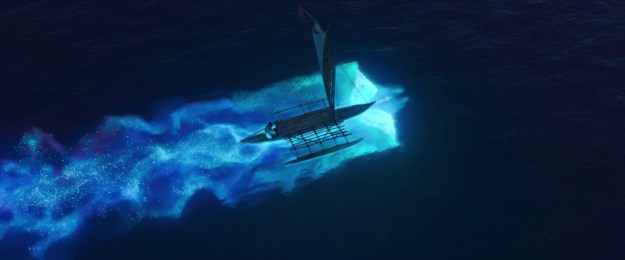
Having selected her boat and pushed it out into the lagoon, Moana looks back at the island and then comes my favorite part of this scene. All of the lights go out in the big hut and a huge manta ray spirit comes flying into the water. The manta is wonderfully animated, shining with bioluminescence in a design that matches the tattoo Tala had. Earlier, Tala had revealed a manta ray tattoo on her back, revealing that she would come back as one when she died. Moana sees this spirit and knows its her grandmother guiding her out to sea. This moment, I admit, always brings tears to my eyes because, despite being beautiful to see, it also means that her beloved grandmother is gone.

See her light up the night in the sea, she calls me
And yes I know that I can go
There’s a moon in the sky and the wind is behind me
Soon I’ll know how far I’ll go

With the help of Tala’s spirit, Moana is guided beyond the lagoon with far less fuss than I thought there might be. I admit, when I first watched this film in the theater, I half expected to hear her father pleading for Moana to come back, but nothing of the sort happened. On another random note, I’m really glad her father didn’t follow through on his threat of burning the boats. When he said “I should’ve burned those boats years ago” I had a strong flashback to King Triton just before he destroyed the grotto in The Little Mermaid and for a moment I believed we were going to get a repeat of that scenario.

I hope you enjoyed “How Far I’ll Go (reprise)” I hope I can come back and finish the rest of the songs from Moana sooner rather than later. Let me know what you thought of this song in the comments below and have a great day!

See also:

Moana “Where You Are” (2016)

Moana “How Far I’ll Go” (2016)

Moana “We Know the Way” (2016)

Moana “You’re Welcome” (2016)

Moana “Shiny” (2016)

Moana “I am Moana” (2016)

Moana “Know Who You Are” (2016)

Disney Films & Soundtracks A-Z

Become a patron of the blog at: patreon.com/musicgamer460

Check out the YouTube channel (and consider hitting the subscribe button)

Don’t forget to like Film Music Central on Facebook 🙂

Dumbo “When I See an Elephant Fly” (1941)

In keeping with the unofficial theme this week of covering Disney’s non-politically correct moments, it wouldn’t do to forget the crows in Dumbo. But first, a quick recap as to how Dumbo meets these characters:

dumbo-99-640x400.png

Things have been going badly for our baby elephant: first his mother his locked away in chains; then a stunt goes awry and Dumbo is turned into a circus clown; third, and most recently, his well-meaning friend Timothy Q. Mouse accidentally gets him drunk and they both hallucinate pink elephants! (It’s amazing what they could put in a film back in 1941!!) The following morning, Dumbo and Timothy wake up….in a tree!! This is where Dumbo and his friend meet the crows.

Dumbo-disneyscreencaps.com-6001.jpg

Oh those crows…to be honest, I didn’t realize for a long time that the crows were a racist depiction. When you’re a little kid, you don’t think about those things, you just see some singing birds and that’s that. But as I got older and learned about the history of these things, I began to see these crows in a whole new light. And one thing I learned is that stereotypes can appear in disguise, for instance using black crows instead of, well, pardon the non-PC reference but using black crows instead of black humans. Another big clue? The leader of these crows is named…Jim Crow (no, seriously, check out the credits on Wikipedia!) A third clue? The birds all speak “jive,” a style of slang well-associated with African-American musicians during this time. They also sing jive too, and that’s where we get to “When I See An Elephant Fly.”


I seen a peanut stand, heard a rubber band
I seen a needle that winked its eye
But I be done seen ’bout ev’rything
When I see an elephant fly

(What d’you say, boy?) 
I said when I see an elephant fly
I seen a front porch swing, heard a diamond ring
I seen a polka-dot railroad tie
But I be done seen ’bout ev’rything
When I see an elephant fly

hqdefault (1).jpg

One thing that is fun about this song is most of the words have a double meaning; it helps if you put quotes around the words with changed meanings: so…a front porch that “swings” (dances); a diamond “ring” (like a bell), a railroad “tie” (necktie), and so on.

(I saw a clothes horse, he r’ar up and buck) 
(And they tell me that a man made a vegetable truck) 
(I didn’t see that, I only heard) 
(But just to be sociable, I’ll take your word)

(I heard a fireside chat, I saw a baseball bat) 
(And I just laughed till I thought I’d die) 
But I be done seen ’bout ev’rything
When I see an elephant fly

Well I be done seen ’bout ev’rything
When I see an elephant fly
(With the wind)

When I see an elephant fly

See, initially, the crows are inclined to tease Dumbo for his ears just like everyone else has throughout the story. But then Timothy sets them all straight by recounting (briefly) all the terrible things that have happened to Dumbo. The shamed crows decide to make it up to the pair by helping Dumbo to fly for real (it’s implied that Dumbo flew to the tree while he was drunk and just doesn’t remember doing so). To help in this process, the head crow presents a feather to Dumbo, calling it a “magic” feather that will help him fly (with a knowing wink to Timothy who catches on quick). Sure enough, with the feather clutched tight, Dumbo CAN fly!! As the crows say (as Dumbo and Timothy return to the circus), “those city boys are in for a big surprise!”

What do you think about “When I See An Elephant Fly”? Were the racist elements obvious or did it also take you a while to catch on? Let me know what you think in the comments below and have a great day!

See also:

Dumbo “Look Out For Mr. Stork” (1941)

Dumbo “Pink Elephants on Parade” (1941)

Dumbo “Song of the Roustabouts” (1941)

Disney Films & Soundtracks A-Z

Become a patron of the blog at: patreon.com/musicgamer460

Check out the YouTube channel (and consider hitting the subscribe button)

Don’t forget to like Film Music Central on Facebook 🙂

Dumbo “Song of the Roustabouts” (1941)

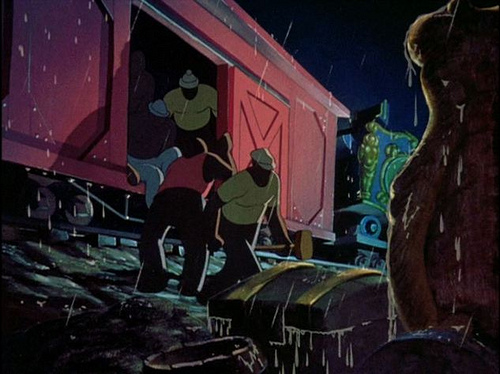
Forgive the pun but I decided it’s time to clear another elephant out of the room. Unfortunately, for everything good that Disney has contributed to film and animation, there are multiple examples of Disney portraying things they probably want to forget about. One example is the “Song of the Roustabouts” from Dumbo (1941). After baby Dumbo arrives on the train (via late delivery from the stork), the train pulls in to where the circus will be held the following day. As a storm breaks out, the elephants and other animals disembark to help set up the big top, accompanied by the roustabouts: these are unskilled laborers, often employed for hard labor.

7450688312_8f2f865864.jpg

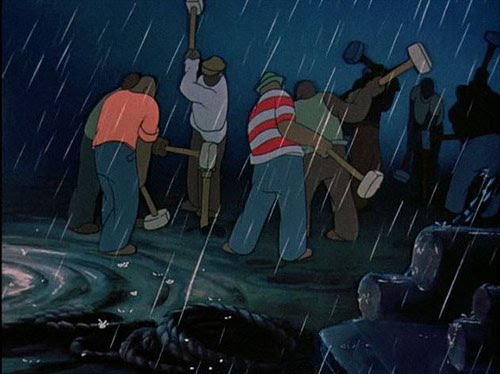
It’s hard to tell given this scene takes place at night, but the roustabouts in Dumbo are all African-American, and given that this takes place in 1941 the lyrics are…interesting to say the very least. The song starts off with cries of “Hike! Ugh!” as the singers/workers establish a driving pattern to aid in driving in the tent stakes:

Hike! Ugh! Hike! Ugh! Hike! Ugh! Hike!
We work all day, we work all night
We never learned to read or write
We’re happy-hearted roustabouts

Hike! Ugh! Hike! Ugh! Hike! Ugh! Hike!
When other folks have gone to bed
We slave until we’re almost dead
We’re happy-hearted roustabouts

Just stop and look at these two verses alone: according to the roustabouts they can’t read or write, they work extremely hard and yet despite all this they’re “happy-hearted roustabouts”? It sounds ironic in 2018 but in 1941 they’re being quite serious.

Hike! Ugh! Hike! Ugh! Hike! Ugh! Hike!
We don’t know when we get our pay
And when we do, we throw our pay away
We get our pay when children say
With happy hearts, “It’s circus day today”

This is the verse that disturbs me the most, it implies that when the roustabouts DO get paid, they promptly blow their money on frivolous things (keeping in line with certain stereotypes about African-Americans being lazy, etc. Remember, this was 1941 and these things were considered acceptable then).

hqdefault.jpg

Muscles achin’
Back near breaking
Eggs and bacon what we need (Yes, sir!)
Boss man houndin’
Keep on poundin’
For your bed and feed
There ain’t no let up
Must get set up
Pull that canvas! Drive that stake!
Want to doze off
Get them clothes off
But must keep awake

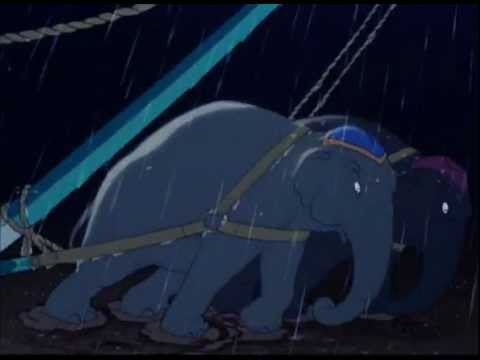
During this long section, the other animals are shown helping in the set up, mostly the elephants moving stakes and poles, but the camels are helping too. It’s funny, when I watched this movie as a young kid, I was convinced that the circus animals really did help in this way. Even Dumbo is seen doing his part alongside his mother.

Hep! Heave! Hep! Heave! Hep! Heave!
Hep! Heave! Hep!

Swing that sledge! Sing that song!
Work and laugh the whole night long
You happy-hearted roustabouts!
Pullin’, poundin’, tryin’, groundin’
Big top roundin’ into shape
Keep on working!
Stop that shirking!
Grab that rope, you hairy ape!
Poundin’! poundin’! poundin’! poundin’!
Oh

dumbo5.jpg

The storm that started when the train arrived has now become a full-on thunderstorm (poor Dumbo hides in fright from the lightning). And the song does throw in one last unbelievable line with “Grab that rope, you hairy ape!” (I really won’t explain that one in further detail since it really speaks for itself). At last, despite the driving rain and winds, the big top is raised and come morning the circus is ready to begin!

It might seem strange to focus on these songs (especially given the issues going on in the country right now), but I can’t let these songs slip away unnoticed. Not writing about them is tantamount to saying they never happened, but they did. So on that note, I hope you found “Song of the Roustabouts” interesting. Let me know what you think of this song in the comments below and have a great day!

See also:

Dumbo “Look Out For Mr. Stork” (1941)

Dumbo “Pink Elephants on Parade” (1941)

Dumbo “When I See an Elephant Fly” (1941)

Disney Films & Soundtracks A-Z

Become a patron of the blog at: patreon.com/musicgamer460

Check out the YouTube channel (and consider hitting the subscribe button)

Don’t forget to like Film Music Central on Facebook 🙂

Peter Pan “What Made the Red Man Red?” (1953)

Before I get started with talking about this song, let’s get the elephant out of the room shall we? Yes, “What Made the Red Man red?” is a highly racist, non-politically correct song that employs multiple Native American stereotypes. That being said, remember that this was 1953 and the world was a very different place from what it is now.

(also, I’m going to refer to the tribe as ‘Indians’ because that’s how they’re described in the film, I know Native American is the correct word to use)

At the start of this song, Wendy, John and Michael are celebrating the safe return of Tiger Lily with Peter Pan, the Lost Boys and the Indian tribe. In gratitude, the Chief dubs Peter “Chief Flying Eagle” and everyone celebrates. As the party gets going, the Lost Boys have three questions:

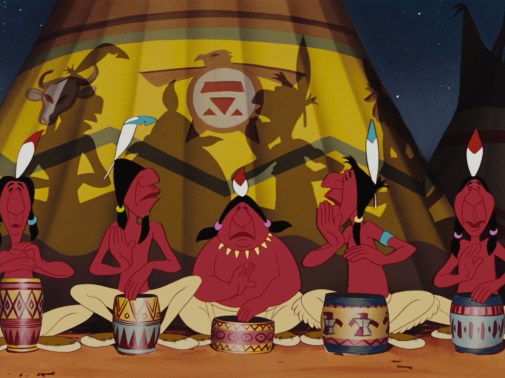
“What made the red man red?” (it should be noted that in this film the Indians, except for Tiger Lily, are almost literally red-skinned, based on the derogatory slang once used to describe them).

“When did he first say ‘ugh’?” (another stereotype, this one contends that Indians say ‘ugh’ in response to a lot of things)

“Why does he ask you ‘how’?” (another stereotype and something of a generalization: there ARE some tribes that use this as a greeting, but the stereotype makes it appear that ALL Indians use this as a greeting, which isn’t true).

Peterpan-disneyscreencaps-5563.jpg

The Chief and his chorus of braves set out to answer these questions, accompanied by the drums:

Why does he ask you, “How?”
Once the Injun didn’t know
All the things that he know now
But the Injun, he sure learn a lot
And it’s all from asking, “How?”
Hana Mana Ganda
Hana Mana Ganda
We translate for you
Hana means what mana means
And ganda means that, too

This scene is also notable because it shows several characters smoking on a peace pipe. While Wendy abstains (and prevents Michael from using it too), John takes a pretty good puff and turns green as a result (in kind of the same way that Pinocchio did over a decade prior).

0fac2d35bc7083f9b0f0fc30838c67fe

In between the verses, everyone starts dancing, including Wendy, though she doesn’t get to enjoy herself for long. Wendy runs headlong into an Indian matriarch who proclaims “Squaw (Wendy) no dance, squaw get firewood!” Wendy is miffed that she can’t have fun like the other boys (and Tiger Lily, more on that in a moment) but she goes off to get the firewood.

When did he first say, “Ugh!”
In the Injun book it say
When first brave married squaw
He gave out with heap big ugh
When he saw his Mother-in-Law

Meanwhile, Wendy is returning with a load of firewood (still trying to have a good time) when she gets a look at Tiger Lily and Peter Pan:

large

What made the red man red?

Let’s go back a million years
To the very first Injun prince
He kissed a maid and start to blush
And we’ve all been blushin’ since

You’ve got it right from the headman
The real true story of the red man
No matter what’s been written or said
Now you know why the red man’s red!

The scene implies that Tiger Lily gave Peter a great big kiss which makes Peter blush with happiness. Wendy is furious that someone else is kissing ‘her’ Peter, and when the matriarch demands she get more firewood, Wendy retorts “Squaw NO getting firewood, squaw go home!” And she marches off to the Lost Boys home, very upset. I always felt bad for Wendy, everyone else got to have fun but her.

Political incorrectness aside, this song marks the turning point in the story for Wendy. Up until this point, she’d been having fun with Peter in Neverland (although the visit to the mermaids didn’t exactly go as planned), but now she’s beginning to realize that she doesn’t belong here, it’s time to go home (as in back to London). Also, no one yet knows that Captain Hook has taken Tinkerbell captive, as he is determined to find the Lost Boys hideout and eliminate his nemesis once and for all!

What do you think of this song? Have you seen this song before? Let me know what you think of it in the comments below, and have a great day!

See also:

Disney Films & Soundtracks A-Z

Peter Pan “You Can Fly!” (1953)

Peter Pan “Following the Leader” (1953)

Peter Pan “The Elegant Captain Hook” (1953)

My Thoughts on: Peter Pan (1953)

Become a patron of the blog at: patreon.com/musicgamer460

Check out the YouTube channel (and consider hitting the subscribe button)

Don’t forget to like Film Music Central on Facebook 🙂
Remembering James Horner: Troy (2004)

trojan-horse troy the movie

Troy is a 2004 epic film that is a (greatly abbreviated) adaptation of the Illiad (which tells the story of the Trojan War). The film features a star-studded cast:

  • Brad Pitt: Achilles
  • Sean Bean: Odysseus
  • Brian Cox: Agamemnon
  • Peter O’Toole: King Priam
  • Eric Bana: Hector
  • Orlando Bloom: Paris
  • Diane Kruger: Helen

While not perfect, Troy is a good film with a remarkable score by James Horner. The music is even more remarkable when you consider that Horner put it together in the space of four weeks after Gabriel Yared’s score for the film was rejected.

For the score, Horner employed singer Tanja Carovska (who had also provided vocals for Yared’s rejected score) as well as using Eastern Mediterranean music and brass instruments to create a feeling of ancient Greece.

Troy Movie

Horner created several motifs throughout the score, a few of which I’d like to point out:

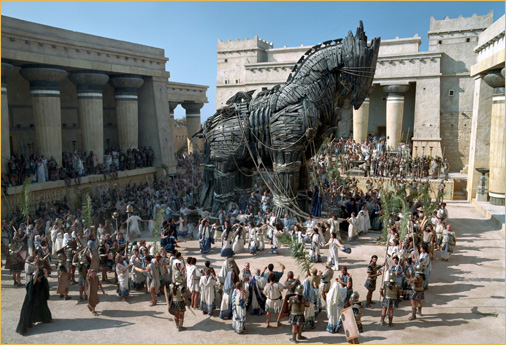
-The Greeks: The theme for the Greek army really emerges in full when they approach Troy in their thousand ships. It’s distinguished by a driving trumpet theme, highlighting the relentlessness of the Greek soldiers led by the egomaniacal Agamemnon. Most tellingly, it also re-emerges (briefly) just before the Trojan Horse is revealed onscreen for the first time, a musical hint that there are Greeks hidden inside.

The Greeks arrive at Troy

-Achilles: The theme for the legendary hero is also based on brass instruments, but it has a nobler tone than the theme assigned to the Greeks. Most notable appearance would have to be when Achilles storms the beach leading the Myrmidons. There’s also a reprise when Achilles heads off to find Briseis during the sacking of Troy.

nNy0BNw.jpg

Achilles on the beach (theme starts when Achilles jumps off the ship)

-Achilles and Briseis: The love motif for Achilles and Briseis (a Trojan princess turned priestess turned captive) forms the basis of the end credits song “Remember” as performed by Josh Groban. No matter what Achilles claims, I think throughout the story he remembers what his mother said, that if he goes to Troy he will never come home. So his love for Briseis is tempered by this knowledge, that’s why the theme is relatively sad for a love theme. A good example of hearing this theme is at the end right before Achilles dies and he tells Briseis to leave with Paris.

Troy “The Trojan Horse”

-The Trojan Horse: I’ve covered the music for the Trojan Horse in depth before, but I have to talk about it again because it really is my favorite musical moment in the film. Even if you’re not familiar with the story of the Trojan Horse, the sheer ominousness of the music tells you that there’s something fishy with this horse. But of course no one listens to Paris’ suggestion to just burn the horse where it stands (the one time he makes a good decision in the entire film) and the horse is brought into the city. The music is triumphant and tragic all at once, because the Trojans think they’ve won but in fact they’re doomed.

Horner’s score for Troy remains one of my favorites and I highly recommend it to any fans of James Horner’s music. It’s hard to believe he’s been gone for three years already, but as long as we keep listening to his music, he’ll never really be forgotten.

This is my contribution to the Remembering James Horner Blogathon, hope you enjoy it.

See also:

3rd Annual Remembering James Horner Blogathon: Day 1

You can become a patron of the blog at patreon.com/musicgamer460

Check out the YouTube channel (and consider hitting the subscribe button)

Don’t forget to like Film Music Central on Facebook 🙂