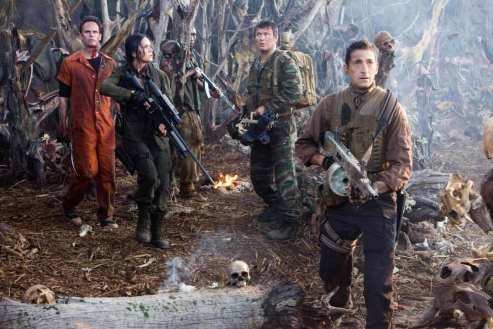
In an age where sequels are being made left and right, it surprised no one when, after a gap of 20 years, a third installment of the Predator franchise was released. Predators (unlike the previous two installments) takes place on an alien planet and follows a group of mercenaries and other “undesirables” that have been abducted and taken to this planet, which we learn serves as a game preserve for the Predator civilization. The group, including Royce (Adrien Brody) and Isabelle (Alice Braga) must evade a group of hunters while also trying to find a way off the planet to get home.
The total group consists of:
Royce- ex-Special Forces turned mercenary
Isabelle- sniper from Israeli Defense Forces
Cuchillo- a Mexican drug cartel enforcer
Nikolai- a Spetsnaz soldier
Mombasa- a soldier in the Revolutionary United Front
Stans- a death row inmate from San Quentin
Hanzo- a Yakuza enforcer
Edwin- a general practice doctor
Of the entire group, it is Edwin who sticks out, as he is the only member of the group who does not seem to be a lethal killer. Appearances are deceiving however, and it eventually comes out that Edwin is actually a psychopathic murderer (apparently very comfortable with poisons) who feels “right at home” on this alien planet filled with “monsters.”
Most of the story centers around the plan of freeing a trapped Predator (who is being held prisoner by a rival clan of larger Predators) in the hopes that it will use his ship to take them back to Earth. Unfortunately, not only are Royce and Isabelle the lone human survivors (so far as we know), but the ship self-destructs, leaving the pair stranded on the alien planet for the time being.
The film was released with mixed to positive reviews, with some saying the sequel finally hit the mark set by the original film and others saying it still lacks the quiet suspense that made the first film so good.
The score was composed by John Debney, although it was briefly speculated that Alan Silvestri would return to the franchise (having scored Predator and Predator 2). The clip I found is from a scoring session for the film and provides a tantalizing glimpse of the recording process. The one thing that will always amaze me about film music is how many details you can hear when the dialogue and sound effects are removed from the mix. Hearing this brief excerpt of music makes me wish I’d seen this film when it was released (it’s been on my “to watch” list for the last seven years).
Have you seen Predators? Did you think it was worth seeing? Let me know in the comments below, and I hope you enjoy watching this brief excerpt from the scoring session for the film.
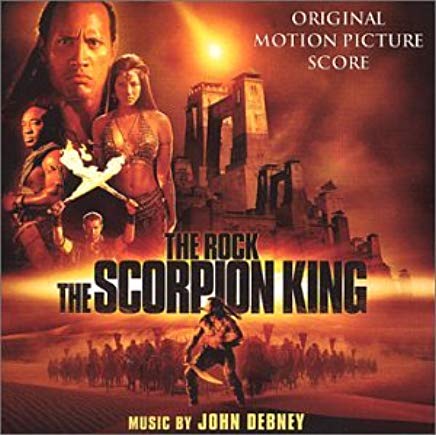
Let’s face it: you either love The Scorpion King or you hate it, there is no middle ground.
This spin-off of The Mummy Returns is set 5,000 years before the original Mummy films and tells the story of how Mathayus (Dwayne “The Rock” Johnson in his first film as a leading man) rose to power as the “Scorpion King.” Mathayus is initially part of a small group of Akkadians contracted by King Pheron to kill a sorcerer working for a tyrannical king named Memnon. They are betrayed by Pheron’s son Takmet (who murdered his own father and joined Memnon after they left on their mission) but Mathayus is still able to reach the sorcerer’s tent…only to find that it’s actually a beautiful sorceress named Cassandra.
Mathayus hesitates long enough to be captured and after his companions are killed, he is left to die a slow agonizing death buried up to his neck in the desert. Thereafter, Mathayus seeks vengeance on Memnon for killing his companions (one of whom was his half-brother) and also information from the sorceress (for example, why she persuaded Memnon to not kill him on the spot as he did the others).
Along the way, Mathayus meets various allies, including the Nubian king Balthazar (who initially does not like Mathayus because he despises Akkadians). When Cassandra returns to Memnon after being with Mathayus for some time, the latter organizes an all-out assault on Memnon’s stronghold Gomorrah to save Cassandra and kill Memnon once and for all.
The orchestral score for this film was composed by John Debney; this music was mixed in with various rock songs (the latter are what appear on the soundtrack album for the film). In the extended “making of the score” video which you can access in the link above, there are numerous shots of the orchestra in the recording studio with the in-progress film playing on a large screen for the conductor’s reference. As I’ve said before, this is the stage of film music production that I love the best, and I hope to witness it in person one day.
Debney (and the film’s director) discuss how various parts of the score came together, including the overall sound of the music. Since this is meant to take place long before any recorded history, Debney did not want to invoke one culture above another, but instead wanted to create a sense of something new and unfamiliar. The director also discussed including a touch of rock music, and thus giving the film something of a more contemporary feel in certain places. This is really one of the better interviews I’ve found for the making of a film score and even if you’ve never seen The Scorpion King, I really think you will enjoy it.
The Passion of the Christ (2004) is a film that is not easily forgotten once you’ve seen it. This was the first R-rated film I ever saw in theaters (the youth group I was in went to see it one weekend, we all had to get our parents to sign waivers since we were under 18) and it’s a film that physically impacted me for weeks afterward.
For those who haven’t seen it, The Passion of the Christ details the final twelve hours of the life of Jesus, from his arrest to his crucifixion (with a short epilogue on the day of his resurrection). The entire film is subtitled, with the primary languages being Aramaic, Hebrew and Latin (to make the story feel more authentic). The film was directed by Mel Gibson and was a huge hit upon release, although many criticized the extreme graphic violence in certain scenes (I personally have only been able to see this film three times since 2004).
The score that accompanies this film was composed by John Debney (The Jungle Book) and it is widely regarded as a masterpiece of film music. In the extended video which you can reach via the link above, Debney (and Mel Gibson) discuss how various themes came together, primarily Satan’s theme and the theme for Mary, the mother of Jesus. Interestingly, instead of using a traditional ensemble, or using only instruments that might have been heard in ancient Jerusalem, Debney opted to use a more global sound (Satan’s theme, for instance, is created with a traditional Chinese instrument), as this is a story that Gibson wanted to be accessible to everyone.
The music for The Passion of the Christ really is beautiful, and I do recommend this film as well, but with one major caveat: if graphic violence disturbs you, do NOT watch this film. The torture segments (particularly the flogging scene) are very bloody, and could easily be traumatizing.
Have you seen The Passion of the Christ? What did you think of it, or the music? Let me know in the comments 🙂
In 2015 Cinderella became the latest Disney animated film to undergo the live-action remake treatment and the results were….okay (depending on who you ask). The biggest change between the 1950 original and this version is that the latter is not a musical (which I think is a real shame).
Unlike Maleficent, which told the Sleeping Beauty story from the perspective of the titular character, Cinderella basically retold the story straight (with various changes here and there, but nothing too extreme). And as beautiful as it looked in the previews, I couldn’t bring myself to watch it, as I grew up watching the animated film. Also, no offense, but Cate Blanchett has NOTHING on Eleanor Audley when it comes to playing Lady Tremaine (I watched a few clips to get an idea of the film).
One bright spot is Patrick Doyle’s score, created with an emphasis on romance. Doyle frequently collaborates with director Kenneth Branagh (including Hamlet and Thor) and the resulting music was well-received by critics. Doyle briefly mentions the score in a red carpet interview I was able to find for the film’s premiere (available in the link above). Doyle enjoyed creating the music for this film and described it as being “very eclectic.”
Unfortunately it is a very short interview, but I hope you enjoy it (if anyone can point me to a longer interview regarding this film, I will happily add it) 🙂
I’m glad everyone is enjoying Disturbing Disney so far; I just wanted to let you know that the next installment will come next week. Right now the university is on spring break and I’m working extra hours so I don’t have a lot of time to work on that series right now (that’s why I’ve been doing smaller posts thus far).
Rodgers and Hammerstein’s classic musical The King and I is one of my favorite Broadway musicals. The story is based in part on the memoirs of Anna Leonowens, a widow who served as a governess to the children of King Mongkut of Siam (now Thailand) in the early 1860s. The 1951 musical was adapted into a film in 1956, both starring Yul Brynner as the titular King (he’s one of my favorite characters).
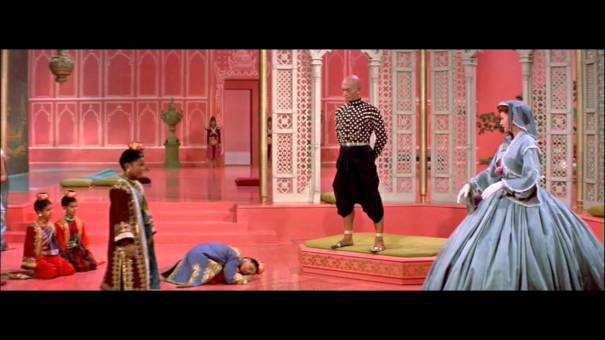
The King and I has many wonderful musical moments; one of my favorites is “The March of the Siamese Children” which takes place relatively early in the story. Anna (Deborah Kerr) is upset that she must stay in the royal palace next to the harem (instead of in a little house of her own as she’d been promised) and is on the verge of returning to England straight away. However, before she goes, the King insists that Anna meet his children first. If she still wants to leave after meeting them, he won’t stop her.
The march then begins with children being led in one by one by their nurses. Each child comes forward, bows to their father, greets Anna by touching their forehead to her hands and then backs away to sit with the royal wives (their respective mothers).
The music is a beautiful theme and variations that repeats over and over, altering slightly for certain children. The most notable change is when Crown Prince Chulalongkorn, the King’s heir marches in; the music here changes to a stirring brass fanfare as befits the heir to the throne. Unlike the other children, Chulalongkorn and the King bow to each other and Anna is told to curtsy to the Crown Prince.
There are some other humorous moments, some of my favorites being:
The twins: The two boys (not surprisingly) are dressed identically and the King seems quite pleased with them.
The forgetful princess: one of the younger daughters accidentally turns her back on her father and when he reminds her with a mock gasp of shock/horror, she quickly turns around with a look of surprise (the King isn’t all that angry with her, as she is still young)
The curious prince: one prince comes out looking very curiously at Anna the entire time and it quickly becomes clear why: he’s never seen someone with Anna’s huge skirts before. He’s curious to see exactly what’s under there…but the King quickly stops that idea.
“I want a hug!”: One daughter forgets where she is and runs to the King for a hug, only to be stopped with a stern look. When the dejected princess begins to back away, she is reassured by the King with a warm smile (which she returns).
The littlest princess: Possibly the most adorable moment comes at the very end when the youngest daughter comes out. She is so small that the King doesn’t see her until she tugs on his pant leg for attention. He then guides her through what she needs to do (it’s adorable!)
Once all the children are assembled, Anna realizes she can’t possibly leave them to return to England (which is what the King thought would happen) and she agrees to stay after all, to the delight of the royal children.
“The March of the Siamese Children” is a delightful moment from a wonderful film and I hope you enjoy it.
I have been waiting months for this film to arrive and once it did, oh my gosh, it was absolutely worth the wait!!
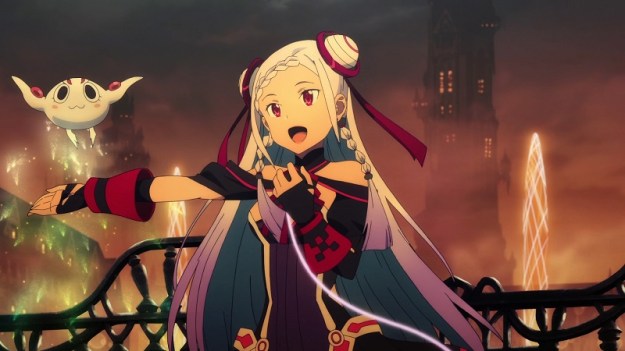
Ordinal Scale is the first full length film set in the world of Sword Art Online, an anime that begins with the tale of 10,000 gamers trapped in a virtual reality “death game” called Sword Art Online (SAO). Of the original 10,000, only 4,000 made it out alive, among them Kirito, his girlfriend Asuna, Klein, Silica, Liz and Agil. Four years after the original death game concluded, in the year 2026, Japan is entranced with a new Augmented Reality (AR) device called the Augma that lets you fight epic battles (among many other functions, think of it has a futuristic version of Google Glass) in the real world. But curiously, monsters from the old SAO game are showing up, which shouldn’t be possible because the server for SAO was shut down when the game ended. Or WAS it??
There are many things I loved about this film, the mystery behind the Augma was intriguing, as was the revelation of who Yuna, the beautiful AI girl who serves as a “host” for Ordinal Scale really is (she has connections to the original SAO game).
And then there’s the ongoing relationship between Kirito and Asuna. To my surprise, Kirito is initially reluctant to engage in Ordinal Scale, which is unusual for him, he’s usually jumping in headfirst to a new game. According to Kirito, he doesn’t like Ordinal Scale because it doesn’t feel the same as a VR (Virtual Reality) game. Unlike VR, in AR your actual physical body is moving, meaning you have to be in great shape to move and engage quickly enough to win (there’s an embarrassing moment when Kirito runs to attack and ends up falling flat on his face after tripping on a curb). But soon Kirito has no choice but to engage in the game when something weird begins happening to the players who survived SAO…
It starts with Kirito’s friend Klein: during one AR battle, the #2 Ordinal Scale player, Eiji, attacks Klein and his friends. At a certain point in the battle, a node on their Augma devices glows and pops out , being sucked up into nearby drones used to project the game all over the city. Not only is Klein’s arm broken, but his memories of SAO (two year’s worth) are missing. And then the same thing happens to Asuna: while protecting Silica from an attack, Asuna’s Augma node is taken and HER memories of SAO (as well as two years worth of memories of her boyfriend) are taken away, devastating her and briefly casting doubt on her relationship with Kirito.
To get Asuna’s memories back, Kirito must become the top player in Ordinal Scale and along the way discover the truth behind this latest game (I won’t spoil it, but it’s really good).
My favorite part of the film comes at the height of the final battle when we’re finally shown something I thought we’d never see: Floor 100 of Sword Art Online (the original game was based on a castle made of 100 floors. The original game ended early on the 75th floor when Kirito realized that the leader of a powerful guild was actually the creator of the SAO game.) For this final battle, Kirito and company are transported to the Ruby Palace on Floor 100 and, even more, are changed back into the forms they possessed in the original game (which brought shouts of joy from the audience).The Ruby Palace is simply beautiful (and huge!!) with wonderful gardens around the entire structure. Inside the castle resembles a giant cathedral as it seems to be one very large room. The boss they have to fight on Floor 100 is insanely powerful and it ultimately takes every ally Kirito and Asuna have ever made to defeat it.
The story ends with something that’s been a long time coming: after getting “married” in the original SAO game, Kirito finally keeps a promise he made in-game and gets engaged to Asuna in the real world (they were 15 going on 16 in the original game, so they’re at least 19 going on 20 now).
But that wasn’t all….after the credits finished, we got a short peek at the upcoming Season 3 of Sword Art Online!!! It’s maybe 90 seconds long, but at the end, we get a glimpse of the latest VR world: Rath, the setting of the recently concluded Alicization Arc. No date was given but it is confirmed now that SAO WILL return!!!While the movie last night was a one night only event, I hope that eventually the film will be released on one of the streaming services so everyone can see it (I know the English dub is in progress). I’m not sure if the movie will be released on DVD here in the US, but if it is I will let you know.
Sword Art Online The Movie: Ordinal Scale was an awesome experience, worth the wait and I sincerely hope there are more films to come!
Before we get to what makes this scene so disturbing, we need a little context first:
So as you might expect, Pinocchio is talked into taking a little trip to Pleasure Island (despite Jiminy’s best efforts to stop him). They join a carriage full to the brim of rowdy boys pulled by eight donkeys (remember that detail). It’s so crowded in fact, that Pinocchio is sitting up front by the Coachman with an older boy named Lampwick. They bond as kids tend to do when they’re traveling together and after a long ferry ride to Pleasure Island, the pair stick together once they get inside.
Pleasure Island looks like the world’s biggest amusement park. There’s the typical rides, a Ferris Wheel, and lots of deliciouis food to eat (pies, ice cream, popcorn, etc.) along with other attractions you wouldn’t normally find: a tent devoted to fistfighting, a model house that the boys are free to rip apart, even “Tobacco Row” where the boys can have all the cigars they want (remember, this is 1940). And above all the clamor is the repeated sound of voices saying “Help yourselves boys, it’s all FREE, everything is FREE!” Jiminy Cricket smells a rat from the start though, but he’s lost Pinocchio in the crowd, so there’s really nothing he can do at the moment. In all the chaos, nobody notices when the Coachman orders the gates to be shut, remarking ominously “give a boy enough rope, and he’ll make a jackass of himself before long.” It’s an odd comment, but it’s meaning becomes too clear in a few minutes:
After a short scene break, we see that Pleasure Island is now deserted. All the rides are dark, the place is a mess, but there’s no boys, anywhere! We know they haven’t gone home because even Jiminy is wondering where the boys are. Actually, the place isn’t entirely empty, Pinocchio and Lampwick are busy playing pool while drinking and smoking cigars, but we’ll get back to them in a moment. After Jiminy gets into an argument with the pair, finally telling them to go ahead and “make jackasses” of themselves, he heads to the gate to leave, but on the other side, he hears the sound of donkeys….a LOT of donkeys.
It’s horrifying to hear this little donkey cry “I want to go home to my mama!” When you know that’s NEVER going to happen!
Through a crack, Jiminy emerges to find the Coachman and his minions loading crate after crate of donkeys back onto the ferry used to take the boys to the island. What happens next is the first disturbing part of this scene:
As you see, the Coachman is screening the donkeys to see if they’re still capable of speech. If they bray in response, they’re stripped of their clothing and sent into an available crate (labeled for the salt mines and the circus, among other places). But in the case of others, like Alexander, who CAN still talk, they’re sent back to a waiting area, until presumably they lose their ability to speak. This is the moment that disturbs me and breaks my heart: when Alexander is thrown back, you can hear him and the others begging to go home, they don’t WANT to be donkeys, and then the Coachman snaps “QUIET!! You boys have had your fun, now PAY for it!” Remember earlier when the carnival promised the boys that “everything is free?” Of course it wasn’t free, that’s one of the first lessons we learn in life, but now these boys have to learn it the hard way.
Now back to Pinocchio and Lampwick (this is the REALLY disturbing part): Lampwick is still making fun of Jiminy, when suddenly his ears turn into donkey ears (to Pinocchio’s surprise).
The oblivious Lampwick continues to mock, and then a donkey tail sprouts out!
“What does he think I look like, a jackass?” Lampwick doesn’t realize it, but his face IS that of a donkey’s now.
Based on Lampwick’s reaction, I think he’d heard stories about Pleasure Island, but had never believed them (hence his cry “I’ve been double crossed (betrayed)”, I bet the Coachman assured him those stories were lies.)
Pinocchio laughingly tells him he does until his laugh changes into a donkey bray. Lampwick finds that funny until HE brays too. Then, Lampwick realizes that something is wrong with HIM! “What…what’s going on?” he asks desperately as he feels his changed face and discovers he has long donkey ears. And then…he sees his face in the mirror and screams “I’ve been double crossed!! Help! Help!! Somebody help!!” Lampwick is running through the pool hall desperately but there’s nothing anyone can do. Pinocchio can only watch in horror as the rest of Lampwick’s body begins to change (an especially horrifying part is when Lampwick’s hands, clawing at Pinocchio for ANY kind of help, turn into hooves before the puppet’s terrified eyes).
Lampwick’s final change is a disturbing moment, especially since you can hear him fighting against losing the power to speak as a human
And then, like a scene straight out of a horror movie, we see Lampwick’s final change in silhouette. With a final cry of “Mama, MAMA!!!” Lampwick is forced down to all fours and begins frantically braying, kicking and smashing everything in sight. It’s a horrifying fate for anyone to experience, but these are all young kids that are now condemned to a lifetime of cruel torture and servitude. There’s no happy ending for these boys, not even a glimmer of hope. And the same fate nearly comes to Pinocchio as well as HE begins to change also (though noticeably he’s changing into a GRAY donkey, everyone else turned brown.) Fortunately, Jiminy finds Pinocchio in time and the pair flee the cursed island quickly enough that Pinocchio only has donkey ears and a tail.
What a horrifying, disturbing fate for all those little boys. And just imagine all the families who are waiting for children that will never come home? The more you think about the situation, the more disturbing it becomes. And remember at the beginning when I pointed out the coach was drawn by donkeys? I have no doubt that the Coachman uses boys-turned-int0-donkeys to help carry more boys to Pleasure Island for the same fate. Oh the disturbing irony of it all. Without a doubt, THIS is one of the most disturbing moments in all of Disney animation, not just because of Lampwick’s terrified reaction to his transformation, but also because these hundreds of boys are left to their fate, with no hope of rescue.
Next time will be one more example from Pinocchio; see, even though he’s escaped Pleasure Island, Pinocchio isn’t out of danger yet. That’s because his father Geppetto has been swallowed by a whale…
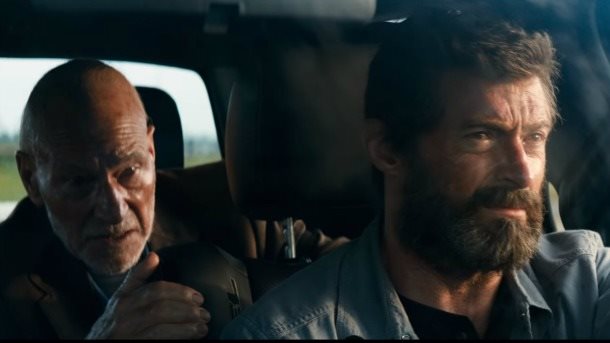
Wow, where do I even start with Logan? Holy fracking s***!!!! Let me start by saying that I have wanted to see Hugh Jackman playing Wolverine in theaters for a while now, but something has always come up previously. Knowing that Logan was my last chance, I made every effort to see this film as soon as possible and it was totally worth it!
Now, normally when I discuss a film I’ve just seen I hold nothing back regarding spoilers, but…based on what I saw, I cannot find it in myself to spoil this film completely. You really need to watch this film for yourself (if you haven’t already). However, there a few things I NEED to talk about…: *various spoilers follow from this point*
The film is set in 2029 in a noticeably dystopian future (I should point out that this is not immediately obvious, but it plays into the plot at a crucial moment). Logan (for a host of reasons) is working as a limo driver, ferrying all kinds of people to where they need to go. When he’s not working jobs, he lives south of the border taking care of Professor X, who is not well. It is mentioned (and this made my jaw drop) that for reasons unknown (even to Professor X), no new mutants have been born in 25 years; Logan is of the opinion that the mutant gene has died out. Well, that isn’t entirely true…because one day Logan runs into Laura.
Dafne Keen as Laura/X-23: In the world of comics, I didn’t learn of X-23’s existence until just a few years ago (she “guest-starred” in a Black Widow comic). From then on, I was fascinated by the existence of a female Wolverine (I love the retractable claws), and when I learned that the young girl in Logan was X-23…well, that cemented my need to see this film.
Watching Logan and Laura interact was one of my favorite parts of this film. Having Logan confronted with suddenly having a daughter (and a feisty one at that) told a great story, one that I wish could have been continued past this film. My favorite fight scene is towards the end when the pair team up and fight in the woods against a team of bad guys (the moment where she launches off of Logan’s back is as awesome as you think it is).
It turns out that Laura is an escapee from a hidden project that had been attempting to artificially create mutants, using genetic material swiped from various mutants (including Logan). The “X-23” program is deemed a failure when the children are found to be uncontrollable past a certain point and once the “X-24” project is completed, the children are going to be executed until an organization sympathetic to the children helps them to escape the facility. Logan is (reluctantly) hired to take Laura to a place in North Dakota identified as “Eden”, which proves to be a launching point for a final run to the Canadian border, where the children are to be granted asylum, IF they can get across that is. See, the agency that created the children wants them back, desperately, and they’ll stop at nothing to get them.
I don’t want to reveal too much more, but I will say a few things in general:
this film absolutely needed an R rating to tell this story properly, there is no way Logan would have worked as a PG-13 film
if you haven’t figured out the identity of X-24, the reveal is very well done and generated an audible gasp from me
Dafne Keen absolutely KILLS it as a younger, female version of Wolverine. I would be genuinely happy to see a standalone X-23 film (with Dafne continuing to play the character).
Patrick Stewart’s performance as Professor X deserves an Oscar, as does Hugh Jackman’s performance as a noticeably-past-his-prime Wolverine.
Marco Beltrami’s score for the film is excellent (he rarely disappoints me)
Logan is a well-executed conclusion to the Wolverine saga, though I am very sad to see Jackman exit the role. He will always be Wolverine to me.
Boyd Holbrook’s character has one of the best “bad guy gets his comeuppance in spades” scenes that I’ve seen in quite a long time. Just goes to show that one should never piss off a group of mutants.
While this IS the conclusion of the “old” X-Men as we know it, I believe there has been a hook left to follow a new generation of mutants (and I don’t just mean the recent films following younger versions of the classic characters), which would be exciting.
One last note: be prepared to cry at the end.
I’m so happy I went to see Logan, it did not disappoint. Have you gone to see Logan yet? What did you think about it? Let me know what you think in the comments below!
I think it should go without saying that Pinocchio is one of the most disturbing Disney movies ever created. It will certainly occupy quite a few places in this series (which is why I’m starting out with it), and one of the most disturbing parts of this film is the character of the Coachman (voiced by Charles Judels, who coincidentally also voices Stromboli in the same film).
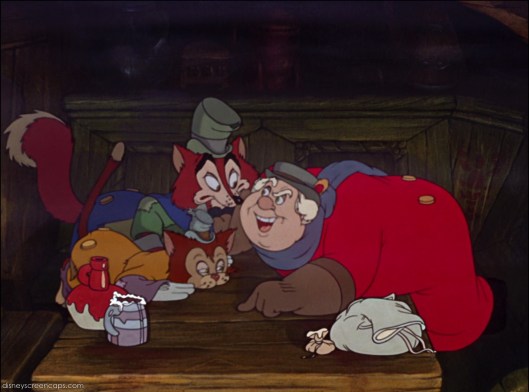
The Coachman is introduced about halfway through the film. At a sleepy tavern one night, the tricksters “Honest” John (a fox) and Gideon (a cat) are regaling the Coachman with how they tricked Pinocchio into going with Stromboli, the latter paying them a (tiny) modest fee in return. The Coachman appears bemused by all of this, and finally asks the two if they’d like to make some REAL money, thumping down an enormous bag of money on the table. To get paid, all Honest John and Gideon have to do is find as many naughty boys as they can and direct them to a coach that he has leaving at midnight. A few of the details are obscured in whispers, but the conclusion is that by the end of it all, the Coachman will be taking all the boys off to Pleasure Island.
“PLEASURE ISLAND?!!?” Honest John appears petrified for once and questions what will happen if the law finds out?? (Note how the music rises in “panic” along with Honest John’s words). Given the disregard for the law Honest John has shown before, it speaks volumes that he’s worried about it now. But the Coachman isn’t worried as there’s no risk: “You see…” he says “they never come back…as BOYS!!!”
THIS is what makes this a “Disturbing Disney” scene, not just the Coachman’s threat about the boys never returning (as humans) but also his unexpected transformation into this monstrous/demonic figure. When I re-watched the film for the first time in many years, I literally leaped back in my seat as I hadn’t remembered this part at all!! It’s a truly disturbing moment that makes the skin crawl. Clearly, the Coachman isn’t an ordinary human, in fact, I don’t think he’s human at all! Based on what we’ll see in the second installment, I think it likely that the Coachman is a literal “devil in disguise” (he is wearing red after all) or at the very least he’s a dark spirit working in league with the devil.
One last note, I just wanted to mention my thoughts on something I read while researching for this post: for those who say that this scene is a metaphor for pedophilia (i.e. they never come back as “boys” because he’s going to use them in THAT way, etc.), I would say consider WHEN this film was made. I’m not saying that issue didn’t exist in 1940, but films were still highly censored when it came to taboo subjects and if the review board had the slightest inkling that’s what this moment referred to, the scene would have been cut for sure (or the line would have been altered). That’s all I wanted to say about that; I believe the Coachman’s words can be interpreted literally, they’re not coming back as “boys” because they’re not going to be human when they return.
And to think this is found in a movie watched by children…*shudders* and if you think THIS is bad, just wait until #2, that’s when I’ll tell you the secret of Pleasure Island (and what happens to Pinocchio’s friend Lampwick…I nearly started with this scene instead but I thought it would be better to build up to it.)
What do you think of the first installment of “Disturbing Disney” ? I promise I’ve got plenty more to share with you. I can’t wait to see Logan tonight and share my thoughts on it with you 🙂
“Cruella de Vil” is one of those memorable Disney songs that tends to stick in the brain long after you’ve seen the movie it belongs to. It is also a villain song that is not actually performed by the villain. (The song was composed by Mel Leven and is the major song moment of the film).
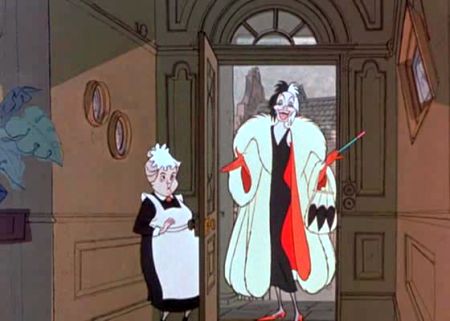
To set up some context, 101 Dalmatians centers on two Dalmatians, Pongo and Perdita and their human “pets”, Roger and Anita Radcliffe (Pongo belonged to Roger and Perdita belonged to Anita before the two married). Some time after their pets marry, Perdita is expecting puppies when an unexpected visitor drops by; Cruella de Vil was Anita’s school mate and she has apparently dropped by on occasion in the past (considering Roger recognizes the car when it pulls up).
Anita DARLING!
Roger has spent the last several days working on a new song, but he’s struggled to come up with appropriate lyrics. Suddenly, while mulling over Cruella’s name, he realizes its the perfect inspiration for the song! (Cruella de Vil is an obvious play on the words “Cruel Devil”)
“Cruella de Vil” mockingly paints Cruella as this devilish figure that inspires fear and terror wherever she goes. Roger takes great delight in performing this number while a slightly anxious Anita tries to hush him up (as Cruella is moments away from stepping through the door). Roger eventually retreats to his music room to continue (literally) banging the song out while Cruella comes through like a fur-lined whirlwind. Cruella SEEMS nice enough at first, if a little eccentric (she has an unhealthy obsession with furs) but noticeably, Pongo and Perdita react negatively to her presence. While Cruella has a very one-sided conversation with Anita, Roger plays variations on his song with the piano, a trumpet and a slightly obnoxious trombone (to Cruella’s annoyance; she has no idea what Anita sees in Roger).
For some reason, Cruella is fixated on knowing when Perdita’s puppies will arrive (she initially thinks they’ve already been born). After promising to return when the puppies are born (in approximately three weeks), Cruella leaves as abruptly as she arrived and a teasing Roger returns to continue his song. As mocking as the song is, it’s all meant in good fun (for now anyways).
This is a song I’ve always loved to dance around to, it’s short, fun and a classic example from the early post-Golden Age of Disney films.
















 Film Music Central