Category Archives: Films

Keep Watching the Skies Blogathon: The Day the Earth Stood Still (1951)

*This post is part of the Keep Watching the Skies Blogathon hosted by The Cinematic Frontier

When I think of “classic” science fiction cinema, I inevitably think of two films: Forbidden Planet (1956) and The Day the Earth Stood Still (1951), though regarding the latter, it took me a long time to remember what the film was called. It kept turning out that every time the film was on Turner Classic Movies, I would end up catching it in the middle. So for a while it would be “that movie with Gort in it.” Of course now I know that The Day the Earth Stood Still is so MUCH more than that.

download

Released in 1951, The Day the Earth Stood Still is set during a time when the Cold War against the Soviet Union (and a fear of Communism in general) is gaining momentum. The score for this film was composed and conducted by the legendary Bernard Herrmann and featured extensive use of the theremin in the opening title. In fact, the score for this film is what inspired Danny Elfman to be interested in film composing.

The Day the Earth Stood Still – Main Title (1951)

A strange flying saucer enters Earth’s atmosphere and lands in Washington D.C., where it is quickly surrounded by the Army.

The Day the Earth Stood Still- Klaatu Arrives (1951)

An alien, Klaatu (Michael Rennie), appears and announces he comes in peace. Unfortunately, when he reveals a strange device, one of the soldiers panics and shoots Klaatu in the shoulder, prompting the large robot Gort to emerge from the spacecraft. Surveying the situation, Gort begins to vaporize the weapons with a beam from his “eyes” when Klaatu commands him to stop.

The Day the Earth Stood Still – Gort (1951)

Klaatu is taken to the hospital, but it turns out he is more than capable of healing himself (leaving the poor doctor ready to retire after learning his patient is actually 78 and only in what he considers middle age for his species). Mr. Harley, the secretary to the President arrives, and asks Klaatu why he has come. The mission is simple: Klaatu has an urgent message that must be shared with ALL the governments of the world at the same time. Mr. Harley protests that this will be impossible, and when the authorities prove less than helpful, Klaatu decides to escape and spend some time among the populace, to see if he can learn why the human race is so suspicious.

kozl-figure-7

Assuming the identity of “Mr. Carpenter”, Klaatu takes a room in a boarding house where he meets and befriends Helen Benson (Patricia Neal), a widow, who lives with her young son Bobby. The next day, Klaatu lets Bobby show him around the city, where he is visibly disturbed to learn that so many people have been killed due to war. He is also impressed by the Lincoln Memorial (“Those are great words…”) Knowing that his message must still be shared, Klaatu asks Bobby who the smartest man in the world is. Bobby figures that it must be Professor Barnhardt, who happens to live in the city. Finding the professor out, Klaatu leaves a “calling card” by adding in a vital part of an equation (that an ordinary person would not know), knowing that he’ll be contacted as soon as the professor sees it.

Sure enough, the professor and Klaatu end up meeting and the alien shares a small part of his message: If the governments of the world do not listen to him, Earth is at risk of annihilation. This statement terrifies the professor:

“Such power exists?” he asks breathlessly

“I assure you” Klaatu answers “Such power exists.”

Professor Barnhardt promises to assemble as many world scientists at the spaceship as he can, but in the meantime, he thinks it would help if Klaatu were to give a “minor demonstration” of what might happen, but asks also that no one be killed as a result of this “demonstration.” Amused by the challenge, Klaatu sneaks back to the spaceship to prepare for the event, but doesn’t realize Bobby is following him and sees him communicating with Gort.

The Day the Earth Stood Still- Power Loss (1951)

The “demonstration” turns out to be a total loss of power all over the world (be it motive, electrical, etc.) for precisely thirty minutes (excluding planes in the air or the power necessary to run hospitals). To create a musical sense of the chaos that was happening, Herrmann created a series of tonal clusters (a large series of notes grouped very closely together) and held them out for long periods of time, to create that feeling of static helplessness that almost everyone feels during this period (except for Professor Barnhardt, he revels in the chaos, knowing its source).

Just as the power outage begins, Helen confronts Klaatu about what Bobby told her and while they are trapped in a hospital together, Klaatu confesses everything and asks for her help. Helen promises to do what she can, but there’s a wrinkle, Helen’s boyfriend Tom already believes that “Mr. Carpenter” is the alien and is doing his best to turn Klaatu in to the authorites, believing that this will make him a “big hero.” A disgusted Helen breaks up with him, and the authorities begin to close in on Klaatu’s location.

The Day the Earth Stood Still- Klaatu Barada Nikto (1951)

En route to the gathering of scientists, Klaatu tells Helen that should ANYTHING happen to him, she must go to Gort and tell him “Klaatu barada nikto.” This is because there is “no limit” to what Gort could do, “he could incinerate the Earth.” Before they can reach the spaceship, the Army cuts the pair off. Klaatu runs for it, but is gunned down in the street, prompting Helen to run for the spaceship. And back at that same spaceship, Gort has begun to awaken, sensing Klaatu’s death. When two Army sentries approach, Gort promptly vaporizes THEM (not just their weapons like before). Helen approaches, but is terrified by the huge robot. However, she manages to get the words out just before Gort can vaporize her and Gort responds by taking her to the ship before leaving to retrieve Klaatu’s body.

Back in the spaceship, Helen watches awestruck as Gort begins manipulating a series of dials that begin to heal and revive Klaatu’s body! The alien ultimately returns to life, but it’s not permanent. Even they, as advanced as they are, do not possess “the power of life and death”, as that is reserved for the “Almighty Spirit.”

(On a side note, Michael Rennie absolutely HATED that reference to the Almighty Spirit (it was added by the studio at the last minute, as they felt they were making these aliens out to be gods) as he felt it didn’t fit everything we’d learned about Klaatu and his culture up to that point)

The Day the Earth Stood Still- Klaatu’s Speech (1951)

Meanwhile, the crowd of scientists has gathered outside, but the Army is urging them to leave, as they have no idea where Gort is. Just as Professor Barnhardt agrees that they should disperse for their own safety, the spaceship opens up one last time, revealing Helen, Klaatu and Gort. Helen leaves the ship, while Klaatu stands at the entrance to finally deliver his message:

I am leaving soon, and you will forgive me if I speak bluntly. The universe grows smaller every day, and the threat of aggression by any group, anywhere, can no longer be tolerated. There must be security for all, or no one is secure. Now, this does not mean giving up any freedom, except the freedom to act irresponsibly. Your ancestors knew this when they made laws to govern themselves and hired policemen to enforce them. We, of the other planets, have long accepted this principle. We have an organization for the mutual protection of all planets and for the complete elimination of aggression. The test of any such higher authority is, of course, the police force that supports it. For our policemen, we created a race of robots. Their function is to patrol the planets in spaceships like this one and preserve the peace. In matters of aggression, we have given them absolute power over us. This power cannot be revoked. At the first sign of violence, they act automatically against the aggressor. The penalty for provoking their action is too terrible to risk. The result is, we live in peace, without arms or armies, secure in the knowledge that we are free from aggression and war. Free to pursue more… profitable enterprises. Now, we do not pretend to have achieved perfection, but we do have a system, and it works. I came here to give you these facts. It is no concern of ours how you run your own planet, but if you threaten to extend your violence, this Earth of yours will be reduced to a burned-out cinder. Your choice is simple: join us and live in peace, or pursue your present course and face obliteration. We shall be waiting for your answer. The decision rests with you.

The film ends with Klaatu and Gort leaving in their spaceship, a giant question mark hanging over the fate of the human race: will we join this peaceful group of planets, or will we destroy ourselves?

Of course no answer is given, and that frustrated me for years, because I wanted to know how the story was going to end! Except there isn’t meant to be an ending, not like that anyways. The end of Klaatu’s speech was intended as a direct message to the world in 1951: if we don’t stop fighting each other, we’re going to destroy ourselves.

Though it is now over sixty years old, the film is considered a classic and its message is just as relevant today as it was when the film came out. If you haven’t seen this film before, I highly recommend it (and whatever you do, do NOT watch the remake with Keanu Reeves!!!)

Thanks to The Cinematic Frontier for running this great blogathon! -Becky

Don’t forget to like Film Music Central on Facebook 🙂


The Lion King “King of Pride Rock” (1994) Pt. 1

“King of Pride Rock” takes place at the climax of the film. After a little persuasion from Rafiki (not to mention a spine-tingling heart to heart with his father’s ghost), Simba has returned to the Pride Lands…only to discover that his once beautiful home is practically a desert. When Scar allowed the hyenas to move en masse into the Pride Lands, it upset the delicate balance of life and now all the herds of elephants, antelope, giraffes, etc. have moved away, leaving the pride (not to mention a very large group of hyenas) close to starvation. Simba is quickly joined by Nala, Timon and Puumba, who are all willing to help Simba claim his rightful place as king.

And Simba hasn’t come home a moment too soon: Scar wants to have a word with Sarabi, Simba’s mother. He accuses the lionesses of not doing their jobs of hunting for food, despite Sarabi’s calm replies that there isn’t any food because the herds have all left. Scar vehemently denies the truth (he can’t accept that he’s a terrible king) and when Sarabi tells the delusional lion that they have to leave Pride Rock if they want to survive, the furious Scar explodes in rage, ultimately striking Sarabi across the face, provoking an enraged roar from Simba.

The music during all of this is mournful (the melody is led by an oboe and backed by a choir). Usually in a situation where the villain is in charge, there’s a theme that suggests “evil triumphant” but that doesn’t really happen here (unless you count the brief fanfare when Scar assumes the throne). Scar has mismanaged the Pride Lands so badly that there is nothing to be proud of. Deep down, he probably knows this, but his arrogance won’t let him admit he’s done all the wrong things.


Speaking of doing wrong…Scar almost betrays himself when Simba appears out of nowhere. For a brief moment, his nephew resembles his late brother so much that Scar whispers “Mufasa…no, you’re dead!” I don’t think anyone else heard him though, because doesn’t it sound awfully suspicious to be afraid of what you think is your brother’s ghost? Even Sarabi believes that this is her husband until Simba corrects her, much to Scar’s surprise:

“Why Simba…I’m so surprised to see you…alive” *angry glare at Shenzi, Banzai and Ed, who slink away for safety*

Simba is ready for war (“Give me one good reason why I shouldn’t rip you apart”) and the music backs up Simba’s anger. Listening to this part, Simba can be represented by trumpets and brass. Scar, on the other hand, is more in the woodwinds, and “his” music slinks and wiggles, while Simba’s is (initially) bold and confident. And I say “initially” because Scar has one last trump card to play: the “truth” about who really killed Mufasa. All these years Simba has believed this tragedy was his fault, and now he confesses it to everyone as the “truth” and Scar promptly denounces his nephew as a murderer

“If it weren’t for YOU Mufasa would still be alive, it’s YOUR fault he’s dead, do you deny it? “No” “Then you’re GUILTY!”

And while he distracts Simba with these accusations, Scar surreptitiously begins backing the young lion towards the ledge at the end of Pride Rock, ultimately trapping Simba as he nearly falls over the edge! At this point, the soundtrack skips to the aftermath of the final fight, but I’m going to keep going.

The Lion King “Scar confesses the truth” (1994)

Now, history is about to repeat itself: Scar finds himself standing over Simba, in much the same way he stood over Mufasa right before his death. And at this moment, Scar makes one of his final mistakes (though not the one that gets him killed, that comes in a little bit): he leans down close to Simba and tells him the REAL truth: *I* killed Mufasa….this admission triggers an avalanche of pain and rage in Simba, who in one swoop jumps up and pins SCAR to the ground, demanding that everyone know what he just told them. Cornered, Scar finally admits to the entire pride that HE killed Mufasa and the war is on!! Well, I say war, but it wasn’t THAT big of a fight. At this point, most of Pride Rock is on fire from a lightning strike, and if you watch closely, most of the hyenas are running for their lives (from the flames as much as the wrath of the lion pride). Simba isn’t about to let Scar get away though, and when he spots his uncle trying to slink away, Simba chases him all the way to the top of Pride Rock. As the two lions begin to square off, neither notices that Shenzi, Banzai and Ed have crept in to listen.

The Lion King “Scar vs. Simba/Scar’s Death” (1994)

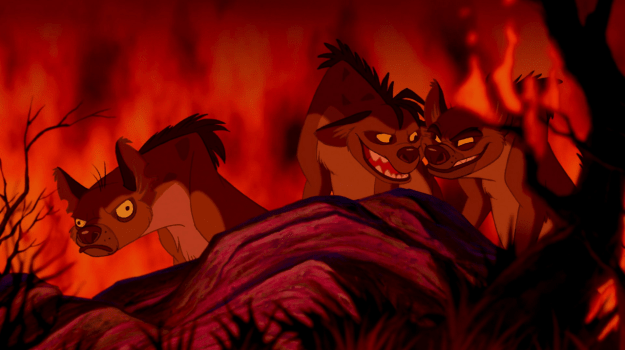
Simba is ready to kill Scar where he stands and the desperate Scar is pleading any excuse he can think of to keep his nephew from cutting his throat. He pleads for mercy, he pleads blood relations, and finally, he pleads the excuse that the HYENAS are the real enemy here, that this entire scheme was their idea, not his (As Shenzi, Banzai and Ed hear this, they growl in anger and slink away, but they’re not done with Scar yet). Simba doesn’t believe a word, but he won’t kill Scar either (as that would lower him to Scar’s level). Instead (oh, the delicious irony!!) he tells his uncle to “Run, run away Scar, and NEVER return” (the exact words that Scar used to make Simba run away). The older lion seems like he will accept this and leave, but just as everything seems over, Scar swipes some coals into Simba’s face and one last fight ensues.

youdothistoherorhim

In the dramatic climax, Simba and Scar (in dramatic slow motion), tear and claw at each other, and Simba is ultimately knocked to the ground. But when Scar lunges for the kill, Simba takes a page from Nala and kicks upward, propelling his uncle over the edge of the cliff! But Scar isn’t dead, not yet anyways. He pulls himself up as Shenzi, Banzai and Ed come forward out of the flames.

End_of_Hyenas.png

“Ah…” he smiles “My friends….”

And Shenzi laughs “Friends?? I thought he said we were the enemy…Yea, that’s what I heard, Ed???” As this conversation goes on, Scar’s eyes become horror filled as he realized that he’s surrounded by a horde of angry hyenas who no longer trust him, and are very, very hungry!! Scar pleads for his life right until the very end, when the hyenas (and the flames) overwhelm him. As Disney villain deaths go, this one is pretty gruesome. As I noted in Beauty and the Beast, this ending was originally intended for Gaston (who was supposed to survive his fall from the tower and be cornered by a pack of wolves).

To be honest, I was going to keep going through Simba’s triumphant accession of the throne, but this has gone on really long so I’m going to split this post in two and post the rest later this week 🙂 The Lion King has a pretty awesome climax, proving why it is one of the greatest films of the Disney Renaissance.

Become a Patron of the blog at patreon.com/musicgamer460

Check out the YouTube channel (and consider hitting the subscribe button

For the rest of my series on The Lion King, see also:

The Lion King “The Circle of Life” (1994)

The Lion King “Be Prepared” (1994)

The Lion King “I Just Can’t Wait to be King” (1994)

The Lion King “Hakuna Matata” (1994)

The Lion King “Can You Feel the Love Tonight” (1994)

The Lion King “To Die For” (1994)

The Lion King “Under the Stars” (1994)

The Lion King “King of Pride Rock” Pt. 2 (1994)

Check out the main Disney soundtrack page here: Disney Films & Soundtracks A-Z

Don’t forget to like Film Music Central on Facebook 🙂

The Two Towers “Lament for Theodred” (2002)

Note: I was actually going to do “Riders of Rohan” today but my headphones are missing right now and I didn’t want to wait all day to do a post, so I picked this one instead 🙂

pdvd_088

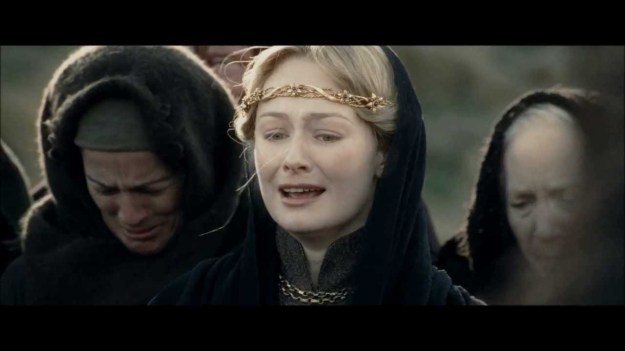
Theodred is a character that we, unfortunately, only “meet” after he has been mortally wounded by orcs at the Fords of the River Isen. (In the books we only learn of his death after the fact). He’s brought back to Edoras by his cousin Eomer, but he never recovers. In fact, a deleted scene was going to strongly hint that Wormtongue poisoned Theodred to make sure that he died.

The Two Towers “Lament for Theodred” (2002)

As King Theoden’s only son, the late prince is given a royal burial in the funeral mounds located outside the gates of Edoras, where all the kings of Rohan are buried. As the body is brought down to be interred into the mound, Eowyn (also Theodred’s cousin, being the sister of Eomer) leads a funeral dirge in Rohirric (the native language of Rohan).

maxresdefault

As strange as the words sound, Tolkien (being an expert in ancient languages) based Rohirric on a dialect of Old English. This is why, if you listen carefully, the words sound almost familiar, even though they’re not understandable. The basic gist of the dirge is that: death has claimed this noble warrior, and all will wail his passing. He will return home to Meduseld (the house of the king) no longer. The words sound harsh to the ear, but the raw heartache behind them is palpable.

This is clearly a very emotional moment for Eowyn, who has already lost her parents, seen her brother exiled and now must watch her cousin be buried. I’m sure she never imagined that she would witness Theodred’s funeral. It always hurts to lose a family member, but Eowyn does her best to keep her emotions in check (she is a princess of Rohan after all, being a niece of the king).

While Theodred is a character we barely get to meet, his death has far-reaching consequences. For one, Theoden has lived to bury his children (thus affecting him for the rest of the story). For another, this makes Eomer, the king’s nephew, the heir to the throne of Rohan. The problem is: Eomer is currenly riding north and growing more distant by the hour. Unless he can somehow be recalled, Rohan is going to be in a lot of trouble very quickly.

See also: Film Soundtracks A-W

Become a Patron of the blog at patreon.com/musicgamer460

Check out the YouTube channel (and consider hitting the subscribe button)

See also:

The Two Towers “Last March of the Ents” (2002)

Don’t forget to like Film Music Central on Facebook 🙂
The Fellowship of the Ring “In Dreams” (2001)

For now, this is the conclusion of The Fellowship of the Ring. “In Dreams” is technically not part of the main soundtrack (you only hear it over the end credits) but it is still a gorgeous piece of music that I want to share with you.

The Fellowship of the Ring “In Dreams” (2001)

“In Dreams” possesses the same melody as “The Shire” and adds lyrics to make a heartwrenching song about meeting those we have lost “in dreams.”

When the cold of Winter comes,

Starless Night will cover Day

In the veiling of the sun,

We will walk in bitter rain…

But in dreams…I can hear your name…

And in dreams…We will meet again

When the seas and mountains fall

And we come, to end of days

In the dark I hear a call, calling me there

I will go there…and back again…

The song is performed by a boy soprano (backed by a choir in various sections) and it is simply beautiful to listen to. And you’ll notice that the final line is a nod to the subtitle of The Hobbit (“There and back again”) which is really cool. A brief personal story, every time I watch The Fellowship of the Ring with my mom, she will not let the DVD be taken out until she’s heard this song (that’s how much she loves it).

See also: Film Soundtracks A-W

See also:

The Fellowship of the Ring “Shadow of the Past” (2001)

The Fellowship of the Ring “The Ring Goes South/Fellowship Main Theme” (2001)

The Fellowship of the Ring “Many Meetings” (2001)

The Fellowship of the Ring “A Knife in the Dark” (2001)

The Fellowship of the Ring “Lothlorien” (2001)

The Fellowship of the Ring “The Treason of Isengard” (2001)

The Fellowship of the Ring “The Wood Elves/Passing of the Elves” (2001)

The Fellowship of the Ring “The Bridge of Khazad-Dum” (2001)

The Fellowship of the Ring “Flight to the Ford” (2001)

The Fellowship of the Ring “The Shire” (2001)

Don’t forget to like Film Music Central on Facebook 🙂

Thinking about: The LEGO Movie (2014)

mv5bmtg4mdk1odexn15bml5banbnxkftztgwnziynjg3mde-_v1_uy1200_cr9006301200_al_

Okay, so here’s the thing about me and movies: I’m extremely picky about what I will and will not watch. This is especially true with comedy films (I’m especially wary of encountering what I like to call “stupid comedy”, those films that are full of really bad/raunchy jokes and minimal plot).

And, to be perfectly honest, when I saw the first trailer for The LEGO Movie, I thought it was the dumbest thing I’d ever seen. I loved LEGOs when I was a kid, but I didn’t think a concept involving building blocks could carry a whole film. It also didn’t help that a lot of the best parts didn’t show up in any of the previews. So, needless to say, when the movie came out, I ignored it (despite the stellar reviews that immediately followed).

wb-883316896006-Full-Image_GalleryBackground-en-US-1483993178101._RI_SX940_

This went on for several months until the university happened to be showing the film for free one night (they have a Late Night Film Series every semester where we can watch recent films for free, which is pretty cool) and I decided to go ahead and give it a shot (since it was free after all). I went in telling myself that if it was really bad, I could always duck out and leave early.

But once the movie started, the craziest thing happened…I couldn’t stop laughing!! Far from hating it, The LEGO Movie turned out to be one of the funniest movies I’d ever seen! I loved all the pop culture references (the Star Wars cameo still makes me laugh), the LEGO sets are out of this world and, it turns out the film has a surprisingly deep message attached to it (something I would have NEVER guessed in a million years).

3e8c1ffa24451f852c6423362af40646

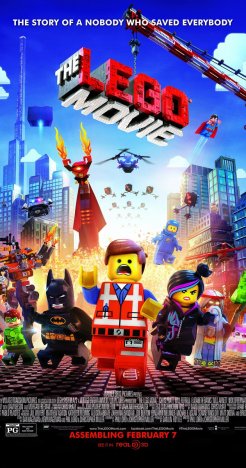
In brief: The LEGO Movie is set in the city of Bricksburg where Emmet (Chris Pratt) lives while he goes about his heavily regulated life as a construction worker. There are rules for everything: you do this at a certain time, you go here at a certain time, life is pretty much a Big Brother-like dystopia except all of the inhabitants seem to be oblivious. But one day…Emmet spots a strange girl digging around the construction site after hours and while trying to follow her, stumbles across the legendary “Piece of Resistance” that will supposedly neutralize Lord Business’s greatest weapon…the Kraggle (i.e. Krazy Glue). From there, Emmet is whisked off on a mindbending adventure (he even meets Batman!!) and ultimately grows into a real hero. And did I mention it has a mind-blowing twist in the third act?

I still watch The LEGO Movie whenever I need cheering up, and I’m impatiently waiting for the sequel to come out.

What did you guys think of The LEGO Movie? Let me know in the comments below!

Become a patron of the blog at: patreon.com/musicgamer460

Check out the YouTube channel (and consider hitting the subscribe button)

Don’t forget to like Film Music Central on Facebook 🙂
See also:

Animated Film Reviews

Thinking about The LEGO Batman Movie (2017)

My Thoughts on: The LEGO Movie 2-The Second Part (2019)

Das Boot “Main Theme” (1981)

das_boot_ver1

Before I go back to my regular series, I thought I would share with you a theme that I recently re-discovered: the main theme from Das Boot (1981), a German epic war film that recounts the (fictional) exploits of the (fictional) U-96, a German U-Boat patrolling the Atlantic during World War II. (Though *this* boat is fictional, some of the exploits were inspired by the actions of the REAL U-96).

The film shows every aspect of life in the submarine: unrelenting boredom, the sudden excitement of battle and the dangers that faced submarines at every turn. A climactic moment comes when the U-96 has been damaged by depth charges so badly that it sinks to the bottom of the ocean near Gibraltar. After a harrowing 16 hours spent making repairs, the ship is able to surface and the engines are successfully restarted.

But (MASSIVE spoilers ahead), there is no happy ending for the U-96. Despite everything they have gone through, shortly after limping into the dock at La Rochelle, the entire area is strafed by American fighters. Most of the crew is injured or killed (including the captain) and the U-96 sinks into the ocean.

The music was composed by Klaus Doldinger and his main theme for Das Boot is one of those pieces of film music that you HAVE to hear, even if you never see the film. There is a haunting quality to this piece that makes it irresistible to me. The full track actually begins with the faint sound of sonar (but most versions I find cut this moment out) and then the cello begins the main theme, starting very low and steadily rising up. It seems to me that Doldinger purposefully modeled the theme after the rising and falling swells of the ocean, where the U-Boats patrolled (and which also served as the tomb for tens of thousands of German sailors).

800x0_Das_Boot_05

As sad as this music sounds, I actually find it rather soothing to listen to. The theme is very symmetrical in the way it rises and falls (it’s actually a good kind of music to get stuck in your head).

If you get the chance, I highly recommend watching this film at least once. The film was dubbed into English by the original cast so you wouldn’t have to worry about watching a subtitled film. Doldinger’s score makes the film worthwhile, along with an amazing performance by the entire cast (Jurgen Prochnow, who plays the captain, also starred as Paul’s father in Dune (1984))

I hope you enjoy this brief look at the main theme of Das Boot, and if you’ve seen the film, let me know what you thought about it in the comments below 🙂

Become a Patron of the blog at patreon.com/musicgamer460

Check out the YouTube channel (and consider hitting the subscribe button)

See also: Film Soundtracks A-W

Don’t forget to like Film Music Central on Facebook 🙂
Anticipating Rogue One: A Star Wars Story (2016)

(I know that Rogue One isn’t scheduled to be released until December, but I couldn’t hold my thoughts in any longer!)

When Disney announced their plans to release a new Star Wars film every single year, I was understandably skeptical. The release of a Star Wars film was meant to be a special event, and if a new film came out every year there would be a huge risk of over-exposing the product and subsequently ruining it. As a result, when the first images for Rogue One were announced, I initially didn’t pay any attention.

Then the first teaser trailer for Rogue One was released. And that changed EVERYTHING for me.

Rogue One: Official Teaser Trailer

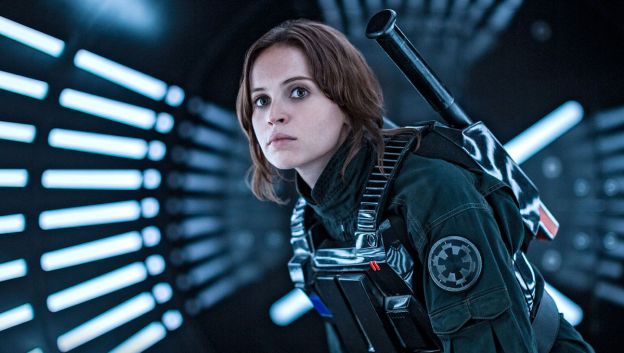
I’d decided to watch the teaser out of curiosity and before I knew it, there I was, back on the edge of my seat, just like with The Force Awakens. In case you don’t know, here is the gist of Rogue One: The story follows Jyn Erso, a woman recently recruited into the Rebel Alliance, who is tasked with leading a team that will steal the plans for the soon-to-be-completed Death Star. These are the same Rebel spies alluded to in the opening crawl of Episode IV, placing the events of Rogue One just before the start of A New Hope.

When the full trailer finally released during the recent Olympic Games in Rio, excitement for the film exploded all over again, and it will be interesting to see how Disney continues to build the excitement in the final months leading up to the premiere.

Rogue One: Official Trailer (Full)

So far, the visuals for this film look absolutely STUNNING. I love the look of Scarif (the tropical planet with the AT-ATs seen in the previews). The film (judging from the previews) has the look and feel of the original trilogy. And that’s a good thing: the over CGI-d look of the prequel trilogy is part of the reason it was so badly received. One of  my favorite shots so far is the brief image of the Death Star orbiting over a large planet (I believe it’s been identified as Jedha). The following shot of the Death Star blocking out the sun gave me goosebumps (and probably doesn’t bode well for the planet if I had to take a wild guess).

The casting looks phenomenal as well: according to imdb.com, Rogue One includes a number of actors who have already appeared in Star Wars. Jimmy Smits is reprising his role of Bail Organa (Leia’s adoptive father); Genevieve O’Reilly reprises her role as a younger Mon Mothma (a role that would’ve appeared in Episode III except those scenes were cut); Warwick Davis (the Ewok Wicket in Return of the Jedi) is returning in another role and in the biggest news of all, James Earl Jones is returning to voice Darth Vader. That’s right, the Dark Lord of the Sith is going to be making an appearance. What exactly this will look like has been the topic of endless speculation, but we have been assured that Vader will show up at a “critical moment.”

Now musically, Rogue One will be very different, because this is the first Star Wars film to be scored by anyone other than John Williams. I’m not terribly worried because Alexandre Desplat (The Grand Budapest Hotel; Argo; The Imitation Game) is a wonderful composer, but it will still be odd to have a score created by someone other than Williams. I have no doubt that Desplat’s score will be heavily influenced by the themes already created for the Star Wars universe (as it would be utter madness to not musically link Rogue One to the other films).

One detail that concerns me is that the film will (allegedly) have no opening crawl. I feel like that’s wrong, as it would set Rogue One apart from the other seven Star Wars films. I understand that the anthology films are considered stand-alones, but I think they should still have an opening crawl, to maintain a sense of visual continuity (these films do all take place in the same universe after all). But this is really a small concern in the big scheme of things: I have a feeling that Rogue One is going to impress just as much as The Force Awakens did last year, if not more.

Are you also excited about the upcoming release of Rogue One? Do you think it might do even better than The Force Awakens? Feel free to leave a comment and let me know what you think 🙂

The Lion King “To Die For” (1994)

I put it off for as long as I could, but now it’s time to discuss the scene everyone remembers from The Lion King: the wildebeest stampede. For as long as I live I will never forget watching this scene play out in the movie theater. After Scar had laid out his devious plan in “Be Prepared,” I was thoroughly convinced that Mufasa was somehow going to stop this from happening, because Scar is the bad guy and he can’t possibly succeed (oh how naive I was!!)

There is an air of tension from the moment we are taken to a canyon where Scar is telling Simba that his father has “a marvelous surprise” planned for him. Simba is begging his Uncle Scar to tell him what the surprise is, but Scar refuses to tell. The devious lion encourages his young nephew to work on his “little roar.” Before leaving to get Mufasa, Simba has one last question:

“Hey Uncle Scar, will I like the surprise?”

*pause, Scar smiles*

“Simba, it’s to DIE for!”

Herd_of_dem_Beests.png

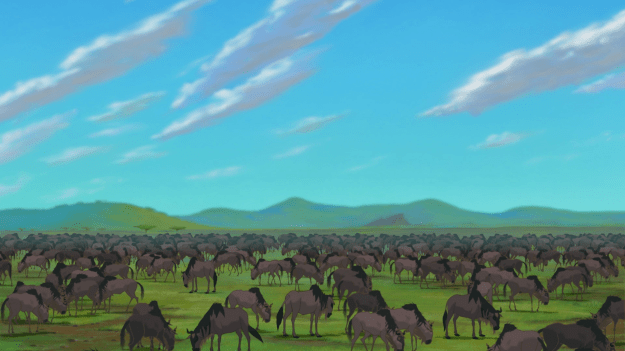
What Simba doesn’t know is that about a hundred feet above him is an enormous herd of wildebeest. The herd is revealed with a rather ominous chord from the orchestra. While the herd quietly grazes, Shenzi, Banzai and Ed wait in the shadows for a signal from Scar. Banzai is going crazy from the temptation of having so much food so close at hand, but Shenzi prevents him from blowing their cover too soon. At a glance from Scar, the three hyenas frighten the herd into stampeding into their only avenue of escape: the canyon, where Simba is still waiting.

Moments before the music starts, Simba is indeed practicing his roar, and is pleased when his extra-loud “RAWR!!” startles a lizard and echoes off the canyon walls. But then…something happens. The pebbles begin to shake, a weird thundering noise is heard, and then hundreds of wildebeest begin pouring down the side of the canyon!!

Wildebeest-Lion-King

For years as a child, the opening of “To Die For” sent me into a state of near panic. The eerie introduction is achieved by a chorus that quickly layers one voice after another until there is a cacophany of sound (imitating the build-up of the stampede). If you listen to the soundtrack version, you can hear the female voices enter first, followed by the lower male voices.

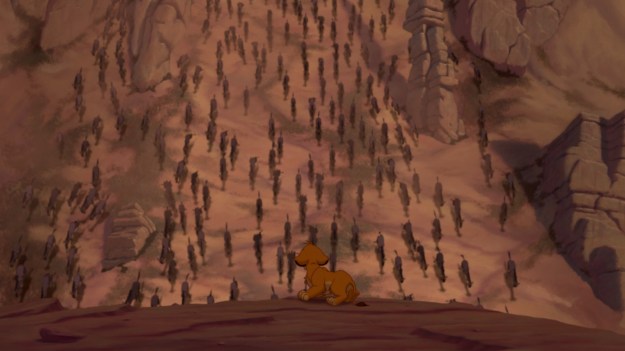
Simba, seeing all of this, is rightfully terrified and begins running for his life, but a small lion has no chance of outrunning a stampede and Simba is soon forced to climb a tree in the middle of the canyon to avoid being trampled to death.

After the initial choral opening, the music is divided between the chorus, woodwinds and a wide selection of timpani, but it’s really the chorus that dominates this piece.


So far Scar’s evil plan is working, but Mufasa is about to be made aware of the situation by his brother (who is rather good at faking concern for his nephew). The two lions race to the scene and Zazu flies down to locate Simba, who is growing more and more panicked. Mufasa doesn’t hesitate to throw himself into the stampede, working his way to where his son is clinging on for dear life. Scar watches events with cool detachment (but he does make sure to knock a frantic Zazu out before he can fly back to Pride Rock and bring more help; the last thing Scar needs/wants is more witnesses to what’s about to happen).

Seeing this in theaters, I remember being scared out of my mind by the charging wildebeests. I was also confused: Mufasa was their king, why wasn’t his presence stopping them? (I had no concept of how a stampede mentality works, once a herd that big gets going, nothing can stop them.) Still, as I watched through my fingers, I was cheering when Mufasa managed to save Simba and (after several mishaps) safely deposit him on the side of the cliff. For a few perilous moments, Mufasa disappeared, having been dragged back down by the wildebeests, but Simba’s father is a powerful lion and with a mighty jump he begins dragging himself up to the nearby ledge (where Scar has been patiently waiting). Simba, believing the danger is over, begins to climb up another way and doesn’t see most of what happens next.

Mufasa-vs-Scar-the-lion-king-2801551-640-380

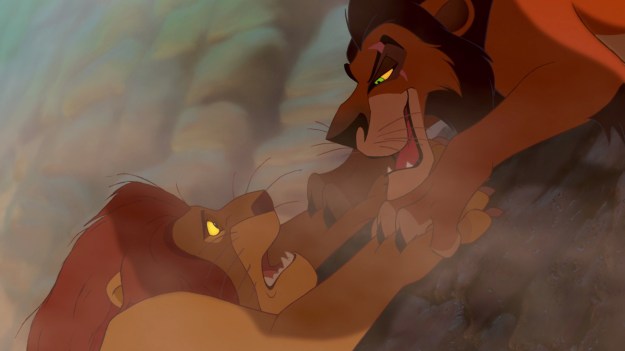
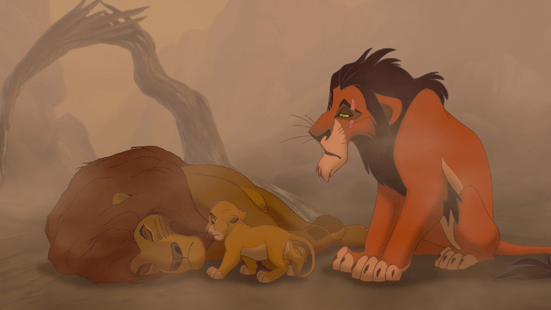
Mufasa is barely holding on; he can’t pull himself all the way up without Scar’s help. Naturally, he calls for Scar to help him. And then…the moment I lost my innocence arrives: Scar slams his claws down into Mufasa’s paws, pulls him close and whispers “Long live the King…” The look of horror right before Scar throws Mufasa to his death stayed with me for a very long time, as did Simba’s scream of terror at seeing his father falling to his death.

And the music for this moment is just haunting too; that “oooooOOOOOO” in the chorus just reinforces what a tragic moment this is.


Of course I was in denial about Mufasa being dead, but the mournful music combined with the visual evidence…it practically destroyed me. And poor Simba, his world as he knows it is gone forever; his dad is gone, he has no idea what he’s going to do. And then it gets worse…Scar appears out of nowhere and plays his last card: guilt.

“Simba….what have *you* done?”

“…the king is dead. And if it weren’t for you, he would still be alive.Oh, what would your mother think!!”

It took me years to understand what Scar was doing; this is textbook emotional abuse, shifting the blame onto the victim, making them think THEY are at fault. Simba is already traumatized by witnessing his father’s death. Scar’s (false) allegations that this is HIS fault will further screw him up mentally for years to come.

188333568

Now, what happens next ultimately proves to be Scar’s undoing. Scar is bigger and much more powerful than Simba: he could easily kill him with a single blow, and no one would be around to dispute his version of events. But for some reason, Scar doesn’t kill Simba and instead commands him to “run far away and never return.”

Instead of killing Simba himself, Scar plans on having the hyenas finish the job. This is the eternal weakness of the Disney villain: sending incompetent henchmen to do their dirty work for them. And despite their success in stampeding the wildebeest, Shenzi, Banzai and Ed ARE incompetent, especially when it comes to killing young lion cubs. Against all odds, Simba manages to get away and sets out across the desert. The hyenas COULD give chase, but Shenzi thinks it over and decides that Simba is as good as dead anyhow and IF he ever came back, THEN they could kill him.

Scar may think he has won, but someday he’s going to wish he’d simply killed Simba himself…

Now that I’m older I love listening to the soundtrack version of this scene. Hans Zimmer does an incredible job layering the melodies to simulate the chaos of a wild stampede. And the sad music after Mufasa is discovered dead still puts an ache in my chest. But I will never forget the first time I saw this scene in the theater, literally cowering in terror as the wildebeest rushed by.

Become a Patron of the blog at patreon.com/musicgamer460

Check out the YouTube channel (and consider hitting the subscribe button)

For more Lion King, see also:

The Lion King “The Circle of Life” (1994)

The Lion King “I Just Can’t Wait to be King” (1994)

The Lion King “Be Prepared” (1994)

The Lion King “Hakuna Matata” (1994)

The Lion King “Can You Feel the Love Tonight” (1994)

The Lion King “Under the Stars” (1994)

The Lion King “King of Pride Rock” (1994) Pt. 1

The Lion King “King of Pride Rock” Pt. 2 (1994)

Don’t forget to like Film Music Central on Facebook

*all images are the property of Walt Disney Studios

Rock-a-Doodle “Never Let Him Crow” (1991)

rockadoodle

Before I get to the song (which I do actually like), a little backstory is needed:

Once upon a time an animator named Don Bluth had a dream: a dream to create an animation company that would rival (and hopefully surpass) Disney itself. To that end, Bluth created his own animation studio and early on produced an acclaimed classic: The Secret of NIMH. More success followed with The Land Before Time, An American Tail, and An American Tail: Fievel Goes West.

With all of these well-known films, one might ask the question: if they were doing so well, why did the studio eventually go bankrupt? Well…a lot of it had to do with films like Rock-a-Doodle (1991), films that looked good as far as animation went, but were really bad in all other areas. In fact, this film did so poorly that it was the beginning of the end for the studio (their final release was The Pebble and the Penguin in 1995).

Rock-a-Doodle “Never Let Him Crow” (1991)

Therefore, if you haven’t heard of Rock-A-Doodle, I’m not surprised. Viewing the film with adult eyes, I can’t believe how flawed the story is. The film follows a young kid named Edmond (Toby Scott Granger) who loves the story of Chanticleer (Glen Campbell), a rooster who sang every morning to make the sun rise. But when the Grand Duke of Owls sabotages the rooster to make it look like the sun comes up on its own, Chanticleer leaves for the city, humiliated. Constant rain has fallen ever since, and in the real world, Edmond’s home is in danger of being flooded too. Seeing his family (out battling the flood) close to being swept away, Edmond opens his bedroom window and begins yelling for Chanticleer. Instead, Edmond somehow summons the Duke, who decides to teach Edmond a lesson by turning him into a cat (somehow in all of this Edmond was sucked into Chanticleer’s animated world, I told you the plot was full of holes). Edmond encourages the remaining farm animals to band together and find Chanticleer in the big city.

ROCK_A_DOODLE-481

There is one bright spot in the film and that is the casting of Christopher Plummer as the evil Duke (an Owl who plots to drive the rooster Chanticleer from the farm because if he leaves the sun won’t rise. Yes, really, that’s the basis of the plot.) How they got Plummer to do this role, I don’t know, but I’m glad he did because he absolutely rocks this part. One of my favorite moments is “Never Let Him Crow.”

ROCK_A_DOODLE-1632

To be technically correct, “Never Let Him Crow” is not so much a song as it is a spoken monologue (from the Duke) with sung commentary from a chorus of Owls. This monologue is also accompanied by a HUGE pipe organ that is playing a slightly abbreviated rendition of Bach’s Toccata and Fugue in D minor (aka that first song from Disney’s Fantasia). The infuriated Duke is relaying the story of how, earlier in the film, he got bit in the leg by a certain “flea-bitten cur” (the dog Patou, played by Phil Harris, aka the voice of Baloo. This was his final film role) and also how he got blasted in the face with a flashlight by Edmond (the kid who gets turned into a cat by aforementioned Duke, yes really! And in this film owls have an extreme dislike of light in any form and fashion, flashlights included).

So he turns on the duke?
And with what do you suppose he turns on the duke?

What master?

A flashlight!

What a horrible thing to do!
Thing to do!

But then, when my back is turned
What four legged, flea-bitten louse comes sneaking through the window
That has the nerve to bite me on the leg?

Who? Who? Who? Who? Who? Who?

Patou.

*Gasps*
Yes!

Death to Patou!!

Destroy the farm! Destroy the cat! The dog!
Or do you want the chicken back?

No! We hate the sun! The answer’s no!

And it’ll make my leg feel so much better…
If that rooster never crows! Tahahaha!

We hate the sun, that much we know
We hate the rooster, we’ll never let him crow
(Never let him crow!)
We hate the sun, from head to toe
(From head to toe!)
We hate the rooster, we’ll never let him crow
Never let him crow!

Never let him crow.

I love the back and forth between the domineering Duke and his cowed subordinates (it doesn’t matter what the Duke says, he is their leader and therefore he is always right). I will also say again how much I like Christopher Plummer’s performance; he certainly sounds like he was enjoying himself.

While I can’t recommend the film as a whole, “Never Let Him Crow” is a relatively solid moment and I hope you enjoy watching it.

See also:

Rock-a-Doodle “Sun Do Shine” (1991)

Rock-a-Doodle “The Owls’ Picnic” (1991)

You can become a patron of the blog at patreon.com/musicgamer460

Check out the YouTube channel (and consider hitting the subscribe button)

For more animated songs and films, check out the main page here

Don’t forget to like Film Music Central on Facebook 🙂

The Fellowship of the Ring “Shadow of the Past” (2001)

After Bilbo takes his leave of the Shire (leaving all Hobbiton in an uproar), Frodo finds himself the owner of Bag End and heir to almost all that Bilbo possessed, including a certain golden ring that he found once, deep in the Misty Mountains. Gandalf already has his suspicions about that ring, given that right before he gave it up, Bilbo had begun to act odd, almost violent towards his old friend.

But most alarming is what he called the ring: “My Precious,” a term that only Gollum had ever used up until now. Things might have turned ugly, but when Gandalf put some force behind his words, Bilbo found himself again and gave the ring up of his own free will (possibly the only person to ever do so).

The Fellowship of the Ring “Shadow of the Past” (Film Scene) (2001)

Even though Frodo had a pretty good idea that Bilbo was leaving, it still hurt that the old hobbit was gone. But if he hoped to get any answers/help from the wizard, Frodo is going to be disappointed, because Gandalf is setting out immediately, where he won’t say, except that there are “questions, questions that need answering.” Before he leaves, he makes sure the Ring is sealed inside an envelope and placed “somewhere out of sight.”

Barad_dur_by_gordontarpley-d35cazm

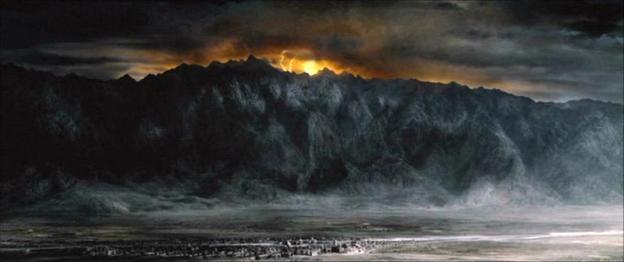
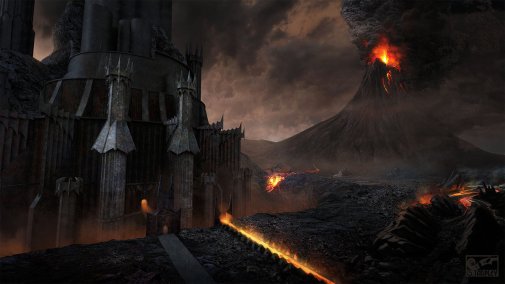
After Gandalf’s hasty departure, Frodo stares down at the envelope containing the Ring, wondering what on earth he’s actually inherited, when the music kicks up into a living nightmare (that’s how I’ve always thought the music sounded.) The scene abruptly shifts to Mordor, a hellish wasteland dominated by the mountain of fire, Mount Doom and the imposing tower of Barad-Dur, atop which sits the devilish Eye of Sauron (so far we’ve only had a fleeting glimpse of that, when Gandalf lightly brushed the Ring with his fingers).

The music twists and turns, harsh trumpets and other brass instruments dominating the theme. This is our first look at Mordor after the Prologue, and the music needs to quickly establish that this is a very bad place (and it succeeds). But there’s more: after we hear the screams of Gollum confessing what little information he knows (“Shire!” “Baggins!”), Mount Doom erupts and the 9 Black Riders are seen departing Minas Morgul, with a brief introduction of their theme.


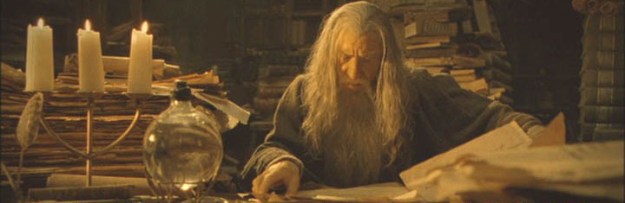
The scene shifts again: now we’re back to Gandalf, who has ridden out to the city of Minas Tirith in Gondor and observes the increased activity in Mordor. With no time to lose, he rides into the city and begins to scour the archives, pouring through old documents until he finds what he is looking for: a long-forgotten scroll written by Isildur, that describes how the Ring came into his possession (already the ring was “precious” to him) and what it looked like before it cooled and shrunk. Originally, there were letters of fire surrounding the band, and only extreme heat would be able to bring them to light again. This is what Gandalf has been seeking: a way to prove once and for all whether or not this mysterious Ring is THE Ring.

gandalf-in-library

A quick note about this brief scene in Gondor: you’ll note that the short fanfare does not match up to the main Gondor theme (first introduced in The Council of Elrond, a story I’ll tell next time). This is because at the time Shore created this part of the score, he had not yet conceptualized what Gondor’s theme would sound like. This short fanfare that we do hear could be considered a musical “placeholder.” It quickly sets the scene, but is otherwise not that important.

You can become a patron of the blog at: patreon.com/musicgamer460

Check out the YouTube channel (and consider hitting the subscribe button)

See also: Film Soundtracks A-W

For more Fellowship of the Ring, see also

The Fellowship of the Ring “The Shire” (2001)

The Fellowship of the Ring “The Wood Elves/Passing of the Elves” (2001)

The Fellowship of the Ring “The Treason of Isengard” (2001)

The Fellowship of the Ring “A Knife in the Dark” (2001)

The Fellowship of the Ring “Flight to the Ford” (2001)

The Fellowship of the Ring “Many Meetings” (2001)

The Fellowship of the Ring “The Ring Goes South/Fellowship Main Theme” (2001)

The Fellowship of the Ring “The Bridge of Khazad-Dum” (2001)

The Fellowship of the Ring “Lothlorien” (2001)

The Fellowship of the Ring “In Dreams” (2001)

Don’t forget to like Film Music Central on Facebook 🙂 Have a great day 🙂