Category Archives: Interview

Daniel Pemberton talks Gold (2016)

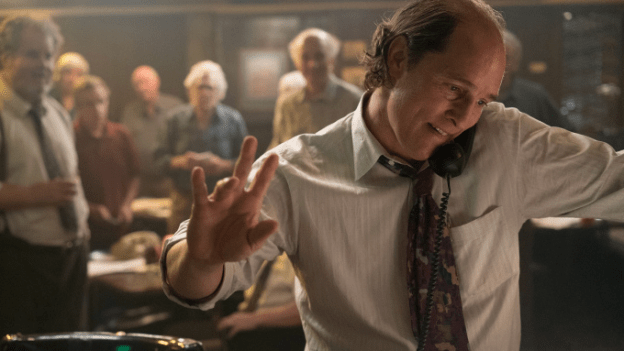
Gold is a 2016 American crime drama film loosely based on a true story about a fraudulent gold mine established in Indonesia and the aftermath when the fraud is uncovered. The film was directed by Stephen Gaghan and stars Matthew McConaughey, Édgar Ramírez, and Bryce Dallas Howard. The musical score for Gold was composed by Daniel Pemberton (Steve Jobs, The Man from U.N.C.L.E) and in this video Pemberton talks at length about how he got started with creating the music for this film.


Daniel Pemberton explains that his initial concept for the score was the sound of bells (which in themselves can create a myriad of sounds). What fascinated me about Pemberton’s approach to the score is the way he incorporated the sound of the New York Stock Exchange opening bell into the music. That sound is, as Pemberton puts it, the essence of capitalism and greed, which makes it perfect for the score. What’s also interesting is the way the composer manipulates the sound of the stock exchange bell. By altering the sound, the composer can create entirely different effects and meanings. This is one of the reasons Daniel Pemberton is quickly becoming one of my favorite film composers, he can take unusual sounds and instruments and fully incorporate them into the score (and you’d never know unless he told you).
 

Let me know what you think about Gold and Daniel Pemberton’s interview in the comments below and have a great day!

See also:

Daniel Pemberton talks The Man from U.N.C.L.E (2015)

Daniel Pemberton talks Steve Jobs (2015)

Daniel Pemberton talks King Arthur: Legend of the Sword (2017)

Film Composer Interviews A-H

Film Composer Interviews K-Z

Become a Patron of the blog at patreon.com/musicgamer460

Check out the YouTube channel (and consider hitting the subscribe button)

Don’t forget to like Film Music Central on Facebook

Michael Giacchino talks Jurassic World: Fallen Kingdom (2018)

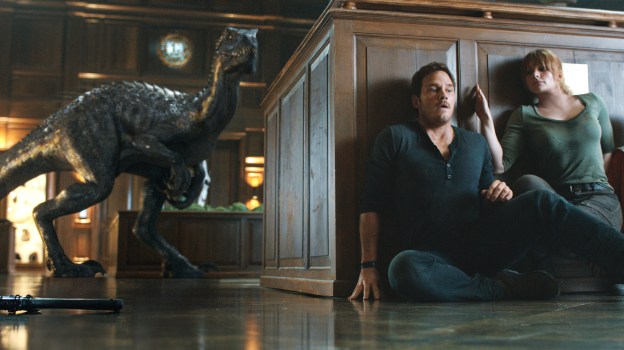
I’ve been suffering from franchise fatigue as of late, which is why I didn’t go see Jurassic World: Fallen Kingdom when it came to theaters in the summer of 2018. However, I have heard good things about Michael Giacchino’s score for this film (he’s one of my favorite film composers since he is almost incapable of composing a bad film score). In looking through the behind-the-scenes videos linked at the top of this post, I was pleasantly surprised to learn that Giacchino took inspiration from the scores that Bernard Herrmann wrote for several Ray Harryhausen films (among them Jason and the Argonauts and The 7th Voyage of Sinbad). Given that those are some of my favorite film scores, I almost feel bad that I didn’t give this film a chance.

Behind the scenes of Jurassic World: Fallen Kingdom Part 1

Behind the scenes of Jurassic World: Fallen Kingdom Part 2

Behind the scenes of Jurassic World: Fallen Kingdom Part 3

Michael Giacchino also discusses how he pushed the envelope in how little he could get away with musically. The best film composers can do a lot with minimal music and Giacchino is good at drawing you in with a series of low, minimal notes before suddenly BOOM! the music explodes and you’re literally jumping in your seat. While I’m still not 100% sure how I feel about the Jurassic World franchise as a whole, I do think they made the right choice in picking Michael Giacchino as the composer. His scores retain the sense of wonder (and extreme danger) that John Williams established with the original Jurassic Park film. I hope you enjoy watching these behind-the-scenes videos looking at the score of Jurassic World: Fallen Kingdom.

Let me know what you think about Jurassic World: Fallen Kingdom in the comments below and have a great day!

See also:

Michael Giacchino talks The Incredibles (2004)

Michael Giacchino talks Mission: Impossible 3 (2006)

Michael Giacchino talks Ratatouille (2007)

Michael Giacchino talks Up (2009)

Michael Giacchino talks Star Trek (2009)

Michael Giacchino talks Super 8 (2011)

Michael Giacchino talks John Carter (2012)

Michael Giacchino talks Star Trek: Into Darkness (2013)

Michael Giacchino talks Jupiter Ascending (2015)

Michael Giacchino talks Jurassic World (2015)

Michael Giacchino scoring Rogue One: A Star Wars Story (2016)

Michael Giacchino talks Zootopia (2016)

Film Composer Interviews A-H

Film Composer Interviews K-Z

Become a Patron of the blog at patreon.com/musicgamer460

Check out the YouTube channel (and consider hitting the subscribe button)

Don’t forget to like Film Music Central on Facebook

Michael Giacchino talks John Carter (2012)

Few Disney films have flopped harder in the last decade than John Carter, an adaptation of Edgar Rice Burrough’s Barsoom novel A Princess of Mars. The film follows the titular character, a Civil War veteran, as he finds himself flung to the dying planet of Barsoom (Mars) and the conflicts taking place therein. The film was meant to be the first of a trilogy, but when John Carter bombed at the box office (costing Disney $200 million in the process), all future sequels were cancelled.

The score for John Carter was composed by Michael Giacchino, who routinely turns in good work, including for this film. While many aspects of the film were criticized, Giacchino’s score was praised for sounding “fresh and adventurous.” In this interview (I apologize for the audio cutting in and out), Giacchino discusses a few details of how the score came together, including the director’s desire to express emotions through the music and which characters should get their own themes. I’d really hoped to find some scoring sessions from this score, and if I ever find some I’ll make sure to attach the links, because it sounds like some good music.

I hope you enjoyed this short interview about the music of John Carter. Let me know what you think about John Carter in the comments below and have a great day!

See also:

Michael Giacchino talks The Incredibles (2004)

Michael Giacchino talks Mission: Impossible 3 (2006)

Michael Giacchino talks Ratatouille (2007)

Michael Giacchino talks Up (2009)

Michael Giacchino talks Star Trek (2009)

Michael Giacchino talks Super 8 (2011)

Michael Giacchino talks Star Trek: Into Darkness (2013)

Michael Giacchino talks Jupiter Ascending (2015)

Michael Giacchino talks Jurassic World (2015)

Michael Giacchino scoring Rogue One: A Star Wars Story (2016)

Michael Giacchino talks Zootopia (2016)

Michael Giacchino talks Jurassic World: Fallen Kingdom (2018)

Film Composer Interviews A-H

Film Composer Interviews K-Z

Become a Patron of the blog at patreon.com/musicgamer460

Check out the YouTube channel (and consider hitting the subscribe button)

Don’t forget to like Film Music Central on Facebook

James Newton Howard talks Dinosaur (2000)

Dinosaur-disneyscreencaps_com-1307_-1024x538.jpg

I remember Dinosaur being a really big deal back in the year 2000. Not only was it a leap in CGI animation, it was also filmed against mostly live-action backgrounds (which I believe was a first). The film follows the story of a dinosaur named Alladar who travels with his adoptive lemur family to find a new home after the island he grew up on is destroyed by a meteor.

James Newton Howard composed the score for Dinosaur and I remember the music standing out to me right away due to the extended preview that the film had in trailers. Howard gave the score this huge, symphonic sound to highlight the live-action background and the various dinosaurs seen in the preview. I was really excited to find this video clip because “making of” clips with James Newton Howard are relatively hard to come by and he’s worked on some of my favorite childhood films.


As the interview clip explains, Howard uses the music in Dinosaur to direct emotional feelings, be it fear, wonder, or humor. And there is a full range of emotions to be found in the film, which shows just how talented this composer is. It was also emphasized that they wanted to make the music sound primal but not ethnic. That is, they didn’t want any music that could be traced back to a particular human culture (since this movie is set way before humans existed).

I really hope you enjoy this behind the scenes video with James Newton Howard. Let me know what you think about Dinosaur (and the music for Dinosaur) in the comments below and have a great day!

See also:

James Newton Howard talks Atlantis: The Lost Empire (2001)

James Newton Howard talks Signs (2002)

James Newton Howard talks The Village (2004)

James Newton Howard scoring King Kong (2005)

Film Composer Interviews A-H

Film Composer Interviews K-Z

Become a Patron of the blog at patreon.com/musicgamer460

Check out the YouTube channel (and consider hitting the subscribe button)

Don’t forget to like Film Music Central on Facebook

Daniel Pemberton talks Steve Jobs (2015)

Steve Jobs (2015) marked the first collaboration between director Danny Boyle and composer Daniel Pemberton (their second team-up, Yesterday, comes out in June). In this behind-the-scenes video, the composer discusses how he divided the film’s score into three distinct parts, each one corresponding to one of the three acts of the film. The first act (he explains) is full of synthesizers to match the vibe of 1984. The second act (and the one I like best) is purely orchestral. Not just orchestral, it’s more of a miniature opera (complete with singers). And the third act is squarely placed in the digital medium, referencing how just about everything in our lives has gone digital, thanks in large part to the real Steve Jobs.


I’m fascinated at how Pemberton essentially created three different scores for this film, that’s not something you come across very often (in fact I’m hard pressed to name another example). Daniel Pemberton is very quickly becoming one of my favorite film composers and I for one am excited to learn more about him. I hope you enjoyed the video! Let me know what you think about Steve Jobs (and it’s score) in the comments below and have a great day!

See also:

Daniel Pemberton talks The Man from U.N.C.L.E (2015)

Daniel Pemberton talks Gold (2016)

Daniel Pemberton talks King Arthur: Legend of the Sword (2017)

Film Composer Interviews A-H

Film Composer Interviews K-Z

Become a Patron of the blog at patreon.com/musicgamer460

Check out the YouTube channel (and consider hitting the subscribe button)

Don’t forget to like Film Music Central on Facebook

Daniel Pemberton talks King Arthur: Legend of the Sword (2017)

While it’s no secret that Guy Ritchie’s retelling of the King Arthur legend was a colossal flop at the box office, that shouldn’t stop you from learning about what went into making the film’s soundtrack. King Arthur: Legend of the Sword marked the second collaboration between Guy Ritchie and Daniel Pemberton and just like he did with The Man from U.N.C.L.E, the composer went all out in putting the music together.

Daniel Pemberton employed a variety of musical instruments both ancient and modern. As he says in the video, he sought to make the score visceral and gritty, something that felt distinctly unpolished. If the excerpts heard in this video are any indication, I think the composer succeeded in that aspect. It’s a shame the film flopped so badly, it sounds like Pemberton’s score for the film is really good (and it’s not that uncommon to find a great score hiding in a terrible film). I find myself hoping that Ritchie and Pemberton will collaborate again (hopefully on The Man from U.N.C.L.E 2), though hopefully the resulting film will do much better than this one did.

Let me know what you think of this behind the scenes look at the music for King Arthur: Legend of the Sword in the comments below and have a great day!

See also:

Daniel Pemberton talks The Man from U.N.C.L.E (2015)

Daniel Pemberton talks Gold (2016)

Daniel Pemberton talks Steve Jobs (2015)

Film Composer Interviews A-H

Film Composer Interviews K-Z

Become a Patron of the blog at patreon.com/musicgamer460

Check out the YouTube channel (and consider hitting the subscribe button)

Don’t forget to like Film Music Central on Facebook

Daniel Pemberton talks The Man from U.N.C.L.E (2015)

I’m fairly certain that The Man from U.N.C.L.E served as my introduction to the film music of Daniel Pemberton. I first watched the film about three years ago and while the story took some time to grow on me, the score immediately grabbed my attention. Pemberton (I’ve since discovered), has this talent for creating quirky and memorable scores that stick in your mind. Such is the case with the score for The Man from U.N.C.L.E.


In the making of featurette which you can access above, Daniel explains that director Guy Ritchie requested a score in which every cue feels iconic. And on that point alone I think the composer succeeded, because none of the music in this film feels “throwaway,” it all feels very necessary. You’ll also learn that Pemberton employed a lot of unique instruments to create the film’s distinctive 1960s-like sound. While there are traditional orchestral elements in certain places, the lion’s share of the music comes from non-traditional instruments, which is really cool.

I hope watching this behind-the-scenes video gives you an even deeper appreciation of Daniel Pemberton’s score for what I consider a highly underrated film. Let me know what you think of the music for The Man from U.N.C.L.E in the comments below and have a great day!

See also:

Daniel Pemberton talks Steve Jobs (2015)

Daniel Pemberton talks Gold (2016)

Daniel Pemberton talks King Arthur: Legend of the Sword (2017)

Film Composer Interviews A-H

Film Composer Interviews K-Z

Become a Patron of the blog at patreon.com/musicgamer460

Check out the YouTube channel (and consider hitting the subscribe button)

Don’t forget to like Film Music Central on Facebook

An Interview with Paul Henning

unnamed

Last month I was privileged to conduct an interview with composer Paul Henning where we discussed (in part) his work in orchestrating Star Wars: The Force Awakens, his work as a performer in film orchestras and the ongoing work of the legendary John Williams. I was fascinated to learn about the process that goes into recording a film score and how the process of orchestrating a score actually works. If you follow the link below, you can check out the audio interview I conducted with Mr. Henning. I hope you enjoy!

An Interview with Paul Henning

Film composer and musician Paul Henning’s most recent project was writing the score for the Tribeca Film Festival opening night documentary ‘Clive Davis: The Soundtrack of Our Lives’. The film premiered at Radio City Music Hall in New York. Paul had a somewhat unconventional role writing music for this project. While the focus was the cadre of huge music artists Clive has worked with, Paul scored key moments of conflict, loss or emotional gravity that were vital to the story.

Paul also recently released his debut album, ‘BREAKING THROUGH’. The album was crafted with a nostalgic, Americana vibe drawn from Paul’s love of the expanses of the Western US and his love of American History. The album features piano solos performed by the Paul and recorded live with a 48-piece studio orchestra. Here is a link to selections of the album for your review: http://www.paulhenning.com/breaking-through.

Paul has served as Concertmaster for the Golden State Pops Orchestra since 2004. He’s also worked on the score orchestrations for over 50 feature films, including ‘Star Wars: The Force Awakens, ‘The BFG’, ‘Night at the Museum: Secret of the Tomb’ and ‘Chocolat’. In addition to his film writing, he also works on orchestral arrangements that have been performed by the Los Angeles Philharmonic, Chicago Symphony, Hollywood Bowl Orchestra, and London Symphony.

An accomplished pianist and violinist, Henning has performed with the Hollywood Studio Symphony on the soundtracks to ‘Frozen’, ‘X-Men: Days of Future Past’, ‘The Maze Runner’, ‘Furious 7’, ‘Moana’, ‘Storks’, ‘Monsters University’ and ‘Alice in Wonderland’, among many others. He has also played violin for artists including Barbra Streisand, Michael Bublé, Neil Young, Aretha Franklin, Andrea Bocelli and Josh Groban. Henning has served as Concertmaster for the Golden State Pops Orchestra since 2004.

Composer Interview with Scott Doherty

Scott Doherty is a lifelong musician, though some might say a reluctant composer. After moving from his hometown of Maine to Los Angeles at the age of 18, Scott’s early musical pursuits included playing live music to large audiences at venues like the House of Blues and the El Ray and performing in the South Coast Repertory Theatre production ‘Against Oblivion’, among other productions. He was led to study and pursue sound and music composition and since then, has composed music for numerous film and TV projects, including ‘Weeds’, ‘Orange is the New Black’ and most recently, ‘The Holdouts’. We sat down to talk with Scott about his career as a musician and composer.

unnamed-2

How did you get into composing for television?
Looking back, I feel like it was something I didn’t directly aim to do. I was in the band world playing keys for other bands and I hit a point with where I felt somewhat stilted, which moved me away from the record format and more into instrumental music. From there I dove into the recording studio and was just fascinated by everything. It was over the course of a year that I was asked to write a couple of score-based projects. I was asked to direct a few shows, music for a documentary called ‘Becoming Santa’, and these projects felt more like a perfect fit, using music to tell stories. Not long after, I ran into a friend who was a music supervisor and she’d become the head of music for the E! Network. I began to work on a string of shows for them, doing theme songs for different shows. I was still craving writing music to picture,  and about that time is when the opportunity for ‘Orange is the New Black’ came in. I was asked to join in the series that would be on Netflix, and at the time, digital wasn’t what it was today – so it was really a leap of faith.

Yeah, I remember at the time it was announced it seemed really weird like, television on Netflix? How does that even work?  *laughs* Yeah, people were really unsure of the platform, but I saw the entire first season of ‘Orange’ before the rest of the world did and I fell in love with it:  the story, the characters, the incredible actors. I just had no idea how lucky we would become with this series.

With each season (of Orange is the New Black’) being released all at once, what is the schedule for creating the score for each episode, compared to a regular television series? Has everything already been shot?  There are a lot of similarities actually, in the way that we have a similar production schedule to a regular show on network cable. There’s about a week to do each episode, and production is usually about three to four episodes ahead of us, but it is still the same production flow. The difference is that we’re not getting feedback week to week from audiences. Because all thirteen episodes are available at once, Netflix encouraged us (in fact they sent a note about it about halfway through the first season) to think of it really as a thirteen hour-long movie, rather than a normal, episodic TV show. And that changed the way that I look at the character theme arcs and making sure that whatever happens in episode one, that same day the audience could be watching episode eight, so the continuity needed to be there.

Right, so if each season is like a movie, does that mean there is more there in terms of character motifs?
Yes, and with ‘Orange’ there is such a diverse cast, with so many “lead” actors and actresses, so we really try and focus in on a specific melodic theme or sonic world that is created to support each character, and some of that makes its way into their flashbacks. Some of those themes are in fact born in flashbacks because with some characters we don’t get to really know them until those moments. But it really does feel more like scoring a film than a television show in that regard.

So with Season 5 coming on June 9th, have any of the (musical) themes changed over the years?
Oh most definitely. One of the biggest would be Dayanara’s theme, which started as her and Bennet’s love theme and as their relationship went on the rocks, it created a flipped version of the same theme, but more dark. Suzanne’s (“Crazy Eyes”) theme starts off more aggressive, but as we get to know her, the innocence comes out. And then there’s a hybrid of the two, and also there’s some situational themes that come back over time. I really feel the prison itself has a real character to it, there’s an “essence” of what prison sounds like.

Definitely. What about Piper? Because she’s the one who’s really thrown headlong into all of this at the start.
I feel like the way we’ve worked with Piper through the seasons is more situational in terms of themes. Some of them have been more whimsical, a theme to reinforce the isolation she was feeling (in the SHU), then in – I think it was season three –  there was the “Piper 2.0” theme with an aggressive Piper finding her voice and that carried over into season four. There really isn’t one central theme for Piper, it really changes from season to season for her.

I actually misunderstood what this show was going to be about. Because when the preview for the pilot came out, I saw that Piper was being sentenced to this relatively short time in prison, so I thought ‘Orange is the New Black’ was meant to be a one-off, a one season and that’s it sort of deal. And then I saw articles about season two, three and I’m like “why is this show still going?” And that’s when I read the summaries and realized this show was a lot more complex than I imagined.
*laughs* Oh yeah, but it’s really something like ’24′, which plays out in real time. And it’s also hard to gauge how much time is actually passing in these seasons. We’ve seen one Christmas and one Valentine’s Day so far. But it really does feel like we haven’t even covered a year yet. No one is too specific with covering sentences. But this latest season (season 5) will cover exactly three days. That was the story motif for this season.

Wow, so there’s a lot of stuff packed in to this season?
Yes! It starts off with a bang and keeps on going, I wish I could talk about it but there’s only a week to go now. What’s great about the first season though, is it uses Piper to introduce us to prison, to what it would feel like to have something from your past that you may have forgotten come back and affect you. And also what it would feel like to be one of those people outside of the walls and suddenly find themselves inside it. And so I think they were able to use her story to get us into prison, and as soon as the 2nd season started, the focus is now on every other inmate. It’s no longer about the singular struggle of this woman, it’s now more about the life of women in prison.

So in theory this show could run indefinitely?
Absolutely!

So, one last question, you said it was the same production flow as a regular television show. So is recording the music anything like film where you have the footage playing out in front of you?
Yes, it’s exactly the same. The way it breaks down is, we go to a spotting session where we sit down and watch the editor’s cut with temporary music put in. And we discuss it and say, “what do we like? Are there any character themes missing? Does it need to be funny or sad?”  And then we have about five to six days to complete twenty-five to thirty pieces of music for the show. We go to a music review and watch the cues one by one, and it’s usually “love it”, “change this one thing” or “try again”. Then we have another day to review it before we start all over again. I tend to write and record the music at the same time. The best-case scenario for me when writing is to turn the music off and watch the same scene five or six times to see if a natural pace or rhythm comes through. And a lot of times the performer’s work is so strong that I begin to hear the music in my head straight away. I try to capture that emotional reaction as quickly as possible.

Wow, that is so amazing! Well thank you very much for sitting down to talk with me about Orange is the New Black
No problem! Thank you.

Don’t forget to like Film Music Central on Facebook 🙂

Bernard Herrmann talks The Bride Wore Black (1968)

the-bride-wore-black-movie-poster-1968-1020216282

Normally when I share composer interviews, it’s for a relatively current film. But when I found an interview for the 1968 film The Bride Wore Black that was given by composer Bernard Herrmann, I just knew I had to share it with you.

The Bride wore Black (released in France as  La Mariée était en noir) is a revenge film directed by Francois Truffaut. It tells the story of a woman named Julie Kohler, whose husband is killed on her wedding day as they’re leaving the church. The crime occurred because five men were horsing around with a loaded rifle in a building across the street and it went off, fatally striking the newly married groom. After learning the identities of the men responsible, Kohler sets out to kill every last man responsible.

The new widow is completely ruthless in her pursuit of vengeance:


  • victim #1 is pushed off a balcony
  • victim #2 is poisoned
  • victim #3 is locked in a small closet where he suffocates to death (she sealed the door shut with duct tape
  • victim #4 would’ve been killed with a handgun but the police arrested him before she could get him
  • victim #5 is shot in the back (fatally) with an arrow as she posed for a painting of Diana, Goddess of the Hunt. After noticing that he’s painted her on the wall in a mural, Julie decides to leave the painting as is, knowing the evidence will lead to her arrest. After arriving at jail (where still-alive victim #4 is also serving time), she ends up working in the kitchen where she is last seen taking a food cart towards the men’s side of the prison (a scream implying she’s completed her task of vengeance).

The music for this film was written by the legendary composer Bernard Herrmann (perhaps best known for his collaborations with Alfred Hitchcock on four of his films, including Psycho). I haven’t found many interviews with Herrmann thus far, so it is fascinating to hear him talking about his work with any film. I admit I haven’t actually seen The Bride Wore Black (not yet anyway), but after watching this interview and reading more about the plot, I definitely need to check this film out.

What do you think of Bernard Herrmann talking about The Bride Wore Black? Have you seen the film? And if you have, what did you think of it? I’d love to hear about it in the comments below!

See also:

Film Composer Interviews A-H

Film Composer Interviews K-Z

Check out the YouTube channel (and consider hitting the subscribe button)

Don’t forget to like Film Music Central on Facebook 🙂