Category Archives: Soundtracks

Troy (2005): The Trojan Horse, The Fall of Troy

51+JIRVGSbL._SY355_

Credit to The Cimarron Group

As I’ve mentioned before, I have an obsession with the film music of James Horner. One score of his in particular that I really love is his score for the epic Troy (2005), starring Brad Pitt as Achilles, Eric Bana as Hector, and Orlando Bloom as Paris. At the time this film came out, I was deeply interested in ancient Greek and Roman culture, to the point where I was considering archaeology as a career. My high school Latin teacher put this film on while we were discussing the Iliad (which is Greek, not Roman but that’s beside the point) and I was in love. Horner’s score grabs you by the throat and doesn’t let go for the entire story.

Horner crafted distinct themes for this film: The Greeks have their theme, as do the Trojans, and Achilles is gifted his own unique theme as well. But one moment in particular, musically as well as visually, has always stood out to me. And that is the scene involving the Trojan Horse.


As the Trojans walk into view on the now-abandoned beach, the music begins low and alread ominous (with the faintest echo of the Greek theme dying away) before the camera begins to pan to the right and up to reveal….a giant horse. The music builds as the camera moves, climaxing in that reveal (because if you know the story of Troy, you know perfectly well what’s about to happen).

As they debate what to do with this “gift,” Paris (sensibly, for once) suggests that they burn the horse, while the others say it’s a gift to the gods and should be brought inside. The music, though low at this point, contains a haunting up and down motif, a brief foreshadow of the musical proclamation to shortly come. Paris urges his father one more time to “burn it.” While Priam (Peter O’Toole) gives no answer, the following scene (and its music), shows what his answer must have been, as we next see the great horse being dragged into the streets of Troy.

Troy- The Trojan Horse

Horner was in his element with this moment. Though the music is framed as a fanfare, something of a triumphal march, the melody is keyed between major and minor: the major representing the Trojans happiness, the minor because they’ve just doomed themselves to total destruction. This is the epitome of musical irony, and I get chills down my spine every time I hear it.

Troy- The Fall of Troy

After everyone’s gone to sleep, the Greeks break out of the horse and the music changes note entirely. During the procession and celebration, the music was bittersweet, now the tone is altogether “sneaky.” It’s the Greeks theme, but much faster (and softer) than usual (they have to be stealthy or the plan won’t work). Of course, with Odysseus (Sean Bean in a rare film where he doesn’t die) in charge, the plan goes off perfectly and the gates are opened with the enormous Greek army waiting outside. The Trojans don’t stand a chance. Two themes develop here: one is the theme of the sacking of Troy, which is very dark and action-filled. The other tracks Achilles’ progress as he frantically searches for Briseis (Rose Byrne) before the Greek army reaches the palace. All is chaos visually and occasionally musically. But the spot during the Fall scene that hits me the hardest is when Priam staggers out onto his balcony to see the city in flames. The music says it all: he’s failed his people, he knows it, and he knows there’s nothing he can do about it.

The Trojan Horse and the Fall of Troy-Soundtrack version

I’ve attached links for the corresponding scenes in the film and the soundtrack version of the music. Watch, listen, and please enjoy!

Become a Patron of the blog at patreon.com/musicgamer460

Check out the YouTube channel (and consider hitting the subscribe button)

See also: Film Soundtracks A-W

Don’t forget to like Film Music Central on Facebook 🙂

Interstellar “No Time for Caution”

Like many, I watched enthralled when Interstellar (2014) came out into theaters. Even before I first saw the film, I’d heard that there were some fairly intense musical sequences. But nothing, absolutely NOTHING could prepare me for the sequence known as “No time for caution.” To briefly sum up how the story gets to this point: Cooper (Matthew McConaughey) is put in charge of a mission to scout three planets to see if one of them is capable of supporting the human race in place of the dying Earth. One planet has already been proven unviable, the third is too far away, and the second planet was claimed (falsely) by Dr. Mann (Matt Damon) to be a viable place to live (frigid conditions notwithstanding).


Dr. Mann claimed that there was water located deep under the surface. Cooper discovered this was a lie and after surviving a murder attempt, Cooper and Brand (Anne Hathaway) chase after Dr. Mann who is making his way to the spaceship Endurance without them. Insane after years of isolation, Dr. Mann has convinced himself that he can somehow control the Endurance and take it back to Earth. In his rush to board, Mann ignores the fact that his ship is docked improperly, meaning the hatch seal is not stable. When the door seal is forced to open anyway, Mann is blown out of the ship into space and Endurance is sent spinning out of control. If Cooper and Brand can’t dock and stabilize the ship, humanity is doomed.

This is where the cue begins. There is a long high pitched drone immediately after the explosion (as Cooper and Brand watch in shock as Endurance begins to spin wildly). Then a strong drumbeat sets in as Cooper makes his decision. He orders TARS (a robot) to analyze the Endurance’s rate of spin (to help with docking). And when Brand asks the fateful question “Cooper what are you doing?” The only answer is “Docking.” This one word sets off the next stage of the cue in a revolving spiral of theme and variation.

In fact, I listened to this cue over and over and it finally hit me, that composer Hans Zimmer used a Baroque form called passacaglia when he put this cue together. A passacaglia is a musical form based on a repeating melody in the bass line. As you listen to the cue, listen closely to the primary melody (which launches around 0:44, 0:45 in the soundtrack version) and hear how it continues, leaping from instrument to instrument for most of the piece.

I hope you enjoy “No Time for Caution” as much as I do. Please comment if you liked it (or even if you didn’t).

Become a Patron of the blog at patreon.com/musicgamer460

Check out the YouTube channel (and consider hitting the subscribe button)

See also: Film Soundtracks A-W

Don’t forget to like Film Music Central on Facebook 🙂
When silence speaks volumes: The chariot race in Ben-Hur (1959)

Film composers have the difficult task of choosing music that correctly fits the intended mood of a particular scene or action sequence. But on a rare occasion, the composer will make the decision to give a scene no music at all, because doing so would actually detract from the moment.

b-h-stones_horiz_a

Credit to Metro-Goldwyn-Mayer (MGM)

A good case in point comes in William Wyler’s 1959 epic Ben-Hur. Scored by film composing legend Miklos Rozsa (1907-1995), the film broke a record for winning 11 Oscars at the Academy Awards, a feat that has never been surpassed (though Titanic and Return of the King have since matched it).

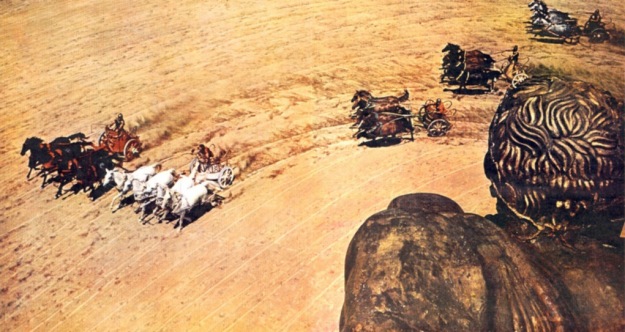
Rozsa’s score contains a number of musical moments: the “Overture” (covered in Soundtracks); the “Rowing of the Galley Slaves”; “Parade of the Charioteers”; and the ever beautiful “Nativity.” However, what many consider the action climax of the film, the chariot race in Part II, has no music at all after the initial “Parade of the Charioteers.”

Rozsa considered for a long time whether or not he should give the actual race any music, but he quickly determined that the action itself would be “music” enough.

02-Chariot-Race-Ben-Hur

The chariot race of Ben-Hur was an event over two years in the making. Not only did the race track have to be built from the ground up, but also the horses had to be trained to run in groups of three and four, the various stunts had to be planned out, and the chariots had to be built and tested to make sure they would hold up under stress. Once everything was ready and the cameras were rolling, the entire race was filmed in one take. The production had become so expensive that it was only possible to do the entire race once.

The entire clip runs for about ten minutes, but it is well worth it to watch all the way through. One moment in particular that always stands out to me comes at 5:35 when Ben-Hur’s (Charlton Heston) horses (in white) and Messala’s (Stephen Boyd) horses (the blacks) are running stride for stride down the track. And on a quick side note, the moment when Ben-Hur nearly falls out of his chariot was NOT scripted. The jump over the fallen chariot was planned, but Heston’s stunt double refused to wear a harness, insisting that he could ride the jump without it (oh was he ever wrong).

Please watch the race here: Ben-Hur Chariot Race and note the complete lack of music, diegetic or otherwise until the race is over. In my opinion, the true test of a film composer’s talent comes when they have to decide when NOT to use the music. Enjoy!

Check out the YouTube channel (and consider hitting the subscribe button)

Don’t forget to like Film Music Central on Facebook 🙂

See also:

When the music says everything: The “Lepers!” scene from Ben-Hur (1959)

“Overture” from Ben-Hur by Miklos Rozsa

Miklos Rozsa conducts Ben-Hur suite (1979)

*Everything is copyright to MGM Studio

Star Trek II “Surprise Attack”

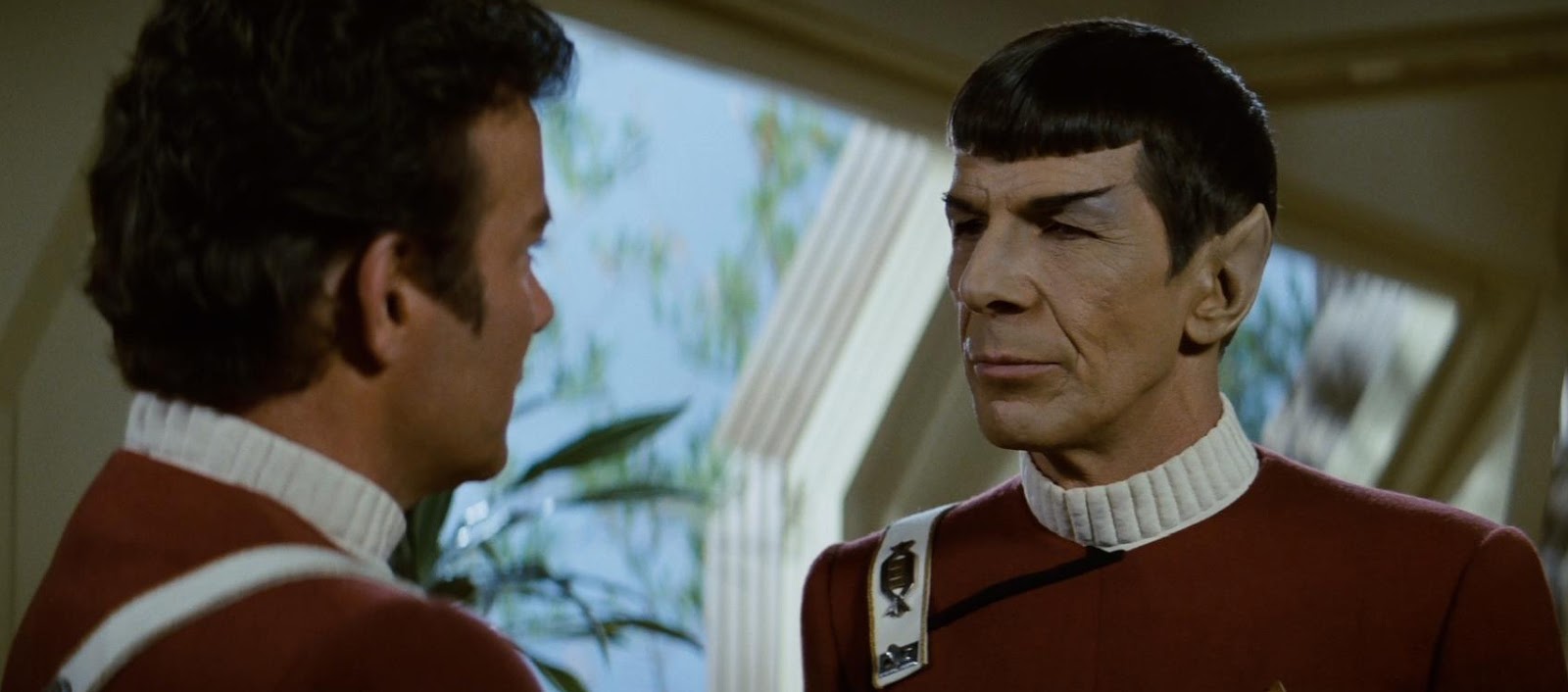
I have something of an obsession with the music of Star Trek and James Horner’s score for The Wrath of Khan is one of my all time favorites.

“Surprise Attack” comes in Act II of the film, when the Enterprise is en route to space station Regula One to find out why someone is trying to usurp the Genesis Project from Dr. Carol Marcus (who happens to be a former love interest of Admiral Kirk). Unbeknownst to our heroes, the villain Khan (first introduced in the original episode “Space Seed” (1967)) has hijacked the starship Reliant and is on an intercept course to have his vengeance on Kirk for stranding him and his crew on the planet Ceti Alpha V over fifteen years ago.

You can listen to the soundtrack here: “Surprise Attack” Soundtrack Version

The film version can be found here: “Surprise Attack” Film Version

star-trek9

Khan and Kirk in their first meeting

The cue begins in the film when Kirk is informed that the Reliant is approaching their position. The music begins with a menacing horn tone that slowly builds in volume and intensity until it cuts off in a percussion burst.This repeats several times, growing faster until the camera cuts to a shot of Reliant approaching and Khan’s theme is heard for the first time.

USS_Reliant

Reliant is coming…

Composer James Horner stated that he wrote Khan’s theme to be a reflection of his increasingly unstable mind. That is why the theme (beginning at 0:20 in the soundtrack version) is full of quickly trilling horns and woodwinds: Khan is so hellbent on revenge that it is literally driving him mad.

Meanwhile, going back to the Enterprise, the crew still has no idea they’re about to be ambushed. And from this point on, Horner begins a musical back-and-forth where the music quickly switches from the Enterprise theme to Khan’s theme and each time Khan’s theme builds a little more until a sequence begins that I like to call “the final countdown.”

Beginning at the section where Khan orders his crew to lock phasers on target (2:11 in the soundtrack version), the music begins a very slow build, starting very soft but gradually growing louder and more frantic as the crew of the Enterprise realizes, a moment too late, that they are about to be attacked. Once the attack starts, something very interesting happens. In the film, the first attack is full of the sounds of explosions, yelling and other sound effects. But in the soundtrack version of this cue, it comes out that Horner has created what can only be described as “musical chaos,” which is perfectly fitting for the mayhem that follows (musical chaos begins at 2:28).

khan12

Khan might just succeed in his dastardly plan!!!

The music violently shifts back to Khan’s theme as the Reliant circles around for another attack. Caught off guard with a crew filled with cadets, the Enterprise doesn’t really stand a chance (especially since Khan knows all the vital areas of the ship from the last time he was there.)

Disarmed and stunned (Scotty informs Kirk that the phasers only have power for “a few short bursts”), everyone is shocked when the commander of the Reliant sends a message asking them to surrender (4:29) The strange “twang” sound heard at that moment comes from an electronic instrument called a Blaster Beam, a 12-18 foot long metal beam strung with several metallic wires. The music dies away as Khan finally reveals himself to Kirk.

I hope you enjoyed this look into the score of The Wrath of Khan!

See also:

 Film Soundtracks A-W

Star Trek II: “Inside Regula I” (1982)

Become a Patron of the blog at patreon.com/musicgamer460

Check out the YouTube channel (and consider hitting the subscribe button)

Don’t forget to like Film Music Central on Facebook 🙂


Pentatonic Music in Film and Cartoons: A look at musical stereotype

It is a sad and frequently overlooked truth that Hollywood is brutally guilty of portraying overtly racist behavior both on and off the silver screen. This includes the film music, as well as the films themselves. While musical stereotyping exists (and continues to exist) on several levels, today I will focus on two examples from one particular area: the use of the pentatonic scale to distinguish Asian characters.

The pentatonic scale is also known as the five-tone scale, because unlike the Western scale, which uses seven notes, the pentatonic scale only uses five (penta- means five, think pentagon, pentagram, etc.).

C_major_pentatonic_scale

This is the major pentatonic scale starting on C and it reads: C D E G A

To create the minor pentatonic scale, take the A and move it to the first position, so: A C D E G

A classic example of using the pentatonic scale to denote an Asian character comes in the 1955 Disney film Lady and the Tramp. The scene in question is when Lady is introduced to Aunt Sarah’s Siamese cats (named Si and Am).

Lady-and-the-Tramp-disneys-lady-and-the-tramp-9614616-720-480

As Lady walks by the basket, before seeing the cats, the music plucks out a descending pentatonic scale, which hints at the cats’ origin even before their song begins.

A live-action example can be heard in the first James Bond film Dr. No (1963). The titular character is the first villain Bond encounters. Dr. No claims to be the child of “a German missionary and a Chinese girl of good family.” Because he is half-Chinese (and most of his workers are seen to be Asian), Dr. No’s theme is delivered with a pentatonic sound. Actually, a hint of the theme appears long before the character himself. At the very beginning of the film when Dr. No’s assassin’s are removing the body of Cmdr. Strangways’ secretary; one of the killers is seen rifling through a file drawer and pulling out two files: one reads Crab Key and the other says Dr. No. When the second file plops down on the cabinet, there is a harsh upward pentatonic scale, alluding to the character’s Asian origin.

dr-no-james-bond-joseph-wiseman-sean-connery-ursula-andress-honey-ryder-spectre-movie-review-1962

The first Bond villain: Dr. Julius No

When Dr. No finally does appear (after Bond and Honey have been captured), the theme returns as the audience sees Dr. No’s feet walking in to take a look at Bond in person.

There is so much more to say on this topic, but I wanted to provide a short look for now.

Become a patron of the blog at: patreon.com/musicgamer460

Don’t forget to like Film Music Central on Facebook 🙂
The Empire Strikes Back or, Everyone has a Theme! Part One: Leitmotif and “The Imperial March”

Empire_strikes_back_old

The Empire Strikes Back
Released: May 21, 1980
Director: Irvin Kershner
Music by: John Williams
*All music is the property of Lucasfilm

The Empire Strikes Back is considered by many to be the greatest movie of the original Star Wars trilogy and it’s no wonder. The film contains battles both on land (Hoth) and in space (the Millennium Falcon vs. Star Destroyers), a terrifying villain (Darth Vader), moments of comedy (C3PO) and one of the biggest twists in the history of film. It also features a gorgeous score composed and conducted by John Williams, a film composer who has been working in Hollywood since the 1950s and is solely responsible for some of the greatest film scores of all time.


For his work on The Empire Strikes Back, Williams began with the musical themes he had established for the original Star Wars and used it as a starting point for the sequel. Two themes were already set in stone:

Luke’s Theme/The Force

Leia’s Theme

As the role of Darth Vader was being greatly expanded from his first appearance, Williams concluded that Vader would need a theme to match. This lead to the creation of “The Imperial March,” a theme that is now synonymous, not just with Star Wars and Darth Vader, but with anything evil in nature.

Darth Vader’s Theme/The Imperial March

These themes, and how they are used, derive from a technique created for opera, known as leitmotif. Leitmotif was made popular by the Romantic composer Richard Wagner in his famous series of “Ring” operas.

Leitmotifs, by nature, are meant to evoke a particular character and are played whenever a specific character is seen on stage OR when they are mentioned by another character. This happens a great deal with “The Imperial March”, and not just in The Empire Strikes Back.

Starting with The Phantom Menace, echoes of “The Imperial March” are heard towards the end of the film when Yoda (reluctantly) gives Obi-Wan permission to train Anakin. (specifically: when Yoda says “Nevertheless, grave danger do I feel in his training”)

The theme grows stronger in Attack of the Clones, but again is heard primarily at the end of the film when the Clone fleet is seen landing in Coruscant, announcing the start of the Clone Wars.

Finally, in Revenge of the Sith, the theme is finally heard in full when Anakin turns to the Dark Side and is dubbed Darth Vader by the new Emperor Palpatine. (The theme can be heard in snippets throughout the latter half of the film, but fully comes out when Vader is being placed into his armor, particularly when the mask slips into place).

Part Two will explore the theme of Han and Leia’s love and the theme of Yoda. Until next time!

Become a Patron of the blog at patreon.com/musicgamer460

Check out the YouTube channel (and consider hitting the subscribe button)

Don’t forget to like Film Music Central on Facebook 🙂

See also:

Film/TV Reviews

The Empire Strikes Back: “The Imperial March” by John Williams

The Empire Strikes Back Part Two!: Han and Leia in Love and Yoda!!

*All music shown is the property of Disney and Lucasfilm, I own nothing.

Empire_strikes_back_old

“I love you….I know…” One of the most remembered lines from the Star Wars universe came moments before Han Solo was frozen in carbonite by the evil Darth Vader. Leia finally realizes that she loves the scoundrel of an ex-smuggler and he reveals that he’s known it pretty much all along.

(On a side note, Han’s response was a complete ad-lib by Harrison Ford, as they had tried numerous takes using the generic “I love you too” and it just wasn’t working out.)

The music heard immediately before this line (when Han and Leia share a brief kiss) is the culmination of a theme that has been building since early in the film when the two are seen arguing in the ice caverns of Hoth.

Musically, this love theme is remarkably similar to Leia’s original theme (as heard in the first film):

Notice that both begin with large leaps from the first note to the second, using a pickup note. Both can also be divided into two sections, with the second section featuring a leap as well. The primary difference is that whereas the love theme drops down a whole step after the initial leap, the original Leia theme keeps going up. It’s almost like an inversion of the original theme, where the music now moves downward instead of up.

Of course Empire Strikes Back is also where we get to meet Yoda, the diminutive (size matters not!) and slightly eccentric Jedi Master who reluctantly agrees to train Luke in the ways of the Force. Yoda’s theme, a quiet melody for woodwinds, is first heard after Yoda is walking back to his hut and inviting Luke to follow. Of course at this point we have no idea that this is actually Yoda (or maybe we do, but Luke certainly doesn’t).

The theme is a perfect match for the ancient Jedi Master. It exudes a quiet confidence, the exact opposite in fact of the “Imperial March.” This theme really comes out in full when Yoda demonstrates what the Force can do when he successfully raises Luke’s sunken X-Wing from the swamp.

Become a Patron of the blog at patreon.com/musicgamer460
Check out the YouTube channel (and consider hitting the subscribe button)
Don’t forget to like Film Music Central on Facebook 🙂
See also:

“Overture” from Ben-Hur by Miklos Rozsa (1959)

One thing that must be understood about “classic” Hollywood films (usually anything made before 1960) is that in those days, the large epic films were constructed very much like an opera or a play would be. By this I mean, they would have separate screens labelled “overture” (as Ben-Hur does above), “Intermission” and also “Exit Music” (music that would play while the audience left the theatre).

This overture was composed by the Hungarian composer Miklos Rozsa for the 1959 epic Ben-Hur. He won the Academy Award for Best Score and many cite it as being one of the greatest film scores of all time. The image is an extreme close-up of the figures of Adam and God on the ceiling of the Sistine Chapel.

Above is the first eight measures from the beginning of the overture (from the original score)

I love this overture because of how it begins, with this attention-grabbing fanfare from the brass and woodwinds. The call repeats three times and swells at the last moment before the brass breaks through with the immortal “Hallelujah” motif (my term for it), the timpani thundering in the background. The motif repeats again, and again, building and swelling and then…dying away into the main love theme and other side themes that recur throughout the film. That’s a technique seen multiple times in film overtures: beginning with a brassy motif and transferring to strings (*cough* think of Star Wars *cough*)

The overture ends as it began, with the brass and woodwind trumpet call, more firm this time. This signals that the overture is ending and the main story is about to begin.

Become a Patron of the blog at patreon.com/musicgamer460

Don’t forget to like Film Music Central on Facebook 🙂

See also:

Miklos Rozsa conducts Ben-Hur suite (1979)

A Tale of Two Spocks: Spock’s Theme in Wrath of Khan and The Undiscovered Country

Whenever a film franchise is fortunate enough to grow into a large series, it is very rare that each of the films can be scored by the same composer (Star Wars being a happy exception). Because most film franchises (i.e. James Bond, Mission Impossible, Star Trek) change film composers frequently, it is common for themes to differ from one film to the next. For example, if you listen to the themes of Mission Impossible and Mission Impossible 2, you would notice a huge difference in terms of style.

Occasionally though, themes created by different composers for the same character can sound very similar. In this case, I draw your attention to a set of themes, each created for the character of Spock from the original Star Trek series. The first theme was created by James Horner for Star Trek II: The Wrath of Khan in 1982.

The music begins with a soft glass-edged melody that gently drops down into the secondary theme (plucked out by the harp). This melody is a perfect characterization of Spock: he is Kirk’s rock, the perfect voice of reason. Kirk cannot conceive of a world where Spock is not by his side (which makes the ending of the film all the more upsetting).

The second theme was composed by Cliff Eidelman for Star Trek VI: The Undiscovered Country. I apologize if the quality of sound isn’t as good, I’m still looking for an audio-only clip of this theme and when I find it I will post it here. At any rate, listen to the theme below and note how similar it is to Horner’s theme (I find both to be exceptionally beautiful).

Star Trek VI: The Undiscovered Country “Spock and Valeris”

In fact, the two themes are so complementary to one another, that one wonders if Eidelman took direct inspiration from Horner’s theme when he put this score together (it’s no secret that they wanted James Horner to compose Star Trek VI, perhaps Eidelman was instructed to imitate Horner’s style. Of course it could just all be a coincidence, but i love to speculate on these things).

Become a Patron of the blog at patreon.com/musicgamer460

Don’t forget to like Film Music Central on Facebook 🙂

"Overture" from The Magnificent Seven by Elmer Bernstein

images

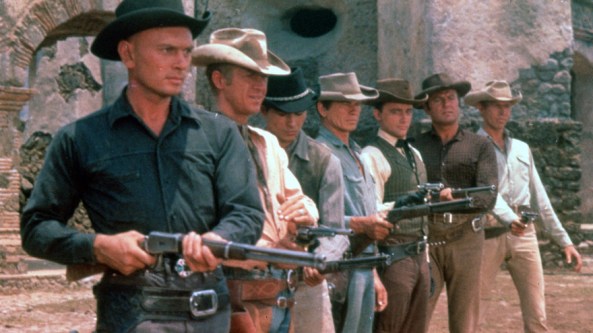
Many consider this 1960 film to be the greatest Western ever made. Adapted from The Seven Samurai by Akira Kurosawa, The Magnificent Seven tells the story of 7 gunfighters who join forces to protect a poor Mexican village from a gang of bandits led by the murderous Calvera (Eli Wallach). Led by Chris (Yul Brynner), the other gunfighters consist of:

  • Vin Tanner (Steve McQueen)
  • Bernardo O’Reilley (Charles Bronson)
  • Lee (Robert Vaughn)
  • Harry Luck (Brad Dexter)
  • Britt (James Coburn)
  • Chico (Horst Buchholz

The task is one step above thankless, as the only pay is a $20 gold piece and whatever food they eat while they’re in the village. And while the group barely tolerates each other at first (as they’re all in it for various reasons, be it money, fame or simply an excuse to relieve boredom), they slowly come together to help the villagers learn to defend themselves from Calvera’s gang.

Elmer Bernstein’s overture to the film has been praised for defining not only this film, but the Western genre as a whole. I posted this theme in particular because a remake of this film is due out next year (with a posthumous score by the late James Horner) and it will be interesting to see how the music has changed from 1960 to 2016. Until the remake comes out, enjoy a classic piece of film music!

TheMagnificentSeven_Blog

From left to right: Yul Brynner, Steve McQueen, Horst Buchholz, Charles Bronson, Robert Vaughn, Brad Dexter and James Coburn.

As a quick update: while Horner’s score does include the classic overture at the very end, the film itself does not live up to the high standard set by this 1960 classic. If given the choice, always go with this one.

See also: Film Soundtracks A-W

Don’t forget to like Film Music Central on Facebook 🙂