Tag Archives: soundtrack

Oliver & Company “Why Should I Worry?” (1988)

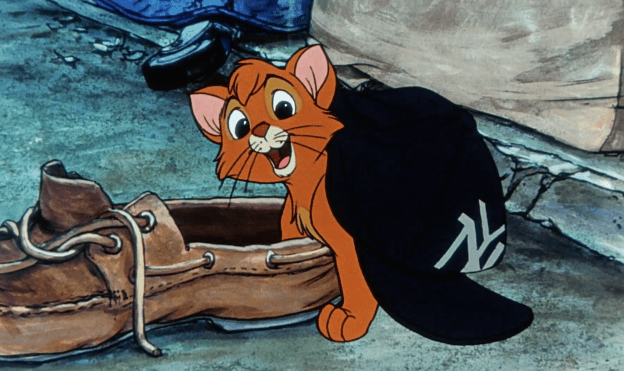
Over the years Disney has adapted many classic stories to be told in their animated films. In 1988, the studio released their interpretation of Charles Dickens’ Oliver Twist as Oliver & Company. Set in New York City, this loose adaptation features some familiar characters with an animal twist:

-Oliver (Joey Lawrence) is an orange tabby kitten forced to wander the streets when nobody adopts him.

-Dodger (Billy Joel) is a street-smart canine who eventually takes Oliver under his wing.

Oliver & Company was the last Disney animated film to be released before the launch of the Disney Renaissance with The Little Mermaid the following year. It was originally conceived as a direct sequel to The Rescuers (1977) but when that idea fell through Penny became “Jenny” and any other similarities were dropped.

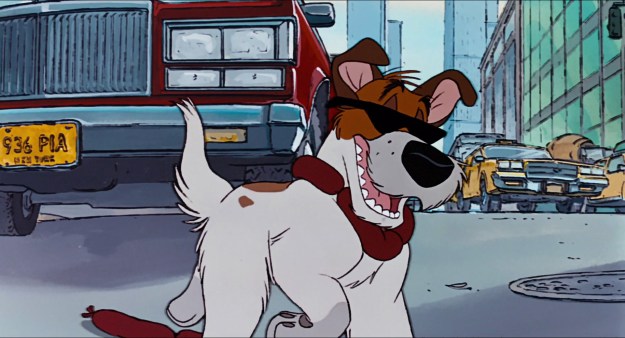
Oliver meets Dodger when they initially form a partnership to steal some hot dogs. However, once the wisecracking dog has what he wants, he summarily takes off, even though he promised half of the food to Oliver. This is the set up for “Why Should I Worry?” which explains Dodger’s views on life in the big city. To date this is the only time Billy Joel has ever played a character in a film, and during the song Dodger takes on aspects of his voice actor (like donning a pair of sunglasses and playing on a piano):

One minute, I’m in Central Park
Then I’m down on Delancey Street
From the Bowery to St. Marks
There’s a syncopated beat
Whoo, whoo, whoo, whoo, whoo
I’m streetwise
I can improvise

Whoo, whoo, whoo, whoo, whoo
Oliver-co-disneyscreencaps.com-1219

I’m street-smart
I’ve got New York City heart

Why should I worry?
Why should I care?
I may not have a dime
But I got street savoir-faire

Why should I worry?
Why should I care?
It’s just be-bopulation
And I got street savoir-faire

The rhythm of the city
Boy, once you get it down
Then you can own this town
You can wear the crown

Why should I worry?
Tell me, why should I care?
Say, I may not have a dime
But, oh, I got street savoir-faire

why-should-i-worry-why-should-i-care.jpg

Why should I worry?
Why should I care?
It’s just doo-wopulation
And I got street savoir-faire

Ev’rything goes
Ev’rything fits

They love me at the Chelsea
They adore me at the Ritz

Why should I worry?
Why should I care?
And even when I crossed that line
I got street savoir-faire

Whoo, whoo, whoo, whoo, whoo

In similar fashion to “The Bare Necessities,” while Dodger easily navigates the city streets, showing off how cool he is, Oliver is barely able to follow along, almost getting into serious trouble multiple times. Dodger is clearly popular and well-known, since everywhere he goes he attracts hordes of dogs to sing along with him. If you look carefully, you’ll also see cameos from Pongo, Jock, Trusty, and Peg (all from 101 Dalmatians) during the song (they’re very short “blink and you’ll miss them” cameos).

“Why Should I Worry?” is a fun song, Billy Joel has you bopping along in no time. Let me know what you think about “Why Should I Worry?” in the comments below and have a great day!

See also:

Oliver & Company “Good Company” (1988)

Disney/Dreamworks/Pixar/etc. Soundtracks A-Z

Become a Patron of the blog at patreon.com/musicgamer460

Check out the YouTube channel (and consider hitting the subscribe button)

Don’t forget to like Film Music Central on Facebook

Sleeping Beauty “Skumps” (1959)

As we begin to reach the end of the film, we finally go back to the castle where King Stefan is impatiently waiting for the sun to set so he can finally see his daughter. King Hubert (Philip’s father) tries to cheer Stefan up by presenting him a bottle of wine that he has been saving for sixteen years. This leads to “Skumps” (also known as “The Drinking Song”), a jovial song performed by Hubert and Stefan as they toast Aurora’s imminent return and the fact that the marriage of their children will unite their kingdoms. Of course Hubert wants the wedding to happen right away but, as Stefan rightly points out “I haven’t even SEEN my daughter yet, and you’re trying to take her away from me!” (Maleficent delves a whole lot deeper into the question of what happens when you’re not actually raised by your parents and then reintroduced to them).

Skumps! Skumps!

Skumps!

A toast to this night!

The outlook is rosy,

But the future is bright,

Our children will marry, Our kingdoms unite, Skumps! Skumps! Skumps!

Skumps!

Skumps!

A toast to the home!

One grander by far than a palace in Rome!

Ah, let me fill up your glass, That glass was all foam!

Skumps! Skumps! Skumps!

It’s an amusing song meant to brighten the mood before the drama that will follow. And despite the lighthearted tone, things nearly break down between Hubert and Stefan. When the latter attempts to break it to his fellow monarch that the revelation about Philip might come as a shock to Aurora, Hubert takes it wrong and things nearly break down into warfare between the two (Hubert attacks Stefan using a fish as a sword) before the pair realize how ridiculous they’re being and dissolve into laughter. The two kings are sure that Philip and Aurora will love each other, but boy does Philip have news for his father.

I like to call this part of the film “The Comedy of Errors” because of all the misunderstandings that occur in short order. It can be summed up like this:

1) King Hubert thinks his son Prince Philip is in love with a peasant girl
2) The fairies think Aurora is in love with a commoner
3) Neither side realizes they’ve actually met Aurora/Prince Philip (though admittedly Hubert does think this initially)
4) And most importantly, Maleficent is wise to the fairy’s scheme and nobody knows it.

Based on all of these misunderstandings, Aurora is miserable while being led back to the castle, Philip has left to seek the girl he loves and Hubert is in a quandary about how to tell Stefan that Philip doesn’t want to marry Aurora anymore.

Let me know what you think about “Skumps” in the comments below and have a great day!

See also:

Sleeping Beauty “Hail to the Princess Aurora” (1959)

Sleeping Beauty “The Gifts of Beauty and Song” (1959)

Sleeping Beauty “I Wonder” (1959)

Sleeping Beauty “Once Upon A Dream” (1959)

Disney/Dreamworks/Pixar/etc. Soundtracks A-Z

Become a Patron of the blog at patreon.com/musicgamer460

Check out the YouTube channel (and consider hitting the subscribe button)

Don’t forget to like Film Music Central on Facebook

Sleeping Beauty “Once Upon A Dream” (1959)

Like many sixteen year old girls, Aurora wants very much to be in love, in fact she claims to have met her true love already….just in her dreams though. She seems so depressed that he isn’t real that the animals decide to do something to cheer her up. It just so happens that Prince Philip is still nearby, drying off after Samson accidentally dunks him into the river. The animals sneak off with his hat, cloak and boots and dress up the owl as her “dream prince” (much to Aurora’s amusement). This leads to the first rendition of “Once Upon a Dream” (taken directly from Tchaikovsky’s “Sleeping Beauty Waltz.”)

I know you, I walked with you once upon a dream
I know you, the gleam in your eyes is so familiar a gleam
Yet I know it’s true that visions are seldom all they seem
But if I know you,
I know what you’ll do
You’ll love me at once
The way you did once upon a dream

The song is simple: Aurora and Philip are in love because they’ve already met in their dreams (a funny premise for a relationship, but this is Disney after all). While Aurora and the animals are having their fun, Philip and Samson finally lay eyes on the mysterious singer and of course Philip falls in love at first sight. So what does the prince do? Join in the song of course! The prince and princess share a dance and then at the crucial moment when Philip asks her name, it’s only THEN that Aurora remembers that she’s not supposed to speak to strangers and runs off. Meanwhile, back at the cottage…things are going…well….not well actually.

Sleeping Beauty Part 2

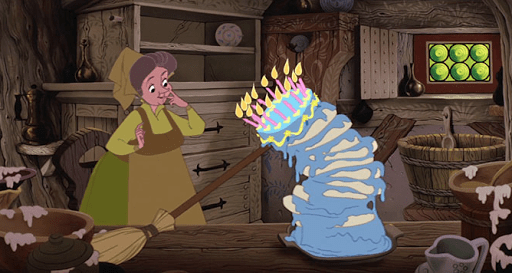
After enduring Flora’s efforts at dressmaking and watching Fauna attempt to make a cake, Merriweather finally snaps and lets the others know that if they’re going to do this properly they just need to use magic. Soon enough the cake is nearly ready, the cottage is clean and the dress is almost done. There’s just one little snag…shall the dress be pink or blue? (On a side note: the running gag of changing the dress’s color stems from a real-life argument the animators had over the very same question. They simply could not agree on whether the dress should be pink or blue so they ended up doing both…in a way.)

Sleeping Beauty Part 2

Flora and Merriweather get into a full-blown fight over the color of the dress, leading to magical sparks flying all over the cottage and straight up the chimney (the one part of the house they forgot to close up. Of course, the magical fight draws the attention of Maleficent’s raven Diablo, who has been searching far and wide for the missing Aurora ever since her other minions revealed that they’ve been searching for a baby for sixteen years! Diablo peeks his head in and witnesses Aurora coming home to tell her aunts about the wonderful man she’s just met, only to hear some rather earth-shattering news (one, her name is Aurora and not Briar Rose. Two, she’s a princess and she’s going back to the royal castle tonight and three, she must NEVER see that young man again (because of course the fairies have no way of knowing who he is.))

This news delights Diablo and he rushes off to inform his mistress while Aurora, quite naturally, has an emotional breakdown. This leads to one of the most ridiculous lines I have ever heard. Merriweather turns to the others and says “And we thought she’d be so happy…” I’m sorry but, how would YOU react if everything you’d ever known your whole life turned out to be a lie? I don’t think I would be happy about it personally (but that’s just me.) And remember when I said that Aurora speaks the least out of any Disney Princess? Once Aurora runs upstairs and throws herself on the bed…she doesn’t speak again for the rest of the movie.

Let me know what you think about “Once Upon A Dream” in the comments below and have a great day!

See also:

Sleeping Beauty “Hail to the Princess Aurora” (1959)

Sleeping Beauty “The Gifts of Beauty and Song” (1959)

Sleeping Beauty “I Wonder” (1959)

Sleeping Beauty “Skumps” (1959)

Disney/Dreamworks/Pixar/etc. Soundtracks A-Z

Become a Patron of the blog at patreon.com/musicgamer460

Check out the YouTube channel (and consider hitting the subscribe button)

Don’t forget to like Film Music Central on Facebook

Sleeping Beauty “I Wonder” (1959)

The prologue of the film being over, the story flashes forward to Aurora’s sixteenth birthday, though in the story she has been raised under the name Briar Rose by her three “aunts.” The teenage princess is voiced by opera singer Mary Costa, who also stood in as the physical model for Aurora. Being an opera singer, Aurora’s singing style is something of a call back to Snow White and the Seven Dwarfs. Costa is a true soprano (as her vocal improvisation at the beginning of “I Wonder” makes perfectly clear.)


On this day, her “aunts” Flora, Fauna and Merriweather need Briar Rose out of the house so that they can make a few surprises for her birthday, so the teenager is shooed out of the house to pick some berries. After Briar Rose leaves, it becomes obvious that the fairies have set a huge (read: impossible) task for themselves. According to Merriweather, Flora “can’t sew” and Fauna “has never cooked.” (Which really makes one wonder who’s been keeping the household running all these years.) Nevertheless, the fairies set out on their task and we’re soon following Briar Rose out into the forest.

Of all the Disney Princesses, Aurora speaks the least, and this scene in the forest marks the opening of her first song, “I Wonder.” In this song, Aurora/Briar Rose summons her animal friends by improvising a clear soprano melody.

Sleeping Beauty Part 2

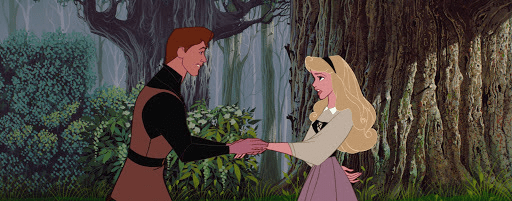
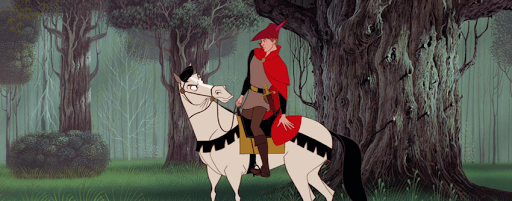
It is during this vocal introduction that we also meet the grown up Prince Philip. The prince has no idea that his betrothed is close by, so naturally he’s curious to see the source of this gorgeous melody. This leads to a hysterical moment where Philip spurs his horse on by promising him extra carrots if he’ll help him look for the singer. The excited horse charges off, only to stop short as he accidentally flings Philip into a creek (the disgruntled prince revokes his offer of carrots). As they attempt to find the singer, we go back to Aurora’s song.

I wonder, I wonder,
I wonder why each little bird has a someone
To sing to, sweet things to,
A gay little love melody
I wonder, I wonder,
I wonder if my heart keeps singing,
Will my song go winging
To someone, who’ll find me
And bring back a love song to me.

As her friends gather, the princess muses aloud about why all the animals around her have their own loved ones, but not her. She then wonders, if she keeps singing, maybe she’ll find a lover of her own (ironically the song concludes with Aurora looking wistfully at the royal castle in the distance, not knowing that she’s looking at her birthplace and rightful home.) It would seem that at sixteen years old, Aurora feels somewhat…smothered…by her well-meaning aunts who “still treat her like a child.”

Having grown up knowing no one but her three aunts, Aurora/Briar Rose is understandably feeling lonely and sad because there isn’t anyone new for her to talk to or meet. She has no idea that her entire life is about to be turned upside down in a matter of hours. I really like “I Wonder,” it’s a beautiful, operatic song that reveals in short order the kind of woman Aurora is growing up to be (clearly the gifts of Beauty and Song have done their work). The only thing that disappoints me is that Aurora doesn’t talk more throughout the film.

Let me know what you think about “I Wonder” in the comments below and have a great day!

See also:

Sleeping Beauty “Hail to the Princess Aurora” (1959)

Sleeping Beauty “The Gifts of Beauty and Song” (1959)

Sleeping Beauty “Once Upon A Dream” (1959)

Sleeping Beauty “Skumps” (1959)

Disney/Dreamworks/Pixar/etc. Soundtracks A-Z

Become a Patron of the blog at patreon.com/musicgamer460

Check out the YouTube channel (and consider hitting the subscribe button)

Don’t forget to like Film Music Central on Facebook
Sleeping Beauty “Hail to the Princess Aurora” (1959)

Evolution of Disney : Sleeping Beauty Part 1

Sleeping Beauty “Hail to the Princess Aurora” (1959)

After the success of Cinderella, nine long years passed before Sleeping Beauty came to the theater. It wasn’t supposed to be that long of a wait, but the production (as many Disney animated features tended to do) ran over-budget and became the most expensive Disney film to date when it was finally finished. Unlike the previous two Disney Princess films, the score to Sleeping Beauty was derived entirely from the music Tchaikovksy wrote for his Sleeping Beauty ballet. The only original item is the lyrics added to the songs (as well as a simplified arrangement of the melody).

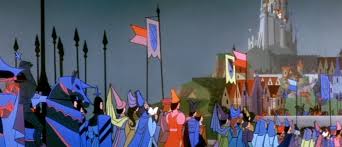
After an introduction by an unseen narrator that explains the circumstances of Princess Aurora’s birth, the film opens with the song “Hail to the Princess Aurora,” ostensibly sung by all the nobles journeying to the castle to see the newborn Princess. This was the first Disney movie to be animated in a widescreen format and the animators took full advantage of the extra space given to them.

Joyfully now to our princess we come,
Bringing gifts and all good wishes, too,
We pledge our loyalty anew

Hail to the Princess Aurora!
All of her subjects adore her!

Hail to the King!
Hail to the Queen!
Hail to the Princess Aurora!

Health to the Princess,
Wealth to the Princess,
Long live the Princess Aurora!

Hail Aurora!
Hail Aurora!
Health to the Princess,
Wealth to the Princess,
Long live the Princess Aurora!

Hail to the King!
Hail to the Queen!
Hail to the Princess Aurora!

“Hail to the Princess Aurora” is a rich choral piece that takes the audience from the town all the way up to the castle where the King and Queen are receiving their guests. Everything is animated in gorgeous colors and this remains one of my favorite openings to a classic Disney film. Let me now what you think about “Hail to the Princess Aurora” in the comments below and have a great day!

See also:

Sleeping Beauty “The Gifts of Beauty and Song” (1959)

Sleeping Beauty “I Wonder” (1959)

Sleeping Beauty “Once Upon A Dream” (1959)

Sleeping Beauty “Skumps” (1959)

Disney/Dreamworks/Pixar/etc. Soundtracks A-Z

Become a Patron of the blog at patreon.com/musicgamer460

Check out the YouTube channel (and consider hitting the subscribe button)

Don’t forget to like Film Music Central on Facebook
Cinderella “So This is Love” (1950)

Cinderella Part 2

Cinderella “So This is Love” (1950)

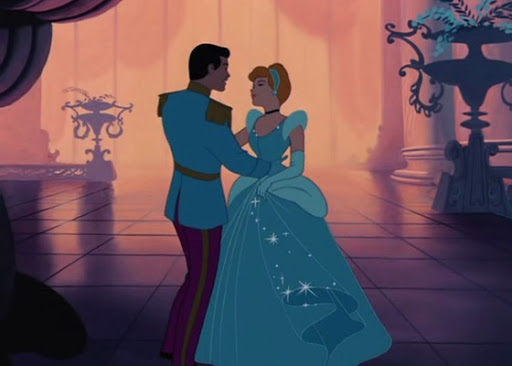
In her new carriage, Cinderella finally arrives at the castle where the ball is already underway. The Prince stands at the head of a receiving line where every single maiden is being presented to him. Cinderella (in her sparkling Christian Dior-inspired dress) arrives and attracts the attention of everyone, particularly the Prince, who brushes right by Cinderella’s stepsisters and asks her for a dance. This leads to “So This is Love” also known as “The Cinderella Waltz.” Unlike Snow White’s songs, Cinderella isn’t exactly singing while she dances, the words reflect her thoughts as she dances with the man of her dreams. While this love scene goes on, several things happen at once. The King orders the Grand Duke to give the couple some privacy (as he is desperate to see his son married) and Lady Tremaine becomes suspicious about who this mysterious young lady is. But before she can get a closer look, the Grand Duke shuts the curtain and doesn’t let her get any closer to the pair.

Mmmmmm, Mmmmmm
So this is love, mmmmmm
So this is love
So this is what makes life divine
I’m all aglow, mmmmmm
And now I know

And now I know

The key to all heaven is mine

My heart has wings, mmmmmm
and I can fly

I’ll touch every star in the sky
So this is the miracle that I’ve been dreaming of

So this is love

In terms of tone (and placement in the film), “So This is Love” is Cinderella’s equivalent to “Someday My Prince Will Come.” Both are waltzes, and both come not long before the climax of the story. The song ends and the couple is clearly in love, but just as things are getting interesting, the clock begins to strike midnight! This is the part that always confused me. If they are truly in love (and the Prince may marry any eligible maiden he chooses), what does it matter if the spell breaks and Cinderella’s dress goes away?

The original concept for “So This is Love” involved Cinderella and the Prince appearing to dance in the clouds (a concept that eventually reappeared at the end of Sleeping Beauty). There was supposed to be a different song as well for this sequence, titled “Dancing on a Cloud,” the lyrics of which survive:

Dancing on a cloud
I’m dancing on a cloud
When I’m in your arms the world is a heavenly place

Dancing in a dream
I’m dancing in a dream
For how can I help but dream when I see your face
before me

 Love is on its way
And as we gently sway
The moon and the stars appear bringing romance
for two

I just can’t believe that I found you
I just can’t believe that it’s true
Yet here am I dancing high on a cloud with you
Dancing on a cloud, I’m dancing on a cloud

While the lyrics are different, the sentiments expressed in “So This is Love” are still present, Cinderella and the Prince are completely in love at first sight and they want this moment to last forever. Let me know what you think about “So This is Love” in the comments below and have a great day!

See also:

Cinderella “A Dream is a Wish Your Heart Makes” (1950)

Cinderella “Sing Sweet Nightingale” (1950)

Cinderella “The Work Song/Cinderelly, Cinderelly” (1950)

Cinderella “Bibbidi-Bobbidi-Boo” (1950)

Disney/Dreamworks/Pixar/etc. Soundtracks A-Z

Become a Patron of the blog at patreon.com/musicgamer460

Check out the YouTube channel (and consider hitting the subscribe button)

Don’t forget to like Film Music Central on Facebook


Cinderella “Bibbidi-Bobbidi-Boo” (1950)

Cinderella-disneyscreencaps.com-5150

Cinderella “Bibbidi-Bobbidi-Boo” (1950)

After having her dress destroyed, poor Cinderella has finally reached her breaking point and just when she is on the verge of giving up, *POOF* here is her Fairy Godmother! And with the power of magic, Cinderella will be able to go to the ball after all! The Fairy Godmother was voiced by Verna Felton, who played a number of roles in Disney films during her career, including the Queen of Hearts, Aunt Sarah (in Lady and the Tramp), Flora in Sleeping Beauty, and Winifred the elephant in The Jungle Book (a posthumous role as she passed away before the film was released).

Listening to this song brings back all the good memories of childhood. The melody practically bounces from one note to the next, this is because the primary melody is a string of triplets (groups of three notes, see the number three under or above each group, that signifies a triplet.) Also, it’s really fun to try and say the nonsense words! During the song, some of Cinderella’s mice friends become horses, while her dog and horse become a coachman and a footman.

Salago-doola
Menchicka boola
Bibbidi-bobbidi-boo
Put ’em together
And what have you got?
Bibbidi-bobbidi-Boo

Salago-doola
Menchicka boola
Bibbidi-bobbidi-boo
It’ll do magic
Believe it or not
Bibbidi-bobbidi-boo

Now salago-doola means
Menchicka boole-roo
But the thingmabob
That does the job
Is bibbidi-bobbidi-boo

Oh…

Salago-doola
Menchicka boola
Bibbidi-bobbidi-boo
Put ’em together
And what have you got?
Bibbidi-bobbidi…
Bibbidi-bobbidi…
Bibbidi-bobbidi-boo

While all of this looks lovely, there’s still the matter of Cinderella’s dress, which the Fairy Godmother almost forgets. Allegedly, Walt Disney’s favorite piece of animation is the moment Cinderella receives her ball gown (which was always one of my favorites as well). Of course, with any bit of magic, there is always a catch: the spell that created her carriage, her dress and everything else, will break at the last stroke of midnight “and all will be as it was before.” Essentially, the Fairy Godmother is giving Cinderella her one chance to make her dreams come true, so she needs to make the most of it. That being said, I always wondered why Cinderella had to leave before the spell broke, surely if the Prince really loved her she could tell him the truth (I’m probably missing the point, I know).

As I’ve gotten older, I can’t help but notice the irony in this situation. If Lady Tremaine had let Cinderella come to the ball in her homemade dress, it’s possible the Prince would’ve never noticed her in the first place. But because she had to be spiteful, Cinderella receives a magical gown that guarantees she will be noticed.

Let me know what you think about “Bibbidi-Bobbidi-Boo” in the comments below and have a great day!

See also:

Cinderella “A Dream is a Wish Your Heart Makes” (1950)

Cinderella “Sing Sweet Nightingale” (1950)

Cinderella “The Work Song/Cinderelly, Cinderelly” (1950)

Cinderella “So This is Love” (1950)

Disney/Dreamworks/Pixar/etc. Soundtracks A-Z

Become a Patron of the blog at patreon.com/musicgamer460

Check out the YouTube channel (and consider hitting the subscribe button)

Don’t forget to like Film Music Central on Facebook


Cinderella “Sing Sweet Nightingale” (1950)

Evolution of Disney: Cinderella Part 1

Cinderella “Sing Sweet Nightingale” (1950)

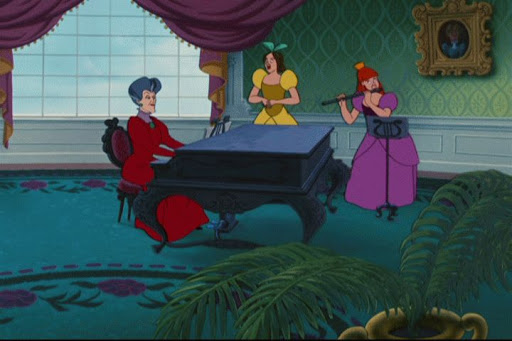
Anastasia and Drizella are taking music lessons from their mother and we are “treated” to the sound of Drizella’s…..talents….followed in contrast by Cinderella’s take on the same melody. This song is special because in it, Walt Disney pioneered the use of double tracked vocals (years before the Beatles did the same thing). A double tracked vocal is when you record an artist singing a song, then record it again and have the artist sing in harmony with the first recording. Ilene Woods did this at least four times, to create a four part harmony with her own voice, and the results are spectacular.

Oh, sing sweet nightingale
Sing sweet nightingale
High above me
Oh, sing sweet nightingale
Sing sweet nightingale

High above
Oh, sing sweet nightingale
Sing sweet nightingale, high
Oh, sing sweet nightingale
Sing sweet nightingale
Oh, sing sweet nightingale
Sing sweet
Oh, sing sweet nightingale, sing
Oh, sing sweet nightingale
Oh, sing sweet
Oh, sing

One of my favorite animations in Cinderella comes when all the different “bubble Cinderellas” sing together. This song also highlights Cinderella’s beautiful singing voice (in comparison to the Drizella’s singing voice and Anastasia’s questionable ability on the flute). You know I think this scene is further proof that Lady Tremaine is completely blind to the realities of her daughters. Anyone with half an ear can see that these two have no musical talent whatsoever, but does Lady Tremaine chastise them for being off-key? Nope!

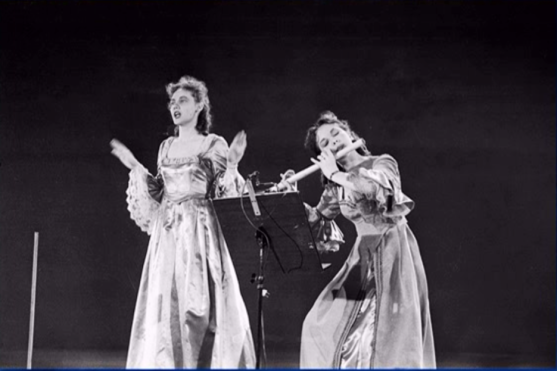
Like most of the scenes in Cinderella, this scene was also filmed in live action before it was animated and I love looking at the picture of the actresses playing Drizella and Anastasia because it’s almost exactly like the final animated version.

cindy-62.png

Let me know what you think about “Sing Sweet Nightingale” in the comments below and have a great day!

See also:

Cinderella “A Dream is a Wish Your Heart Makes” (1950)

Cinderella “The Work Song/Cinderelly, Cinderelly” (1950)

Cinderella “Bibbidi-Bobbidi-Boo” (1950)

Cinderella “So This is Love” (1950)

Disney/Dreamworks/Pixar/etc. Soundtracks A-Z

Become a Patron of the blog at patreon.com/musicgamer460

Check out the YouTube channel (and consider hitting the subscribe button)

Don’t forget to like Film Music Central on Facebook

Cinderella “A Dream is a Wish Your Heart Makes” (1950)

f1182-e4b2d886768d8949b43856570e5fa8d9

Cinderella “A Dream is a Wish Your Heart Makes” (1950)

A lot has happened since Walt Disney released Snow White and the Seven Dwarfs to worldwide acclaim. World War II has come and gone, along with a string of several flops at the box office. Heavily in debt, Disney agreed to produce another animated feature film, this time using the classic fairy tale Cendrillon by Charles Perrault as the inspiration. Begun in 1948 and released in 1950, Cinderella was hailed as the greatest animated film since Snow White and the Seven Dwarfs and is widely considered to be one of the greatest animated films ever made. The future princess was voiced by singer Ilene Woods. She had become friends with songwriters Mack David and Jerry Livingston, and one day they called her over to record demo tracks for three songs: “Bibbidi-Bobbidi-Boo,” “A Dream is A Wish Your Heart Makes,” and “So This Is Love.” When Disney heard the recordings, he hired Woods immediately to voice Cinderella, choosing her over 300 other girls who had auditioned.

Like Snow White before her, Cinderella is living life under the whim of her brutal stepmother Lady Tremaine and her mean stepsisters, Anastasia and Drizella. They also have a devious black cat named Lucifer, who is always trying to catch the mice and birds that are Cinderella’s friends and helpers. While her stepfamily enjoys a luxurious life, Cinderella is forced to do all the chores in her own home. It’s during this time that she rescues a new mouse from Lucifer and names him Gus.

Cinderella sings at the start of another day about how important dreams are, that “dreams are wishes your heart makes.” This is how Cinderella goes through life. Compare the opening of this song to any song that Snow White sings and you’ll see the difference. Whereas Snow White was a high soprano (Adriana Caselotti was an opera singer later in life), Cinderella’s vocal range is closer to that of a contralto (lower than a soprano, but still with a fairly wide range of notes). Keep in mind that over a decade has passed since Snow White was released, and musical styles have changed greatly since then.

A dream is a wish your heart makes
When you’re fast asleep
In dreams you will lose your heartaches
Whatever you wish for, you keep
Have faith in your dreams and someday
Your rainbow will come smiling through
No matter how your heart is grieving
If you keep on believing
The dream that you wish will come true

(Speaking)
Oh, that clock!
Old killjoy.
I hear you! “Come on, get up,” you say!
“Time to start another day!”
Even he orders me around.
Well, there’s one thing.
They can’t order me to stop dreaming.
And perhaps someday…

(Singing)
The dreams that I wish
Will come true

La-da-da-da-da-da-da-da
La-da-da-da-da-da-da-da-da
Hmm-hmm-hmm-hmm-hmmm-hmm-hmm-hmm
La-da-la-da-da-da-da-da-dee
Hmm-mm-hm-mm-mm-hmm-hmm-hmm
La-da-da-da-da-da-da-da-dee
La-da-da-da-daaa-da-da-da
Hmm-hmm-hmm-hm-hmm-hmm-hm-hmm

No matter how your heart is grieving
If you keep on believing
The Dream that you wish
Will come true

This song does a good job in establishing what Cinderella is like, she’s the eternal optimist (she has to be, given the circumstances). Let me know what you think about “A Dream is a Wish Your Heart Makes” in the comments below and have a great day!

See also:

Cinderella “Sing Sweet Nightingale” (1950)

Cinderella “The Work Song/Cinderelly, Cinderelly” (1950)

Cinderella “Bibbidi-Bobbidi-Boo” (1950)

Cinderella “So This is Love” (1950)

Disney/Dreamworks/Pixar/etc. Soundtracks A-Z

Become a Patron of the blog at patreon.com/musicgamer460

Check out the YouTube channel (and consider hitting the subscribe button)

Don’t forget to like Film Music Central on Facebook
 

Snow White and the Seven Dwarfs “Some Day My Prince Will Come” (1937)

Snow-white-disneyscreencaps.com-6725.jpg

Snow White “Some Day My Prince Will Come” (1937)

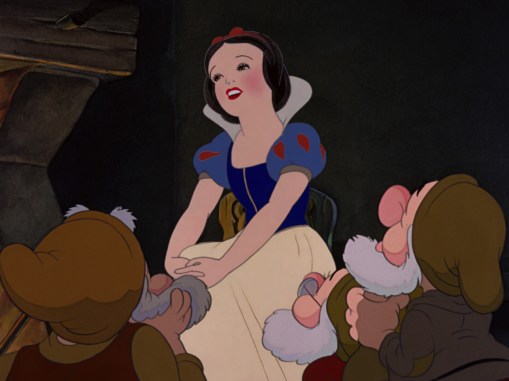
“The Silly Song” is immediately followed by Snow White’s final song in the film “Some Day My Prince will Come,” where she sings to the dwarfs about how she’ll be reunited with her Prince someday and all will live happily ever after. Apparently there was supposed to be a dream sequence to accompany the song but the production either ran out of money or it wasn’t coming up to Disney’s standards, so it was cut. Musically, the song is a gentle waltz (in 3/4 time).

Some day my prince will come
Some day we’ll meet again
And away to his castle we’ll go
To be happy forever, I know

Some day when spring is here
We’ll find a love anew
And the birds will sing,
And wedding bells will ring
Someday when my dreams come true

While “Some Day My Prince Will Come” is a beautiful song, I have a big problem with Snow White being in love with the Prince at all. Leaving aside the fact that Snow White is  only 14 years old (yes, really, that’s how old she’s supposed to be), there’s no getting away from the reality that Snow White has seen the Prince once. And that wasn’t even a proper conversation, it consisted of one “Hello” and a brief love song. Even Aurora and Prince Philip spent more time together! Still, despite all that, it is a nice last song from Snow White.

Let me know what you think about “Some Day My Prince Will Come” in the comments below and have a great day!

See also:

Snow White and the Seven Dwarfs “I’m Wishing/One Song” (1937)

Snow White and the Seven Dwarfs “With a Smile and a Song” (1937)

Snow White and the Seven Dwarfs “Whistle While You Work” (1937)

Snow White and the Seven Dwarfs “Heigh Ho” (1937)

Snow White and the Seven Dwarfs “Bluddle-Uddle-Um-Dum/The Washing Song” (1937)

Snow White and the Seven Dwarfs “The Silly Song” (1937)

Disney/Dreamworks/Pixar/etc. Soundtracks A-Z

Become a Patron of the blog at patreon.com/musicgamer460

Check out the YouTube channel (and consider hitting the subscribe button)

Don’t forget to like Film Music Central on Facebook