Monthly Archives: February 2018

My thoughts on: Yojimbo (1961)

Ever since I first saw Throne of Blood on Hulu (back when the Criterion Collection streamed their films on that site), there has been a special place in my heart for Kurosawa’s jidaigeki films (a jidaigeki film is literally a “period drama” usually set during the Edo period of Japan from 1603-1868, though some can be set earlier). And one of my favorite jidaigeki films is Yojimbo (1961), a film that may sound familiar to fans of Western films. Why would that be? Well, listen to the brief summary first:

A nameless samurai (Toshiro Mifune) comes to a small town that is the center of a feud between two families, both engaged in underworld crime. The nameless samurai plots to save the town by pitting the two families against one another by pretending to be a bodyguard (yojimbo) for each side until they destroy each other.

If that sounds like the plot of A Fistful of Dollars (1964) starring Clint Eastwood as The Man With No Name then you would be correct. What I never knew until I saw Yojimbo is that director Sergio Leone “borrowed” the plot of this film from Kurosawa’s work and repeated it wholesale for his spaghetti Western. Kurosawa filed a lawsuit when the film came to his attention, stating that while Leone had made “a fine movie, but it was my movie!” Ultimately the lawsuit was settled out of court for a certain percentage of the profits made from A Fistful of Dollars.

As stated in the brief summary, the nameless samurai comes to a rural town that is slowly being suffocated by two families. It was originally ruled (more or less) by Seibei    (Seizaburo Kawazu) and his gang. But when Seibei sought to retire and announced that he would be giving all of his territory to his inexperienced son, his right-hand man Ushitora (Kyū Sazanka) balked and started his own gang in retaliation. The two have been trying to eliminate each other for quite some time but remain locked in a stalemate. Seeing how the town is suffering from the two gangs, the nameless samurai (who later gives himself the name Sanjuro Kuwabatake) determines to eliminate them.

yojimbo-1961-movie-review-gang-unosuke-tatsuya-nakadai

Ushitora (left) and his brothers: Unosuke (center) and Inokichi (right)

Part of what makes Yojimbo such an excellent film is that it turns the traditional depiction of a samurai on its head. As a general rule, samurai were depicted as these noble beings, not a hair out of place and they wouldn’t dream of killing anyone for something as base as money. Sanjuro is the complete opposite of all of these ideals: he’s visibly scruffy; his clothes have seen better days; and his whole world apparently revolves around profit (though this is later tempered when he secretly gives his ill-gotten gains to a peasant family to help them start a new life). Toshiro Mifune completely owns this role for certain. In fact, this film did so well that Mifune reprised the role the following year in Sanjuro (1962).

My favorite part of this film is the middle act where Sanjuro plays each gang off of the other, with both sides completely oblivious to the manipulation. For example, Sanjuro overhears one of Ushitora’s men drunkenly spouting off to a friend about how they murdered a government official. After capturing them and taking the pair to Seibei, Sanjuro goes back to Ushitora and tells them that Seibei’s men captured the pair (leaving out the fact that he made the capture himself).
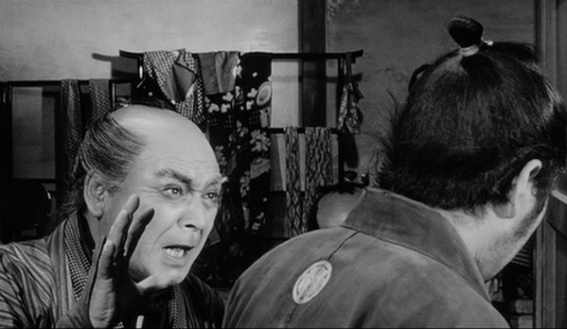
0seibei

Seibei (left) begs Sanjuro to work for him

The plan nearly goes off without a hitch but there are some complications: right in the middle of Sanjuro’s scheming, Ushitora’s younger brother Unosuke (Tatsuya Nakadai) returns after a trip abroad. And the semi-deranged Unosuke brought back a present: a pistol (that he knows how to use very well thank you very much). On top of this, Sanjuro’s good deed of helping a peasant family escape (including the wife who had been forcibly given to one of Ushitora’s associates as a concubine) is found out by Unosuke, who drags him back to his brother’s gang to be beaten unmercifully until he gives up where the family went. Sanjuro manages to escape, naturally, and he makes sure his only friend in the town, Gonji (Eijirō Tōno) the tavern owner, tells Ushitora’s men that the samurai went back to Seibei’s place to hide.

yojimbo-1961-sanjuro-gangsters-ushitora-kyu-sazanka-toshiro-mifune-seibei-seizaburo-kawazu

This proves to be the final straw: Ushitora and his men set fire to the rival gang’s base (a brothel) and slaughter them all as they come running out to fight, though they do spare the brothel girls as they run for their lives. After killing Seibei’s son and his scheming wife, Unosuke shoots Seibei and the war for the town is seemingly over. Gonji sneaks Sanjuro out of town to help him recover, but is caught taking supplies to him and is captured. Sanjuro won’t stand to see his friend hurt, so he returns to town to dispatch Ushitora and his gang. In relatively short order he kills them all, only sparing a young farm boy that he saw at the beginning of the story running away from the family farm, ordering him to go back to his parents and enjoy “a long life sipping gruel.”

With the gangs eliminated, Sanjuro frees Gonji and with a simple “See you around!” heads off for the road.

The film is made even better by Masaru Sato’s excellent, almost jazz-like score for this film. It doesn’t seem like the kind of music you should hear in a period film like Yojimbo, but it absolutely works. One of my favorite musical moments is, when Sanjuro is stalking Ushitora’s gang for the last time, all you really hear for a minute is a soft tap on a high-hat cymbal.

Have you seen Yojimbo or Sanjuro the sequel? If so, what did you think about them? Let me know your thoughts in the comments below! Thank you so much for coming by and checking out the blog, your support means everything to me!

For more of my thoughts on Kurosawa, see also: My Thoughts on Throne of Blood (1957)

And also see: Live-Action Films/TV for the rest of my film reviews 🙂

Become a Patron of the blog at patreon.com/musicgamer460

Check out the YouTube channel (and consider hitting the subscribe button)

Don’t forget to like Film Music Central on Facebook 🙂

Disturbing Disney #18: The Queen’s assignment for her Huntsman

Evolution of Disney : Snow White and the Seven Dwarfs Part 1

In the time leading up to its release, Snow White and the Seven Dwarfs was derided as “Disney’s Folly.” It seemed ludicrous that anyone would be willing to sit through a full-length animated feature film, let alone enjoy it. But upon its release in 1937, Snow White and the Seven Dwarfs was acclaimed as a masterpiece, a title it rightly deserves to this very day.

Based on Grimm’s fairy tale Schneewittchen, the film tells the story of a beautiful princess named Snow White who must flee for her life when her wicked stepmother the Queen learns through her magic mirror that Snow White is now “the fairest in the land.” The princes is taken in by seven dwarfs and dreams of reuniting with a handsome prince, but the Queen is on the prowl to ensure that she, not Snow White, is the fairest one of all. And it is due to the Queen’s wicked plots that the film possesses its own share of disturbing moments.

Humbert.png

While holding court on her peacock throne, the Queen informs her loyal huntsman that he is to take young Snow White deep into the forest to collect wildflowers. And once there, he is to kill her! Considering how calmly the Queen gives these orders, it is safe to presume that she’s had beautiful rivals murdered before, but the Huntsman objects in this case because Snow White is a royal princess, the Queen’s daughter by marriage! Not only will the Queen brook no argument, she even has a way to make sure that the Huntsman completes his mission. Once Snow White is dead, he must cut out her heart and bring it back to the Queen in a special box.

Just think about how sociopathic that request is: the Queen is so obsessed with being the most beautiful woman alive that she will have her own step-daughter murdered and have her heart brutally cut out just to satisfy her own vanity. Not only that, but she has a special chest made for the sole purpose of bringing back the heart so she can gloat. This is disturbing behavior coming from a Queen, and I believe that the vain monarch is so full of herself that she believes she can get away with this forever. Fortunately for our heroine, the Huntsman has a conscience and can’t go through with it, no matter the consequences.

image_21459143.png
This scene has become more disturbing for me the older I have become. Of course I was always scared because the Queen wanted to kill Snow White, but as the passage of time allowed me to better understand the motives behind what was happening, the more I became disturbed by the entire scene. However, the Huntsman’s mission is nothing compared to Snow White’s flight through the forest, which has terrified and disturbed children for the last eighty years.

What do you think of this disturbing moment? Let me know your thoughts in the comments below 🙂 Have a great day!

Become a Patron of the blog at patreon.com/musicgamer460

Check out the YouTube channel (and consider hitting the subscribe button)

Don’t forget to like Film Music Central on Facebook 🙂

See also:

Disturbing Disney #1: The Coachman in Pinocchio (1940)

Disturbing Disney #2: The truth of Pleasure Island in Pinocchio (1940)

Disturbing Disney #3: Escaping Monstro from Pinocchio (1940)

Disturbing Disney #4: Dumbo loses his mother (1941)

Disturbing Disney #5 The death of Bambi’s Mother

Disturbing Disney #6: Faline vs. the dogs (1942)

Disturbing Disney #7: Cruella wants to do WHAT??

Disturbing Disney #8: The Whale Who Wanted to Sing at the Met (from Make Mine Music, 1946)

Disturbing Disney #9: Dr. Facilier’s Fate (The Princess and the Frog, 2009)

Disturbing Disney #10: The rat in Lady and the Tramp (1955)

Disturbing Disney #11: Clayton’s Death in Tarzan (1999)

Disturbing Disney #12: The Bear from The Fox and the Hound (1981)

Disturbing Disney #13: “Smoking them out” in The Fox and the Hound (1981)

Disturbing Disney #14: The Salt Trap in The Jungle Book (1994)

Disturbing Disney #15: Night on Bald Mountain from Fantasia (1940)

Disturbing Disney #16: King Triton destroys Ariel’s grotto

Disturbing Disney #17: Ratigan becomes a monster in The Great Mouse Detective

Disturbing Disney #19: Cinderella’s dress is destroyed (1950)

Disturbing Disney #20: Quasimodo is crowned ‘King of Fools’ (1996)


Soundtrack Review: Winchester (2018)

642b79c5be902241b628ae5ec4a9dab7

Winchester is a 2018 American supernatural horror film directed by Michael and Peter Spierig. It follows the widowed Sarah Winchester (Helen Mirren) as she seeks to help what she believes are spirits killed by Winchester rifles by continually expanding the mansion she lives in (what is now known as the Winchester Mystery House). Due to Sarah’s obsession with spirits, a doctor named Eric Price (Jason Clarke) is summoned to the mansion to determine whether Sarah is mentally capable of running the Winchester Company. The doctor, who does not initially believe in ghosts, soon finds that there are indeed spirits residing in the Winchester mansion. Winchester was released to theaters on February 2nd, 2018.

The score for Winchester was composed by co-director Peter Spierig in his second outing as a film composer. Peter collaborates with his twin brother Michael and collectively they work as The Spierig Brothers. Their critically acclaimed sci-fi thriller Predestination, based on Robert A. Heinlein’s short story “All You Zombies”, was nominated for nine Australian Academy of Cinema and Television Arts (AACTA) Awards, including Best Director, Best Adapted Screenplay, and Best Score for Peter. The film also won four AACTA Awards including Best Actress for Sarah Snook, who stars in Winchester. The Spierig Brothers won the Toronto After Dark Film Festival Special Award for Best Sci-Fi Film and Best Screenplay for Predestination, which also took a second place Audience Award for Best Feature Film.

v1.bjsxODEwMjk5O2o7MTc2NjA7MTIwMDsyMDAwOzgzOA

Listening to the soundtrack, some moments definitely stood out to me, but overall one thing became pointedly clear: the Winchester score succumbs to the age-old trope of using shock chords in a horror film. It’s a practice that dates back many decades and in my opinion it’s completely over done. It’s true that horror films should have that “scare factor” to them, especially in the music whenever possible, but there’s more than one way to elicit scares through the music.

However as I said there were a few moments that stood out to me in a good way. One of these was “Marion,” referring to a relative of Sarah’s that also lives in the mansion with her son Henry. In contrast to the “Winchester House” track which is fairly typical horror movie score fare (loaded with shock chords, grinding metal sounds and various eerie noises), “Marion” is a relatively calm piano track that possibly signifies how “normal” the character is compared to Sarah Winchester with her belief in spirits and the paranormal. “Employment” also ran along similar veins to this piece.

112815777-e7dfff4a-b5cb-470f-b9ed-0f35b62da75e

“Poisoned Mind” was another track filled with shock chords, far too much for my liking to be honest, as was “You’re A Fraud.”

In brief, Winchester doesn’t have the worst soundtrack in the world (for those curious, Van Helsing (2004) still holds that dubious distinction for me), but it is not one of my favorites.

Did you watch Winchester? If you did, what did you think of the film and the soundtrack? Let me know your thoughts in the comments below. Have a good day!

See also: Film Soundtracks A-W

Become a Patron of the blog at patreon.com/musicgamer460

Check out the YouTube channel (and consider hitting the subscribe button)

Don’t forget to like Film Music Central on Facebook 🙂

My Thoughts on Throne of Blood (1957)

Have you ever wondered what Macbeth would look like if William Shakespeare had been a Japanese playwright living in 17th century feudal Japan? Legendary director Akira Kurosawa pondered the exact same question and as a result created Throne of Blood (known as Kumonosu-jō or Spider-Web’s Castle in its original Japanese title). The plot is largely faithful to Shakespeare, but the characters have undergone some changes, so first I’ll list the main characters and their Shakespearean counterparts:

  • Washizu/Macbeth: a loyal retainer of the Great Lord who is unexpectedly promoted to commander of the North Garrison after helping subdue a rebellion.
  • Miki/Banquo: Washizu’s best friend since childhood. He also meets the Witch in Spider-Web Forest
  • Lady Asaji/Lady Macbeth: Washizu’s scheming wife who continually pushes her husband to fulfill his “destiny” as laid out by the Witch.
  • The Great Lord/King Duncan: Ruler of a large territory who places great trust in Washizu and Miki.
  • The Witch of Spider-Web Forest/The Three Witches: Instead of three witches, Washizu and Miki meet only one, who, after singing a morbid song about how all life is connected to the corruption of death, foretells that Washizu will be promoted and shortly thereafter become Great Lord of Spider-Web’s Castle.


As I said before, the film is largely faithful to Shakespeare’s plot: After defeating a rogue lord in battle, Washizu and his friend Miki are on their way to meet the Great Lord when they come across a strange witch in the forest. The witch foretells that Washizu will shortly be named lord of the North Garrison and become ruler of Spider-Web’s Castle thereafter. Miki asks his fortune, and the witch replies that while his son will one day rule, he (Miki) will not. The friends attempt to laugh off the encounter, but when the first set of predictions come true (both are rewarded as the witch said they would be), they begin to wonder if the second prediction will also come true (because the Great Lord has a son of his own).

7be7ada2007e4a5855e4f3c9f40bc645_400

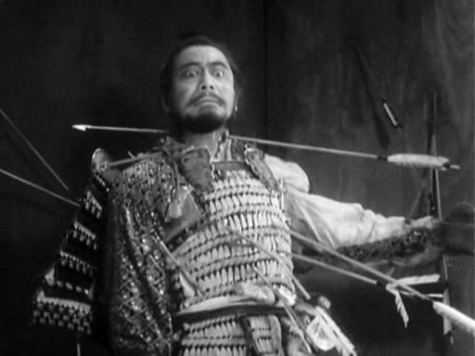
Behind the scene with the arrows in Throne of Blood

Washizu (to me) makes the great mistake of telling Lady Asaji about the prophecy and everything that’s happened and from that point on she can’t let it go; Washizu MUST fulfill the rest of the prophecy or he is no man at all. I have to say that Isuzu Yamada’s performance as Lady Asaji is one of the most chilling renditions of the Lady Macbeth character that I have ever seen. Part of the eeriness comes from Kurosawa instructing the actress to never blink on-camera. This gives her a not-quite-human affect and makes it like she’s wearing a mask (which is a reference to traditional Japanese theater, where the actors wore masks to denote their character). Asaji is near-sociopathic when it comes to getting what she wants, especially when she speaks of killing the Great Lord (which, as Washizu points out, would be an act of treason).

TOB - 9

Great Lord Washizu sees Miki’s ghost at a feast

Despite Washizu’s doubts, he finally gives in and murders the Great Lord off-camera when the latter comes to stay at the garrison for a night (Asaji having convinced him that all of this is a ploy that will eventually lead to Washizu’s execution). Despite successfully becoming the next Great Lord, Washizu is far from happy. But he at least sees one happy ending for his story: his dear friend Miki will be named his heir, as will Miki’s son, since Washizu has no children to succeed him. But while Washizu is content to reign and then turn the castle over to someone else, Lady Asaji is not. In a twist specificially created by Kurosawa, the devious wife drops a bombshell on her husband:

Asaji: “I am….with child.”

Washizu: “Truly?!”

Asaji: “….yes.”

The revelation that Asaji is pregnant (and she truly is, it’s not a lie) changes everything and gives Washizu a true motivation to eliminate Miki and his son from the picture. This is done, though Miki’s son escapes. At a feast later that night, Washizu sees Miki’s ghost sitting at his usual place in the hall, which terrifies the guilty lord who nearly reveals the whole truth to his entire court! I love Mifune’s performance in this scene, he is clearly wrestling with his fear and guilt and a part of him wants to badly to scream his sins in front of the world. But there’s still the child…isn’t there? Well, when the time to give birth arrives, a maid delivers the news: Asaji delivered a stillborn child, one that had been dead in the womb for some time, meaning Washizu ordered his best friend murdered for nothing. The loss of the child and the weight of her guilt combine to drive Asaji mad, and we last see her frantically trying to clean the phantom blood from her hands.

Vlcsnap-165532

Washizu with the fatal arrow in his neck

Washizu dies just like Macbeth at the conclusion of the story, but it’s the manner of his death that I’d like to talk about. Just like in Shakespeare, Washizu receives a final prophecy from the witch: he will not be overthrown until Spider Web’s Forest marches up to the castle. Since forests can’t walk of their own accord, Washizu assumes this means he’s invincible and he tells his men as much. But then, one night, an army organized by the son of the murdered Great Lord arrives and strange noises are heard in the forest. In the morning, the soldiers keeping watch cry out in panic, for there is Spider-Web’s Forest walking up to the castle!

In actuality, the invading soldiers had chopped down the trees to 1) make it easier to reach the castle and 2) disguise how many soldiers and wagons they had with them. Seeing the prophecy come true, Washizu’s men turn on him and suddenly a few arrows are shot at the terrified lord. When he calls them out that killing the Great Lord is treason, a soldier yells back “And who killed our last lord??” Dozens of arrows pursue Washizu as he runs for his life, but every way is cut off by arrows. He’s pierced dozens of times, but he still struggles to get away until suddenly (in one of the best executed jump-cuts you’ll ever see), an arrow pierces his neck, killing him, and bringing an end to the tragedy of Washizu.

throne-of-blood-8

An interesting note about the final scene with the arrows: Toshiro Mifune was really being shot at by live arrows (for the most part, a few are guided by wires which can be seen if you watch for them). His frantic arm movements are actually directing the archers as to which direction they need to shoot in next. This is why Washizu looks so terrified: because Mifune is genuinely terrified!

I would also like to give a quick mention to the wonderful score composed by Masaru Sato (1928-1999), who composed music for Kurosawa’s films for over a decade. He created music that highlights both the good and bad moments in Washizu’s life, and it really adds to the quality of this film.

If you’d like to watch Throne of Blood (which I highly recommend), the Criterion Collection has a restored copy on DVD/Blu Ray. It can also be streamed via FilmStruck. If you’ve seen Throne of Blood, what did you think of it? Let me know your thoughts in the comments below. Have a good day!

See also:

My thoughts on: Yojimbo (1961)

Live-Action Films/TV

Become a Patron of the blog at patreon.com/musicgamer460

Check out the YouTube channel (and consider hitting the subscribe button)

Don’t forget to like Film Music Central on Facebook 🙂

Film 101: Deus ex machina

Literally translating to “god from the machine,” deus ex machina refers to a plot device in which a seemingly unsolvable problem is suddenly and abruptly resolved by the inspired and unexpected intervention of some new event, character, ability, or object. The phrase originates in ancient Greek drama, where the mortal heroes would be rescued from their dilemma by the direct intervention of the gods (usually wheeled onto stage with some kind of machine, hence “god from the machine”).

With the invention of film, naturally examples of deus ex machina abound, though usually they’re the source of great scorn from the audience, as resorting to deus ex machina is usually perceived as “taking the easy way out” when it comes to telling a story.

Some notable examples include (but are by no means limited to):

  • The Eagles in The Hobbit/The Lord of the Rings: The Great Eagles of Middle-Earth actually serve this purpose on multiple occasions: Eagles rescue Bilbo, Gandalf and the Dwarves in The Hobbit; Eagles show up out of nowhere to save the day in The Battle of the Five Armies; Eagles show up out of nowhere to save the day in The Return of the King (I sense a pattern here); an Eagle rescues Gandalf from Isengard; an Eagle rescues Gandalf from Moria (though to be fair, that’s more explicitly stated in the book than in the film); and of course, Eagles rescue Frodo and Sam from the exploding Mount Doom after the Ring was destroyed. So much of this story would not have happened without the Eagles (often unexpected) intervention.

Vizzini_battle_of_the_wits

  • Immunity to Iocane powder in The Princess Bride: So in order to save Buttercup, Wesley challenges Vizzini to a “battle of wits” where the latter has to determine which cup of wine has been poisoned with deadly iocane powder. Only after Vizzini is dead does it come out that both cups were poisoned because (conveniently), Wesley spent several years building up an immunity to the substance.
  • Fawkes and Gryffindor’s sword in Harry Potter and the Chamber of Secrets: Things get pretty dark for Harry by the end of this film: he’s been poisoned by a basilisk, he’s isolated in the Chamber of Secrets deep below Hogwarts, there’s no way he can possibly survive, right? Well…out of nowhere, here comes Fawkes, a magical phoenix whose tears can cure any poison! Fawkes also has the Sorting Hat, which, oh how convenient, produces the legendary sword of Godric Gryffindor, giving Harry the means to kill the basilisk once and for all.

Kylo_Ren_Interrogates_Rey.0

  • Rey’s mind-reading abilities in The Force Awakens: If this is not a deus ex machina moment then it treads dangerously close to being one. Doesn’t it seem particularly odd that, when Kylo is attempting to read her mind to find the information about the map piece, that Rey is suddenly able to turn it around and read Kylo’s mind, just like that? And on a related note, how did she know to use the Jedi mind trick on that stormtrooper?
  • The Martians in The War of the Worlds: This has to be one of the biggest examples of deus ex machina ever made, and no matter how it’s spun for a film, it always sounds really stupid. Consider: Earth has been overwhelmed by a fleet of Martian ships that slaughter and destroy all in their path. Nothing the Earth has can stop them, it’s only a matter of time before everything is wiped out. And then suddenly, all the Martians begin dropping dead. It turns out these unstoppable aliens were brought down by…germs? That’s right, all the military might in the world couldn’t get the job done, but microscopic germs could (it just took time for the Martians to be affected by them). Independence Day somewhat parodies this when David uploads a computer “virus” to the mother ship, bringing down the shields of the invading ships.

I would also like to point out that The Matrix Revolutions somewhat parodies this concept when Neo meets the central interface of Machine City, known as The Deus Ex Machina.

So there are five examples of deus ex machina in film. Let me know what you think of these examples in the comments below and also feel free to share any examples you can think of that I didn’t mention. Have a good day!

Become a Patron of the blog at patreon.com/musicgamer460

Check out the YouTube channel (and consider hitting the subscribe button)

See also:

Film 101: Archetypes

Film 101: The MacGuffin

Don’t forget to like Film Music Central on Facebook 🙂

Soundtrack Review: Maze Runner-The Death Cure (2018)

images

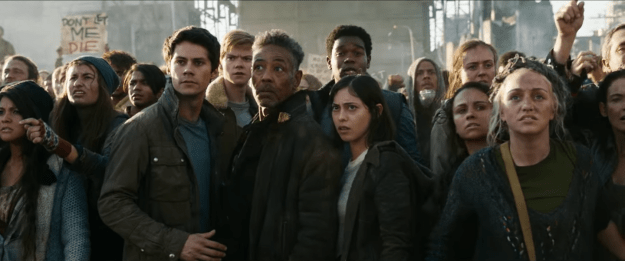
Maze Runner: The Death Cure is a 2018 American dystopian science fiction film based on the third novel in the Maze Runner trilogy written by James Dashner. It was originally meant to be released in 2017 but had to be delayed when series star Dylan O’Brien suffered injuries while filming and required extensive time to recover. In The Death Cure, the surviving “Gladers” must infiltrate WCKD headquarters in order to rescue their friend Minho who is being tortured by WCKD in hopes of developing a cure for the Flare virus that has turned most of the population into “Cranks” (zombie-like beings that have an overwhelming urge to kill anyone who isn’t a Crank). The film and soundtrack released on January 26th, 2018.

The score for The Death Cure was composed by John Paesano, a composer with a lengthy list of film credits to his name. Paesano received an Annie Award for Best Music for his work on DreamWorks’ animated series Dragons: Riders of Berk, which is based on the Academy Award® winning film How To Train Your Dragon. He won a World Soundtrack Award for his score to the hugely successful young adult adaptation, The Maze Runner.

He has now completed the trilogy, which includes The Scorch Trials and The Death Cure. His other credits include Universal Picture’s Almost Christmas and Sony Animation’s The Star. He’s currently scoring both Marvel’s hit series Daredevil and Defenders. Forthcoming in 2018 is Spider-Man PS4, which will be released featuring John’s huge orchestral score.

maze-runner-the-death-cure-clips

Listening to Maze Runner: The Death Cure was a refreshing change of pace compared to the other science fiction works I’ve been listening to as of late (i.e. Annihilation and Altered Carbon). Unlike those works, The Death Cure’s score uses a more traditional orchestra, mostly strings, though there is a healthy dose of synthesizer used as well (in the 21st century, it’s next-to-impossible to find a film score that doesn’t use synthesized music at some point).

Two tracks that stood out to me were “The Virus” and “The Last City.” With “The Virus,” it was very interesting, given the track’s title, how it actually sounded. I was expecting to hear something sinister and dark, but it actually sounded very pleasant. With layered orchestral chords and synthetic drones, the music is actually rather serene at times, which makes me wonder what part of the film this music is attached to with a title like “The Virus.” I really do enjoy listening to this track, it’s simple and direct and hopefully gets its point across in the film.

Last_City

“The Last City” can only be referring to the city that holds WCKD headquarters (and is presumed to be the last functioning city of its kind on Earth). Appropriately enough, given the post-apocalyptic setting, the music for this track is sad, with a mournful horn melody accompanied by strings. I have to imagine that even for those living inside the city things must seem completely hopeless, given how close humanity is to extinction, no wonder the music is so sad. I like how Paesano has written this piece, especially how the strings swell up with a theme of their own and weave in and out with the horn. Like “The Virus,” this track is relatively simple but effective.

And those are my thoughts on the soundtrack of Maze Runner: The Death Cure. Reviews of the film have been mixed, but I think Paesano’s soundtrack is good, and I hope you enjoy listening to it. My thanks to The Krakower Group for making this soundtrack available for review. The soundtrack is available via Sony Classical.

Don’t forget to like Film Music Central on Facebook 🙂

Become a Patron of the blog at patreon.com/musicgamer460

Check out the YouTube channel (and consider hitting the subscribe button)

See also: Film Soundtracks A-W

Soundtrack Review: Annihilation (2018)

Annihilation is a science fiction horror film written and directed by Alex Garland in his second outing as a film director. The film is based on the novel of the same name by Jeff VanderMeer and follows a group of military scientists who enter “the Shimmer,” a mysterious quarantined zone that is full of mutating landscapes and creatures. Annihilation stars Natalie Portman, Oscar Isaac, Jennifer Jason Leigh, , Gina Rodriguez, Tessa Thompson and Tuva Novotny and was released on February 23rd, 2018.

The soundtrack of Annihilation was scored by composing duo Ben Salisbury and Geoff Barrow, who previously worked with Alex Garland on the Academy Award winning film Ex Machina (2015). Ben Salisbury is an Emmy-nominated composer with over 100 film and television composing credits to his name, including Beyonce Knowles’ self-directed documentary feature Beyonce: Life Is But A Dream and the last 3 series of David Attenborough’s acclaimed Life Of… strand for the BBC. Geoff Barrow, known for his extensive body of work as a music producer and founding member of the band Portishead, first began his film music career as the music supervisor and original score writer for graffiti artist Banksy’s Oscar-nominated documentary Exit Through The Gift Shop. He recently worked on the band Arcade Fire’s latest album Everything Now in addition to producing a cover of ABBA’s “SOS” with Portishead for Ben Wheatley’s film adaption of High-Rise.

The first thing I noticed about this soundtrack is that it is clearly related to the music of Ex Machina. It is not identical, per se, but it clearly comes from the same tonal family as the previous film. I don’t say this as a bad thing, in fact, it’s not uncommon for multiple soundtracks from the same composer (or group of composers) to retain similarities across each film. I also think the resemblance has something to do with Annihilation being considered the “spiritual” successor to Ex Machina.

22-annihilation-2.w710.h473

That being said, if you liked Ex Machina and its soundtrack, then you will love the soundtrack for Annihilation. Like the soundtrack for Altered Carbon, most of the tracks contain the same elements: long synthesized tones, metallic wind chimes, and vocal tones. Despite the similarities, some of the tracks did stand out to me.

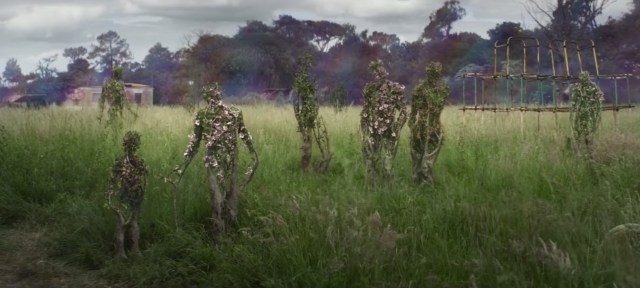
“Shimmer Reveal” is only 38 seconds long but it catches the ear because it starts very soft and steadily grows in volume. As the volume increases, the melody “thickens” with a deeper synthesized tone. It feels like we start looking at a small picture which quickly expands into a panoramic landscape (in fact this is probably when we get our first in-depth look at the “shimmer” which can only be that mysterious thing that Natalie Portman’s character is seen walking into in the previews).

annihilation-plant-evolution-elements

“Abandoned Army Base” is half-mystical and half-sinister in the way it combines a synthesized drone with “creaking” metallic tones that sound like metal being ripped apart and metallic chimes that put me in mind of a monastery. Given that this is a science fiction horror film, I can only presume the sinister component I hear is due to someone or something hiding at this abandoned base, just waiting to snatch an unsuspecting victim (of course I could be wrong, but that’s what it sounds like). And going back to Ex Machina, this track in particular reminds me of Ava’s theme.

I have to bring attention to “In All of Us” simply because this track breaks the overall pattern and includes a melody from a guitar, which is so unexpected that it jars the ear when it arrives. “We Are Headed That Way” which follows that track, is interesting to me because of its title. Given the trailer’s hints that “the Shimmer” is causing a mutation of some kind, I wonder if this title refers to the idea that everything on Earth will eventually be affected by this mutation. Truthfully I can’t wait to find out what “the Shimmer” is actually doing, the visuals in the previews looked amazing.

annihilation_deer

And those are my thoughts on the soundtrack for Annihilation. The soundtrack is currently available via Lakeshore Records and I hope you enjoy listening to it. My thanks to The Krakower Group for making this soundtrack available for review.

If you’ve seen Annihilation, what did you think of the film and its soundtrack? Let me know your thoughts in the comments below, but please no spoilers, I’m seeing the film on Wednesday night 🙂

Become a Patron of the blog at patreon.com/musicgamer460

Check out the YouTube channel (and consider hitting the subscribe button)

Don’t forget to like Film Music Central on Facebook 🙂

See also: Film Soundtracks A-W

My thoughts on: Annihilation (2018)

Soundtrack Review: The Alienist (2018)

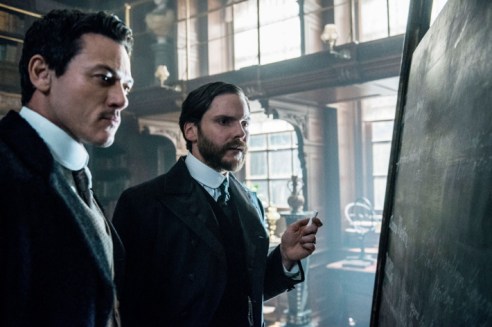
The Alienist is an American television period drama mystery series based on the novel of the same name by Caleb Carr. The ten episode series currently running on TNT stars Daniel Brühl, Luke Evans and Dakota Fanning as a team assembled in late 1890s New York City to investigate a ritualistic serial killer who is murdering street children. The title comes from a late-19th century belief about mental illness. At that time, the mentally ill were considered to be “alienated” from their true nature. Those who studied mental illness were therefore known as “alienists.”

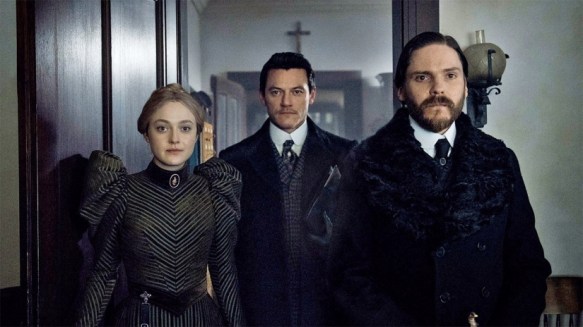
The titular alienist is Dr. Laszlo Kreizler (Daniel Brühl), a criminal psychologist hired to secretly conduct an investigation into the case by police commissioner Theodore Roosevelt (the future President of the United States). Kreizler is aided in his task by newspaper illustrator John Moore (Luke Evans) and Sarah Howard (Dakota Fanning), the police commissioner’s secretary.

alienist

The music for The Alienist was composed by Rupert Gregson-Williams. A truly versatile composer, Gregson-Williams has written a wide range of scores for many feature films, including the Oscar-winning Hotel Rwanda for which he was awarded the European Film Award for Best Composer, the blockbuster DreamWorks animated films Over The Hedge and Jerry Seinfeld’s Bee Movie, for which Rupert was nominated for an Annie Award for his original score and the independent BBC Films’ Love + Hate, for which he was awarded the Reims International Composer Award.

Most recently, Gregson-Williams scored the blockbuster and critically acclaimed Wonder Woman directed by Patty Jenkins and starring Gal Gadot and Chris Pine; the award-winning war drama Hacksaw Ridge, starring Andrew Garfield and directed by Mel Gibson, and the international hit The Legend of Tarzan. His upcoming film projects include “Terminal,” starring Margot Robbie and written and directed by Vaughn Stein.

Having cut the cable cord several years ago, I haven’t been able to watch the show yet, but based on the soundtrack, I think I need to. From the very start with “The Streets of New York” and “Brooklyn Bridge,” there is an old-time sound that is meant to recall the late-19th century. In fact, I was strongly put in mind of the soundtrack to Sherlock Holmes (2009) which is set in a similar time period (albeit in London and not New York City).

05-the-alienist-103.w710.h473

The cue titled “Dr. Laszlo Kreizler,” which I assume is his theme, intrigued me. Given that he’s the titular character, it struck me how sinister his theme sounds with a descending three note motif that recurs in strings and piano. This could be because he studies the mentally ill and crimes committed by people who suffer from mental illness and as a result he’s “tainted” for lack of a better word by what he’s seen. Of course it could also be a musical hint that Kreizler is a villain in disguise, but I can’t say for certain (though now I want to read the book and watch the show to find out if I’m right or not).

Another cue that caught my attention is “Madness of the City” which literally starts with a growl that briefly settles back before exploding into a mad cacophony that literally sounds like someone trying to break through a locked door (which may have been what they were going for) with repeated “banging” sounds. The entire track is underlaid with raging strings (primarily the cello) that continually make their presence known. This is definitely one of my favorite tracks. “Alienated Mind” is also an interesting piece because it consists of long musical drones that remind me of a Buddhist monk chanting “Ommm…”

Alienist-Promo-Still-16-The-Main-Investigators

Finally, I’ll talk about the main title theme for the show, which is very short (only 35 seconds) but contains a wealth of detail. Instead of possessing a distinct theme as most shows do (for example Penny Dreadful, Game of Thrones, Star Trek and NCIS just to name a few), the main theme for The Alienist more closely resembles what music theorists call a “sound cloud,” that is to say a mashup of music that is loosely organized (otherwise it would just be noise) but has no distinct melody. It contains elements from several of the tracks I’ve looked at already, and it carries an air of mystery about it.

And those are my thoughts on the soundtrack for The Alienist. The soundtrack is currently available via Lakeshore Records. My thanks to The Krakower Group for making this soundtrack available for review. Let me know what you think of The Alienist and its soundtrack in the comments below!

See also:

TV Soundtracks

Become a Patron of the blog at patreon.com/musicgamer460

Check out the YouTube channel (and consider hitting the subscribe button)

Don’t forget to like Film Music Central on Facebook 🙂
 

My thoughts on: Black Panther (2018)

22550566_10210694196133125_6370782124244474724_o

*caution, spoilers ahead*

It has been a very long time since I went to see a film set in the Marvel Cinematic Universe. Due to burn-out and other situations, I believe the last film I went to see was Avengers: Age of Ultron all the way back in 2015. I truly thought I was permanently burned out on the MCU until I saw the first teasers for Black Panther late last year. Something about the film kept drawing me in, as much as I tried to ignore it. Then, when the first reviews came out critically praising the film as a masterpiece, I knew that I would have to go and see for myself.

The critics are right. Black Panther IS a masterpiece. In fact, I’d go so far as to say that this is the best film in the MCU to date (though Avengers: Infinity War might claim that title once it releases in May).

RET0720_v021_1056_R

As far as I can tell (my knowledge of the MCU timeline isn’t the best), Black Panther picks up about a week after the events of Civil War, during which time T’Chaka, the king of Wakanda, was assassinated in an explosion at the United Nations. His son T’Challa is set to be crowned king and fully come into his rights as the Black Panther that protects Wakanda from the outside world. A beautiful prologue explains that Wakanda was built over a huge meteorite of vibranium that crashed into the Earth. Because the vibranium allowed Wakanda to build and work with technology that far outstripped the rest of the world, the nation hides in plain sight, posing as a Third World country while it is actually the most advanced on Earth.

I think my favorite scene in the whole film is when T’Challa (Chadwick Boseman) is returning to Wakanda with Nakia (an ex-girlfriend) for his coronation. The ship they’re flying on appears to be heading straight into a mountain when at the last second it’s revealed to be a hologram! The facade melts away to reveal this beautiful city full of flying ships, mag-lev trains and of course the enormous vibranium mine (overseen by a huge panther statue). The entire city is a perfect example of Afro-Futurism, combining traditional African designs with futuristic technology (it’s sheer perfection to watch).

blackpanther-enter-wakanda

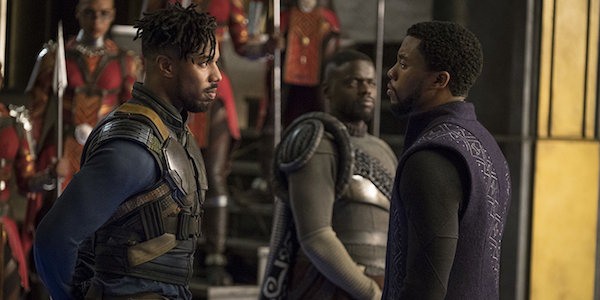
Enter Erik Killmonger (Michael B. Jordan), my new favorite villain in the MCU (sorry Loki). Erik is introduced as an associate of Ulysses Klaue (whose vibranium stealing exploits have been a thorn in Wakanda’s side for thirty years). It turns out that Killmonger is actually the son of T’Chaka’s brother. When Eric was a young boy, T’Chaka confronted his brother over helping Klaue steal vibranium and was forced to kill him. But the real tragedy of the situation emerges when it is revealed that T’Chaka chose to leave his nephew behind, rather than take him back to Wakanda. Is it any wonder that Erik is bitter and seeks to rule Wakanda as its rightful king?

aaa91a4eecb9611cb8b9a782596fa8cc785303ea

Killmonger fascinates me because his motives are so complex. He genuinely believes that he knows what’s best for Wakanda. The young king, knowing who Erik is, doesn’t want the truth coming out in front of his council, but it does anyway. Aside from being stunned to learn that there’s a royal cousin that nobody in Wakanda knew about, they agree that Erik is fully within his rights as a royal prince to challenge for the throne by ritual combat. And this led to my other favorite scene: as Erik and T’Challa fight, Erik spells out why he is the better king for Wakanda, revealing that he has killed many, many times (and for each kill there’s a self-inflicted scar on his body).

tmp_VVmutN_f1c17a15745213f3_BlackPanther5a68e7526439f

I found the clash between Erik, who grew up in America, and the culture of Wakanda to be enthralling. Now I understand the article titles I saw that mentioned the conflict between African-Americans and Africans. Even though they have a common origin (in Africa), the way they grew up almost guarantees they’ll be nothing like each other, and so it is with T’Challa and Erik.

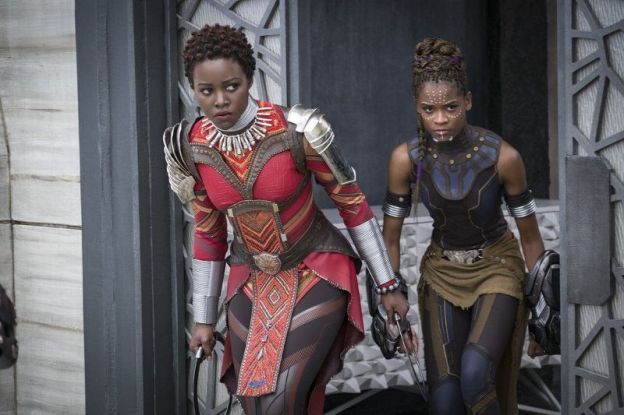
Another part of the film that I absolutely loved are the Dora Milaje; an all-female squad of elite warriors that protect the king of Wakanda at all times. They’re led by Okoye (Danai Gurira, aka Michonne on The Walking Dead!), an absolutely bad-ass warrior who will not hesitate to attack her enemies with a spear. Their fighting style is thrilling to watch; they move with such precision and grace that you can’t doubt their lethal abilities.

Aside from T’Challa himself, I absolutely loved his little sister Shuri (Letitia Wright). Though only 16, she’s in charge of Wakanda’s technological developments, which also include providing updates to the Black Panther’s suit and weapons. It’s hinted that she can fight as well, but it doesn’t come out until the big fight at the end when she emerges with Nakia in fighting armor and wreaks havoc on the enemy. I definitely want to see more of Shuri (and Wakanda in general) in the MCU.

Final thoughts: Black Panther is without a doubt the best film produced for the MCU yet. It’s a compelling story, without any flaws that I could find. Definitely go see it!

What did you think of Black Panther? Let me know your thoughts in the comments below 🙂 As always, thank you for coming by and checking out the blog, your support means everything to me!

Become a Patron of the blog at patreon.com/musicgamer460

Check out the YouTube channel (and consider hitting the subscribe button)

Don’t forget to like Film Music Central on Facebook 🙂
See also: Film/TV Reviews

Film 101: The MacGuffin

If you’ve ever read in-depth about films, you’ve probably come across some variation of the following statements:

“The hero chased a series of MacGuffins for the entire story.”

“The plot twist revealed yet another MacGuffin…”

But what is a MacGuffin? Well, MacGuffin’s are plot devices that originated in literary fiction and have long since moved over to film as well. They appear as some goal, desired object, or other motivator that the protagonist (and sometimes the antagonist) pursues, very often with little to know narrative explanation as to why they desire this thing. It should also be noted that a MacGuffin’s importance comes not because of the object itself, but rather how it affects the characters and their motivations.

In most films where a MacGuffin appears, they’re usually the main focus of the film in the first act, but thereafter decline in importance, often being forgotten by the end of the story (though sometimes it will magically reappear to aid in the climax of the plot).

main-qimg-7d67316b6f2945a20470644302521f57-c

There are many examples of MacGuffins in film but one of the most popular would be the search for the Death Star Plans (held by R2-D2 and C-3PO) in the original Star Wars film. From the beginning of the film (when Darth Vader chases down Princess Leia’s ship), almost to the end (when the Falcon escapes the Death Star to head to the Rebel base on Yavin 4), the plot is driven around obtaining those plans for either the Empire or the Rebellion. This is an almost identical scenario to the one in The Force Awakens where both the First Order and the Resistance are seeking the last map piece to locate Luke Skywalker.

rGtrj

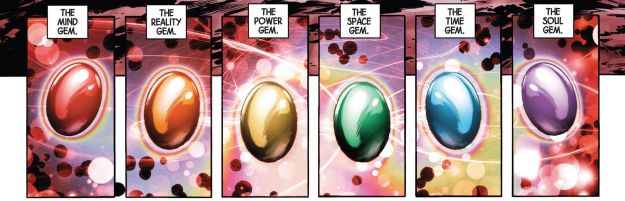
The Infinity Stones could be described as the ultimate MacGuffin of the entire Marvel Cinematic Universe, as possession of these objects (the Tesseract, the Aether, the Mind Stone, the Power Stone, the Eye of Agamotto) has driven a large number of the films, with the threat of Thanos coming to collect them himself growing ever larger. Just for a refresher:

-The Tesseract: Captain America: The First Avenger; Thor; The Avengers; Avengers: Infinity War

– The Aether: Thor: The Dark World; Avengers: Infinity War

-The Mind Stone: The Avengers; Avengers: Age of Ultron; Avengers: Infinity War

-The Power Stone: Guardians of the Galaxy; Avengers: Infinity War

-The Eye of Agamotto: Dr. Strange; Avengers: Infinity War

frodo-the-lord-of-the-rings-the-return-of-the-king-el-retorno-del-rey-2003

Another MacGuffin example that appears both in literature and film is the One Ring from The Lord of the Rings. If you think about it, for the most of the story the Ring doesn’t really do anything except lie on a chain around Frodo’s neck. The entire plot revolves around destroying this Ring of pure evil before the Dark Lord Sauron can get his hands on it or before anyone else can claim it for their own, but we never really get to see it used to its full potential (though admittedly hints are given as to what it can do).

Possibly the most famous MacGuffin of all cinematic history comes in the classic Citizen Kane, when the reporter attempts to track down the meaning of Kane’s last whispered word “Rosebud.” To this end, he interviews countless former friends, lovers and associates, all in an attempt to find where this one word came from (I’m not going to tell you because the reveal is something everyone should experience for themselves).

And that’s my explanation for what a MacGuffin is. Having read through the examples, do any MacGuffins come to mind that I didn’t list? Let me know your thoughts in the comments below 🙂

Don’t forget to like Film Music Central on Facebook 🙂

Become a Patron of the blog at patreon.com/musicgamer460

Check out the YouTube channel (and consider hitting the subscribe button)

See also:

Film 101: Archetypes

Film 101: Deus ex machina