Moana “How Far I’ll Go (reprise)” (2016)

maxresdefault.jpg

Moana “How Far I’ll Go (reprise)” (2016)

Given how vigilant Moana’s father is about no one leaving the island, I was curious to see how his daughter would manage to get away. The moment arrives, rather shockingly, when Grandmother Tala is revealed to be dying (a fan theory speculates that this is because she gave the Heart of Te Fiti to Moana that had hitherto been keeping her alive all these years). Moana is deeply upset, but Tala, knowing that this is her granddaughters only chance to get away, tells her to go and find Maui. This is absolutely heartbreaking: Moana doesn’t want to leave her grandmother without properly saying goodbye, but she also wants to set things right for the island. So she heads for the boats, which starts off the reprise of “How Far I’ll Go.”

There’s a line where the sky meets the sea and it calls me
But no one knows, how far it goes
All the time wondering where I need to be is behind me
I’m on my own, to worlds unknown

There’s a surprising moment when Moana is gathering supplies at her home: her mother Sia finds her and there’s a long stretch where they just stare at each other. And without saying a word Sia shows her support by throwing in some more supplies and giving them to Moana. She’s heartbroken but she also knows this is something her daughter has to do (I have a suspicion she’s known this for a while now).

Every turn I take, every trail I track
Is a choice I make, now I can’t turn back
From the great unknown where I go alone
Where I long to be

d05847c83c4db74a8726fcce3f443c7d.jpg

Having selected her boat and pushed it out into the lagoon, Moana looks back at the island and then comes my favorite part of this scene. All of the lights go out in the big hut and a huge manta ray spirit comes flying into the water. The manta is wonderfully animated, shining with bioluminescence in a design that matches the tattoo Tala had. Earlier, Tala had revealed a manta ray tattoo on her back, revealing that she would come back as one when she died. Moana sees this spirit and knows its her grandmother guiding her out to sea. This moment, I admit, always brings tears to my eyes because, despite being beautiful to see, it also means that her beloved grandmother is gone.

See her light up the night in the sea, she calls me
And yes I know that I can go
There’s a moon in the sky and the wind is behind me
Soon I’ll know how far I’ll go

With the help of Tala’s spirit, Moana is guided beyond the lagoon with far less fuss than I thought there might be. I admit, when I first watched this film in the theater, I half expected to hear her father pleading for Moana to come back, but nothing of the sort happened. On another random note, I’m really glad her father didn’t follow through on his threat of burning the boats. When he said “I should’ve burned those boats years ago” I had a strong flashback to King Triton just before he destroyed the grotto in The Little Mermaid and for a moment I believed we were going to get a repeat of that scenario.

I hope you enjoyed “How Far I’ll Go (reprise)” I hope I can come back and finish the rest of the songs from Moana sooner rather than later. Let me know what you thought of this song in the comments below and have a great day!

See also:

Moana “Where You Are” (2016)

Moana “How Far I’ll Go” (2016)

Moana “We Know the Way” (2016)

Moana “You’re Welcome” (2016)

Moana “Shiny” (2016)

Moana “I am Moana” (2016)

Moana “Know Who You Are” (2016)

Disney Films & Soundtracks A-Z

Become a patron of the blog at: patreon.com/musicgamer460

Check out the YouTube channel (and consider hitting the subscribe button)

Don’t forget to like Film Music Central on Facebook 🙂

My thoughts on: Richard III (1955)


Of all of Laurence Olivier’s Shakespeare films, my absolute favorite remains Richard III (1955), one of the best (if not entirely complete) film renditions of the story. The play, as the title indicates, follows the titular Richard, brother of Edward IV (Sir Cedric Hardwicke) as he rises in power to become Richard III, last king of the Plantagenet dynasty. The cast is full of talent, the principal players are as follows:

  • Richard III: Laurence Olivier
  • Edward IV: Sir Cedric Hardwicke
  • Clarence (brother of Edward and Richard): Sir John Gielgud
  • Duke of Buckingham: Sir Ralph Richardson
  • The Lady Anne (Richard’s wife): Claire Bloom
  • Henry, Earl of Richmond (Henry VII): Stanley Baker

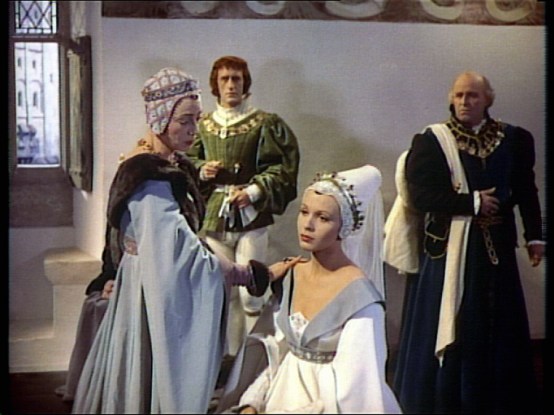
From start to finish, Olivier’s Richard dominates the story. Similar to Iago in Othello, the future king hides his true motives from all but a few (namely the Duke of Buckingham his confidante) and to most of the court appears to be brusque, awkward, but a gentleman regardless. Nothing could be further from the truth: Richard more than anything wants the crown of England, but his brothers Edward and George, the Duke of Clarence (not to mention Edward’s sons) stand in his way. To achieve this goal, Richard resorts to murder, threats, and outright playacting to get what he wants.


Olivier’s acting is so versatile, it’s a delight to watch him at work. When he talks directly to the audience, as in the “Now is the winter of our discontent” monologue, he speaks as if he’s talking to a fellow conspirator. When he woos the Lady Anne, he lays the charm on so unbelievably thick that you almost believe he’s sincere…until Anne leaves and Richard reveals that this was all part of the plan. The only time Richard lets his ‘mask’ slip is when young Richard of York, his nephew, taunts him by saying that his uncle Richard should carry him on his humpbacked shoulder. This invokes one of the oldest storytelling tropes: no villain can stand to be mocked. Olivier created this moment from scratch, there’s no precedent for it in previous adaptations. In that moment, he turns and stares at young Richard with an absolute death glare, sending the young prince stumbling backward in fright. Oddly, no one else (except for maybe Buckingham) seems to catch this moment.

RICHARD III

Another scene I like comes late in the story when Richard (with Buckingham’s help) has finally convinced the people to have him proclaimed king. As the people leave to prepare for the coronation, Buckingham walks up to congratulate his friend, only to be stopped short as Richard thrusts his hand out, signalling that Buckingham should instead kneel before him. It’s an abrupt moment, one that clearly shows that things are not as they were between the two.

I said at the beginning that this adaptation was not entirely complete and that’s because a lot of material is cut out. This is one of Shakespeare’s longer works, a complete performance would last upward of four hours, so for a film naturally some parts had to be cut out. One of the biggest changes is the removal of Queen Margaret (the widow of Henry VI) from the story. This is huge because Margaret’s ‘curses’ play a crucial role in the story. Also, the roles of the Duchess of York (Richard’s mother) and Queen Elizabeth (Edward IV’s wife) are severely reduced as well (you can see more of their performances in The Hollow Crown: The Wars of the Roses).

If you like Shakespeare on film, you will love Richard III. A fully restored copy can be bought from the Criterion Collection (in fact this was the first Criterion film I ever owned) and is well worth the price. Let me know what you think of Richard III in the comments below and have a great day 🙂

See also:

Film/TV Reviews

Become a patron of the blog at: patreon.com/musicgamer460

Check out the YouTube channel (and consider hitting the subscribe button)

Don’t forget to like Film Music Central on Facebook 🙂

My thoughts on: Othello (1965)

When I was in high school, I had to read several of Shakespeare’s plays for class. We read Romeo and Juliet; Hamlet; Macbeth; Julius Caesar and my favorite was Othello. This is one of Shakespeare’s tragedies and follows the ill-fated story of the titular character, a Moorish general serving the Duke of Venice who elopes with the beautiful Desdemona. Iago, a soldier who is bitter that Othello did not name him as his lieutenant, conspires to bring about the general’s downfall.

Of the Shakespeare works I’ve read, Othello is one of my favorites. Iago is a truly despicable villain, made more so by the fact that up until the final moments of the play, nobody realizes what he’s done and calls him “honest Iago.” The play has been adapted to film in English several times, but I think the best example is the 1965 film starring Laurence Olivier in the title role. The main cast is as follows:

  • Othello: Laurence Olivier
  • Desdemona: Maggie Smith (aka Professor McGonagall in Harry Potter)
  • Iago: Frank Finlay
  • Emilia (Iago’s wife): Joyce Redman
  • Michael Cassio, Othello’s lieutenant: Derek Jacobi (in his screen debut)
  • Robert Lang: Roderigo, a Venetian nobleman who wants to marry Desdemona even though her father already said no several times.

image-w1280.jpg

The first thing we must talk about in this version of the play is Olivier’s portrayal of the character. Controversially, remember this was the mid-1960s and the Civil Rights era was in full swing in the United States, Olivier plays the character in blackface from head to toe and also adopts a deep, booming voice. It seems shocking that an actor as well regarded as Laurence Olivier would do this, but in truth no offense was intended (though it would certainly not happen if the film were being made today). Actually, up until the 1990s, there was a long tradition (going back to the 1600s) of actors “blacking up” in order to play the Moorish general (this is because most interpreted “Moorish” to mean African and therefore dark skinned). This is not like some blackface that mocks Africans; Olivier plays it completely straight. Please don’t let this turn you off from watching this version of the play, Olivier’s performance is one for the ages (he earned an Oscar nomination for it).

In the story, after it’s revealed that Othello and Desdemona have eloped (to the shame and outrage of her father Brabantio), the Duke sends the general to Cyprus in order to deal with a Turkish fleet that is threatening the area. Desdemona accompanies him, as does Iago, Emilia and Michael Cassio, whom the aforementioned Iago is determined to ruin so that he might be lieutenant instead.

article-2412397-1BA8CB33000005DC-74_634x430

Manipulation is a big part of the story, particularly how Iago manipulates Othello to believe things that the audience knows are simply not true. For example, Iago begins by getting Cassio drunk and then has him purposefully provoked, knowing how the lieutenant will retaliate. He then spreads a lie that Cassio is like this often, and given the spectacle Cassio makes, Othello dismisses him from his service. But it gets worse: Iago then contrives to have his wife steal one of Desdemona’s handkerchiefs (one that her husband gave her) and ensures that it finds its way to Cassio’s hands. He ends up giving it to his mistress Bianca, but Iago tells Othello that it came straight from Desdemona’s hands, leading the general to believe that his faithful wife is sleeping with Cassio!

Iago is completely sure of himself for most of the story; he actually reminds me of Littlefinger in Game of Thrones. He manipulates everyone so well that no one realizes his connection to what has happened until the very end, when his wife puts two and two together and realizes Iago started everything. You will love Frank Finlay’s performance as Iago, he seems to be everywhere throughout the story (only Olivier has more screen time than he does).

2be7470868e4086cd76aaa26229db8a6.jpg

This being a tragedy, it is no surprise when I say that Othello, Desdemona and Emilia end up dead. Having been whipped into a jealous frenzy, Othello smothers his wife and later commits suicide when the truth has been revealed to him. Emilia on the other hand, is murdered by Iago when she blurts out the truth to several witnesses (Iago tried to have Cassio murdered, but he survived albeit with a bad leg injury). Othello’s last scene is mesmerizing: this is a man who knows he’s killed a woman who was nothing but faithful to him and the guilt is eating him alive. Olivier pours all of his ethos into this performance.

The film is shot with minimal sets which are expanded from the sets used for a 1964 stage version of the play staged by the National Theatre Company. This is the first English-language version of the play to be filmed in color and also, of all Olivier’s Shakespeare films, the one with the least music. Except for one scene where the soldiers sing some drinking songs and some instruments are played, there is no music at all (contrast this with Richard III (1955) which has a HUGE score).

To conclude, if you want to see a masterful rendition of Othello, please check out this film. I don’t think anyone has done the story more justice than Laurence Olivier. If you’ve seen Olivier’s Othello, what did you think about it? Let me know your thoughts in the comments below and have a great day!

See also:

Film/TV Reviews

Become a patron of the blog at: patreon.com/musicgamer460

Check out the YouTube channel (and consider hitting the subscribe button)

Don’t forget to like Film Music Central on Facebook 🙂
My thoughts on: Island of Lost Souls (1932)

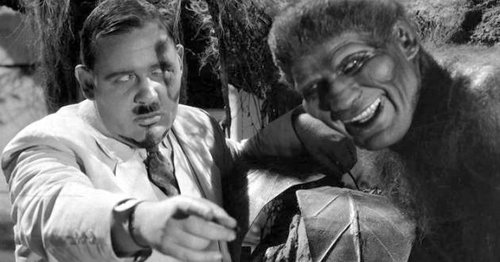
H.G. Wells 1896 novel The Island of Dr. Moreau has been adapted to film multiple times in the course of film history, but the first was a pre-Code film entitled Island of Lost Souls (1932). When I say “pre-Code” I mean it was a film released before the Motion Picture Production Code (better known as the “Hays Code”) took effect. The Code, which regulated film content in the decades before modern film ratings existed, was in place from 1934 to 1968 and made sure films didn’t contain such unsavory details as scantily clad women or other such content they deemed “inappropriate” for film. Being pre-Code then, Island of Lost Souls contains a number of elements that wouldn’t reappear in cinema for several decades (more on those details later).

The film stars Charles Laughton as the infamous Dr. Moreau, a brilliant doctor and scientist with a keen interest in the evolution of life (both plant and animal). Richard Arlen plays Edward Parker, a shipwrecked traveler who ends up stranded on Moreau’s island; the famed Bela Lugosi is the Sayer of the Law and Kathleen Burke is Lota, the mysterious “panther woman.”

23KEHR1-jumbo.jpg

From the moment Parker arrives on the island (even before when he’s rescued by a ship headed to Moreau’s island), it’s clear there’s something strange going on. Moreau’s manservant M’ling (Tetsu Komai) has strange features, including fur tipped ears under his hair. On the island itself, the “natives” possess a variety of animal-like features. Though they wear clothes and walk on two legs, they seem barely human, despite Moreau’s assurances that nothing is amiss. Laughton’s performance as Moreau is spine-chilling: he presents himself as an amiable scientist, a man of culture, but the truth is he sees himself as a god, a being capable of terrifying things. Actually I see a great similarity between Laughton’s Moreau and Colin Clive’s Frankenstein (which only came out the year before this film). In that earlier film, after the Monster comes to life, Frankenstein proclaims “Oh God, now I know what it’s like to BE God!!” Really the only difference between the two is Frankenstein worked with deceased bodies to craft his monster, while Moreau worked on living animals. And while the latter’s look slightly more human, they’re no less monstrous.

Island-Of-Lost-Souls.jpg

Parker eventually stumbles onto the horrifying truth: these “men” of the island were made this way by Moreau. He’d started by forcibly evolving plant life into strange and exotic forms, but that hadn’t been enough. He’d begun to experiment on animals in London, relocating to the island when a dog got loose and revealed his work too soon. Moreau is obsessed with evolving animals into human form and develops a set of laws to keep them in line. As pronounced by the Sayer of the Law, the law is as follows:

“Not to go on all fours, that is the Law. Are we not men?”

“Not to eat meat, that is the Law. Are we not men?”

“Not to spill blood, that is the Law. Are we not men?”

Originally, Parker was to be allowed to leave the next day, but after meeting Lota, a mysterious woman (the only one on the island and Moreau’s greatest creation), the doctor notes that Lota is responding to Parker the way a real woman would, so he conspires to keep Parker on the island to see if Lota is capable of doing everything a woman can, up to and including getting pregnant (never mind that Parker has a fiancee waiting for him). Lota is an interesting character: she looks completely human (and is presented as such by Moreau), but if you watch her carefully, you can see she still moves in an animal like manner in the way she holds her head and her body. They also used faint makeup around her eyes to give the impression of feline eyes.

912eHFzLEgL._SL1500_.jpg

However, there’s a flaw in Moreau’s work: Lota begins to revert to her original form as claws replace her fingernails. Presumably, the other beast men of the island are also reverting, however slowly, for it partially explains what happens at the end of the film.

In the climax, Parker’s fiancee has gone looking for him and gets another captain to bring her to the island. Moreau doesn’t want his “guests” to leave, so he orders one of the beast men to kill the ship captain before he can bring more of his crew onto the island. The beast man does as he is asked, but now there’s a problem, a big problem. By ordering the beast man to kill and thus “spill blood,” one of the laws has been broken. When the Sayer of the Law confronts him about this, the beast man replies “He TOLD me to spill blood.” Moreau did his experiments a little too well and doesn’t realize his beast men have an ability (however basic) to reason things out. Thus, led by the Sayer of the Law, the beast men reason that: Moreau told one of them to spill blood, which breaks the law, which means there is NO law. Also, the Sayer confirms that Moreau is a man like the dead ship’s captain…which means Moreau, their creator and tormentor, can die as well. When this realization is reached, all hell breaks loose. Having lost all authority, Moreau is dragged to the experimentation room and torn apart by his own instruments while the island goes up in flames. Parker, his fiancee and Moreau’s assistant Montgomery get away, but Lota sacrifices her life to stop a beast man from pursuing them.

Island-of-Lost-Souls (1).jpg

The film is a good example of early horror, the beast man makeups are particularly well done. Bela Lugosi is practically unrecognizable as the Sayer of the Law (in fact if I hadn’t known he was in this film I’d have never guessed it was him). If you’re a fan of H.G. Wells, I highly recommend this film to you.

If you’ve seen Island of Lost Souls what did you think of it? Let me know your thoughts in the comments below and have a great day!

See also:

Film/TV Reviews

Become a patron of the blog at: patreon.com/musicgamer460

Check out the YouTube channel (and consider hitting the subscribe button)

Don’t forget to like Film Music Central on Facebook 🙂

My thoughts on: Watership Down (1978)

MPW-54085.jpg

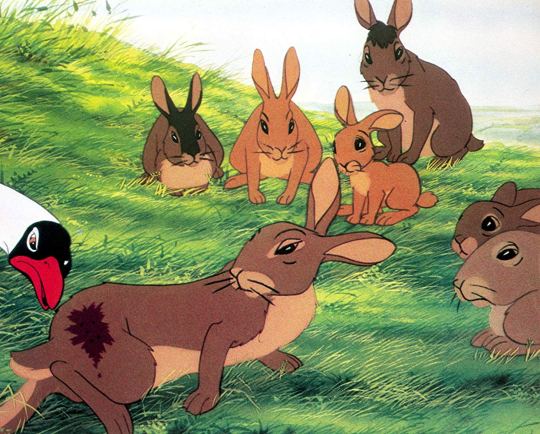
For a long time the only thing I knew about Watership Down was the book written by Richard Adams in 1972. I did my best to read my mom’s battered copy, but it was a very long story and I quickly lost interest. Fast forward a number of years and I was delighted to discover a movie version of the story existed! The film simplified the story considerably and it’s remained a favorite of mine for many years.

Watership Down, to put it simply, is a story about rabbits. Author Richard Adams created an entire rabbit language and culture and it’s so thoroughly put together that by the end of the story you kind of believe that these things about rabbits are really true, but I digress…in the story, we primarily follow a group of rabbits led by Hazel and his runt brother Fiver. The latter has this gift of seeing things before they happen, and one evening he has a vision that something terrible will happen to their warren. While most of the rabbits don’t believe a word Fiver says, Hazel believes his brother and convinces a small group to leave the warren and find a new home.

maxresdefault.jpg

Finding a new home (the titular Watership Down as it becomes known in the book) takes up most of the story and it’s far from easy. The rabbits travel across the countryside, evading dogs, busy roads, a weird warren of rabbits led by Cowslip and most importantly, the overcrowded warren of Efrafa led by General Woundwort. The film, though animated, does not shy away from revealing how graphically dangerous the journey is. For example, one female rabbit is snatched by a hawk; Bigwig is nearly strangled to death in bloody fashion by a snare; and in Efrafa, we see numerous examples of how rabbits are punished for breaking the rules (getting scratched up and having their ears torn up). Watership Down is one of those films that on the outside looks like an ordinary children’s film but it really deals with some extremely adult topics (lucky for me I didn’t see the film until I was in my teens).

The story isn’t ALL dark, some wonderful comic relief is provided by the seagull Kehaar (Zero Mostel in his final role). The rabbits befriend him when they discover him by their new warren with a damaged wing. He helps them rescue a lot of rabbits from Efrafa in the climax of the story before returning to his “big water” (the ocean).

MV5BNDA5MzA2MjIxOV5BMl5BanBnXkFtZTgwNDI2OTI4NDE@._V1_SY1000_CR0,0,1244,1000_AL_.jpg

Another character I must talk about is the fearsome General Woundwort. He’s the biggest rabbit you’ll ever see (in fact the book implies he’s more hare than rabbit, and yes there is a difference). Woundwort rules Efrafa with an iron paw and won’t allow any rabbits to leave, despite legitimate complaints that there is simply no room for kittens (baby rabbits) to be born. When the Watership Down rabbits successfully rescue a large group of Efrafans, Woundwort goes on the warpath and leads his rabbit soldiers to take ‘his’ rabbits back. The depths of Woundwort’s madness can be seen in his final moments: Hazel has contrived to lead a dog to the down, knowing that it will hunt down or chase away all the Efrafans (his people are safely underground in the burrows where the dog can’t get to them). As the Efrafans run for their lives, Woundwort appears and shouts “Come back you fools, come back and fight, dogs aren’t dangerous!” Any rabbit with common sense would know that dogs are very dangerous and should be avoided at all costs. Not only does Woundwort claim this ISN’T the case but his last act is to charge straight at the dog!

2016_WatershipDown_Press_290316-920x610.jpg

While I wouldn’t recommend showing this film to children under the age of 10, it is a good film to watch if you like stories about adventure with a touch of the supernatural thrown in for good measure. There’s a wonderful song, “Bright Eyes” sung by Art Garfunkel halfway through the story while Fiver searches for Hazel after an expedition to add female rabbits to the warren goes wrong. It’s a great interlude in the action.

All in all, Watership Down is a great film and one that everyone should see at least once. What did you think of Watership Down? Let me know your thoughts in the comments below and have a great day!

See also:

Animated Film Reviews

Become a patron of the blog at: patreon.com/musicgamer460

Check out the YouTube channel (and consider hitting the subscribe button)

Don’t forget to like Film Music Central on Facebook 🙂


My thoughts on: Won’t You Be My Neighbor? (2018)

neighborposter

I was beginning to think I’d never get to see this amazing documentary about the late Fred Rogers. First, I didn’t think it was showing anywhere close to where I lived. And then, when I did find it, things kept coming up to prevent me from going. But finally I was able to go and I’m so glad I did. Won’t You Be My Neighbor loosely tells the story of Fred Rogers and how he created Mister Roger’s Neighborhood (1968-2001).

While billed as a documentary, Won’t You Be My Neighbor? doesn’t feel like one in the traditional sense. There’s no overarching narrative where a voice intones “In 1968 this happened and in 1969 that happened…” Instead, the story is related via many clips of Fred Rogers and is supplemented by many people who worked with him and lived with him, including his widow and his two sons.

Many of these clips will be familiar if you’ve ever searched for Fred Rogers on YouTube. For instance, they show the clip of Mister Rogers speaking before Congress, a video that makes the rounds on social media about once a month. There’s also the special video he made after 9/11, that reappears on Facebook every once in a while. What’s really fascinating is in-between these clips are all the stories about the show: how it tackled pretty adult issues for a children’s show. For instance, in June of 1968 (shortly after RFK’s assassination) there was a show where Daniel Tiger asks Lady Aberlin (Betty Aberlin) “What does assassination mean?” This was interspersed with footage from the night of the assassination. Part of what made Mister Rogers so extraordinary was his understanding of what children really needed, as one person explains, he never forgot what it was like to be a child.

I told myself going in that I wouldn’t cry but…towards the end of the story, I couldn’t help myself. See, towards the end, the story shifts to the present day and there are hints about the current situation and what Fred might have said were he still here. And as they kept sharing his message of love and compassion and just helping others, the tears came and I could not stop them. In this messed up world, we need Mister Roger’s message, now more than ever.

If you need a break, however briefly, from the madness, go see Won’t You Be My Neighbor?. It’s only around 90 minutes, but it’s a really fascinating look back at an extraordinary man.

What did you think of this documentary? Let me know your thoughts in the comments below and have a great day!

See also:

Film/TV Reviews

Become a patron of the blog at: patreon.com/musicgamer460

Check out the YouTube channel (and consider hitting the subscribe button)

Don’t forget to like Film Music Central on Facebook 🙂

Dumbo “When I See an Elephant Fly” (1941)

In keeping with the unofficial theme this week of covering Disney’s non-politically correct moments, it wouldn’t do to forget the crows in Dumbo. But first, a quick recap as to how Dumbo meets these characters:

dumbo-99-640x400.png

Things have been going badly for our baby elephant: first his mother his locked away in chains; then a stunt goes awry and Dumbo is turned into a circus clown; third, and most recently, his well-meaning friend Timothy Q. Mouse accidentally gets him drunk and they both hallucinate pink elephants! (It’s amazing what they could put in a film back in 1941!!) The following morning, Dumbo and Timothy wake up….in a tree!! This is where Dumbo and his friend meet the crows.

Dumbo-disneyscreencaps.com-6001.jpg

Oh those crows…to be honest, I didn’t realize for a long time that the crows were a racist depiction. When you’re a little kid, you don’t think about those things, you just see some singing birds and that’s that. But as I got older and learned about the history of these things, I began to see these crows in a whole new light. And one thing I learned is that stereotypes can appear in disguise, for instance using black crows instead of, well, pardon the non-PC reference but using black crows instead of black humans. Another big clue? The leader of these crows is named…Jim Crow (no, seriously, check out the credits on Wikipedia!) A third clue? The birds all speak “jive,” a style of slang well-associated with African-American musicians during this time. They also sing jive too, and that’s where we get to “When I See An Elephant Fly.”


I seen a peanut stand, heard a rubber band
I seen a needle that winked its eye
But I be done seen ’bout ev’rything
When I see an elephant fly

(What d’you say, boy?) 
I said when I see an elephant fly
I seen a front porch swing, heard a diamond ring
I seen a polka-dot railroad tie
But I be done seen ’bout ev’rything
When I see an elephant fly

hqdefault (1).jpg

One thing that is fun about this song is most of the words have a double meaning; it helps if you put quotes around the words with changed meanings: so…a front porch that “swings” (dances); a diamond “ring” (like a bell), a railroad “tie” (necktie), and so on.

(I saw a clothes horse, he r’ar up and buck) 
(And they tell me that a man made a vegetable truck) 
(I didn’t see that, I only heard) 
(But just to be sociable, I’ll take your word)

(I heard a fireside chat, I saw a baseball bat) 
(And I just laughed till I thought I’d die) 
But I be done seen ’bout ev’rything
When I see an elephant fly

Well I be done seen ’bout ev’rything
When I see an elephant fly
(With the wind)

When I see an elephant fly

See, initially, the crows are inclined to tease Dumbo for his ears just like everyone else has throughout the story. But then Timothy sets them all straight by recounting (briefly) all the terrible things that have happened to Dumbo. The shamed crows decide to make it up to the pair by helping Dumbo to fly for real (it’s implied that Dumbo flew to the tree while he was drunk and just doesn’t remember doing so). To help in this process, the head crow presents a feather to Dumbo, calling it a “magic” feather that will help him fly (with a knowing wink to Timothy who catches on quick). Sure enough, with the feather clutched tight, Dumbo CAN fly!! As the crows say (as Dumbo and Timothy return to the circus), “those city boys are in for a big surprise!”

What do you think about “When I See An Elephant Fly”? Were the racist elements obvious or did it also take you a while to catch on? Let me know what you think in the comments below and have a great day!

See also:

Dumbo “Look Out For Mr. Stork” (1941)

Dumbo “Pink Elephants on Parade” (1941)

Dumbo “Song of the Roustabouts” (1941)

Disney Films & Soundtracks A-Z

Become a patron of the blog at: patreon.com/musicgamer460

Check out the YouTube channel (and consider hitting the subscribe button)

Don’t forget to like Film Music Central on Facebook 🙂

Dumbo “Song of the Roustabouts” (1941)

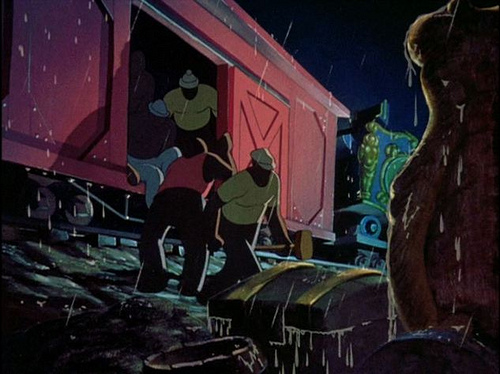
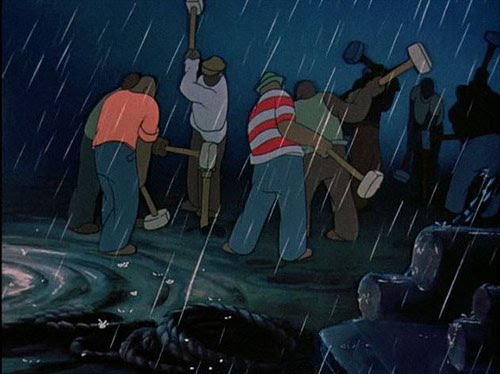
Forgive the pun but I decided it’s time to clear another elephant out of the room. Unfortunately, for everything good that Disney has contributed to film and animation, there are multiple examples of Disney portraying things they probably want to forget about. One example is the “Song of the Roustabouts” from Dumbo (1941). After baby Dumbo arrives on the train (via late delivery from the stork), the train pulls in to where the circus will be held the following day. As a storm breaks out, the elephants and other animals disembark to help set up the big top, accompanied by the roustabouts: these are unskilled laborers, often employed for hard labor.

7450688312_8f2f865864.jpg

It’s hard to tell given this scene takes place at night, but the roustabouts in Dumbo are all African-American, and given that this takes place in 1941 the lyrics are…interesting to say the very least. The song starts off with cries of “Hike! Ugh!” as the singers/workers establish a driving pattern to aid in driving in the tent stakes:

Hike! Ugh! Hike! Ugh! Hike! Ugh! Hike!
We work all day, we work all night
We never learned to read or write
We’re happy-hearted roustabouts

Hike! Ugh! Hike! Ugh! Hike! Ugh! Hike!
When other folks have gone to bed
We slave until we’re almost dead
We’re happy-hearted roustabouts

Just stop and look at these two verses alone: according to the roustabouts they can’t read or write, they work extremely hard and yet despite all this they’re “happy-hearted roustabouts”? It sounds ironic in 2018 but in 1941 they’re being quite serious.

Hike! Ugh! Hike! Ugh! Hike! Ugh! Hike!
We don’t know when we get our pay
And when we do, we throw our pay away
We get our pay when children say
With happy hearts, “It’s circus day today”

This is the verse that disturbs me the most, it implies that when the roustabouts DO get paid, they promptly blow their money on frivolous things (keeping in line with certain stereotypes about African-Americans being lazy, etc. Remember, this was 1941 and these things were considered acceptable then).

hqdefault.jpg

Muscles achin’
Back near breaking
Eggs and bacon what we need (Yes, sir!)
Boss man houndin’
Keep on poundin’
For your bed and feed
There ain’t no let up
Must get set up
Pull that canvas! Drive that stake!
Want to doze off
Get them clothes off
But must keep awake

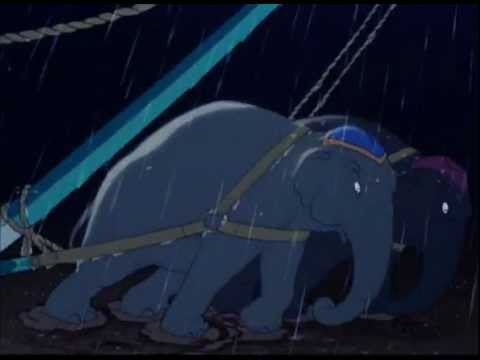
During this long section, the other animals are shown helping in the set up, mostly the elephants moving stakes and poles, but the camels are helping too. It’s funny, when I watched this movie as a young kid, I was convinced that the circus animals really did help in this way. Even Dumbo is seen doing his part alongside his mother.

Hep! Heave! Hep! Heave! Hep! Heave!
Hep! Heave! Hep!

Swing that sledge! Sing that song!
Work and laugh the whole night long
You happy-hearted roustabouts!
Pullin’, poundin’, tryin’, groundin’
Big top roundin’ into shape
Keep on working!
Stop that shirking!
Grab that rope, you hairy ape!
Poundin’! poundin’! poundin’! poundin’!
Oh

dumbo5.jpg

The storm that started when the train arrived has now become a full-on thunderstorm (poor Dumbo hides in fright from the lightning). And the song does throw in one last unbelievable line with “Grab that rope, you hairy ape!” (I really won’t explain that one in further detail since it really speaks for itself). At last, despite the driving rain and winds, the big top is raised and come morning the circus is ready to begin!

It might seem strange to focus on these songs (especially given the issues going on in the country right now), but I can’t let these songs slip away unnoticed. Not writing about them is tantamount to saying they never happened, but they did. So on that note, I hope you found “Song of the Roustabouts” interesting. Let me know what you think of this song in the comments below and have a great day!

See also:

Dumbo “Look Out For Mr. Stork” (1941)

Dumbo “Pink Elephants on Parade” (1941)

Dumbo “When I See an Elephant Fly” (1941)

Disney Films & Soundtracks A-Z

Become a patron of the blog at: patreon.com/musicgamer460

Check out the YouTube channel (and consider hitting the subscribe button)

Don’t forget to like Film Music Central on Facebook 🙂

Peter Pan “What Made the Red Man Red?” (1953)

Before I get started with talking about this song, let’s get the elephant out of the room shall we? Yes, “What Made the Red Man red?” is a highly racist, non-politically correct song that employs multiple Native American stereotypes. That being said, remember that this was 1953 and the world was a very different place from what it is now.

(also, I’m going to refer to the tribe as ‘Indians’ because that’s how they’re described in the film, I know Native American is the correct word to use)

At the start of this song, Wendy, John and Michael are celebrating the safe return of Tiger Lily with Peter Pan, the Lost Boys and the Indian tribe. In gratitude, the Chief dubs Peter “Chief Flying Eagle” and everyone celebrates. As the party gets going, the Lost Boys have three questions:

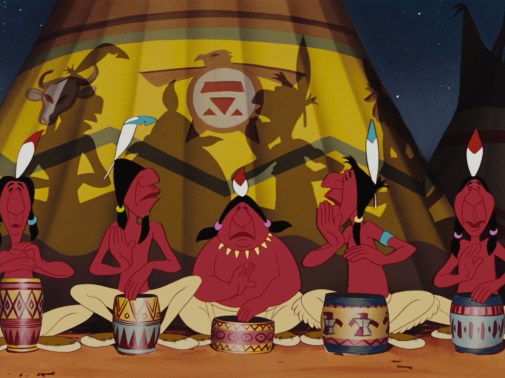
“What made the red man red?” (it should be noted that in this film the Indians, except for Tiger Lily, are almost literally red-skinned, based on the derogatory slang once used to describe them).

“When did he first say ‘ugh’?” (another stereotype, this one contends that Indians say ‘ugh’ in response to a lot of things)

“Why does he ask you ‘how’?” (another stereotype and something of a generalization: there ARE some tribes that use this as a greeting, but the stereotype makes it appear that ALL Indians use this as a greeting, which isn’t true).

Peterpan-disneyscreencaps-5563.jpg

The Chief and his chorus of braves set out to answer these questions, accompanied by the drums:

Why does he ask you, “How?”
Once the Injun didn’t know
All the things that he know now
But the Injun, he sure learn a lot
And it’s all from asking, “How?”
Hana Mana Ganda
Hana Mana Ganda
We translate for you
Hana means what mana means
And ganda means that, too

This scene is also notable because it shows several characters smoking on a peace pipe. While Wendy abstains (and prevents Michael from using it too), John takes a pretty good puff and turns green as a result (in kind of the same way that Pinocchio did over a decade prior).

0fac2d35bc7083f9b0f0fc30838c67fe

In between the verses, everyone starts dancing, including Wendy, though she doesn’t get to enjoy herself for long. Wendy runs headlong into an Indian matriarch who proclaims “Squaw (Wendy) no dance, squaw get firewood!” Wendy is miffed that she can’t have fun like the other boys (and Tiger Lily, more on that in a moment) but she goes off to get the firewood.

When did he first say, “Ugh!”
In the Injun book it say
When first brave married squaw
He gave out with heap big ugh
When he saw his Mother-in-Law

Meanwhile, Wendy is returning with a load of firewood (still trying to have a good time) when she gets a look at Tiger Lily and Peter Pan:

large

What made the red man red?

Let’s go back a million years
To the very first Injun prince
He kissed a maid and start to blush
And we’ve all been blushin’ since

You’ve got it right from the headman
The real true story of the red man
No matter what’s been written or said
Now you know why the red man’s red!

The scene implies that Tiger Lily gave Peter a great big kiss which makes Peter blush with happiness. Wendy is furious that someone else is kissing ‘her’ Peter, and when the matriarch demands she get more firewood, Wendy retorts “Squaw NO getting firewood, squaw go home!” And she marches off to the Lost Boys home, very upset. I always felt bad for Wendy, everyone else got to have fun but her.

Political incorrectness aside, this song marks the turning point in the story for Wendy. Up until this point, she’d been having fun with Peter in Neverland (although the visit to the mermaids didn’t exactly go as planned), but now she’s beginning to realize that she doesn’t belong here, it’s time to go home (as in back to London). Also, no one yet knows that Captain Hook has taken Tinkerbell captive, as he is determined to find the Lost Boys hideout and eliminate his nemesis once and for all!

What do you think of this song? Have you seen this song before? Let me know what you think of it in the comments below, and have a great day!

See also:

Disney Films & Soundtracks A-Z

Peter Pan “You Can Fly!” (1953)

Peter Pan “Following the Leader” (1953)

Peter Pan “The Elegant Captain Hook” (1953)

My Thoughts on: Peter Pan (1953)

Become a patron of the blog at: patreon.com/musicgamer460

Check out the YouTube channel (and consider hitting the subscribe button)

Don’t forget to like Film Music Central on Facebook 🙂

Remembering James Horner: Troy (2004)

trojan-horse troy the movie

Troy is a 2004 epic film that is a (greatly abbreviated) adaptation of the Illiad (which tells the story of the Trojan War). The film features a star-studded cast:

  • Brad Pitt: Achilles
  • Sean Bean: Odysseus
  • Brian Cox: Agamemnon
  • Peter O’Toole: King Priam
  • Eric Bana: Hector
  • Orlando Bloom: Paris
  • Diane Kruger: Helen

While not perfect, Troy is a good film with a remarkable score by James Horner. The music is even more remarkable when you consider that Horner put it together in the space of four weeks after Gabriel Yared’s score for the film was rejected.

For the score, Horner employed singer Tanja Carovska (who had also provided vocals for Yared’s rejected score) as well as using Eastern Mediterranean music and brass instruments to create a feeling of ancient Greece.

Troy Movie

Horner created several motifs throughout the score, a few of which I’d like to point out:

-The Greeks: The theme for the Greek army really emerges in full when they approach Troy in their thousand ships. It’s distinguished by a driving trumpet theme, highlighting the relentlessness of the Greek soldiers led by the egomaniacal Agamemnon. Most tellingly, it also re-emerges (briefly) just before the Trojan Horse is revealed onscreen for the first time, a musical hint that there are Greeks hidden inside.

The Greeks arrive at Troy

-Achilles: The theme for the legendary hero is also based on brass instruments, but it has a nobler tone than the theme assigned to the Greeks. Most notable appearance would have to be when Achilles storms the beach leading the Myrmidons. There’s also a reprise when Achilles heads off to find Briseis during the sacking of Troy.

nNy0BNw.jpg

Achilles on the beach (theme starts when Achilles jumps off the ship)

-Achilles and Briseis: The love motif for Achilles and Briseis (a Trojan princess turned priestess turned captive) forms the basis of the end credits song “Remember” as performed by Josh Groban. No matter what Achilles claims, I think throughout the story he remembers what his mother said, that if he goes to Troy he will never come home. So his love for Briseis is tempered by this knowledge, that’s why the theme is relatively sad for a love theme. A good example of hearing this theme is at the end right before Achilles dies and he tells Briseis to leave with Paris.

Troy “The Trojan Horse”

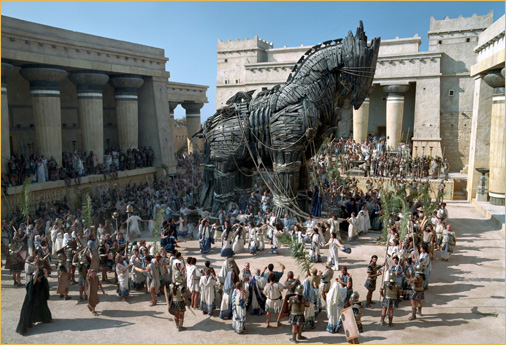
-The Trojan Horse: I’ve covered the music for the Trojan Horse in depth before, but I have to talk about it again because it really is my favorite musical moment in the film. Even if you’re not familiar with the story of the Trojan Horse, the sheer ominousness of the music tells you that there’s something fishy with this horse. But of course no one listens to Paris’ suggestion to just burn the horse where it stands (the one time he makes a good decision in the entire film) and the horse is brought into the city. The music is triumphant and tragic all at once, because the Trojans think they’ve won but in fact they’re doomed.

Horner’s score for Troy remains one of my favorites and I highly recommend it to any fans of James Horner’s music. It’s hard to believe he’s been gone for three years already, but as long as we keep listening to his music, he’ll never really be forgotten.

This is my contribution to the Remembering James Horner Blogathon, hope you enjoy it.

See also:

3rd Annual Remembering James Horner Blogathon: Day 1

You can become a patron of the blog at patreon.com/musicgamer460

Check out the YouTube channel (and consider hitting the subscribe button)

Don’t forget to like Film Music Central on Facebook 🙂