Pocahontas “Savages, Part II” (1995)

At the conclusion of “Savages, Part I”, the English settlers and the warriors led by Powhatan were preparing for battle (with the latter planning to execute John Smith first thing in the morning). Meanwhile, Pocahontas has fled to Grandmother Willow, upset and depressed that everything is falling apart and the man she’s so recently fallen in love with is going to be executed and there’s nothing she can do to stop it.

Pocahontas “Savages, Part II” (1995)

Grandmother Willow tries to give some advice, reminding Pocahontas of her dream, but she isn’t in the mood to hear it. Meeko, however, is inspired to dig inside his hole in the tree for something.

This “something” turns out to be John Smith’s compass, which contains a large arrow shaped needle inside (Meeko had swiped it during an earlier meeting and Smith had let the raccoon keep it). Pocahontas watches the compass and realizes that as she turns it in her hands, the arrow/needle spins, just like the arrow in her dream!!

maxresdefault

From the moment Pocahontas picked the compass up, the music has begun to pick up in intensity (clearly signalling that something big is about to happen). When she makes the connection between the compass needle and her dream, it picks up a little more. At the peak, there is a short, instrumental refrain of “Listen With Your Heart” as several things happen at once: the sun rises (it’s time for the execution) and the compass needle comes to a stop pointing directly east. The meaning is clear: Pocahontas needs to stop the execution.
Savages.png

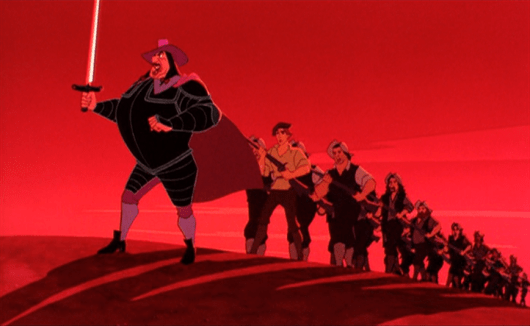
With this decision made, the song resumes with an abrupt cut to Ratcliffe literally walking out of the sunrise, cutting a villainous figure in his black armor. At the same time, Powhatan and his warriors begin the march to the execution site (with Smith in tow) while, in a THIRD musical thread, Pocahontas begins her run to stop an all-out war!

maxresdefault-1

And, according to the song, Pocahontas truthfully doesn’t know if she can stop this war from happening, but with the power of the spirits (which she invokes along the way), she’s certainly going to try. This semi-hopeful verse is sharply contrasted with the two warring sides who are basically singing the same words (so I’m copying the verse in full):

(Them:)This will be the day/This will be the morning/We will see them dying in the dust

(Pocahontas): I don’t know what I can do/still I know I have to try

(Them):Now we make them pay!

(Pocahontas): Eagle help my feet fly!/(Them): Now without a warning

(Pocahontas): Mountain help my heart be great/(Them): Now we leave ’em blood and bone and dust

(Pocahontas):Spirits of the Earth and Sky/(Them): It’s them, or us

(Pocahontas): Please don’t let it be too late!!/Them: They’re just a bunch of filthy, stinking…

(Them): Savages, savages/demons, devils (kill them!)/savages, savages, what are we waiting for? Destroy their evil race, until there’s no a trace left!

(Pocahontas): How loud are the drums of war!!/Them: Now we see what comes, of trying to be chums/ Pocahontas: Is this the death of all I love, carried in the drumming of…

(All): WAR!!!

Towards the end, all three groups converge at a cliff where the tribe has assembled to execute Smith as revenge for Kocuom’s death. While the approaching settlers watch in horror, Powhatan prepares to crush Smith’s skull with a war hammer (a club with a large stone set in it). At the last moment, Pocahontas darts forward and throws herself over Smith before the hammer can fall.

Saved!!! For now anyway. Pocahontas has an ultimatum: if Powhatan wants to kill John Smith, he has to kill her too, and also she loves him (to the surprise of her father). All of this, Pocahontas says, is the result of walking a path of anger. She, meanwhile, will choose love.

Moved by what his daughter has said, and seeing the slaughter that will come if they continue, Powhatan swears that if there will be any more killing “it will not start with me” and he orders Smith to be released. Everyone begins to lower their weapons, and war seems to have been averted…which is great…right?

Ratcliffe doesn’t think so. This was his big chance to take the Indians out and now the battle isn’t happening at all!. He tries to take advantage by shouting for his men to fire, but the settlers aren’t having it. The whole point of attacking was to rescue Smith, but the tribe has let him go so clearly they don’t want to fight (and therefore neither should they). Seeing his control slip away, Ratcliffe decides to force the issue, grabbing a musket and taking aim at Powhatan. Smith sees this and shoves the chief out of the way just as Ratcliffe fires, taking the bullet instead. Instead of sparking a new conflict, this backfires horribly and Ratcliffe finds him at the receiving end of the settlers’ wrath (a great comeuppance for Ratcliffe by the way, since he ends up being hog-tied by the end).

So on the one hand, the day is saved, but on the other, John is badly injured. This is one Disney film that won’t have the typical ending. How do I mean? Well, you’ll have to check out the finale to find out 🙂

It nearly goes without saying that “Savages, Parts I and II” are one of my favorite Disney songs and I hope you enjoyed reading about it and listening to it.

You can become a patron of the blog at: patreon.com/musicgamer460

Check out the YouTube channel (and consider hitting the subscribe button)

For more Pocahontas, see also:

Pocahontas “The Virginia Company” (1995)

Pocahontas “Steady as the Beating Drum” (1995)

Pocahontas “Just Around the Riverbend” (1995)

Pocahontas “Listen With Your Heart” (1995)

Pocahontas “Mine, Mine, Mine!” (1995)

Pocahontas “Savages, Part I” (1995)

Don’t forget to like Film Music Central on Facebook 🙂

Pocahontas “Savages, Part I” (1995)

I wanted to save this song for last, but I couldn’t hold out any longer!!!

pocahontas

With practically every Disney film ever made, there comes a point where events spiral out of control and everything is on the verge of disaster!! “Savages, Part I” begins at such a moment: Kocuom is dead at the hands of Thomas, but only Pocahontas and John Smith know that. The warriors who capture Smith assume that, as the only white man present, that HE fired the shot, and even if Pocahontas told them the truth, they wouldn’t believe her. Chief Powhatan is beyond disappointed in his daughter and he also blames her for Kocuom’s death (“because of YOUR foolishness, Kocuom is dead!”)

Pocahontas “Savages Part I” (1995)

But the turmoil in the village is nothing compared to what’s brewing in the English camp. Thomas has gone racing back to report Smith’s capture, rousing everyone in the process. Ratcliffe is secretly delighted by this turn of events; he’s been itching for any excuse for an all out attack on the “savages” and this provides the perfect opportunity.

tumblr_mdi82dv7991ry7vf9

“Savages” begins with Ratcliffe stirring the settlers into a frenzy, reminding them that these “savages” are no good, they deserve to die because they’re different, etc.For example:

What can you expect/from filthy little heathens/here’s what you get when races are diverse!

Their skin’s a hellish red/they’re only good when dead/they’re vermin as I’ve said and worse!!

Actually, the soundtrack version of the song is much nastier, the opening line goes: …from filthy little heathens/their whole disgusting race is like a curse! (I think they realized when they developed this song, that they were going a step too far and they adjusted the line for the home video release of the film.)

Theses opening verses are so openly racist that in the years since its release, this song in particular has gotten a lot of flak, with critics saying the song’s sentiments are completely inappropriate.While is is true that “Savages” expresses racist sentiments, that’s also the point of the entire song!! This song is fully exposing Ratcliffe as the evil, racist villain he’s always been, and the settlers are fully caught up in the wake of his ranting (except for Thomas, who has his own doubts).

They’re savages!
Savages! Barely even human!

Savages! Savages! Drive them from our shore!
They’re not like you and me, which means they must be evil
We must sound the drums of war!

They’re savages!
Savages!
Dirty shrieking devils!

Now we sound the drums of war!

2

With the English settlers ramped up to go to war, the song switches to Powhatan’s village, where the villagers are making preparations of their own. While the English consider the Indians to be “savages”, the natives consider the white men to be “demons” who must be wiped out before anyone else can die.

This is what we feared/the pale-face is a demon/the only thing they feel at all is greed.

Beneath that milky hide/there’s emptiness inside/I wonder if they even bleed??

They’re savages! Savages!

Barely even human! Savages! Savages!

Killers at the core…

They’re different from us,
which means they can’t be trusted…

We must sound the drums of war!

They’re savages!
Savages!
First we deal with this one
Then we sound the drums of war!

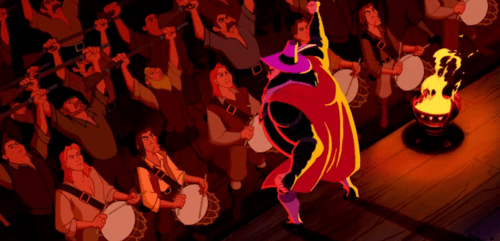
John Smith can only watch as the war preparations continue, with the Indians planning to execute him before the battle. The camera cuts back and forth to show how alike the two sides really are: both are arming for war, both are really angry and both are beating “the drums of war” (no matter how different they look, a drum is a drum.)

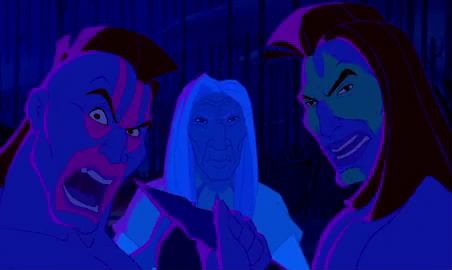
The truth is, both sides are blinded by hatred. Neither can see that they are equally human because one looks different from the other. It’s interesting how, in the song, each side is color-coded and made to look increasingly not-human (the English are colored orange/crimson and the Indians are colored indigo with war paint added on top of it).

Things are definitely out of control, and if the two sides meet, it’s going to be bad (mostly for the Indians, because the English settlers have a lot of muskets and cannons and arrows and spears will have practically zero effect on that kind of firepower.) What’s going to happen? Will John Smith die at sunrise? We’ll find out in “Savages, Part II” !!!!

You can become a patron of the blog at: patreon.com/musicgamer460

Check out the YouTube channel (and consider hitting the subscribe button)

For more Pocahontas, see also:

Pocahontas “The Virginia Company” (1995)

Pocahontas “Steady as the Beating Drum” (1995)

Pocahontas “Just Around the Riverbend” (1995)

Pocahontas “Listen With Your Heart” (1995)

Pocahontas “Mine, Mine, Mine!” (1995)

Pocahontas “Savages, Part II” (1995)

Don’t forget to like Film Music Central on Facebook 🙂

An Interview with Adam Blau

(From Adam’s official bio): Adam is a rising star in the comedy world, with many directors entrusting his musical talents to bolster their projects, often working closely with writers and performers to lend a strong and humorous musical sensibility to their projects. His music has uplifted projects by some of the world’s most popular comedians, including truTV’s Billy on the Street, starring Billy Eichner; NBC’s Mulaney, starring John Mulaney; several Funny or Die shorts; and IFC’s upcoming Brockmire starring Hank Azaria. In addition to composing score, Adam regularly collaborates with the showrunners and writers of projects to create and develop a variety of songs for special episodes – songs ranging from “serious” to intentionally over-the-top satires.

Adam has also scored music and written songs for celebrated films like Warner Bros.’ License to Wed, starring Robin Williams, Mandy Moore and John Krasinski; SXSW favorite The Overbrook Brothers; Phoebe in Wonderland, starring Elle Fanning; and Indian Pictures’ Fuzz Track City. Known for his expertise in percussion, Adam has spearheaded specialty drumline sessions for high profile projects, including Christophe Beck’s We Are Marshall and Mark Isham’s The Express, as well as arranging and producing world percussion for Joel McNeely’s scores to Disney’s popular Tinker Bell films.

unnamed

What got you interested in composing for film and television?
Well, I had been a musician to some extent for most of my life…I started playing when I was very young, and I’ve always been involved with music in some capacity. And while I was living in New York I was pretty active in theater, music directing and accompanying, that kind of thing. As part of that, I had some friends who were writing comedy shows and they needed some interstitial music between scenes, or maybe they needed a song, and so I would help them out and it was really fun. And as an extension of that I wrote some songs for a friends show in Los Angeles, and while I was visiting LA I met a couple of people who needed some extra music for a film they were working on, they’d had a composer drop out of the production and so from New York I experimented with some music for this film and I ended up really enjoying it. In fact, I ended up being “bitten by the bug” and picked everything up and moved from New York to LA and it seems to have worked out pretty well so far.
Are you inspired by any particular composer?
In general sure, I have those (soundtracks) I like to listen to independent of the film, but being so involved in multiple facets of music production, it’s rare these days for me to be listening to any current film scores while I’m composing, because I do so much of that as part of my actual work. But Carter Burwell’s score for Adaptation is a big one, it really got me in tune with what a film score could be/should be…in terms of what I’m writing, so much of the scoring process is dependent on the material and who I’m working with. There is an extent to which it’s a bit of a service industry because I’m writing music for what is essentially someone else’s vision. I think a huge part of the job is finding out what the vision is for the director and seeing how the music can best manifest that idea for them. Now I’m going to put my on thumbprint on it one way or the other, but especially in writing for television comedy, it’s writing in a particular style, usually to form the “punchline.” So I do listen to works by several composers, but in terms of my current writing, they don’t really influence/inspire me in that sort of way, because it’s dependent on what the director needs.

What’s it like working on You’re The Worst ? How is the music composed for each episode: do you get to see any footage or is everything done in advance?
It’s a blast, the show itself…especially in seasons 2 and 3, goes in a very interesting direction. It’s a fairly racy comedy, but they really start talking about some more significant issues. The characters are very well conceived and written and that’s a testament to the show’s creator. The characters can be assholes at times, but over time you can understand why they might be that way. As that goes on, the show shifts tonally, there’s a spectrum of comedy to emotional stuff.
It’s a really great thing, as a composer, to be able to work in the comedic realm but also to work with the more serious, dramatic stuff, or spoofing a genre, like the ‘Sunday Funday’ episodes. And the other part that is really rewarding, is writing actual songs for the characters. Gretchen is a music publicist and she represents this one group, and Stephen (the show’s creator) and I co-wrote all of the songs that they do; and in the PTSD episode we wrote a song that serves as a “relief” for this one character. It’s an original song that we wrote together, and the song is currently being sold as a benefit for the Wounded Warriors organization. The variety is thrilling for me.
How long do you have to put a particular score together? Is there less time for television?
The schedule, for television, is just ridiculous, there is a very quick turn-around between when the picture is locked, like when they’re done editing and when the episode is released, so we have maybe a week, maybe…to get the music finished. Now, I ask for scripts very early in the process, just so I can look through and see if there are song moments or other moments to keep an eye out for. If there’s music within the show, I write it in advance and then go to the set, which is really rare, but I go and teach it to them. I prepare as much as I can in advance though, but by the time it starts being cut, and by the time the show gets to the producers, there is already temporary music in place, either composed by me or someone else, to prompt discussion about what should be in place there. And by the time we come to a spotting session where we meet to discuss how the episode should be scored, either I’ve already written a couple of pieces OR we will discuss if something is working or if we want to go in a different direction. It’s a quick process, sometimes it feels too quick but other times that quick turn-around is a blessing.

How would you describe your compositional style? More orchestral or electronic/synthetic?

It’s totally a case by case basis, I’ve written for full orchestra, like with License to Wed, which had a jazz, swingy feel for the most part. So we wrote it for a huge orchestra. And the other end of the spectrum then is the electronic stuff that I do for You’re the Worst, it is totally case by case. And with percussion stuff, my first stint with that was for a film called We Are Marshall, and there was also Yours, Mine and Ours as well.

The genre is really dictated by the material and also the budget. I would prefer to work with a live orchestra, but with most tv it is simply not in the cards (except for maybe Game of Thrones which has the budget to do it.)
What’s your favorite genre to work with? Why?

I am happy working in any genre, but I like working in comedies because it allows for working in a lot of ways, I admit I am a huge comedy junkie and I love sitcoms. But these days, if you’re doing comedy, you get to write in a number of genres and run the gamut, because writing comedy can also mean writing in a serious moment or a song, so you can try a lot of different things. One of my strengths has been being able to wear a number of different hats, learning a new genre or figuring out the core elements of a particular style and working in that new style, it’s a fun challenge trying to do that. I also enjoy the collaborative process with comedy as well.
Does one score/project stand out as your favorite?

It’s truly hard to pick a single project that I would call my favorite. I would have a hard time sitting here working day after day on shows that I don’t like so much, so I try to find something enjoyable about the project itself or the music for that project, or the people I work with, or otherwise it’s a long hard slog. But there are some standouts for me, You’re The Worst is definitely a highlight. And the people are just so spectacular to work with as well.

Me: Well thank you so much for meeting with me to talk about You’re The Worst and your work as a composer

Adam: Thank you!

You can follow Adam Blau on Twitter @adamblau .

Don’t forget to like Film Music Central on Facebook 🙂

James Newton Howard talks Atlantis: The Lost Empire (2001)

I can’t say it often enough: Atlantis: The Lost Empire is one of the most underrated films that Disney has ever made. Seriously, the animation is beautiful, the story is great, and the MUSIC is one of the best parts! (See Atlantis: The Lost Empire “The Crystal Chamber” for more of my thoughts on this score).

If you haven’t seen the film, the story follows a young cartographer and linguist named Milo Thatch (Michael J. Fox), who is determined to prove the lost city of Atlantis (whose destruction we witness in the beginning of the film) exists and thereby clear his grandfather’s name (his late grandfather was a famous explorer who lost his reputation when he insisted that Atlantis was real). According to Thatch’s research, the key to discovering the location of the sunken city can be found in a mysterious artifact known as The Shepherd’s Journal. But as it turns out, his grandfather had already found the Journal in a previous expedition and left it to his friend, eccentric millionaire Preston B. Whitmore, to be held in his possession until Milo was “ready” to find Atlantis himself. Whitmore wants to help Milo because of a bet he made with his grandfather over whether or not Atlantis existed. Since Milo’s grandfather found the Journal, Whitmore agreed to finance any future expedition with the best materials and the best crew. To that end, Milo is introduced to mostly the same crew that helped Milo’s grandfather find the Journal in Iceland.

The most notable members include:

  • Tiberius Roarke: Commander and secretly a snake in the grass who wants to rob Atlantis of its treasures for huge profits
  • Helga Sinclair: Roarke’s lieutenant (and possibly some-time lover?) who is also in this for the profits (though she does express brief reservations when they discover Atlantis is still inhabited)
  • Vinny Santorini: a demolitions expert obsessed with making things go BOOM! Previously worked in a flower shop (though he’d prefer you didn’t know that)
  • Gaeton Moliere (better known as “Mole”), a geologist with an unhealthy dirt obsession. A line in the direct-to-video sequel implies he was raised by naked mole rats.
  • Dr. Joshua Strongbear: a doctor of African-American/Native American descent. He talks a lot but has a really good heart when push comes to shove.
  • Audrey Ramirez: A teenage mechanic from Puerto Rico and the youngest member on the expedition. If it has an engine, she can make it run. Her sister is a famous boxer.
  • “Cookie”: The expedition cook (though that term is used very loosely) who believes in HIS basic food groups: “beans, bacon, whiskey and lard.”

After numerous hurdles (including having their main ship blown to pieces by a mechanical Leviathan), the surviving crew arrive at Atlantis and are stunned to discover a living city inhabited by hundreds (if not more) of people. The surviving Atlanteans are still ruled by King Kashekim Nedakh (who was king when Atlantis sank under the sea) and his only daughter Kidagakash or “Kida” is heir to the throne. Roarke successfully bargains for the crew to stay the night in the city and Milo goes off to explore with Kida, who is fascinated to meet someone from the surface. Predictably, things go sour when it turns out that Roarke and the rest of the crew are actually mercenaries that have a taste for pillaging ancient treasures for profit. In this case, they’re after the semi-mystical “Heart of Atlantis,” the crystal that is currently keeping the city and its inhabitants alive. Kida is absorbed into the Crystal after Roarke deduces its location and Milo gives chase to bring her back before the entire city dies. After a lengthy battle (in which Roarke, Helga and the rest of the crew who didn’t side with Milo are killed), Milo decides to stay in Atlantis with Kida while Audrey, Cookie, and the rest of our heroes return to the surface (with an Atlantean ship filled to the brim with treasure as their reward for doing the right thing).

This film was my first exposure to James Newton Howard (The Hunger Games series, Maleficent), and I will defend this score forever. That being said, I was beyond happy when I stumbled across this interview on YouTube where Howard talks about his work on this film. And as Howard puts it, there are really two films going on in this story: there’s the action/adventure of finding Atlantis, and once our hero Milo arrives, a totally new story begins (with a new score to match). To help distinguish Atlantis musically, Howard used a variety of Balinese instruments (which favor bells and gongs) to create a very unique sound.

I hope you enjoy listening to this interview with James Newton Howard! If you also enjoy this film, let me know what you like about it 🙂

You can become a patron of the blog at patreon.com/musicgamer460

Check out the YouTube channel (and consider hitting the subscribe button)

See also:

James Newton Howard talks Dinosaur (2000)

James Newton Howard talks Signs (2002)

James Newton Howard talks The Village (2004)

James Newton Howard scoring King Kong (2005)

Film Composer Interviews A-H

Film Composer Interviews K-Z

Don’t forget to like Film Music Central on Facebook 🙂
John Debney talks The Jungle Book (2016)

It’s no secret that I have mixed feelings about the live-action Disney remakes. It just so happens that The Jungle Book (2016) is one I dislike, only because I have very strong feelings for the animated original. My own feelings for the work aside, I have heard that the score was well done, not surprising since it was composed by John Debney (his musical magnum opus remains the score for The Passion of the Christ (2004)).

In this short interview, Debney talks about how he came to work on the score for the film, what kind of vision the director had and how Mowgli needed a theme of his own. But that’s not all I discovered. I also found a B-roll of footage from the scoring sessions, and I’m pleased to share it with you here. Please note around 1:58-2:00 the giant score that the composer is flipping through. You can also see a beat counter next to his head at the beginning of the video.

The Jungle Book scoring session B-Roll (2016)

I love watching scoring sessions, it’s something I really hope to witness firsthand someday in the future. I hope you enjoy this interview and the footage from the soundstage. I have a lot more interviews queued up and I can’t wait to finally get them published!

See also:

Film Composer Interviews A-H

Film Composer Interviews K-Z

John Debney (and Tom Morello) talk Iron Man 2 (2010)

John Debney talks The Scorpion King (2002)

John Debney scoring Predators (2010)

John Debney talks The Passion of the Christ (2004)

Become a Patron of the blog at patreon.com/musicgamer460

Check out the YouTube channel (and consider hitting the subscribe button)

Don’t forget to like Film Music Central on Facebook 🙂
R.I.P. Carrie Fisher (1956-2016)

carrie_fisher_2013

She’s gone. Our Princess Leia, heroine extraordinaire of the Star Wars Universe, has passed away several days after suffering a heart attack en route from London to LAX. And she was only 60!!

I’d actually thought I was numb to the loss that this year has inflicted. After all, think of everyone who has been taken: David Bowie, Alan Rickman, George Michael, Anton Yelchin, Gene Wilder, Florence Henderson, John Glenn, Zsa Zsa Gabor, the list stretches on and on. There’s been so much death and there’s only so much of it I can process before my mind retreats for the sake of its own sanity. But then THIS happened and it hurts like a knife plunged straight into my heart.

princess-leia-1

I actually thought she was getting better, reports had said she was stable (which is good) and I was looking forward to hearing word of her recovery. And then, not even ten minutes ago, I saw the news…that she was gone.

I’m probably going to spend the next few days raging at the injustice of it all, not to mention binging on the classic Star Wars films.

fy4wlzf

The other role I loved her in: Jake’s jilted bride in The Blues Brothers

As raw as this wound is, i can’t help but wonder what’s going to happen with Episode IX (filming having wrapped for Episode VIII). Before Rogue One, I presume they would’ve tastefully either explained her absence or killed the character offscreen (or something of the sort), but after Rogue One….I hope and pray that they don’t do what they did with Tarkin. I don’t care if the actress gave permission for her image to be used for such a thing, if they attempt to “resurrect” her for Episode IX, I won’t forgive them, ever.

I’m hurt, I’m angry, and most of all I’m upset that yet another amazing, talented person was taken away from us by a cruel year. Rest in peace Carrie Fisher, to me you’ll always be Princess Leia.

Rogue One: A Star Wars Story (2016), My Thoughts!!

Warning!!! This review spoils EVERYTHING about Rogue One, if you haven’t seen the film and DON’T want to know, stop reading NOW!!!

Still here? Okay, continue!! (But remember, you were warned!!)

Oh my gosh, oh my gosh, OH.MY.GOSH!!! Thursday night, 9:45 p.m., the long wait finally ended and I saw Rogue One: A Star Wars Story, the first stand-alone Star Wars film in the Anthology series. And oh boy did it deliver!! The film does have one flaw, but I’ll get to that after a bit, let’s start with one of the best parts of the film…

DARTH VADER IS BACK!!!

Let’s all be honest, I think most of us who have gone to see this film did it because Vader was showing up (I know that certainly helped to sway my decision). This is the first time Vader (in all his armored glory) has graced the cinematic screen since Revenge of the Sith in 2005 (though granted that was a very short appearance). In Rogue One, Vader is at the height of his power and general nastiness. Believe it or not, he’s in the film for not quite ten minutes (split into two appearances): his first scene takes place on the lava planet Mustafar where he’s since built an imposing castle-fortress to reside in when he’s not on some mission for the Emperor. I THOUGHT I recognized the planet, but I wasn’t sure until a YouTube review from @StupendousWave (my favorite source for Star Wars news) confirmed my suspicion. Not only do we see this amazing fortress, we also see Vader, briefly, as we’ve never seen him before: completely armorless in a bacta tank. It’s only a few glimpses, really, but it was more than enough to show how little remains of Vader’s human body before he re-armors in order to greet Director Krennic properly.

Speaking of Krennic, he’s the main antagonist for most of the film, or at least he tries to be. Krennic comes across as one of those villains who assigns to himself more importance than he actually has. For instance, a major sticking point (with Krennic) is that he receive the proper credit for developing the Death Star for all these years. When this credit is about to be taken away from him (by a certain character that I will discuss shortly), Krennic dares to whine about this to Vader, who Force chokes him for his troubles.

59984

I really thought that Krennic would meet his ultimate fate at Vader’s hands, but what really happened was almost as good. The film’s climax takes place on the tropical planet of Scarif, where the Death Star plans are stored in an archive. The Rebels, led by Jyn Erso and company, infiltrate the base, and Krennic (arriving around the same time) moves to stop them. Ultimately, the Death Star arrives and after a long engagement with the Rebel fleet, the Death Star is ordered to fire on the base, destroying it. Krennic, badly wounded from a blaster shot, is trapped on the base’s communication tower and witnesses the weapon he helped create firing on the planet, knowing there is no way he can escape the shock wave in time. Talk about irony!!

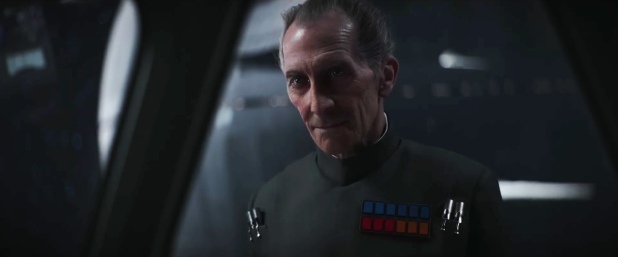
And who orders the Death Star to fire? Who is taking the credit for this great achievement away from Director Krennic? Why, Grand Moff Tarkin of course! You know, the villain portrayed by Peter Cushing in the original Star Wars film in 1977? Yes, him!!

RogueOneCGI

But wait, I hear you all say, didn’t he die back in 1994? Yes, yes he did! And yet, here he is! I confess, I did NOT see this moment coming. I partially blame this on being buried in dissertation work, but also on a slight misunderstanding on my part. I, of course, heard the news very early this year that Disney was working on a CGI replication of Cushing’s character. However, when the main villian was announced to be Director Krennic, I was under the impression that they had scrapped the CGI-Cushing idea. It never dawned on me that they were going to do both!

I mentioned that the film has one flaw, and, please don’t be upset, but that flaw is Tarkin. Don’t misunderstand me, the character as he appears on screen is a remarkable achievement. Digital creations of a human character have come lightyears in terms of appearance and believability and Tarkin is so realistic it’s scary. But…it doesn’t quite work. The first time we see Tarkin, he has his back to the audience (though you know instantly who he is). The big reveal comes when he turns around, and the moment I saw him, I KNEW what they had done. You can see the CGI elements in the way Tarkin moves his head and speaks. The “uncanny valley”, as it were, is still in effect. I WAS able to suspend my disbelief some of the time though, so for me it wasn’t a fatal flaw. I am curious to know what you all thought of seeing Tarkin brought back to life again.

rogue1

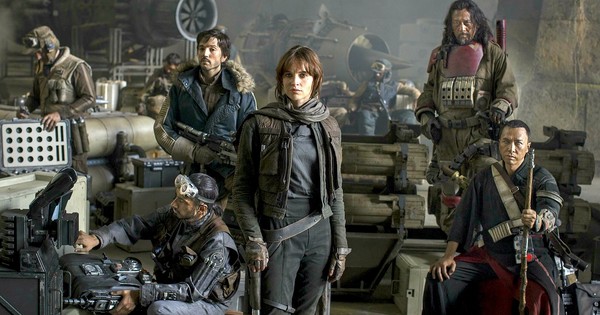
Moving on to the rest of the story and our heroes, Jyn Erso, Cassian Andor and K-2SO make a great trio. Jyn is the daughter of Galen Erso, a brilliant scientist forcibly returned to the Death Star project by Krennic, and also the man responsible for placing the fatal flaw inside the Death Star that leads to its destruction in Episode IV. Jyn, his only child, has lived on her own for years, and loves her father very much. She is initially recruited to the Rebellion because the Alliance is searching for her father, and a Rebel extremist named Saw Gerrera has in custody a defecting Imperial pilot who came from the installation where Galen works (it’s a little complicated, but still good!)

Outside of Jyn, K-2SO might be the best character on the side of the heroes: he’s an Imperial droid reprogrammed by Cassian and he has the snarkiest sense of humor you’ve ever seen, but his loyalty to Cassian (and the Rebellion) is unquestionable. He and Jyn do not get along for most of the film, but by the end, they’ve earned each other’s respect.

jedhajpg

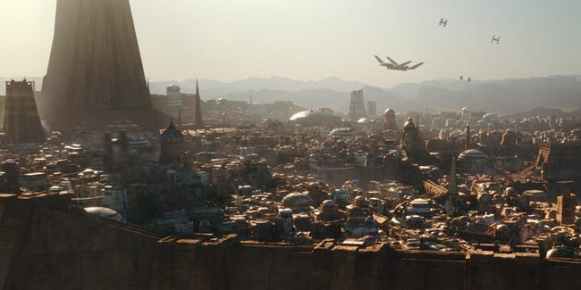
My other two favorite characters are Chirrut and Baze Malbus. They were formerly Guardians of the Whills (they served at the local Jedi temple on the planet Jedha, they can feel the Force, but can’t actively control it the way a Jedi could) before the Empire, and now they are inseparable. Chirrut still believes in the Force after all this time, while Baze has become more of a skeptic. Chirrut has this habit of praying over and over “I am one with the Force and the Force is with me, I am one with the Force and the Force is with me, etc.” He’s actually blind, but is so in tune with the Force that he can fight as well as any sighted person.

And speaking of the end, deep down, I think I knew this was going to happen, but I was secretly hoping at least one of them would get out alive. Yes, you heard right, in the end, none of them make it off Scarif. Jyn, Cassian, K-2SO, Chirrut, Baze, even Bodhi (the defecting Imperial pilot who has been helping them), one by one, they all die. Jyn and Cassian are the last, they successfully transmit the Death Star plans up to the fleet, but immediately afterward, the battleship fires on the planet. It’s not enough to break up the planet itself (the weapon isn’t quite finished yet), but it is enough to destroy the base. The blast is set out in the nearby ocean so it takes a few minutes for the destruction to reach the pair. Jyn and Cassian have just enough time to reach the beach, reflect on what they’ve done and embrace before they meet their end in a fiery cloud of death. It’s terrifying to me because as they sit meeting their end, Jyn is facing the shockwave as it comes, and you can’t help but wonder what she’s feeling, knowing her death is seconds away.

170303_QUORA_RogueOne.jpg.CROP.promo-xlarge2

And the Easter eggs in this film boggle the mind, simply because there are so many of them! Let me see if I can name more than a few: there’s several sightings of Senator Bail Organa (Jimmy Smits reprising his role from the prequel trilogy); Jyn and Cassian (literally) bump into the pair that tries to assault Luke in the cantina on Tatooine (“He doesn’t like you, I don’t like you either…”); R2 and C-3PO pop up for a split second at Yavin base; in possibly one of the best Easter egg moments, the characters of Red Leader and Gold Leader are featured, briefly, in the climactic battle over Scarif in a clever re-use of some footage from Episode IV; and there are several references to the Star Wars Rebels series (listen for the page asking for “General Syndulla”). There’s more, but that’s most of them.

Lastly, I have to talk about the music. I was so nervous about Michael Giacchino composing the score for this film, and I was terrified it wouldn’t be any good. While I still need to go back and analyze the score, my first impression was very favorable. It definitely helps that Giacchino re-used several of Williams’ themes at key points in the story (particularly the Imperial March, I would’ve been furious if he’d left THAT out). The music definitely isn’t bad, but how GOOD it ultimately is I can’t say just yet (I need to listen to the soundtrack separate from the film before I can give a definite opinion).

Final thoughts:

Rogue One is a worthy addition to the Star Wars canon, though it treads dangerously close to the line with its use of CGI to recreate certain characters. The Easter eggs make this film a fun watch for any Star Wars fan.

It was WEIRD having no opening crawl (and no Star Wars fanfare), I almost wish they would go back and recreate the opening to have a crawl anyway.

It was cool (and a little freaky) to see Peter Cushing’s Tarkin walking and talking again, they’ve almost nailed recreating a human character in full CGI (but NOT QUITE)

Ending the film moments before Episode IV begins was a nice touch, though I am somewhat not okay with how they recreated Princess Leia. I would have preferred seeing her from the back only.

I am so happy we got to see Vader use his lightsaber!!!!! After the first scene, I was terrified that we weren’t going to get any more Vader, not even with his lightsaber, so seeing that at the end was fantastic!

And those are my thoughts on Rogue One. What did YOU think of the film? Loved it? Hated it? Already in line to see it again? Let me know in the comments below (first chance I get I’m going to see this film again, that’s for sure).

Become a Patron of the blog at patreon.com/musicgamer460

Check out the YouTube channel (and consider hitting the subscribe button)

Don’t forget to like Film Music Central on Facebook 🙂

See also:

Star Wars Episode I: The Phantom Menace (1999)

Star Wars Episode II: Attack of the Clones (2002)

Star Wars Episode III: Revenge of the Sith (2005)

My Thoughts on: Star Wars (1977)

Star Wars Episode V: The Empire Strikes Back (1980)

My Thoughts on: Star Wars: Return of the Jedi (1983)

A Random Thought on “The Force Awakens”

My Thoughts on: Solo: A Star Wars Story (with spoilers!) (2018)

My Thoughts on: Star Wars: The Rise of Skywalker (2019)

Danny Elfman talks Meet the Robinsons (2007)

 There are (unfortunately) a lot of films in the Walt Disney canon that are extremely underrated, and Meet the Robinsons is one of them. I admit, when I saw the previews for this film, I didn’t think it was something I would like. How I ended up watching this film, I really don’t remember, but I do know that I was surprised by how much I enjoyed it.

Danny Elfman talks Meet the Robinsons (2007)

The film follows Lewis (Jordan Fry), a 12-year old orphan who is an aspiring inventor. He’s obsessed with locating his mother, who abandoned him at an orphanage as an infant. Lewis builds a memory scanner that he hopes will show him who his mother is, but in the midst of the science fair, a strange kid named Wilbur Robinson (Wesley Singerman) shows up (claiming to be a ‘time cop’) and before he knows it, Lewis is whisked off to a strange (and pretty wonderful) future.

In this future, there are flying cars, singing frogs and wonderful inventions for every aspect of life. It’s hundreds of times better than anything Lewis has experienced and he very much wants to stay. But first, Wilbur (who actually isn’t a time cop of any kind) needs Lewis’ help to fix one of his dad’s time machines (which crashed when the two boys got into an argument). Lewis agrees, on the condition that Wilbur take him to see his mother afterward. Lewis ends up meeting the rest of the Robinson family, all except Cornelius, the head of the family, who’s away on a business trip. Lewis really wants to be adopted by the Robinsons, but when they learn he’s from the past (and especially when they see his distinctive hair, they suddenly change their minds), upsetting Lewis, who now thinks they don’t really care about him. The truth is…kind of complicated. It turns out that Cornelius IS Lewis and Wilbur is his future son (apparently there’s no lasting harm to the space-time continuum if you meet your future family).

605145c0a76e6f56e2feea39421221cc

At the same time all of this is going on, a strange “Bowler Hat Man” has been seen sneaking around and stealing various items. It turns out that this is Lewis’ former best friend Goob, now grown up. Goob hates Lewis/Cornelius because his projects made him so tired he didn’t make an important catch at a baseball game and he became so bitter over it that he never got adopted. As a result, he ends up working with another abandoned invention of Cornelius’ named DOR-15 (“Doris”) with the aim of stealing Lewis’ very first invention and ruining HIS future. There’s a brief glimpse of a horrifying future where the entire human population is mind-controlled by clones of Doris (Doris appears as a bowler hat but it can clamp down and obscure the eyes when it’s controlling it’s victim). Lewis is able to end this future by promising to never invent Doris in the first place, and after briefly meeting his future self (how does this not disrupt the space-time continuum??), he is returned to his own time, now knowing that the future is going to be beautiful indeed.

Mega_doris

Danny Elfman composed the music for this film and I think he did a brilliant job. The “Making of” video located above looks into how Elfman crafted the score and took inspiration from other cartoon composers like Carl Stalling (who was responsible for most of the music for the original Looney Tunes cartoons). There are some great shots of Elfman in the recording studio (with the work-in-progress film playing on a big screen).

Meet the Robinsons may be nearly 10 years old, but it’s still a fun film that you should definitely try (and the score is great to listen to as well). I hope you enjoy this look into the making of the music for Meet the Robinsons!


See also:

Danny Elfman talks Batman (1989)

Danny Elfman talks Batman Returns (1992)

Danny Elfman “Planet of the Apes” scoring session (2001)

Danny Elfman talks Spider-Man (2002)

Danny Elfman talks Alice in Wonderland (2010)

Danny Elfman talks Fifty Shades of Grey (2015)

Danny Elfman talks Alice Through the Looking Glass (2016)

Film Composer Interviews A-H

Film Composer Interviews K-Z

Become a Patron of the blog at patreon.com/musicgamer460

Check out the YouTube channel (and consider hitting the subscribe button)

Don’t forget to like Film Music Central on Facebook 🙂
Patrick Doyle talks Brave (2012)

Brave is a gorgeous animated film that was created by Pixar and released by Walt Disney Studios in 2012 (Disney acquired Pixar in 2006). The lead character, Princess Merida, has a distinct honor: she is the first Pixar character to be named an official Disney Princess.

hero_EB20120620REVIEWS120629997AR

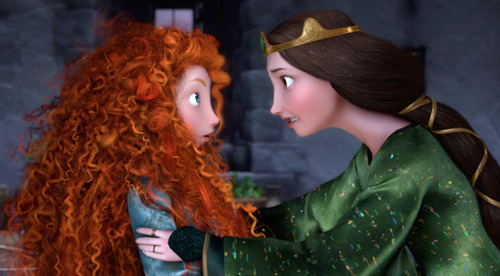
In Brave, Merida, a headstrong princess of the clan Dunbroch and the eldest child of King Fergus and Queen Elinor, is upset to learn that she will be betrothed to a prince from another clan. During an archery tournament that is meant to determine who she will marry, Merida secretly enters and wins the contest, shaming the other princes and infuriating her mother, who desperately wants Merida to act like “a proper princess.”


Wanting to change her fate, Merida defies her family with near-disastrous consequences for all involved. She follows will-o’-the-wisps to the hut of an elderly witch and receives a spell in the form of a cake which she is told to feed to her mother. Upon doing so, Elinor is transformed into a bear and loses her ability to speak. Upon returning to the hut, the pair find the witch gone with a message that explains that “the bond torn by pride” must be repaired by the second sunrise or the transformation will be permanent. Merida must work to repair her relationship with her mother and also prevent war from breaking out between the clans due to Merida’s actions at the tournament. Part of the plot involves respecting tradition while also learning to change for the future. Ultimately, Merida is able to convince the other clans (with subtle help from her mother) that the firstborn of any clan, male or female, should marry in their own time to whoever they choose.

The score for this film was composed by Patrick Doyle, a Scottish film composer best known for his work on several Shakespeare films (Henry V (1989) and Hamlet (1996)) and Harry Potter and the Goblet of Fire (2005). In this five minute interview, Doyle talks about the score and how he created a musical theme for Merida.

tumblr_inline_mwq8ittk6U1qkfkhh

Have you seen Brave? What did you think of it? Did you like the music? Let me know in the comments!

See also:

Film Composer Interviews A-H

Film Composer Interviews K-Z

Patrick Doyle Talks Cinderella (2015)

Become a patron of the blog at: patreon.com/musicgamer460

Check out the YouTube channel (and consider hitting the subscribe button)

Don’t forget to like Film Music Central on Facebook, 🙂

Alice in Wonderland “In a World of My Own” (1951)

If Alice in Wonderland could be summed up in one sentence, it would be: Be careful what you wish for, you just might get it!

The incredibly naive Alice is bored to death listening to a history lesson read by her sister. She’d much rather live in a nonsensical world she dubs “Wonderland”, where “cats and rabbits would reside in fancy little houses, and be dressed in shoes and hats and trousers…” Alice also imagines that all the flowers could talk and sing and that they would talk with her for hours and hours. Alice’s cat Dinah (who clearly understands her mistress), isn’t so sure about this idea of “Wonderland” (smart kitty).

It’s a neat trick on Disney’s part to have this song foreshadow a good deal of what’s to come in the film: Alice ends up exploring the White Rabbit’s house, and even later she does in fact get to talk to (and sing with) the flowers.

mn0057587

“In a World of My Own” is a beautiful little song and the picture it paints sounds charming, but poor Alice finds out that dreaming about Wonderland and actually LIVING in it, are two entirely separate things!

Become a patron of the blog at: patreon.com/musicgamer460

See also:

Alice in Wonderland “The Un-Birthday Song” (1951)

Alice in Wonderland “All in the Golden Afternoon” (1951)

Alice in Wonderland “Painting the Roses Red” (1951)

Don’t forget to like Film Music Central on Facebook 🙂

And for more animated film music, check out the main page here: Disney/Dreamworks/Pixar/etc. Soundtracks A-Z