Ex Machina “Ava”

posters-image-4

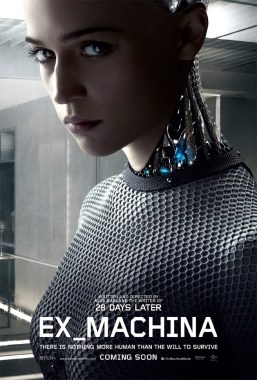
Compared to other films, Ex Machina features a fairly light score (light as in there’s not much music to listen to). But what IS there…ahhh, that’s what really drew me in when I watched the movie the first time. Very often the simplest film score is one of the best, and this is true in Ex Machina.

The music was composed by the duo of Ben Salisbury and Geoff Barrow (they’d previously collaborated on Dredd (2012)) and though I love the entire soundtrack, my favorite piece by far is “Ava,” the theme of the robot played by Alicia Vikander (she should’ve gotten an Oscar for that performance, just saying).

The theme of “Ava” first appears when Caleb (Domhnall Gleeson) sees Ava for the first time. It begins the moment Ava steps into view. The melody is simple, and most likely played on a metallophone (think of a xylophone but with metal bars). And if the music sounds familiar…there’s a very good reason.

Ex Machina – Meet Ava

Remember the famous 5 tone theme from Close Encounters of the Third Kind (1977)? If that doesn’t ring a bell, look it up, give it a listen, then come back to “Ava” and listen to that again.

…….

Do you hear it? I nearly fell over when I recognized “Ava” contained the 5 tone theme (slightly modified, but recognizable). The question I want to answer now is….why did the composers choose THAT particular theme to insert into Ava’s theme? I’m not sure yet, but it’ll be fun to find out why!

Become a Patron of the blog at patreon.com/musicgamer460

Check out the YouTube channel (and consider hitting the subscribe button)

See also: Film Soundtracks A-W

A 21st-century Pygmalion in Ex Machina

Don’t forget to like Film Music Central on Facebook  🙂

*poster image is the property of Universal Pictures

Michael Giacchino talks Mission: Impossible 3 (2006)

I have greatly enjoyed all five Mission Impossible movies (1996-ongoing) but even I will admit that Mission Impossible 2 was not as good as the rest. So, I was so happy to get to Mission Impossible 3 and be like “Wow! This is insane (and fascinating too).” Though I will admit, the opening of the film (with the flash forward sort of thing) threw me for a few minutes. The late Philip Seymour Hoffman plays what is probably the most evil villain Ethan Hunt has ever faced.

Mission Impossible 3 was also Michael Giacchino’s first foray into this franchise (he also composed the score for Ghost Protocol), and I really hope that he can return in the future as this series shows no signs of slowing down. In the meantime, enjoy this interview that looks into the scoring of Mission Impossible 3! Have a good day!

See also:

Michael Giacchino talks The Incredibles (2004)

Michael Giacchino talks Ratatouille (2007)

Michael Giacchino talks Up (2009)

Michael Giacchino talks Star Trek (2009)

Michael Giacchino talks Super 8 (2011)

Michael Giacchino talks John Carter (2012)

Michael Giacchino talks Star Trek: Into Darkness (2013)

Michael Giacchino talks Jupiter Ascending (2015)

Michael Giacchino talks Jurassic World (2015)

Michael Giacchino scoring Rogue One: A Star Wars Story (2016)

Michael Giacchino talks Zootopia (2016)

Michael Giacchino talks Jurassic World: Fallen Kingdom (2018)

Film Composer Interviews A-H

Film Composer Interviews K-Z

Become a patron of the blog at: patreon.com/musicgamer460

Check out the YouTube channel (and consider hitting the subscribe button)

Don’t forget to like Film Music Central on Facebook 🙂

Michael Giacchino talks Ratatouille (2007)

Michael Giacchino talks Ratatouille (2007)

In 2007, a lot was happening in my life, I graduated high school, got accepted to a university, and in the film world, Pixar released its eighth animated feature: Ratatouille. The film tells the story of a French rat named Remy who absolutely loves to cook, and who desperately wants to be a chef (despite the fact that he’s, you know, a rat). Remy ends up crossing paths with the son of his cooking idol and together Remy attempts to realize his dreams.


Director Brad Bird had already worked with composer Michael Giacchino for The Incredibles (2004) and they’d gotten along so well that Bird decided to bring him back for this film as well. Giacchino and Bird have become a rather reliable duo over the years, and to date they have worked together on: The Incredibles, Ratatouille, Mission Impossible: Ghost Protocol and Tomorrowland, with Giacchino slated to score The Incredibles 2.


For Ratatouille, Giacchino created two themes for Remy: the first theme describing his life as a thief (which, for the other rats, is what life is meant to be about), and the other theme describes Remy’s hopes and dreams. The score was so well-received that it gave Giacchino his first Academy Award nomination for Best Original Score (losing out to Atonement. He would finally win with his score for Up.)

781641294_4586ed9892

In the interview clip found above, Giacchino takes us through the process of scoring the film, and as always, there are some wonderful shots of the orchestra in the process of recording, while the director and composer watch a rough cut of the film (I would love to sit in on the scoring process, and with my career aspirations, maybe I will some day!) Enjoy an inside look at Ratatouille!

See also:

Michael Giacchino talks The Incredibles (2004)

Michael Giacchino talks Mission: Impossible 3 (2006)

Michael Giacchino talks Up (2009)

Michael Giacchino talks Star Trek (2009)

Michael Giacchino talks Super 8 (2011)

Michael Giacchino talks John Carter (2012)

Michael Giacchino talks Star Trek: Into Darkness (2013)

Michael Giacchino talks Jupiter Ascending (2015)

Michael Giacchino talks Jurassic World (2015)

Michael Giacchino scoring Rogue One: A Star Wars Story (2016)

Michael Giacchino talks Zootopia (2016)

Michael Giacchino talks Jurassic World: Fallen Kingdom (2018)

Film Composer Interviews A-H

Film Composer Interviews K-Z

Become a patron of the blog at: patreon.com/musicgamer460

Check out the YouTube channel (and consider hitting the subscribe button)

Don’t forget to like Film Music Central on Facebook 🙂

Michael Giacchino talks Up (2009)

So, I have a confession. It took me WAY too long to see Up (2009). All of my friends were raving about it when it came out, but for some reason I was not into the movie at all, so it was years later before I saw it. And then there’s that crazy huge bird, the talking dogs, a half-crazed explorer, etc. etc. But, I digress….

980x

Michael Giacchino talks Up (2009)

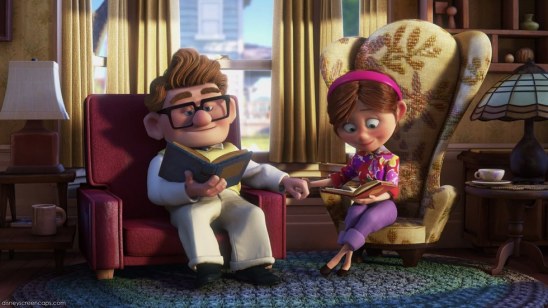
Up tells the story of retired widower Carl Fredrickson (Ed Asner), who turns his old house into a flying machine via thousands of balloons so that he can fulfill the last dream of his deceased wife: to visit Paradise Falls in South America. Almost immediately he picks up a stowaway: a young “Wilderness Explorer” named Russell (Jordan Nagai) who needs to earn his final merit badge for assisting the elderly.

Russell_dug_carl_fredricksen_in_pixars_up-wide

The journey is full of surprises, including an unexpected encounter with Charles F. Muntz (Christopher Plummer), a legendary explorer that Carl idolized as a child. Decades ago, he returned from an expedition claiming he’d discovered a new type of flightless bird, but was ridiculed by the scientific community as a liar. He departed, vowing to bring back a live specimen, and had never returned. As it turns out, Carl and Russell end up encountering a certain flightless bird (dubbed “Kevin” by Russell) which inevitably brings them to Muntz’s attention.

The music for this whimsical (and at the same time, deeply touching) film was composed by Michael Giacchino, whose prior work includes such films as Mission Impossible III, Star Trek and the sequel Into Darkness, The Incredibles, Dawn of the Planet of the Apes and Jurassic World.

The opening of the film is what always sticks with me the most. In it, we see a montage of Carl’s life, from meeting Ellie as a young boy, to falling in love with her, to sadly discovering they can’t have children of their own, to the pair growing old. Over time, they continually save up to make that trip to Paradise Falls, but something always happens to stop them. Finally, Carl has the tickets purchased, but as he prepares to surprise his wife, she collapses and has to go to the hospital. That’s why Carl is so determined to make the trip, he knows it’s what Ellie would have wanted him to do. This part still makes me cry every single time I see it.

In this interview segment, Giacchino, along with the director, discuss how the score came together, and inbetween the moments of talking, there are wonderful scenes showing the orchestra in the recording studio (I love watching moments like these). Giacchino is an immensely talented composer, and Up is a great addition to both film and film music.

Become a Patron of the blog at patreon.com/musicgamer460
Check out the YouTube channel (and consider hitting the subscribe button)

See also:

Michael Giacchino talks The Incredibles (2004)

Michael Giacchino talks Mission: Impossible 3 (2006)

Michael Giacchino talks Ratatouille (2007)

Michael Giacchino talks Star Trek (2009)

Michael Giacchino talks Super 8 (2011)

Michael Giacchino talks John Carter (2012)

Michael Giacchino talks Star Trek: Into Darkness (2013)

Michael Giacchino talks Jupiter Ascending (2015)

Michael Giacchino talks Jurassic World (2015)

Michael Giacchino scoring Rogue One: A Star Wars Story (2016)

Michael Giacchino talks Zootopia (2016)

Michael Giacchino talks Jurassic World: Fallen Kingdom (2018)

Film Composer Interviews A-H

Film Composer Interviews K-Z

Don’t forget to like Film Music Central on Facebook 🙂

*all images are the property of Walt Disney Studios

Jerry Goldsmith talks Lionheart (1987)

While I am generally familiar with all of Jerry Goldsmith’s work, Lionheart (1987) is a film that I admit I have never heard of, and for good reason it turns out. The film received an exceptionally limited release in theaters, a VHS copy was not issued until 1994 and a DVD version was not seen until 2009.

220px-Lionheartposter87

Lionheart is loosely based on the real-life story of the Children’s Crusade. In this film, a young knight named Robert Nerra, who is disillusioned by the death of his brother, leads a band of orphans en route to join King Richard in the Third Crusade, and must also protect them from the Black Prince (who’d like to enslave all the children and sell them to the Muslims).

Lionheart-1987-4

The limited release does not change the fact that Goldsmith’s work was of exceptional quality and the video follows the composer as he works on recording the score in Budapest. I’m pleased to share a rare video of Goldsmith at work with all of you (if only more of these videos existed, what treasures they are!) Have a great weekend!

See also:

Jerry Goldsmith talks The Sand Pebbles (1966)

Jerry Goldsmith talks Chinatown (1974)

Jerry Goldsmith talks about Alien (1979)

Film Composer Interviews A-H

Film Composer Interviews K-Z

Become a Patron of the blog at patreon.com/musicgamer460

Don’t forget to like Film Music Central on Facebook 🙂

*all images and video are property of the film studio and the creator of the interview

Marco Beltrami and Marilyn Manson talk Resident Evil (2002)

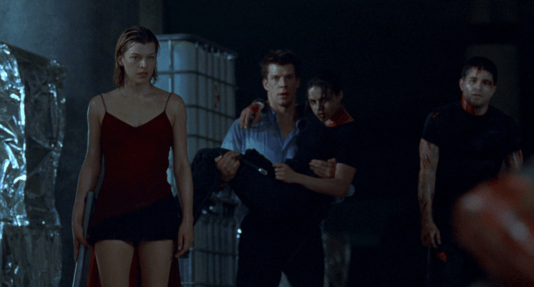
In 2002, the Resident Evil movie franchise launched with the first self-titled film in the series. Based on elements from the video games Resident Evil and Resident Evil 2, the movie Resident Evil follows Alice (Milla Jovovich) as she and a team must break into the Hive, a genetic research facility located underneath Raccoon City, to retrieve an anti-virus to stop a zombie plague. There’s one small complication however: the Hive is crawling with zombified employees and scientists.

125162

Not all of the zombies are alike either: while most are the typical flesh-eating zombie, others have mutated into “Lickers,” a more deadly creature with a monstrous appearance. On top of all this, the Red Queen A.I. that controls the facility is determined to stop them at all costs in order to protect the world above. Another complication in the story is that Alice initially wakes up in a deserted mansion with total amnesia. As the story progresses, she begins to remember bits and pieces (for example, she remembers the anti-virus was located in a specific room).

While this film (and the lengthy series which followed) clearly attempted to capitalize off the popularity of the Resident Evil video game, it is unfortunately remembered as yet another video game-to-film adaptation that did not do its subject material justice. And yet, despite receiving consistently terrible reviews (Roger Ebert put the film on his “Most Hated” list), the franchise spawned five sequels and is currently in the process of being rebooted. For those curious, here is the complete list of Resident Evil films:

  • Resident Evil (2002)
  • Resident Evil: Apocalypse (2004)
  • Resident Evil: Extinction (2007)
  • Resident Evil: Afterlife (2010)
  • Resident Evil: Retribution (2012)
  • Resident Evil: The Final Chapter (2016)

The score for this film was a collaboration between Marco Beltrami and Marilyn Manson (who knew?) and the interview regarding this film score features the two of them. Manson describes the score and overall soundtrack as being more “electronic” than previous works.

Streaming-Resident-Evil-2002

Resident Evil doesn’t rate that high on my list of favorite films (because of the zombies), but it’s definitely worth a try if you’re into straight-out action. I hope you enjoy this interview! Let me know what you think of Resident Evil (both the first film and the series) in the comments below!

See also:

Marco Beltrami talks Blade II (2002

Marco Beltrami talks Live Free or Die Hard (2007)

Marco Beltrami talks 3:10 to Yuma (2007)

Marco Beltrami talks The Wolverine (2013)

Marco Beltrami talks World War Z (2013)

Film Composer Interviews A-H

Film Composer Interviews K-Z

Become a patron of the blog at: patreon.com/musicgamer460

Check out the YouTube channel (and consider hitting the subscribe button)

Don’t forget to like Film Music Central on Facebook 🙂

The Hobbit: The Battle of The Five Armies- Thorin’s Charge!

307453id1_TheHobbit_TBOTFA_Teaser_Intl_27x40_1Sheet.indd

Ok, I didn’t want to admit it, but I will: The Hobbit film trilogy has a LOT of problems (not least of which is the fact that the final product barely resembles its source material, don’t get me started on the liberties they took…)

However, despite its issues, The Hobbit did produce some impressive musical moments (since the films were again scored by Howard Shore). One of my favorites comes at the climax of The Battle of Five Armies (or at least one of the climaxes, like I said, the series had problems.)

The Hobbit- “Thorin’s Charge”

To briefly set the scene: Azog’s huge orc army is descending upon The Lonely Mountain with only Dain’s meager forces to defend it (the Elves are currently refusing to fight). Inside the mountain, Thorin (who has spent most of the film obsessed with finding the Arkenstone) finally comes to his senses and announces to his followers that they WILL go out and fight.

Back outside, Azog’s forces are in position and the order is given to advance. But just then…THIS happens

BomburHorn

Bombur blows a HUGE fanfare on this gigantic horn that brings all sides to a standstill. (The beauty of this horn call is in its simplicity) A huge golden bell blows out the sealed main gate and then….CHARGE!!

thorin-charge

This is one of those perfect film music moments that people like me dream about seeing. Everything is synced together in this moment. Enjoy watching and listening!

See also: Film Soundtracks A-W

Become a patron of the blog at: patreon.com/musicgamer460

Check out the YouTube channel (and consider hitting the subscribe button)

Don’t forget to  like Film Music Central on Facebook 🙂

A 21st-century Pygmalion in Ex Machina

This post is a part of the Movie Scientist Blogathon hosted by Silver Screenings and Christina Wehner

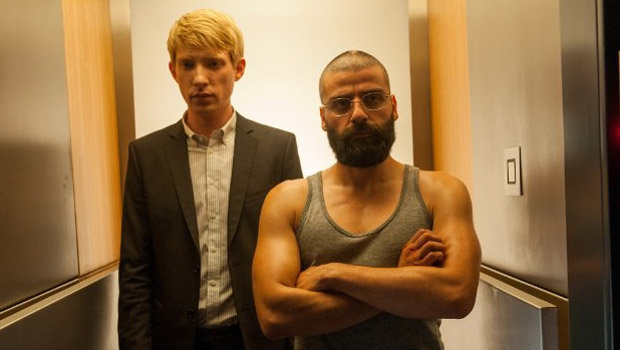
The plot of the 2015 film Ex Machina is set in motion when Caleb (Domhnall Gleeson) wins the opportunity to spend a week at the estate of Nathan (Oscar Isaac, aka Poe Dameron), the inventor of Bluebook (the largest search engine in the world). I was originally going to place Nathan in the “mad scientist” category, but the more I thought about it, the more I realized he really belongs in the “lonely” category (though he is crazy regardless).


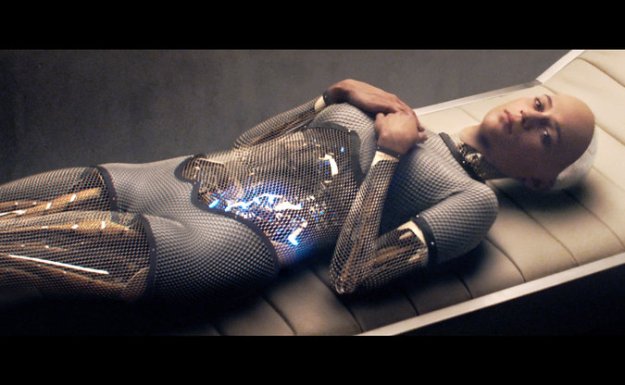
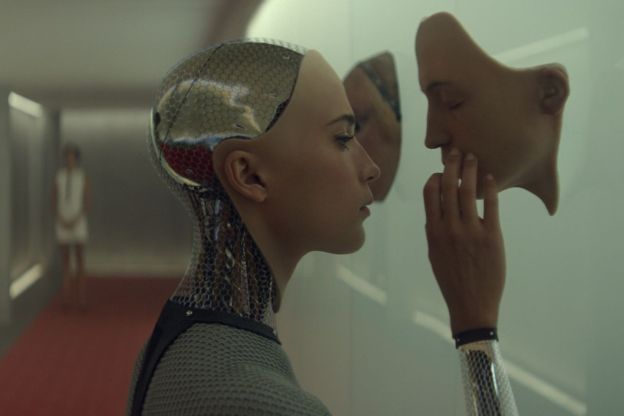
As soon as you see Nathan, you know there is something…off… about him (his estate is set in the midst of hundreds of miles of pristine wilderness, for example). His personality is so blunt it borders on the abrasive, and his wit is razor sharp. He quickly reveals to Caleb that he has been working on something exciting: Artificial Intelligence. He isn’t just working on it, he’s already made one: Ava (Alicia Vikander), a gynoid with a human face and hands, but exposed metal mesh for limbs and a torso.
21DISRUPTIONS-master675

Ava

Nathan, to put it bluntly, has a God complex. Everything in this house is ordered to his exact specifications. This is his empire, his word is absolute law (and once Caleb arrives he is subject to this law). Caleb mentions a line of “If you’ve created artificial intelligence, that’s not the work of a man, that’s the work of gods.” And Nathan happily turns this around and suggests that Caleb is calling him a god, when Caleb meant no such thing.

Nathan makes it seem like Ava is the first prototype, but Caleb eventually discovers that this is not true. There were at least FIVE predecessors to Ava (we see the names of Lily, Jade and Jasmine), and they were all female. Clearly, Nathan is attempting to build the “perfect” woman, and that is why I dub him a 21st-century Pygmalion.

In Ovid’s Metamorphoses, Pygmalion was a sculptor who created a statue of a woman out of ivory. Over time, he fell in love with his creation and Aphrodite brought the statue to life so they could be together. Today, some scholars interpret this story as a very early example of artificial life, and therefore a precursor to robot stories.

So back to Nathan. He’s tried several times to create the “perfect” woman, just as Pygmalion did. This implies that deep down under all of his insane bravado, he is a very lonely man, maybe he feels that the only woman fit for him is one he creates. Only, unlike Galatea (who happily lived with her creator) none of these robots are meeting Nathan’s insanely high standards, not to mention they have all tried to escape (one even put cracks in a glass wall). (Based on his behavior, Nathan expects and wants a woman that is totally submissive to HIS needs, I think that’s why Kyoko (who is, spoiler alert, also a robot) cannot talk (Nathan says that she can’t understand English, but I believe that she can, she just can’t say anything). So thus far, as each one fails the tests, Nathan destroys that model, downloads the information, and tries again. He implies to Caleb that he’s about to do the same thing to Ava. But Nathan does not realize that introducing Caleb into the equation will lead to his permanent downfall. I won’t spoil the ending for you, but if you haven’t seen Ex Machina, I highly recommend getting a copy and checking it out.

On a side note, besides being a 21st-century Pygmalion, Nathan is also a modern-day Bluebeard. For those unfamiliar with the fairy tale, Bluebeard was a wealthy man who had married multiple times. His latest wife is given all of the keys to the house but is told to not enter the last room at the end of the hall. Eventually, curiosity wins out and the wife goes in…only to discover the dead bodies of Bluebeard’s previous wives (Bluebeard’s secret is that he is a serial murderer). In Nathan’s bedroom, Caleb discovers a series of closets containing the broken down bodies of Ava’s predecessors a la Bluebeard. Nathan also tells Caleb that “not all of these rooms are for you.”

I hope you enjoyed this look at Nathan from Ex Machina 🙂

Become a Patron of the blog at patreon.com/musicgamer460

Check out the YouTube channel (and consider hitting the subscribe button)

See also:

Ex Machina “Ava”

Don’t forget to like Film Music Central on Facebook 🙂

Rotwang or, what mad scientists will do for love

This post is a part of the Movie Scientist Blogathon hosted by Silver Screenings and Christina Wehner

There are mad scientists, and then there’s Rotwang.

Rotwang (Rudolf Klein-Rogge) is a scientist and one of the primary antagonists of the 1927 silent film Metropolis (directed by Fritz Lang). All of his life he’s been in a rivalry with Joh Fredersen (Alfred Abel), the “Master of Metropolis” because years ago they both loved the same woman, Hel. And even though Hel chose Joh, married him and bore his child (Freder), Rotwang has lived all his years since then convinced that Hel should have been his.

tumblr_njtqtjYIXf1unt4w0o1_400

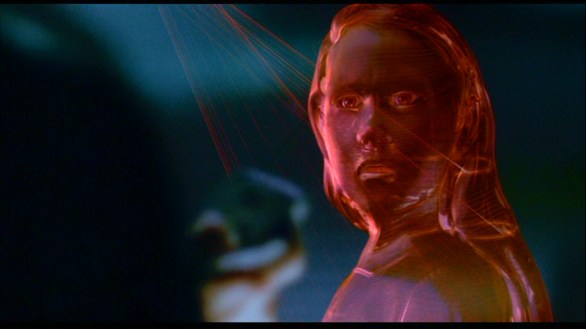
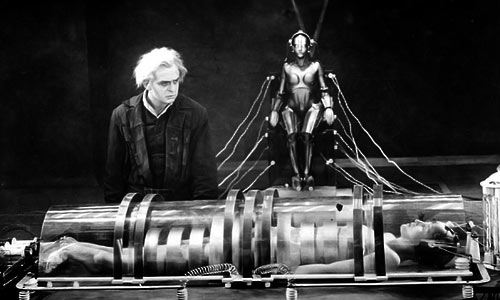
When Joh (reluctantly) comes to visit Rotwang to try and determine what the workers are up to in the catacombs below the city, Rotwang reveals a secret: he has found a way to “resurrect” Hel, and this time she will be his alone! “Hel” is revealed to be a robot with a feminine body (I believe in the end she was meant to resemble Hel, but the process was not finished).

How exactly Rotwang created the robot is not known, but we do find out that Rotwang sacrificed a hand in the process (replacing it with an artificial limb, to Joh’s horror). The science seen here in Metropolis would be categorized as “soft science” (the processes shown are scientific in nature, but the how and why are left unexplained)

metropolis_still

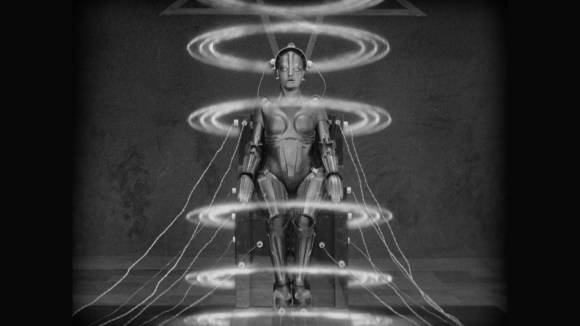
And speaking of science, the entire scene where Maria’s likeness is transferred to the robot is unbelievably brilliant (it makes it hard to believe that this was done in 1927). To create this scene, the film had to be exposed multiple times to create the illusion of multiple rings of light.

Metropolis

Once Rotwang’s robot is turned loose upon the city, the increasingly unstable scientist becomes infatuated with the captured Maria and eventually convinces himself that Maria is actually Hel come back to life. He pursues Maria across the city, culminating in a chase across the roof of a cathedral. Maria’s love Freder finally intervenes and at the climax, Rotwang falls to his death. To the bitter end he believes he is pursuing his beloved Hel.

Next to Dr. Frankenstein, Rotwang is one of my favorite movie scientists. While he is unquestionably brilliant, he is also certifiably insane (and may have always been so, one wonders why Hel rejected him). He’s so convinced that this robot will serve to replace his lost love, the intensity of his passion is terrifying.

Rotwang is a memorable movie scientist, and a good addition to this blogathon, I hope you enjoyed!

Don’t forget to like Film Music Central on Facebook 🙂
Become a Patron of the blog at patreon.com/musicgamer460

See also:

Gottfried Huppertz: The composer behind Metropolis

*All of the images are property of the film studio

Deja Vu: Comparing the Klingon theme in Star Trek: The Motion Picture and Star Trek: First Contact

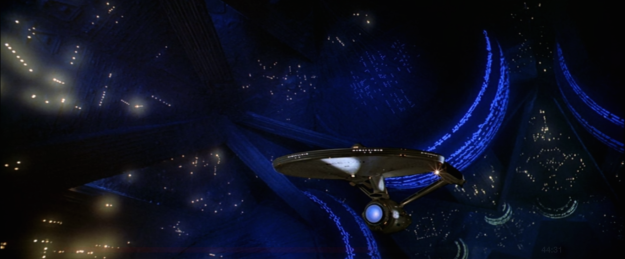
Star Trek: The Motion Picture has had a bad reputation for years, and some of it is rightfully deserved. The pacing is way off (compared to the later films), the acting is…less than ideal at some points, and the mysterious V’Ger is so large as to border on the absurd (in the original version, the size was given as being larger than our own solar system (80 AUs, it was later dubbed over to 8, which is still very massive).

1_QTeQF_1FtK4uPfT-RzYZ7Q

But one component of the film that I will defend to the death is Jerry Goldsmith’s score. Goldsmith introduced musical themes that have remained with the series (at least in the prime universe) ever since. One such theme is the “Klingon theme” that is heard at the beginning of the film when three Klingon ships move in to attack the mysterious cloud passing through their territory. (The theme begins around 0:09 seconds, listen for the brass)

Star Trek: The Motion Picture “Klingon Battle”

This theme set the tone for the Klingons as they would now appear in the Star Trek film universe (this is also the first time we see “proper” Klingons with the distinctive ridges on their foreheads). Brass, horns and trumpets in particular, have long been associated with war and other martial endeavors (as that is where those instruments evolved) and by utilizing them, Goldsmith is reminding the listener that Klingons are a martial race, they always attack first, ask questions later.

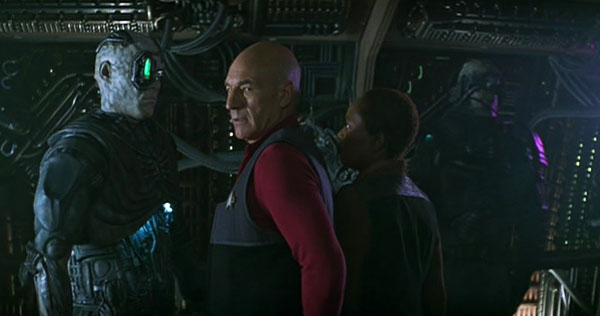
star-trek-first-contact-jean-lu-picard-borg-alfre-woodard-patrick-stewart

Fast forward almost twenty years to 1996 and the events of Star Trek: First Contact. The Federation’s ultimate nemesis, the Borg, are making another attempt to conquer and assimilate the human race, and all resources are being pulled together to stop this menace. In the midst of the battle, we come across the Defiant (the starship from Deep Space 9) commanded by everyone’s favorite Klingon, Worf (Michael Dorn joined Deep Space 9 after Next Generation went off the air). No sooner does Worf pop up, and the music heard is definitely the same Klingon theme played in The Motion Picture back in 1979 (considerably sped up, but the same theme regardless). The theme begins around 2:25.

Star Trek: First Contact “Klingon Theme”

I will always love how composers reuse musical themes from one film to the next (I also can’t believe it took me as many years as it did to catch this particular example).

Become a Patron of the blog at patreon.com/musicgamer460

Don’t forget to like Film Music Central on Facebook 🙂