It’s finally time for the 3rd Annual Remembering James Horner Blogathon. Each day I’ll be posting a recap of what everyone’s submitted for the blogathon 🙂 I can’t wait to read all of your posts as well as add my own this weekend 🙂 Thanks again for taking part in this blogathon, have fun!
*Spoilers for Infinity War below, don’t read if you haven’t seen the film yet*
Alan Silvestri has so far worked on three films in the Marvel Cinematic Universe: Captain America: The First Avenger (2011); The Avengers (2012) and Avengers: Infinity War (2018) (he will also be scoring the currently untitled Avengers 4). Before seeing Infinity War, I didn’t think anything could top the musical excellence that was The Avengers but now I know otherwise. Silvestri has truly outdone himself with his score for Infinity War.
The score contains callbacks to Silvestri’s previous entries in the MCU including a re-appearance of the original Captain America theme (which visibly excited the audience in the theater I sat in). There is also, naturally, several recurrences of the main “Avengers” theme that debuted (so far as I know) in the 2012 film of the same name. But the callbacks don’t stop with Silvestri’s material; there is also a reprise of Ludwig Göransson’s Black Panther theme when the film moves to Wakanda. Even the entrance of the Guardians of the Galaxy is in line with their previous films. While “Rubberband Man” (performed by The Spinners) does not feature in Vol. 1 or 2 of Guardians of the Galaxy, it did come from a list of compiled songs that could be used in future GoTG entries. So musically the score ties back to the MCU’s past.
As for the new music in Infinity War, I hate to do this but we need to talk about THAT scene on Vormir, because that is the section that drove me to the point of tears. It was all going normally enough until Thanos learned that he needed to sacrifice what he loved most to get the Soul Stone. In the moment when he grabbed Gamora’s arm, the music just exploded into this cacophony of pain and sorrow. I’ve mentioned before that this scene humanized Thanos for me; I should have said it was the music in this scene that did it. The music reflects the pain of Gamora (learning that after all these years Thanos really does love her and because of that she must die) and of Thanos (who must sacrifice the one person he does love in order for his goal to be achieved). This is the kind of music that pierces you like a knife, locking you into the moment so that you can’t look away even if you want to.
And then there’s the ending scene, where everyone starts to disappear. In contrast to the scene on Vormir, here there is a distinct lack of music that I can remember. There may have been some in the background, but if there was, it wasn’t enough to draw my attention. In fact, right after Thanos vanished from Wakanda, it was so quiet I thought the people had already disappeared. I still can’t get the sounds of the ending scene out of my head. If you recall, many MCU films end with a reprise of the main theme, sometimes subtle, sometimes not so much. But here, at the end of Infinity War, there’s no uplifting music to reassure us that all is right with the world again because everything is now very wrong. The music itself feels “shell-shocked” just like the surviving heroes who are realizing that (for the moment at least) they’ve lost.
Honestly, I feel like my words are inadequate to describe how amazing the score for Avengers: Infinity War is, but I hope I did enough to give you a rough idea of how this score impacted me. Truthfully I could go on for several more paragraphs but really the best way to experience this score is to go watch the film as many times as possible and listen to the music. I know that can be hard with all the action on the screen but Silvestri does his best to bring the music to your attention.
Let me know what you thought of the music for Avengers: Infinity War in the comments below and have a great day 🙂
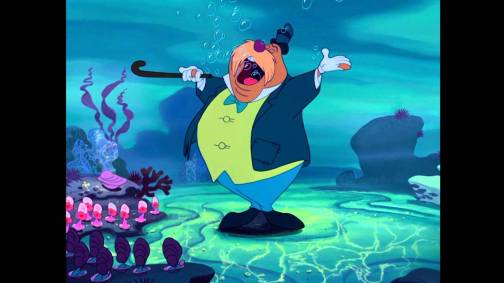
When you break Alice in Wonderland down, it’s obvious that the film is really a series of isolated stories tied together by the narrative of Alice exploring Wonderland. One such story is “The Walrus and the Carpenter” as told to the wandering Alice by Tweedle-Dee and Tweedle-Dum. I’ve been tempted several times to include this scene in my Disturbing Disney series because of one particular moment, but for now I’ll let you decide for yourselves if it’s disturbing or not.
As Tweedle-Dee and Tweedle-Dum narrate: A Walrus and a Carpenter are walking along a beach one day, which could be cleared of all its sand in half a year (the carpenter says) as long as you don’t mind the work involved that is.
Work!!? (the Walrus is clearly averse to doing any work whatsoever) In fact, whenever the subject of work (or any kind of labor) is mentioned, the Walrus launches into this tune:
The time has come to talk of other things Of shoes and ships and sealing wax Of cabbages and kings And why the sea is boiling hot And whether pigs have wings Calloo-Callay No work today! We’re cabbages and kings
The carpenter then spots a bed of oysters in the ocean nearby, and being dreadfully hungry, points them out to the Walrus, who wants them as well. Thus, he marches into the ocean (while the carpenter builds a restaurant from scratch) and entices the oysters to follow him saying:
Oh, uh, Oysters, come and walk with us The day is warm and bright A pleasant walk A pleasant talk Would be a sheer delight
Even though Mother Oyster advises all her oyster children to remain in their beds, the Walrus wins out by blustering on:
Yes, yes, of course, of course, but, uh, ha, ha!
The time has come, my little friends To talk of other things Of shoes and ships and sealing wax Cabbages and kings And why the sea is boiling hot And whether pigs have wings, ha ha Callo-Callay Come, run away With cabbages and kings!
And so the oysters march off behind the Walrus and this is where it starts to get disturbing. For the oysters aren’t just oysters, they now run along the beach like little girls in dresses and bonnets (with happy smiling faces), which makes what happens next all the more menacing. The Walrus marches the oyster girls straight into the ready-made restaurant, and after sending the Carpenter away on a wild goose chase, draws the oyster girls in ever closer
Well, yes, yes, splendid idea, ha ha! Very good, indeed Now, if you’re ready, Oysters, dear We can begin the feed
(Oysters): FEED??
Oh, yes…
The time has come, my little friends To talk of food and things
We don’t see what happens next but you know what’s going to happen. By the time the Carpenter comes back with the bread and sauce for the oysters, it’s too late, they’ve all been eaten by the Walrus!! This is too much for the Carpenter who chases the Walrus back down the beach in a rage over being swindled out of an oyster dinner. But what I’d like to get back to is this scene with the Walrus alone with the Oysters: it is downright menacing I think! Just go back and look at that picture of the Walrus with his evil grin as it dawns on the oysters what’s about to happen. I think it’s pretty disturbing, but what do you think? Let me know your thoughts in the comments below and have a great day!
“Are you not entertained?” boomed Russell Crowe in Gladiator, a movie that hit the headlines again recently, 18 years after it first hit our screens. It was after Mr. Crowe decided that it was time to sell off some of his personal effects, including a jockstrap from one of his movies and a fake Roman chariot used in Gladiator. Well, to answer your question, Mr. Crowe, we were entertained (as you can see from our review), but while we remember the classic quotes from the movie and the stunning landscape that provided a backdrop to the action, one aspect has been lost slightly in any discussions about the movie which won the 73rd Academy Award for Best Picture. That aspect is the music for the movie, which was created by a legend in his industry: Hans Zimmer.
Zimmer won awards at the Golden Globes, but the critical legacy seems to have revolved around the graphics used in the movie, with more awards for the likes of best costume design picked up by Gladiator than plaudits for the score. The visual effects and costumes at the time were stand-out, but looking back, they don’t seem like anything special, especially compared to costumes and backdrops from the stunning period dramas we’ve seen from the past decade (think Downton Abbey or Versailles for good examples of this).
The music, meanwhile, when you watch the movie again, hasn’t aged at all, despite the raft of technological changes which have emerged since the movie’s production. It is the look of the movie that has arguably had the biggest impact on pop culture as well; one look at the details about this fantastic game shows that there is far more of a focus on the aesthetics of the game rather than the music, which focuses primarily on sound effects like beeps and chimes.
This Platinum Play casino review shows that the Gladiator slot reached new heights of popularity, becoming one of the most popular games from that particular operator, highlighting how the music has become something of the forgotten element of the award-winning movie.
Not the only snub to Hans
For as much as it may seem unfair, Zimmer perhaps won’t have been overly surprised by his snub. After all, he has already seen his score for Hannibal be horribly underrated. With tracks like The Battle and Now We Are Free significant pieces of music, it is still a tragedy that the blood and guts is what sticks in the mind all these years later, and that the selling off of items by Russell Crowe can still be what grabs the headlines, rather than the inspirational work of a great movie soundtrack composer.
The CV and the awards that Hans Zimmer has earned throughout his career highlight that he is a man who has clearly earned appreciation in the world of music, even if he hasn’t been able to remain memorable in public consciousness. For the time being, if you want to enjoy Hans Zimmer, you just need to watch movies as diverse as The Lion King, Inception, and, of course, Gladiator, to hear him at his finest.
The Adventures of Ichabod and Mr. Toad (1949) is one of those early Disney films that has sadly fallen by the wayside. It came about in the years immediately after World War II when Disney found themselves with a pile of animated segments that were too long to be theatrical shorts but too short to be full length features. As a result, Disney created a series of “package films,” films that consisted of two or more animated segments. Previous installments included: Saludos Amigos (1942), The Three Caballeros (1944), Make Mine Music (1946), Fun and Fancy Free (1947), Melody Time (1948) and also The Many Adventures of Winnie the Pooh (1977).
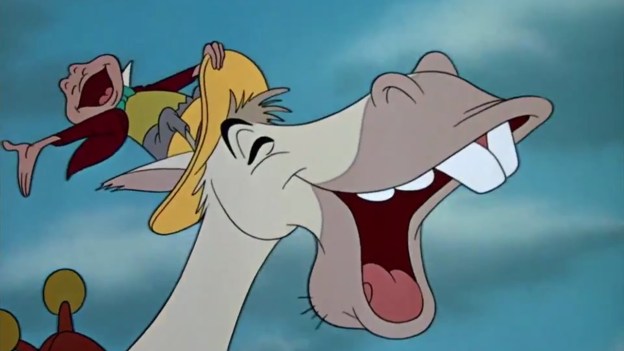
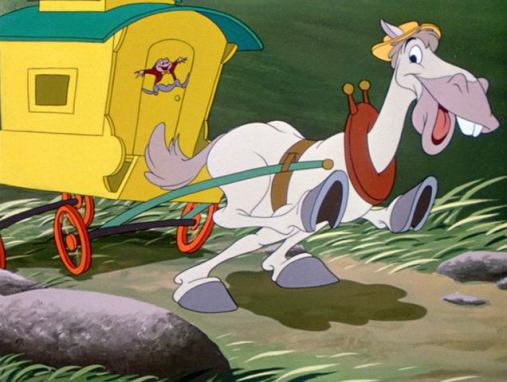
The first segment in this package film adapts Kenneth Grahame’s classic story “The Wind in the Willows” and is narrated by Basil Rathbone. The story follows the misadventures of one J. Thaddeus Toad (Eric Blore), a country squire who is spending his fortune on every fad he comes across. When we first meet him, he’s engaged in his latest mania: driving a gypsy cart across the countryside with his new friend, a Cockney-speaking horse named Cyril Proudbottom (J. Pat O’Malley) and together they are singing the insane “Merrily Song.”
Mr. Toad:Tally Ho! Tally Ho! Tally Ho!
Are we on our way to Nottingham, to Brittingham; to Buckingham
Or any hammy hamlet by the sea? NO! Cyril: Are we on our way to Devonshire; to Lancashire or Worcestershire?
I’m not so sure, we’ll have to wait and see! Mr. Toad: NO! Are we on our way to Dover or going merrily over
The jolly road that goes to Plymouth, ho!
Mr. Toad and Cyril: NO! We’re merrily, merrily, merrily, merrily,
merrily on our way to nowhere in particular.
We’re merrily, merrily, merrily, merrily,
merrily on our way where the roads are perpendicular.
Cyril: We’re always in a hurry. Mr. Toad: We have no time to stall. Mr. Toad and Cyril: We’ve got to be there, we’ve got to be there,
but where we can’t recall.
Whoo! We’re merrily, merrily, merrily,
merrily, merrily on our way, and we may
be going to Devonshire to Lancashire to Worcestershire.
We’re not so sure, but what do we care, we’re only sure we got to be THERE!
We’re merrily on our way to nowhere at all!
Mr. Toad’s enthusiasm is infectious, or at least it is to me, because every time I watch this scene I’ve got a big grin on my face by the end. And it’s easy to understand why Mr. Toad is so happy: who wouldn’t be excited getting to ramble about the countryside in any direction they wished to go? Never mind all the chaos and destruction he’s leaving in his wake, Mr. Toad can’t help but pursue his mad adventures.
I hope you enjoyed reading about and listening to “The Merrily Song” from The Wind in the Willows. Let me know what you thought about this scene in the comments below and have a great day 🙂
The first sequel to Don Bluth’s beloved-if-somewhat-disturbing An American Tail is an underrated gem of a story that follows Russian immigrant mouse Fievel Mouskewitz and his family as they immigrate to the wild West to make a better life than the one they have in New York City. Predictably, Fievel is separated from his family during the journey and he must race to catch up to their new home in Green River before the nefarious Cat R. Waul (John Cleese) fulfills his dream of turning all the mice into mouse burgers via a giant mouse trap.
One of my favorite sub-plots in this story is that of Tanya, Fievel’s older sister. With a gorgeous singing voice, Tanya is filled with dreams of becoming a great actress or a singer (or both) but her mother won’t hear of it. It’s not until Cat R. Waul happens to hear her singing to herself one day (“Dreams to Dream”) that Tanya is given a chance to realize her dream of becoming a performer. She’s taken to the local saloon and made up into a show girl by Miss Kitty (Tiger’s on-again off-again girlfriend) and is then thrust onto the stage where she has to perform for a saloon full of cats! Tanya’s nerves almost get the better of her, but with a little encouragement from Miss Kitty, she lets out a glass-breaking note that leaves the entire room staring at her in awe, and then the real fun begins!
“The Girl You Left Behind” is one of my favorite animated songs that doesn’t come from a Disney film. It was created by the late James Horner and features the vocals of Cathy Cavadini (aka Blossom from The Powerpuff Girls). In this song, Tanya entertains the cats by singing about “the girl you left behind” and how they shouldn’t let her go.
Do you… do you ever miss…
Do you ever miss the girl…you left behind?
Is the girl you left behind out there tonight romancin’?
Makin’ eyes at someone else and singin’, is she dancin’?
Only the girl you left behind is real when you’re sleepin’
Puts the teardrops in your eyes from secrets she is keepin’
Happy just playin’ a tune and dance the whole night away
Hope the girl you left behind will be there for you someday
Lonely is the wind that blows, you know you’ll always miss her
Lonely is a lover’s heart, if only you could
Kiss her, kiss her, kiss her
Tanya’s debut takes place while Chula (Cat R. Waul’s tarantula henchman) is hunting Fievel to eliminate him as a loose end (he knows about the cats’ plan to kill all the mice). The poor mouse tries time and time again to get his sister’s attention but she’s so caught up in her performance that she doesn’t notice.
Chula is a sadistic tarantula with a high aversion to pain (just listen to his dialogue during the scene where he gets sprayed with Miss Kitty’s perfume). At one point, he corners Fievel and sings a demented version of “The Itsy Bitsy Spider” that goes like this: The itsy bitsy spider caught a mouse in his web/The itsy bitsy spider BIT OFF THE MOUSE’S HEAD!
All the girls you left behind could fill up California
Please don’t leave them too darn long, I think I oughta warn ya
Absence makes the heart go cold and makes a heart to wander
If you stay there by their sides, you’ll feel their hearts grow fonder
Cats:
Hope you see her someday
Hope I find my way
Back to the girl I left behind
Tanya:
So tell me you will never roam
Cats:
(We swear we won’t go roaming)
Tanya:
You’ll be by your fireside
Cats:
(We’ll all be home sweet home and kiss her, kiss her, kiss her)
Tanya: So where’s the girl you left behind?
Cats: She’s waitin’ for her sister
We won’t stop until we’re home we’ll hug and hug and kiss her
I’ll find the girl
I’ll find the girl
I’ll find the girl
I’ll find the girl
All: You’ll (I’ll) find the girl
You’ll (I’ll) find the girl you (I) left behind
Tonight! Tonight! Tonight!
That’s right
Alright!
I can’t lie, as a little kid, I used to pretend I was Tanya putting on the performance of a lifetime. I wanted to put a big feather in my hair and dress up too (*sighs* good times…) What do you think of “The Girl You Left Behind”? Let me know your thoughts in the comments below and have a great day 🙂
I Kill Giants is a 2017 fantasy thriller film directed by Anders Walter based on the graphic novel of the same name written by Kelly and Ken Nimura. The film follows young Barbara Thorson (Madison Wolfe) as she escapes into a fantasy world to fight giants in order to avoid her problems in the real world.
The soundtrack for I Kill Giants was composed by Laurent Perez del Mar. He is critically acclaimed for his work on the score for the Academy Award®-nominated feature film The Red Turtle, produced by the famous studios Ghibli. His score has earned numerous accolades, including an award from the prestigious International Films Music Critics Association in 2017, and nominations by the Annie Awards and from the Prix Lumières in the best music category. He became a member of the Academy of Motion Picture Arts and Science in 2017.
Perez del Mar is as comfortable composing for animated films (he wrote scores for Zarafa, nominated for the César in 2012 and Wolfy, The Incredible Secret which won the César in 2014), as he is for feature films (My Son by Christian Carion, featuring Guillaume Canet and Melanie Laurent, Antigang featuring Jean Reno, Carole Matthieu featuring Isabelle Adjani, and Mrs. Mills by Sophie Marceau).
This score is full of some beautiful moments. As you might expect in a fantasy film, there are elements of mystery and whimsy as well as suspense (because Barbara is killing giants after all). Parts of the score, particularly “I Kill Giants” and “Giants” reminded me of elements from the score for Ex Machina and The Machine. Especially in the former piece, there’s an almost music box quality to the melody that is loosely similar to Ava’s theme in Ex Machina.
One of my favorite parts of the soundtrack is “Gift of Gold.” I’m not sure where it falls in the story but the melody is absolutely gorgeous. It starts out relatively innocent, a warm, quick-paced melody that slowly turns dark as minor-keyed notes begin to slip in. It’s like when someone is presenting a happy front to the world but the sad reality slips out over time (which is really similar to what Barbara is doing, though her front isn’t really a “happy” one).
The tracks that make reference to the titular giants surprised me. Given the trailer I saw, I thought the music that involved or referenced the giants would be a lot scarier or more intense. But “Another Giant is Coming,” “Giants,” “I Kill Giants,” and even “Fight the Forest Giant” were more sad in tone than anything else. This could *spoiler alert* be attributed (at least in part) to the giants being symbolic of Death and Barbara’s desire to keep Death away. “Fight the Forest Giant” is a minor exception as it devolves somewhat into the expected “scary fight music” towards the middle of the piece.
I Kill Giants has one of the best scores I’ve heard this year so far (and only Red Sparrow and Annihilation rank higher at the moment) and I highly recommend you go listen to it as soon as possible. Let me know what you thought of I Kill Giants and its soundtrack in the comments below and have a great day!
Tomb Raider is a 2018 action-adventure film directed by Roar Uthaug and is based on the 2013 video game of the same name. This film officially reboots the Tomb Raider film series and stars Alicia Vikander (Ex Machina, The Man from UNCLE) as Lara Croft while she journeys to the last-known location of her father, a mysterious island in the “devil’s sea.”
The score for Tomb Raider was composed by Tom Holkenborg, aka Junkie XL, who is a Grammy® nominated and multi-platinum producer, musician, and composer whose versatility puts him on the cutting edge of contemporary music, as well at the vanguard of exciting new film composers. His film scoring credits include Mad Max Fury Road, Deadpool, Black Mass, Divergent, Brimstone and The Dark Tower. Tom says about the soundtrack: “We spend a lot of time on the ‘island‘ in the movie. It is otherworldly and wild, and I wanted to get people out of their comfort zones with some eerie crescendo moments. I spent months having custom pacific drums built, which I played myself to create insane adrenaline inducing rhythms. I also distorted our orchestral recordings, which yielded some unsettling qualities within the score.
The soundtrack is typical action-adventure fare, though this isn’t a bad thing as it makes for good listening. “Return to Croft Manor” is a traditional, orchestral introduction to the soundtrack with a repeating theme that overlaps and recurs throughout. The early pieces in the score are refined and somewhat elegant, rather fitting with the film’s opening set in London. Once the story moves to the island of Yamatai however, the music becomes very wild and unruly indeed.
“The Devil’s Sea” perfectly encapsulates the nightmarish behavior of the waters surrounding Yamatai. The music twists, turns, and practically writhes in contortions of agony that keep you on the edge of your seat. This is by far my favorite piece in the soundtrack.
“What Lies Underneath Yamatai” has traces of mystery in it, but largely consists of synthesized tones (accented by strings) that rise and fall in the same way you’ve heard in a dozen action films when the hero/heroine gets close to their objective.
In conclusion, the soundtrack doesn’t bring anything particularly new to the table, but it is good listening, which is never a bad thing.
What do you think of the soundtrack for Tomb Raider? Let me know your thoughts in the comments below and have a great day!
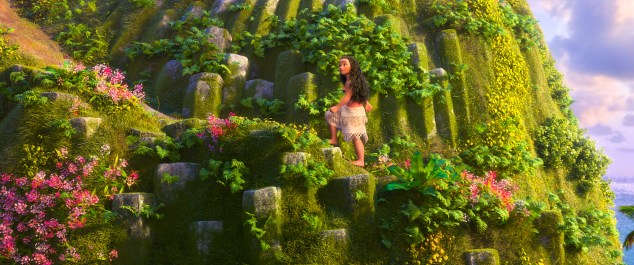
Moana has nearly convinced herself that she can live happily for the rest of her life on Motonui but fate has a different plan for this chief’s daughter. One day, as Moana is going about helping the people, a group comes up to show her a basket of rotten coconuts. No problem, Moana instructs them to start gathering from a different grove and to remove the diseased trees. But then the fishermen come up and show their empty baskets: there are no fish in the lagoon, nor are there any to be found in any of the other usual fishing spots that Moana suggests they try instead. While her father gets into a heated discussion with the fishermen, Moana is struck by a brilliant idea: why don’t they go beyond the reef to fish? I believe that she is making a sincere suggestion that might help the island (and not just because she wants to go explore herself) but her father does not see it that way at all. He rejects her flatly and insists they will find another way because “no one sails beyond the reef.”
Disheartened (again), Moana remains on the beach and ponders her seemingly unending desire to explore the ocean. This is the setting of “How Far I’ll Go.” There’s a version of this song in almost every animated Disney song that I can think of:
And those are just to name a few! But despite this type of song showing up in so many films, it doesn’t change the fact that I love this song! It resonates with me because I too struggle with wanting to do things that people close to me do not always understand.
I’ve been staring at the edge of the water Long as I can remember Never really knowing why I wish I could be the perfect daughter But I come back to the water No matter how hard I try
Every turn I take, every trail I track Every path I make, every road leads back To the place I know where I cannot go Where I long to be
See the line where the sky meets the sea It calls me And no one knows How far it goes If the wind in my sail on the sea Stays behind me One day, I’ll know If I go, there’s just no telling how far I’ll go
I know everybody on this island Seems so happy on this island Everything is by design I know everybody on this island Has a role on this island So maybe I can roll with mine
Moana’s argument does make sense: everybody else is perfectly happy with their roles on the island, so why shouldn’t she be content with her role as a chief’s daughter (and future chief in her own right)? She doesn’t understand why she’s drawn back time and time again to the ocean, in fact she wonders if there’s something wrong with her!
I can lead with pride I can make us strong I’ll be satisfied if I play along But the voice inside Sings a different song What is wrong with me?
All of Moana’s doubts are swept away every time she stares back at the ocean. Deep down, nothing else matters if she can just get out there and explore. That’s why, despite just hearing her father say no one can go beyond the reef, Moana runs back to the beach, grabs a boat and begins paddling out into the lagoon (despite not knowing the first thing about sailing!!)
See the light as it shines on the sea It’s blinding But no one knows How deep it goes And it seems like it’s calling out to me So come find me And let me know What’s beyond that line? Will I cross that line? See the line where the sky meets the sea It calls me And no one knows How far it goes If the wind in my sail on the sea Stays behind me One day, I’ll know How far I’ll go
The song ends on a high note but almost immediately turns into disaster when Moana’s boat is capsized and she nearly drowns with her foot stuck in the coral reef. This scene subverted a fairly common Disney trope where the hero/heroine gets caught doing something they shouldn’t by the stern authority figure/parent. I fully expected Moana to get caught by her father and get another tongue-lashing, but instead the only one who catches her is her beloved grandmother Tala (who doesn’t mind at all that Moana loves the ocean).
“How Far I’ll Go” was composed and written by Lin-Manuel Miranda (of Hamilton fame) and remains one of my favorite Disney songs almost two years after the film came out in theaters. What do you think of “How Far I’ll Go?” Let me know your thoughts in the comments below and have a great day!
Prince John is, not surprisingly, infuriated when he hears what the people of Nottingham are singing about him. So, he decides the town should sing “a new tune.”
“Double the taxes,” he cries “triple the taxes! SQUEEZE every last drop out of those insolent, musical peasants.”
It’s left to Alan-a-Dale to explain what happens next. Whereas before the town was merely oppressed by high taxes, now it’s been completely ruined. Anyone who can’t pay their taxes ends up in a dungeon deep inside Nottingham Castle. And since everyone was destitute to begin with, this means the entire population of Nottingham is imprisoned (even the minstrel rooster, who sadly sings about the woes of the town).
Every town… Has its ups and downs… Sometimes ups… Outnumber the downs… But not in Nottingham
I’m inclined to believe, If we were so down, We’d up and leave, We’d up and fly if we had wings for flyin’… Can’t you see the tears we’re cryin’? Can’t there be some happiness for me? Not in Nottingham.
The song is intermixed with various scenes of the townspeople sleeping in the dungeon. There is even a chain gang of raccoons being led inside, presumably after a long day of hard labor. It seems the only ones not locked up are Friar Tuck and the two church mice. Tuck is ringing the church bell to announce the evening service, but nobody is coming. Nevertheless, the friar is determined to keep hope alive, even though no one has donated to the church’s poor box in ages. This gives Mrs. Church Mouse an idea; there’s one last farthing saved in their little home in the church wall, but she decides the poor need it more than they do. Cue the arrival of the Sheriff of Nottingham to ruin the moment (it’s almost like he has an internal sensor to let him know when there’s any money around).
When the wolf takes the just-donated farthing for “taxes,” Friar Tuck reaches his limit with the fat Sheriff. He forces the wolf outside to give him a good thrashing with a quarterstaff; unfortunately that gives the Sheriff grounds to arrest the badger for high treason and he’s led off to jail to join the rest of the people of Nottingham.
I’ve always liked “Not in Nottingham,” it’s so sad but it also perfectly sums up the desperate situation happening in the town. Roger Miller’s performance is rich, smooth and a joy to listen to. What do you think of the song “Not in Nottingham”? Let me know your thoughts in the comments below and have a great day!











 Film Music Central