Tag Archives: film music

Brian Tyler “Alien vs. Predator: Requiem” scoring session (2007)

Note: I apologize for the blurry quality of the video, but the sound quality is perfect)

“Alien vs. Predator: Requiem” scoring session (2007)

It seemed like genius when Hollywood conceived the idea to do a crossover between the Alien and Predator franchises. Think about it: two “ultimate” alien species meeting each other, it’s potential movie GOLD! And to be fair, the first Alien vs. Predator did reasonably well, well enough for a sequel to be commissioned at any rate. Unfortunately, Alien vs. Predator: Requiem was….not so good (to put it politely). In fact, one of the few things praised about the film was Brian Tyler’s score (one of his earlier works).

u4S3eIGmG3LWEdPucNlEcFXv3Ng

If you haven’t seen the film, you’re not missing much. It basically picks up about five minutes after the first Alien vs. Predator film ends, with a hybrid Alien/Predator (known as a Predalien) bursting from a slain Predator, damaging their spaceship and sending it hurtling back to Earth. It sounds like it should be a great story (but trust me, it isn’t). Despite the film’s many, MANY flaws, Brian Tyler’s score does what it can to add some suspense to the story, and in the recording session footage that I found, you can hear the complexity that was woven into the material by the composer. I hope you enjoy listening to an example of Brian Tyler’s earlier work (he’d only been working on film scores for 10 years at this stage) and I apologize again for the blurry video quality.

You can become a patron of the blog at patreon.com/musicgamer460

See also:

Film Composer Interviews A-H

Film Composer Interviews K-Z

Brian Tyler scoring Partition (2007)

Brian Tyler talks War (2007)

Brian Tyler talks Rambo (2008)

Brian Tyler “Law Abiding Citizen” scoring sessions (2009)

Brian Tyler “Dragonball Evolution” scoring session (2009)

Brian Tyler talks The Expendables (2010) 

Brian Tyler talks Fast Five (2011)

Brian Tyler “Battle: Los Angeles” (2011) scoring session

Brian Tyler scoring session for Iron Man 3 (2013)

Brian Tyler “Teenage Mutant Ninja Turtles” (2014) scoring session

Brian Tyler conducting and scoring Now You See Me 2 (2016)

Brian Tyler “Power Rangers” scoring session (2017)

Brian Tyler conducts The Mummy (2017)

And don’t forget to like Film Music Central on Facebook

Mulan “Reflection” (1998)

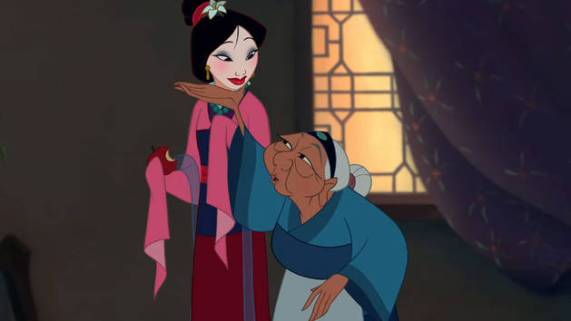
To say that Mulan’s visit with the matchmaker went badly would be an understatement: it was an unmitigated disaster. And what’s more, the matchmaker pronounced these words of doom: “You may look like a bride, but you will NEVER bring your family honor!” In other words, Mulan has been deemed incapable of making a good marriage, and considering she’s the only child of her family, that’s nothing short of catastrophic. Upset because she’s let everyone down, Mulan heads home to think about where her place in life really is. This is the song “Reflection” and it touches close to my heart because I’ve been where Mulan is at times.


In “Reflection” Mulan expresses how she is suffering from an identity crisis. Her whole life she’s been prepared to be the “perfect bride”, and now that she’s failed, where does she go from here? She can’t really be herself, because that upsets her family. In her guise as a perfect young lady, Mulan doesn’t even recognize herself:

Look at me, I will never pass for a perfect bride, or a perfect daughter.

Can it be, I’m not meant to play this part?

Now I see, that if I were truly to be myself, I would break my family’s heart…

I think this song speaks to everyone, male or female, that is struggling to discover who they really are, not what society dictates they should be. I find the chorus to be very powerful.

Reflection-mulan-32957031-1904-1071

Who is that girl I see? Staring straight, back at me? Why is my reflection someone I don’t know? 

Somehow I cannot hide, who I am, though I’ve tried,

When will my reflection show, who I am inside?

Mulan-Reflection-6

And this image of Mulan with half the makeup on is really striking: this is the visual evidence that she is caught between two worlds: a world where she can be herself, and the traditional world where everyone wants her to live.

I also really like the conversation Mulan has with her father under the cherry tree. He doesn’t yell or rant, he doesn’t even act angry. Instead he talks about how beautiful the cherry blossoms are this year. One blossom, however, hasn’t bloomed with the others. But when it does bloom, it will be the most beautiful blossom of all. This is a beautiful analogy: as her father sees it, Mulan is simply a late-bloomer, and someday he’s sure she’ll make him very proud (despite what the matchmaker said).

One last note: people keep trying to tell me that this is Christina Aguilera singing in this scene and it is NOT. Christina Aguilera sings the pop version of “Reflection” while Lea Salonga sings in the movie version. What do you think of “Reflection?” Leave a comment below and tell me what you think 🙂 Next time, we’ll take a break and look at an orchestral selection with “Mulan’s Decision.”

Become a patron of the blog at: patreon.com/musicgamer460

Check out the YouTube channel (and consider hitting the subscribe button)

See also:

Mulan “Honor to Us All” (1998)

Mulan “Mulan’s Decision” (1998)

Mulan “I’ll Make a Man Out of You” (1998)

Mulan “A Girl Worth Fighting For” (1998)

Mulan “The Huns Attack” (1998)

Mulan “I’ve Heard a Great Deal About You Fa Mulan…” (1998)

And don’t forget to like Film Music Central on Facebook

Mulan “Honor to Us All” (1998)

Mulan was the 36th entry in Disney’s Animated Classics series. The film is based on the legend of Hua Mulan, a woman who lived during the Han Dynasty. For twelve years she practiced kung fu and fought in the army, becoming a well-respected soldier before retiring to her hometown. The score was composed and conducted by the legendary Jerry Goldsmith, while the songs were written by Matthew Wilder and David Zippel.

I remember seeing the trailers for Mulan in the theater, and this film certainly didn’t disappoint me once I saw it for myself. The animation is stunningly gorgeous, the colors are vibrant and the story is very well done. After nearly a decade of churning out great animated films, Disney was in peak form and it really shows here.

In Disney’s Mulan, the story starts at the Great Wall of China. While the guards patrol, invaders suddenly appear: it’s the Huns, led by the feared warrior leader Shan Yu! The Hun leader sees the Great Wall as a personal challenge from the Emperor and he’s more than happy to invade and prove that his army is superior. News of the Hun invasion is brought to the Imperial Palace, and the Emperor commands that all reserves be called up, as he puts it: “A single grain of rice can tip the scales; one man, may be the difference, between victory and defeat.”

At the same time, Mulan is practicing for some type of examination (she’s painting cheat notes on her forearm). Today is a very big day: this is the day Mulan is presented to the local matchmaker to determine what sort of husband she will have. Being a girl in ancient China, making a good marriage is the only way that Mulan can bring honor to her family. Well, for such a big day, it’s not getting off to a great start, because Mulan is LATE!!

maxresdefault (1)

Racing into town on her horse Khan, Mulan is ushered into a series of rooms where she is bathed, dressed and painted to look like a beautiful, traditional Chinese lady from a good family. This is the setting of “Honor to Us All.” Each section of Mulan’s preparation constitutes a different verse of the song, and each verse sings of how obedient girls should be, how finding a great husband is everything, and being the best wife one can be brings great honor to the family and honor is EVERYTHING.

This is what you give me to work with?
Well, honey, I’ve seen worse
We’re gonna turn this sow’s ear
Into a silk purse

We’ll have you washed and dried
Primped and polished till you glow with pride
Trust my recipe for instant bride
You’ll bring honor to us all

Wait and see
When we’re through
Boys will gladly go to war for you
With good fortune
And a great hairdo
You’ll bring honor to us all

During this sequence, there are already hints that Mulan is not your average girl. For one, she has no qualms about riding a horse into town, hair all askew. For another, she appears to have a mind for strategy: in between rooms, she passes by two men playing a game called Go. After observing the board, she makes a move that apparently wins the game for one of the players (though neither of the men could see the move themselves).

image_367787bc

A girl can bring her family
Great honor in one way
By striking a good match
And this could be the day

Men want girls with good taste
Calm, Obedient, who work fast paced

With good breeding (and a tiny waist)

You’ll bring honor to us all

When we’re through, you can’t fail
Like a lotus blossom soft and pale
How could any fellow say “No sale”
You’ll bring honor to us all

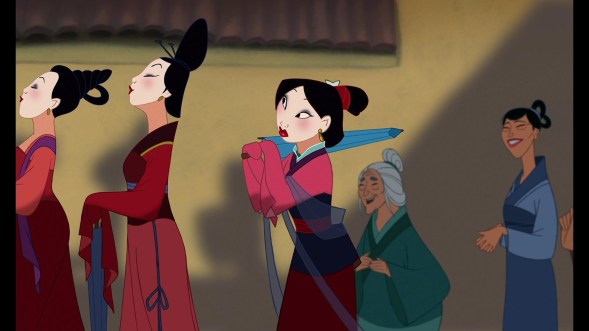
Mulan looks distinctly uncomfortable while being dressed up, and deep down she is terrified of disappointing her family. Mulan is barely finished in time and must go racing after the other girls who are already en route to the matchmaker.

maxresdefault

Scarier than the undertaker
We are meeting our matchmaker

Destiny
Guard our girls
And our future as it fast unfurls
Please look kindly on these cultured pearls
Each a perfect porcelain doll

Please bring honor to us
Please bring honor to us all!

In the nick of time, Mulan is able to join the other girls and comport herself so that she too looks like a perfectly behaved young lady. But while the other girls in line seem quite happy to be meeting the matchmaker, Mulan still isn’t quite sure about the whole affair, but it’s too late to back out now, because they’ve arrived at the matchmaker’s house.

Random thoughts and trivia!

  • I LOVE the reveal of who “Little Brother” really is. You absolutely expect a human, only to find that it’s….a dog!
  • Mulan’s singing voice is provided by Lea Salonga, who was also the singing voice of Princess Jasmine.
  • Mulan’s SPEAKING voice is provided by Ming-Na Wen, aka Melinda May in Agents of SHIELD
  • Grandmother Fa is voiced by June Foray, better known for voicing Granny and Witch Hazel in the Looney Tunes cartoons, among many other roles
  • Mulan is the final film in the Disney Renaissance to be presented in the format of a musical.

I hope you enjoy listening to “Honor to Us All”!

Become a Patron of the blog at patreon.com/musicgamer460

Check out the YouTube channel (and consider hitting the subscribe button)

For more great Disney songs and films, check out the main page here: Disney Films & Soundtracks A-Z

See also:

Mulan “Reflection” (1998)

Mulan “Mulan’s Decision” (1998)

Mulan “I’ll Make a Man Out of You” (1998)

Mulan “A Girl Worth Fighting For” (1998)

Mulan “The Huns Attack” (1998)

Mulan “I’ve Heard a Great Deal About You Fa Mulan…” (1998)

Like Film Music Central on Facebook here

*all images are the property of Walt Disney Studios

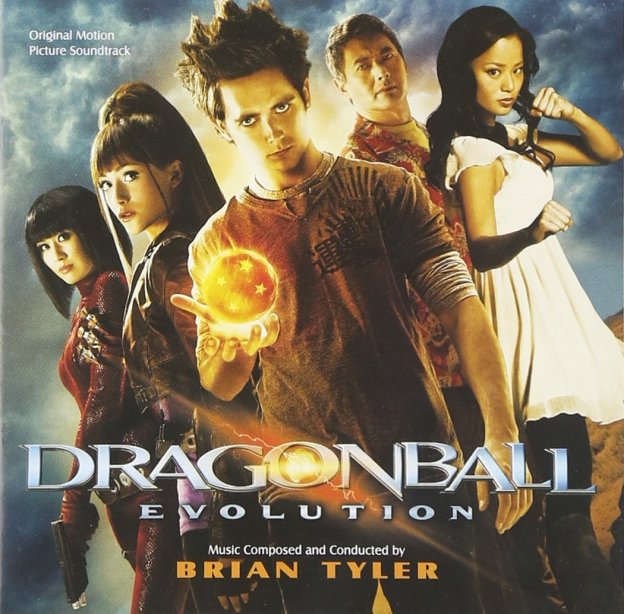
Brian Tyler “Dragonball Evolution” scoring session (2009)

“Dragonball Evolution” scoring session (2009)

I bet I know what you’re thinking: WHAT? They made a live-action movie based on Dragon Ball? Where, when and how can I get it???

Not.so.fast.

There’s a reason you likely haven’t heard of this film (and if you have seen it, you know what I’m about to say): it SUCKS. Badly. I mean REALLY badly. So badly that Akira Toriyama, the creator of the Dragon Ball manga, practically disowned the film. Yea, that’s pretty bad.

Based on the titular Dragon Ball manga, the film follows Goku and Bulma as they travel together to gather the seven Dragon Balls in a race to stop the demon Lord Piccolo before he can gather them first. Several of the major characters from the series are encountered: Goku, Chi-Chi, Bulma, Master Roshi, Piccolo and Yamcha. Shen Long, the legendary wish-granting dragon who only appears when the seven dragon balls are gathered, makes an appearance as well.

dragonball-evolution-poster

Despite the film being an overwhelming failure, there is one bright spot: the musical score, composed and conducted by Brian Tyler. The score was very well received and positively compared to other contemporary film scores.

dragon-ball-evolution-1013099

I found this short clip from a recording session for the film uploaded in February of 2009. What I love about Brian Tyler’s musical style, is that he doesn’t completely abandon classical conventions, the way some 21st century composers do. Instead, he works to blend the traditional orchestral sound with more “modern” themes using synthesizers and electronic instruments. He essentially goes for the best of both worlds and so far he has nailed it every time.

 Enjoy this look at the recording of the Dragonball Evolution soundtrack, and if you’re interested in the series, try the Dragon Ball and Dragon Ball Z anime instead of this film.

You can become a patron of the blog at patreon.com/musicgamer460

See also:

Film Composer Interviews A-H

Film Composer Interviews K-Z

Brian Tyler “Alien vs. Predator: Requiem” scoring session (2007)

Brian Tyler scoring Partition (2007)

Brian Tyler talks War (2007)

Brian Tyler talks Rambo (2008)

Brian Tyler “Law Abiding Citizen” scoring sessions (2009)

Brian Tyler talks The Expendables (2010) 

Brian Tyler talks Fast Five (2011)

Brian Tyler “Battle: Los Angeles” (2011) scoring session

Brian Tyler scoring session for Iron Man 3 (2013)

Brian Tyler “Teenage Mutant Ninja Turtles” (2014) scoring session

Brian Tyler conducting and scoring Now You See Me 2 (2016)

Brian Tyler “Power Rangers” scoring session (2017)

Brian Tyler conducts The Mummy (2017)

Like Film Music Central on Facebook here

*film poster is the property of 20th Century Fox

Quo Vadis (1951): Sword and Sandal Blogathon

This post is part of the Sword and Sandal blogathon hosted by Moon in Gemini

Poster_-_Quo_Vadis_(1951)_01.jpg

The 1950s were known for many things, but in Hollywood, they were primarily known as the decade of the Biblical epic. A number of great epics including Quo Vadis were made in this ten year span, films such as The Ten Commandments (1956), Ben Hur (1959), David and Bathsheba (1951), Solomon and Sheba (1959), etc. Quo Vadis is considered one of the greats of this era, and rightfully so.

Quo Vadis- Marcus and Lygia first meet

Based on the best selling novel Quo Vadis: A Narrative of the Time of Nero (1895) by Henryk Sienkiewicz, the film follows the Roman tribune Marcus Vinicius (Robert Taylor) as he encounters a mysterious sect called “Christians” after falling in love with a captive woman named Lygia (who belongs to this mysterious cult). Marcus, who holds token respect for the Roman gods at the beginning of the story, initially cannot fathom this Christ that the Christians hold in great reverence. In his mind, he loves Lygia (Deborah Kerr), therefore Lygia should love him back and that should be the end of it. But even though Lygia DOES love Marcus in return, her faith in God is too strong to permit her to leave her faith for the love of one man.

Peter Ustinov Quo Vadis

Ustinov’s portrayal of Nero is quite chilling at times

All of this takes place during the reign of the Emperor Nero (Peter Ustinov), a spoiled, full-of-himself ruler, who believes he is a god on Earth (and is worshipped as such), capable of doing no wrong, a veritable genius (though his musical skills are mediocre at best). His wife, the Empress Poppaea, has eyes only for Marcus, and sees Lygia as a rival that should be eliminated. Attempting to keep the half-mad Emperor in line is Gaius Petronius, Nero’s “arbiter of elegance” (and also the uncle of Marcus). Petronius maintains his place in court by simultaneously mocking and then praising Nero to the heavens in such a witty fashion that Nero cannot bear to part with him.

shotimg48268_3

Lygia is not happy with Marcus

Impatient to have Lygia, Marcus decides to have her kidnapped from her foster home (since she is technically a Roman hostage, being the daughter of a pagan king who fought against Rome and therefore belongs to Nero) and brought to the palace, to be given to Marcus at a feast, as a reward for being so successful in recent combat. Lygia manages to escape though, and goes into hiding with other Christians. Marcus tracks her to a secret gathering led by the apostle Paul and Peter himself, newly arrived in Rome. While he is intrigued by the Christian teachings, Marcus cannot (as yet) believe in them, but he understands enough to let Lygia go and promises not to follow her anymore.

Quo Vadis- Nero sings while Rome burns

At the same time though, the Christians are becoming an annoying thorn in Nero’s side, as is the city of Rome itself. The former bothers him because they deny his divinity, and the latter bothers him because of its overwhelming corruption. Petronius unwittingly gives Nero an idea when he mocks the emperor’s epic about “burning Troy” because the emperor had never seen a burning city himself. After moving the imperial court safely to Antium, Nero makes plans to have the city (barring the Palatine area where the wealthy live) set ablaze, while he returns to compose his greatest epic. When the arson backfires (thanks to the intervention of Marcus) and many people end up escaping with their lives, the emperor needs a scapegoat to divert attention from himself. Against the protests of Petronius, Nero writes an edict pronouncing the Christians are responsible for burning Rome and are henceforth enemies of the state. In despair, Petronius commits suicide several days later (but not before endorsing the Roman general Galba as a replacement ruler for Nero).

Quo Vadis- Marcus looks for Lygia

maxresdefault

Peter is successfully smuggled out of Rome along with a young boy named Nazarius. But along the way, Christ comes to Peter (speaking through the boy) and when Peter asks “Quo Vadis Domine?/Where are you going Lord?, Christ answers “My people in Rome have need of thee, if thou deserts my people, I shall go and be crucified a second time.” By which Peter understood that he needed to go back to Rome, because it was time that he gave his life while preaching the Word.

The Empress Poppaea, seeing Marcus really is in love with Lygia after he rescues her from the fire, arranges to have him arrested and thrown in jail with the other Christians, among whom are Peter and Lygia’s foster parents. Over the course of several days, the Christians are systematically killed, some by lion, some by crucifixion while being burned alive. But Nero finds no joy in the spectacle, because, instead of screaming in terror, the Christians go singing to their deaths, proclaiming the world that is to come with their words. Nero decides to have Peter crucified upside down as an example, but still the Christians go singing as they die. Poppaea has one final spectacle planned: while Marcus stands bound at her side, Lygia will be tied to a post in the arena, while a wild bull is let loose. Only her giant protector, Ursus, will be able to stop the bull from killing Lygia. As the fight goes on, Marcus struggles to get free, and in a visible leap of faith, begins to pray for Christ to give Ursus strength to kill the bull, which happens!! In the chaos, Marcus breaks his bonds and jumps to the arena floor, telling the people of Rome the truth: that NERO burned Rome and it is Nero who should die, with General Galba set up in his place. Nero flees for his life, but ultimately commits suicide, urged on by Acte, a former wife (who still loves Nero despite everything and doesn’t want to see the crowds rip him apart).

For now, Rome is safe again, as General Galba rides triumphant into Rome, while Marcus, Lygia, Nazarius, and Ursus, ride away from the city, to places unknown.

The score for this film is one of my favorites and was composed by Miklos Rozsa. Rozsa is probably best known for his work on Ben-Hur (1959), and not many know that several themes heard in that film were created for Quo Vadis eight years earlier. Rozsa spent a great deal of time researching ancient music and instruments for this film, and assisted the props team in creating highly detailed replicas of ancient musical instruments that were seen all over the film.

The “Quo Vadis” of the title comes from the pivotal moment when Peter encounters Christ while fleeing Rome and asks him “Quo Vadis Domine?” Where are you going Lord? The story can be found in the Apocrypha of the Bible.

Biblical epics can be hard to get through because of their sheer length, but Quo Vadis is worth watching at least once if you’ve never seen it before. Made in an era long before CGI, the hand-built models and miniatures give scenes (especially the burning of Rome sequence) a sense of reality that you would be hard pressed to find today.

This is my entry for the Sword and Sandal blogathon, and I hope you enjoyed it!

You can become a patron of the blog at patreon.com/musicgamer460

Check out the YouTube channel (and consider hitting the subscribe button)

Like Film Music Central on Facebook here

*film poster and images are the property of MGM

 

Michael Giacchino talks Jupiter Ascending (2015)

Michael Giacchino talks Jupiter Ascending (2015)

Oh Jupiter Ascending….if I could describe this movie in one word it would be potential. This movie had the potential to be so incredibly awesome. Think about it: in a world where reboots, remakes, sequels and franchises are the norm in Hollywood, it’s very rare to find a film with a wholly original concept.

And the concept sounds great on paper: the galaxy is ruled by a group of alien royal dynasties, who harvest the life forces of evolved planets in order to remain perpetually young themselves.

JUPITER ASCENDING

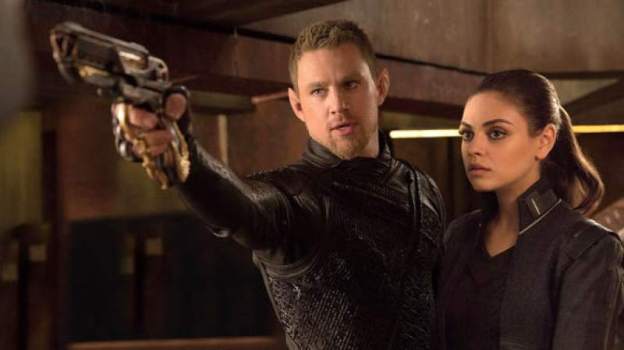
An ordinary human girl, Jupiter Jones, finds out that due to her genetic makeup, she is actually the heiress to the planet Earth. However, the alien Balem, one of the sons of the previous owner of the planet, wants Earth for himself, as Earth is meant to be harvested next.Jupiter finds herself plunged into interstellar intrigue with the fate of planet Earth at stake.

It sounds really good, it SHOULD have been really good, and yet….despite amazing visuals and a gorgeous score from Michael Giacchino (more on that in a minute), this film fell FLAT and I mean really flat!!! Portions of the dialogue were cringe-worthy, and the performance of several actors was criticized as wooden, flat and generally not as good as it could have been. In other words, Jupiter Ascending launched into theaters and then was quietly never heard of again.

Jupiter Ascending Soundtrack

One of the few bright spots in this film was the score, written as I said by Michael Giacchino. In this interview that I discovered, Giacchino explained that when the Wachowskis approached him about scoring this film, they actually asked him to write the music BEFORE the film had been shot, so they could edit the film around the music.

020315-jupiter-ascending-mila-kunis-costume-594

This is rarely seen in the world of film music, as normal practice is to make the film first and THEN create the musical score. In effect then, the Wachowski’s were asking Michael Giacchino to create a “symphony” for Jupiter Ascending that would then be edited into a proper film score.

JUPITER ASCENDING

While I can’t necessarily recommend the film itself, I do recommend checking out the soundtrack to this film (see the link above) and take a few moments to enjoy the music that Giacchino worked so hard to create. It always hurts when a great score is attached to a less-than-stellar film. But, such are the risks of being a film composer. Enjoy the interview!

(I apologize for the background noise, it sounds like they filmed in a restaurant)

See also:

Michael Giacchino talks The Incredibles (2004)

Michael Giacchino talks Mission: Impossible 3 (2006)

Michael Giacchino talks Ratatouille (2007)

Michael Giacchino talks Up (2009)

Michael Giacchino talks Star Trek (2009)

Michael Giacchino talks Super 8 (2011)

Michael Giacchino talks John Carter (2012)

Michael Giacchino talks Star Trek: Into Darkness (2013)

Michael Giacchino talks Jurassic World (2015)

Michael Giacchino scoring Rogue One: A Star Wars Story (2016)

Michael Giacchino talks Zootopia (2016)

Michael Giacchino talks Jurassic World: Fallen Kingdom (2018)

Film Composer Interviews A-H

Film Composer Interviews K-Z

Become a patron of the blog at: patreon.com/musicgamer460

Check out the YouTube channel (and consider hitting the subscribe button)

Like Film Music Central on Facebook here

*film poster is the property of Warner Bros. Pictures

Michael Giacchino talks Star Trek: Into Darkness (2013)

I’m still not sure what J.J. Abrams was thinking about when he was working on this movie. Everyone who knows about Star Trek knows that Star Trek II: The Wrath of Khan is considered to be the greatest film in the classic franchise, and that it would be downright suicidal to tamper with it in any way. Well…tamper they did, because Into Darkness, the follow up to Star Trek (2009) is nothing less than a poorly disguised remake of Wrath of Khan, and suffice it to say it did not improve on the original. To sum up the plot in brief: Kirk and his crew must stop the brilliant Khan, along with a renegade Admiral, from causing a full-scale war to break out between the Federation and the Klingon Empire. This includes engaging the superior USS Vengeance and stopping Khan from using it as a means to destroy Starfleet Headquarters! This is also the final film to feature Leonard Nimoy in his role as the original Spock (also known as Spock Prime).

To be fair, Benedict Cumberbatch turns in an excellent performance as the villain, and the main cast performs admirably, but still, the fact remains that the producers chose to rehash old territory, instead of making something new. But I digress…

(for my full thoughts on this film, see: On this day in Film History: Into Darkness? More like a rip-off of Khan )

I was beginning to despair of ever finding an interview for this film when suddenly, out of nowhere, I spotted a video with Giacchino’s name and Into Darkness put together. It seems that while promoting the film, Giacchino gave an interview on the film for a German media site/group (I’m not sure which), and the best part is the interview is nearly ten minutes long! It is so rare to find any lengthy interviews with film composers, so I knew I had to share this one with you.

Giacchino is asked several questions about the process of creating the score for Into Darkness (I apologize in advance because the displayed questions are in German), whether certain characters have their own theme (he discusses Khan’s theme in particular) and what it was like to work on such a legendary franchise. This is not just a regular interview though, there are cuts to footage from the film to show certain themes that the composer is talking about, which makes this interview even more valuable.

See also:

Michael Giacchino talks The Incredibles (2004)

Michael Giacchino talks Mission: Impossible 3 (2006)

Michael Giacchino talks Ratatouille (2007)

Michael Giacchino talks Up (2009)

Michael Giacchino talks Star Trek (2009)

Michael Giacchino talks Super 8 (2011)

Michael Giacchino talks John Carter (2012)

Michael Giacchino talks Jupiter Ascending (2015)

Michael Giacchino talks Jurassic World (2015)

Michael Giacchino scoring Rogue One: A Star Wars Story (2016)

Michael Giacchino talks Zootopia (2016)

Michael Giacchino talks Jurassic World: Fallen Kingdom (2018)

Film Composer Interviews A-H

Film Composer Interviews K-Z

Become a patron of the blog at: patreon.com/musicgamer460

Check out the YouTube channel (and consider hitting the subscribe button)

Like Film Music Central on Facebook here

Michael Giacchino talks Star Trek (2009)

It’s no secret that I’m not exactly the biggest fan of the rebooted Star Trek franchise. However, I can’t deny that Michael Giacchino’s score for the film was well done. I was delighted to find a short interview given by the composer regarding his work on this film as part of a “Star Trek in concert” event. Giacchino, like many, grew up watching the original Star Trek series and films, and now here he is with the task of continuing that legacy!

For anyone not familiar with the story: Star Trek takes place in an alternate universe created when the Romulan Nero (Eric Bana) travels back in time to destroy the planet Vulcan in revenge for his home planet of Romulus (which was destroyed in the future when a star went supernova). As a result, the original crew of the Enterprise that we’ve come to know so well (Kirk, Spock, McCoy and company) end up leading different lives and come together under much different circumstances. The question is, can they learn to work together quickly enough to stop Nero?

Whether you’re a fan of the new Star Trek or not, Giacchino’s music is definitely worth a few moments of your time. Here’s hoping that Star Trek Beyond also features an enjoyable score.

See also:

Michael Giacchino talks The Incredibles (2004)

Michael Giacchino talks Mission: Impossible 3 (2006)

Michael Giacchino talks Ratatouille (2007)

Michael Giacchino talks Up (2009)

Michael Giacchino talks Super 8 (2011)

Michael Giacchino talks John Carter (2012)

Michael Giacchino talks Star Trek: Into Darkness (2013)

Michael Giacchino talks Jupiter Ascending (2015)

Michael Giacchino talks Jurassic World (2015)

Michael Giacchino scoring Rogue One: A Star Wars Story (2016)

Michael Giacchino talks Zootopia (2016)

Michael Giacchino talks Jurassic World: Fallen Kingdom (2018)

Film Composer Interviews A-H

Film Composer Interviews K-Z

Become a Patron of the blog at patreon.com/musicgamer460

Check out the YouTube channel (and consider hitting the subscribe button)

Like Film Music Central on Facebook here

Marco Beltrami talks The Wolverine (2013)

MV5BNzg1MDQxMTQ2OF5BMl5BanBnXkFtZTcwMTk3MjAzOQ@@._V1_SX640_SY720_

Marco Beltrami talks The Wolverine (2013)

The Wolverine opened in 2013 as the sixth installment overall in the X-Men film franchise. This was not the first film to give an origin story for Hugh Jackman’s Wolverine. The studio had tried to tell this story once before in 2009 with X-Men Origins: Wolverine, and even though that film was a financial success, it fell flat with fans and critics. This time however, the studio succeeded and The Wolverine was praised by all.

The film follows Logan as he is taken to Japan to meet a Japanese businessman whose life he saved during the bombing of Nagasaki in 1945. Now dying, the elderly man, named Yashida, offers Logan a deal: transfer his healing factor to Yashida’s body, a process that would restore Yashida’s youth and turn Logan mortal (and Logan had previously expressed that he considered his immortality a curse). Logan refuses, but Yashida will not let him go just like that. The Wolverine must fight for his life, and battle some internal demons along the way.

THE WOLVERINE

Marco Beltrami was brought in to score the film and the brief interview clip above gives some insight into the scoring process that took place for this film. It’s always amazing to hear the music as it is being recorded, because often many sounds are lost in the muddle of the completed film (between sound effects, dialogue and other background noises), you rarely get the chance to hear the pure sound of the music.

Since most of this film is set in Japan, Beltrami used traditional Japanese instruments, but not in a “traditional” way. He wanted to stay away from the stereotype of hearing soft, traditional Japanese music when the scene is set in Japan. From what I’ve heard, I believe he did an excellent job. Please enjoy!

See also:

Marco Beltrami talks Blade II (2002)

Marco Beltrami and Marilyn Manson talk Resident Evil (2002)

Marco Beltrami talks Live Free or Die Hard (2007)

Marco Beltrami talks 3:10 to Yuma (2007)

Marco Beltrami talks World War Z (2013)

Film Composer Interviews A-H

Film Composer Interviews K-Z

Become a patron of the blog at: patreon.com/musicgamer460

Check out the YouTube channel (and consider hitting the subscribe button)

Like Film Music Central on Facebook here

John Ottman talks X-Men: Days of Future Past (2014)

xmen_days_of_future_past_ver5

John Ottman talks X-Men: Days of Future Past

After the success of X-Men: First Class (2011), 20th Century Fox launched production on X-Men: Days of Future Past, a film that served as a sequel not only to First Class, but also to The Last Stand (2006).

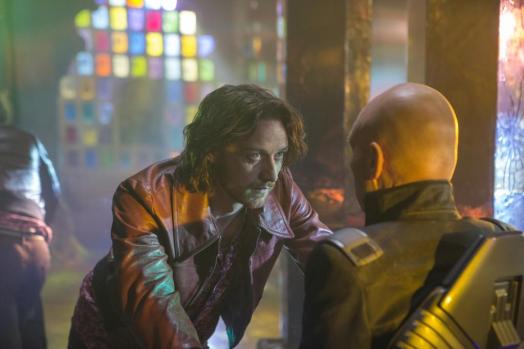
Beginning in the future, Days of Future Past shows a world in chaos. Near invincible Sentinel machines are exterminating mutants and any humans helping them. A group of mutants hiding in China include Professor Xavier, Magneto, Wolverine, Storm and Kitty Pryde. With it being only a matter of time before this last hideout is overrun by Sentinels, a plan is made to send Wolverine’s consciousness back in time fifty years to prevent Mystique from assassinating Dr. Bolivar Trask and thereby stop the eventual development of the Sentinels, saving the future in the process.

537e13b7ecad04770ef0af62-750-375

This film combined the original X-Men cast with the younger cast introduced in First Class (Wolverine, being essentially immortal, serves as a kind of go-between).

For the music, the score was composed by John Ottman, a longtime collaborator with director Bryan Singer. Ottman became the first composer to work on more than one X-Men film (having scored X2 in 2003) and retained the main theme of X2 for Days of Future Past. As the composer states in the interview, Singer asked that Ottman create something that sounded “more modern” (in the vein of other current superhero films) and move away from the more traditional sounds created by Henry Jackman in the score for First Class.

IH7A1365.CR2

I haven’t seen much of the new X-Men films (though I have seen the original trilogy), but the more I see and hear of the music, the more interested I become. Fans of the new trilogy should enjoy this look at how the music of Days of Future Past was created. Enjoy!

*film poster is the property of 20th Century Fox

You can become a patron of the blog at patreon.com/musicgamer460

See also:

John Ottman talks X2 (2003)

See also:

Film Composer Interviews A-H

Film Composer Interviews K-Z

Like Film Music Central on Facebook at www.facebook.com/filmmusiccentral