Tag Archives: film

My Thoughts on: The Golden Voyage of Sinbad (1973)

tumblr_mmfwn3314s1snwsxio2_1280

I have always been a fan of Ray Harryhausen’s stop-motion animation and his three Sinbad films are among my favorites. I particularly enjoy The Golden Voyage of Sinbad, the second Sinbad film that Harryhausen worked on. The film follows the legendary sailor (John Phillip Law) as he discovers a mysterious gold tablet before finding himself driven to the country of Marabia. There he meets the Grand Vizier (Douglas Wilmer) (who wears a golden mask to hide his burned face) and finds a second gold tablet that interlocks with the first. It turns out the tablets are a map to the lost island of Lemuria and Sinbad organizes his crew to sail there. But Sinbad and the Vizier aren’t the only ones interested in finding Lemuria: this place is also sought by Prince Koura (Tom Baker), an evil sorcerer who is angry that Sinbad has taken the gold tablet that a magical servant was bringing to him. Both sides race to find Lemuria and the secrets it contains.

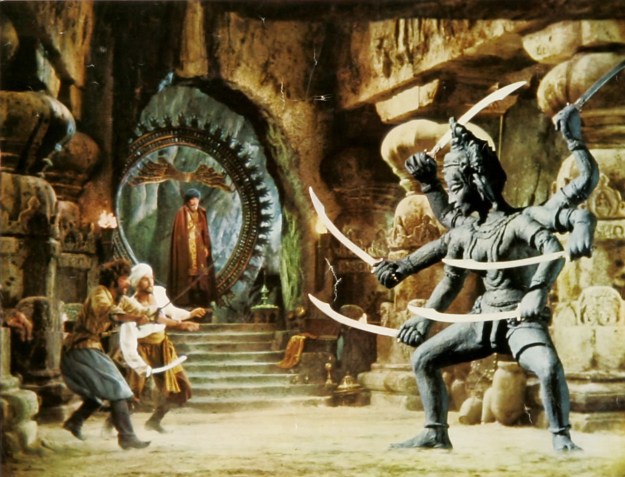
Kali dances for Koura

As with any Ray Harryhausen film, there are a number of stop-motion creations in this story. These include:

  • the homunculus: a tiny winged creature that Koura uses as a spy
  • the Siren: Koura uses his magic to bring the wooden figurehead of Sinbad’s ship to life.
  • the one-eyed centaur
  • a griffin

All of these creations are amazing to watch, but my favorite out of all of them is Harryhausen’s work on “Kali” a six-armed statue that Koura brings to life in a Lemurian temple. While named Kali, the statue bears more resemblance to the Hindu god Shiva (particularly in its initial pose before it comes to life). There is a beautiful scene where Koura orders Kali to dance and the statue obeys, all six arms moving throughout. Given how much care needs to be taken in stop-motion animation, I always find myself wondering just how long it took to animate the statue.

Centaur vs. Griffin

While the film is enjoyable, it also has several flaws. The one that bothers me the most is how Margiana (a slave girl that Sinbad frees after seeing her in a vision connected to the tablet) received a tattoo of an eye on her palm. It is revealed late in the film that this tattoo marks her as sacred to one of Lemuria’s gods but this revelation is extremely problematic because if Lemuria is a lost island that no one has found in centuries, then how did Margiana receive the tattoo for one of their gods? It seems awfully convenient to the plot that a mysterious tattoo just happens to coincide with the place Sinbad and company are trying to reach.

Time for some interesting trivia!

-That is indeed the same Tom Baker who played the Fourth Doctor in Doctor Who. In fact, Baker got the role of the Doctor because of his performance in this film.

-Christopher Lee was a front runner to play Prince Koura

-Miklos Rozsa scores this film and parts of the score are very similar to segments in Ben-Hur (1959)

One thing is for sure, they definitely don’t make films like The Golden Voyage of Sinbad anymore, which is a real shame since it is so much fun to watch. Let me know what you think of The Golden Voyage of Sinbad in the comments below and have a great day!

See also:

Film Reviews

Become a Patron of the blog at patreon.com/musicgamer460

Check out the YouTube channel (and consider hitting the subscribe button)

Don’t forget to like Film Music Central on Facebook

My Thoughts on: The LEGO Movie 2-The Second Part (2019)

*note: I’m trying to keep spoilers to a minimum but a few are going to leak out. So keep that in mind as you read my review!

One of the fears with sequels is that they won’t live up to the bar set by the first film, particularly when it’s a film as funny as the The LEGO Movie. Happily, The LEGO Movie 2: The Second Part proves to be a fun and entertaining story, though it is not without its fair share of weak moments.

The sequel picks up immediately where the first film left off, with Bricksburg invaded by “aliens” from the planet Duplo. The story then flashes forward five years and sees Bricksburg transformed into a post-apocalyptic wasteland. Honestly, I was unsure about the post-apocalyptic vibe, but it really does work. My biggest complaint is that we don’t see enough of this new Bricksburg. Most of the story takes place in and around the “Systar System,” where Emmet must go to rescue his kidnapped friends. I will say it is very funny to see Emmet (Chris Pratt) retaining his “Everything is Awesome” personality while everyone else goes hardcore.

lego-movie-2-620x370

There are a number of catchy songs in The LEGO Movie 2, all of which I loved. My favorites that I want to highlight include:

-“Not Evil” -Sung by the ruler of the Systar System, Queen Watevra Wa’Nabi (Tiffany Haddish), it’s a great song where the alien queen sings about all the ways she’s NOT evil (it’s as great as it sounds).

-“Catchy Song”- All I can say is “this song’s gonna get stuck inside your head.” You’ve been warned.

-“Gotham City Guys”-I can’t really give too much context for this song because that would spoiler a lot of the plot but this might be my absolute favorite song in the entire film.

-“Everything’s NOT Awesome”-The title speaks for itself.

8978fd87652851c61a79f75532408dd36dde769d

Aside from the awesome songs, mostly great plot and what I’m pretty sure is a wicked funny Twilight joke, I do have a problem with the last act of the film. It involves Emmet and his new friend Rex Dangervest (also played by Chris Pratt). Rex’s backstory involves a lot of time spent in live-action and it is by far the weakest part of the film. I’m pretty sure this sequence is meant to be funny in a roundabout sort of way, but to me it came across as awkward and incredibly fake (I couldn’t quite suspend my disbelief watching it). I also feel like the story relies a little too much on Finn (the kid from the first film) and his family for the plot to make sense. It’s not that the segments are bad (they’re not), I just feel like there’s too many of them. The good news is the story comes back together by the end and provides a satisfactory ending.

However, I really do think that this should be the end of the story and there should not be a LEGO Movie 3. I think that because the story, while funny, relied a bit too much on jokes it introduced in the first film. I can only imagine a third film would do that even more and thus lessen the humor.

In conclusion, The LEGO Movie 2 is a lot of fun, and if you liked the first film, you’re going to enjoy this one. It’s not quite as strong as the first film, but its weaknesses aren’t enough to derail the story. Let me know what you think about The LEGO Movie 2 in the comments below and have a great day!

See also:

Thinking about The LEGO Batman Movie (2017)

Thinking about: The LEGO Movie (2014)

Animated Film Reviews

Become a Patron of the blog at patreon.com/musicgamer460

Check out the YouTube channel (and consider hitting the subscribe button)

Don’t forget to like Film Music Central on Facebook

The Two Towers “Forth Eorlingas!” (2002)

forth.jpg

As the battle of Helm’s Deep draws to a close, all seems lost for our heroes. The Uruk-Hai have overrun the outer defenses and what forces remain are holed up inside the great hall. Theoden seems almost suicidal in his despondency (“So much death. What can man do against such reckless hate?”) but even as the enemy begins breaking through, Aragorn remembers that this is the day Gandalf promised to return with help. With this in mind, he encourages Theoden to ride out and take the Uruk-Hai head on. Eager to go down fighting (that’s certainly how it appears to me), Theoden agrees, proclaiming that “the horn of Helm Hammerhand shall sound in the Deep. One last time.”

The Two Towers “Forth Eorlingas!” (2002)

Interestingly, the music that starts this moment (beginning when Aragorn remembers Gandalf’s promise) is a soft rendition of the music heard in “The Last March of the Ents.” It might just be a coincidence, but it could also be a musical clue that the trees of Fangorn Forest have also arrived to take revenge on the Uruk-Hai for attacking them in the past.

As Theoden and the others get ready to charge out, Gimli runs up to a tower where a massive horn can be seen. If you haven’t read the books, this is the legendary horn of King Helm Hammerhand, a great king of Rohan who saved his people from destruction. He used to sound that horn every time he went into battle, and even after he died people would swear they could hear the horn sounding on certain nights. The sound of this horn was said to terrify all who heard it, so maybe Theoden is hoping to psych out the Uruk-Hai (even a little) when the moment comes.

I love the moment the charge begins. The music has remained relatively soft and steady all this time, even as Theoden utters these last lines and the doors threaten to give way:

Fell deeds awake. Now for wrath, now for ruin, and the red dawn!

At that moment, Gimli sounds the Horn of Helm and it’s this spine-tingling roar that instantly gives you goosebumps. In the next second, the door crashes down and Theoden leads a wild charge as the horn spurs them on. The music restarts as the king rides out into the morning light (a fanfare version of Rohan’s theme), but that glorious moment when all you hear is the horn is what sticks with me the most.

What do you think of this moment in “Forth Eorlingas”? Let me know your thoughts in the comments below and have a great day!

See also:

Become a Patron of the blog at patreon.com/musicgamer460

Check out the YouTube channel (and consider hitting the subscribe button)

Don’t forget to like Film Music Central on Facebook

The Return of the King “Lighting the Beacons” (2003)

The Return of the King “Ride of the Rohirrim” (2003)

The Return of The King “The Haradrim Arrive” (2003)

The Fellowship of the Ring “The Shire” (2001)

The Fellowship of the Ring “Shadow of the Past” (2001)

The Fellowship of the Ring “The Wood Elves/Passing of the Elves” (2001)

The Fellowship of the Ring “The Treason of Isengard” (2001)

The Fellowship of the Ring “A Knife in the Dark” (2001)

The Fellowship of the Ring “Flight to the Ford” (2001)

The Fellowship of the Ring “The Bridge of Khazad-Dum” (2001)

The Fellowship of the Ring “Many Meetings” (2001)

The Fellowship of the Ring “The Ring Goes South/Fellowship Main Theme” (2001)

The Fellowship of the Ring “In Dreams” (2001)

The Two Towers “Lament for Theodred” (2002)

The Two Towers “Last March of the Ents” (2002)


The Return of The King “The Haradrim Arrive” (2003)

download.png

The Return of the King “The Haradrim Arrive” (2003)

Yesterday I talked about “Ride of the Rohirrim” and how the riders crashed into the armies of Mordor. For a few glorious minutes it looks like the battle is definitively won, with Eomer eager to drive the orcs all the way to the river, while Theoden wants to make sure the city is secured. But suddenly, everything comes to a halt and we hear a strange booming in the distance along with shouting. The Haradrim (glimpsed in The Two Towers by Frodo, Sam, and Gollum) have arrived, mounted on enormous oliphaunts. The riders of Rohan are frozen by this sight (and if you listen closely, before the camera closes in on the oliphaunts, you can hear some of them say they’ve never seen anything like this). I’m not sure if this is actually a separate cue or not, but it is one of my favorite musical moments in The Return of the King.

What’s great about the Haradrim’s introduction to the scene is that all of the orchestral music has stopped (just moments before we had a rousing fanfare as the Rohirrim routed orcs left and right). Aside from the booming steps of the oliphaunts, all you hear for a few moments is the leering horn sounded by one of the Harad riders along with the war shouts of their fighters. I’m fascinated by the sound of this horn, as it helps to establish just how different the men of Harad are from anyone we’ve met before. Everything about it just sounds foreign. When the camera finally pans downward to capture an oliphaunt in all of its glory, the score finally returns with an ominous chord, to emphasize that the Haradrim are just as much a threat as the orcs. This impression is helped by the reveal that the oliphaunt’s tusks and feet are bound with metal spikes and razor sharp wire, ready to obliterate anything in their path (like horses, for example).

Theoden is not daunted, however, and quickly orders the riders to reform into a line, ready to charge. However, unlike the first charge, this one feels different. It’s understandably rushed given the Haradrim are swiftly approaching, but it also feels like more of a desperate gamble compared to the first charge (especially when you hear Theoden’s command to take them head-on). Given the ominous sounds in the score, it’s no surprise that this second charge is swiftly crushed by the oliphaunts, who literally sweep horses and riders from their path with their tusks (while archers and spear men have free reign to take out as many as they can).

What do you think about the arrival of the Haradrim? Let me know your thoughts in the comments below and have a great day!

See also:

Become a Patron of the blog at patreon.com/musicgamer460

Check out the YouTube channel (and consider hitting the subscribe button)

Don’t forget to like Film Music Central on Facebook 🙂

The Return of the King “Lighting the Beacons” (2003)

The Return of the King “Ride of the Rohirrim” (2003)

The Fellowship of the Ring “The Shire” (2001)

The Fellowship of the Ring “Shadow of the Past” (2001)

The Fellowship of the Ring “The Wood Elves/Passing of the Elves” (2001)

The Fellowship of the Ring “The Treason of Isengard” (2001)

The Fellowship of the Ring “A Knife in the Dark” (2001)

The Fellowship of the Ring “Flight to the Ford” (2001)

The Fellowship of the Ring “The Bridge of Khazad-Dum” (2001)

The Fellowship of the Ring “Many Meetings” (2001)

The Fellowship of the Ring “The Ring Goes South/Fellowship Main Theme” (2001)

The Fellowship of the Ring “In Dreams” (2001)

The Two Towers “Lament for Theodred” (2002)

The Two Towers “Last March of the Ents” (2002)

The Return of the King “Ride of the Rohirrim” (2003)

Rohirrim-e1435532015649.jpg

The Return of the King “Ride of the Rohirrim” (2003)

It’s one of the oldest tropes in storytelling, but also one of the best: when the heroes seem doomed to fail against overwhelming odds, more heroes suddenly arrive to lend their assistance. This is the setup that leads to “Ride of the Rohirrim,” one of the best cues in the entire film. At this point, Minas Tirith is close to being completely overrun by the armies of Mordor. Gandalf is doing his best to lead the defense but there’s simply too many of them (not to mention he also has the Witch King to deal with). But then…a distant horn call grabs everyone’s attention: Rohan has arrived!

The Return of the King “Ride of the Rohirrim” Soundtrack (2003)

The music starts off slow as Theoden gives his commanders their orders. But as the king launches into a rousing speech to his men, the music is filled with more and more trumpets, culminating in a blast as Theoden shouts “A sword day, a red day, ‘ere the Sun rises!” The music then briefly pulls back but not by much, it’s clear the climax for this scene is imminent. One of my favorite moments comes right before the charge when all the horns of Rohan are sounded at once (it actually gives me goosebumps every time I hear it).

The charge itself is followed by Rohan’s theme played over and over again as the Rohirrim charge the lines of Mordor. What’s clever here is that Howard Shore grows the theme in power with each iteration. No matter how many arrows the orcs send at them, the riders simply keep coming. I love how the charge builds with equal intensity, you can see the lust for battle building in all of the riders as they race forward. I also love the moment when it finally dawns on the orc commander that nothing is stopping this charge from hitting them head on. Finally, with trumpets blazing in the background, the cavalry strikes the orcs and decimates their forces. It’s a supremely uplifting moment that instantly restores hope that the good guys will win the day. But while Rohan’s arrival has somewhat evened the odds, our heroes are forgetting that Mordor has been holding forces in reserve all this time. For next time I’ll discuss the arrival of the Haradrim.

What do you think of “Ride of the Rohirrim”? Let me know your thoughts in the comments below and have a great day!

See also:

Become a Patron of the blog at patreon.com/musicgamer460

Check out the YouTube channel (and consider hitting the subscribe button)

Don’t forget to like Film Music Central on Facebook 🙂

The Return of the King “Lighting the Beacons” (2003)

The Fellowship of the Ring “The Shire” (2001)

The Fellowship of the Ring “Shadow of the Past” (2001)

The Fellowship of the Ring “The Wood Elves/Passing of the Elves” (2001)

The Fellowship of the Ring “The Treason of Isengard” (2001)

The Fellowship of the Ring “A Knife in the Dark” (2001)

The Fellowship of the Ring “Flight to the Ford” (2001)

The Fellowship of the Ring “The Bridge of Khazad-Dum” (2001)

The Fellowship of the Ring “Many Meetings” (2001)

The Fellowship of the Ring “The Ring Goes South/Fellowship Main Theme” (2001)

The Fellowship of the Ring “In Dreams” (2001)

The Two Towers “Lament for Theodred” (2002)

The Two Towers “Last March of the Ents” (2002)

All Dogs Go to Heaven “You Can’t Keep a Good Dog Down” (1989)

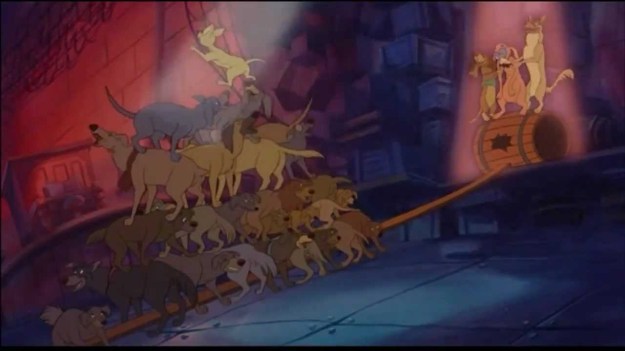
After literally digging his way out of the city pound (the canine equivalent of prison), Charlie (Burt Reynolds) and his long-suffering best friend Itchy (Dom DeLuise) make their way back to the casino that Charlie used to run with Carface (Charlie’s name is conspicuously scratched out on all the signs). All of the dogs are shocked to see Charlie, since apparently he was meant to be “on death row” (scheduled to be euthanized if I had to take a guess). Charlie doesn’t have a clue that it was Carface who set him up to be taken away in the first place, he’s too busy enjoying his freedom. As Charlie explains (with Itchy’s help), nothing is ever going to keep this dog down!


Why settle for a couple of bones when you can have the whole bank?”
Oh you can’t keep a good dog down (No sir)
No you can’t keep a good dog down
I’ve seen pain and hurt, I’ve eaten dirt (That’s true)
It’s hard to buy but even I have been jilted by a skirt (He lies)
But look out, I’m still around
Cause you can’t keep a good dog down

Ya can’t keep a good dog down (No you can’t)
No no no no, you can’t keep a good dog down
I’ve been bought and sold
He’s been warm and cold
But ten to one I’ll still be runnin’ rackets when I’m old
Not in some cage in the city pound
Cause you can’t keep a good dog
Can’t keep a good, I say you can’t keep a good dog down

In him’s the luck of the Irish
The pride of the German
And even a bit of Siam
Siam? You see the come of the English
The charm of the Spanish
A pedigree certainly ain’t what I am
So call me a mixed up pup
(You’re a mixed up pup)
But the only way this pup knows is up
Ya can’t keep a good dog down

maxresdefault (4).jpg

I need to talk about this verse before we move on to the rest of the song. I nearly fell over in shock when Itchy did the line “And even a bit of Siam” complete with a bowl on his head and a faux Asian face (granted it’s not as extreme as older Asian stereotypes, but still!) The reference to Siam is not a problem in and of itself as the film takes place about 4 months before Siam became Thailand (while only the year 1939 is given, Carface later mentions Mardi Gras which takes place in February). No, my problem is that in a film made in the late 1980s, they thought it was okay to include a racist, Asian stereotype. That is not okay!

This concludes my rant, now back to the song:

He’s been fat and thin
I’ve been out and in
He tried a life of virtue
But prefer a life of sin
So tonight when we own this town
I’ve known hunger, I’ve known thirst
Lived the best and seen the worst
But the only way I know to finish best to finish first
So watch out when you hear this sound
Cause you can’t keep a good dog, no ya
Can’t keep a good, I say you can’t keep a good dog down
You can’t keep a good dog down!

Burt Reynolds and Dom DeLuise were friends for many years and you can really feel a solid dynamic between them as they perform this song. The song makes it clear that Charlie is popular, charismatic and a confirmed crook (the last verse even mentions “He tried a life of virtue but prefer a life of sin” It’s not wonder Charlie is so nervous about judgement once he arrives in Heaven). I also noticed that despite being a dog, Charlie acts remarkably human during this scene (in that he stands and performs on two legs). Most of the time Charlie gets around like a regular dog, but this is a noticeable exception (sometimes I wonder if Bluth originally meant to make the dogs more anthropomorphic and then changed his mind).

The Siam moment aside (do let me know what you think about that in the comments), “You Can’t Keep a Good Dog Down” provides a rousing musical start to the film. Which is good because the story only gets darker from here (at some point I’ll write some articles pointing out all the Nightmare Fuel aspects of this film). In the meantime, let me know what you think about “You Can’t Keep a Good Dog Down” in the comments below and have a great day! Thanks for helping the blog reach 650 followers!

See also:

All Dogs Go to Heaven “Let Me Be Surprised” (1989)

All Dogs Go to Heaven 2 “It Feels so Good to be Bad!” (1996)

Disney/Dreamworks/Pixar/etc. Soundtracks A-Z

Become a patron of the blog at: patreon.com/musicgamer460

Check out the YouTube channel (and consider hitting the subscribe button)

Don’t forget to like Film Music Central on Facebook

The Hunchback of Notre Dame “Out There” (1996)

Quasimodo has one of the most dysfunctional and abusive upbringings in the Disney canon (even worse than Rapunzel’s, because while it’s true Mother Gothel kidnapped the princess and mentally abused her so she’d stay in the tower, she didn’t kill either of Rapunzel’s parents). After causing the death of Quasimodo’s mother, Judge Frollo (Tony Jay) nearly drowns her baby before the Archdeacon of Notre Dame stops him and orders him to raise the child as his own as penance for what he has done. Frollo translates this to keeping Quasimodo (Tom Hulce) locked up in the bell tower for the next twenty years, raising him to believe he is a monster that his mother abandoned.


As a young man, Quasimodo spends most of his days observing the residents of Paris (when not ringing the church bells) as they go about their daily lives, longing to walk among them. He especially wants to participate in the annual Feast of Fools and his friends the stone gargoyles encourage him to go. When Frollo learns that the bell-ringer tried to leave (again), he reminds Quasimodo that he is a monster and if he goes outside he’ll be reviled as such. The only way he can remain safe is to stay in the tower and do exactly as Frollo says. While Quasimodo acquiesces to his master’s wishes, his desire to experience life outside the cathedral remains and this is the theme for “Out There.”

maxresdefault (2).jpg

Safe behind these windows and these parapets of stone
Gazing at the people down below me
All my life, I watch them as I hide up here alone
Hungry for the histories they show me
All my life, I memorize their faces
Knowing them as they will never know me
All my life, I wonder how it feels to pass a day
Not above them
But part of them

And out there, living in the sun
Give me one day out there, all I ask is one
To hold forever
Out there, where they all live unaware
What I’d give
What I’d dare
Just to live one day out there

Out there among the millers and the weavers and their wives
Through the roofs and gables I can see them
Every day they shout and scold and go about their lives
Heedless of the gift it is to be them

If I was in their skin
I’d treasure every instant

Out there, strolling by the Seine
Taste a morning out there, like ordinary men
Who freely walk about there
Just one day and then, I swear
I’ll be content
With my share

Won’t resent
Won’t despair
Old and bent
I won’t care
I’ll have spent one day out there!

maxresdefault (3).jpg

Quasimodo expresses the wish of many Disney heroes and heroines: “I don’t like how my life currently is, but if I can just do this one thing I will be happy forever.” The song is practically a staple in Disney musicals but that isn’t a bad thing if it’s done properly and “Out There” is one of my favorite Disney songs. During the scene, Quasimodo clambers all over Notre Dame, letting you see the beautiful sculptures and architecture that make the cathedral so famous. The animators took a special trip to Paris to sketch the building and it really shows throughout the film.

Of course, if you’ve been keeping up with Disturbing Disney then you know Quasimodo’s first trip into the outside world will end badly. Despite that, it’s so easy to feel for the bell-ringer as he sings; to be that close to a bustling medieval city that you’re not allowed to visit would leave anyone feeling lonely and depressed (it’s amazing that Quasimodo grows up relatively well-adjusted).

What do you think about “Out There”? Let me know your thoughts in the comments below and have a great day!

See also:

The Hunchback of Notre Dame “The Bells of Notre Dame” (1996)

The Hunchback of Notre Dame “Topsy Turvy” (1996)

The Hunchback of Notre Dame “God Help the Outcasts” (1996)

The Hunchback of Notre Dame “Heaven’s Light/Hellfire” (1996)

The Hunchback of Notre Dame “The Court of Miracles” (1996)

Disney/Dreamworks/Pixar/etc. Soundtracks A-Z

Become a patron of the blog at: patreon.com/musicgamer460

Check out the YouTube channel (and consider hitting the subscribe button)

Don’t forget to like Film Music Central on Facebook

Tangled “When Will My Life Begin?” (2010)

The more I learn about Tangled, the more I regret not going to see the film in theaters when I had the chance (it’s been on my *to watch* list for quite a while). The story is Disney’s take on the Rapunzel fairy tale and follows our heroine as she yearns to experience life outside of her tower home. What Rapunzel doesn’t realize is that her “mother” is actually a wicked woman who kidnapped Rapunzel as a baby in order to exploit the healing powers contained in her hair. Having been raised in the belief that the outside world is cruel and dangerous (echoes of Quasimodo in The Hunchback of Notre Dame), Rapunzel spends her days doing just about anything you can imagine. “When Will My Life Begin?” follows Rapunzel’s daily routine as she cleans, cooks, paints, creates and tries to stave off the boredom of spending every day in the tower.


7 AM, the usual morning lineup
Start on the chores and sweep ’til the floor’s all clean
Polish and wax, do laundry, and mop and shine up
Sweep again, and by then it’s like 7:15!

And so I’ll read a book
Or maybe two or three
I’ll add a few new paintings to my gallery
I’ll play guitar and knit
And cook and basically
Just wonder when will my life begin?

Then after lunch it’s puzzles and darts and baking
Papier-mâché, a bit of ballet and chess
Pottery and ventriloquy, candle making
Then I’ll stretch, maybe sketch, Take a climb, sew a dress!

Rapunzel-balancing-cookies-in-Tangled.jpg

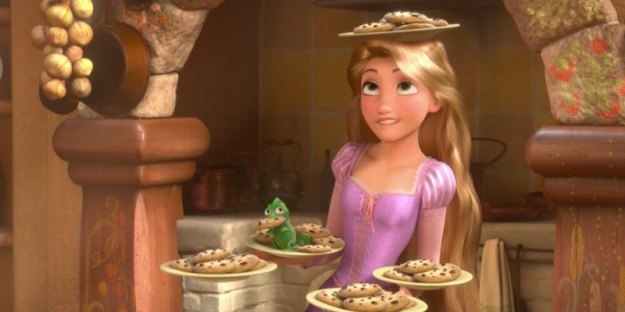
Having lived in the tower for eighteen years, Rapunzel has taught herself a number of hobbies but it’s more than obvious that these activities lost their novelty a long time ago. She tries to keep an upbeat tone but her frustrated expression tells you everything you need to know: Rapunzel is bored and wants to go outside, despite what Mother Gothel has told her.

And I’ll reread the books
If I have time to spare
I’ll paint the walls some more
I’m sure there’s room somewhere
And then I’ll brush and brush
and brush and brush my hair
Stuck in the same place I’ve always been

And I’ll keep wonderin’ and wondering
And wondering and wondering
When will my life begin?

And tomorrow night
The lights will appear
Just like they do on my birthday each year
What is it like
Out there where they glow?
Now that I’m older
Mother might just
Let me go…

WWMLB_38.png

For years Rapunzel has been curious about a group of lights that appear in the sky every year on her birthday. She has no way of knowing that the lights are lit in her memory as the people hope their missing princess will see them and find her way home. That’s the real reason why Gothel won’t let Rapunzel go see the lights; she knows that Rapunzel would be recognized as the missing princess sooner or later and then it would be all over for the vain woman. It makes me sad to see Rapunzel expressing her hope that her mother might finally let her go this year, because you already know what Gothel’s answer is going to be.

What do you think about the song “When Will My Life Begin?” Let me know your thoughts in the comments below and have a great day!

See also:

Tangled “Mother Knows Best” (2010)

Tangled “Mother Knows Best (reprise)” (2010)

Disney/Dreamworks/Pixar/etc. Soundtracks A-Z

Become a patron of the blog at: patreon.com/musicgamer460

Check out the YouTube channel (and consider hitting the subscribe button)

Don’t forget to like Film Music Central on Facebook

The Little Mermaid “Part of Your World” (1989)

“Part of Your World” is a type of song that can be found in many Disney films. This is the song you hear when the hero/heroine laments how unhappy they are with their lives and how they wish things could be different. Similar songs include “Out There,” “Go the Distance,” “How Far I’ll Go,” and “When Will My Life Begin?” Actually it was “Part of Your World” that started the tradition of heroes/heroines expressing their desires early in the film (although I do feel like Aurora’s “I Wonder” is this type of song as well and that song pre-dates The Little Mermaid by 30 years).

In this song, Ariel is going over her beloved collection of human artifacts and wishing that she could go be with the humans on the surface. Unknown to Ariel and Flounder, Sebastian overhears the entire song, which is a big problem since he could tell King Triton about Ariel’s fascination with human items (which isn’t allowed).

Look at this stuff. Isn’t it neat?
Wouldn’t you think my collection’s complete?
Wouldn’t you think I’m the girl,
the girl who has everything?

Look at this trove, treasures untold
How many wonders can one cavern hold?
Looking around here, you’d think
Sure, she’s got everything

I’ve got gadgets and gizmos a-plenty
I’ve got whooz-its and whats-its galore
You want thing-a-mabobs? I’ve got twenty
But who cares? No big deal. I want more!

I wanna be where the people are
I wanna see, wanna see ’em dancin’
Walkin’ around on those…
What do you call ’em? Oh, feet

Flippin’ your fins you don’t get too far
Legs are required for jumpin’, dancin’
Strolling along down the…
What’s that word again? Street

part_of_your_world1.jpg

Up where they walk
Up where they run
Up where they stay all day in the sun
Wanderin’ free,
wish I could be
part of that world

What would I give
if I could live
outta these waters?
What would I pay
to spend a day
warm on the sand?

Betcha on land
they understand
Bet they don’t reprimand their daughters
Bright young women,
sick of swimmin’
ready to stand

bdc44869-ac09-441e-ab7d-2733423f033d.jpg

And I’m ready to know what the people know
Ask ’em my questions and get some answers
What’s a fire and why does it…
What’s the word? Burn?

When’s it my turn?
Wouldn’t I love,
love to explore that shore up above?
Out of the sea,
wish I could be
part of that world

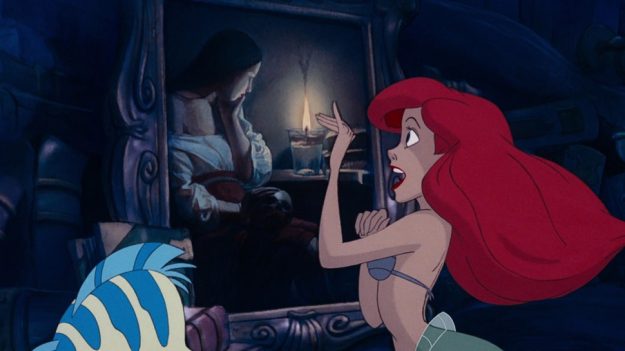
The song does reveal a bit of naïveté on Ariel’s part (I draw your attention back to the line “Bet they don’t reprimand their daughters”). Ariel seems to be under the impression that if she lived on land with the humans then she would be free to do as she pleased (as opposed to living under the sea forced to abide by her father’s rules). It’s a nice thought, but it’s hardly accurate (note that Ursula doesn’t do too much to dispel Ariel’s romanticized notions of surface life either in “Poor Unfortunate Souls”). It’s also fascinating to see what Ariel has in her grotto as I’m pretty sure books and paintings would not long survive exposure to sea water (however it is a Disney movie so things like this just happen).

Believe it or not, “Part of Your World” almost didn’t make it into the final cut of the film. Jeffrey Katzenberg, then head of Disney, thought the song was boring and that it would go over the heads of children. Fortunately, Glen Keane and Howard Ashman fought to keep the song included and won. Another interesting piece of trivia: that shot of Ariel reaching through the hole at the top of the grotto was the very last shot to be completed and it took four tries to get it right. And to record this song, Jodi Benson actually sang in the dark to get a proper feeling of being “under the sea.”

What do you think of “Part of Your World”? Let me know your thoughts in the comments below and have a great day!

See also:

Disney/Dreamworks/Pixar/etc. Soundtracks A-Z

The Little Mermaid “Daughters of Triton” (1989)

The Little Mermaid “Poor Unfortunate Souls” (1989)

The Little Mermaid “Les Poissons” (1989)

The Little Mermaid “Vanessa’s Song” (1989)

Become a patron of the blog at: patreon.com/musicgamer460

Check out the YouTube channel (and consider hitting the subscribe button)

Don’t forget to like Film Music Central on Facebook

My Thoughts on: Rear Window (1954)

*This film is being reviewed at the request of a Patreon patron

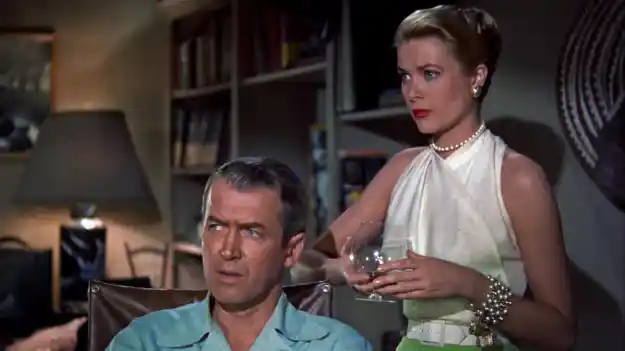
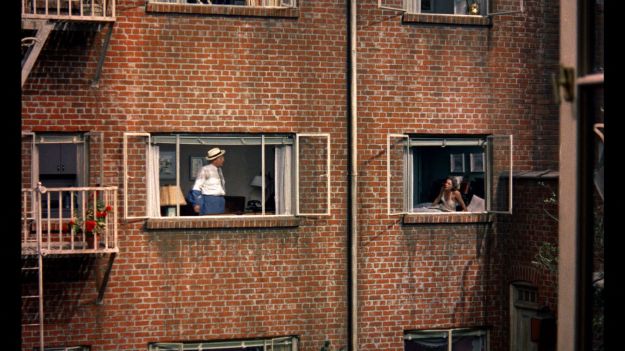
I was initially excited to watch Rear Window, a mystery film directed by Alfred Hitchcock. Up until now the only Hitchcock films I’ve seen are Rebecca, The Birds and excerpts from Psycho so I was looking forward to seeing what this film was like. Rear Window follows a photographer (James Stewart) laid up in his apartment with a broken leg. With little else to do, he ends up observing the lives of his neighbors through their back windows. One night he becomes convinced that one of his neighbors, Mr. Thorwald (Raymond Burr) has murdered his wife and spends the rest of the film trying to prove it.

rearwindow-web2

With all due respect to Hitchcock, the film didn’t do much for me. I did enjoy watching Grace Kelly (as I hadn’t seen any of her films before) and James Stewart is always fun to watch but…there was something about this film that just bothered me. I think having the action confined to Jeff’s apartment (we only see what he sees) frustrated me, because I’m used to films that follow other characters around. Also, the stories of his neighbors look strange when they’re viewed through tiny windows (which look small even when Jeff is looking through binoculars or his camera lens). It reminded me a bit of watching a film within a film, particularly silent films (like when Lisa breaks into Thorwald’s apartment while Jeff watches), since you see the action but can’t really hear much of what’s being said. I’m probably just missing the point of the film, but I wanted to see more than what I was given.

63397bee18f329a6852fe140b82a7f7e

I will say I did like the confrontation between Jeff and Thorwald, when Jeff gets the idea to blind the villain with his flash bulbs to buy some time. It’s a highly suspenseful scene because you’re anxiously wondering if Jeff can get the next bulb ready before Thorwald completely recovers. I was also fascinated to learn that the piano player was Rogdom Bagdasarian, better known as the creator of Alvin and the Chipmunks. And while I was glad to check another Hitchcock film off my “to watch” list, I don’t think I’ll be watching it again any time soon.

What do you think about Rear Window? Let me know your thoughts on this film in the comments below and have a great day!

See also:

Film/TV Reviews

Become a patron of the blog at: patreon.com/musicgamer460

Check out the YouTube channel (and consider hitting the subscribe button)

Don’t forget to like Film Music Central on Facebook