Tag Archives: film

Lady and the Tramp “The Siamese Cat Song” (1955)

I just realized it’s been forever since I actually covered a piece of film music, so I thought I’d ease myself back in with one of the less well-known pieces of Disney music: “The Siamese Cat Song” from Lady and the Tramp (1955). Sadly, Lady and the Tramp is not very high on the radar of kids today, which is a shame, as the film is a gem with its animation and songs.

“The Siamese Cat Song”, although one of my favorite pieces, is rather controversial, because it contains a blatant Asian stereotype in the form of Si and Am, the two Siamese cats introduced by Aunt Sarah (after Lady’s owners leave for a short vacation). In keeping with their Asian origins, the song is built around a pentatonic (five tone) melody and begins with the ominous ringing of a gong (also strongly associated with Asian cultures in general).


When Si and Am speak (in unison a lot of the time), they have visible buck teeth. And the way they talk/sing is overly formal with bad English (a parody of Asians speaking in English). For example, here is the first verse:

We are Siamese, if you please

We are Siamese if you *don’t* please

Now we lookin’ over our new domicile

If we like we stay for maybe quite a while

The language is overly formal (note the “if you please”), and the grammar…bad! But stereotypes aside, I really like this song, because while the cats remain very polite in tone throughout their song, their actions reveal that they are nothing but trouble!

siamese-cats

Do you seeing that thing swimming round and round?
Yes. Maybe we can reaching in and make it drown.
If we sneaking up upon it carefully
There will be a head for you, a tail for me.

Do you hear what I hear?
A baby cry?
Where we finding baby there be milk nearby.

If we look in baby buggy there could be
Plenty milk for you and also some for me.

In short order, the two cats: topple a vase of flowers, shred the curtains, terrorize the goldfish (narrowly saved from being eaten by Lady), attempt to eat the pet bird, and in general make a huge mess. And then…the baby starts crying upstairs. Being clever cats, Si and Am deduce that there must be fresh milk nearby for the baby (and if so they will gladly help themselves). However, Lady has had enough of these two, and she makes a stand at the top of the stairs. Realizing they’ve gone too far, Si and Am run for it, and all three collide in a heap back in the sitting room, where the two devious felines make it look like Lady started it as soon as Aunt Sarah enters the room. I always hated this part because I knew none of this was Lady’s fault and yet here’s mean Aunt Sarah blaming everything on Lady.

I hope you liked this brief look at “The Siamese Cat Song”

See also:

Lady and the Tramp “Bella Notte” (1955)

Lady and the Tramp “He’s a Tramp” (1955)

Don’t forget to like Film Music Central on Facebook 🙂

Become a Patron of the blog at patreon.com/musicgamer460

Check out the YouTube channel (and consider hitting the subscribe button)

For more classic Disney songs, check out the main page: Disney Films & Soundtracks A-Z

My Neighbor Totoro (1988): One of My All Time Favorite Cartoons Blogathon

my_neighbor_totoro_-_tonari_no_totoro_movie_poster

This post is part of the One of My All Time Favorite Cartoons Blogathon hosted by MovieMovieBlogBlog

My Neighbor Totoro is set in post-World War II Japan (presumably in the 1950s based on the types of cars and technology visible in the story) and follows the Kusakabe family as they move to a new house in the countryside because the mother is in a nearby hospital. Mr. Kusakabe is a professor at a university in Tokyo; eldest daughter Satsuki is in grade school, while youngest daughter Mei is only four.The girls encounter a variety of spirits, starting with dust sprites (black puff balls with eyes), and forest spirits collectively known as “totoro”. Mei sees them first, in a hilarious sequence that has me giggling every time. The two smaller totoro she meets end up leading her to the magical home of Totoro, THE forest spirit of the local area. Totoro is a huge grey spirit, with a big fluffy belly, long rabbit ears and the biggest smile you ever saw (and he also loves to sleep a lot).Satsuki is initially skeptical, but once she meets Totoro at a bus stop one night, both of them become good friends with the forest spirit.

I love the bus stop scene; the smile that grows on Totoro’s face is just infectious. He doesn’t have an umbrella of his own at first, so Satsuki offers him the umbrella she brought for her father. When Totoro hears the sounds the rain makes on the umbrella, it makes him really happy, like, super happy! And the Catbus….well, I love it, but you can’t really describe it. The Catbus must be experienced 🙂

Their mom has been in the hospital for what is implied to be a long time. Her illness is never disclosed, but it is believed to be tuberculosis (as Miyazaki’s own mother spent a long time in the hospital for that reason). Towards the end of the film, the girls receive news that their mother will be allowed home for a short visit, but shortly before the visit, Satsuki receives word that her mother actually can’t come home after all due to a small relapse of her illness. The older Satsuki does her best to take this news in stride, but little Mei won’t have it. Frustrated with having to hold in her feelings for so long, Satsuki finally snaps and yells at Mei, asking if she wants their mother to die. A horribly upset Mei ends up running away to bring some fresh corn to her mother (she gets the idea after hearing a neighbor tell her and her sister earlier that if their mom ate some fresh vegetables she would get better right away). The little girl soon becomes lost and the whole village turns out to look for her. Satsuki is guilt-ridden, but she knows what to go to for help: Totoro!! She finds Totoro in his tree and begs for help, and Totoro is more than happy to oblige! He summons the Catbus who takes an astounded Satsuki to where Mei is sitting lost. And once the sisters are reunited, Catbus offers to take them both to see their mother (and of course they agree!)

The story ends shortly thereafterward, with the girls being brought back home. A series of still images during the end credits reveals that their mother finally does come home for a visit (or possibly for good) and alls well that ends well.

My Neighbor Totoro is one of the greatest animated films I’ve ever seen. For me, it embodies what childhood should be, and I highly recommend it for anyone who hasn’t seen it yet!

I also love all the spirits: the dust sprites, the mini Totoros, and of course Totoro himself, they’re all so beautifully animated, I find myself wishing things like them existed in real life.

Thanks to MovieMovieBlogBlog for hosting this great blogathon! -Becky

Become a patron of the blog at: patreon.com/musicgamer460

Check out the YouTube channel (and consider hitting the subscribe button)

See also: Animated Film Reviews

Don’t forget to like Film Music Central on Facebook 🙂

The Lightsaber Duel at Cloud City: A Nightmare in Three Stages

The lightsaber duel between Luke Skywalker and Darth Vader in The Empire Strikes Back is often referred to as the greatest saber duel of the saga, and for good reason. The staging is perfect, the tension is spot on (and it happens to feature the biggest cinematic twist of all time).

I already wrote about the duel somewhat here but now I’d like to go into a bit more detail.

As I see it, the duel is divided into three stages, with a different setting and feel for each.

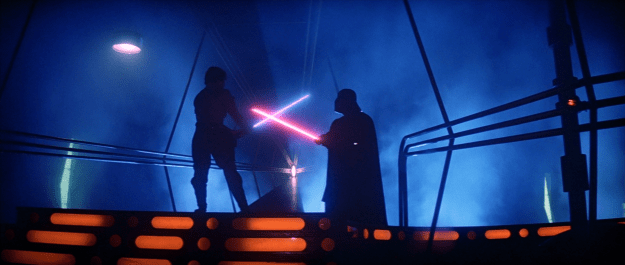
Lukevaderesb.png

Stage One is set in the carbon freezing chamber on Cloud City (where Han Solo was recently frozen into carbonite) and is also where Vader plans to do the same thing to Luke. At the beginning of the duel, Vader believes that Luke will be a pushover, so he’s not really expending a lot of energy. Quite the opposite, he lets Luke initiate the duel (Luke activates his saber first AND he makes the first attack), Vader only parries the blows in response. In fact, Vader isn’t even holding his saber with both hands, whereas Luke is clearly expending a lot of energy early on (and getting nowhere).

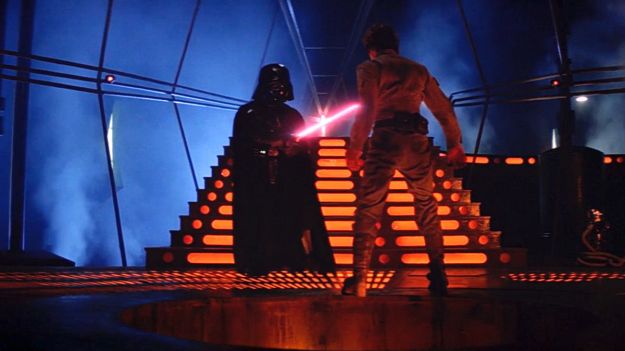
open-uri20150608-27674-hk4fmv_45560d3d

There is a bit of taunting (on Vader’s part) but not too much, as he wants this duel to end quickly. It doesn’t take much to get Luke down the stairs and right in front of the pit as Vader activates the machine with the Force. And then Vader gets cocky: forcing Luke down into the pit, he boasts “all too easy” and flips the switch. But Luke (thanks to his training) is able to leap out a split second before the freezing process begins, much to Vader’s surprise (he says he’s “impressed” but I really think surprised is the better word). Clearly, this duel is not going to be a quick pushover, so once Luke kicks Vader off the edge of the platform (and I somewhat believe Vader let that happen), the Dark Lord disappears to regroup for Stage Two.

5-star-wars-easter-eggs-with-horrifying-consequences-560835

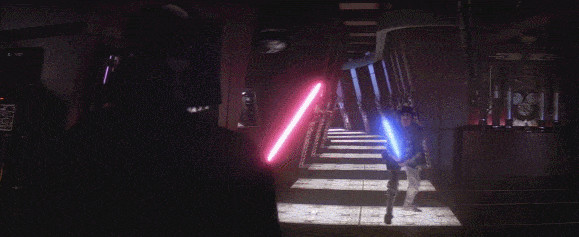
Stage Two takes place in an abandoned hallway deep inside Cloud City. And even before it begins, Luke has a choice to make: at this point, Vader has vanished to who knows where and Luke doesn’t HAVE to follow him (I know I wouldn’t, I mean really, venturing into a dark hallway in search of a ticked off Dark Lord with a lightsaber? NOPE!), but of course he does.

the_empire_strikes_back

There’s a literal transition point as Luke comes to a brightly lit service corridor that takes him to the location of stage 2: the abandoned hallway with a large octagonal window looking out into the air shaft of Cloud City. And once Luke reaches that point…the breathing begins (a moment that always sends a shiver down my spine). Luke re-ignites his saber (Vader’s is already activated), but instead of launching back into the duel, Vader decides a “lesson” is in order (this is discussed more in the radio drama version of ESB and as far as I know is canon): sure, Luke is (at best) a competent duelist, a skill surely inherited from his father, but what experience does he have against a veteran Force user who can duel AND manipulate objects in the Force at the same time? Of course Luke doesn’t have any such experience which is why he gets the crap knocked out of him by various flying debris. At this point, Vader is still somewhat toying with Luke, but things are definitely more serious (I’m still not sure if Vader intended to have Luke go flying out the window, cause after that moment Vader comes over to look like “did I kill him?”)

duel3

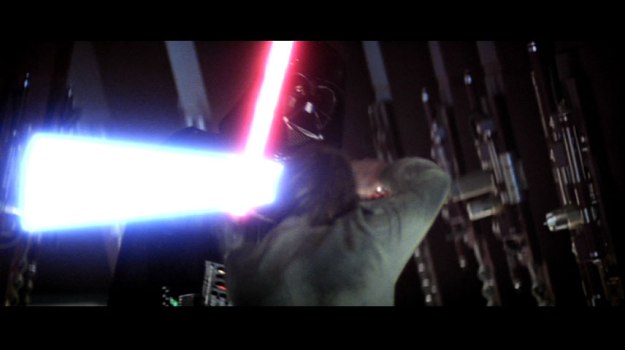
Fortunately, Luke doesn’t go falling to his death, but instead manages to make his way to a platform station of some kind even lower down the air shaft, the setting for Stage Three (and the end of the duel) But he barely has a chance to look around before Vader shows up, and this time the Sith Lord isn’t messing around. His strikes come fast and hard, and Luke is quickly chased backwards out to the near edge of the platform. Vader (holding Luke at saberpoint) declares his opponent beaten, it’s time to give up. Unfortunately, Vader also taunts Luke by saying “Don’t let yourself be destroyed as Obi-Wan did” reminding Luke about how Vader killed Obi-Wan in front of him. This visibly angers Luke and he stages a miraculous (and brief) comeback, which ends when he manages to score a partial blow on Vader’s shoulder.

BAD.IDEA

That this not-even-half-trained-would-be-Jedi managed to score a blow on him enrages Vader and pushes him over the edge. He pushes Luke back again and in a short series of moves deprives Luke of his lightsaber…and his right hand!! (For years I dreaded this moment, because it always seemed to come out of nowhere, and I hated Luke’s scream of pain).

esb-13

Now the fight is really finished, but Vader isn’t done yet. Now that Luke is cornered (literally), he makes his “pitch” for Luke to join the Dark Side. Of course Luke refuses, pointing out that he (Vader) killed his father. This prompts the biggest cinematic twist of all time:

“No” (Vader says) “*I* am your father.”

On the one hand, it makes no sense because Episode IV clearly establishes Vader and Luke’s father as two separate people. And yet….why would Vader lie? Luke knows there’s no reason for Vader to lie, hence his (understandably) upset reaction.

With the duel over, it appears Luke has no place to go except with Vader, but Luke figures he still has one way out: he’s at the edge of the main air shaft of Cloud City, and he’s not sure what’ll happen down there, but it has to be better than going with Vader…so he lets himself fall! There’s more, but that’s a separate scene.

Fun notes:

I remarked in my earlier post that Vader was played by master fencer Bob Anderson for this entire duel (David Prowse kept breaking the saber blades), hence  the reason this duel is shot from so many unusual angles (looking down at Vader, looking up at Vader, a lot of close-up shots) because Anderson was nowhere near the height and size of Prowse.

Only Mark Hamill, George Lucas, and one other writer knew the truth about the big twist. Everyone else was given a fake page of script where the “twist” was given as “You don’t know the truth, Obi-Wan killed your father.” (I mean that WOULD have been a pretty epic twist in and of itself)

The hallway seen in stage 2 is the same hallway Rey sees early in her Force vision in Episode VII. I really hope they explain at some point how Maz got the lightsaber, because last time it was seen, it was tumbling into the atmosphere of Bespin.

You can become a patron of the blog at patreon.com/musicgamer460

Check out the YouTube channel (and consider hitting the subscribe button)

Don’t forget to like Film Music Central on Facebook 🙂


What Disney taught me about life: Things I learned from the Movies

This post is part of the Things I Learned from the Movies Blogathon hosted by Silver Screenings and Speakeasy.

So, I have a confession to make. Originally I was going to write about what Disney films taught me about humor, but as I got started, I realized I couldn’t think of any good examples. So, I decided to make the subject a little broader, and talk about several life lessons I learned from Disney films (my apologies for the last minute change).

  1. Sometimes when you love a person, you have to let them go. This happens in Pocahontas (1995) when Pocahontas and John Smith know they love each other, but John has to go back to England to be treated for his injuries. Pocahontas could go with him, but she needs to stay with her people, and so they say goodbye, even though it breaks both their hearts.
  2. Imagination is a very powerful tool. I learned this from The Sword in the Stone (1963). Most of Merlin’s lessons are based on the Wart’s ability to “imagine” that he is a fish, or a bird or a squirrel before the magic can actually work. And as the Wart’s imagination is opened up further, he grows further and further as a young man.
  3. You don’t always fall in love at first sight. I know most Disney films portray the opposite, but that’s exactly my point. Until very recently, Disney portrayed true love as being something that could occur in a single meeting. Or, to be more generous, something that could occur over a relatively short period of time. While that’s better, I really think that real love takes closer to a year to happen. The good news is that Disney is slowly moving away from “true love at first sight”.

and the most important thing I learned from Disney films?

4. Sometimes the “bad guy” wins. The big example for this comes from The Lion King, when Scar succeeds with his plan to kill Mufasa. While we all want to believe that the hero always wins and the villain always loses, in real life it’s usually the other way around. And, while it took me years to understand, I think it’s good that Disney includes this concept in some of their stories. It hurts, but it’s a lesson that needs to be shared.

And that’s a small sample of the things I learned from Disney movies. I hope you enjoyed checking it out! Thanks to Silver Screenings and Speakeasy for hosting this great blogathon!

You can become a patron of the blog at patreon.com/musicgamer460

Don’t forget to like Film Music Central on Facebook 🙂

Pocahontas “The Virginia Company” (1995)

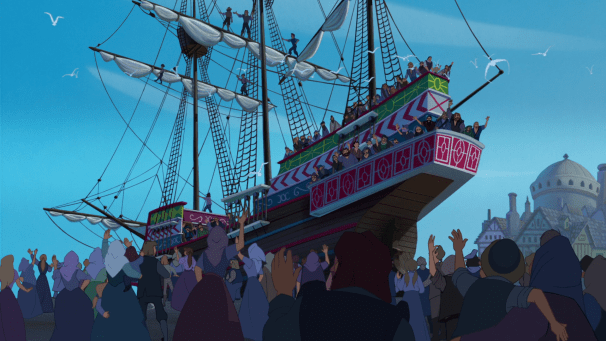
pocahontas

In 1995, Disney released Pocahontas, their 33rd animated feature film, and the first Disney film to be based on a real historical person (that being Pocahontas, though the details have been heavily romanticized). To my surprise, I learned that this film received mixed reviews and is in fact considered the “beginning of the end” of the Disney Renaissance. I certainly didn’t get that impression when I saw the film in theaters, but I was only in the first grade at the time, and wasn’t exactly in a position to judge film quality.

Pocahontas “The Virginia Company” (1995)

Whether you like or dislike the film, there’s no denying Pocahontas has another great Disney score, with the songs once again being composed by Alan Menken. And the first song we hear is “The Virginia Company”, a short chorus that introduces the English settlers: Thomas (Christian Bale), the barely adult kid leaving home to make his fortune; Lon (Joe Baker) and Ben (Billy Connolly), two seasoned sailors who are well acquainted with the hero of the film, Captain John Smith (Mel Gibson), a man who’s traveled everywhere and doesn’t think this “New World” will be any different from the others he’s seen.

And last, but not least, there’s Governor Ratcliffe (David Ogden Stiers), his manservant Wiggins (also David Ogden Stiers) and his pompous pooch Percy. Ratcliffe is the nominal leader of the expedition and will be Governor of the new colony (but really, he’s just in it to get really rich so he can come back to England and worm his way into the aristocracy).

In “The Virginia Company”, the settlers sing about how this New World is a paradise full of gold and silver, and they’ll all become really rich:

In sixteen hundred seven
We sailed the open sea
For glory, God and gold
And the Virginia Company

For the New World is like heaven
And we’ll all be rich and free
Or so we have been told
By the Virginia Company

So we have been told
By the Virginia Company
For glory, God and gold
And the Virginia Company

On the beaches of Virginny
There’s diamonds like debris
There’s silver rivers flow
And gold you pick right off a tree

With a nugget for my Winnie
And another one for me
And all the rest’ll go
To the Virginia Company
It’s glory, God and gold
And the Virginia Company

They have this view because of the enormous riches the Spanish found when they plundered the New World and discovered the treasures of the Aztecs, the Inca and so on. Still, it is a stirring song to hear, and a good introduction to the story.

You can become a patron of the blog at: patreon.com/musicgamer460

Check out the YouTube channel (and consider hitting the subscribe button)

See also:

Pocahontas “Steady as the Beating Drum” (1995)

Pocahontas “Just Around the Riverbend” (1995)

Pocahontas “Listen With Your Heart” (1995)

Pocahontas “Mine, Mine, Mine!” (1995)

Pocahontas “Savages, Part I” (1995)

Pocahontas “Savages, Part II” (1995)

Don’t forget to like Film Music Central on Facebook 🙂


The Lion King “King of Pride Rock” Pt. 2 (1994)

With Scar finally out of the way for good (thanks to a hungry pack of hyenas), Pride Rock is finally saved. Rainfall douses the flames and an exhausted Simba appears out of the smoke to be acclaimed as king by his lionesses and friends (as well as being reunited with Nala). But Rafiki points out that there is one more duty to perform: he needs to properly claim his rightful place at the ledge of Pride Rock, where all can see and hear him.


As the long climb begins, a great fanfare strikes up. This is the moment Simba fulfills his long-delayed destiny. For one moment, he even appears as Mufasa himself (causing a double take from Zazu). Reaching the top (as the bones and debris are washed away by the rain) Simba watches the emerging stars and hears Mufasa’s last word to him “Remember…” and he ROARS!!!

The Lion King “Ending scene” (1994)

I love this part, though I have a little piece of trivia to share: that’s not a lion’s roar. Those are actually tiger roars you are hearing (but it still sounds so cool!!!)

presentation

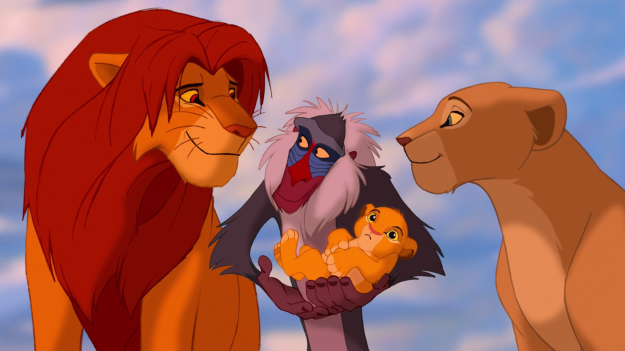
Time lapse to a restored Pride Rock in all its verdant glory and the animals of the Pride Lands have all returned. Simba, Nala, Timon and Pumbaa stand at the ledge as Zazu circles above. And then Rafiki appears, revealing the reason for the celebration: Simba and Nala have their own baby (Kiara, with her own love story in The Lion King II) and its time for her to be presented to the Pride Lands as the Circle of Life goes on 🙂

And that’s the end of The Lion King 🙂 I hope you enjoyed looking at this great film. Let me know your thoughts in the comments below.

Become a Patron of the blog at patreon.com/musicgamer460

Check out the YouTube channel (and consider hitting the subscribe button

For more Lion King, see also:

The Lion King “The Circle of Life” (1994)

The Lion King “I Just Can’t Wait to be King” (1994)

The Lion King “Be Prepared” (1994)

The Lion King “To Die For” (1994)

The Lion King “Hakuna Matata” (1994)

The Lion King “Can You Feel the Love Tonight” (1994)

The Lion King “Beneath the Stars” (1994)

The Lion King “King of Pride Rock” Pt. 1 (1994)

Thanks for coming by the blog, you guys are the best!

Don’t forget to like Film Music Central on Facebook 🙂

Dual Roles Blogathon: Jean Marais in Beauty and the Beast (1946)

This post is part of the Dual Roles Blogathon hosted by Christine Wehner and Silver Screenings

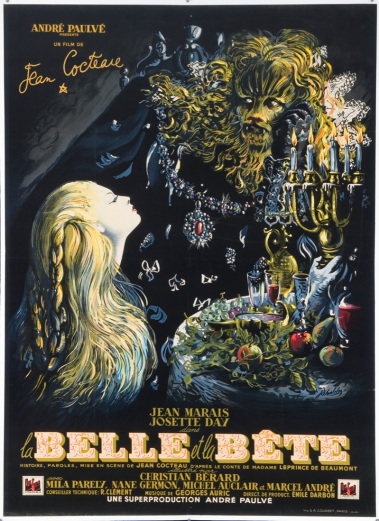
018-beauty-and-the-beast-theredlist

I finally got to see Jean Cocteau’s masterpiece this summer and I fell head over heels in love with the production. Long before Disney’s Beauty and the Beast took the world by storm, Cocteau created a film based very closely on the original fairy tale, using ingenious practical effects to bring the story to life. Jean Marais starred as the Beast who eventually wins Belle’s heart, but that’s not all. He also portrays the human Prince….AND Avenant, the villain who also loves Belle and wants her for himself!

If you watch this film without seeing the credits, it would be easy to miss that Marais plays a TRIPLE role in the film. As the Beast, he is hidden under a gorgeously complex makeup that completely transforms him from head to toe. The human Prince doesn’t appear until the last ten minutes of the film, and Avenant is just so…different from the other characters he plays.

beautyandthebeast

Let’s start with the Beast: It is revealed by the end that the Beast was a prince whose parents did not believe in spirits. As punishment, the spirits transformed their son into a Beast, and the castle was laid under a heavy enchantment. The Beast was then given several magical items (a magic mirror that could show you what you wished, a glove that could take you where you wished to go and the ability to create precious gifts at will.) The only way for the curse to be lifted is for the Beast to earn the willing love of a woman. But all the time the Beast is fighting the instinct to turn into a wild animal, and this is impeding his ability to fall in love with Belle (and also receive her love). Marais’ performance as the tormented beast is a sight to behold: he (as the Beast) truly wants to love Belle, but at the same time he doesn’t believe he deserves that love (because of his beastly nature).

As I said before, the makeup for the Beast is simply amazing! (It puts all CGI motion capture to shame). He is covered in fur so well that it looks completely natural!

belle-et-avenant-debut

Eat your heart out Gaston, Avenant did it all long before you came around!

In his role as Avenant, Marais transforms into something else entirely (and not in a good way). He starts off innocently enough as a childhood friend of Belle’s who only wants to help since the family has fallen on hard times. He offers at the beginning to marry Belle, knowing this would help the family’s position (and it’s implied he’s offered before) but Belle politely refuses, as she wants to help her father. Avenant is angry about this gentle rejection (for the moment), and contents himself with helping the family however he can. Things become complicated after Belle disappears to be with the Beast and Avenant “helps” Belle’s brother Ludovic with his debts by introducing him to a moneylender, a deal that eventually leaves the family in near total poverty. Avenant feels no blame for the role he played in putting the family in this situation, showing a hint that he is not as good-natured as he appears to be.

Things get much worse when Belle returns for a visit, richly appareled in robes fit for a princess (complete with a crown!). Though Belle denies it (and simply isn’t aware of it yet), everyone else can see that the young woman is head over heels in love with the Beast, and Avenant becomes overwhelmingly jealous, to the point that he is nearly seething with rage. When Belle’s jealous sisters plot to keep Belle at home longer than her promise so the Beast will become angry and kill her, Avenant willingly goes along with the plan, initially hiding Beast’s horse Magnifique and then stealing the horse (along with Ludovic) so that they can ride back to Beast’s castle to steal the Beast’s treasure (and kill the Beast as well).

Avenant’s plan MIGHT have succeeded (the Beast is already half-dead of grief at this point) except he and Ludovic are unaware of the Beast’s warning to Belle that the treasury (dubbed Diana’s Pavilion) must ONLY be entered by the front door using the key, going in any other way has deadly consequences. This is because the treasure room is guarded by a living statue of Diana that fires a magic arrow on any intruder. In this case, the target is Avenant who, before the horrified eyes of Ludovic, turns into an exact duplicate of the Beast before toppling to the floor of the treasure chamber, presumably to his death, since he is not seen again.

MBDBEAN EC004

BEAUTY AND THE BEAST, (aka ‘Belle et la bête, La’), Jean Marais, Josette Day, 1946

And then there is the brief appearance of the Prince. So different is this character that it wasn’t until I went back and checked the credits that I realized Marais was playing three roles! In fact, the dialogue teases the fact that the two roles are played by the same person when Belle admits that the Prince resembles someone from the village she might have loved once. But where Avenant was full of jealous rage, the Prince is gentle and patient, the perfect match for Belle.

Jean Marais is such a versatile actor in this classic film, it takes great talent to be able to play two roles in a film, let alone three! If you haven’t seen Cocteau’s Beauty and the Beast, I highly recommend it 🙂 Thanks to Christine Wehner and Silver Screenings for hosting this great blogathon!!

Become a Patron of the blog at patreon.com/musicgamer460

Check out the YouTube channel (and consider hitting the subscribe button)

Don’t forget to like Film Music Central on Facebook 🙂

The Lion King “Under the Stars” (1994)

The time has almost come to bring The Lion King to a close. After today I’ll share the final scene of the film and that will be the end. I hope you’ve enjoyed this look at one of the most popular films of the Disney Renaissance.

“Under the Stars” is one of my favorite instrumental themes from the film. This is the part of the story where Simba is convinced he needs to return to Pride Rock to confront Scar. A now-grown Nala (who snuck away from the desolate Pride Lands in search of help) has already tried to convince Simba to return, but the guilt-ridden Simba (who still believes Mufasa’s death is his fault) refuses, and won’t tell her why either. He storms off in anger and finally vents his frustrations to the night sky (where Mufasa once told him the great kings of the past watch over them)

You said you’d always be there for me! But you’re not…that’s because of me. It’s my fault…it’s MY fault!”

And just in the nick of time, Rafiki shows up! Simba doesn’t remember him of course, but he was the mandrill who presented Simba to the kingdom as the future king. Rafiki is singing a crazy song to himself, it goes like this:

“Asante sana, squash banana, wewe nugu mimi hapana”

And when Simba demands to know what the heck all that means, Rafiki explains that it means (in part at least) “You are a baboon, and I’m not!” When Simba tells Rafiki he must be confused, the mandrill reminds Simba that he (Simba) doesn’t even know who HE is, but he (Rafiki) does, he’s “Mufasa’s boy!”

The Lion King: Simba meets Rafiki/Mufasa’s Ghost (1994)

Of course hearing his father’s name brings Simba running after Rafiki for more information, especially when Rafiki insists that Mufasa is still alive and that he can show his father to him, but only if he follows him deep into the jungle. Simba does follow, and I love the music that comes while he’s creeping and running after Rafiki. It’s a very primal song, full of African drum beats and chanting. Sometimes when I just listen to the soundtrack, I imagine a tribal dance going on (as I’m almost positive that’s what this piece was modeled after).

After chasing Rafiki for quite a while, Simba is led to a distant lake where, Rafiki tells him, he will see his father. But when a nervous Simba peers over the edge, he is disappointed.

“That’s not my father…it’s only my reflection.”

“But you see…” Rafiki tells him “He lives in YOU.”

mufasasghost1

And suddenly the reflection changes to that of Mufasa and out of nowhere there’s a ghostly voice coming from the sky (five year old me was freaking out right about now). I absolutely love this animation: Mufasa starts as a ghostly silhouette coming out of the clouds, and as the scene continues, Mufasa’s body takes shape, until at last, we see Mufasa completely as he appeared in life:

“Simba…” (Mufasa says) “You have forgotten me..you have forgotten who you are and so you have forgotten me. Look inside yourself Simba. You are MORE than what you have become. You must take your place in the Circle of Life. Remember who you are, you are my son, and the one true king!”

mufasasghost2

And just as quickly as he comes, Mufasa is gone again. Rafiki (who presumably watched the whole thing) comes back to see if Simba has finally learned his lesson. Simba does understand now, but he’s still a bit scared about his past….time for one more lesson then.

Without warning, Rafiki bashes Simba over the head with his staff. And the following exchange has become almost a mantra for me in getting over the bad things that have happened to me in my life:

“OUCH! Geez, what was that for?

“It doesn’t matter, it’s in the past!’

“Yeah, but it still hurts.”

Oh yes, the past can hurt. But the way I see it, you can either run from it, or, learn from it (tries to hit Simba again but Simba ducks), AHA!! You see! So what are you going to do?”

“First…I’m going to take your stick!! (pause) “I’m going back!!!”

Yes, while Simba is sad that he only got to see his father again for a brief moment, he knows now what he must do: head back to Pride Rock and confront Scar once and for all!

Become a Patron of the blog at patreon.com/musicgamer460
Check out the YouTube channel (and consider hitting the subscribe button

For more of The Lion King, see also:

The Lion King “The Circle of Life” (1994)

The Lion King “I Just Can’t Wait to be King” (1994)

The Lion King “Be Prepared” (1994)

The Lion King “To Die For” (1994)

The Lion King “Hakuna Matata” (1994)

The Lion King “Can You Feel the Love Tonight” (1994)

The Lion King “King of Pride Rock” Part 1 (1994)

The Lion King “King of Pride Rock” Pt. 2 (1994)

Don’t forget to like Film Music Central on Facebook 🙂

Keep Watching the Skies Blogathon: The Day the Earth Stood Still (1951)

*This post is part of the Keep Watching the Skies Blogathon hosted by The Cinematic Frontier

When I think of “classic” science fiction cinema, I inevitably think of two films: Forbidden Planet (1956) and The Day the Earth Stood Still (1951), though regarding the latter, it took me a long time to remember what the film was called. It kept turning out that every time the film was on Turner Classic Movies, I would end up catching it in the middle. So for a while it would be “that movie with Gort in it.” Of course now I know that The Day the Earth Stood Still is so MUCH more than that.

download

Released in 1951, The Day the Earth Stood Still is set during a time when the Cold War against the Soviet Union (and a fear of Communism in general) is gaining momentum. The score for this film was composed and conducted by the legendary Bernard Herrmann and featured extensive use of the theremin in the opening title. In fact, the score for this film is what inspired Danny Elfman to be interested in film composing.

The Day the Earth Stood Still – Main Title (1951)

A strange flying saucer enters Earth’s atmosphere and lands in Washington D.C., where it is quickly surrounded by the Army.

The Day the Earth Stood Still- Klaatu Arrives (1951)

An alien, Klaatu (Michael Rennie), appears and announces he comes in peace. Unfortunately, when he reveals a strange device, one of the soldiers panics and shoots Klaatu in the shoulder, prompting the large robot Gort to emerge from the spacecraft. Surveying the situation, Gort begins to vaporize the weapons with a beam from his “eyes” when Klaatu commands him to stop.

The Day the Earth Stood Still – Gort (1951)

Klaatu is taken to the hospital, but it turns out he is more than capable of healing himself (leaving the poor doctor ready to retire after learning his patient is actually 78 and only in what he considers middle age for his species). Mr. Harley, the secretary to the President arrives, and asks Klaatu why he has come. The mission is simple: Klaatu has an urgent message that must be shared with ALL the governments of the world at the same time. Mr. Harley protests that this will be impossible, and when the authorities prove less than helpful, Klaatu decides to escape and spend some time among the populace, to see if he can learn why the human race is so suspicious.

kozl-figure-7

Assuming the identity of “Mr. Carpenter”, Klaatu takes a room in a boarding house where he meets and befriends Helen Benson (Patricia Neal), a widow, who lives with her young son Bobby. The next day, Klaatu lets Bobby show him around the city, where he is visibly disturbed to learn that so many people have been killed due to war. He is also impressed by the Lincoln Memorial (“Those are great words…”) Knowing that his message must still be shared, Klaatu asks Bobby who the smartest man in the world is. Bobby figures that it must be Professor Barnhardt, who happens to live in the city. Finding the professor out, Klaatu leaves a “calling card” by adding in a vital part of an equation (that an ordinary person would not know), knowing that he’ll be contacted as soon as the professor sees it.

Sure enough, the professor and Klaatu end up meeting and the alien shares a small part of his message: If the governments of the world do not listen to him, Earth is at risk of annihilation. This statement terrifies the professor:

“Such power exists?” he asks breathlessly

“I assure you” Klaatu answers “Such power exists.”

Professor Barnhardt promises to assemble as many world scientists at the spaceship as he can, but in the meantime, he thinks it would help if Klaatu were to give a “minor demonstration” of what might happen, but asks also that no one be killed as a result of this “demonstration.” Amused by the challenge, Klaatu sneaks back to the spaceship to prepare for the event, but doesn’t realize Bobby is following him and sees him communicating with Gort.

The Day the Earth Stood Still- Power Loss (1951)

The “demonstration” turns out to be a total loss of power all over the world (be it motive, electrical, etc.) for precisely thirty minutes (excluding planes in the air or the power necessary to run hospitals). To create a musical sense of the chaos that was happening, Herrmann created a series of tonal clusters (a large series of notes grouped very closely together) and held them out for long periods of time, to create that feeling of static helplessness that almost everyone feels during this period (except for Professor Barnhardt, he revels in the chaos, knowing its source).

Just as the power outage begins, Helen confronts Klaatu about what Bobby told her and while they are trapped in a hospital together, Klaatu confesses everything and asks for her help. Helen promises to do what she can, but there’s a wrinkle, Helen’s boyfriend Tom already believes that “Mr. Carpenter” is the alien and is doing his best to turn Klaatu in to the authorites, believing that this will make him a “big hero.” A disgusted Helen breaks up with him, and the authorities begin to close in on Klaatu’s location.

The Day the Earth Stood Still- Klaatu Barada Nikto (1951)

En route to the gathering of scientists, Klaatu tells Helen that should ANYTHING happen to him, she must go to Gort and tell him “Klaatu barada nikto.” This is because there is “no limit” to what Gort could do, “he could incinerate the Earth.” Before they can reach the spaceship, the Army cuts the pair off. Klaatu runs for it, but is gunned down in the street, prompting Helen to run for the spaceship. And back at that same spaceship, Gort has begun to awaken, sensing Klaatu’s death. When two Army sentries approach, Gort promptly vaporizes THEM (not just their weapons like before). Helen approaches, but is terrified by the huge robot. However, she manages to get the words out just before Gort can vaporize her and Gort responds by taking her to the ship before leaving to retrieve Klaatu’s body.

Back in the spaceship, Helen watches awestruck as Gort begins manipulating a series of dials that begin to heal and revive Klaatu’s body! The alien ultimately returns to life, but it’s not permanent. Even they, as advanced as they are, do not possess “the power of life and death”, as that is reserved for the “Almighty Spirit.”

(On a side note, Michael Rennie absolutely HATED that reference to the Almighty Spirit (it was added by the studio at the last minute, as they felt they were making these aliens out to be gods) as he felt it didn’t fit everything we’d learned about Klaatu and his culture up to that point)

The Day the Earth Stood Still- Klaatu’s Speech (1951)

Meanwhile, the crowd of scientists has gathered outside, but the Army is urging them to leave, as they have no idea where Gort is. Just as Professor Barnhardt agrees that they should disperse for their own safety, the spaceship opens up one last time, revealing Helen, Klaatu and Gort. Helen leaves the ship, while Klaatu stands at the entrance to finally deliver his message:

I am leaving soon, and you will forgive me if I speak bluntly. The universe grows smaller every day, and the threat of aggression by any group, anywhere, can no longer be tolerated. There must be security for all, or no one is secure. Now, this does not mean giving up any freedom, except the freedom to act irresponsibly. Your ancestors knew this when they made laws to govern themselves and hired policemen to enforce them. We, of the other planets, have long accepted this principle. We have an organization for the mutual protection of all planets and for the complete elimination of aggression. The test of any such higher authority is, of course, the police force that supports it. For our policemen, we created a race of robots. Their function is to patrol the planets in spaceships like this one and preserve the peace. In matters of aggression, we have given them absolute power over us. This power cannot be revoked. At the first sign of violence, they act automatically against the aggressor. The penalty for provoking their action is too terrible to risk. The result is, we live in peace, without arms or armies, secure in the knowledge that we are free from aggression and war. Free to pursue more… profitable enterprises. Now, we do not pretend to have achieved perfection, but we do have a system, and it works. I came here to give you these facts. It is no concern of ours how you run your own planet, but if you threaten to extend your violence, this Earth of yours will be reduced to a burned-out cinder. Your choice is simple: join us and live in peace, or pursue your present course and face obliteration. We shall be waiting for your answer. The decision rests with you.

The film ends with Klaatu and Gort leaving in their spaceship, a giant question mark hanging over the fate of the human race: will we join this peaceful group of planets, or will we destroy ourselves?

Of course no answer is given, and that frustrated me for years, because I wanted to know how the story was going to end! Except there isn’t meant to be an ending, not like that anyways. The end of Klaatu’s speech was intended as a direct message to the world in 1951: if we don’t stop fighting each other, we’re going to destroy ourselves.

Though it is now over sixty years old, the film is considered a classic and its message is just as relevant today as it was when the film came out. If you haven’t seen this film before, I highly recommend it (and whatever you do, do NOT watch the remake with Keanu Reeves!!!)

Thanks to The Cinematic Frontier for running this great blogathon! -Becky

Don’t forget to like Film Music Central on Facebook 🙂

 

The Music of Star Trek Blogathon: Recap

At last! After months of planning, The Music of Star Trek Blogathon is finally here!!!! I can’t wait to see what everyone has come up with. One last note, don’t forget to include a line at the top of your post that says “This post is part of The Music of Star Trek Blogathon hosted by Film Music Central” and include a link back to my blog page, that way anyone reading it knows that it is part of the blogathon 🙂

Day One

Thoughts All Sorts shares some thoughts on the music in Star Trek (2009): Some Musical Thoughts- Star Trek (2009)

MovieRob examines the pilot episode of Star Trek: The Next Generation “Encounter at Farpoint” : Star Trek: The Next Generation “Encounter at Farpoint” (1987)

My entry for this blogathon looks at one of the greatest cliffhangers of all time: The Music of Star Trek: The Best of Both Worlds (1990)

Plain, Simple Tom examines the now-iconic music in “Amok Time” : “Amok Time”

The Temp Track provides a ranking of every Star Trek film score there is: Scoring the Final Frontier: Celebrating 50 Years of Trek Tracks

The Temp Track also takes a look at the themes of Star Trek VI: Only Kirk Could Go To Qo’noS: Cold War Allegory and the Title Theme for Star Trek VI

Day Two

MovieRob: Star Trek Deep Space Nine “The Emissary” 

The Temp Track: The Temp Track: Star Trek (2009): The First Sixty Seconds

Day Three

MovieRob: Star Trek: Voyager “Caretaker”

MovieRob: Star Trek: Enterprise “Broken Bow”

Rhyme and Reason: Star Trek: Voyager Musical Highlights

Riley on Film: Theme from ‘Star Trek’ (1966-1969)

The Temp Track: Musical Spock

Meg nog List Blog: Star Trek Nemesis and Blue Skies