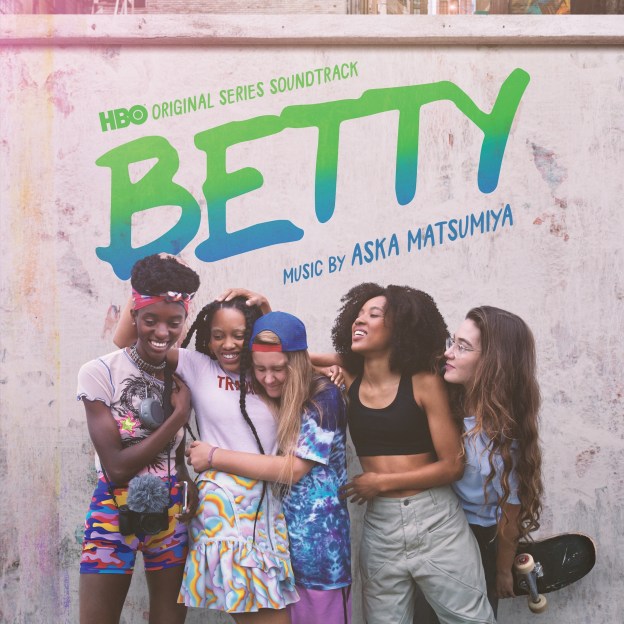
Milan Records, together with HBO, has announced that the original soundtrack for Betty, composed by Aska Matsumiya, will be released on May 15, 2020. Available for preorder now, the album features score music written by Matsumiya as well as additional tracks featured in HBO’s newest original series following a group of female skateboarders in New York City. Aska Matsumiya is a LA based Japanese composer and producer who has excelled across Film, Television, Advertising and music production. Aska provided the score for the Amazon feature film, “I’m Your Woman” for director Julia Hart. In addition, she partnered with A24 and acclaimed director Kogonada on his film “After Yang”, collaborating with composer Ryuichi Sakamoto starring Colin Farrell.
Making its debut today alongside album preorder is the lead offering from the soundtrack – listen to “Why Not Bambi” here. Based on Crystal Moselle’s original film Skate Kitchen and starring much of the film’s original cast, Betty premiered on HBO May 1 and airs every Friday at 11:00 PM ET/PT.
Of the soundtrack, composer ASKA MATSUMIYA says:
“Writing the music for Betty allowed me to be in touch with a side of myself that remains youthful and raw and spontaneous. It was really so much fun and I tried to let that momentum carry the music.”
Starring Dede Lovelace, Moonbear, Nina Moran, Ajani Russell, and Rachelle Vinberg, Betty follows a diverse group of young women navigating their lives through the predominantly male-oriented world of skateboarding, set against the backdrop of New York City.
BETTY (HBO ORIGINAL SERIES SOUNDTRACK) TRACKLISTING –
1. Betty
2. Vibez
3. Space Ride
4. Why Not Bambi
5. Anxiety Attack
6. Chinatown Quest
7. Strawberry Field
8. The Sound
9. Feeling Blues Cloud
10. No Jordan
11. No Chill
12. Hypnotism – Bebel Matsumiya
13. AMNSA – Rosehardt
14. Strangers – Ruby Haunt
15. One of the Girls – Otha
16. Apocalypse – Cigarettes After Sex
17. Djougou Toro – Volta Jazz
The soundtrack for Betty will be available starting May 15, 2020 and can be pre-ordered now.
Milan Records, an imprint of Sony Music Masterworks, has released the soundtrack for season 1 of Succession with music by Academy Award-nominated composer Nicholas Britell(If Beale Street Could Talk, Moonlight, The Big Short and Vice) in vinyl format. Created by Oscar and WGA nominee Jesse Armstrong (In the Loop), with the pilot written by Armstrong and directed by Oscar-winner Adam McKay (The Big Short), Succession tracks the lives of the Roy family as they contemplate their future once their aging father begins to step back from the media and entertainment conglomerate they control.
Academy Award-nominated composer and pianist Nicholas Britell is known for his critically acclaimed scores on feature films with close collaborators, Academy-Award winners Barry Jenkins and Adam McKay. His most recent work includes the score for Jenkins’ If Beale Street Could Talk (2018) for which he received his second Academy Award nomination as well as a BAFTA and Critics Choice nomination, and was awarded Best Original Score by numerous critics’ groups, including LA, Boston, Chicago and Washington DC Film Critics Association, New York Film Critics Online and the Online Film Critics Association. In 2018, he also wrote the score for McKay’s Vice, starring Christian Bale, which went on to receive eight Academy Award nominations
Of the soundtrack, composer Nicholas Britell says:
“I am so excited to be releasing this music from Season 1 of Succession. The score features a juxtaposition of strings, winds, brass, pianos, odd electronic textures, 808 bass, and hip-hop beats. From the earliest stages of working on the show, I hoped for the music to have a sense of old-world gravitas, while also feeling strange and – at times – absurd. I’ve loved collaborating with Jesse Armstrong and Adam McKay to craft this musical landscape for Succession.”
Set in New York, Succession explores themes of power, politics, money, and family. Logan Roy (Brian Cox), the tough, powerful, aging patriarch, is head of Waystar Royco, a family-controlled international media conglomerate. He is married to his third wife, Marcia (Hiam Abbass), a loving, formidable partner. The Roy family, which includes troubled former heir-apparent Kendall (Jeremy Strong), his outspoken, fun-loving brother Roman (Kieran Culkin), and his savvy but conflicted sister, Shiv (Sarah Snook), jousting for power as they struggle to retain control of their father’s empire. Connor Roy (Alan Ruck), Logan’s eldest son, and only child from his first marriage, has pursued an independent life in New Mexico.
You can get the soundtrack to season 1 of Succession on vinyl now.
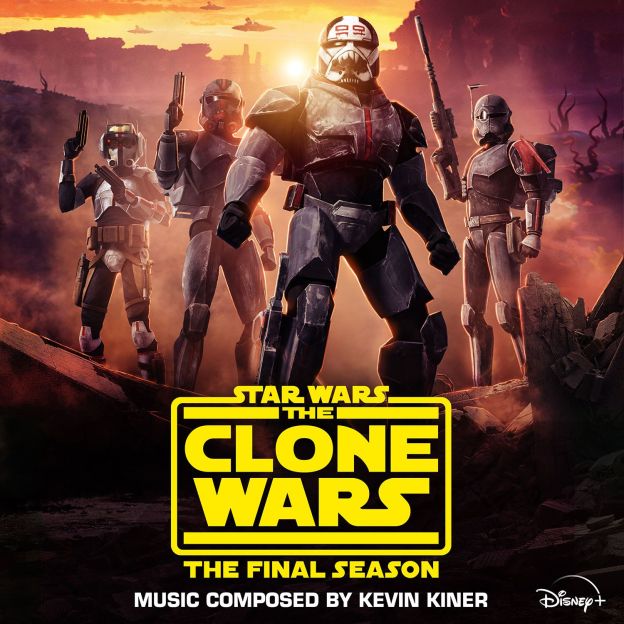
The last of three original soundtracks composed by Kevin Kiner for Star Wars: The Clone Wars was released day along with the final episode in the series. All 12 episodes of season 7 (and indeed the entire Clone Wars series) have been scored by Kevin Kiner, an award-winning composer who is one of the most versatile and sought-after composers in Hollywood.
Highlight tracks include the adrenaline-inducing “Ahsoka vs. Maul” which calls back to John Williams’s “Duel of the Fates” from ‘The Phantom Menace’, and the heart-wrenching electronic synths and angelic tones of “Burying the Dead”.
About Star Wars: The Clone Wars Season 7:
Now it is the end of the historic Clone Wars, as the forces of darkness have amassed great power in their bid to transform the Republic into the Galactic Empire. In the conflict’s final days, clone troopers specialize for the dangerous missions ahead, Ahsoka Tano confronts life outside of the Jedi Order, and a familiar menace returns to wreak havoc.
If you haven’t checked out the soundtrack for Star Wars: The Clone Wars Season 7 before now, I highly recommend checking out the tracks for the last four episodes, as Kevin Kiner takes the music to another level.
Fox Music/Hollywood Records has released the digital soundtrack from the Amazon Original series, Tales from the Loop. From executive producer Matt Reeves and based on the acclaimed art of Swedish artist Simon Stålenhag, Tales from the Loop explores the town and people who live above “The Loop,” a machine built to unlock and explore the mysteries of the universe – making things possible that were previously relegated only to science fiction. In this fantastical mysterious town, poignant human tales are told that bare universal emotional experiences, while drawing on the intrigue of genre storytelling.
The album features original themes by Philip Glass and score by Paul Leonard-Morgan. Born in Baltimore, Maryland, Philip Glass is a graduate of the University of Chicago and the Juilliard School. Glass has expanded his repertoire to include music for opera, dance, theater, chamber ensemble, orchestra and film. His scores have received Academy Award nominations (Kundun, The Hours, Notes on a Scandal) and a Golden Globe (The Truman Show). Paul Leonard-Morgan’s unique cinematic style of fusing orchestra with electronica has put him in high demand as a film composer, a producer and arranger for bands, and has led him to win a BAFTA award, and receive Emmy & Ivor Novello nominations. In 2016, Leonard-Morgan began working with Academy-Award winning director Errol Morris on a string of projects including the documentary feature The B-Side, the award-winning Netflix series Wormwood, and the newly-completed motion picture on Steve Bannon, American Dharma. Other credits include The Quiet One–the story of Rolling Stones founding member Bill Wyman, the feature Last Breath, the hit series reboot Dynasty for The CW, and Designated Survivor on Netflix.
Leonard-Morgan said (on working on Tales from the Loop):
“Collaborating with Philip Glass on Tales from the Loop was an incredible experience. Philip and I had a discussion with Nathaniel Halpern (showrunner) and Mark Romanek (executive producer) about their vision for the show, the incorporation of unusual instruments, and their shared desire of wanting the soundtrack to be an integral part of the show: ‘Music which could be listened to by itself, melodies which could be hummed, a soundtrack which will stand the test of time apart from the series.’ Philip went and scored a bunch of initial ideas, as did I, and we discussed where they all might work together. Both of us playing off each other’s sounds and melodies to create a truly unique score. Over and again, we kept coming back to the original idea: to make beautiful music, which would work hand in hand with Nathaniel’s brilliant visions and beautiful cinematography. The 8 episodes are so unique—they’re like nothing we’ve ever seen, and hopefully the score stays true to this. Melodies come back throughout the show, each guiding us through the world of the loop. During recording sessions every 3 weeks, the natural sounds of the solo violin and the solo cello gave a beautiful, haunting sound to the loop, becoming an integral part of the sound.”
Glass added:
“I’ve always tried to collaborate with people from many disparate perspectives; everyone from indigenous musicians to electronic musicians have expanded my musical sensibilities. Working with Paul was no exception and the intersection of our two styles has produced a score both unexpected and familiar that accompanies the series beautifully.”
The soundtrack for Tales From the Loop is like nothing I’ve ever heard for television before, and I don’t say that lightly. Television music, in my experience, is either quite minimal or very grandiose (think Game of Thrones for the latter). But Tales from the Loop strikes a middle ground that I don’t think I’ve ever heard until now. Everything, every single track, is perfectly symphonic, like something you’d hear in a concert hall. And I can’t emphasize enough how much of a good thing this is. This is music that can be enjoyed completely separate from the show as well as while you watch each episode. It takes phenomenal skill to make music that can thrive outside of the show and with Philip Glass and Paul Leonard-Morgan in charge of the score it’s little wonder it worked out that way.
In hindsight, it actually makes a lot of sense that the soundtrack for Tales From the Loop would feel symphonic in nature. After all, Glass is well known for his concert works, and it’s only natural that that would bleed over into his work for film and television.
If you’re able to, check out the soundtrack for Tales From the Loop. It’s peaceful, it’s relaxing, and it’s like listening to a long, quiet symphonic work in a concert hall (and that’s a good thing).
Let me know your thoughts on Tales From the Loop (and it’s soundtrack) in the comments below and have a great day!
Star Wars is known for many things, but one of my favorites is the many great musical moments that define each of the films in their own way. In the prequel trilogy, one of my favorite moments comes at the very end of The Phantom Menace when everyone gathers in The (capital of Naboo) to celebrate their victory over the Trade Federation and the new alliance between the Gungans and the people of Naboo.
During “Augie’s Great Municipal Band”, the Gungans march up the main boulevard of Theed to the steps of the palace, celebrating all the way, while Queen Amidala waits for them along with a host of important characters (the Jedi council and the newly-elected Chancellor Palpatine among them). “Augie’s Great Municipal Band” has a bouncing melody that appears to perfectly reflect the excitement of the moment. But there’s a secret here, courtesy of John Williams.
Listen to this melody in the video above, listen to it very carefully. Do you hear it? Don’t feel bad if you can’t, I didn’t know this existed until I was told about it. Pay attention to the children’s choir, does it sound at all familiar? In a way it should, they’re actually singing the Emperor’s theme in a major key (it’s usually minor) and at least double the speed. That’s right, John Williams hid the Emperor’s theme in a scene of celebration as an extremely subtle bit of foreshadowing that Palpatine is literally controlling all of this. It’s downright spooky once you make the connection, not to mention it makes you view this “celebration” in a completely different light. Everything is going according to Palpatine’s plan, and the Jedi are already doomed, even though they appear to be stronger than ever.
Of all the musical foreshadowing John Williams has done in the Skywalker Saga, this is among the most subtle. Be sure to think about this the next time you watch the conclusion of The Phantom Menace, you’ll never look at that scene in the same way ever again.
Let me know what you think about “Augie’s Great Municipal Band” in the comments below and have a great day!
Thankfully the coronavirus hasn’t stopped all television from being made. In fact, Icelandic composer Atli Örvarsson (The Hitman’s Bodyguard, Rams) will compose the upcoming thriller “Defending Jacob,” which is set to premiere globally on Apple TV+ on April 24th, 2020.
“Defending Jacob” will premiere its first three episodes exclusively on Apple TV+ starting Friday, April 24th, and new episodes will premiere weekly thereafter Friday.
The new character-driven thriller starring Chris Evans, Michelle Dockery, Jaeden Martell, Cherry Jones, Pablo Schreiber, Betty Gabriel and Sakina Jaffrey is based on the 2012 New York Times best-selling novel of the same name by William Landay. “Defending Jacob” unfolds around a shocking crime that rocks a small Massachusetts town, and follows an assistant district attorney who finds himself torn between his sworn duty to uphold justice and his unconditional love for his son.
Örvarsson recorded the score at The Village in Los Angeles with a 24-piece orchestra. Atli on the sound of “Defending Jacob”:
It was music from my upcoming album which sparked the interest of the filmmakers and as a result, composing the music for the series has felt almost like a continuation of that. The instrumentation and general feel is cut from the same cloth and there’s a definite Nordic Noir feel to the show, which has made the whole process feel even more natural. The vision of Morten Tyldum (director) and Mark Bomback (writer/producer) has been very compatible with my own, which has made the whole process a real joy!
Raised in the small town of Akureyri in the north of Iceland, Atli Örvarsson relocated to Los Angeles early on to pursue a career in composition. There, Atli worked extensively alongside prolific TV veteran Mike Post and Hollywood legend Hans Zimmer, which launched his career leading him to score over 40 films and countless TV shows.
Atli’s accolades include winning the HARPA Nordic Film Composer Award for his acclaimed score to Rams, several ASCAP & BMI Film & TV Music Awards, a “Breakthrough of the Year” nomination with the IFMCA Awards in 2009, plus he was nominated for the prestigious World Soundtrack Academy’s “Discovery of the Year Award” for his score for Babylon A.D in 2009 and his score for Ploey: You Never Fly Alone was nominated for a “Public Choice Award” in 2018.
Defending Jacob premieres on Apple TV+ on April 24, 2020.
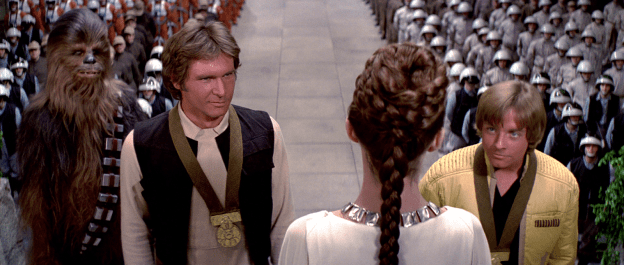
Given the enormous amount of music that John Williams has composed for Star Wars over the decades, it stands to reason that some pieces will be remembered more than others. One piece that might not be remembered as much as it should is “The Throne Room”, the fanfare that concludes Episode IV before the credits begin to roll. To put it in context, the Death Star has been blown up, the surviving heroes have returned in triumph, and now it’s time for our heroes to receive their reward from Princess Leia:
It’s a stirring fanfare to be sure. As the heroes stride down the aisle to where Princess Leia and the other Rebel Alliance leaders are waiting, you hear a heroic version of “The Force” theme backed up primarily by the brass (and supported by the strings underneath). This music has all the makings of a climactic ending, and originally that’s what it was supposed to be. Remember, at the time the score was composed, there was no guarantee that there would be any sequel to Star Wars, let along a decades-spanning franchise that shows no sign of slowing down. With that in mind, it’s my understanding that the decision was made to give Star Wars as “final” sounding of an end as possible, just in case this was all she wrote and the film bombed at the box office (an idea that sounds laughable now but was a distinct possibility at the time).
“The Throne Room” is designed to bring the story of Star Wars to a close without the aid of dialogue. It tells us all we need to know: the heroes have done what they needed to do, now they can take a breath and celebrate their victory. And if this had been all there was, anyone could say this piece of music brings Star Wars to a thrilling conclusion. But of course, history tells us this was only the beginning for Star Wars. That being said, it doesn’t change the fact that “The Throne Room” is a beautiful piece of music, one that all fans of film music should take a few minutes and listen to.
Let me know what you think of “The Throne Room” in the comments below and have a great day!
Now that we’re a third of the way through the final season of Star Wars: The Clone Wars, Disney has released the official soundtrack for the first four episodes. This covers soundtrack excerpts for “The Bad Batch”, “A Distant Echo”, “On the Wings of Keeradaks”, and “Unfinished Business.”
If you’ve been following the final season of Star Wars: The Clone Wars on Disney+ then you know the music has been as brilliant as ever. There have been callbacks to some classic Star Wars motifs, and plenty of action as only composer Kevin Kiner can deliver it.
Kiner said (of this season): “It has been such a fantastic ride scoring ‘Clone Wars’ and working with Dave Filoni and George Lucas was a dream come true. I feel like season seven is everything we all wanted ‘Clone Wars’ to be, top to bottom. From the music to the animation to the story lines to the directing, this is the show I always wanted to be a part of!”
The release dates for the remaining soundtrack releases are as follows (hopefully the coronavirus will not delay them):
4/10: Star Wars: The Clone Wars – The Final Season (Episodes 5-8)
5/4: Star Wars: The Clone Wars – The Final Season (Episodes 9-12)
Tracklist
Star Wars Main Title & A Galaxy Divided
Misplaced Hope
Droids Approaching
Clones Retreat
Anakin and Padmé
Chase in the Sky
Poltechs
Search Party
Escape Route
Walkers Battle
Mission Begins
Ticking Time Bomb
Bad Batch Heroics
Finest Troopers
Enjoy the new soundtrack release for Star Wars: The Clone Wars and have a great day!
When Star Wars: The Force Awakens arrived at theaters in 2015, John Williams proved that he hadn’t missed a step by filling the film with all kinds of musical themes. Heroes and villains alike were given their own memorable themes. “March of the Resistance” is one of the heroic themes and was written for the Resistance as a whole, though I feel it could also be applied to certain characters. Check out “March of the Resistance” below:
This theme arrives for the first time in the midst of the Battle of Takodana, just as our heroes have been taken captive by the First Order. It starts as the camera turns and reveals Resistance X-Wings are racing towards the ruins of Maz’s Castle led by Poe Dameron.
“March of the Resistance” is one of the more “classic” Star Wars themes that John Williams created for The Force Awakens. By “classic” I mean that this theme could easily fit into the original trilogy with its jaunty bass tones and upbeat rhythms. Think about it, doesn’t this theme feel like it could apply to the Rebellion just as much as the Resistance? Not only that, but I really feel this theme could apply to Poe Dameron as his own personal theme. It fits Poe perfectly: it’s brash, it’s loud, and it just oozes confidence, all qualities that the future Resistance general definitely possesses. I’m not sure if Poe has his own theme or motif, but if he doesn’t, I’m probably just going to apply this theme to him from now on because it is just too perfect for him.
This theme recurs at several points in the sequel trilogy after debuting here, most notably in The Rise of Skywalker when the Resistance is departing to bring the fight to the Final Order. It’s a very versatile theme, good for playing over sections of the film that show the Resistance in action. It’s also quite memorable, as its one theme from the sequel trilogy that I’ve found myself humming from time to time.
I hope you enjoyed listening to “March of the Resistance” from Star Wars: The Force Awakens. Let me know what you think about this theme in the comments below and have a great day!
This is my honest opinion: if you try to tell me there are no great musical themes in Star Wars: The Force Awakens, then you haven’t been paying attention, because John Williams introduces a beautiful, original theme relatively early in the film. This is “Rey’s Theme” and it comes when, you guessed it, we first meet Rey living as a scavenger on Jakku.
The theme starts as Rey is leaving the ruins of the crashed Star Destroyer, having finished her work for the day. It starts off with a bit of whimsy, a soft chiming melody that soon grows into a flowing theme with the strings and woodwinds. This melody tells us several things: that Rey is young and idealistic (much as Luke Skywalker was many years ago), but also that she has her own inner strength even before she starts to use the Force. The former is heard in the opening part of the theme, and the inner strength is revealed when the strings come in, pushing the theme to new heights.
This original version of “Rey’s Theme” lays the foundation for several melodies to come in the sequel trilogy, particularly in The Rise of Skywalker. Williams will put this melody through several variations, altering it to meet Rey’s changing circumstances as the story progresses.
As a musical introduction to one of the most pivotal characters of the sequel trilogy, “Rey’s Theme” performs its purpose beautifully. This theme deserves to be remembered just as much as “The Force Theme”, “The Imperial March”, “Duel of the Fates” and any other classic Star Wars theme. For me, this theme is clear proof that John Williams is just as talented as ever when it comes to creating memorable film music themes.
I hope you enjoy listening to “Rey’s Theme” as originally heard in Star Wars: The Force Awakens, let me know what you think about it in the comments below and have a great day!






 Film Music Central