After escaping the Dodo and his friends (who wanted to burn Alice alive in the White Rabbit’s house because they thought she was a monster), Alice continues to try and find said White Rabbit (the reason she tumbled into Wonderland in the first place) only to stumble into a large garden of talking flowers! I have to say this is one of my favorite sequences because the flowers are so beautifully animated, each with a distinct personality.
The flowers seem to be led by the Red Rose, who is initially very kind to Alice. All of the flowers want to sing to Alice about how wonderful they are, but no one can agree on which flower they should sing about. The Red Rose decrees that they will all sing “All in a Golden Afternoon” because “that’s the song about all of us.” And so the flowers sing together with the Red Rose serving as the conductor (with Alice listening in wonder):
Little bread-and-butterflies kiss the tulips
And the sun is like a toy balloon
There are get up in the morning glories
In the golden afternoon
There are dizzy daffodils on the hillside
Strings of violets are all in tune
Tiger lilies love the dandy lions
In the golden afternoon
(The golden afternoon)
There are dog and caterpillars and the copper centipede
Where the lazy daisies love the very peaceful life
They lead…
You can learn a lot of things from the flowers
For especially in the month of June
There’s a wealth of happiness and romance
All in the golden afternoon
All in the golden afternoon
The golden afternoon…
(Alice chimes in)
You can learn a lot of things from the flowers
For especially in the month of June
There’s a wealth of happiness and romance
All- (voice cracks)
(All together): All in the golden afternoon!
“All in the Golden Afternoon” is a beautiful song and a reasonably sane interlude after the ridiculousness of the Dodo (though it won’t be long before we’re thrown into the insanity of the Un-Birthday Party, but I digress…). Alice loves the song, but the good time doesn’t last: the flowers are very curious to know just what kind of flower Alice is. When the naturally befuddled girl can’t give a clear answer, the flowers come to the only natural conclusion: Alice must be a weed and weeds aren’t welcome in the garden, so out she goes!
I always thought it rather silly that the flowers would think Alice was a flower too (considering she doesn’t look anything like a flower), but then again, this IS Wonderland we’re talking about, most of the inhabitants aren’t known for their common sense (just wait until we get to the Queen of Hearts).
What do you think of All in the Golden Afternoon? Let me know your thoughts on this song in the comments below 🙂
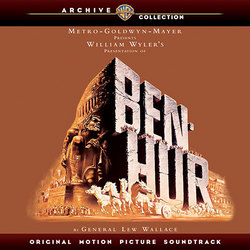
Longtime readers of this blog know that I am a huge fan of composer Miklos Rozsa’s film scores. Rozsa (1907-1995) was a titan of film music and his epic score for Ben-Hur (1959) remains a benchmark that few have ever equalled (let alone surpassed).
I am pleased to announce that Tadlow Music is releasing a completely new recording of this 157 minute score on October 3rd, one that will feature previously unrecorded music. The music has been recorded by the City of Prague Philarmonic and is conducted by Nic Raine.
If you haven’t seen the 1959 epic, it is NOTHING like the travesty that came out in 2016 (in fact, forget that movie even exists). The 1959 version of Ben-Hur is still considered to be one of the greatest films ever made, winning a record 11 Academy Awards (a feat that has only been equaled twice and NEVER surpassed) as it tells the story of a Judean prince (played brilliantly by Charlton Heston) whose life is thrown into turmoil at the same time that a strange carpenter begins preaching a new message to the people.
When you listen to this soundtrack, I highly recommend starting with the Overture. While it may seem strange now for a film to have an “overture” like an opera, back in the day it was fairly common for an epic film to start with a musical overture of some kind (there was also intermission music and exit music) that would play as the audience took their seats.
Another track that I absolutely recommend is the “Parade of the Charioteers” (this is usually preceded by a series of fanfares). This is the music that precedes the climactic chariot race (where Ben-Hur and Messala settle their differences once and for all) and is rightly considered one of the greatest sequences ever put on film. Curiously, the race itself has no music, something I’ve talked at length about.
Another track that I must recommend is the music that accompanies the “Lepers!” scene. As I’ve said previously, this scene features some amazing musical work, as Rozsa must convey with music alone that something terrible has happened to Ben-Hur’s mother and sister without the audience actually seeing what it is.
Truthfully, I could recommend this entire soundtrack, as it is a beautiful masterpiece, whose importance to film music cannot be overstated. In fact, parts of the score were used as temporary music for Star Wars (1977) (and it is said you can still hear its influence in certain places). If you want to hear some fantastic music, please pick up this new recording when it comes out in October. My thanks to The Krakower Group for making this information available.
I was fortunate enough to be able to experience the soundtrack for the upcoming film American Assassin, due to be released next week in theaters. Directed by Michael Cuesta, American Assassin follows the rise of Mitch Rapp, a CIA black ops recruit, after losing his parents in a car accident and his girlfriend to a terrorist attack shortly after they were engaged.
The soundtrack was composed by Steve Price and is simply amazing. This review will look at several pieces from the soundtrack, to give you an idea of what is to come. The opening track is titled “The Proposal” and begins with a quiet melody, partially played on piano. This is later mixed with a cello; it is simple but romantic at the same time. The twist comes halfway through the track: the music suddenly turns dark (emphasized by very low tones on the piano) and the tension is slowly turned up as the mood turns from light and happy to dark and unsure. Even though the film hasn’t come out yet, the music allows me to visualize what is likely happening: Mitch has just proposed to his girlfriend (or maybe he is getting ready for it), when, according to the music, something terrible happens.
The fifth track is titled “Plutonium” and is not so much a melody as it is a cluster of sound waves that rise and fall in volume. The opening moments are dripping with menace (appropriate for plutonium, which can be deadly in the wrong hands), and for most of the track there is no motion in the sound, but this begins to change toward the end. I don’t mean to imply that lack of motion is a bad thing because it isn’t. Sometimes the soundtrack just needs to convey the threat of something, it doesn’t necessarily have to move the audience along, so to speak.
The tenth track is titled “I Trusted You” and it might just be my favorite in the soundtrack. The first minute is pure frenetic energy, but then it slides back into a contemplative mode, as if the scene began with a burst of action and then tapered off, perhaps into dialogue. I loved the mix of energy between the different instruments, and how seamlessly it transitioned from action to drama (fast-paced to slow-paced, it’s a slight oversimplification, but it gets my point across).
And that is my brief preview into the music for American Assassin. I absolutely loved everything I heard and I believe Steve Price has done a magnificent job. I apologize deeply for not getting these music reviews out sooner, the dissertation has taken over a large chunk of my life and I was forced to place these reviews on the back burner. But now I promise that if I blog on nothing else for the near future, I will get some reviews out to you every week. I hope you enjoyed this one, there’s plenty to come I promise. My thanks to The Krakower Group for making the soundtrack of American Assassin available. Have a good weekend everyone!
I came across Roger Corman’s The Masque of the Red Death completely by accident several years ago when I was browsing through Netflix for something interesting to watch. While I generally don’t like horror, I do like Vincent Price very much, so I figured a film with Price in it couldn’t be THAT bad, so I gave it a try. The film is based on Edgar Allan Poe’s short story of the same name and tells the story of Prince Prospero (Price), a Satanist who invites several dozen nobles and their wives to stay in his castle while the Red Death ravages the countryside.
He promises that as long as they stay inside the castle they are safe, but in reality Prospero knows that everyone is doomed…except for him of course. As he explains to a terrified Francesca (played by Jane Asher, she is a peasant girl that Prospero kidnapped at the start of the film), he (Prospero) has made a deal with Satan himself: in return for delivering all of these souls to Hell via the Red Death, not only will Prospero be spared from the plague, but a high seat in Hell is reserved for him (Prospero has previously denied the existence of God and Heaven and therefore believes that ruling in Hell is the best thing to hope for).
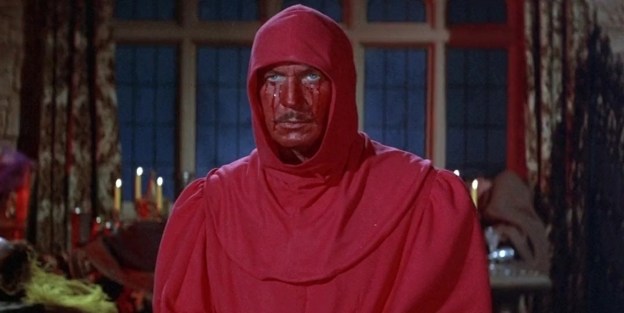
From left to right: Prospero, Red Death and Francesca
For the film’s final ball scene, Prospero had commanded that nobody was to wear red (as it would be in bad taste). But, unknown to everyone, the living symbol of the Red Death has slipped into the castle and his presence lures Prospero into his Black Room. The Prince mistakenly believes that he is meeting with an ambassador of Satan who has come to “reward” him for his services (a claim the Red Death does not deny until Francesca is safely out of the castle where her lover Gino is waiting for her). As Prospero and the Red Death come back to the dancers, Death announces “It’s time for a new dance to begin…the Dance of Death!”
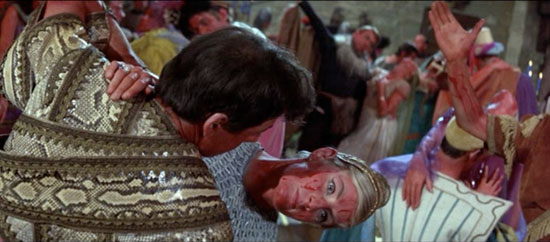
Upon these words, the scene of mirthful dancing and partying is changed into a danse macabre. One by one, each pair of dancers becomes coated in red “blood” (the symbol of infection with Red Death) and begin a halting, staggering ballet. It’s never been quite clear to me if they’re already dead or not, but it is an unforgettable scene. I draw this moment to your attention because of the haunting melody that begins with the first transformation. As the camera slides up and down the figure of the first pair, a sad woodwind melody begins. It continues at a leisurely pace as Prospero and Death walk among them (Prospero is amused by all of it). But once Francesca is sent away, Death finally reveals that the Prince is very mistaken in his beliefs as he informs Prospero that “Death has no master.”
When Prospero protests that “there is no God (because Satan “killed” him)” Death replies “He (Satan) does not rule alone. And your pact with him will not save you.” Prospero finally reaches out to see the face underneath the mask only to find…his own. As Death had earlier told him “There is no face of Death, until the moment of your own death.” Seeing his own face reveals that it is Prospero’s time to die, a fate that the Prince tries to flee. And once he starts to run, the leisurely melody turns into an almost frantic march as the dancers swarm Prospero, looks of rage on their bloody faces. And at every opening…there is Death waiting with open arms. Finally, in a lumbering climax, all of the dancers fall dead on the floor, all but Prospero….and Death. Terrified, Prospero flees to the Black Room and locks the door, but Death is already inside. With the Prince cornered, Death delivers one of the most haunting lines I have ever heard: “Why should you be afraid to die? Your soul has been dead for a long time.” And with one touch…Prospero is dead.
This scene remains my favorite of the film, and if you haven’t seen it before, I hope you enjoy it. Let me know what you think about it in the comments below.
Thanks to everyone who has participated in the blogathon so far. Today is the last day and here is my contribution. Enjoy!
It’s been two years since James Horner was ripped away from us, his passing left a void that may never be filled. He had a gift for creating magical themes that stuck in the head for hours after the movie was over. And one of my favorite examples from the mid-90s was the main theme from Casper (1995).
Loosely based on the comics character Casper the Friendly Ghost, Casper follows a paranormal therapist, Dr. James Harvey (Bill Pullman) and his daughter “Kat” as they travel from state to state in an attempt to make contact with the spirit of Harvey’s deceased wife Amelia. The pair come to Casper’s former home when the spoiled heiress who inherited the home wants the ghosts (Casper and his uncles) removed so she can claim the “treasure” hidden inside.
Casper’s theme, listed on the soundtrack as “Casper’s Lullaby”, is a haunting piano melody that comes to the forefront particularly when Casper remembers the events of his death, and also during the Halloween dance when Kat realizes she’s dancing with Casper (who’s alive for one night).
It’s such a haunting melody, one that highlights the tragedy of Casper’s short life, and the fact that he “didn’t go where he was supposed to” but stayed behind instead. Actually, ever since Horner passed away, I’ve had a hard time listening to this theme, as it reminds me that one of the greatest film composers is gone before his time. I hope you enjoy listening to Casper’s Lullaby, and I hope you enjoy the rest of the blogathon today.
It’s finally here, the 2nd Annual Remembering James Horner Blogathon is here! Even before I woke up this morning day 1 is off to a good start with two amazing entries already. As I see new entries come up, I will add them to this list below. Enjoy!!
One doesn’t normally associate the horror genre with Star Trek in any way, shape or form (though the infamous “Genesis” episode in Star Trek: The Next Generation comes awfully close in my opinion), and yet there is a scene midway through Star Trek II: The Wrath of Khan that could be straight out of a horror film.
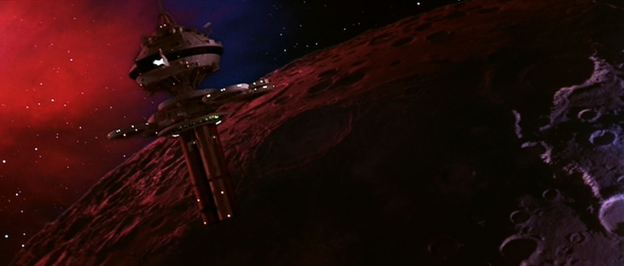
The Enterprise is diverted from a routine training mission by an emergency call from space station Regula One and along the way are ambushed by Khan Noonien Singh, who seeks revenge against Admiral Kirk for stranding him and his followers on Ceti Alpha V fifteen years previously. Barely surviving this attack, the Enterprise limps to the space station, knowing Khan has been there and gone, not sure what they’ll find. Kirk, McCoy and Lieutenant Saavik beam over to see what, if anything, remains on the space station.
From the moment they transport down, the music is like something straight out of a horror film. The space station appears totally abandoned, and the music is dark and ominous. Even though Khan has left, there’s still no way of knowing if he’s left any “surprises” for Kirk and his crew.
Kirk, Saavik and McCoy walk through the empty corridors of the station, and the air is thick with tension. But it isn’t until we go back to a last shot of McCoy that we get the big “horror film” moment. He’s about to cross into a new section when he’s suddenly startled by a rat (because of course there are rats on space stations). And just when he thinks it is safe to keep going….WHAM!! He walks headfirst into the arms of a dead crew member, hanging upside down from a balcony.
It’s a truly horrifying moment, and one that I think is slightly underrated, due to the space battle that happens before and after this segment of the film. But this music is beautiful foretaste of what will come when Horner scores Aliens a few years after this film. I hope you enjoy a look at the scene “Inside Regula One.”
So yesterday I shared with you the disturbing sequence involving a monstrous bear in the 1981 film The Fox and the Hound. But before we got to that point, there’s actually another equally disturbing moment that gave me chills as a kid.
After Todd is nearly lured into a steel trap, he makes a run for it along with his newfound mate Vixie. They run to their burrow and hide but are quickly cornered by the hunter and Copper. As there’s no way for the hunter to get a clean shot (and Copper is unable to dig his way in), the hunter gets an idea: he’ll “smoke” them out of their burrow by setting a clump of dried grass on fire and fanning the flames so that they roar INTO the burrow.
With one exit blocked by flames, the hunter and Copper stand poised at the main entrance, ready to kill the foxes the moment they come out. Inside Todd and Vixie are cornered by a growing inferno and finding it hard to breathe with all the smoke. This moment scared me half to death because, as a kid, I had a fear of being trapped by fire, so this scene was somewhat traumatic for me.
Even how Todd and Vixie escape this trap is somewhat disturbing. They can’t go out the main way because they’ll be killed instantly. So the only other way out is the back entrance (which is currently surrounded by scorching flames). But since it’s their only option…the two foxes run THROUGH the flames and make it out, to the shock and amazement of the hunter, who resumes the chase that will lead him straight to the crazy huge bear.
The whole scenario is disturbing for me, but at least Todd and Vixie aren’t burned to death, and to be fair, it doesn’t look like they were burned at all (which is totally possible in the world of Disney). So while this is a disturbing moment, it’s not as disturbing as it could have been.
What do YOU think of this disturbing moment in The Fox and the Hound? Let me know what you think in the comments below, I’d love to hear about it 🙂
Normally when I share composer interviews, it’s for a relatively current film. But when I found an interview for the 1968 film The Bride Wore Black that was given by composer Bernard Herrmann, I just knew I had to share it with you.
The Bride wore Black (released in France as La Mariée était en noir) is a revenge film directed by Francois Truffaut. It tells the story of a woman named Julie Kohler, whose husband is killed on her wedding day as they’re leaving the church. The crime occurred because five men were horsing around with a loaded rifle in a building across the street and it went off, fatally striking the newly married groom. After learning the identities of the men responsible, Kohler sets out to kill every last man responsible.
The new widow is completely ruthless in her pursuit of vengeance:
victim #1 is pushed off a balcony
victim #2 is poisoned
victim #3 is locked in a small closet where he suffocates to death (she sealed the door shut with duct tape
victim #4 would’ve been killed with a handgun but the police arrested him before she could get him
victim #5 is shot in the back (fatally) with an arrow as she posed for a painting of Diana, Goddess of the Hunt. After noticing that he’s painted her on the wall in a mural, Julie decides to leave the painting as is, knowing the evidence will lead to her arrest. After arriving at jail (where still-alive victim #4 is also serving time), she ends up working in the kitchen where she is last seen taking a food cart towards the men’s side of the prison (a scream implying she’s completed her task of vengeance).
The music for this film was written by the legendary composer Bernard Herrmann (perhaps best known for his collaborations with Alfred Hitchcock on four of his films, including Psycho). I haven’t found many interviews with Herrmann thus far, so it is fascinating to hear him talking about his work with any film. I admit I haven’t actually seen The Bride Wore Black (not yet anyway), but after watching this interview and reading more about the plot, I definitely need to check this film out.
What do you think of Bernard Herrmann talking about The Bride Wore Black? Have you seen the film? And if you have, what did you think of it? I’d love to hear about it in the comments below!
Partition is a very sad story, set in 1947 during the partition of India (when Pakistan was created as a Muslim nation). It is based on the Romeo and Juliet story type, where two people fall in love even though it is forbidden. In this case, a Hindu man, Gian Singh, slowly falls for Naseem, a Muslim girl, even though all the rules of their respective religions forbid this.
With Naseem separated from her parents and Gian finding himself responsible for her, the pair end up bonding over their mutually traumatic pasts and get married, having a son named Vijay. Things become complicated when word arrives that Naseem’s family is actually in a certain village in the newly formed Pakistan. Naseem leaves to visit, promising to return in a month, but her family is so infuriated that she’s married a Sikh that they lock her in a room and forbid her from returning to India. Gian is determined to rescue his wife, so he disguises himself as a Muslim and crosses into Pakistan.
After a disastrous attempt to rescue her, Naseem’s mother recognizes that her daughter really does love Gian and she lets her out so she can catch her husband at the train station. But just as the couple is able to reunite, Naseem’s brother Akbar pushes Gian onto the train tracks and he is killed by the approaching train, to the horror of Naseem. While the police arrest Akbar for murder, Naseem and Vijay are able to escape to England and make a new life.
What makes this film notable for me is that it features a score by Brian Tyler, who is rapidly becoming one of my favorite film composers. This behind the scenes video shows Tyler at work in the studio, annotating his score and recording with a rough cut of the film playing on a screen in front of him. He also worked with the Hollywood Studio Symphony for recording the score as well.
One big thing with the music that Tyler wanted to create is, that while there is a sense of Western music in the score, there is also a frequent callback to the sound of India as well. He wanted to create the feeling that you (the audience) have been transported through time to this very traumatic period in the history of India and Pakistan.
There is something magical about watching Brian Tyler on the podium conducting his music, I definitely need to hear more of this score now. If you’ve seen Partition, I would love to know your thoughts on the film and the score in the comments below.







 Film Music Central