Category Archives: Soundtracks

Soundtrack Review: Molly’s Game (2017)

Molly’s Game is a 2017 American crime drama film based on the memoir Molly’s Game: From Hollywood’s Elite to Wall Street’s Billionaire Boys Club, My High-Stakes Adventure in the World of Underground Poker by Molly Bloom. The movie stars Jessica Chastain as Molly Bloom, Idris Elba, Kevin Costner, Michael Cera and Brian D’Arcy, among others. The film follows Bloom as she comes under investigation from the FBI for running underground poker games for Hollywood celebrities, athletes, wealthy businessmen…and the Russian mob. The film was initially screened at the Toronto International Film Festival on September 8th, 2017 and was released to theaters on December 25th, 2017.

The score for Molly’s Game was written by English composer Daniel Pemberton. Pemberton is an Ivor Novello-winning and multiple Golden Globe and BAFTA Award-nominated composer who has been regularly cited as one of the most exciting and original new voices working in modern film scoring today. His bold writing and unusual and innovative arrangements on scores for movies have seen the soundtracks constantly singled out for critical acclaim. Pemberton’s mix of opera and electronics for Danny Boyle’s Steve Jobs (starring Michael Fassbender and Kate Winslet) not only garnered him a Golden Globe nomination for Best Original Score but so impressed writer Aaron Sorkin that Pemberton was invited to score his much anticipated directorial debut, the recently completed Molly’s Game. Pemberton’s recent scores also include: The Man From UNCLE (2015); King Arthur: Legend of the Sword (2017) and All the Money in the World (2017).

mollysgame.jpg

From the moment I started listening to the score for Molly’s Game, it instantly sounded familiar to me, though it took some digging before I could pin down the reason why. As soon as I looked up Pemberton’s filmography my eyes jumped to The Man From UNCLE (a film I like every much) which I’d thought of repeatedly while listening to the score for Molly’s Game. It’s very obvious to my ears that these two scores come from the same composer, they have the same…frenetic (for lack of a better word) style with a modern feeling “edge” to the music.

Honestly I still have a hard time describing Daniel Pemberton’s film scores and that’s because they sound so different from what I normally listen to. I think it would be fair to say I’m a bit of a traditionalist when it comes to film music; I like full-bodied symphonic scores a la John Williams, Miklos Rozsa and especially Erich Wolfgang Korngold. And Pemberton’s music, so far as I can tell, is very non-traditional, non-symphonic and just…different. But that’s not a bad thing, not at all! Even though I have a hard time describing this new, modernist style that Pemberton is pushing, I can say for certain that I love what I’m hearing.

Review-Mollys-Game-3.png

Most of the tracks in this score have a similar sound to what I heard in The Man From UNCLE, which is that fast-paced style that ranges between extremely light synthetic rock and electronic dancing music. Some of my favorite tracks in this style included “House of Cards,” “The Russians,” and “Red & Black.” However some, like “Molly’s Dream” and “Scars” are slower, more melodic. I like “Molly’s Dream” in particular because it explicitly features the piano, a marked contrast from the bulk of the score.

If you’ve enjoyed Pemberton’s work up to this point, then his score for Molly’s Game will please you immensely. If you’re unfamiliar with Pemberton’s work, I still think you’ll enjoy it. It’s refreshing to listen to film scores that aren’t loaded to the gills with symphonic instruments and pounding drums. I can’t wait to see what Pemberton brings to the field in the future (his next project is listed as Ocean’s 8, the all-female remake of Ocean’s 11). I hope you enjoyed my thoughts on the score for Molly’s Game. If you’d like to discuss it further, let me know in the comments below 🙂

You can become a patron of the blog at: patreon.com/musicgamer460

Check out the YouTube channel (and consider hitting the subscribe button)

See also: Film Soundtracks A-W

Don’t forget to like Film Music Central on Facebook 🙂

The Hunchback of Notre Dame “The Court of Miracles” (1996)

By this point in the story things are looking pretty grim for our heroes: not only does Frollo claim to know exactly where Esmeralda and the rest of the gypsies are hiding, he also plans to “attack at dawn with a thousand men.” After Frollo leaves with a knowing smile on his face, Phoebus (who has heard everything), comes out of hiding and tells Quasimodo that they need to find the Court of Miracles and Esmeralda before Frollo does.


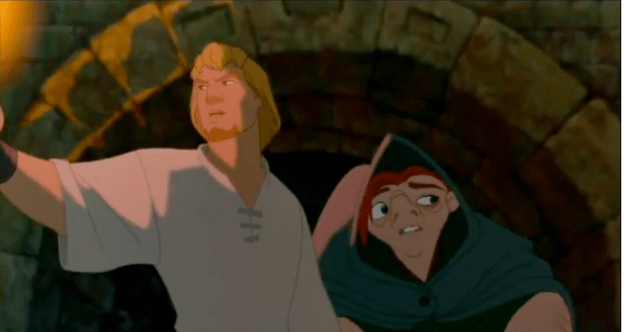
And as it turns out, Quasimodo has a way of finding the hidden refuge in the talisman that Esmeralda gave him. It turns out it’s actually a map of Paris and a certain symbol leads them to the entrance of an old catacomb. As the pair make their way, it quickly becomes obvious that they’re being followed, though Phoebus and Quismodo don’t notice. Phoebus, who has been trying (and failing) to make light of the situation, notes that:

“speaking of trouble we should’ve run into some by now.”

“What do you mean?”

“Oh, you know, a guard…a booby trap…” *the torch is snuffed out* “Or an ambush…”

d-court-2.png

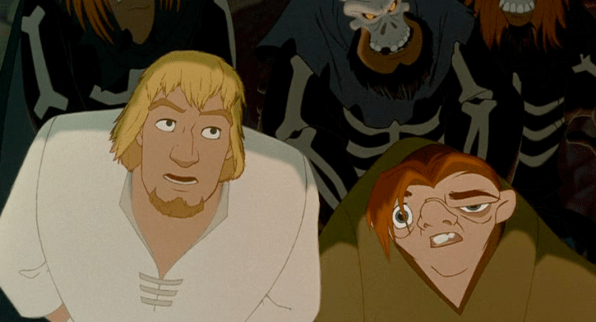
Torches blaze up and the pair are surrounded by gypsies, exactly who they were hoping to find! Unfortunately for our heroes, Clopin, their leader, isn’t interested in anything they have to say since Phoebus is still recognized as Frollo’s captain of the guard and Quasimodo is mistakenly believed to be a loyal henchman, so they must be spies! This is the start of the all too short “Court of Miracles” where Clopin and the rest of the gypsies taunt their captives with how they keep themselves safe by killing any and all intruders.

You were very clever to have found our hideaway,

unfortunately…you won’t live to tell the tale!

Maybe you’ve heard of a terrible place where the scoundrels of Paris collect in a lair,

Maybe you’ve heard of that mythical place called the Court of Miracles…

Hello! You’re There!

d-court-4

In a bit of a twist, it’s revealed that many of the gypsies are only pretending to be disabled. The disguises come off when they return home, hence the seeming reason why it’s call the court of “miracles” because everyone suddenly becomes normal:

The lame can walk! And the blind can see!

But the dead don’t talk! So you won’t be around to reveal what you’ve found!

We have our methods for spies and intruders, rather like hornets protecting their hive.

Here in the Court of Miracles where it’s a miracle if you get out alive!

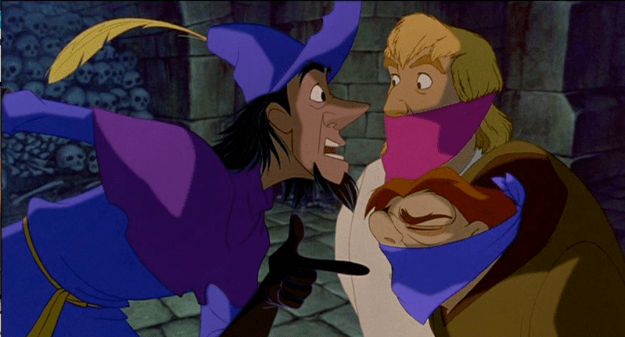
With a loud laugh, Phoebus and Quasimodo are dragged into the Court of Miracles where they’re led to a large scaffold, to be mocked and jeered at by the rest of the gypsies before they’re executed (Djali the goat recognizes the pair and runs to get Esmeralda). Clopin is now dressed as a judge and prepares to hold a “trial” for the pair.

d-clo-jugde-27

Justice is swift in the Court of Miracles,

I am the lawyer and judge all in one!

We like to get the trial over with quickly because it’s the sentence that’s really the fun!

Any last words? *Phoebus and Quasimodo shout through their gags* That’s what they ALL say…

Now that we’ve seen all the evidence *Puppet “Wait, I object!* Overruled! *”I object!!”* 

*QUIET!!!* *…dang…*

We find you totally innocent…which is the worst crime of all…SO YOU’RE GOING TO HANG!!

“STOP!!” And just in the nick of time, here comes Esmeralda to save our heroes’ skins! She informs the incredulous Clopin that Phoebus and Quasimodo aren’t spies, they’re friends.

“Why didn’t they say so?” Clopin sputters, not quite believing what he’s hearing.

“We DID say so!” the disgruntled pair spit back, annoyed at having come all this way only to be nearly executed for trying to do the right thing. Unfortunately, the right thing turned out to be exactly what Frollo wanted them to do…which is lead him directly to the Court of Miracles…

And that’s “The Court of Miracles” from The Hunchback of Notre Dame! It’s a short song, but one of my favorites 🙂 I always thought it was funny that Clopin was so caught up in the moment of catching more spies that he completely missed the pair telling him they weren’t spying at all but were trying to warn them! Let me know what you think of this song in the comments below.

You can become a patron of the blog at: patreon.com/musicgamer460

Check out the YouTube channel (and consider hitting the subscribe button)

See also: Disney Films and Soundtracks A-Z

The Hunchback of Notre Dame “The Bells of Notre Dame” (1996)

The Hunchback of Notre Dame “Out There” (1996)

The Hunchback of Notre Dame “Topsy Turvy” (1996)

The Hunchback of Notre Dame “God Help the Outcasts” (1996)

The Hunchback of Notre Dame “Heaven’s Light/Hellfire” (1996)

Don’t forget to like Film Music Central on Facebook 🙂
Pinocchio “Hi Diddle Dee Dee (reprise)” (1940)

what-do-you-see

Having been rescued from Stromboli with the timely assistance of the Blue Fairy (who also warned that this was the last time she could directly help), Pinocchio is heading straight for home, determined to be a good boy and go to school. Jiminy Cricket is very happy too, as this time Pinocchio seems to thoroughly mean what he says. Unfortunately, who does the young puppet run into on the way home but Honest John and Gideon (again!! Honestly those two seem to be everywhere don’t they?) Having received orders from the Coachman to round up every naughty boy they can find (as detailed in the beginning of my Disturbing Disney series), the wily con men see Pinocchio as the perfect target.

Stopping Pinocchio, Honest John insists that the puppet looks deathly ill and that he simply must have an examination (so apparently Honest John is a doctor too, amazing for a talking fox who can’t read).

Pinocchio “Examination and Hi Diddle Dee Dee (reprise)” (1940)

While Gideon literally scribbles down a “report,” Honest John gives Pinocchio a thorough “examination” including this “diagnosis” of his heart:

“Now that heart. Ooh, my goodness! A palpitating syncopation of the killer diller with the wicky wacky stomping of the floy joy.”

i-m-giving-you-my-ticket

Honest John solemnly pronounces the results: “My boy…you are allergic.” It’s hysterical how he pronounces the word like it’s the most terrible disease in the world, when that’s not even close to how it works (as we all know, you’re allergic to something, it’s not just a case of being “allergic.”) Of course Pinocchio has no way of knowing that, but even so, when Honest John pronounces that the only cure is a holiday on Pleasure Island, the puppet weakly insists that he can’t go. But that’s no problem as Honest John gives Pinocchio his very own “ticket” (the Ace of Spades, otherwise known as the Death card) and lead the puppet away with a stirring reprise of “Hi Diddle Dee Dee” :

Hi Diddle Dee Dee, it’s Pleasure Isle for me!

Where every day is a holiday, and kids have nothing to do but play

Hi Diddle Dee Doo, if what I hear is true,

At noon each day there’s a big parade, the river’s flowing with lemonade,

A land of pudding and marmalade, it’s Pleasure Isle for me!

Jiminy Cricket (who had walked on ahead), realizes that Pinocchio is going the wrong way (again) and chases after the group as they lead Pinocchio to the carriage that will be departing at midnight for Pleasure Island!

And that’s the reprise of “Hi Diddle Dee Dee!” Let me know what you thought about it in the comments below!

You can become a patron of the blog at: patreon.com/musicgamer460

See also:

Pinocchio “When You Wish Upon a Star” (1940)

Pinocchio “Little Wooden Head” (1940)

Pinocchio “Hi Diddle Dee Dee (An Actor’s Life for Me!)” (1940)

Pinocchio “I’ve Got No Strings” (1940)

For more the more disturbing aspects of Pinocchio, see also:

Disturbing Disney #1: The Coachman in Pinocchio (1940)

Disturbing Disney #2: The truth of Pleasure Island in Pinocchio (1940)

Disturbing Disney #3: Escaping Monstro from Pinocchio (1940)

Don’t forget to like Film Music Central on Facebook 🙂
Soundtrack Review: Red Sparrow (2018)

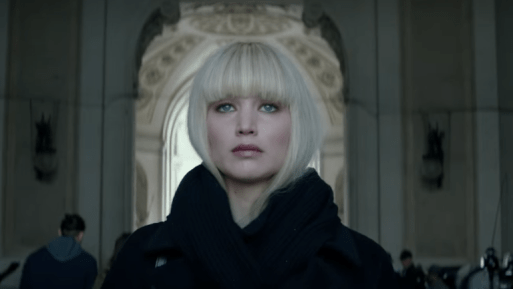
Red Sparrow is an American spy thriller film directed by Francis Lawrence and based on the 2013 novel of the same name by Jason Matthews. The film tells the story of a Russian intelligence officer, Dominika Egorova (Jennifer Lawrence), who is sent to make contact with a CIA agent and possible mole. The film also stars Joel Edgerton, Charlotte Rampling, Mary-Louise Parker and Jeremy Irons. It released to theaters on March 2nd, 2018.
The score for Red Sparrow was composed by James Newton Howard, one of the film industry’s most versatile and honored composers, with a career spanning over thirty years and encompassing more than 130 film and television projects. His myriad film credits include the Oscar®-nominated scores for Defiance, Michael Clayton, The Village, The Fugitive, The Prince of Tides, and My Best Friend’s Wedding, as well as Oscar® nominated songs for Junior and One Fine Day. Howard also received Golden Globe nominations for his scores for Peter Jackson’s blockbuster remake of King Kong and Defiance, as well as the aforementioned songs.

James Newton Howard’s score for Red Sparrow is, in a word, beautiful. Howard’s scores have always been among my favorites, but this one might just be one of his best. For a start, the score begins with a proper overture which came as a very pleasant surprise to me. Overtures in film music are typically, in my experience, associated with the golden age of cinema, when many films contained an overture and an intermission like a stage play or an opera. And like those overtures, Howard’s overture sets the tone for the entire soundtrack: it’s a haunting string melody, mixed with woodwinds, that gently draws you into itself until you’re lost in the rising and falling sounds. Appropriately enough, there are faint overtones of Russian-styled music in the melody, which makes sense given where the film is set. However, this sound does not dominate the overture, it is a hint of “Russian-ness” and nothing more.

Most of the score follows the lyrical example of the overture, especially the last track before the end titles which is listed as “Didn’t I Do Well.” This last piece is more upbeat than the overture and actually put me in mind of a ballet number, which may be deliberate since Jennifer Lawrence’s character is *minor spoiler* a former ballerina. I say it reminds me of ballet because the leaps and quick changes in the melody are reminiscent of the steps a ballet dancer takes.

Red-Sparrow

However, some of the tracks in the score depart from the style featured in the overture and “Didn’t I Do Well” and lean closer to a more modern feel, with electronic sounds and a faster paced, more “jagged” melody. Examples of this include “Take Off Your Dress” and “The Steam Room.” The latter especially could be considered the most “violent” sounding piece in the entire soundtrack (I have my theories as to why but I’ll need to see the film to know for certain) but I enjoyed listening to it because it stood in marked contrast to the other pieces surrounding it in the score.

In conclusion, Howard’s score for Red Sparrow is a gorgeous listening experience and I can already tell it will be the highlight of the film (even if the rest of the film disappoints, which I hope it doesn’t). I think you will definitely enjoy it.

Let me know what you thought of Red Sparrow’s soundtrack in the comments below. 🙂

You can become a patron of the blog at: patreon.com/musicgamer460

Check out the YouTube channel (and consider hitting the subscribe button)

See also: Film Soundtracks A-W

My thoughts on: Red Sparrow (2018)

Don’t forget to like Film Music Central on Facebook 🙂
My thoughts on: Jurassic Park (1993)

61RLRZnbc+L._SY550_

Given my well-known aversion to scary films, it often surprises my friends when they find out I enjoy watching Jurassic Park. While it’s true that this film has its own fair share of insanely terrifying moments (including one in particular that still scares me quite a bit), my lifelong love of dinosaurs as well as my appreciation of Spielberg’s storytelling abilities overrides my fear (John William’s excellent score helps as well). I dimly remember seeing advertisements for this film on TV and being super excited that there was a “dinosaur movie” being made.

And given I was all of 5 years old when the film came out, I couldn’t understand why my parents wouldn’t let me see the movie with the dinosaurs in it (dinosaurs were my first obsession, I couldn’t read enough about them). Of course now I understand that they kept me far away from this film because it was full of scenes that were not appropriate for a 5 year old kid, but unfortunately for my psyche, I didn’t know that when I was 9 and finally managed to see the movie for the first time at my best friend’s house.

10007883794_c90e20625f_b

“Welcome to Jurassic Park”

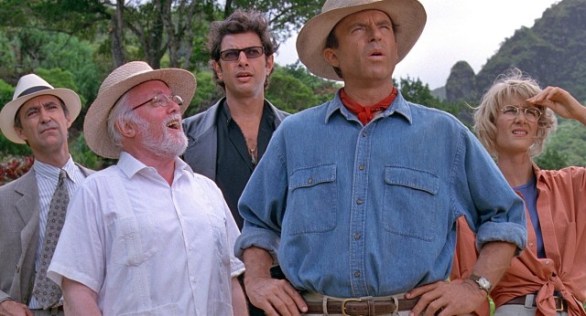
If you haven’t seen the film, Jurassic Park is adapted from Michael Crichton’s 1990 novel of the same name and follows the development of a theme park being built on (fictional) Isla Nublar off Costa Rica that is filled with genetically engineered dinosaurs resurrected from ancient DNA samples. After a deadly accident, the park’s creator John Hammond (Richard Attenborough) needs a group of experts to sign off on the park before the investors will fully commit to opening the island to the public. To that end, the following group is invited to the island to tour the facility:

  • Dr. Alan Grant (Sam Neil): an archaeologist who focuses on velociraptors and also subscribes to the (then-new) belief that dinosaurs were the direct ancestors of modern birds.
  • Dr. Ellie Sattler (Laura Dern): a graduate student studying with Dr. Grant (and also his girlfriend). She specializes in paleobotany.
  • Dr. Ian Malcolm (Jeff Goldblum): a mathematician who specializes in chaos theory. He’s firmly against the entire concept of Jurassic Park, correctly predicting that they will be unable to control the dinosaurs they have created, insisting that “life finds a way.”
  • Donald Gennaro (Martin Ferrero): a lawyer working on behalf of Jurassic Park’s investors. He’s initially skeptical of the project but quickly changes his mind once he first sees the dinosaurs in person.

This group is also joined by Lex and Tim Murphy (Ariana Richards and Joseph Mazzello respectively), Hammond’s grandchildren. Tim is obsessed with dinosaurs (and is a big fan of Dr. Grant’s work), while Lex is a tomboy and a would-be computer hacker.

jurassicpark3d-02

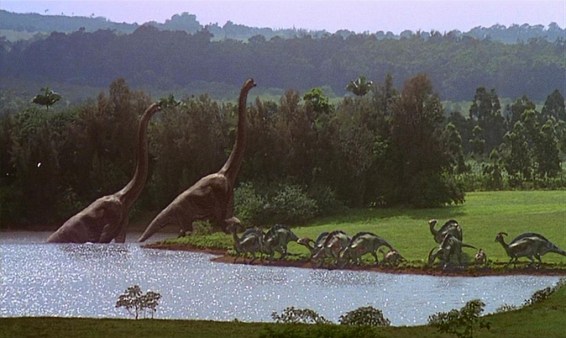
This first part of the film shows the dinosaurs in all of their positive glory: we see a giant herd of dinosaurs gathered around a lake, feeding from the trees, even a triceratops (albeit one that’s in pain). But things start to become menacing almost straight away: we see the velociraptor enclosure and how they have to be fed by lowering whole (Live!!) cows into a brush-filled space, the only sign of their presence being the rustling of the branches. And then there’s the threat of a hurricane moving onto the island that threatens to cut the tour of the park short and oh yes, there’s also the sub-plot of programmer Dennis Nedry (Wayne Knight) plotting to steal various DNA samples for a rival company.

One part of this film I like is how Hammond and most of his staff are in complete denial of how completely in-over-their-heads they are in regards to the dinosaurs they’ve created. The more you hear them talk, the more you just know something is going to go terribly wrong and does it ever! Due to a series of events, the power is cut to the electric fences surrounding each enclosure and the T-Rex is among the first to get out (and did I mention the group touring the park is right in front of that area??)

Jurassic-park-t-rex-600x318

“The T-Rex Attacks”

The T-Rex is a masterpiece of early-90s CGI that has held up surprisingly well over the last 25 years. Originally, the dinosaurs were going to be realized with traditional stop-motion animation until a computer test demonstrated that the dinosaurs could be almost fully created with CGI. But what really puts the T-Rex over the top is the real-life component of the creature. For the epic sequence where the dinosaur stalks the human characters, a full-size animatronic head, arm and two feet were created. Shots of these components were interspersed with the CGI creation to create a spine-tingling moment.

But as scary as the T-Rex scene is, it’s nothing compared to the kitchen scene. You know the one I’m talking about: it’s late in the story, most of the surviving characters have made their way back to the main park building…but so have the velociraptors, who begin stalking Tim and Lex as they run and hide in the kitchen. This sequence terrified me as a kid because I was about the same age as Tim and Lex (give or take a few years) so I could completely identify with them as they hid from the velociraptors. Like the earlier T-Rex scene, the footage of the raptors is a combination of animatronics, live-action puppets (with human performers) and CGI. In fact, there were so many wires required to make the puppet and animatronic components work, that Tim and Lex had to repeatedly jump over them to keep from tripping on them (it’s a wonder they filmed that scene without any of that becoming visible). This scene is so well done that, even though I know it’s all part of a movie and no one is in any actual danger, I still feel terrified that the raptors are going to find and eat the kids!

And then there’s John William’s beautiful score for this film. When you run through a list of Williams’ most recognized pieces, the main theme form Jurassic Park is almost always included and rightfully so. It was the composer’s intention to create music that embodied the sense of awe a person would feel if they really did see dinosaurs walking in front of them as the characters in the film do and the score definitely succeeds with this.

And now for some random thoughts and trivia:

  • Wayne Knight gives an absolutely hysterical performance as Dennis Nedry, it’s almost a shame he gets his comeuppance so early in the story. That being said, his scene with the Dilophosaurus is so funny because he’s talking to a dinosaur and saying “I don’t have any food for you” when it’s patently obvious that the dinosaur considers him to be the food!
  • The T-Rex animatronic was the biggest creation of its time (even bigger than the Alien Queen created for Aliens which gives you an idea of its size).
  • When the T-Rex charges through the sunroof of the Jeep, the glass was supposed to come out, but it was NOT supposed to crack (so note carefully how Tim and Lex’s screams jump up about an octave as they suffer a genuine and unexpected scare).
  • Exactly who was going to die or not changed several times throughout filming. At one point, Mr. Albert (Samuel L. Jackson) was going to live, the lawyer was going to live, but Hammond was going to die (as his counterpart in the book does).
  • When the group has sat down for lunch after arriving on the island, watch the images playing in the background carefully. One of the “concept art” images is an exact match for the Mosasaurus enclosure seen in Jurassic World (2015)

And those are my thoughts on Jurassic Park! I still like watching it from time to time when I want to have a day to myself (usually during a weekend). What do you think of Jurassic Park? Let me know your thoughts in the comments below!

For more film reviews see also: Film/TV Reviews

Become a Patron of the blog at patreon.com/musicgamer460

Check out the YouTube channel (and consider hitting the subscribe button)

Don’t forget to like Film Music Central on Facebook 🙂

Soundtrack Review: Winchester (2018)

642b79c5be902241b628ae5ec4a9dab7

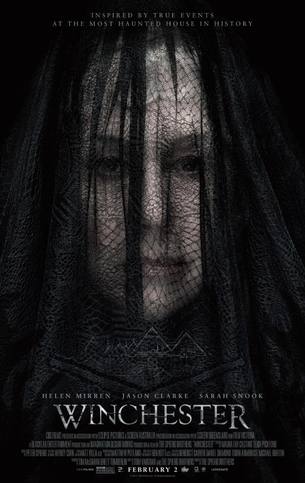
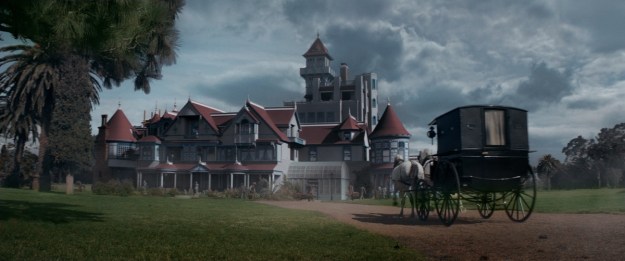
Winchester is a 2018 American supernatural horror film directed by Michael and Peter Spierig. It follows the widowed Sarah Winchester (Helen Mirren) as she seeks to help what she believes are spirits killed by Winchester rifles by continually expanding the mansion she lives in (what is now known as the Winchester Mystery House). Due to Sarah’s obsession with spirits, a doctor named Eric Price (Jason Clarke) is summoned to the mansion to determine whether Sarah is mentally capable of running the Winchester Company. The doctor, who does not initially believe in ghosts, soon finds that there are indeed spirits residing in the Winchester mansion. Winchester was released to theaters on February 2nd, 2018.

The score for Winchester was composed by co-director Peter Spierig in his second outing as a film composer. Peter collaborates with his twin brother Michael and collectively they work as The Spierig Brothers. Their critically acclaimed sci-fi thriller Predestination, based on Robert A. Heinlein’s short story “All You Zombies”, was nominated for nine Australian Academy of Cinema and Television Arts (AACTA) Awards, including Best Director, Best Adapted Screenplay, and Best Score for Peter. The film also won four AACTA Awards including Best Actress for Sarah Snook, who stars in Winchester. The Spierig Brothers won the Toronto After Dark Film Festival Special Award for Best Sci-Fi Film and Best Screenplay for Predestination, which also took a second place Audience Award for Best Feature Film.

v1.bjsxODEwMjk5O2o7MTc2NjA7MTIwMDsyMDAwOzgzOA

Listening to the soundtrack, some moments definitely stood out to me, but overall one thing became pointedly clear: the Winchester score succumbs to the age-old trope of using shock chords in a horror film. It’s a practice that dates back many decades and in my opinion it’s completely over done. It’s true that horror films should have that “scare factor” to them, especially in the music whenever possible, but there’s more than one way to elicit scares through the music.

However as I said there were a few moments that stood out to me in a good way. One of these was “Marion,” referring to a relative of Sarah’s that also lives in the mansion with her son Henry. In contrast to the “Winchester House” track which is fairly typical horror movie score fare (loaded with shock chords, grinding metal sounds and various eerie noises), “Marion” is a relatively calm piano track that possibly signifies how “normal” the character is compared to Sarah Winchester with her belief in spirits and the paranormal. “Employment” also ran along similar veins to this piece.

112815777-e7dfff4a-b5cb-470f-b9ed-0f35b62da75e

“Poisoned Mind” was another track filled with shock chords, far too much for my liking to be honest, as was “You’re A Fraud.”

In brief, Winchester doesn’t have the worst soundtrack in the world (for those curious, Van Helsing (2004) still holds that dubious distinction for me), but it is not one of my favorites.

Did you watch Winchester? If you did, what did you think of the film and the soundtrack? Let me know your thoughts in the comments below. Have a good day!

See also: Film Soundtracks A-W

Become a Patron of the blog at patreon.com/musicgamer460

Check out the YouTube channel (and consider hitting the subscribe button)

Don’t forget to like Film Music Central on Facebook 🙂

Soundtrack Review: Maze Runner-The Death Cure (2018)

images

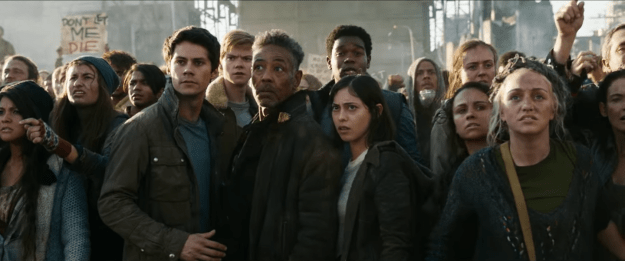
Maze Runner: The Death Cure is a 2018 American dystopian science fiction film based on the third novel in the Maze Runner trilogy written by James Dashner. It was originally meant to be released in 2017 but had to be delayed when series star Dylan O’Brien suffered injuries while filming and required extensive time to recover. In The Death Cure, the surviving “Gladers” must infiltrate WCKD headquarters in order to rescue their friend Minho who is being tortured by WCKD in hopes of developing a cure for the Flare virus that has turned most of the population into “Cranks” (zombie-like beings that have an overwhelming urge to kill anyone who isn’t a Crank). The film and soundtrack released on January 26th, 2018.

The score for The Death Cure was composed by John Paesano, a composer with a lengthy list of film credits to his name. Paesano received an Annie Award for Best Music for his work on DreamWorks’ animated series Dragons: Riders of Berk, which is based on the Academy Award® winning film How To Train Your Dragon. He won a World Soundtrack Award for his score to the hugely successful young adult adaptation, The Maze Runner.

He has now completed the trilogy, which includes The Scorch Trials and The Death Cure. His other credits include Universal Picture’s Almost Christmas and Sony Animation’s The Star. He’s currently scoring both Marvel’s hit series Daredevil and Defenders. Forthcoming in 2018 is Spider-Man PS4, which will be released featuring John’s huge orchestral score.

maze-runner-the-death-cure-clips

Listening to Maze Runner: The Death Cure was a refreshing change of pace compared to the other science fiction works I’ve been listening to as of late (i.e. Annihilation and Altered Carbon). Unlike those works, The Death Cure’s score uses a more traditional orchestra, mostly strings, though there is a healthy dose of synthesizer used as well (in the 21st century, it’s next-to-impossible to find a film score that doesn’t use synthesized music at some point).

Two tracks that stood out to me were “The Virus” and “The Last City.” With “The Virus,” it was very interesting, given the track’s title, how it actually sounded. I was expecting to hear something sinister and dark, but it actually sounded very pleasant. With layered orchestral chords and synthetic drones, the music is actually rather serene at times, which makes me wonder what part of the film this music is attached to with a title like “The Virus.” I really do enjoy listening to this track, it’s simple and direct and hopefully gets its point across in the film.

Last_City

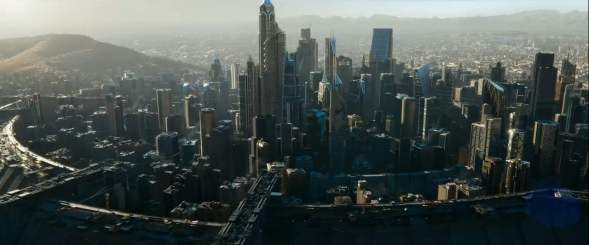
“The Last City” can only be referring to the city that holds WCKD headquarters (and is presumed to be the last functioning city of its kind on Earth). Appropriately enough, given the post-apocalyptic setting, the music for this track is sad, with a mournful horn melody accompanied by strings. I have to imagine that even for those living inside the city things must seem completely hopeless, given how close humanity is to extinction, no wonder the music is so sad. I like how Paesano has written this piece, especially how the strings swell up with a theme of their own and weave in and out with the horn. Like “The Virus,” this track is relatively simple but effective.

And those are my thoughts on the soundtrack of Maze Runner: The Death Cure. Reviews of the film have been mixed, but I think Paesano’s soundtrack is good, and I hope you enjoy listening to it. My thanks to The Krakower Group for making this soundtrack available for review. The soundtrack is available via Sony Classical.

Don’t forget to like Film Music Central on Facebook 🙂

Become a Patron of the blog at patreon.com/musicgamer460

Check out the YouTube channel (and consider hitting the subscribe button)

See also: Film Soundtracks A-W

Soundtrack Review: Annihilation (2018)

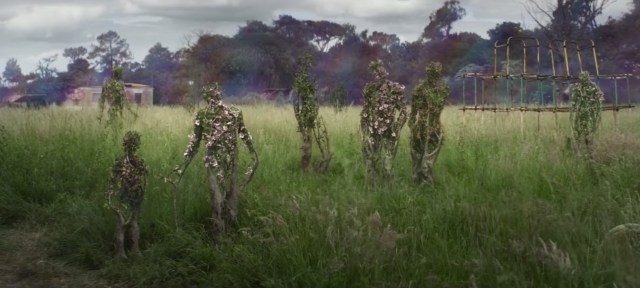
Annihilation is a science fiction horror film written and directed by Alex Garland in his second outing as a film director. The film is based on the novel of the same name by Jeff VanderMeer and follows a group of military scientists who enter “the Shimmer,” a mysterious quarantined zone that is full of mutating landscapes and creatures. Annihilation stars Natalie Portman, Oscar Isaac, Jennifer Jason Leigh, , Gina Rodriguez, Tessa Thompson and Tuva Novotny and was released on February 23rd, 2018.

The soundtrack of Annihilation was scored by composing duo Ben Salisbury and Geoff Barrow, who previously worked with Alex Garland on the Academy Award winning film Ex Machina (2015). Ben Salisbury is an Emmy-nominated composer with over 100 film and television composing credits to his name, including Beyonce Knowles’ self-directed documentary feature Beyonce: Life Is But A Dream and the last 3 series of David Attenborough’s acclaimed Life Of… strand for the BBC. Geoff Barrow, known for his extensive body of work as a music producer and founding member of the band Portishead, first began his film music career as the music supervisor and original score writer for graffiti artist Banksy’s Oscar-nominated documentary Exit Through The Gift Shop. He recently worked on the band Arcade Fire’s latest album Everything Now in addition to producing a cover of ABBA’s “SOS” with Portishead for Ben Wheatley’s film adaption of High-Rise.

The first thing I noticed about this soundtrack is that it is clearly related to the music of Ex Machina. It is not identical, per se, but it clearly comes from the same tonal family as the previous film. I don’t say this as a bad thing, in fact, it’s not uncommon for multiple soundtracks from the same composer (or group of composers) to retain similarities across each film. I also think the resemblance has something to do with Annihilation being considered the “spiritual” successor to Ex Machina.

22-annihilation-2.w710.h473

That being said, if you liked Ex Machina and its soundtrack, then you will love the soundtrack for Annihilation. Like the soundtrack for Altered Carbon, most of the tracks contain the same elements: long synthesized tones, metallic wind chimes, and vocal tones. Despite the similarities, some of the tracks did stand out to me.

“Shimmer Reveal” is only 38 seconds long but it catches the ear because it starts very soft and steadily grows in volume. As the volume increases, the melody “thickens” with a deeper synthesized tone. It feels like we start looking at a small picture which quickly expands into a panoramic landscape (in fact this is probably when we get our first in-depth look at the “shimmer” which can only be that mysterious thing that Natalie Portman’s character is seen walking into in the previews).

annihilation-plant-evolution-elements

“Abandoned Army Base” is half-mystical and half-sinister in the way it combines a synthesized drone with “creaking” metallic tones that sound like metal being ripped apart and metallic chimes that put me in mind of a monastery. Given that this is a science fiction horror film, I can only presume the sinister component I hear is due to someone or something hiding at this abandoned base, just waiting to snatch an unsuspecting victim (of course I could be wrong, but that’s what it sounds like). And going back to Ex Machina, this track in particular reminds me of Ava’s theme.

I have to bring attention to “In All of Us” simply because this track breaks the overall pattern and includes a melody from a guitar, which is so unexpected that it jars the ear when it arrives. “We Are Headed That Way” which follows that track, is interesting to me because of its title. Given the trailer’s hints that “the Shimmer” is causing a mutation of some kind, I wonder if this title refers to the idea that everything on Earth will eventually be affected by this mutation. Truthfully I can’t wait to find out what “the Shimmer” is actually doing, the visuals in the previews looked amazing.

annihilation_deer

And those are my thoughts on the soundtrack for Annihilation. The soundtrack is currently available via Lakeshore Records and I hope you enjoy listening to it. My thanks to The Krakower Group for making this soundtrack available for review.

If you’ve seen Annihilation, what did you think of the film and its soundtrack? Let me know your thoughts in the comments below, but please no spoilers, I’m seeing the film on Wednesday night 🙂

Become a Patron of the blog at patreon.com/musicgamer460

Check out the YouTube channel (and consider hitting the subscribe button)

Don’t forget to like Film Music Central on Facebook 🙂

See also: Film Soundtracks A-W

My thoughts on: Annihilation (2018)

Soundtrack Review: The Alienist (2018)

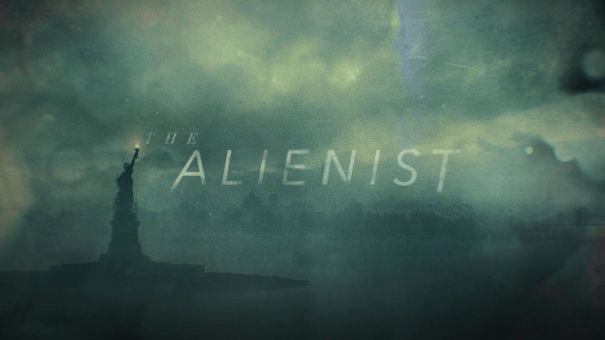
The Alienist is an American television period drama mystery series based on the novel of the same name by Caleb Carr. The ten episode series currently running on TNT stars Daniel Brühl, Luke Evans and Dakota Fanning as a team assembled in late 1890s New York City to investigate a ritualistic serial killer who is murdering street children. The title comes from a late-19th century belief about mental illness. At that time, the mentally ill were considered to be “alienated” from their true nature. Those who studied mental illness were therefore known as “alienists.”

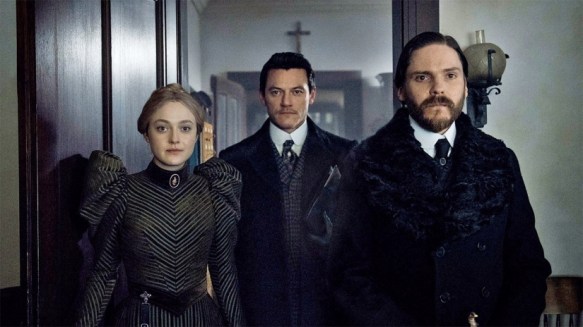
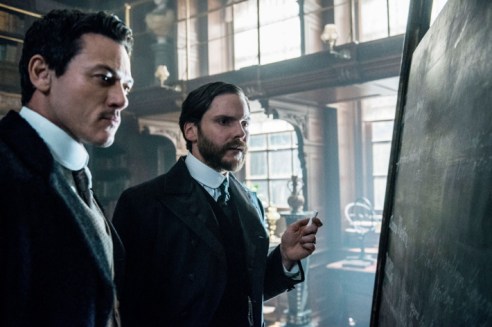
The titular alienist is Dr. Laszlo Kreizler (Daniel Brühl), a criminal psychologist hired to secretly conduct an investigation into the case by police commissioner Theodore Roosevelt (the future President of the United States). Kreizler is aided in his task by newspaper illustrator John Moore (Luke Evans) and Sarah Howard (Dakota Fanning), the police commissioner’s secretary.

alienist

The music for The Alienist was composed by Rupert Gregson-Williams. A truly versatile composer, Gregson-Williams has written a wide range of scores for many feature films, including the Oscar-winning Hotel Rwanda for which he was awarded the European Film Award for Best Composer, the blockbuster DreamWorks animated films Over The Hedge and Jerry Seinfeld’s Bee Movie, for which Rupert was nominated for an Annie Award for his original score and the independent BBC Films’ Love + Hate, for which he was awarded the Reims International Composer Award.

Most recently, Gregson-Williams scored the blockbuster and critically acclaimed Wonder Woman directed by Patty Jenkins and starring Gal Gadot and Chris Pine; the award-winning war drama Hacksaw Ridge, starring Andrew Garfield and directed by Mel Gibson, and the international hit The Legend of Tarzan. His upcoming film projects include “Terminal,” starring Margot Robbie and written and directed by Vaughn Stein.

Having cut the cable cord several years ago, I haven’t been able to watch the show yet, but based on the soundtrack, I think I need to. From the very start with “The Streets of New York” and “Brooklyn Bridge,” there is an old-time sound that is meant to recall the late-19th century. In fact, I was strongly put in mind of the soundtrack to Sherlock Holmes (2009) which is set in a similar time period (albeit in London and not New York City).

05-the-alienist-103.w710.h473

The cue titled “Dr. Laszlo Kreizler,” which I assume is his theme, intrigued me. Given that he’s the titular character, it struck me how sinister his theme sounds with a descending three note motif that recurs in strings and piano. This could be because he studies the mentally ill and crimes committed by people who suffer from mental illness and as a result he’s “tainted” for lack of a better word by what he’s seen. Of course it could also be a musical hint that Kreizler is a villain in disguise, but I can’t say for certain (though now I want to read the book and watch the show to find out if I’m right or not).

Another cue that caught my attention is “Madness of the City” which literally starts with a growl that briefly settles back before exploding into a mad cacophony that literally sounds like someone trying to break through a locked door (which may have been what they were going for) with repeated “banging” sounds. The entire track is underlaid with raging strings (primarily the cello) that continually make their presence known. This is definitely one of my favorite tracks. “Alienated Mind” is also an interesting piece because it consists of long musical drones that remind me of a Buddhist monk chanting “Ommm…”

Alienist-Promo-Still-16-The-Main-Investigators

Finally, I’ll talk about the main title theme for the show, which is very short (only 35 seconds) but contains a wealth of detail. Instead of possessing a distinct theme as most shows do (for example Penny Dreadful, Game of Thrones, Star Trek and NCIS just to name a few), the main theme for The Alienist more closely resembles what music theorists call a “sound cloud,” that is to say a mashup of music that is loosely organized (otherwise it would just be noise) but has no distinct melody. It contains elements from several of the tracks I’ve looked at already, and it carries an air of mystery about it.

And those are my thoughts on the soundtrack for The Alienist. The soundtrack is currently available via Lakeshore Records. My thanks to The Krakower Group for making this soundtrack available for review. Let me know what you think of The Alienist and its soundtrack in the comments below!

See also:

TV Soundtracks

Become a Patron of the blog at patreon.com/musicgamer460

Check out the YouTube channel (and consider hitting the subscribe button)

Don’t forget to like Film Music Central on Facebook 🙂


Pinocchio “I’ve Got No Strings” (1940)

Having been unwittingly sold by Honest John and Gideon to the gypsy Stromboli, Pinocchio is all set to make his big debut in the puppet* theater as the star attraction. Nearby, Jiminy Cricket watches the proceedings with disgust, he can’t believe Pinocchio has fallen into this “I’ll be a big star” trap so easily. The show begins and Pinocchio is introduced by a chorus of puppet trumpeters.

To my knowledge, “I’ve Got No Strings” is the only Disney song to have a false entrance. For you see, as the music begins and Pinocchio (Dickie Jones) begins his first line “I’ve got no strings to hold me do-” he trips over his own feet and somersaults down the stairs to land in a heap on the stage, to the great amusement of the audience.

pinoc-pe-06

Pinocchio “I’ve Got No Strings” (1940)

In a big dose of foreshadowing, Stromboli nearly loses his temper and only his hastily remembered knowledge that there is an audience present stops him from beating the puppet on the spot. Stromboli encourages Pinocchio to try again (I shudder to think of what might’ve happened if Pinocchio had messed up a second time) and the song properly begins:

pinocchio-31.png

I’ve got no strings
To hold me down
To make me fret
Or make me frown
I had strings
But now I’m free
There are no strings on me
 
Hi-ho the me-ri-o
That’s the only way to go
I want the world to know
Nothing ever worries me
 
I’ve got no strings
So I have fun
I’m not tied up to anyone
They’ve got strings
But you can see
There are no strings on me
Pinocchio is a hit with the audience! To the delight of the young puppet, the audience applauds his performance and Pinocchio joins in the applause until the scene changes and a coy Dutch girl puppet descends to the stage:
maxresdefault
You have no strings
Your arms is free
To love me by the Zuider Zee
Ya, ya, ya
If you would woo
I’d bust my strings for you
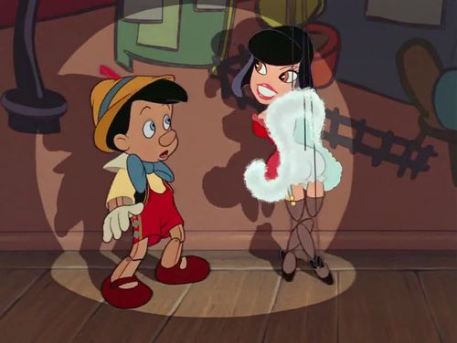
After a group of Dutch girl puppets dance around Pinocchio (knocking him around a little in the process), they retreat only to be replaced by a sultry French girl puppet:
tumblr_inline_n60743tz9N1rdnnfj
You’ve got no strings
Comme ci comme ça
Your savoire-faire is ooh la la
I’ve got strings
But entre nous
I’d cut my strings for you
After this solo, Pinocchio is joined by a group of French girl puppets dancing the can-can, a revealing dance where (in real life), the dancers raise their skirts to show off their legs and petticoats. This is the one dance that attracts the attention of Jiminy Cricket who whips out a pair of spectacles to get a better look at the dancing girls. Of all the puppets, I liked the French puppet the best (just my preference). At the end of the dance, the scene changes once more and Pinocchio is joined by a Russian girl puppet:
373e051e04ac5eca6b565a111250006e--swing-state-tin
Down where the Volga flows
There’s a Russian rendez-vous
Where me and Ivan go
But I’d rather go with you, hey!
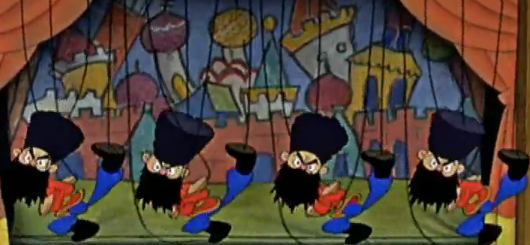
Unlike the other verses, this time the Russian girl is replaced by a troupe of male Russian dancers doing the traditional Hopak dance (often mis-labeled as “The Cossack Dance”), which is actually Ukrainian in origin. Pinocchio is so taken with this dance that he does his best to imitate the puppets with varying degrees of success. When the puppets move to wildly spinning, Pinocchio attempts to copy them, but as you might expect, the young puppet ends up tangling himself in all the puppets and proclaims to the audience:
puppets
 
There are no strings on me!
To his relief, the audience’s laughter is complimented by wild cheers and applause and money begins raining down onto the stage (to the great delight of Stromboli). Jiminy is saddened by Pinocchio’s success, as it seems now like the young puppet will never want to go home and learn how to be a real boy.
Of all the songs in Pinocchio, “I’ve Got No Strings” is widely considered to be one of the most popular and enduring songs along with “When You Wish Upon a Star.” The music was composed by Leigh Harline, with lyrics provided by Ned Washington. The song was (in)famously used in the marketing for Avengers: Age of Ultron when a twisted rendition of the first verse played in the background of several trailers (ending with Ultron finishing the line “there are no strings on me.”) In the film, this song serves the purpose of giving the audience a lighthearted moment before the story takes another turn for the dark; in this case, when Stromboli locks Pinocchio into a birdcage and promises to chop him up for firewood if he doesn’t behave and keep making money for the gypsy.
*I know technically the “puppets” are all marionettes because they’re manipulated by strings, but I referred to them as puppets because that’s easier to type out than saying marionettes over and over again.
What do you think of “I’ve Got No Strings”? Besides Pinocchio, is there a puppet in this song that you like the best? Let me know your thoughts in the comments below 🙂 Thank you so much for supporting the blog, it means the world to me.
Don’t forget to like Film Music Central on Facebook 🙂
Become a Patron of the blog at patreon.com/musicgamer460
Check out the YouTube channel (and consider hitting the subscribe button)
See also: