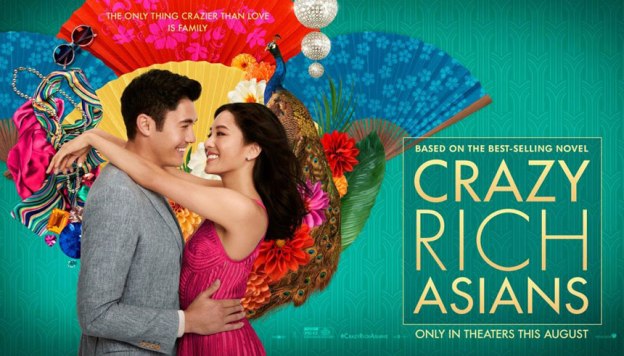
Brian Tyler scoring Crazy Rich Asians (2018)

Based on the bestselling novel by Kevin Kwan, Crazy Rich Asians was one of the best romantic comedy films of 2018. The film follows Rachel Chu (Constance Wu) as she travels to Singapore with her boyfriend Nick Young to attend his best friend’s wedding and discovers Nick comes from an immensely wealthy family. The score for this film was composed by Brian Tyler to accompany a soundtrack full of songs that mostly speak about money (which is a major theme of the movie).

This behind-the-scenes video shows Brian Tyler in the midst of a scoring session for the film. As I’ve said many times, it’s always fun to watch the composer at work, and Tyler is a particular favorite to watch, as you can always tell he’s completely into his work. The pieces covered in this video are “Text Ting Swing” and “Love Theme from Crazy Rich Asians.” I enjoyed listening to both of them, they each feature Brian Tyler’s signature flair and actually made me want to listen to more of the soundtrack.

I hope you enjoyed this brief, behind-the-scenes look at the scoring of Crazy Rich Asians. Let me know what you think about it in the comments below and have a great day!

See also:

Brian Tyler “Alien vs. Predator: Requiem” scoring session (2007)

Brian Tyler scoring Partition (2007)

Brian Tyler talks War (2007)

Brian Tyler talks Rambo (2008)

Brian Tyler “Law Abiding Citizen” scoring sessions (2009)

Brian Tyler “Dragonball Evolution” scoring session (2009)

Brian Tyler talks The Expendables (2010) 

Brian Tyler talks Fast Five (2011)

Brian Tyler “Battle: Los Angeles” (2011) scoring session

Brian Tyler scoring session for Iron Man 3 (2013)

Brian Tyler “Teenage Mutant Ninja Turtles” (2014) scoring session

Brian Tyler conducting and scoring Now You See Me 2 (2016)

Brian Tyler “Power Rangers” scoring session (2017)

Brian Tyler conducts The Mummy (2017)

Film Composer Interviews A-H

Film Composer Interviews K-Z

Become a Patron of the blog at patreon.com/musicgamer460

Check out the YouTube channel (and consider hitting the subscribe button)

Don’t forget to like Film Music Central on Facebook

Dumbo “Pink Elephants on Parade” (1941)

“Pink Elephants on Parade” might possibly be one of the most psychedelic and mind-twisting pieces of animation that early Disney ever produced. The song comes after Dumbo has been forced to become a circus clown and is still deeply depressed over being separated from his mother. The well-meaning Timothy Q. Mouse takes Dumbo to get a drink of water to help him feel better, not realizing that a bottle of champagne has been added to the watering trough. As a result, both Dumbo and Timothy quickly become intoxicated (remember, this is 1941, different time, different standards) and begin seeing things, particularly strange pink elephants that quickly take over the screen. The song “Pink Elephants On Parade” comments on how unnatural it is to see pink elephants and what a disturbing sight it is. The song’s purpose is to 1) lighten the mood after all of the terrible things that have happened to Dumbo and 2) transition the story to the eventual discovery that Dumbo can fly.

Look out! Look out!
Pink elephants on parade.
Here they come!
Hippety hoppety.

They’re here, and there.
Pink elephants ev’rywhere!

Look out! Look out!
They’re walking around the bed.
On their head!
Clippety cloppety.

Arrayed in braid.
Pink elephants on parade!

What’ll I do? What’ll I do?
What an unusual view!

I could stand the sight of worms
And look at microscopic germs
But technicolor pachyderms
Is really too much for me!

I am not the type to faint
When things are odd or things
are quaint
But seeing things you know that ain’t
Can certainly give you an awful fright!
What a sight!

Chase ’em away!
Chase ’em away!
I’m afraid need your aid
Pink elephants on parade!

Hey hey hey

Pink elephants!
Pink elephants!
Pink elephants….

Once the elephants take over, Dumbo and Timothy disappear from the song and are not seen again until the elephants fade away. Until then, the screen is full of multi-colored elephants twisting and turning into different shapes. I know some people have commented on finding this scene scary or even a little disturbing, but I don’t personally remember being scared, if anything I thought it was funny. That being said, the song does contain some very surreal animation; for example a snake becomes an elephant dancer, which transforms into a ball, which becomes a floating eye (definitely not something you see every day). Also, if some of the footage looks familiar, it’s because part of it was recycled for “Heffalumps and Woozles” from Winnie the Pooh and the Blustery Day (1968).

Let me know what you think about “Pink Elephants on Parade” in the comments below and have a great day!

See also:

Dumbo “Look Out For Mr. Stork” (1941)

Dumbo “Song of the Roustabouts” (1941)

Dumbo “When I See an Elephant Fly” (1941)

Disney/Dreamworks/Pixar/etc. Soundtracks A-Z

Become a Patron of the blog at patreon.com/musicgamer460

Check out the YouTube channel (and consider hitting the subscribe button)

Don’t forget to like Film Music Central on Facebook

Dumbo “Look Out For Mr. Stork” (1941)

hqdefault.jpg

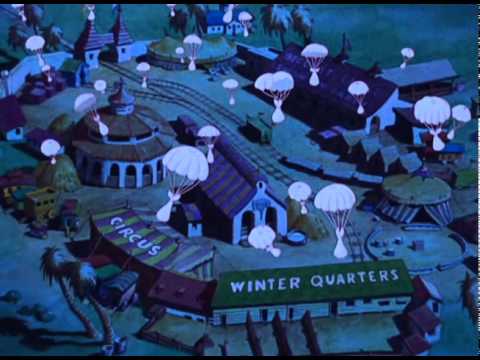
The original Dumbo film was released in 1941 and followed the adventures of the titular baby elephant, who for some reason was born with enormous ears. The story begins the night before the circus is due to leave for the next town, but before the train leaves the storks arrive to deliver a plethora of babies to all of the circus animals. This is the scene for “Look Out For Mr. Stork.” The premise of this song is that the stork delivers babies to everyone, rich or poor, whether you want it or not (that’s actually a little disturbing if you think about it, imagine if these baby animals were sent to parents that didn’t want them!)

Look out for Mr. Stork
That persevering chap
He’ll come along and drop
A bundle in your lap
You may be poor or rich
It doesn’t matter which
Millionaires, they get theirs
Like the butcher and the baker
So look out for Mr. Stork
And let me tell you, friend
Don’t try to get away
He’ll find you in the end
He’ll spot you out in China or he’ll fly to County Cork
So you better look out for Mr. Stork

Look out for Mr. Stork
He’s got you on his list
And when he comes around
It’s useless to resist
Remember those quintuplets and the woman in the shoe
Maybe he’s got his eye on you

Well, almost all of the circus animals receive babies. While newborn babies are sent to their parents left and right, Mrs. Jumbo, one of the elephants, doesn’t receive a baby that she is clearly expecting (not to worry, he arrives the next morning, that particular stork was running late). However, knowing in hindsight that Mrs. Jumbo will get her baby doesn’t change the fact that seeing her be disappointed again and again is very heartbreaking to watch. This is yet another example of how good early Disney was with incorporating some really sad material into their animated films.

Despite the sadness of Mrs. Jumbo, it is fun to watch all the baby animals arrive. One of my favorite moments is when the litter of tiger cubs come crawling out and wake up their mother. Though, as a child, part of me always wondered what the circus staff would make of all the babies the next day.

Let me know what you think about “Look Out For Mr. Stork” in the comments below and have a great day!

See also:

Dumbo “Song of the Roustabouts” (1941)

Dumbo “Pink Elephants on Parade” (1941)

Dumbo “When I See an Elephant Fly” (1941)

Disney/Dreamworks/Pixar/etc. Soundtracks A-Z

Become a Patron of the blog at patreon.com/musicgamer460

Check out the YouTube channel (and consider hitting the subscribe button)

Don’t forget to like Film Music Central on Facebook

Brother Bear “Great Spirits” (2003)

Brother Bear is another example of a Disney animated film that has slowly but surely been forgotten. The 44th animated feature produced by Disney, Brother Bear was one of the last traditionally animated films produced by the company until The Princess and the Frog (2009), as the company was transitioning to computer animated features during this time. Like Tarzan (1999), Brother Bear features a Phil Collins musical soundtrack.

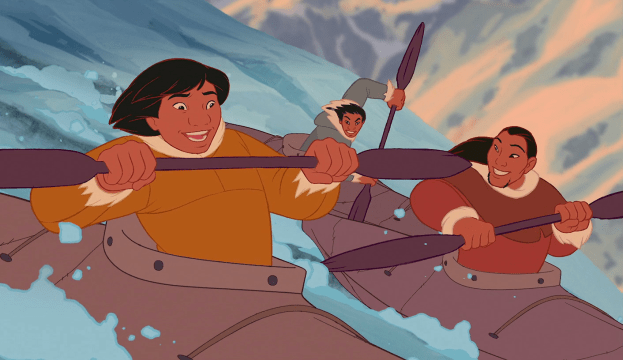
Set at the end of the last Ice Age, Brother Bear follows three Inuit brothers, Sitka, Denahi, and Kenai as they go about their lives in their village. The film particularly focuses on Kenai, who is receiving his totem that he must fulfill in order to become a man. While Sitka receives the eagle of guidance, and Denahi the wolf of wisdom, Kenai receives the bear of love (much to his embarrassment) and ends up going on a long journey to learn the meaning of his totem.

The story begins with “Great Spirits,”  a song that feels very similar to “Steady As the Beating Drum” in Pocahontas. The lyrics, like many Disney songs, contain the lesson that Kenai will have to learn, that “we are all the same, brothers to each other.”

When the earth was young
And the air was sweet
And the mountains kissed the sky
In the far beyond, with its many paths
Man and nature lived side by side

In this wilderness of danger and beauty
Lived three brothers, bonded by love
Their hearts full of joy
They ask now for guidance
Reaching out to the skies up above

Great Spirits of all who lived before
Take our hands and lead us
Fill our hearts and souls with all you know
Show us that in your eyes
We are all the same
Brothers to each other
In this world we remain truly brothers all the same

Give us wisdom to pass to each other
Give us strength so we understand
That the things we do
The choices we make
Give direction to all life’s plan

To look in wonder at all we’ve been given
In a world that’s not always as it seems
Every corner we turn
Only leads to another
A journey ends
But another begins

Great Spirits of all who lived before
Take our hands and lead us
Fill our hearts and souls with all you know
Show us that in your eyes
We are all the same
Brothers to each other
In this world we remain truly brothers all the same

The post-Ice Age world is beautifully animated, with gorgeous landscapes and subtle reminders that this isn’t quite the world we’re familiar with (views of the receding glaciers, Kenai riding a mammoth). It’s a shame this film doesn’t get more attention because it really is beautiful and “Great Spirits” is a wonderful song.

Let me know what you think about “Great Spirits” in the comments below and have a great day!

See also:

Disney/Dreamworks/Pixar/etc. Soundtracks A-Z

Become a Patron of the blog at patreon.com/musicgamer460

Check out the YouTube channel (and consider hitting the subscribe button)

Don’t forget to like Film Music Central on Facebook
Announcing the 4th Annual Remembering James Horner Blogathon

maxresdefault.jpg

Unbelievably, it is time once again to announce the 4th Annual Remembering James Horner Blogathon which will be held from June 21-23 2019. I established this blogathon to honor the memory of composer James Horner, who tragically died in a plane crash in 2015. Participation is simple: Choose one of Horner’s film scores and talk about why you like it or what makes it special for you. It doesn’t have to be a detailed analysis (unless you want to go that direction), you don’t even have to talk about the entire score if you don’t want to.

For examples of blogathon entries from years past, I’ve included links to recaps of the past blogathons below.

3rd Annual Remembering James Horner Blogathon: Full Recap

2nd Annual Remembering James Horner Blogathon Recap!

Remembering James Horner Blogathon: Recap

If you’re not sure which film to choose, here is a link to James Horner’s filmography: James Horner Filmography

You can sign up for the blogathon by filling out the sign up page below. I need the name of your blog, your blog’s URL and the name of the film you’re going to cover. Each film can only be selected twice to avoid too many duplicates. Let me know if you have any questions and I look forward to reading your posts in June!

Bambi “Let’s Sing a Gay Little Spring Song” (1942)

186ebde3d84e0107d485bf74c8fa3c44e7bf4b1d

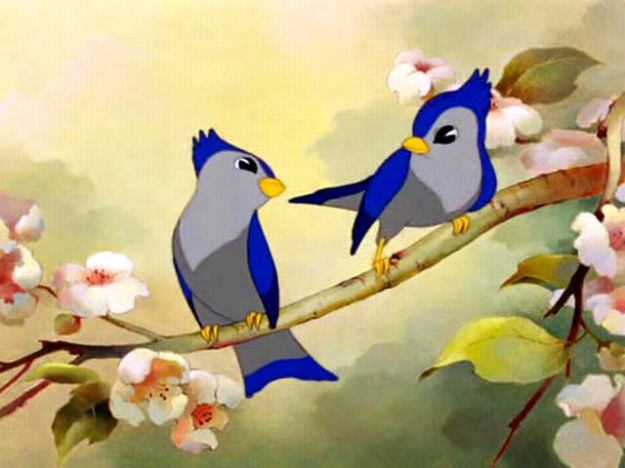
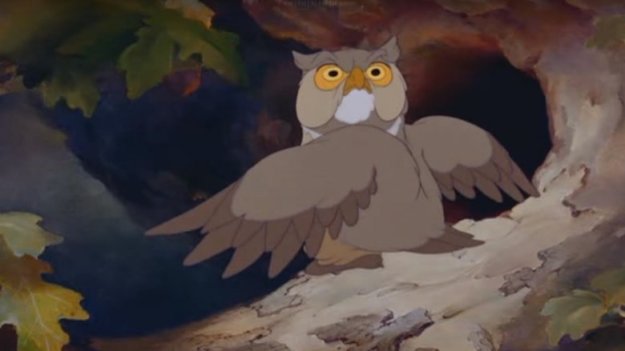
After Bambi is taken in by his father, the story moves forward presumably to the following spring and there’s a humorous song called “Let’s Sing a Gay Little Spring Song” (featuring extensive use of the word “gay” when it referred to one being “happy”). This song is performed by all the birds of the forest as they flitter about and find mates, to the unending consternation of Friend Owl, who is just trying to get some sleep. This song has one of my favorite funny moments in it. Mid-song, Owl starts hooting to try and get the birds to be quiet. After a giant HOOT-HOOT! all of the birds go silent, momentarily placating Owl into thinking he’s gotten his peace and quiet. Wrong! The song restarts without warning and Owl finally gives up, flying to a distant tree to try and get some sleep.

Let’s sing a gay little spring song
This is the season to sing
So I’d like to suggest
That we all do our best
And warble a song about spring
Spring, spring, spring
Let’s get together and sing

Let’s sing a gay little spring song
Just like the bird on the wing
Things always seem right
When you’re chipper and bright
So let’s get together and sing
Sing, sing, sing
Let’s sing a song about spring

Let’s twitter and tweet
Like the birdies in May
Get into the mood
And be merry today
Forget all your troubles and warble away
Do, re, mi, fa, so, la, ti, do
Oh!

Let’s sing a gay little spring song
Music’s a wonderful thing
Come on and rejoice
At the top of your voice
Oh, let’s sing a song about spring
Spring, spring, spring
Let’s get together and sing

Let’s sing a gay little spring song
This is the season to sing

I know some people like to titter about the name of this song, but it really is fun to listen to. If birds could sing with human voices, I’d imagine this is exactly what they’d sound like. Another funny thing is, when I was little, I felt really bad for Friend Owl, but also laughed at him too. Now that I’m getting older, I find myself understanding how the poor bird feels (especially when he launches into his line at the end of the scene: “Same thing every spring….love’s sweet song…humph! Pain in the pinfeathers I call it!”)

tonal-whiplash-1533222943.jpg

After the extremely dark moment where Bambi loses his mother, it made sense to transition to a bright moment full of laughter and bright colors (which is an extreme contrast with the winter scene that preceded this one). As much as I enjoy this scene, there are times where I feel like it’s almost too much, like sometimes I feel like the song is too happy. However, for the most part, I enjoy listening to it.

Let me know what you think of “Let’s Sing a Gay Little Spring Song” in the comments below and have a great day!

See also:

Bambi “Love is a Song” (1942)

Bambi “Little April Shower” (1942)

Bambi “Looking For Romance” (1942)

Disney/Dreamworks/Pixar/etc. Soundtracks A-Z

Become a Patron of the blog at patreon.com/musicgamer460

Check out the YouTube channel (and consider hitting the subscribe button)

Don’t forget to like Film Music Central on Facebook

My Thoughts on: The Expendables 2 (2012)

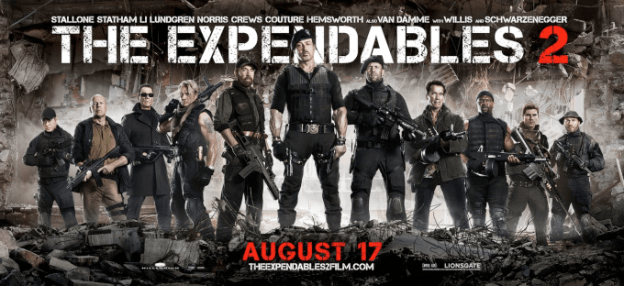
As crazy as the first Expendables film was, The Expendables 2 manages to take it to the next level and still be just as enjoyable. In fact, the second film manages to improve in several points, most notably by including Chuck Norris in a hilarious cameo that pays homage to the “Chuck Norris facts” memes popular at the time.

Like the first film, The Expendables 2 centers around a mission that goes sideways for Barney and his crew, only this time it gets a member of the group (Liam Hemsworth) killed. The bulk of the film follows the group as they hunt down the people responsible to wreak bloody vengeance on them. The film also features a great villain played by Jean-Claude Van Damme, who does a great job making you hate his guts.

There isn’t too much more to say about this film, since for the most part it’s full of what you see in the first Expendables film: gunfights, explosions, crazy stunts, etc. It’s an enjoyable ride regardless and it only served to whet my appetite for further adventures featuring the Expendables.

Let me know what you think about The Expendables 2 in the comments below and have a great day!

See also:

My Thoughts on: The Expendables (2010)

Brian Tyler talks The Expendables (2010)

Film Reviews

Become a Patron of the blog at patreon.com/musicgamer460

Check out the YouTube channel (and consider hitting the subscribe button)

Don’t forget to like Film Music Central on Facebook
My Thoughts on: The Expendables (2010)

By all the rules of film as I understand them, The Expendables should not work. It’s a film filled with big action stars from the last 30 years who are slowly but surely getting past their prime and a story with actors like that just shouldn’t work! However, the action is so over the top that it does work and that’s why I freaking love The Expendables. It’s a story that follows Barney Ross (Sylvester Stallone) and his band of fellow mercenaries as they go on a job for Mr. Church (Bruce Willis). The regular band of Expendables consists of:

  • Lee Christmas (Jason Statham)
  • Yin Yang (Jet Li)
  • Gunner Jensen (Dolph Lundgren)
  • Toll Road (Randy Couture)
  • Hale Caesar (Terry Crews)

There’s also Mickey Rourke as Tool and Steve Austin (of WWE fame) as Dan Paine, one of the bad guys.

The plot of The Expendables, in a nutshell, is extremely basic. The band of mercenaries gets hired on a job that becomes very complicated and messy before all is said and done. In this case, Barry and the rest of our heroes are engaged to take out the dictator of a small island nation, only to find out that he’s being backed by a rogue CIA agent. It’s about as basic as a plot gets for an action film, but that’s alright because the insane levels of violence make up for any missing plot details. Seriously, this film (and the entire Expendables series) is an homage to the action flicks of the 80s. There are explosions everywhere, huge gunfights, and so much blood and death it’s kind of scary at times. And yet, despite that, as I said before, it just works. All the violence, all the gun fights, there’s something oddly cathartic about it all, that I can’t help but love.

It really is great to see so many action stars together in one place, that’s just part of what makes The Expendables so much fun, seeing all of those stars together and just watching them bounce off one another in all kinds of entertaining ways (I particularly love the dynamic between Jason Statham and Sylvester Stallone).

Let me know what you think about The Expendables in the comments below and have a great day!

See also:

My Thoughts on: The Expendables 2 (2012)

Brian Tyler talks The Expendables (2010)

Film Reviews

Become a Patron of the blog at patreon.com/musicgamer460

Check out the YouTube channel (and consider hitting the subscribe button)

Don’t forget to like Film Music Central on Facebook

Bambi “Looking For Romance” (1942)

When last we saw Bambi and company, the young Prince had just won a hard-fought battle so he could claim Faline as his mate. Now that they’re together, it’s time for the obligatory Disney love song between the new couple. I owe Disney a great apology regarding this song. When I was younger, I was bored STIFF by this section because we’d just had this awesome fight and now we have this “mushy stuff” that seems to go on forever and ever before the story gets good again. But now that I’m much, much older, I can appreciate the animation and the song itself. “Looking for Romance” is ostensibly sung by Bambi and Faline as they run through the meadow at night together, and travel through other parts of the forest. In reality, the song is performed by Donald Novis and the Disney Chorus.

I bring you a song
And I sing as I go
For I want you to know
That I’m looking for romance

I bring you a song
In the hope that you’ll see
When you’re looking at me
That I’m looking for love

I’m seeking that glow
Only found when you’re young and it’s May
Only found on that wonderful day
When all longing is through

I’m seeking that glow
Only found when a thrill is complete
Only found when two hearts gently beat
To the strains of a waltz that’s both tender and new

I bring you a song
For I’m seeking romance
You’re by my side

There’s a moon up above
It shines with a light that’s so mellow and bright
It’s easy to see that tonight we shall fall in love

I bring you a song
For I’m seeking romance
And you

Watching this scene, it’s beautiful how the animators were able to realize moonlight so convincingly. One of my favorite moments (apart from the music) is when you see two birds go flying through the night, with the moonlight causing them to glow. It’s a gorgeous moment and the last real slow moment of the film because things are about to get very dangerous once again for Bambi and all his friends.

Let me know what you think about “Looking For Romance” in the comments below and have a great day!

See also:

Bambi “Love is a Song” (1942)

Bambi “Little April Shower” (1942)

Bambi “Let’s Sing a Gay Little Spring Song” (1942)

Disney/Dreamworks/Pixar/etc. Soundtracks A-Z

Become a Patron of the blog at patreon.com/musicgamer460

Check out the YouTube channel (and consider hitting the subscribe button)

Don’t forget to like Film Music Central on Facebook

Bambi “Love is a Song” (1942)

On August 13th, 1942, RKO Radio Pictures released Walt Disney’s fifth animated classic Bambi, based on the 1923 novel  Bambi, a Life in the Woods, by Felix Salten. Disney actually acquired the rights to Bambi in 1937, after MGM’s attempts to turn the book into a live-action film proved to be unfeasible. Originally meant to be Disney’s second animated feature, the project became delayed (among other things, the animators discovered that animating deer realistically was no easy task) and work didn’t really get going until 1939. The score for this film proved to be the final work of composer Frank Churchill (1901-1942), who died after committing suicide following a severe bout of depression.

The film went through many stages, but the following main characters emerged:

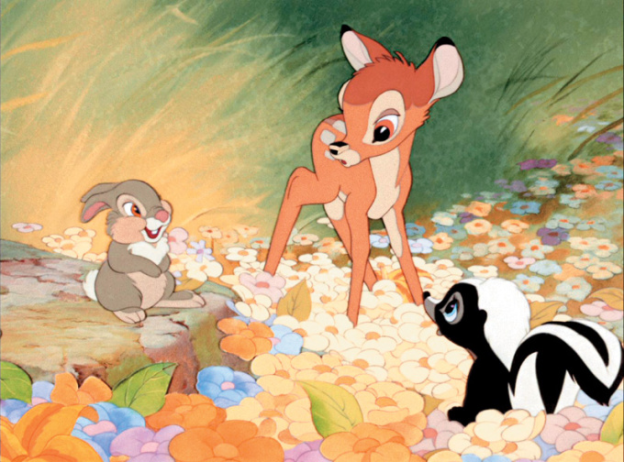
Bambi: the son of the Great Prince of the Forest (Fred Shields); spends the first half of the story living with his unnamed mother (Paula Winslowe). Bambi’s closest friends are Thumper, a gray rabbit, and Flower, a male skunk (the name is based on a joke where Bambi, learning to speak, mistakenly thinks that Flower is, well, a flower, much to Thumper’s amusement).

The film’s opening song (referenced again as the film closes) is “Love is a Song,” performed as the opening credits roll. The song speaks to an enduring theme in the story that love takes many forms and despite changes in life, it never really goes away.

Love is a song that never ends
Life may be swift and fleeting
Hope may die yet love’s beautiful music
Comes each day like the dawn

Love is a song that never ends
One simple theme repeating
Like the voice of a heavenly choir
Love’s sweet music flows on

Like the voice of a heavenly choir
Love’s sweet music flows on

I actually didn’t like this opening when I was younger because the themes about love went over my head (plus I wanted to get on with the story). Years later I can appreciate what “Love is a Song” is trying to say. Let me know what you think of “Love is a Song” in the comments below and have a great day!

See also:

Bambi “Little April Shower” (1942)

Bambi “Let’s Sing a Gay Little Spring Song” (1942)

Bambi “Looking For Romance” (1942)

Disney/Dreamworks/Pixar/etc. Soundtracks A-Z

Become a Patron of the blog at patreon.com/musicgamer460

Check out the YouTube channel (and consider hitting the subscribe button)

Don’t forget to like Film Music Central on Facebook