Tag Archives: Disney

Hercules “Go the Distance” (1997)

Fifteen year old Hercules is having a really hard time fitting in, even more so than most teenagers. The gangly teen possesses the strength of an immortal god and has no idea how to control it. And while his mortal parents love him dearly, they have no idea how to help their son control his strength either. Things come to a head when Hercules attempts to insert himself into a discus game, loses control and inadvertently destroys the entire market. This incident (apparently the last of many) is the final straw for the other residents of the town, who warn Amphitryon (Hercules’ adoptive father) to “keep that FREAK away from here!”

Hercules can’t help wanting to agree with that assessment: what is he if not a freak? All he wants is to find a place where he belongs and is welcomed by all. This is the basis for “Go the Distance,” and it is a song that is very close to my heart. See, like Hercules, I had a very hard time fitting in too, and so I’d spend hours and hours daydreaming of finding a place where I really belonged. In Hercules’ mind, if he can find this place of ultimate welcome, he will have “gone the distance.” Like most songs in the Disney Renaissance, “Go the Distance” was composed by Alan Menken with lyrics provided by David Zippel. Roger Bart is the singing voice of Hercules.

Go_the_Distance

I have often dreamed
Of a far off place
Where a great, warm welcome will be waiting for me
Where the crowds will cheer
When they see my face
And a voice keeps saying
This is where I’m meant to be

I will find my way
I can go the distance
I’ll be there some day
If I can be strong
I know every mile will be worth my while
I would go most anywhere to feel like I belong

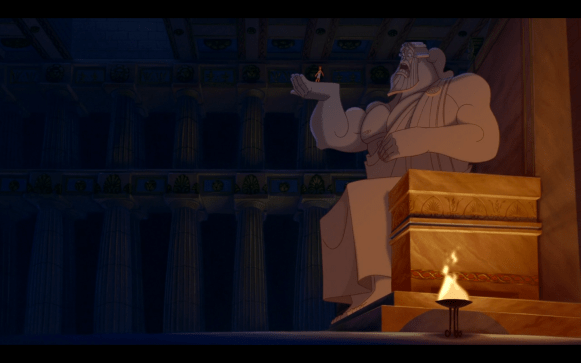
But where to start? Well, upon returning home, Hercules’ finds his parents have some news for him: he’s not actually their son. They found him as a baby wearing a medallion with the symbol of the gods on it. This gives Hercules an idea: he can go to the Temple of Zeus and ask the gods for the answers! This leads to the following reprise as Hercules travels on his way:
temple

I am on my way
I can go the distance
I don’t care how far
Somehow I’ll be strong
I know every mile
Will be worth my while
I would go most anywhere to find where I belong

And in the immense Temple of Zeus Hercules does indeed find his answers: he’s FAR from normal, in fact, he’s actually a god (what a thing to find out when you’re 15)! The long lost son of Zeus and Hera to be exact! There IS a way that Hercules can come home to Mount Olympus however: he must become a true hero to regain his godhood. And to become a hero…he must seek out Philoctetes, a legendary trainer of heroes.

But before Hercules leaves, Zeus has a gift for his son: Pegasus, now a fully-grown winged horse! The pair bond instantly, as they did before and now Hercules has a plan: find Philoctetes, become a hero and rejoin the gods on Mount Olympus! The teenager has a final reprise as he flies off on Pegasus into parts unknown:

I will beat the odds
I can go the distance
I will face the world
Fearless, proud and strong
I will please the gods
I can go the distance
Till I find my hero’s welcome
Right where I belong!
Just as the moment ends, the camera pans up to show how close the planets are to alignment (something that will be revisited periodically until the climax of the story). Next time: Hercules and Pegasus meet Philoctetes, who is not quite what they expected.
And that’s “Go the Distance”! I really love this song and I hope you enjoyed it as well.

Hercules “Gospel Truth II & III” (1997)

At the end of “Gospel Truth I,” we’re taken into Mount Olympus where all the gods have gathered to celebrate the birth of Hercules to head god Zeus and his wife Hera (which is nothing like the actual Greek myth but this is Disney we’re talking about so I can live with it). On top of the amazing gifts the other gods have brought, Zeus creates an infant Pegasus out of a combination of clouds just for Hercules. The touching moment is soured however, when Hades, god of the Underworld (James Woods) makes an unexpected entrance.

Hades isn’t banned from Olympus per se, in fact Zeus goes so far as to invite the flame-haired god to join the celebration. The thing with Hades is…he’s very bitter over having to “work” as god of the Underworld while the rest of the gods get to lounge about all day on Mount Olympus. And because he’s so bitter, none of the other gods really like him (in fact they use one of Zeus’ jokes as an excuse to laugh him out of Mount Olympus). But if Hades has his way, they won’t be laughing for long, as the Muses return to narrate in “Gospel Truth II”

If there’s one God you don’t want to get steamed up
It’s Hades, ’cause he had an evil plan
He ran the Underworld
But thought the dead were dull and uncouth

He was as mean as he was ruthless
And that’s the Gospel truth
He had a plan to shake things up
And that’s the Gospel truth

Yes, Hades is Lord of the Underworld but he hates the job and he despises the unending stream of dead souls who flow into his domain. To that end, he’s working on a plan to free the Titans from their prison during a planetary alignment (in 18 years time) and use them as an army to eliminate Zeus and take power. He consults the three Fates to see if this will indeed occur and they assure him: in 18 years his plans will succeed HOWEVER., they caution: “should Hercules fight, you will fail.”

Fates_4

What the fates have done here is given a prophecy in the style of the famed oracle of Delphi which was famous for a number of reasons but one in particular that I wish to point out: the Oracle had a habit of phrasing it’s predictions in such a way that there was a hidden meaning in the statement. So the Fates have said that if Hercules fights (against Hades), then the plan will fail. To Hades, the solution is obvious: the infant god must be eliminated. However, if one looks deeper, there’s another route that Hades could have gone and it would have worked so much better.

Instead of eliminating the young god and inadvertently putting him on the path of becoming a hero when Pain and Panic bungle the job, Hades could have spent the next 18 years ingratiating himself to his young nephew and turning him against the rest of the gods (Hades is slick enough that you know he could’ve pulled it off) and when the time came, Hercules wouldn’t have fought against him. It’s an interesting what-if scenario but we all know Hades didn’t go this way.

Hades plan to eliminate Hercules by having him turned mortal and then killed halfway works: Pain and Panic (the traditional bumbling henchmen) do succeed in turning the infant god mortal. However, because he didn’t drink the last drop of a magic formula that made him mortal, the infant retains his immortal strength (but is otherwise like a normal baby). But because Hercules is now a mortal, even though Zeus and Hera know where he is, they can’t bring him home (why Zeus as king of the gods can’t just make his son a god again I’m really not sure). As the Muses narrate for the final time in “Gospel Truth III” :

Muses-from-Hercules-Gravitas

Young Herc was mortal now
But since he did not drink the last drop
He still retained his godlike strength
So thank his lucky star

But Zeus and Hera wept
Because their son could never come home
They’d have to watch their precious baby
Grow up from afar

Though Hades’ horrid plan
Was hatched before Herc cut his first tooth
The boy grew stronger every day
And that’s the gospel truth

The gospel truth

This is the last we see and hear of the Muses until they narrate Hercules’ rise to fame in “Zero to Hero.” From this point on until then we get to follow Hercules as a teenager struggling to fit in with his abnormal strength. I like these segments of “Gospel Truth,” they move the action along and provide exposition without boring the audience. And the soul music style sets Hercules apart from other Disney films.

And those are my thoughts on “Gospel Truth II & III.” Let me know what you think about these two sequences in the comments below!

You can become a patron of the blog at: patreon.com/musicgamer460

Check out the YouTube channel (and consider hitting the subscribe button)

See also:

Hercules “Gospel Truth” (1997)

Hercules “Go the Distance” (1997)

Hercules “One Last Hope” (1997)

Hercules “Zero to Hero” (1997)

Hercules “I Won’t Say I’m in Love” (1997)

And for more Disney songs see also: Disney/Dreamworks/Pixar/etc. Soundtracks A-Z

Don’t forget to like Film Music Central on Facebook 🙂

The Hunchback of Notre Dame “The Court of Miracles” (1996)

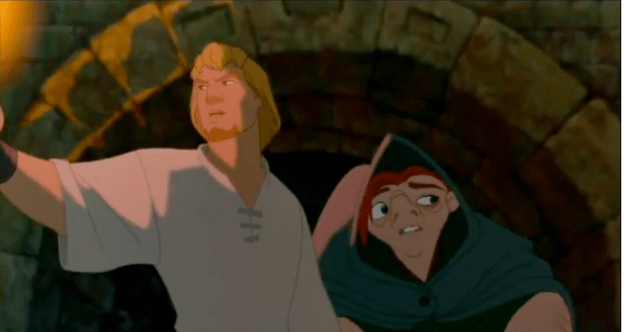
By this point in the story things are looking pretty grim for our heroes: not only does Frollo claim to know exactly where Esmeralda and the rest of the gypsies are hiding, he also plans to “attack at dawn with a thousand men.” After Frollo leaves with a knowing smile on his face, Phoebus (who has heard everything), comes out of hiding and tells Quasimodo that they need to find the Court of Miracles and Esmeralda before Frollo does.


And as it turns out, Quasimodo has a way of finding the hidden refuge in the talisman that Esmeralda gave him. It turns out it’s actually a map of Paris and a certain symbol leads them to the entrance of an old catacomb. As the pair make their way, it quickly becomes obvious that they’re being followed, though Phoebus and Quismodo don’t notice. Phoebus, who has been trying (and failing) to make light of the situation, notes that:

“speaking of trouble we should’ve run into some by now.”

“What do you mean?”

“Oh, you know, a guard…a booby trap…” *the torch is snuffed out* “Or an ambush…”

d-court-2.png

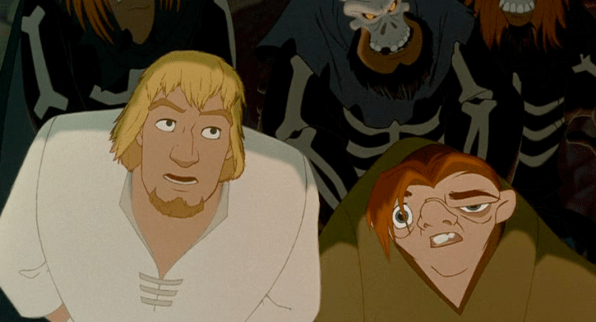
Torches blaze up and the pair are surrounded by gypsies, exactly who they were hoping to find! Unfortunately for our heroes, Clopin, their leader, isn’t interested in anything they have to say since Phoebus is still recognized as Frollo’s captain of the guard and Quasimodo is mistakenly believed to be a loyal henchman, so they must be spies! This is the start of the all too short “Court of Miracles” where Clopin and the rest of the gypsies taunt their captives with how they keep themselves safe by killing any and all intruders.

You were very clever to have found our hideaway,

unfortunately…you won’t live to tell the tale!

Maybe you’ve heard of a terrible place where the scoundrels of Paris collect in a lair,

Maybe you’ve heard of that mythical place called the Court of Miracles…

Hello! You’re There!

d-court-4

In a bit of a twist, it’s revealed that many of the gypsies are only pretending to be disabled. The disguises come off when they return home, hence the seeming reason why it’s call the court of “miracles” because everyone suddenly becomes normal:

The lame can walk! And the blind can see!

But the dead don’t talk! So you won’t be around to reveal what you’ve found!

We have our methods for spies and intruders, rather like hornets protecting their hive.

Here in the Court of Miracles where it’s a miracle if you get out alive!

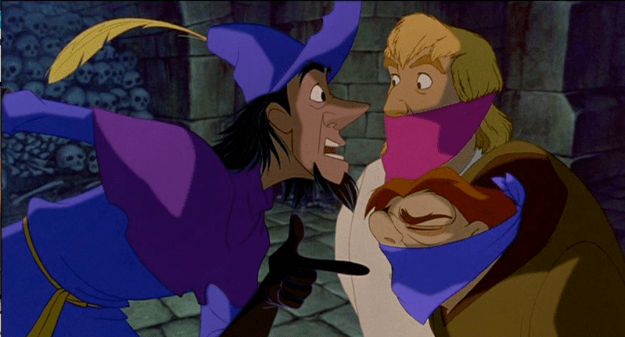
With a loud laugh, Phoebus and Quasimodo are dragged into the Court of Miracles where they’re led to a large scaffold, to be mocked and jeered at by the rest of the gypsies before they’re executed (Djali the goat recognizes the pair and runs to get Esmeralda). Clopin is now dressed as a judge and prepares to hold a “trial” for the pair.

d-clo-jugde-27

Justice is swift in the Court of Miracles,

I am the lawyer and judge all in one!

We like to get the trial over with quickly because it’s the sentence that’s really the fun!

Any last words? *Phoebus and Quasimodo shout through their gags* That’s what they ALL say…

Now that we’ve seen all the evidence *Puppet “Wait, I object!* Overruled! *”I object!!”* 

*QUIET!!!* *…dang…*

We find you totally innocent…which is the worst crime of all…SO YOU’RE GOING TO HANG!!

“STOP!!” And just in the nick of time, here comes Esmeralda to save our heroes’ skins! She informs the incredulous Clopin that Phoebus and Quasimodo aren’t spies, they’re friends.

“Why didn’t they say so?” Clopin sputters, not quite believing what he’s hearing.

“We DID say so!” the disgruntled pair spit back, annoyed at having come all this way only to be nearly executed for trying to do the right thing. Unfortunately, the right thing turned out to be exactly what Frollo wanted them to do…which is lead him directly to the Court of Miracles…

And that’s “The Court of Miracles” from The Hunchback of Notre Dame! It’s a short song, but one of my favorites 🙂 I always thought it was funny that Clopin was so caught up in the moment of catching more spies that he completely missed the pair telling him they weren’t spying at all but were trying to warn them! Let me know what you think of this song in the comments below.

You can become a patron of the blog at: patreon.com/musicgamer460

Check out the YouTube channel (and consider hitting the subscribe button)

See also: Disney Films and Soundtracks A-Z

The Hunchback of Notre Dame “The Bells of Notre Dame” (1996)

The Hunchback of Notre Dame “Out There” (1996)

The Hunchback of Notre Dame “Topsy Turvy” (1996)

The Hunchback of Notre Dame “God Help the Outcasts” (1996)

The Hunchback of Notre Dame “Heaven’s Light/Hellfire” (1996)

Don’t forget to like Film Music Central on Facebook 🙂

Pinocchio “Hi Diddle Dee Dee (reprise)” (1940)

what-do-you-see

Having been rescued from Stromboli with the timely assistance of the Blue Fairy (who also warned that this was the last time she could directly help), Pinocchio is heading straight for home, determined to be a good boy and go to school. Jiminy Cricket is very happy too, as this time Pinocchio seems to thoroughly mean what he says. Unfortunately, who does the young puppet run into on the way home but Honest John and Gideon (again!! Honestly those two seem to be everywhere don’t they?) Having received orders from the Coachman to round up every naughty boy they can find (as detailed in the beginning of my Disturbing Disney series), the wily con men see Pinocchio as the perfect target.

Stopping Pinocchio, Honest John insists that the puppet looks deathly ill and that he simply must have an examination (so apparently Honest John is a doctor too, amazing for a talking fox who can’t read).

Pinocchio “Examination and Hi Diddle Dee Dee (reprise)” (1940)

While Gideon literally scribbles down a “report,” Honest John gives Pinocchio a thorough “examination” including this “diagnosis” of his heart:

“Now that heart. Ooh, my goodness! A palpitating syncopation of the killer diller with the wicky wacky stomping of the floy joy.”

i-m-giving-you-my-ticket

Honest John solemnly pronounces the results: “My boy…you are allergic.” It’s hysterical how he pronounces the word like it’s the most terrible disease in the world, when that’s not even close to how it works (as we all know, you’re allergic to something, it’s not just a case of being “allergic.”) Of course Pinocchio has no way of knowing that, but even so, when Honest John pronounces that the only cure is a holiday on Pleasure Island, the puppet weakly insists that he can’t go. But that’s no problem as Honest John gives Pinocchio his very own “ticket” (the Ace of Spades, otherwise known as the Death card) and lead the puppet away with a stirring reprise of “Hi Diddle Dee Dee” :

Hi Diddle Dee Dee, it’s Pleasure Isle for me!

Where every day is a holiday, and kids have nothing to do but play

Hi Diddle Dee Doo, if what I hear is true,

At noon each day there’s a big parade, the river’s flowing with lemonade,

A land of pudding and marmalade, it’s Pleasure Isle for me!

Jiminy Cricket (who had walked on ahead), realizes that Pinocchio is going the wrong way (again) and chases after the group as they lead Pinocchio to the carriage that will be departing at midnight for Pleasure Island!

And that’s the reprise of “Hi Diddle Dee Dee!” Let me know what you thought about it in the comments below!

You can become a patron of the blog at: patreon.com/musicgamer460

See also:

Pinocchio “When You Wish Upon a Star” (1940)

Pinocchio “Little Wooden Head” (1940)

Pinocchio “Hi Diddle Dee Dee (An Actor’s Life for Me!)” (1940)

Pinocchio “I’ve Got No Strings” (1940)

For more the more disturbing aspects of Pinocchio, see also:

Disturbing Disney #1: The Coachman in Pinocchio (1940)

Disturbing Disney #2: The truth of Pleasure Island in Pinocchio (1940)

Disturbing Disney #3: Escaping Monstro from Pinocchio (1940)

Don’t forget to like Film Music Central on Facebook 🙂

Disturbing Disney #18: The Queen’s assignment for her Huntsman

Evolution of Disney : Snow White and the Seven Dwarfs Part 1

In the time leading up to its release, Snow White and the Seven Dwarfs was derided as “Disney’s Folly.” It seemed ludicrous that anyone would be willing to sit through a full-length animated feature film, let alone enjoy it. But upon its release in 1937, Snow White and the Seven Dwarfs was acclaimed as a masterpiece, a title it rightly deserves to this very day.

Based on Grimm’s fairy tale Schneewittchen, the film tells the story of a beautiful princess named Snow White who must flee for her life when her wicked stepmother the Queen learns through her magic mirror that Snow White is now “the fairest in the land.” The princes is taken in by seven dwarfs and dreams of reuniting with a handsome prince, but the Queen is on the prowl to ensure that she, not Snow White, is the fairest one of all. And it is due to the Queen’s wicked plots that the film possesses its own share of disturbing moments.

Humbert.png

While holding court on her peacock throne, the Queen informs her loyal huntsman that he is to take young Snow White deep into the forest to collect wildflowers. And once there, he is to kill her! Considering how calmly the Queen gives these orders, it is safe to presume that she’s had beautiful rivals murdered before, but the Huntsman objects in this case because Snow White is a royal princess, the Queen’s daughter by marriage! Not only will the Queen brook no argument, she even has a way to make sure that the Huntsman completes his mission. Once Snow White is dead, he must cut out her heart and bring it back to the Queen in a special box.

Just think about how sociopathic that request is: the Queen is so obsessed with being the most beautiful woman alive that she will have her own step-daughter murdered and have her heart brutally cut out just to satisfy her own vanity. Not only that, but she has a special chest made for the sole purpose of bringing back the heart so she can gloat. This is disturbing behavior coming from a Queen, and I believe that the vain monarch is so full of herself that she believes she can get away with this forever. Fortunately for our heroine, the Huntsman has a conscience and can’t go through with it, no matter the consequences.

image_21459143.png
This scene has become more disturbing for me the older I have become. Of course I was always scared because the Queen wanted to kill Snow White, but as the passage of time allowed me to better understand the motives behind what was happening, the more I became disturbed by the entire scene. However, the Huntsman’s mission is nothing compared to Snow White’s flight through the forest, which has terrified and disturbed children for the last eighty years.

What do you think of this disturbing moment? Let me know your thoughts in the comments below 🙂 Have a great day!

Become a Patron of the blog at patreon.com/musicgamer460

Check out the YouTube channel (and consider hitting the subscribe button)

Don’t forget to like Film Music Central on Facebook 🙂

See also:

Disturbing Disney #1: The Coachman in Pinocchio (1940)

Disturbing Disney #2: The truth of Pleasure Island in Pinocchio (1940)

Disturbing Disney #3: Escaping Monstro from Pinocchio (1940)

Disturbing Disney #4: Dumbo loses his mother (1941)

Disturbing Disney #5 The death of Bambi’s Mother

Disturbing Disney #6: Faline vs. the dogs (1942)

Disturbing Disney #7: Cruella wants to do WHAT??

Disturbing Disney #8: The Whale Who Wanted to Sing at the Met (from Make Mine Music, 1946)

Disturbing Disney #9: Dr. Facilier’s Fate (The Princess and the Frog, 2009)

Disturbing Disney #10: The rat in Lady and the Tramp (1955)

Disturbing Disney #11: Clayton’s Death in Tarzan (1999)

Disturbing Disney #12: The Bear from The Fox and the Hound (1981)

Disturbing Disney #13: “Smoking them out” in The Fox and the Hound (1981)

Disturbing Disney #14: The Salt Trap in The Jungle Book (1994)

Disturbing Disney #15: Night on Bald Mountain from Fantasia (1940)

Disturbing Disney #16: King Triton destroys Ariel’s grotto

Disturbing Disney #17: Ratigan becomes a monster in The Great Mouse Detective

Disturbing Disney #19: Cinderella’s dress is destroyed (1950)

Disturbing Disney #20: Quasimodo is crowned ‘King of Fools’ (1996)


Pinocchio “I’ve Got No Strings” (1940)

Having been unwittingly sold by Honest John and Gideon to the gypsy Stromboli, Pinocchio is all set to make his big debut in the puppet* theater as the star attraction. Nearby, Jiminy Cricket watches the proceedings with disgust, he can’t believe Pinocchio has fallen into this “I’ll be a big star” trap so easily. The show begins and Pinocchio is introduced by a chorus of puppet trumpeters.

To my knowledge, “I’ve Got No Strings” is the only Disney song to have a false entrance. For you see, as the music begins and Pinocchio (Dickie Jones) begins his first line “I’ve got no strings to hold me do-” he trips over his own feet and somersaults down the stairs to land in a heap on the stage, to the great amusement of the audience.

pinoc-pe-06

Pinocchio “I’ve Got No Strings” (1940)

In a big dose of foreshadowing, Stromboli nearly loses his temper and only his hastily remembered knowledge that there is an audience present stops him from beating the puppet on the spot. Stromboli encourages Pinocchio to try again (I shudder to think of what might’ve happened if Pinocchio had messed up a second time) and the song properly begins:

pinocchio-31.png

I’ve got no strings
To hold me down
To make me fret
Or make me frown
I had strings
But now I’m free
There are no strings on me
 
Hi-ho the me-ri-o
That’s the only way to go
I want the world to know
Nothing ever worries me
 
I’ve got no strings
So I have fun
I’m not tied up to anyone
They’ve got strings
But you can see
There are no strings on me
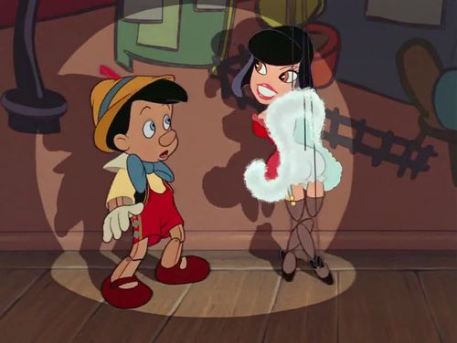
Pinocchio is a hit with the audience! To the delight of the young puppet, the audience applauds his performance and Pinocchio joins in the applause until the scene changes and a coy Dutch girl puppet descends to the stage:
maxresdefault
You have no strings
Your arms is free
To love me by the Zuider Zee
Ya, ya, ya
If you would woo
I’d bust my strings for you
After a group of Dutch girl puppets dance around Pinocchio (knocking him around a little in the process), they retreat only to be replaced by a sultry French girl puppet:
tumblr_inline_n60743tz9N1rdnnfj
You’ve got no strings
Comme ci comme ça
Your savoire-faire is ooh la la
I’ve got strings
But entre nous
I’d cut my strings for you
After this solo, Pinocchio is joined by a group of French girl puppets dancing the can-can, a revealing dance where (in real life), the dancers raise their skirts to show off their legs and petticoats. This is the one dance that attracts the attention of Jiminy Cricket who whips out a pair of spectacles to get a better look at the dancing girls. Of all the puppets, I liked the French puppet the best (just my preference). At the end of the dance, the scene changes once more and Pinocchio is joined by a Russian girl puppet:
373e051e04ac5eca6b565a111250006e--swing-state-tin
Down where the Volga flows
There’s a Russian rendez-vous
Where me and Ivan go
But I’d rather go with you, hey!
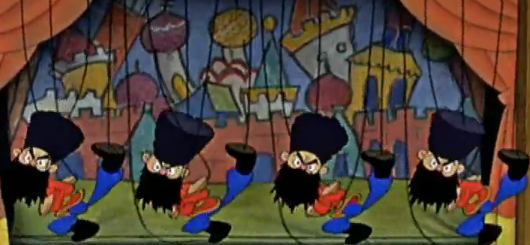
Unlike the other verses, this time the Russian girl is replaced by a troupe of male Russian dancers doing the traditional Hopak dance (often mis-labeled as “The Cossack Dance”), which is actually Ukrainian in origin. Pinocchio is so taken with this dance that he does his best to imitate the puppets with varying degrees of success. When the puppets move to wildly spinning, Pinocchio attempts to copy them, but as you might expect, the young puppet ends up tangling himself in all the puppets and proclaims to the audience:
puppets
 
There are no strings on me!
To his relief, the audience’s laughter is complimented by wild cheers and applause and money begins raining down onto the stage (to the great delight of Stromboli). Jiminy is saddened by Pinocchio’s success, as it seems now like the young puppet will never want to go home and learn how to be a real boy.
Of all the songs in Pinocchio, “I’ve Got No Strings” is widely considered to be one of the most popular and enduring songs along with “When You Wish Upon a Star.” The music was composed by Leigh Harline, with lyrics provided by Ned Washington. The song was (in)famously used in the marketing for Avengers: Age of Ultron when a twisted rendition of the first verse played in the background of several trailers (ending with Ultron finishing the line “there are no strings on me.”) In the film, this song serves the purpose of giving the audience a lighthearted moment before the story takes another turn for the dark; in this case, when Stromboli locks Pinocchio into a birdcage and promises to chop him up for firewood if he doesn’t behave and keep making money for the gypsy.
*I know technically the “puppets” are all marionettes because they’re manipulated by strings, but I referred to them as puppets because that’s easier to type out than saying marionettes over and over again.
What do you think of “I’ve Got No Strings”? Besides Pinocchio, is there a puppet in this song that you like the best? Let me know your thoughts in the comments below 🙂 Thank you so much for supporting the blog, it means the world to me.
Don’t forget to like Film Music Central on Facebook 🙂
Become a Patron of the blog at patreon.com/musicgamer460
Check out the YouTube channel (and consider hitting the subscribe button)
See also:


The Little Mermaid “Vanessa’s Song” (1989)

636402_1297041230292_full

When Ursula made the deal with Ariel to make her human for three days so she could attempt to earn True Love’s Kiss from Prince Eric, I’m fairly certain the sea witch thought it was one of the easiest deals she’d ever made. Knowing full well that Ariel had practically no reliable information about life in the human world, Ursula likely thought that Ariel would make a fool of herself and never come close to earning any kind of kiss from anyone, let alone Prince Eric.

So imagine Ursula’s surprise and indignation when Sebastian and Flounder help set up “Kiss the Girl” and come within inches of getting Eric and Ariel to kiss; whether it would have been True Love’s Kiss we don’t really know and Ursula wasn’t willing to find out as she made sure Flotsam and Jetsam (her minion eels) sabotaged the moment by capsizing the boat. The sea witch is furious!

“Oh, she’s better than I thought. At this rate, he’ll be kissing her by

sunset for sure. Well, it’s time Ursula took matters into her own tentacles!

Triton’s daughter will be mine – and then I’ll make him writhe. I’ll see him

wriggle like a worm on a hook!”

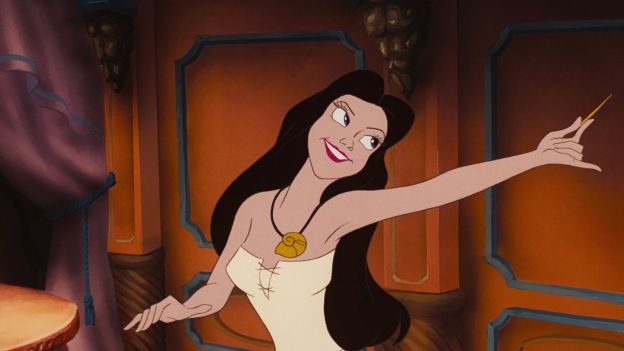
Ursula quickly begins preparing a spell and, laughing, transforms into a beautiful human woman with dark brown hair, but still wearing her nautilus shell.

Later that same evening, Prince Eric is still moping about the fact that he hasn’t found that mysterious woman who saved his life (you’d think despite the lack of voice that he’d simply recognize Ariel but it’s never that simple). Grimsby, his long-suffering butler, sympathizes with the prince, but he also gently reminds him that while his mystery woman may never be found, there’s a very real woman inside the castle (indicating the silhouette of Ariel getting ready for bed).

Left alone again, Eric contemplates Grimsby’s words before chucking his flute into the sea and turning to head inside. But before he can leave, a mysterious song begins floating up from the beach. A strange woman  with dark brown hair and a nautilus shell necklace is walking along the beach and singing with Ariel’s voice. A golden tendril of magic flows out from the shell and visibly enchants the prince.

maxresdefault

To Ariel’s horror, Eric announces the next morning that he’s found the woman who saved his life and they’ll be getting married that evening. Ariel cannot see the nautilus shell and so she believes that Eric is genuinely in love with another woman, meaning her entire plan has been for nothing!

As the wedding barge gets under way that evening, Scuttle flies out to check out the ship and is attracted by a beautiful, but strange song coming from one of the cabins. Vanessa (the mysterious woman Eric is marrying) is getting ready for the wedding and singing to herself:

What a lovely little bride I’ll make
My dear, I’ll look divine
Things are working out according to my ultimate design
Soon I’ll have that little mermaid
And the ocean will be mine!

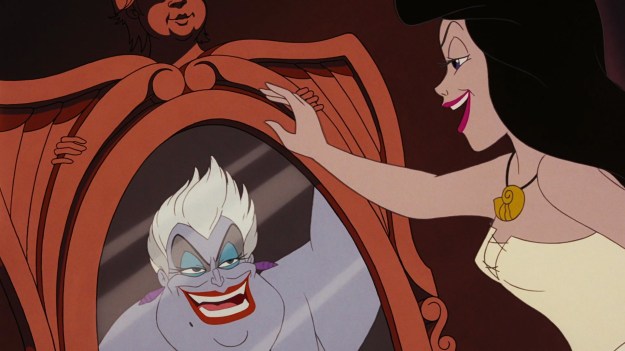
As the blushing bride examines her reflection in the mirror, the laughing face of Ursula peers out instead!! Scuttle can’t believe his eyes, Eric is about to marry the sea witch, Ariel needs to know about this! The frantic bird flies off to warn Ariel and her friends before it’s too late.

Tlmpe1040

Given that Ursula is using Ariel’s stolen voice, it’s no surprise when I say that Jodi Benson also provided Vanessa’s lines and also performed “Vanessa’s Song” which is really a brief reprise of “Poor Unfortunate Souls” (a melody you can hear just as the brief song ends). It really just serves to confirm to the audience and reveals to our heroes that this is indeed Ursula in disguise (though I don’t think there was ever really any doubt for the audience given we witnessed the start of Ursula’s transformation back in her lair).

What do you think of “Vanessa’s Song”? It’s one of the shortest “songs” in any Disney film, but it is one of my favorite moments as well. I remember as a little kid I would always gasp when the mirror tilted up to reveal Ursula’s reflection. Given her magical skills, it’s a wonder she didn’t keep herself looking like that (or similarly) on a permanent basis. Let me know your thoughts on this song in the comments below 🙂

Become a Patron of the blog at patreon.com/musicgamer460

Check out the YouTube channel (and consider hitting the subscribe button)

See also:

The Little Mermaid “Daughters of Triton” (1989)

The Little Mermaid “Part of Your World” (1989)

The Little Mermaid “Poor Unfortunate Souls” (1989)

The Little Mermaid “Les Poissons” (1989)

For more Disney songs, see here

Don’t forget to like Film Music Central on Facebook 🙂

Alice in Wonderland “Painting the Roses Red” (1951)

6547287_orig

Thoroughly tired of all the silliness in Wonderland, Alice wants more than ever to go home. Fortunately (maybe), the Cheshire Cat has returned with one last piece of advice. if Alice really wants to go home, then she needs to talk to the Queen.

“All ways here you see, are the Queen’s ways.”

“But I’ve never met any Queen!”

“You haven’t? You HAVEN’T? Oh, but you must! She’ll be mad about you, simply mad!”

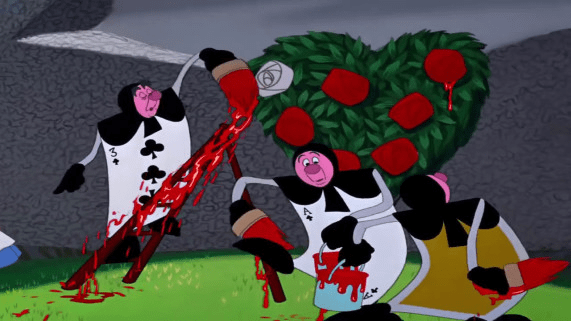
And so, the Cheshire Cat reveals a shortcut to the gardens surrounding the Queen’s castle (which also happen to be the same gardens Alice saw through the keyhole when she first arrived in Wonderland). It’s a very pretty garden, but there are some odd things going on. For instance…there’s a bunch of cards running around, and they’re busy painting the roses. When Alice asks the cards what on earth they’re doing, they are all quick to explain (and this is the setting of “Painting the Roses Red”:

Painting the roses red
We’re painting the roses red
We dare not stop
Or waste a drop
So let the paint be spread
We’re painting the roses red

Oh, painting the roses red
And many a tear we shed
Because we know
They’ll cease to grow
In fact, they’ll soon be dead
And yet we go ahead
Painting the roses red
We’re painting the roses red

Alice: Oh, pardon me,
But Mister Three,
Why must you paint them red?

Cards: Huh? Oh!
Three: Well, the fact is, Miss,
We planted the white roses by mistake,
And…

Cards: The Queen she likes ’em red
If she saw white instead,
Two: She’d raise a fuss
Ace: And each of us
Cards: Would quickly lose his head

Alice: Goodness!

maxresdefault (1)

Cards: Since this is the part we dread
We’re painting the roses red

Alice: Oh, Dear! Then let me help you!

Alice: Painting the roses red
We’re painting the roses red
Don’t tell the Queen what you have seen
Or say that’s what we said
But we’re painting the roses red
Alice: Yes, painting the roses red
Two: Not pink
Ace: Not green
Alice: Not aquamarine
All: We’re painting the roses red!

It’s a hilarious song with a ridiculous concept: the Ace, Two and Three of Clubs have mistakenly planted white roses instead of red ones, and because the Queen hates white roses, they’re hastily covering their mistake by painting the roses red (even acknowledging in their song that this will kill the roses entirely). But the Cards figure that killing the roses in the short term is better than losing their heads so, they continue to paint. Alice is happy to help in the work, but it’s ultimately not going to do the Cards any good, because here comes the Queen!!

Alice-disneyscreencaps_com-7221

After the Hearts line up in formation, the White Rabbit reappears to announce: “Her Imperial Highness, Her Grace, Her Excellency, Her Royal Majesty, the Queen of Hearts!”

Unfortunately for the cards, they left one rose only half painted, causing the completely mad Queen to bellow “Whose been painting my roses red??” The guilty cards plea for mercy but the Queen only shouts “OFF WITH THEIR HEADS!!” The cards are then dragged away as the others sing:

“They’re going to lose their heads, for painting the roses red!”

I absolutely love this song: it’s short and to the point and serves as a nice piece of filler to introduce the Queen of Hearts to the story. Despite only appearing in this last part of the film, the Queen of Hearts is considered one of the iconic Disney villains. I hope you enjoyed listening to “Painting the Roses Red.”

Don’t forget to like Film Music Central on Facebook 🙂

Become a Patron of the blog at patreon.com/musicgamer460

Check out the YouTube channel (and consider hitting the subscribe button)
See also:

Alice in Wonderland “The Un-Birthday Song” (1951)

Alice in Wonderland “All in the Golden Afternoon” (1951)

Alice in Wonderland “In a World of My Own” (1951)

Pinocchio “Hi Diddle Dee Dee (An Actor’s Life for Me!)” (1940)

Geppetto the toy maker is overjoyed to find that his wooden puppet Pinocchio has come to life. And though he is not yet a “real” boy, he treats him as his own son regardless and decides that Pinocchio needs to go to school, since that’s where all good little boys go during the day. After some persuasion, Pinocchio sets off with his new school books and a spiffy little vest to go with his regular outfit. Though he’s meant to be his conscience, Jiminy Cricket is nowhere to be found as yet.

Pinocchio “Hi Diddle Dee Dee” (1940)

On the way to school, Pinocchio attracts the attention of a fox and his cat companion, who can hardly believe that they’re seeing a puppet walking and talking without strings! The fox stops Pinocchio and introduces himself as “Honest” John (his full name is John Worthington Foulfellow) and the cat, who doesn’t speak, is Gideon. Pinocchio informs the pair that he is on his way to school, but Honest John (voiced by Walter Catlett) says that this is a ridiculous notion.

John_And_Gideon

Why should this young boy be going to school when it’s perfectly obvious he’s a natural actor (said with a wink and a nod to Gideon who quickly understands where Honest John is going with this conversation). The pair quickly divert Pinocchio from his path to school and begin describing the wonderful life he could have as an actor and this is the subject of “Hi Diddle Dee Dee (An Actor’s Life for Me!):

Hi-Diddle-Dee-Dee. An actor’s life for me!
A high silk hat, and a silver cane.
A watch of gold, with a diamond chain.
Hi-Diddle-Dee-Day an actor’s life is gay!
It’s great to be a celebrity.
An actor’s life for me!

Hi-Diddle-Dee-Dum. An actors life is fun!
With clothes that come from the finest shop.
And lots of peanuts and soda pop.
Hi-Diddle-Dee-Dee an actor’s life for me.
It’s great to be a celebrity.
An actor’s life for me!

Hi-Diddle-Dee-Dee, an actors life for me!
A waxed moustache and a beaver coat.
A pony cart and a billy goat.
Hi-Diddle-Dee-Dum, an actors life is fun!
You wear your hair in a pompadour!
You ride around in a coach with four!
You stop and buy out a candy store!
An actor’s life for me!

Hi-Diddle-Dee-Dee. An actor’s life for me!
A high silk hat, and a silver cane.
A watch of gold with a diamond chain.
Hi-Diddle-Dee-Doo. You sleep ’til after two!
It’s great to be a celebrity, an actor’s life for me!

Honest John paints the rosiest picture imaginable: if Pinocchio goes off to be an actor, he’ll be fantastically rich and able to do anything he wants! He’ll wear the finest clothes, be able to buy out candy stores, it’s a grand life! The puppet is easily persuaded to follow the fox and cat to the theater (in this case the travelling puppet theater owned by Stromboli), all thoughts of school and being a “real” boy forgotten for the moment. Of course the naive puppet has no way of knowing that this “actor’s life” wouldn’t apply to him, not where he’s going anyway. Pinocchio doesn’t know it, but Honest John and Gideon are on their way to sell the young puppet to Stromboli for however much they can get from the Italian (it’s rather disturbing when you think about it).

hqdefault

And where is Jiminy Cricket? It turns out the newly minted “conscience” overslept on his first day and now he’s racing to catch up to his charge, figuring that Pinocchio couldn’t possibly have gotten into too much trouble yet (oh how wrong he is!!) The trio quickly passes him in the street and Jiminy is stunned to see Pinocchio walking with the fox and cat in the opposite direction of school! The cricket chases after them, but being so small, he is unable to make them stop and they journey on to Stromboli’s.

“Hi Diddle Dee Dee” is notable for being the first Disney villain’s song ever performed. Originally, Gideon was going to have a voice too (in fact the legendary Mel Blanc was hired to record his lines), but it was later decided to make the cat a mute comedic figure similar to Dopey and so all of Blanc’s lines were cut except for a few hiccuping sounds. I’d also like to point out that the song uses “gay” to mean “happy/wonderful” (just in case there was any confusion).

What do you think of “Hi Diddle Dee Dee”? It’s a rather short but enjoyable song (and certainly not what you picture for a “villain’s” song. Let me know your thoughts about the song in the comments below!

Don’t forget to like Film Music Central on Facebook 🙂

For more Disney songs, see here

Become a Patron of the blog at patreon.com/musicgamer460

Check out the YouTube channel (and consider hitting the subscribe button)
See also:

Pinocchio “When You Wish Upon a Star” (1940)

Pinocchio “Little Wooden Head” (1940)

Pinocchio “I’ve Got No Strings” (1940)

Pinocchio “Hi Diddle Dee Dee (reprise)” (1940)

For the more disturbing aspects of Pinocchio, see also:

Disturbing Disney #1: The Coachman in Pinocchio (1940)

Disturbing Disney #2: The truth of Pleasure Island in Pinocchio (1940)

Disturbing Disney #3: Escaping Monstro from Pinocchio (1940)

Alice in Wonderland “The Un-Birthday Song” (1951)

alice-with-cheshire-cat

Alice in Wonderland- The Cheshire Cat

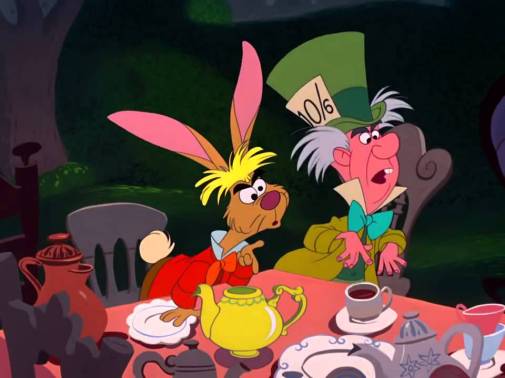
After a series of nonsensical encounters, Alice makes her way further into Wonderland and encounters the Cheshire Cat. Still determined to find the White Rabbit, Alice asks the Cheshire Cat if he knows where to find him. While the Cat doesn’t know himself, he advises Alice to ask either the Mad Hatter or the March Hare, who is also mad. When Alice objects at the idea of “going among mad people” the Cheshire Cat remarks that “Oh you really can’t help that, most everyone is mad here.” Knowing this, Alice decides to take a chance and visit the March Hare on the grounds that maybe he’s not quite as mad as a Mad Hatter.

alice in wonderland tea party

Alice in Wonderland “The Un-Birthday Song” (1951)

As it turns out, the choice doesn’t really matter because Alice ends up seeing both anyway, as the pair are having a tea party at the  home of the March Hare (along with their friend the Dormouse). And it’s not just any kind of party either, it’s an Un-Birthday party!! The trio are gathered at a long table lined with all kinds of chairs and an eccentric collection of tea sets, all raucously wishing each other a very merry un-birthday.

The Mad Hatter was voiced by Ed Wynn (perhaps best remembered as Uncle Albert, the man who laughed so hard he kept floating up to the ceiling in Mary Poppins (1964)). The March Hare was voiced by Jerry Colonna (who also narrated the Disney shorts Casey at the Bat (1946) and The Brave Engineer (1950)). The Dormouse was voiced by Jimmy MacDonald, who also happened to be the voice of Mickey Mouse at the time (he played the world’s most famous mouse from 1948 until 1977, taking over from Walt Disney when the latter’s voice grew too hoarse to perform as Mickey.)

54d4f351760631c07582a0726b8f69cc

As I was saying, the trio were all busy singing about un-birthdays:

A very merry unbirthday to me!
To who?
To me!
Oh you!

A very merry unbirthday to you!
Who me?
Yes, you!
Oh, me!

Let’s all congratulate us with another cup of tea!
A very merry unbirthday to you!

Alice is delighted with the song, but the Hatter and Hare are initially not pleased with her appearance (they insist there’s “no room” at the enormous table); but they’re quickly won over when Alice remarks how much she enjoyed their singing at this “birthday party.” (You’ll note a running gag in this interlude is that Alice is very nearly handed a cup of tea several times only to have it jerked away at the last possible moment). When the insulted Hare, Hatter and Dormouse insist that this is an “Un-Birthday Party,” Alice admits she doesn’t even know what that is, prompting the Hare and Hatter to explain:

maxresdefault (1)

Now, statistics prove, prove that you’ve one birthday
Imagine, just one birthday every year
Ah, but there are three hundred and sixty four unbirthdays!
Precisely why we’re gathered here to cheer

Alice chimes in: Then today is my unbirthday too!

It is?
What a small world this is.
In that case…
A very merry unbirthday,
To me?
To you!

A very merry unbirthday
For me?
For you!

Now blow the candle out my dear
And make your wish come true
A very merry unbirthday to you!

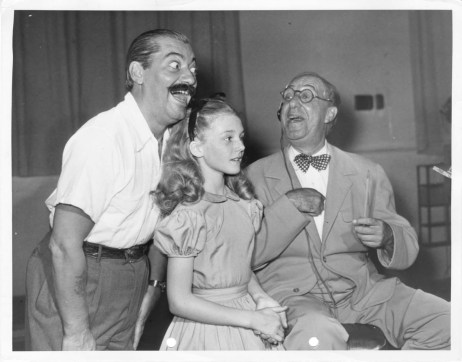
An interesting detail about this film is that it was nearly entirely shot in live action to serve as reference for the animators. Fortunately for us, the live action footage of the Mad Tea Party survived to the present day, and a talented YouTuber by name of Broadway Classixs synced the two pieces of footage together to show the origins of this hysterical scene.

Live_action_reference_photo_1049-9_blog

The Mad Tea Party: Live Action/Animated Comparison

With the song over, Alice is eager to ask the Hatter and Hare if they know where the White Rabbit is, but it soon becomes obvious that holding any type of rational conversation is a near-impossible task. For one, the Hatter and the Hare are constantly interrupting each other (or Alice); second, the group is constantly changing places around the table so they can get clean tea cups and third…there’s no need to look for the White Rabbit because he comes running directly by! Unfortunately for the Rabbit, the Hatter and Hare decide he simply must stay for tea…and also that his pocket watch needs fixing (with butter, jam, sugar and a healthy splash of tea). The miserable Rabbit, still complaining that he’s late, hurries off and a frustrated Alice follows, thoroughly fed-up with the antics of the Mad Hatter and the March Hare. Even though Alice sang wistfully about living in a nonsense world at the beginning of the story, she’s quickly finding out that actually living in a nonsense world is quite another matter altogether.

And that’s “The Un-Birthday Song”! I hope you enjoyed it, for more Alice in Wonderland, see the links below. And also let me know if you liked this song in the comments 🙂

Become a Patron of the blog at patreon.com/musicgamer460

Don’t forget to like Film Music Central on Facebook 🙂

Check out the YouTube channel (and consider hitting the subscribe button)
For more Disney songs, see here

See also:

Alice in Wonderland “Painting the Roses Red” (1951)

Alice in Wonderland “All in the Golden Afternoon” (1951)

Alice in Wonderland “In a World of My Own” (1951)

Alice in Wonderland (1951) takes us down the rabbit hole