Tag Archives: Disney

Snow White and the Seven Dwarfs “Heigh Ho” (1937)

Snow White and the Seven Dwarfs Part 2

Appropriately enough, as we meet the dwarfs in their incredibly sparkly mine, they’re singing about….digging!!! This cute little ditty actually doesn’t have too much in the way of melody going on, as the notes are mostly in sync with their picks. What is cool though is the introduction before the song starts (the first four measures): it’s musically recreating the sound of the dwarfs mining!

We dig dig dig dig dig dig dig 
In our mine the whole day through
To dig dig dig dig dig dig dig
Is what we like to do

It ain’t no trick to get rich quick
If you dig dig dig with a shovel or a pick
In a mine! In a mine! In a mine! In a mine!
Where a million diamonds shine!

We dig dig dig dig dig dig dig 
From early morn till night
We dig dig dig dig dig dig dig up 
Everything in sight

We dig up diamonds by the score
A thousand rubies, sometimes more
Though we don’t know what we dig ’em for
We dig dig dig a-dig dig

aa37f70e-3847-47fe-939a-912c15cce8c4

Through this song, we are visually introduced to all of the dwarfs and begin to get an idea of what they are like. In particular, we learn that Dopey isn’t all that bright, as he likes to mess around by putting diamonds in his eyes (much to Doc’s annoyance). I also find the scene where Dopey throws away “defective” jewels by tossing them over a cliff incredibly funny. There’s probably a fortune’s worth of jewels in that dust pan and he just tosses it away like it’s nothing (also, note how the jewels are coming out of the ground fully cut like finished gems). As the work continues, the clock announces it’s 5pm and time to go home, which announces the proper start of “Heigh Ho.”


“Heigh Ho” technically begins with a call and response as it is Doc who sings out the first “Heigh Ho!!” And all the dwarfs (minus Dopey who doesn’t talk) respond with their own “Heigh Ho!” which leads into the beginning of the song where they all sing and whistle in unison, basically singing the same verse over and over again (I’ve said it before and I’ll say it again, Disney songs at this point are designed to be relatively simplistic in terms of melody and lyrics). Sound film had only existed for about ten years at this point so filmmakers and animators were still showing off how closely they could synchronize sound to movement.

Heigh-ho, Heigh-ho
Heigh-ho, Heigh-ho
Heigh-ho
[Chorus]: Heigh-ho, Heigh-ho
It’s home from work we go
[Whistle]
Heigh-ho, Heigh-ho, Heigh-ho
[Chorus]: Heigh-ho, Heigh-ho
[Whistle]
Heigh-ho, Heigh-ho
Heigh-ho, Heigh-ho
Heigh-ho, Heigh-ho
Heigh-ho hum

“Heigh Ho” remains one of the most popular songs from this film and is considered one of the iconic Disney songs. Let me know what you think of “Heigh Ho” in the comments below and have a great day!

See also:

Snow White and the Seven Dwarfs “I’m Wishing/One Song” (1937)

Snow White and the Seven Dwarfs “With a Smile and a Song” (1937)

Snow White and the Seven Dwarfs “Whistle While You Work” (1937)

Snow White and the Seven Dwarfs “Bluddle-Uddle-Um-Dum/The Washing Song” (1937)

Snow White and the Seven Dwarfs “The Silly Song” (1937)

Snow White and the Seven Dwarfs “Some Day My Prince Will Come” (1937)

Disney/Dreamworks/Pixar/etc. Soundtracks A-Z

Become a Patron of the blog at patreon.com/musicgamer460

Check out the YouTube channel (and consider hitting the subscribe button)

Don’t forget to like Film Music Central on Facebook

Snow White and the Seven Dwarfs “Whistle While You Work” (1937)

6e644-1184136_1361628309987_full

Snow White and the Seven Dwarfs “Whistle While You Work” (1937)

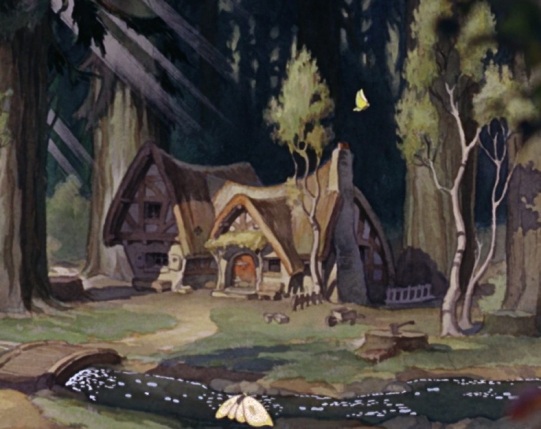
Previously, Snow White had just escaped to the forest and made friends with the animals therein. Now she needs a place to stay and the animals are more than happy to help out. Unbeknownst to everyone (including the animals apparently), this cottage is actually the home of the seven dwarfs: Doc, Happy, Sneezy, Sleepy, Bashful, Grumpy and Dopey. Based on the evidence, that house was never cleaned a day in its life. Snow White, of course, has a plan to fix all that so she and the animals decide to clean the house for the “children” so that when they come back, maybe they’ll let her stay. This idea serves as the introduction for “Whistle While You Work.”

Just whistle while you work
And cheerfully together we can tidy up the place
So hum a merry tune
It won’t take long when there’s a song to help you set the pace

And as you sweep the room
Imagine that the broom is someone that you love
And soon you’ll find you’re dancing to the tune
(Spoken: Oh, no, no, no, no! Put them in the tub)
When hearts are high the time will fly so whistle while you work

dd7b7-snow-white

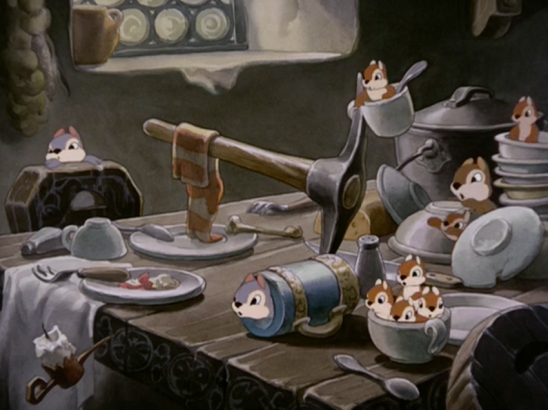
I can’t tell you how many times I sang this song to myself as a child while I cleaned my room or did a chore. It was funny because at the time I couldn’t whistle so I’d sing the verse and then blow air frantically to try and whistle the tune (but I digress…). Of course in the movie the song is accompanied by funny scenes of the animals (along with Snow White) cleaning the filthy cottage. My particular favorite is seeing the chipmunk winding up the spider’s web like a ball of yarn only to have the spider come down to object! This is where we leave Snow White for now, as it’s finally time to meet the seven dwarfs.

Let me know what you think of “Whistle While You Work” in the comments below and have a great day!

See also:

Snow White and the Seven Dwarfs “I’m Wishing/One Song” (1937)

Snow White and the Seven Dwarfs “With a Smile and a Song” (1937)

Snow White and the Seven Dwarfs “Heigh Ho” (1937)

Snow White and the Seven Dwarfs “Bluddle-Uddle-Um-Dum/The Washing Song” (1937)

Snow White and the Seven Dwarfs “The Silly Song” (1937)

Snow White and the Seven Dwarfs “Some Day My Prince Will Come” (1937)

Disney/Dreamworks/Pixar/etc. Soundtracks A-Z

Become a Patron of the blog at patreon.com/musicgamer460

Check out the YouTube channel (and consider hitting the subscribe button)

Don’t forget to like Film Music Central on Facebook
Snow White and the Seven Dwarfs “With a Smile and a Song” (1937)

Evolution of Disney : Snow White and the Seven Dwarfs Part 1

Of course for the Queen, seeing the Prince in love with Snow White is the last straw and she arranges to have the young Princess murdered out in the countryside. Fortunately for us, the Huntsman has a conscience and Snow White runs deep into the forest where she encounters a large group of forest animals (interesting how they can understand humans, isn’t it?) Now trying to cheer herself up, Snow White sings “With a Smile and a Song” to remind herself (and her new animal friends) about how being positive can help you get through tough times. As with the earlier songs, the vocal part is relatively simple.

With a smile and a song
Life is just a bright sunny day
Your cares fade away
And your heart is young

With a smile and a song
All the world seems to waken anew
Rejoicing with you
As the song is sung

There’s no use in grumbling
When raindrops come tumbling
Remember, you’re the one
Who can fill the world with sunshine

When you smile and you sing
Everything is in tune and it’s spring
And life flows along
With a smile and a song

I enjoy this song as much as the others, but something about it has always bothered me. Caselotti’s voice is so high-pitched in this song that, to my ears, some of the words come across as unintelligible. It still sounds beautiful but it would be nice to understand all of the lyrics. It’s also interesting to compare the animation of the animals in this film to their super-realistic appearance in Bambi. While it’s true that Disney wasn’t going for realism in Snow White, everything is still recognizable (deer look like deer, rabbits like rabbits, etc.)

“With a Smile and a Song” is a nice, peaceful interlude after Snow White’s terrifying run through the forest (which really needs to be covered in Disturbing Disney) and easily sets up a transition for the princess to travel to the cottage of the seven dwarfs. Let me know what you think about “With a Smile and a Song” in the comments below and have a great day!

See also:

Snow White and the Seven Dwarfs “I’m Wishing/One Song” (1937)

Snow White and the Seven Dwarfs “Whistle While You Work” (1937)

Snow White and the Seven Dwarfs “Heigh Ho” (1937)

Snow White and the Seven Dwarfs “Bluddle-Uddle-Um-Dum/The Washing Song” (1937)

Snow White and the Seven Dwarfs “The Silly Song” (1937)

Snow White and the Seven Dwarfs “Some Day My Prince Will Come” (1937)

Disney/Dreamworks/Pixar/etc. Soundtracks A-Z

Become a Patron of the blog at patreon.com/musicgamer460

Check out the YouTube channel (and consider hitting the subscribe button)

Don’t forget to like Film Music Central on Facebook
Snow White and the Seven Dwarfs “I’m Wishing/One Song” (1937)

Evolution of Disney : Snow White and the Seven Dwarfs Part 1

Snow White “I’m Wishing/One Song” (1937)

It’s hard to imagine, but there was a time when Disney did not completely rule the world of animation and children’s movies. Back in the 1930s, Disney was seen as a small studio that created funny cartoons, but little else. Of course Walt Disney had bigger plans, including an idea for making a full-length film that was completely animated (something unheard of at the time). What was once known as “Disney’s Folly” became known to history as Snow White and the Seven Dwarfs.

Released in 1937, the titular character is voiced by the singer Adriana Caselotti. She sings several songs over the course of the film, the first of which is “I’m Wishing,” sung to her bird friends as she gets water from the well in the castle courtyard. The melody is relatively simplistic, with many leaps from the tonic to the dominant (D to A) and back again. Before the melody returns for a final reprise (just before the Prince interjects), there is a lovely interlude where Caselotti shows off her vocal prowess and sings a call and response with her “echo” in the well.

Evolution of Disney : Snow White and the Seven Dwarfs Part 1

The song serves as a good introduction for the character: she’s a young (at least teenage) girl who’s clearly done her best to be happy, but still dreams of finding true love (and probably getting away from her stepmother the Queen). The music for this song (and most of the others) was composed by Frank Churchill, who’s last work would prove to be the score for Bambi in 1942.

You wanna hear a secret?
Promise not to tell?
(sung)
We are standing by a wishing well
Make a wish into the well
That’s all you have to do
And if you hear it echoing
Your wish will soon come true

I’m wishing
(I’m wishing)
For the one I love
To find me
(To find me)
Today
(Today)

I’m hoping
(I’m hoping)
And I’m dreaming of
The nice things
(The nice things)
He’ll say
(He’ll say)

I’m wishing
(I’m wishing)
For the one I love
To find me
(To find me)
Today

It’s amazing how lifelike Snow White looks (and remember this was 1937, before computers, all of this was done BY HAND). By the way, look at the Prince below, doesn’t he remind you just a little of Prince Philip from Sleeping Beauty? This charming song is immediately followed by “One Song” sung by the unnamed Prince (his role was supposed to be larger but Disney wasn’t entirely convinced that his animators could bring a male character to life convincingly so this is the first and last time we see him until the end of the movie, where he again sings “One Song”).

Evolution of Disney : Snow White and the Seven Dwarfs Part 1

Like “I’m Wishing,” “One Song” is a simple melody, well-suited for a tenor’s voice, that clearly sets out what the Prince is saying (i.e. I’ve fallen in love with you at first sight). The melody is again very simple, with a medium range of notes. Disney songs have a tendency to be very simple melodically (the idea was that this made them more appealing to children).

Now that I’ve found you
Here’s what I have to say

One Song
I have but one song
One song
Only for you

One heart
Tenderly beating
Ever entreating
Constant and true

One love
That has possessed me
One love
Thrilling me through

One song
My heart keeps singing
Of one love
Only for you

 The only question I have is, if the Prince really loves Snow White that much, why didn’t he just take her away right then and there? Where did he go after this song ends? Nevertheless, it is a sweet moment (and the look on the Queen’s face when she sees the Prince wooing her stepdaughter is priceless!) Originally, there was going to be an idea that the Prince was supposed to be coming to court the Queen, which would also explain her outrage at seeing him woo Snow White, but the idea was ultimately dropped.

What do you think of “I’m Wishing” and “One Song”? Let me know your thoughts in the comments below and have a great day! This is going to be the start of me re-formatting my earliest blog posts. When I first started, I wasn’t sure what the blog would look like, so I experimented with some different formats. Now I’m going to fix my early work to match what I do now. Hope you enjoy!

See also:

Snow White and the Seven Dwarfs “With a Smile and a Song” (1937)

Snow White and the Seven Dwarfs “Whistle While You Work” (1937)

Snow White and the Seven Dwarfs “Heigh Ho” (1937)

Snow White and the Seven Dwarfs “Bluddle-Uddle-Um-Dum/The Washing Song” (1937)

Snow White and the Seven Dwarfs “The Silly Song” (1937)

Snow White and the Seven Dwarfs “Some Day My Prince Will Come” (1937)

Disney/Dreamworks/Pixar/etc. Soundtracks A-Z

Become a Patron of the blog at patreon.com/musicgamer460

Check out the YouTube channel (and consider hitting the subscribe button)

Don’t forget to like Film Music Central on Facebook

Michael Giacchino talks John Carter (2012)

Few Disney films have flopped harder in the last decade than John Carter, an adaptation of Edgar Rice Burrough’s Barsoom novel A Princess of Mars. The film follows the titular character, a Civil War veteran, as he finds himself flung to the dying planet of Barsoom (Mars) and the conflicts taking place therein. The film was meant to be the first of a trilogy, but when John Carter bombed at the box office (costing Disney $200 million in the process), all future sequels were cancelled.

The score for John Carter was composed by Michael Giacchino, who routinely turns in good work, including for this film. While many aspects of the film were criticized, Giacchino’s score was praised for sounding “fresh and adventurous.” In this interview (I apologize for the audio cutting in and out), Giacchino discusses a few details of how the score came together, including the director’s desire to express emotions through the music and which characters should get their own themes. I’d really hoped to find some scoring sessions from this score, and if I ever find some I’ll make sure to attach the links, because it sounds like some good music.

I hope you enjoyed this short interview about the music of John Carter. Let me know what you think about John Carter in the comments below and have a great day!

See also:

Michael Giacchino talks The Incredibles (2004)

Michael Giacchino talks Mission: Impossible 3 (2006)

Michael Giacchino talks Ratatouille (2007)

Michael Giacchino talks Up (2009)

Michael Giacchino talks Star Trek (2009)

Michael Giacchino talks Super 8 (2011)

Michael Giacchino talks Star Trek: Into Darkness (2013)

Michael Giacchino talks Jupiter Ascending (2015)

Michael Giacchino talks Jurassic World (2015)

Michael Giacchino scoring Rogue One: A Star Wars Story (2016)

Michael Giacchino talks Zootopia (2016)

Michael Giacchino talks Jurassic World: Fallen Kingdom (2018)

Film Composer Interviews A-H

Film Composer Interviews K-Z

Become a Patron of the blog at patreon.com/musicgamer460

Check out the YouTube channel (and consider hitting the subscribe button)

Don’t forget to like Film Music Central on Facebook

James Newton Howard talks Dinosaur (2000)

Dinosaur-disneyscreencaps_com-1307_-1024x538.jpg

I remember Dinosaur being a really big deal back in the year 2000. Not only was it a leap in CGI animation, it was also filmed against mostly live-action backgrounds (which I believe was a first). The film follows the story of a dinosaur named Alladar who travels with his adoptive lemur family to find a new home after the island he grew up on is destroyed by a meteor.

James Newton Howard composed the score for Dinosaur and I remember the music standing out to me right away due to the extended preview that the film had in trailers. Howard gave the score this huge, symphonic sound to highlight the live-action background and the various dinosaurs seen in the preview. I was really excited to find this video clip because “making of” clips with James Newton Howard are relatively hard to come by and he’s worked on some of my favorite childhood films.


As the interview clip explains, Howard uses the music in Dinosaur to direct emotional feelings, be it fear, wonder, or humor. And there is a full range of emotions to be found in the film, which shows just how talented this composer is. It was also emphasized that they wanted to make the music sound primal but not ethnic. That is, they didn’t want any music that could be traced back to a particular human culture (since this movie is set way before humans existed).

I really hope you enjoy this behind the scenes video with James Newton Howard. Let me know what you think about Dinosaur (and the music for Dinosaur) in the comments below and have a great day!

See also:

James Newton Howard talks Atlantis: The Lost Empire (2001)

James Newton Howard talks Signs (2002)

James Newton Howard talks The Village (2004)

James Newton Howard scoring King Kong (2005)

Film Composer Interviews A-H

Film Composer Interviews K-Z

Become a Patron of the blog at patreon.com/musicgamer460

Check out the YouTube channel (and consider hitting the subscribe button)

Don’t forget to like Film Music Central on Facebook

The Three Caballeros “The Three Caballeros” (1944)

*note: in the context of this song “gay” means happy/carefree

the-three-caballeros.jpg

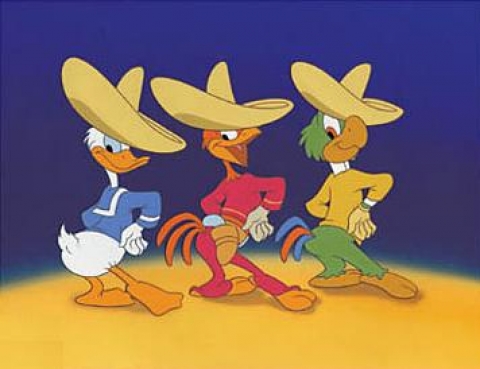
I’m not sure if I’ve mentioned it before, but during the 1940s Disney released a lot of what were called “package films.” While ostensibly released as a single feature, package films actually contained a series of separate animated shorts connected by a plot line. This happened because Disney found themselves with a lot of material that was too long to be regular cartoons and too short to be standalone features. This is how The Three Caballeros came into being. The common thread is that Donald Duck is celebrating his birthday and while opening his presents he learns about Mexico and South America via his friends José Carioca (a Brazilian parrot) and Panchito Romero Miguel Junipero Francisco Quintero González III (a Mexican rooster).

Once Panchito joins the party, he leads his friends in singing “The Three Caballeros.” In this song, Panchito praises the life of a caballero and how he is always loyal to his friends (unless there’s a girl involved, in which case forget it!) The rhythm and last verse of this song come from Ay, Jalisco, no te rajes!, a popular Mexican ranchera song released in 1941.

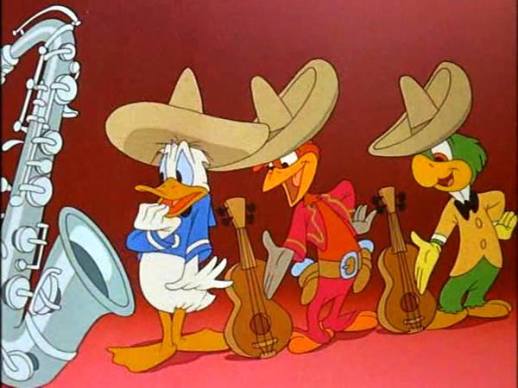
A running gag throughout the song is Donald trying (and failing) to imitate José and Panchito. For example, he flops to the ground when the others fly, and he can’t summon a guitar out of thin air (instead he gets a saxophone, a trumpet, and a double bass).

We’re three caballeros
Three gay caballeros
They say we are birds of a feather
We’re happy amigos
No matter where he goes
The one, two, and three goes
We’re always together

We’re three happy chappies
With snappy serapes
You’ll find us beneath our sombreros
We’re brave and we’ll stay so
We’re bright as a peso
Who says so?
We say so!
The three caballeros

04.jpg

Ooooh!
We have the stars to guide us
Guitars here beside us
To play as we go
We sing and we samba
We shout, ¡Ay caramba!
What means “Ay caramba”?
Oh, yes! I don’t know

Ooooh!
Through fair and stormy weather
We stand close together
Like books on a shelf
And pals though we may be
When some Latin baby
Says yes, no, or maybe
(wolf whistle)
Each man is for himself!

03.jpg

¡Ay, Jalisco no te rajes!
Me sale del alma
Gritar con color
Abrir todo el pecho
Pa’ echar este grito
¡Qué lindo es Jalisco!
Palabra de honor!

The end of the song made me laugh for years when I was growing up. At the end, when the song has supposedly finished, Panchito keeps right on holding that last note (and truthfully, a well-trained singer can theoretically hold a note indefinitely). José and Donald try everything to make Panchito stop, but nothing affects the rooster, until he appears to shrink away and disappear. Just when the pair think he’s gone though, the rooster reappears with a gigantic piñata!

What do you think about “The Three Caballeros”? Let me know your thoughts in the comments below and have a great day!

See also:

Disney/Dreamworks/Pixar/etc. Soundtracks A-Z

Become a Patron of the blog at patreon.com/musicgamer460

Check out the YouTube channel (and consider hitting the subscribe button)

Don’t forget to like Film Music Central on Facebook
Pinocchio “When You Wish Upon a Star” (1940)

Pinocchio003

Pinocchio “When You Wish Upon a Star” (1940)

As Disney’s second animated feature film, Pinocchio is responsible for creating one of the company’s most memorable songs. Since its release, “When You Wish Upon a Star” has become the official anthem for the Walt Disney Company (a snippet plays right before the start of every Disney movie) and has been covered numerous times. But the original version was performed by Cliff Edwards (the voice of Jiminy Cricket) and became an instant hit. In fact, “When You Wish Upon a Star” was the first Disney song to win an Academy Award, taking home the Oscar for Best Song.

The song arrives at the start of the film and takes us through the opening credits until we come to Jiminy Cricket himself, singing the last part of the song by the Pinocchio storybook.

When you wish upon a star
Makes no difference who you are
Anything your heart desires
Will come to you

If your heart is in your dream
No request is too extreme
When you wish upon a star
As dreamers do

Fate is kind
She brings to those who love
The sweet fulfillment of
Their secret longing

Like a bolt out of the blue
Fate steps in and sees you through
When you wish upon a star
Your dreams come true

The song is also reprised at the end of the film while everyone is celebrating Pinocchio’s transformation into a real boy. To be perfectly honest, this song always makes me cry every time I hear it, so much so that there are times I have to skip over it so I can watch the film without bawling.

Here’s an interesting piece of trivia: if you look closely at the background of the picture with Pinocchio’s book, you’ll see two books titled Alice in Wonderland and Peter Pan. Both of these stories would be released as Disney films in the following decade (1951 and 1953 respectively).

What do you think of “When You Wish Upon a Star”? Let me know your thoughts in the comments below and have a great day!

See also:

Pinocchio “Little Wooden Head” (1940)

Pinocchio “Hi Diddle Dee Dee (An Actor’s Life for Me!)” (1940)

Pinocchio “I’ve Got No Strings” (1940)

Pinocchio “Hi Diddle Dee Dee (reprise)” (1940)

Disney/Dreamworks/Pixar/etc. Soundtracks A-Z

Disturbing Disney #1: The Coachman in Pinocchio (1940)

Disturbing Disney #2: The truth of Pleasure Island in Pinocchio (1940)

Become a Patron of the blog at patreon.com/musicgamer460

Check out the YouTube channel (and consider hitting the subscribe button)

Don’t forget to like Film Music Central on Facebook

Pinocchio “Little Wooden Head” (1940)

Pinocchio047

When we first meet Geppetto the toymaker, it’s through the eyes of Jiminy Cricket, who is stopping by the toymaker’s shop/home for theDisturbing Disney #1: The Coachman in Pinocchio (1940) night. The elderly toymaker has just finished his latest creation, a wooden marionette he dubs Pinocchio (which means “pine eye” because he was carved from a block of pine wood).

Delighted with how Pinocchio has turned out, Geppetto winds up a music box and dances with the little puppet while singing “Little Wooden Head.”

Little wooden head, go play your part
Bring a little joy to every heart
Little do you know and yet it’s true
That I’m mighty proud of you
Little wooden feet and best of all
Little wooden seat in case you fall
(How graceful!)
My little wooden head!

Geppetto then introduces Pinocchio to his two pets, Cleo the goldfish and Figaro the cat. While Cleo is delighted, Figaro is quite jealous (it doesn’t help that Geppetto uses the puppet to have some fun at the cat’s expense).

Little does Geppetto suspect that the little puppet he loves so much will soon be brought to life by the Blue Fairy after he makes a wish on the Wishing Star. This is a very short song but it quickly establishes that Geppetto is a good and kindly man who loves to bring joy to others through the toys he makes (this is why the Blue Fairy grants his wish).

What do you think of “Little Wooden Head”? Let me know your thoughts in the comments below and have a great day!

See also:

Pinocchio “When You Wish Upon a Star” (1940)

Pinocchio “Hi Diddle Dee Dee (An Actor’s Life for Me!)” (1940)

Pinocchio “I’ve Got No Strings” (1940)

Pinocchio “Hi Diddle Dee Dee (reprise)” (1940)

Disney/Dreamworks/Pixar/etc. Soundtracks A-Z

Disturbing Disney #1: The Coachman in Pinocchio (1940)

Disturbing Disney #2: The truth of Pleasure Island in Pinocchio (1940)

Become a Patron of the blog at patreon.com/musicgamer460

Check out the YouTube channel (and consider hitting the subscribe button)

Don’t forget to like Film Music Central on Facebook

The Hunchback of Notre Dame “Out There” (1996)

Quasimodo has one of the most dysfunctional and abusive upbringings in the Disney canon (even worse than Rapunzel’s, because while it’s true Mother Gothel kidnapped the princess and mentally abused her so she’d stay in the tower, she didn’t kill either of Rapunzel’s parents). After causing the death of Quasimodo’s mother, Judge Frollo (Tony Jay) nearly drowns her baby before the Archdeacon of Notre Dame stops him and orders him to raise the child as his own as penance for what he has done. Frollo translates this to keeping Quasimodo (Tom Hulce) locked up in the bell tower for the next twenty years, raising him to believe he is a monster that his mother abandoned.


As a young man, Quasimodo spends most of his days observing the residents of Paris (when not ringing the church bells) as they go about their daily lives, longing to walk among them. He especially wants to participate in the annual Feast of Fools and his friends the stone gargoyles encourage him to go. When Frollo learns that the bell-ringer tried to leave (again), he reminds Quasimodo that he is a monster and if he goes outside he’ll be reviled as such. The only way he can remain safe is to stay in the tower and do exactly as Frollo says. While Quasimodo acquiesces to his master’s wishes, his desire to experience life outside the cathedral remains and this is the theme for “Out There.”

maxresdefault (2).jpg

Safe behind these windows and these parapets of stone
Gazing at the people down below me
All my life, I watch them as I hide up here alone
Hungry for the histories they show me
All my life, I memorize their faces
Knowing them as they will never know me
All my life, I wonder how it feels to pass a day
Not above them
But part of them

And out there, living in the sun
Give me one day out there, all I ask is one
To hold forever
Out there, where they all live unaware
What I’d give
What I’d dare
Just to live one day out there

Out there among the millers and the weavers and their wives
Through the roofs and gables I can see them
Every day they shout and scold and go about their lives
Heedless of the gift it is to be them

If I was in their skin
I’d treasure every instant

Out there, strolling by the Seine
Taste a morning out there, like ordinary men
Who freely walk about there
Just one day and then, I swear
I’ll be content
With my share

Won’t resent
Won’t despair
Old and bent
I won’t care
I’ll have spent one day out there!

maxresdefault (3).jpg

Quasimodo expresses the wish of many Disney heroes and heroines: “I don’t like how my life currently is, but if I can just do this one thing I will be happy forever.” The song is practically a staple in Disney musicals but that isn’t a bad thing if it’s done properly and “Out There” is one of my favorite Disney songs. During the scene, Quasimodo clambers all over Notre Dame, letting you see the beautiful sculptures and architecture that make the cathedral so famous. The animators took a special trip to Paris to sketch the building and it really shows throughout the film.

Of course, if you’ve been keeping up with Disturbing Disney then you know Quasimodo’s first trip into the outside world will end badly. Despite that, it’s so easy to feel for the bell-ringer as he sings; to be that close to a bustling medieval city that you’re not allowed to visit would leave anyone feeling lonely and depressed (it’s amazing that Quasimodo grows up relatively well-adjusted).

What do you think about “Out There”? Let me know your thoughts in the comments below and have a great day!

See also:

The Hunchback of Notre Dame “The Bells of Notre Dame” (1996)

The Hunchback of Notre Dame “Topsy Turvy” (1996)

The Hunchback of Notre Dame “God Help the Outcasts” (1996)

The Hunchback of Notre Dame “Heaven’s Light/Hellfire” (1996)

The Hunchback of Notre Dame “The Court of Miracles” (1996)

Disney/Dreamworks/Pixar/etc. Soundtracks A-Z

Become a patron of the blog at: patreon.com/musicgamer460

Check out the YouTube channel (and consider hitting the subscribe button)

Don’t forget to like Film Music Central on Facebook