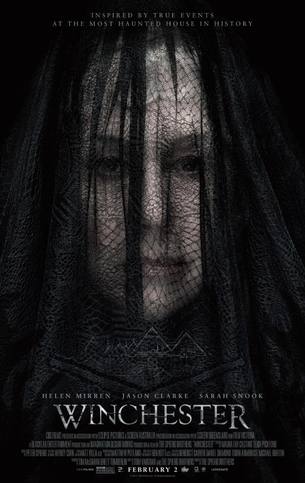
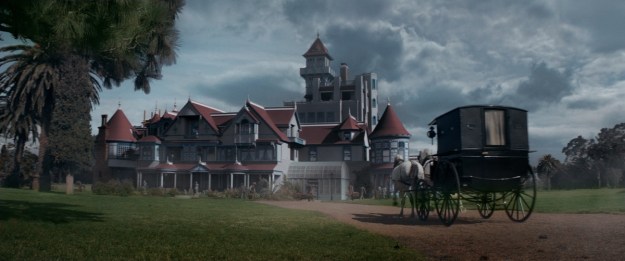
Winchester is a 2018 American supernatural horror film directed by Michael and Peter Spierig. It follows the widowed Sarah Winchester (Helen Mirren) as she seeks to help what she believes are spirits killed by Winchester rifles by continually expanding the mansion she lives in (what is now known as the Winchester Mystery House). Due to Sarah’s obsession with spirits, a doctor named Eric Price (Jason Clarke) is summoned to the mansion to determine whether Sarah is mentally capable of running the Winchester Company. The doctor, who does not initially believe in ghosts, soon finds that there are indeed spirits residing in the Winchester mansion. Winchester was released to theaters on February 2nd, 2018.
The score for Winchester was composed by co-director Peter Spierig in his second outing as a film composer. Peter collaborates with his twin brother Michael and collectively they work as The Spierig Brothers. Their critically acclaimed sci-fi thriller Predestination, based on Robert A. Heinlein’s short story “All You Zombies”, was nominated for nine Australian Academy of Cinema and Television Arts (AACTA) Awards, including Best Director, Best Adapted Screenplay, and Best Score for Peter. The film also won four AACTA Awards including Best Actress for Sarah Snook, who stars in Winchester. The Spierig Brothers won the Toronto After Dark Film Festival Special Award for Best Sci-Fi Film and Best Screenplay for Predestination, which also took a second place Audience Award for Best Feature Film.
Listening to the soundtrack, some moments definitely stood out to me, but overall one thing became pointedly clear: the Winchester score succumbs to the age-old trope of using shock chords in a horror film. It’s a practice that dates back many decades and in my opinion it’s completely over done. It’s true that horror films should have that “scare factor” to them, especially in the music whenever possible, but there’s more than one way to elicit scares through the music.
However as I said there were a few moments that stood out to me in a good way. One of these was “Marion,” referring to a relative of Sarah’s that also lives in the mansion with her son Henry. In contrast to the “Winchester House” track which is fairly typical horror movie score fare (loaded with shock chords, grinding metal sounds and various eerie noises), “Marion” is a relatively calm piano track that possibly signifies how “normal” the character is compared to Sarah Winchester with her belief in spirits and the paranormal. “Employment” also ran along similar veins to this piece.
“Poisoned Mind” was another track filled with shock chords, far too much for my liking to be honest, as was “You’re A Fraud.”
In brief, Winchester doesn’t have the worst soundtrack in the world (for those curious, Van Helsing (2004) still holds that dubious distinction for me), but it is not one of my favorites.
Did you watch Winchester? If you did, what did you think of the film and the soundtrack? Let me know your thoughts in the comments below. Have a good day!
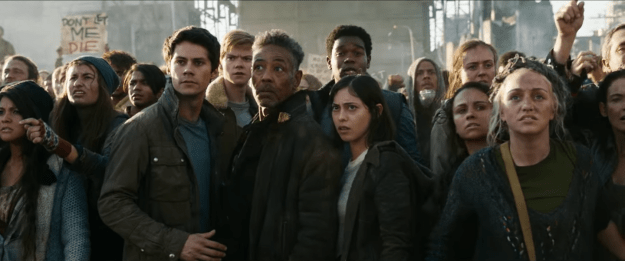
Maze Runner: The Death Cure is a 2018 American dystopian science fiction film based on the third novel in the Maze Runner trilogy written by James Dashner. It was originally meant to be released in 2017 but had to be delayed when series star Dylan O’Brien suffered injuries while filming and required extensive time to recover. In The Death Cure, the surviving “Gladers” must infiltrate WCKD headquarters in order to rescue their friend Minho who is being tortured by WCKD in hopes of developing a cure for the Flare virus that has turned most of the population into “Cranks” (zombie-like beings that have an overwhelming urge to kill anyone who isn’t a Crank). The film and soundtrack released on January 26th, 2018.
The score for The Death Cure was composed by John Paesano, a composer with a lengthy list of film credits to his name. Paesano received an Annie Award for Best Music for his work on DreamWorks’ animated series Dragons: Riders of Berk, which is based on the Academy Award® winning film How To Train Your Dragon. He won a World Soundtrack Award for his score to the hugely successful young adult adaptation, The Maze Runner.
He has now completed the trilogy, which includes The Scorch Trials and The Death Cure. His other credits include Universal Picture’s Almost Christmas and Sony Animation’s The Star. He’s currently scoring both Marvel’s hit series Daredevil and Defenders. Forthcoming in 2018 is Spider-Man PS4, which will be released featuring John’s huge orchestral score.
Listening to Maze Runner: The Death Cure was a refreshing change of pace compared to the other science fiction works I’ve been listening to as of late (i.e. Annihilation and Altered Carbon). Unlike those works, The Death Cure’s score uses a more traditional orchestra, mostly strings, though there is a healthy dose of synthesizer used as well (in the 21st century, it’s next-to-impossible to find a film score that doesn’t use synthesized music at some point).
Two tracks that stood out to me were “The Virus” and “The Last City.” With “The Virus,” it was very interesting, given the track’s title, how it actually sounded. I was expecting to hear something sinister and dark, but it actually sounded very pleasant. With layered orchestral chords and synthetic drones, the music is actually rather serene at times, which makes me wonder what part of the film this music is attached to with a title like “The Virus.” I really do enjoy listening to this track, it’s simple and direct and hopefully gets its point across in the film.
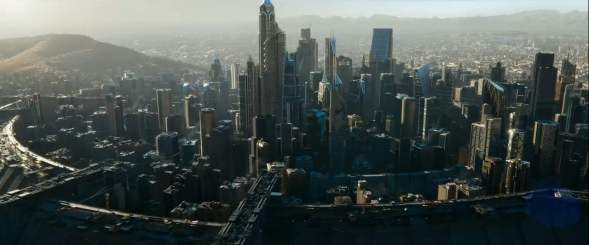
“The Last City” can only be referring to the city that holds WCKD headquarters (and is presumed to be the last functioning city of its kind on Earth). Appropriately enough, given the post-apocalyptic setting, the music for this track is sad, with a mournful horn melody accompanied by strings. I have to imagine that even for those living inside the city things must seem completely hopeless, given how close humanity is to extinction, no wonder the music is so sad. I like how Paesano has written this piece, especially how the strings swell up with a theme of their own and weave in and out with the horn. Like “The Virus,” this track is relatively simple but effective.
And those are my thoughts on the soundtrack of Maze Runner: The Death Cure. Reviews of the film have been mixed, but I think Paesano’s soundtrack is good, and I hope you enjoy listening to it. My thanks to The Krakower Group for making this soundtrack available for review. The soundtrack is available via Sony Classical.
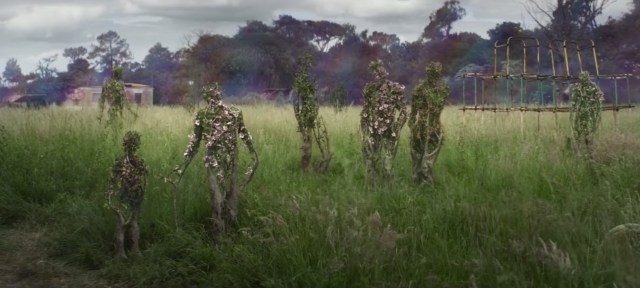
Annihilation is a science fiction horror film written and directed by Alex Garland in his second outing as a film director. The film is based on the novel of the same name by Jeff VanderMeer and follows a group of military scientists who enter “the Shimmer,” a mysterious quarantined zone that is full of mutating landscapes and creatures. Annihilation stars Natalie Portman, Oscar Isaac, Jennifer Jason Leigh, , Gina Rodriguez, Tessa Thompson and Tuva Novotny and was released on February 23rd, 2018.
The soundtrack of Annihilation was scored by composing duo Ben Salisbury and Geoff Barrow, who previously worked with Alex Garland on the Academy Award winning film Ex Machina (2015). Ben Salisbury is an Emmy-nominated composer with over 100 film and television composing credits to his name, including Beyonce Knowles’ self-directed documentary feature Beyonce: Life Is But A Dream and the last 3 series of David Attenborough’s acclaimed Life Of… strand for the BBC. Geoff Barrow, known for his extensive body of work as a music producer and founding member of the band Portishead, first began his film music career as the music supervisor and original score writer for graffiti artist Banksy’s Oscar-nominated documentary Exit Through The Gift Shop. He recently worked on the band Arcade Fire’s latest album Everything Now in addition to producing a cover of ABBA’s “SOS” with Portishead for Ben Wheatley’s film adaption of High-Rise.
The first thing I noticed about this soundtrack is that it is clearly related to the music of Ex Machina. It is not identical, per se, but it clearly comes from the same tonal family as the previous film. I don’t say this as a bad thing, in fact, it’s not uncommon for multiple soundtracks from the same composer (or group of composers) to retain similarities across each film. I also think the resemblance has something to do with Annihilation being considered the “spiritual” successor to Ex Machina.
That being said, if you liked Ex Machina and its soundtrack, then you will love the soundtrack for Annihilation. Like the soundtrack for Altered Carbon, most of the tracks contain the same elements: long synthesized tones, metallic wind chimes, and vocal tones. Despite the similarities, some of the tracks did stand out to me.
“Shimmer Reveal” is only 38 seconds long but it catches the ear because it starts very soft and steadily grows in volume. As the volume increases, the melody “thickens” with a deeper synthesized tone. It feels like we start looking at a small picture which quickly expands into a panoramic landscape (in fact this is probably when we get our first in-depth look at the “shimmer” which can only be that mysterious thing that Natalie Portman’s character is seen walking into in the previews).
“Abandoned Army Base” is half-mystical and half-sinister in the way it combines a synthesized drone with “creaking” metallic tones that sound like metal being ripped apart and metallic chimes that put me in mind of a monastery. Given that this is a science fiction horror film, I can only presume the sinister component I hear is due to someone or something hiding at this abandoned base, just waiting to snatch an unsuspecting victim (of course I could be wrong, but that’s what it sounds like). And going back to Ex Machina, this track in particular reminds me of Ava’s theme.
I have to bring attention to “In All of Us” simply because this track breaks the overall pattern and includes a melody from a guitar, which is so unexpected that it jars the ear when it arrives. “We Are Headed That Way” which follows that track, is interesting to me because of its title. Given the trailer’s hints that “the Shimmer” is causing a mutation of some kind, I wonder if this title refers to the idea that everything on Earth will eventually be affected by this mutation. Truthfully I can’t wait to find out what “the Shimmer” is actually doing, the visuals in the previews looked amazing.
And those are my thoughts on the soundtrack for Annihilation. The soundtrack is currently available via Lakeshore Records and I hope you enjoy listening to it. My thanks to The Krakower Group for making this soundtrack available for review.
If you’ve seen Annihilation, what did you think of the film and its soundtrack? Let me know your thoughts in the comments below, but please no spoilers, I’m seeing the film on Wednesday night 🙂
The Alienist is an American television period drama mystery series based on the novel of the same name by Caleb Carr. The ten episode series currently running on TNT stars Daniel Brühl, Luke Evans and Dakota Fanning as a team assembled in late 1890s New York City to investigate a ritualistic serial killer who is murdering street children. The title comes from a late-19th century belief about mental illness. At that time, the mentally ill were considered to be “alienated” from their true nature. Those who studied mental illness were therefore known as “alienists.”
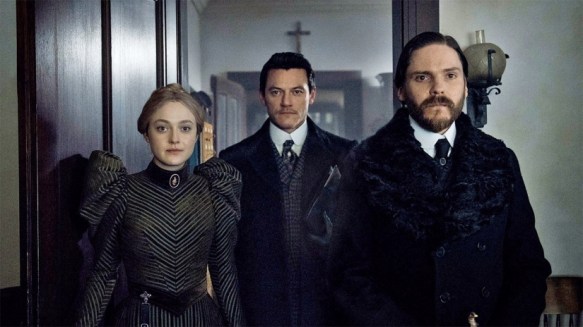
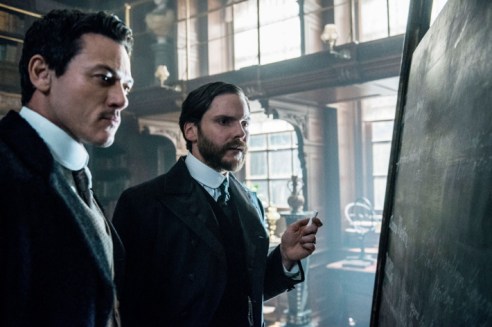
The titular alienist is Dr. Laszlo Kreizler (Daniel Brühl), a criminal psychologist hired to secretly conduct an investigation into the case by police commissioner Theodore Roosevelt (the future President of the United States). Kreizler is aided in his task by newspaper illustrator John Moore (Luke Evans) and Sarah Howard (Dakota Fanning), the police commissioner’s secretary.
The music for The Alienist was composed by Rupert Gregson-Williams. A truly versatile composer, Gregson-Williams has written a wide range of scores for many feature films, including the Oscar-winning Hotel Rwanda for which he was awarded the European Film Award for Best Composer, the blockbuster DreamWorks animated films Over The Hedge and Jerry Seinfeld’s Bee Movie, for which Rupert was nominated for an Annie Award for his original score and the independent BBC Films’ Love + Hate, for which he was awarded the Reims International Composer Award.
Most recently, Gregson-Williams scored the blockbuster and critically acclaimed Wonder Woman directed by Patty Jenkins and starring Gal Gadot and Chris Pine; the award-winning war drama Hacksaw Ridge, starring Andrew Garfield and directed by Mel Gibson, and the international hit The Legend of Tarzan. His upcoming film projects include “Terminal,” starring Margot Robbie and written and directed by Vaughn Stein.
Having cut the cable cord several years ago, I haven’t been able to watch the show yet, but based on the soundtrack, I think I need to. From the very start with “The Streets of New York” and “Brooklyn Bridge,” there is an old-time sound that is meant to recall the late-19th century. In fact, I was strongly put in mind of the soundtrack to Sherlock Holmes (2009) which is set in a similar time period (albeit in London and not New York City).
The cue titled “Dr. Laszlo Kreizler,” which I assume is his theme, intrigued me. Given that he’s the titular character, it struck me how sinister his theme sounds with a descending three note motif that recurs in strings and piano. This could be because he studies the mentally ill and crimes committed by people who suffer from mental illness and as a result he’s “tainted” for lack of a better word by what he’s seen. Of course it could also be a musical hint that Kreizler is a villain in disguise, but I can’t say for certain (though now I want to read the book and watch the show to find out if I’m right or not).
Another cue that caught my attention is “Madness of the City” which literally starts with a growl that briefly settles back before exploding into a mad cacophony that literally sounds like someone trying to break through a locked door (which may have been what they were going for) with repeated “banging” sounds. The entire track is underlaid with raging strings (primarily the cello) that continually make their presence known. This is definitely one of my favorite tracks. “Alienated Mind” is also an interesting piece because it consists of long musical drones that remind me of a Buddhist monk chanting “Ommm…”
Finally, I’ll talk about the main title theme for the show, which is very short (only 35 seconds) but contains a wealth of detail. Instead of possessing a distinct theme as most shows do (for example Penny Dreadful, Game of Thrones, Star Trek and NCIS just to name a few), the main theme for The Alienist more closely resembles what music theorists call a “sound cloud,” that is to say a mashup of music that is loosely organized (otherwise it would just be noise) but has no distinct melody. It contains elements from several of the tracks I’ve looked at already, and it carries an air of mystery about it.
And those are my thoughts on the soundtrack for The Alienist. The soundtrack is currently available via Lakeshore Records. My thanks to The Krakower Group for making this soundtrack available for review. Let me know what you think of The Alienist and its soundtrack in the comments below!
Having been unwittingly sold by Honest John and Gideon to the gypsy Stromboli, Pinocchio is all set to make his big debut in the puppet* theater as the star attraction. Nearby, Jiminy Cricket watches the proceedings with disgust, he can’t believe Pinocchio has fallen into this “I’ll be a big star” trap so easily. The show begins and Pinocchio is introduced by a chorus of puppet trumpeters.
To my knowledge, “I’ve Got No Strings” is the only Disney song to have a false entrance. For you see, as the music begins and Pinocchio (Dickie Jones) begins his first line “I’ve got no strings to hold me do-” he trips over his own feet and somersaults down the stairs to land in a heap on the stage, to the great amusement of the audience.
In a big dose of foreshadowing, Stromboli nearly loses his temper and only his hastily remembered knowledge that there is an audience present stops him from beating the puppet on the spot. Stromboli encourages Pinocchio to try again (I shudder to think of what might’ve happened if Pinocchio had messed up a second time) and the song properly begins:
I’ve got no strings To hold me down To make me fret Or make me frown I had strings But now I’m free There are no strings on me
Hi-ho the me-ri-o That’s the only way to go I want the world to know Nothing ever worries me
I’ve got no strings So I have fun I’m not tied up to anyone They’ve got strings But you can see There are no strings on me
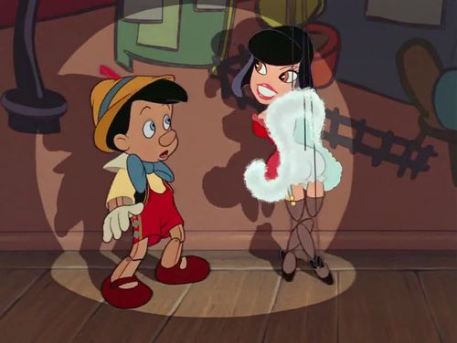
Pinocchio is a hit with the audience! To the delight of the young puppet, the audience applauds his performance and Pinocchio joins in the applause until the scene changes and a coy Dutch girl puppet descends to the stage:
You have no strings Your arms is free To love me by the Zuider Zee Ya, ya, ya If you would woo I’d bust my strings for you
After a group of Dutch girl puppets dance around Pinocchio (knocking him around a little in the process), they retreat only to be replaced by a sultry French girl puppet:
You’ve got no strings Comme ci comme ça Your savoire-faire is ooh la la I’ve got strings But entre nous I’d cut my strings for you
After this solo, Pinocchio is joined by a group of French girl puppets dancing the can-can, a revealing dance where (in real life), the dancers raise their skirts to show off their legs and petticoats. This is the one dance that attracts the attention of Jiminy Cricket who whips out a pair of spectacles to get a better look at the dancing girls. Of all the puppets, I liked the French puppet the best (just my preference). At the end of the dance, the scene changes once more and Pinocchio is joined by a Russian girl puppet:
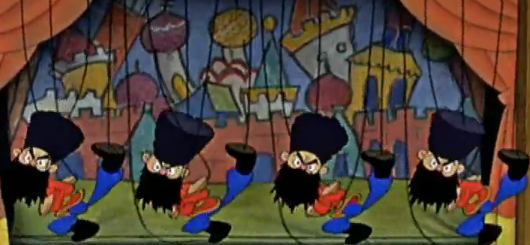
Down where the Volga flows There’s a Russian rendez-vous Where me and Ivan go But I’d rather go with you, hey!
Unlike the other verses, this time the Russian girl is replaced by a troupe of male Russian dancers doing the traditional Hopak dance (often mis-labeled as “The Cossack Dance”), which is actually Ukrainian in origin. Pinocchio is so taken with this dance that he does his best to imitate the puppets with varying degrees of success. When the puppets move to wildly spinning, Pinocchio attempts to copy them, but as you might expect, the young puppet ends up tangling himself in all the puppets and proclaims to the audience:
There are no strings on me!
To his relief, the audience’s laughter is complimented by wild cheers and applause and money begins raining down onto the stage (to the great delight of Stromboli). Jiminy is saddened by Pinocchio’s success, as it seems now like the young puppet will never want to go home and learn how to be a real boy.
Of all the songs in Pinocchio, “I’ve Got No Strings” is widely considered to be one of the most popular and enduring songs along with “When You Wish Upon a Star.” The music was composed by Leigh Harline, with lyrics provided by Ned Washington. The song was (in)famously used in the marketing for Avengers: Age of Ultron when a twisted rendition of the first verse played in the background of several trailers (ending with Ultron finishing the line “there are no strings on me.”) In the film, this song serves the purpose of giving the audience a lighthearted moment before the story takes another turn for the dark; in this case, when Stromboli locks Pinocchio into a birdcage and promises to chop him up for firewood if he doesn’t behave and keep making money for the gypsy.
*I know technically the “puppets” are all marionettes because they’re manipulated by strings, but I referred to them as puppets because that’s easier to type out than saying marionettes over and over again.
What do you think of “I’ve Got No Strings”? Besides Pinocchio, is there a puppet in this song that you like the best? Let me know your thoughts in the comments below 🙂 Thank you so much for supporting the blog, it means the world to me.
When Ursula made the deal with Ariel to make her human for three days so she could attempt to earn True Love’s Kiss from Prince Eric, I’m fairly certain the sea witch thought it was one of the easiest deals she’d ever made. Knowing full well that Ariel had practically no reliable information about life in the human world, Ursula likely thought that Ariel would make a fool of herself and never come close to earning any kind of kiss from anyone, let alone Prince Eric.
So imagine Ursula’s surprise and indignation when Sebastian and Flounder help set up “Kiss the Girl” and come within inches of getting Eric and Ariel to kiss; whether it would have been True Love’s Kiss we don’t really know and Ursula wasn’t willing to find out as she made sure Flotsam and Jetsam (her minion eels) sabotaged the moment by capsizing the boat. The sea witch is furious!
“Oh, she’s better than I thought. At this rate, he’ll be kissing her by
sunset for sure. Well, it’s time Ursula took matters into her own tentacles!
Triton’s daughter will be mine – and then I’ll make him writhe. I’ll see him
wriggle like a worm on a hook!”
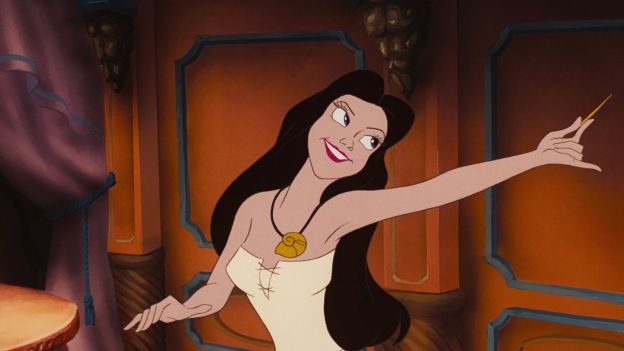
Ursula quickly begins preparing a spell and, laughing, transforms into a beautiful human woman with dark brown hair, but still wearing her nautilus shell.
Later that same evening, Prince Eric is still moping about the fact that he hasn’t found that mysterious woman who saved his life (you’d think despite the lack of voice that he’d simply recognize Ariel but it’s never that simple). Grimsby, his long-suffering butler, sympathizes with the prince, but he also gently reminds him that while his mystery woman may never be found, there’s a very real woman inside the castle (indicating the silhouette of Ariel getting ready for bed).
Left alone again, Eric contemplates Grimsby’s words before chucking his flute into the sea and turning to head inside. But before he can leave, a mysterious song begins floating up from the beach. A strange woman with dark brown hair and a nautilus shell necklace is walking along the beach and singing with Ariel’s voice. A golden tendril of magic flows out from the shell and visibly enchants the prince.
To Ariel’s horror, Eric announces the next morning that he’s found the woman who saved his life and they’ll be getting married that evening. Ariel cannot see the nautilus shell and so she believes that Eric is genuinely in love with another woman, meaning her entire plan has been for nothing!
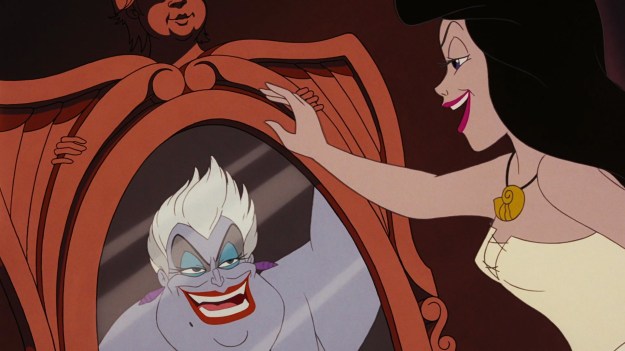
As the wedding barge gets under way that evening, Scuttle flies out to check out the ship and is attracted by a beautiful, but strange song coming from one of the cabins. Vanessa (the mysterious woman Eric is marrying) is getting ready for the wedding and singing to herself:
What a lovely little bride I’ll make My dear, I’ll look divine Things are working out according to my ultimate design Soon I’ll have that little mermaid And the ocean will be mine!
As the blushing bride examines her reflection in the mirror, the laughing face of Ursula peers out instead!! Scuttle can’t believe his eyes, Eric is about to marry the sea witch, Ariel needs to know about this! The frantic bird flies off to warn Ariel and her friends before it’s too late.
Given that Ursula is using Ariel’s stolen voice, it’s no surprise when I say that Jodi Benson also provided Vanessa’s lines and also performed “Vanessa’s Song” which is really a brief reprise of “Poor Unfortunate Souls” (a melody you can hear just as the brief song ends). It really just serves to confirm to the audience and reveals to our heroes that this is indeed Ursula in disguise (though I don’t think there was ever really any doubt for the audience given we witnessed the start of Ursula’s transformation back in her lair).
What do you think of “Vanessa’s Song”? It’s one of the shortest “songs” in any Disney film, but it is one of my favorite moments as well. I remember as a little kid I would always gasp when the mirror tilted up to reveal Ursula’s reflection. Given her magical skills, it’s a wonder she didn’t keep herself looking like that (or similarly) on a permanent basis. Let me know your thoughts on this song in the comments below 🙂
Thoroughly tired of all the silliness in Wonderland, Alice wants more than ever to go home. Fortunately (maybe), the Cheshire Cat has returned with one last piece of advice. if Alice really wants to go home, then she needs to talk to the Queen.
“All ways here you see, are the Queen’s ways.”
“But I’ve never met any Queen!”
“You haven’t? You HAVEN’T? Oh, but you must! She’ll be mad about you, simply mad!”
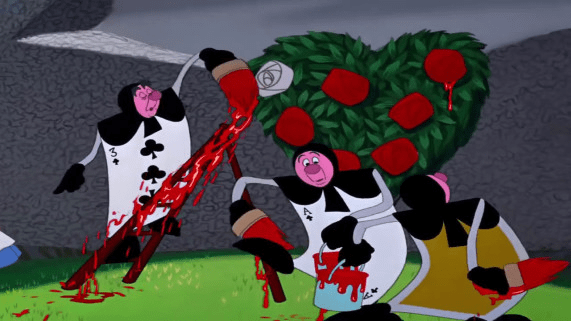
And so, the Cheshire Cat reveals a shortcut to the gardens surrounding the Queen’s castle (which also happen to be the same gardens Alice saw through the keyhole when she first arrived in Wonderland). It’s a very pretty garden, but there are some odd things going on. For instance…there’s a bunch of cards running around, and they’re busy painting the roses. When Alice asks the cards what on earth they’re doing, they are all quick to explain (and this is the setting of “Painting the Roses Red”:
Painting the roses red We’re painting the roses red We dare not stop Or waste a drop So let the paint be spread We’re painting the roses red We’re painting the roses red
Oh, painting the roses red And many a tear we shed Because we know They’ll cease to grow In fact, they’ll soon be dead And yet we go ahead Painting the roses red Painting the roses red We’re painting the roses red
Alice: Oh, pardon me, But Mister Three, Why must you paint them red?
Cards: Huh? Oh! Three: Well, the fact is, Miss, We planted the white roses by mistake, And…
Cards: The Queen she likes ’em red If she saw white instead, Two: She’d raise a fuss Ace: And each of us Cards: Would quickly lose his head
Alice: Goodness!
Cards: Since this is the part we dread We’re painting the roses red
Alice: Oh, Dear! Then let me help you!
Alice: Painting the roses red We’re painting the roses red Don’t tell the Queen what you have seen Or say that’s what we said But we’re painting the roses red Alice: Yes, painting the roses red Two: Not pink Ace: Not green Alice: Not aquamarine All: We’re painting the roses red!
It’s a hilarious song with a ridiculous concept: the Ace, Two and Three of Clubs have mistakenly planted white roses instead of red ones, and because the Queen hates white roses, they’re hastily covering their mistake by painting the roses red (even acknowledging in their song that this will kill the roses entirely). But the Cards figure that killing the roses in the short term is better than losing their heads so, they continue to paint. Alice is happy to help in the work, but it’s ultimately not going to do the Cards any good, because here comes the Queen!!
After the Hearts line up in formation, the White Rabbit reappears to announce: “Her Imperial Highness, Her Grace, Her Excellency, Her Royal Majesty, the Queen of Hearts!”
Unfortunately for the cards, they left one rose only half painted, causing the completely mad Queen to bellow “Whose been painting my roses red??” The guilty cards plea for mercy but the Queen only shouts “OFF WITH THEIR HEADS!!” The cards are then dragged away as the others sing:
“They’re going to lose their heads, for painting the roses red!”
I absolutely love this song: it’s short and to the point and serves as a nice piece of filler to introduce the Queen of Hearts to the story. Despite only appearing in this last part of the film, the Queen of Hearts is considered one of the iconic Disney villains. I hope you enjoyed listening to “Painting the Roses Red.”
Geppetto the toy maker is overjoyed to find that his wooden puppet Pinocchio has come to life. And though he is not yet a “real” boy, he treats him as his own son regardless and decides that Pinocchio needs to go to school, since that’s where all good little boys go during the day. After some persuasion, Pinocchio sets off with his new school books and a spiffy little vest to go with his regular outfit. Though he’s meant to be his conscience, Jiminy Cricket is nowhere to be found as yet.
On the way to school, Pinocchio attracts the attention of a fox and his cat companion, who can hardly believe that they’re seeing a puppet walking and talking without strings! The fox stops Pinocchio and introduces himself as “Honest” John (his full name is John Worthington Foulfellow) and the cat, who doesn’t speak, is Gideon. Pinocchio informs the pair that he is on his way to school, but Honest John (voiced by Walter Catlett) says that this is a ridiculous notion.
Why should this young boy be going to school when it’s perfectly obvious he’s a natural actor (said with a wink and a nod to Gideon who quickly understands where Honest John is going with this conversation). The pair quickly divert Pinocchio from his path to school and begin describing the wonderful life he could have as an actor and this is the subject of “Hi Diddle Dee Dee (An Actor’s Life for Me!):
Hi-Diddle-Dee-Dee. An actor’s life for me! A high silk hat, and a silver cane. A watch of gold, with a diamond chain. Hi-Diddle-Dee-Day an actor’s life is gay! It’s great to be a celebrity. An actor’s life for me!
Hi-Diddle-Dee-Dum. An actors life is fun! With clothes that come from the finest shop. And lots of peanuts and soda pop. Hi-Diddle-Dee-Dee an actor’s life for me. It’s great to be a celebrity. An actor’s life for me!
Hi-Diddle-Dee-Dee, an actors life for me! A waxed moustache and a beaver coat. A pony cart and a billy goat. Hi-Diddle-Dee-Dum, an actors life is fun! You wear your hair in a pompadour! You ride around in a coach with four! You stop and buy out a candy store! An actor’s life for me!
Hi-Diddle-Dee-Dee. An actor’s life for me! A high silk hat, and a silver cane. A watch of gold with a diamond chain. Hi-Diddle-Dee-Doo. You sleep ’til after two! It’s great to be a celebrity, an actor’s life for me!
Honest John paints the rosiest picture imaginable: if Pinocchio goes off to be an actor, he’ll be fantastically rich and able to do anything he wants! He’ll wear the finest clothes, be able to buy out candy stores, it’s a grand life! The puppet is easily persuaded to follow the fox and cat to the theater (in this case the travelling puppet theater owned by Stromboli), all thoughts of school and being a “real” boy forgotten for the moment. Of course the naive puppet has no way of knowing that this “actor’s life” wouldn’t apply to him, not where he’s going anyway. Pinocchio doesn’t know it, but Honest John and Gideon are on their way to sell the young puppet to Stromboli for however much they can get from the Italian (it’s rather disturbing when you think about it).
And where is Jiminy Cricket? It turns out the newly minted “conscience” overslept on his first day and now he’s racing to catch up to his charge, figuring that Pinocchio couldn’t possibly have gotten into too much trouble yet (oh how wrong he is!!) The trio quickly passes him in the street and Jiminy is stunned to see Pinocchio walking with the fox and cat in the opposite direction of school! The cricket chases after them, but being so small, he is unable to make them stop and they journey on to Stromboli’s.
“Hi Diddle Dee Dee” is notable for being the first Disney villain’s song ever performed. Originally, Gideon was going to have a voice too (in fact the legendary Mel Blanc was hired to record his lines), but it was later decided to make the cat a mute comedic figure similar to Dopey and so all of Blanc’s lines were cut except for a few hiccuping sounds. I’d also like to point out that the song uses “gay” to mean “happy/wonderful” (just in case there was any confusion).
What do you think of “Hi Diddle Dee Dee”? It’s a rather short but enjoyable song (and certainly not what you picture for a “villain’s” song. Let me know your thoughts about the song in the comments below!
As you’ve read through this series, you’ll note that many of these ‘disturbing’ moments come from the villains in the story and The Great Mouse Detective is no exception. Based on the Basil of Baker Street book series by Eve Titus, the film follows the titular Basil, a mouse detective who operates on the same deductive principles as Sherlock Holmes (and it just so happens Basil’s tiny home is located at 221B Baker Street).
His nemesis and obsession is the evil genius Ratigan (voiced brilliantly by Vincent Price). Ratigan is “the Napoleon of crime” with ambitions of taking over the mouse world. He himself is a giant rat, but he hates to be reminded of it, to the point that he will have his own henchmen killed if they refer to him as a rat.
For most of the film, Ratigan presents himself as a perfectly poised gentle-mouse, but there are hints that he’s hiding a big secret. For one, every time he gets the least bit upset, all of his henchmen quake in terror, as if expecting some monster to come out. Second, especially when Ratigan finds out that Basil is on the case of the missing toymaker, the rat is visibly seen holding back a wave of fierce anger (so much so that his face turns bright red), just barely managing to hold it back.
But the final straw comes when Basil ultimately ruins the villain’s plans to take over Mouse England. A furious Rattigan makes a run for it in his dirigible, with the young Olivia (the toymaker’s daughter) as a hostage. Basil gives chase however in a hastily rigged craft of his own (aided by Dawson and Olivia’s father) and they chase Rattigan all over London before the rat, distracted by Basil jumping aboard, crashes headlong into the clock face of Big Ben!
Deep inside the clockworks and gears, Rattigan seeks to eliminate Basil once and for all (and at least be rid of his nemesis even if his plans are ruined), but Olivia foils this by biting down on his hand, distracting him long enough for Basil to trap his cape in some gears before leaping down to rescue Olivia (who was kicked into the works by Rattigan) from being crushed. Basil saves the young mouse just in the nick of time and when the trapped Rattigan sees the pair getting away…his anger finally boils over, leading into one of the more disturbing sequences in the pre-Disney Renaissance canon.
Technically speaking, this sequence is historic because it’s one of the earliest uses of CGI animation in a Disney film (though not the first). The clock gears of Big Ben are all computer animated, with the hand-drawn characters laid on top. According to the animators, this is what allowed them to create the sequence where Ratigan runs in, up, and through the gears during the chase. I also love to draw attention to Henry Mancini’s music for this scene: as Ratigan comes into frame behind Basil, listen closesly as the music starts. The melody is on a piano and is broken down into several interlocking segments with differing rhythms; just like the clock gears in Big Ben!
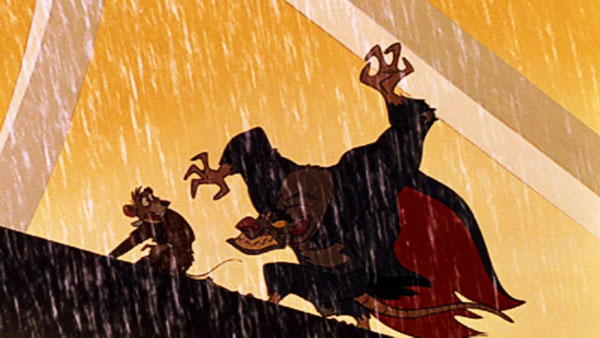
As Basil and Olivia reach the top of the clock tower, we look back to see a monstrous Ratigan, all poise and polish gone, running on all fours up through the gears, clothes in tatters, inarticulately growling as he pursues his quarry. He’s partly in shadows, and partly lit up by lightning flashes, which only adds to his menace. We can see now why his henchmen were so afraid; beneath that calculating veneer…Ratigan is a complete monster!
As the enraged rat gets ever closer, Basil tries desperately to get Olivia to safety before the villain can get to them, but their craft is just out of reach. Finally, just as the rat leaps for Basil, he tosses Olivia to her father, who catches his daughter with relief. But the nightmare is just starting for Basil: he’s in the clutches of Ratigan as they fall all the way down onto the hands of Big Ben in the pouring rain. The rat is determined that this time, Basil isn’t getting away from him: “there’s no escape THIS time Basil!” He uses his claws, visibly razor sharp, to slash and maul the detective, wanting to make him suffer for daring to humiliate the rat time and time again. It’s a spine-chilling moment, as you can hear Basil’s groans of pain (though in typical Disney fashion there isn’t a trace of blood to be seen).
Ratigan moves in for the kill and with one blow sends Basil flying off into the abyss (just missing the hands of his friends) and seemingly to his death. An overjoyed Ratigan crows that he’s finally won! But a voice from below replies: “On the contrary, the game’s not over yet!” Unbelievably, Basil has taken hold of the wreckage of the dirigible and Ratigan’s special bell, which he now mockingly rings. Just at that moment, the clock strikes the hour and the vibrations send a stunned Ratigan tumbling off, but not before he latches onto Basil and brings the mouse down with him!!
It seems to be the end for both Basil and his nemesis, but the detective has one last trick up his sleeve: when he fell, he took the propeller from the dirigible with him, and now he uses it to fly back up to his friends as the storm finally passes.
Despite the happy ending, this scene with Ratigan always scared me as a child: the transformation is so complete that he doesn’t seem like the same character anymore. And that scene where Basil gets literally mauled by this monster, it’s hard to believe sometimes that this movie was made for children. Because if you really think about it, if that scene were done realistically, there should be blood everywhere, not to mention broken bones from that fall onto the clock hands. It amazes me that in the very next scene Basil isn’t bandaged up in a few places.
What do you think of Ratigan’s final transformation into a horrific monster? Did this scene disturb you also? Let me know your thoughts in the comments below!
The Little Mermaid is universally acknowledged to be the film that launched the Disney Renaissance (a period that lasted from 1989 until Disney’s Tarzan in 1999). The Academy Award winning score was composed by Alan Menken, who collaborated with lyricist Howard Ashman on the songs.
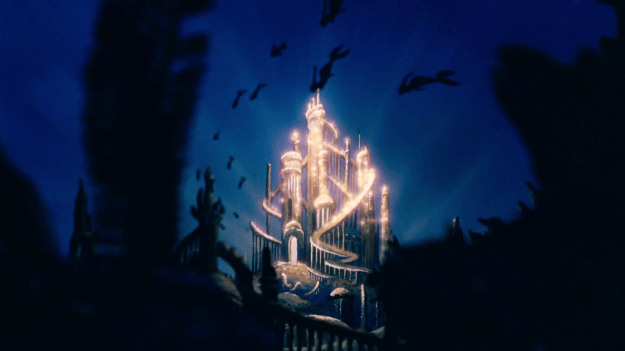
It’s a big day in the undersea kingdom of Atlantica. The court composer Sebastian (a Jamaican crab) is putting on a concert starring the daughters of King Triton, with tonight being the debut of the youngest, Princess Ariel. King Triton, benevolent ruler of the Seven Seas, makes a grand entrance into the crowded concert hall in a seashell chariot pulled by several dolphins, lighting up the chandelier with a burst from his magical trident.
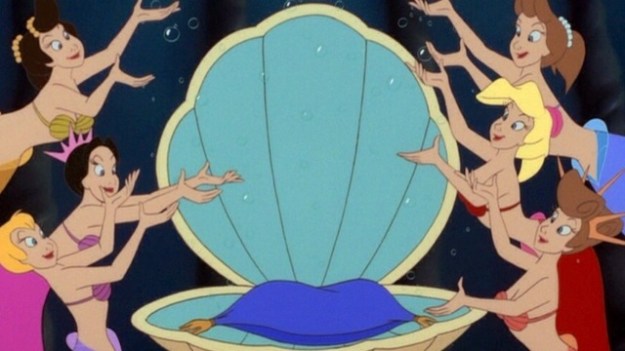
King Triton is most excited for this concert as he’s been looking forward to Ariel’s first performance. Sebastian insists that he is excited too (though he quietly mumbles that it would be helpful if the princess attended more rehearsals). Despite his grumblings, Sebastian takes the stage and the show begins with six of Triton’s children appearing out of clam shells singing (appropriately enough) “Daughters of Triton”:
Oh, we are the daughters of Triton Great father who loves us and named us well: Aquata Andrina Arista Attina Adella Alana And then there is the youngest in her musical debut A seventh little sister, we’re presenting her to you To sing a song Sebastian wrote, her voice is like a bell She’s our sister Ari…
Whoops! The concert comes to a crashing halt as the final clam shell opens to reveal…no one! Ariel isn’t here! Her sisters gasp in shock, the audience is befuddled, Sebastian is mortified and King Triton is understandably upset, bellowing out “ARIEL!!!” very angry that his youngest daughter has seemingly skipped out on an important event. Where IS Ariel? Well, as it turns out, she’s been busy hunting for human artifacts with her best friend Flounder (even though she’s been told repeatedly to stay away from anything related to humans).
Originally this scene was going to play out differently. In an earlier storyboard, the scene was going to start with Sebastian going backstage to check on the sisters as they are warming up for their performance. He would then notice that Ariel isn’t there and grow frantic when Andrina mentions that no one has seen her in quite some time. The crab races off to tell King Triton the bad news, but a spotlight illuminates him before he can reach the king, so the crab resigns himself to the inevitable and begins the show. It was decided that the scene would play better if Ariel’s absence was a complete surprise for everyone.
Due to how the scene ends, this is a rare example of a Disney song that ends abruptly (another good example is “A Girl Worth Fighting For” from Mulan).
I always found the ending of this scene to be awkward as a kid, with the way the music comes to a sudden halt and how awkward everyone acts with the revelation that Ariel has no-showed the concert. Now that I’m older I can appreciate this scene better, as it starts a quasi-tradition of Disney princesses not being where they’re expected to be (for example, Pocahontas isn’t waiting to meet her father when he comes back from battle; Mulan is late to meet the matchmaker, you get the idea).
What do you think of “Daughters of Triton”? Let me know your thoughts in the comments below 🙂














 Film Music Central