Yearly Archives: 2017

Dr. Strangelove: Or How I Learned to Stop Worrying and Love the Bomb (1964)

The pitch black comedy Dr. Strangelove (Or How I Learned To Stop Worrying and Love the Bomb) is one of those films you frequently see on lists of “Movies you must see before you die” . I’ve known of this film for years, but would you believe I only saw it for the first time several days ago? It’s true! Allow me to explain: twice a year Barnes & Noble has a 50% off sale for their Criterion film collection. And twice a year I look through the list to find one or two films (sometimes three) to pick up (I don’t have a choice anymore since Criterion pulled their collection from Hulu and I can’t afford the streaming service they started). For this sale, I added Kurosawa’s The Hidden Fortress (bringing me closer to collecting all of his jidaigeki films) and, of course, Dr. Strangelove. I wasn’t going to pick it originally, as my thoughts going in were to pick up Kurosawa’s work only (I nearly bought Kagemusha instead). But then I saw Dr. Strangelove and I decided it would be good to keep collecting films besides Kurosawa. So I brought it home, put the disc in and started watching.

My first thought? Well this is…..different. I knew going in that Dr. Strangelove is a black comedy (that is, it makes fun of very serious subject matter, in this case nuclear war) but that still didn’t quite prepare me for everything I heard.

The plot is as follows: General Jack D. Ripper (Jack the Ripper, get it?) goes rogue and orders the 843rd Bomb Wing of the Strategic Air Command to attack using “Wing Attack Plan R” a plan that is to be used by a general when a prior nuclear strike has taken out his superiors. But in reality, no such strike has taken place and General Ripper is using this plan to conduct a pre-emptive strike on the Soviet Union, betting that once the Pentagon finds out, they will have no choice but to proceed with an all-out attack to prevent the Soviets from retaliating.

image-w1280

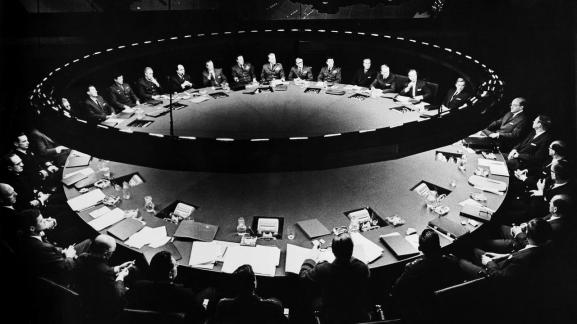
Instead, the members of the War Room (including the President) meet with the Soviet Ambassador to figure out a way to either recall the planes or shoot them down to prevent them from firing on their targets. To make a long story short: all of the planes are eventually recalled but one (because that plane’s radio was damaged by a missile so they can’t receive the recall order).

Choosing a closer target because they are low on fuel, a bomb is launched (with the pilot riding it down like a bronco) and the mushroom cloud is viewed from a distance. This triggers a hitherto unknwon “doomsday device” that the Soviet Ambassador has revealed to the War Room. Once triggered, the device detonates a large amount of nuclear bombs in various locations, bombs that have been tainted with a radioactive element that will encircle the Earth with deadly radiation for 93 years. Vague plans are made to move several hundred thousand people into deep mine shafts (where the radiation can’t reach) to ensure the survival of the human race, but before any firm conclusion is reached, there is a series of nuclear bomb explosions, leaving the fate of the world up in the air.

2812849_l3

(Personally, I think the implication is that the Earth is destroyed)

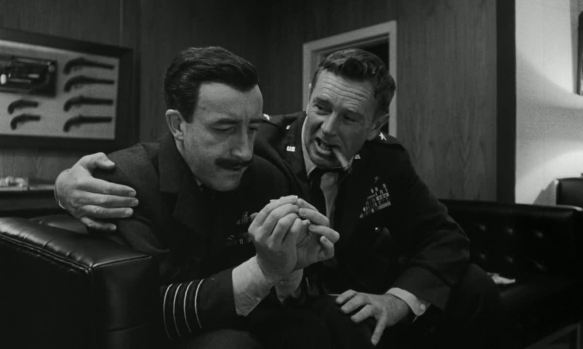
One of the standout performances in this film is Peter Sellers (perhaps best known as Inspector Clouseau in The Pink Panther) who plays no less than three parts in this film, each one with a different accent. His roles are:

  • Group Captain Lionel Mandrake: an exchange officer from the RAF (British accent)
  • Merkin Muffley, the President of the United States (a role played completely straight I should add) (perfect American accent)
  • The titular Dr. Strangelove, a former Nazi and expert on nuclear war (German accent)

Sellers was originally meant to play a fourth role, that of Major Kong, the pilot who ultimately rides a nuclear bomb down to the ground, but with three roles already on his plate, Sellers found himself unable to fully immerse into the Southern-accented role and Slim Pickens (yes that’s really his name) replaced him. Sellers delivers the performance of a lifetime, each character is fully realized and unique, in fact his performance of the President is so different that I had to double-check the credits to reassure myself that it was in fact Sellers playing the role!

2016-11-cs-drstrange-s

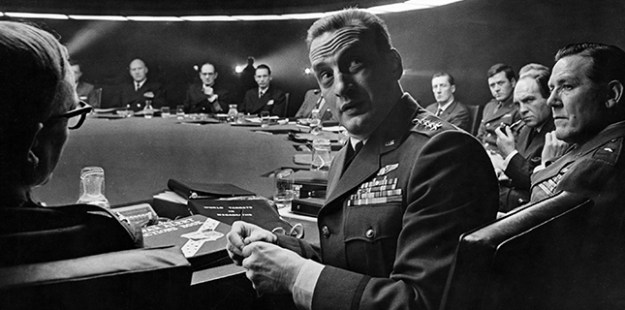
Even though he got tricked into it, I love George C. Scott’s performance as the over-the-top General Turgidson. I say he got tricked into it because Scott wasn’t comfortable acting too over-the-top but director Stanley Kubrick got him to do it by telling him the first few takes were “practice takes” that didn’t count. When Scott found out the truth he was furious with Kubrick for a very long time and swore he’d never work with him again (though in later years he admitted this performance was among his favorites).

If you haven’t seen Dr. Strangelove, it is definitely worth the time to grab a copy and give it a look. If you HAVE seen Dr. Strangelove already, let me know what you thought of it in the comments below.

Become a Patron of the blog at patreon.com/musicgamer460

Check out the YouTube channel (and consider hitting the subscribe button)

See also: Film/TV Reviews

Don’t forget to like Film Music Central on Facebook 🙂

An Interview with Paul Henning

unnamed

Last month I was privileged to conduct an interview with composer Paul Henning where we discussed (in part) his work in orchestrating Star Wars: The Force Awakens, his work as a performer in film orchestras and the ongoing work of the legendary John Williams. I was fascinated to learn about the process that goes into recording a film score and how the process of orchestrating a score actually works. If you follow the link below, you can check out the audio interview I conducted with Mr. Henning. I hope you enjoy!

An Interview with Paul Henning

Film composer and musician Paul Henning’s most recent project was writing the score for the Tribeca Film Festival opening night documentary ‘Clive Davis: The Soundtrack of Our Lives’. The film premiered at Radio City Music Hall in New York. Paul had a somewhat unconventional role writing music for this project. While the focus was the cadre of huge music artists Clive has worked with, Paul scored key moments of conflict, loss or emotional gravity that were vital to the story.

Paul also recently released his debut album, ‘BREAKING THROUGH’. The album was crafted with a nostalgic, Americana vibe drawn from Paul’s love of the expanses of the Western US and his love of American History. The album features piano solos performed by the Paul and recorded live with a 48-piece studio orchestra. Here is a link to selections of the album for your review: http://www.paulhenning.com/breaking-through.

Paul has served as Concertmaster for the Golden State Pops Orchestra since 2004. He’s also worked on the score orchestrations for over 50 feature films, including ‘Star Wars: The Force Awakens, ‘The BFG’, ‘Night at the Museum: Secret of the Tomb’ and ‘Chocolat’. In addition to his film writing, he also works on orchestral arrangements that have been performed by the Los Angeles Philharmonic, Chicago Symphony, Hollywood Bowl Orchestra, and London Symphony.

An accomplished pianist and violinist, Henning has performed with the Hollywood Studio Symphony on the soundtracks to ‘Frozen’, ‘X-Men: Days of Future Past’, ‘The Maze Runner’, ‘Furious 7’, ‘Moana’, ‘Storks’, ‘Monsters University’ and ‘Alice in Wonderland’, among many others. He has also played violin for artists including Barbra Streisand, Michael Bublé, Neil Young, Aretha Franklin, Andrea Bocelli and Josh Groban. Henning has served as Concertmaster for the Golden State Pops Orchestra since 2004.

In theory: Going to a Film Festival

I’m pretty sure my list of “things to do before I die” is close to a mile long. I’ve been fortunate enough to achieve some of the things on the list, and others I’m not sure I’ll ever get to do. But one thing I would like very much to do is attend a film festival (hopefully as a critic, because that would be fun!). In a perfect world (where I could afford to go anywhere at anytime), one film festival I would love to attend is the Anthem Film Festival being held next month (July 19-22) in Las Vegas. Attending this festival would actually kill two birds with one stone as it were, because not only do I want to attend a film festival, I also want to visit Las Vegas at least once in my life. While I can’t actually attend, I thought it would be fun to think about what I would (or would not) do if I did get to go.

For me the most important thing about the film festival would be selecting which films to go see, and that can be pretty overwhelming because film festivals often have a great selection to choose from. But like any festival event, it’s impossible to see EVERYTHING being offered, at some point you just have to miss out on something. So how would I pick? Well, I would start by scanning the list of what’s available to see if there’s anything that belongs in one of my favorite film genres. Failing that, I would do a search by subject matter and see if any of the topics being explored is one I have a personal interest in. In this case, I have a hit with Re-Evolution, a film that is described as “combining V for Vendetta with the philosophy of Atlas Shrugged.” This film would be at the top of my list because I have an interest in subject matter of this type. Other films would be selected based on this choice, with a secondary list made of films I am merely curious about.

I would not actually bring a lot of materials along with me. I travel with the philosophy that the more you bring, the more you have to worry about losing while you’re away. For a film festival, I would probably be content to take a notebook and some pens, to jot down any notes or thoughts regarding the films I’d seen. I would also use the notebook to write down any questions I might have once the film is over.

As for any “Dos and don’ts” regarding what to ask in a Q&A, I confess I can’t think of anything you shouldn’t do (besides asking questions that are inappropriate or in bad taste). I’m sure the best way to spend a Q&A is to listen intently to what is being asked, and if there’s a point in the film that you really want clarified, don’t be afraid to go to the microphone and ask, you may not get the chance later.

For anyone travelling there, it is always good to look up travel deals like those found here. Many times (but not always), airlines and hotels will have discounts available if you are travelling to a big event, especially if you can arrange to be travelling as part of a group.

And that is a small taste of what I would do I went to a film festival. Hopefully I WILL get to go someday and afterwards I’ll get to share about all the wonderful films I saw. Hope you enjoyed!

Don’t forget to like Film Music Central on Facebook 🙂

“He’s not bad, just conflicted”: My crush on Tom Hiddleston’s Loki

This is my entry for the 2017 Reel Infatuation Blogathon hosted by Silver Screenings and Reel Infatuation, I’m happy to be participating for the second year!!

I have this habit of developing crushes on villains. I’m not sure why, I think it’s because so many times the villain is the most interesting character in the story, he has layers to him, and interesting motivations. And then there’s a character like Loki, brought to brilliant life by Tom Hiddleston, who is another case entirely.

Loki-avengers-hawkeye-opening-scene

From the moment he first travelled through the Tesseract in The Avengers (my first experience with the character), I was in love with Loki of Asgard. The would-be King of Asgard/Midgard/whatever he can conquer is equal parts menace and charm. He’s also not afraid to get his hands dirty (unlike some villains) as he doesn’t hesitate to attack a man to get his eyeball (long story).

But please don’t get the idea that I have a crush on Loki because he does all of these evil things. What really attracts me to him is the fact that, for a villain, he really isn’t evil at all. In fact, the more I learn about Loki (as Tom Hiddleston has played him), the more sympathetic I am to his cause.

Black_Widow_and_Loki

Take, for example, Hiddleston’s performance in the first Thor film. We (the audience) know from the start that Loki is actually a Frost Giant disguised as an Aesir. But Loki doesn’t know this until deep into the film, and once he knows the truth, you can tell it just DESTROYS him inside, to realize that he isn’t actually Odin’s son, that he actually belongs to a race that every last warrior in Asgard is raised from birth to despise.

tom-hiddleston-loki-thor-slice-600x200

And seeing Loki in such pain, I want to reach through the screen, comfort him and slap Odin upside the head for being such an idiot in favoring meathead Thor the way he does. It’s no wonder Loki has issues. And I know all about struggling through issues, so I am very much attracted to a man who suffers through similar things.

I hope this makes sense, why I have such a crush on Loki. He can be so charming, mischievous and it strikes me that he is the kind who does not give his affections (or trust) lightly. And at the same time, he is also not afraid to go after what he believes is rightfully his. He has his convictions (I don’t care what Coulson says), and I admire that in a man.

And that’s my crush on Loki 🙂 I hope you enjoyed it!

Become a Patron of the blog at patreon.com/musicgamer460

Check out the YouTube channel (and consider hitting the subscribe button)

Don’t forget to like Film Music Central on Facebook 🙂

The magic of James Horner: Casper (1995)

Thanks to everyone who has participated in the blogathon so far. Today is the last day and here is my contribution. Enjoy!

It’s been two years since James Horner was ripped away from us, his passing left a void that may never be filled. He had a gift for creating magical themes that stuck in the head for hours after the movie was over. And one of my favorite examples from the mid-90s was the main theme from Casper (1995).

Loosely based on the comics character Casper the Friendly Ghost, Casper follows a paranormal therapist, Dr. James Harvey (Bill Pullman) and his daughter “Kat” as they travel from state to state in an attempt to make contact with the spirit of Harvey’s deceased wife Amelia. The pair come to Casper’s former home when the spoiled heiress who inherited the home wants the ghosts (Casper and his uncles) removed so she can claim the “treasure” hidden inside.

Casper’s Lullaby

Casper’s theme, listed on the soundtrack as “Casper’s Lullaby”, is a haunting piano melody that comes to the forefront particularly when Casper remembers the events of his death, and also during the Halloween dance when Kat realizes she’s dancing with Casper (who’s alive for one night).

How Casper Died

It’s such a haunting melody, one that highlights the tragedy of Casper’s short life, and the fact that he “didn’t go where he was supposed to” but stayed behind instead. Actually, ever since Horner passed away, I’ve had a hard time listening to this theme, as it reminds me that one of the greatest film composers is gone before his time. I hope you enjoy listening to Casper’s Lullaby, and I hope you enjoy the rest of the blogathon today.

Don’t forget to like Film Music Central on Facebook 🙂

See also:

2nd Annual Remembering James Horner Blogathon Day 1!!

2nd Annual Remembering James Horner Blogathon Day 2!!

Remembering James Horner Blogathon Day 3

Composer Interview with Scott Doherty

Scott Doherty is a lifelong musician, though some might say a reluctant composer. After moving from his hometown of Maine to Los Angeles at the age of 18, Scott’s early musical pursuits included playing live music to large audiences at venues like the House of Blues and the El Ray and performing in the South Coast Repertory Theatre production ‘Against Oblivion’, among other productions. He was led to study and pursue sound and music composition and since then, has composed music for numerous film and TV projects, including ‘Weeds’, ‘Orange is the New Black’ and most recently, ‘The Holdouts’. We sat down to talk with Scott about his career as a musician and composer.

unnamed-2

How did you get into composing for television?
Looking back, I feel like it was something I didn’t directly aim to do. I was in the band world playing keys for other bands and I hit a point with where I felt somewhat stilted, which moved me away from the record format and more into instrumental music. From there I dove into the recording studio and was just fascinated by everything. It was over the course of a year that I was asked to write a couple of score-based projects. I was asked to direct a few shows, music for a documentary called ‘Becoming Santa’, and these projects felt more like a perfect fit, using music to tell stories. Not long after, I ran into a friend who was a music supervisor and she’d become the head of music for the E! Network. I began to work on a string of shows for them, doing theme songs for different shows. I was still craving writing music to picture,  and about that time is when the opportunity for ‘Orange is the New Black’ came in. I was asked to join in the series that would be on Netflix, and at the time, digital wasn’t what it was today – so it was really a leap of faith.

Yeah, I remember at the time it was announced it seemed really weird like, television on Netflix? How does that even work?  *laughs* Yeah, people were really unsure of the platform, but I saw the entire first season of ‘Orange’ before the rest of the world did and I fell in love with it:  the story, the characters, the incredible actors. I just had no idea how lucky we would become with this series.

With each season (of Orange is the New Black’) being released all at once, what is the schedule for creating the score for each episode, compared to a regular television series? Has everything already been shot?  There are a lot of similarities actually, in the way that we have a similar production schedule to a regular show on network cable. There’s about a week to do each episode, and production is usually about three to four episodes ahead of us, but it is still the same production flow. The difference is that we’re not getting feedback week to week from audiences. Because all thirteen episodes are available at once, Netflix encouraged us (in fact they sent a note about it about halfway through the first season) to think of it really as a thirteen hour-long movie, rather than a normal, episodic TV show. And that changed the way that I look at the character theme arcs and making sure that whatever happens in episode one, that same day the audience could be watching episode eight, so the continuity needed to be there.

Right, so if each season is like a movie, does that mean there is more there in terms of character motifs?
Yes, and with ‘Orange’ there is such a diverse cast, with so many “lead” actors and actresses, so we really try and focus in on a specific melodic theme or sonic world that is created to support each character, and some of that makes its way into their flashbacks. Some of those themes are in fact born in flashbacks because with some characters we don’t get to really know them until those moments. But it really does feel more like scoring a film than a television show in that regard.

So with Season 5 coming on June 9th, have any of the (musical) themes changed over the years?
Oh most definitely. One of the biggest would be Dayanara’s theme, which started as her and Bennet’s love theme and as their relationship went on the rocks, it created a flipped version of the same theme, but more dark. Suzanne’s (“Crazy Eyes”) theme starts off more aggressive, but as we get to know her, the innocence comes out. And then there’s a hybrid of the two, and also there’s some situational themes that come back over time. I really feel the prison itself has a real character to it, there’s an “essence” of what prison sounds like.

Definitely. What about Piper? Because she’s the one who’s really thrown headlong into all of this at the start.
I feel like the way we’ve worked with Piper through the seasons is more situational in terms of themes. Some of them have been more whimsical, a theme to reinforce the isolation she was feeling (in the SHU), then in – I think it was season three –  there was the “Piper 2.0” theme with an aggressive Piper finding her voice and that carried over into season four. There really isn’t one central theme for Piper, it really changes from season to season for her.

I actually misunderstood what this show was going to be about. Because when the preview for the pilot came out, I saw that Piper was being sentenced to this relatively short time in prison, so I thought ‘Orange is the New Black’ was meant to be a one-off, a one season and that’s it sort of deal. And then I saw articles about season two, three and I’m like “why is this show still going?” And that’s when I read the summaries and realized this show was a lot more complex than I imagined.
*laughs* Oh yeah, but it’s really something like ’24′, which plays out in real time. And it’s also hard to gauge how much time is actually passing in these seasons. We’ve seen one Christmas and one Valentine’s Day so far. But it really does feel like we haven’t even covered a year yet. No one is too specific with covering sentences. But this latest season (season 5) will cover exactly three days. That was the story motif for this season.

Wow, so there’s a lot of stuff packed in to this season?
Yes! It starts off with a bang and keeps on going, I wish I could talk about it but there’s only a week to go now. What’s great about the first season though, is it uses Piper to introduce us to prison, to what it would feel like to have something from your past that you may have forgotten come back and affect you. And also what it would feel like to be one of those people outside of the walls and suddenly find themselves inside it. And so I think they were able to use her story to get us into prison, and as soon as the 2nd season started, the focus is now on every other inmate. It’s no longer about the singular struggle of this woman, it’s now more about the life of women in prison.

So in theory this show could run indefinitely?
Absolutely!

So, one last question, you said it was the same production flow as a regular television show. So is recording the music anything like film where you have the footage playing out in front of you?
Yes, it’s exactly the same. The way it breaks down is, we go to a spotting session where we sit down and watch the editor’s cut with temporary music put in. And we discuss it and say, “what do we like? Are there any character themes missing? Does it need to be funny or sad?”  And then we have about five to six days to complete twenty-five to thirty pieces of music for the show. We go to a music review and watch the cues one by one, and it’s usually “love it”, “change this one thing” or “try again”. Then we have another day to review it before we start all over again. I tend to write and record the music at the same time. The best-case scenario for me when writing is to turn the music off and watch the same scene five or six times to see if a natural pace or rhythm comes through. And a lot of times the performer’s work is so strong that I begin to hear the music in my head straight away. I try to capture that emotional reaction as quickly as possible.

Wow, that is so amazing! Well thank you very much for sitting down to talk with me about Orange is the New Black
No problem! Thank you.

Don’t forget to like Film Music Central on Facebook 🙂

2nd Annual Remembering James Horner Blogathon Recap!

It’s finally here, the 2nd Annual Remembering James Horner Blogathon is here! Even before I woke up this morning day 1 is off to a good start with two amazing entries already. As I see new entries come up, I will add them to this list below. Enjoy!!

Day 1

Plain, Simple Tom Reviews: The Land Before Time (1988)

Movierob: The Pelican Brief (1993)

Listening to Film: “Nautical but Nice”: James Horner and the Music for Wrath of Khan

Listening to Film: “The Underappreciated” (Star Trek III)

Reelweegiemidget: Willow (1988)

Day 2

Sean Munger: Postmodern patriotism: Howard’s “Apollo 13” as history and mythology

MovieRob: Clear and Present Danger (1994)

Day 3

MovieRob: The Karate Kid (2010)

The magic of James Horner: Casper (1995)

Christina Wehner: Sneakers (1992)

Listening to Film: The Rocketeer (1991)

Tranquil Dreams: The Spiderwick Chronicles (2008)

Old School Evil: The Land Before Time (1988)

Thank you to everyone who participated!

Don’t forget to like Film Music Central on Facebook 🙂

Brian Tyler conducts The Mummy (2017)

One thing that never fails to get to me is when a wonderful film score is attached to a terrible film: a recent case in point being the most recent box office bomb, The Mummy. Despite the film being an abysmal failure (and hopefully the death knell of the Dark Universe before it really gets going), the score, composed and conducted by Brian Tyler, is really beautiful.

An amazing thing about Tyler is that on his Facebook page he will release footage of himself conducting pieces from his film scores (I have a confession, that’s where I find most of Tyler’s material to share with you). And when I saw that he had posted video of himself conducting the score at a special premiere, I had to watch.


It was beautiful!! Brian Tyler is a very talented composer and it shows in this excerpt. The music begins relatively subdued, with an iteration of a particular theme (I suspect it is Ahmanet’s). But as the music goes on, this theme gains intensity and power, until the full orchestra and chorus is backing it.

Unfortunately, I fear the abysmal reviews of the film will prevent many people from experiencing the beauty of this film score (a similar thing happened with Gods of Egypt; Marco Beltrami composed a great score, but the bad reviews meant that many people never heard it). Thus, I am sharing this performance with all of you and I hope you enjoy it. On a side note, when I commented on Facebook that I loved how the theme built in power, Brian Tyler liked the comment!!

If you feel that I should give this film a chance when it’s available to rent on Redbox, let me know in the comments below (I’ll consider it if enough people think so).

You can become a patron of the blog at patreon.com/musicgamer460

Check out the YouTube channel (and consider hitting the subscribe button)

See also:

Film Composer Interviews A-H

Film Composer Interviews K-Z

Brian Tyler “Alien vs. Predator: Requiem” scoring session (2007)

Brian Tyler scoring Partition (2007)

Brian Tyler talks War (2007)

Brian Tyler talks Rambo (2008)

Brian Tyler “Law Abiding Citizen” scoring sessions (2009)

Brian Tyler “Dragonball Evolution” scoring session (2009)

Brian Tyler talks The Expendables (2010) 

Brian Tyler talks Fast Five (2011)

Brian Tyler “Battle: Los Angeles” (2011) scoring session

Brian Tyler scoring session for Iron Man 3 (2013)

Brian Tyler “Teenage Mutant Ninja Turtles” (2014) scoring session

Brian Tyler conducting and scoring Now You See Me 2 (2016)

Brian Tyler “Power Rangers” scoring session (2017)

Don’t forget to like Film Music Central on Facebook 🙂

Disturbing Bluth: An Introduction

So for the past number of months I have been regaling you with tales of ‘Disturbing Disney’, finding the most disturbing Disney film moments I can remember and breaking them down in minute detail. Rest assured I have no plans of ending that series anytime soon (in fact I’m making plans to turn that series into a book, though that won’t come to pass for a while), but given how I still feel under the weather today, I thought I would take some time to introduce the subject of Disturbing Disney’s sister series: Don Bluth.

If you found any part of Disturbing Disney remotely disturbing or messed up, believe me when I say, you’ve seen NOTHING yet. It dawned on me somewhere around entry #10 that Don Bluth would require a series all his own to highlight the psychological torture he unwittingly put me through as a child.

For those who may not have seen the..imaginative…works of Don Bluth, allow me to make introductions. Don Bluth is, to be fair, a talented animator who originally worked for Disney, his first job as an assistant on Sleeping Beauty (1959). He returned to Disney full time in the 1970s and worked on Robin Hood, Winnie the Pooh and Tigger Too, The Rescuers and he directed the animation for Pete’s Dragon. Not long after this, Bluth took 9 fellow Disney animators and set off to start his own animation studio, one that he hoped would rival Disney itself. Bluth was frustrated with how Disney was run at the time, and he wanted to revive the traditional animation that originally made Disney films famous.

Starting with The Secret of NIMH in 1982, Bluth directed a series of films that, though spectacularly animated, became the stuff of nightmares for children all over the world. And the biggest reason for this is due to Bluth’s philosophy on film: Bluth believed that children were capable of witnessing just about anything onscreen so long as the story had a happy ending that (in theory) cancelled out the previous trauma. In other words, Bluth wanted to go in directions that the Disney studio would not, considering that way ‘too dark.’

Disturbing Don Bluth will break down each of Bluth’s major films, all of which are full to the brim of Disturbing moments that, I assure you, will make Disturbing Disney look TAME by comparison. This series will look at films such as:

The Secret of NIMH (1982)

An American Tail (1986)

The Land Before Time (1988)

All Dogs Go to Heaven (1989)

Thumbelina (1994)

That may seem like a short list, but in those films is contained more disturbing moments then I can count. For example, you’ll hear about how a young dinosaur nearly drowns in tar, a mouse is terrorized by a sea monster, a dog has a vivid nightmare of Hell (demons included) and one of the most traumatizing “death of a mother” scenes that I can remember (with one heck of a secret behind it).

I hope to be starting on this series very soon, and Disturbing Disney will also continue. I’m already feeling much better, so hopefully by Monday I will be able to resume a regular blogging schedule.

Check out the YouTube channel (and consider hitting the subscribe button)

Don’t forget to like Film Music Central on Facebook 🙂


My thoughts on Alien: Covenant (2017)

Oh my. Oh my oh my oh my…..well, I finally worked up the courage to go see an Alien film in the theater, and the experience was exactly what I suspected it would be: I.Was.TERRIFIED!!!! Not all the time, but enough that I was thoroughly weirded out by the time the movie ended.

And every time I relate my fright to someone, the first thing they ask is: but did you LIKE it? And…well….I’m actually not sure. I THINK I liked it, I mean if the goal of the film was to scare it’s audience half to death (and gross out the other half) than I think it succeeded).

The story is eerily similar to the original Alien film (which I believe was the idea): the colony ship Covenant is en route to Origae-6 with 2000 colonists (and 1000+ human embryos) in hypersleep and cryo-storage. With seven years and four months left in the voyage, the ship is overseen by the synthetic Walter, who is a physical duplicate of David, the android we met in Prometheus (the events of which are revealed to have occurred ten years before this film). Everything is fine until a random neutrino storm damages the ship. The crew is woken to deal with the problem, but the captain’s pod malfunctions and Branson (James Franco!!) burns to death trapped inside his pod (in the first majorly disturbing scene of the film).

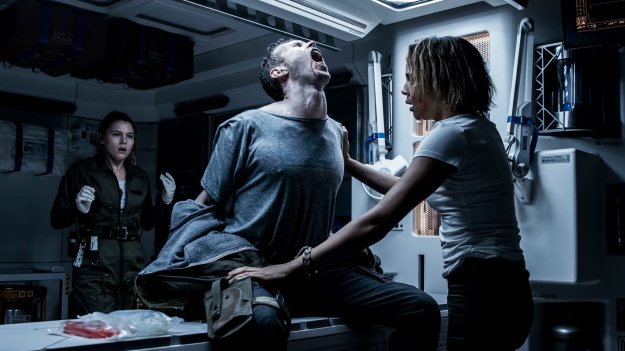
From that point, through pretty much the rest of the film, the crew makes one bad decision after another, and the only one who speaks any degree of sense is Daniels (Covenant’s version of Ripley), who vehemently protests departing their original course to pursue a mystery planet that was previously undetected. This planet turns out to be where David and Shaw ended up after departing at the end of Prometheus. The Covenant crew lands to explore (leaving the main colony ship and a few crew members in orbit) and finds a gorgeous planet, fertile and perfectly habitable (bad weather notwithstanding) but no animals of any kind. Still, there’s no apparent danger until one crew member steps on a pile of half buried jars that release the same pesky pathogen from Prometheus. And a little while later, a second crew member ingests the same pathogen at the site of Shaw’s crashed ship.
alien-covenant-backburster

Well, you can guess what happens: chaos!! The first crew member becomes host to a “back-burster” because, well, it claws its way out of the poor guy’s back in a terrifying scene. And, I have to admit that the one critic was right; these crew members act really really dumb. I mean, the one is trying to fend off this newborn Alien with a KNIFE, like that is going to do ANYTHING!! And the one crewmember who DOES go for a gun, misses at point blank range!! *facepalms* As bad as all of that was, it’s nothing compared to the “mouth-burster” that appears from the other crew member. I can’t describe it to you without feeling nauseous, but you can imagine what it looked like.

(Un)Fortunately the crew is “rescued” by David, who has been living alone on the planet for the last 10 years. Claiming that Shaw was killed in the crash and the planet’s population wiped out accidentally, David takes them to the heart of a city that is now a necropolis, literally. The square is full of thousands of blackened corpses, all twisted up in terror from the pathogen that killed them.

The truth about what David has done is absolutely horrifying (especially given that Shaw rescued him and put him back together). Not only did Shaw not die in the crash, she was systematically tortured as David experimented with what the pathogen would do to a human body. It is further revealed that David deliberately released the pathogen on the planet, knowing what it would do to the people living there. It seems that from the beginning David has had nothing but contempt for the humans who created them, deriding them to Walter as “a dying species” who are not worthy to start a new life elsewhere. It seemed to me that David hoped to sway Walter to his side, and I couldn’t help but be reminded of the dynamic between Data and Lore in Star Trek: The Next Generation. David refers to Walter as “brother”, and like Lore, he possesses advanced emotional capabilities that Walter does not have. In fact, Walter informs David that others were afraid of him for that reason, which is why subsequent models were made with less emotions (almost the identical reasoning for why Data was made without emotions). Seeing that Walter will not join him, David attempts to kill him, but Walter has a secret: his body is capable of self-repair (something David is unaware of). The first climax involves a tremendous fight between Walter and David (essentially Michael Fassbender is fighting himself and it’s great!!) but the outcome is left unresolved, we only see “Walter” running out after the few surviving crewmembers when pilot Tennessee brings another ship down to rescue them.

ALIEN: COVENANT

It should be mentioned that before all this, David revealed to the captain that he has created eggs, yes THOSE eggs, facehuggers and all. The captain is lured into peeking into an open egg in one of the stupidest moments I’ve ever seen (I mean seriously, looking into the scary alien egg because the untrustworthy android told you to? Seriously?) Revealing David to be the creator of the traditional xenomorph to me turns the history of Alien on its head. Because, it now comes out that the most deadly creature in history was created by one of our own androids for the express purpose of wiping out the human race. But then again, if THAT is true, how is it possible that Predators have been hunting Aliens for thousands of years (per the events of Alien vs Predator and Alien vs. Predator Requiem)? Ah plot holes…don’t you just love them?

Returning to the story, there’s one last fight between Daniels and the xenomorph who is clinging to the ship, but it is disposed of. The fight is over, good guys won, but just as we all breathe a deep sigh of relief…it turns out it’s not over at all. See, the one surviving crewmember, turns out he was already infected with a chestburster (when or how that happened, I’m still not sure, though I have my suspicions. And don’t even ask me why it took longer for this one to gestate). Now there’s a fully formed Alien loose on board the Covenant. It takes out two more crew members (who are too busy getting “busy” in the shower to hear the alarm bells) and it takes the combined efforts of Daniels and Tennessee (“Walter” is watching in fascination) to eject the Alien from the ship.

NOW the crisis seems to be over and Daniels and Tennessee can return to their sleep pods for the remainder of their trip. But just before she goes to sleep, Daniels asks “Walter” if he will help her build the cabin she talked about at the beginning of the film. But the android doesn’t answer…because he isn’t Walter. He’s David…and now he has control of everything on the ship. The last scene with Daniels is the most horrifying at all because she knows exactly what David plans to do with her (the same that he did to Shaw) and watching her futilely bang and scream inside her sleep pod before she is yanked into cryo-sleep is terrifying to watch. And that’s where the film ends, with David in control, looking over the 2000 colonists that are now his unwitting test subjects. A final transmission reveals that any news of this “incident” won’t be relayed to Earth for at least 18 months. It’s a dark ending, and a terribly dark film, one that I’m not sure I’ll ever be able to watch again because it was just that terrifying.

But one detail in the film intrigued me to no end: at least half of the film uses Jerry Goldsmith’s original Alien score to the exclusion of any other type of music. Even the opening titles (where and how the main title appears) is done in the same way as the original Alien title. It’s an interesting decision that makes sense to a certain degree. Ridley Scott is determined to have Covenant (and the films that follow) set squarely in the Alien universe (no confusion like what happened in Prometheus). What better way to do that than using the original Alien music? When in doubt, set the world with music.

Having watched Alien, Aliens and Prometheus (along with Alien vs Predator), I thought I had some idea of what to expect from this film. I knew there would be blood and gore, that goes without saying for an Alien film, but I was not prepared for what I saw in the film, not even close to prepared.

Contrary to what some people perceive, I am not scared of seeing blood in and of itself. What gets to me is when it’s a LOT of blood, and especially when it’s right up front, no getting away from it. And when you compare Alien: Covenant to its predecessors, one thing stands out right away: the amount of blood actually visible during the violent sequences. Oh sure, there’s the iconic “chestburster” scene with its violent spurt of blood; the pilot Ferro meets a bloody end in Aliens, but really, most of the deaths happen so fast there isn’t any blood at all. But in Alien: Covenant, it seems like every other death scene is an excuse to let loose a torrent of blood and guts. While the “back-burster” scene was gross, I could (mostly) watch because it was really just a chest-burster in reverse. However, the scene that will always bother me is the “mouth-burster.” As soon as I realized what was happening, I had to look away, I could not watch it happen, because I felt physically ill at the thought of it. I know the Alien films are firmly set in the horror genre, but I really feel like that scene took it too far (unless your goal is to make the audience want to throw up).

One detail I’m glad for is that they kept Shaw’s torture and death offscreen, only showing us a few details via David’s drawings. And thankfully, by the time they showed those pictures in detail, my mind was so weirded out that I didn’t really process the images (I didn’t even realize it was Shaw until the last picture) or what they were all about. And speaking of David’s “experiments”, something has been bugging me: in the flashback, the pathogen turned all the Engineers into blackened corpses, right? In that case, where did David get that dissected corpse that was laying on the table? It had an Engineer’s physique, so where did it come from?

These are my excess thoughts on Alien: Covenant; despite the fact that I was royally grossed out and freaked out, I’ll probably be lining up to see the sequel whenever it gets here, if only because now I have to see how this prequel series will line up with the original Alien (that is, if there IS another sequel).

See also:

My Thoughts on: Alien (1979)

My Thoughts on: Aliens (1986)

Become a Patron of the blog at patreon.com/musicgamer460

Check out the YouTube channel (and consider hitting the subscribe button)

Film Reviews

Don’t forget to like Film Music Central on Facebook 🙂