Let me just start by saying that I am not a fan of the Fifty Shades of Grey trilogy; not the books or the movies. I don’t like the concept behind the story (did you know this started as Twilight fanfiction?) and it just…*shudders* it doesn’t sit well with me.
That being said…my ears perked up with interest when I discovered that Danny Elfman wrote the score for Fifty Shades of Grey (and he has also scored Fifty Shades Darker). I have been a fan of Elfman’s work ever since I first heard the music for Batman (1989) and I was surprised to hear that he is working on this film trilogy. Elfman isn’t the first composer I would think of when it comes to dark romantic films, but to each his own.
I can’t recommend this film, but it was interesting to briefly hear Elfman’s thoughts on how he put the important musical themes together for this story.
Now I have to ask, for those of you who may have seen Fifty Shades of Grey, did you like it at all? Was it worth seeing? I would love to hear your comments on this film, so let me know in the comments below 🙂
Check out the YouTube channel (and consider hitting the subscribe button)
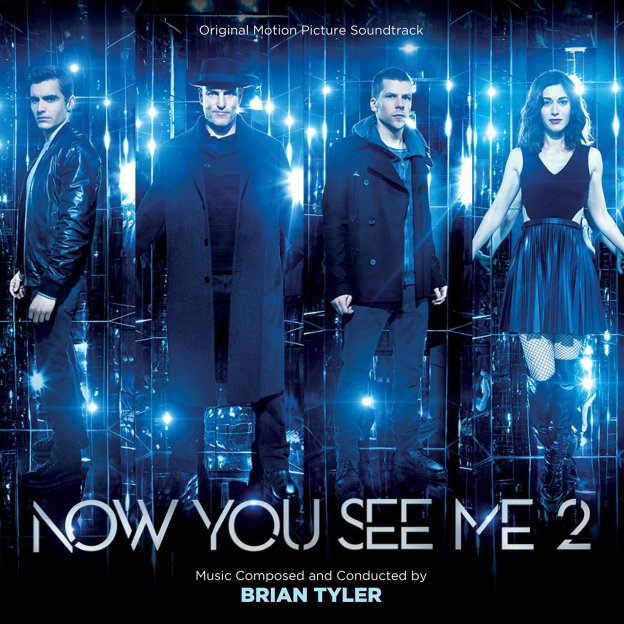
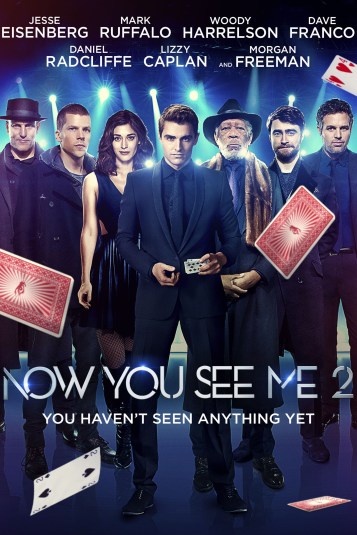
I have not seen Now You See Me (2013) or its sequel Now You See Me 2, though I have heard plenty about both films. Both films feature a group of stage magicians who use their talents to pull off huge and daring heists. The scores for both films were composed by Brian Tyler, and what I have here is two clips relating to the sequel, Now You See Me 2, which came out last year. The top link takes you to a concert performance of the film’s main theme, which I found very beautiful. I will never stop loving the experience of hearing movie music in a concert environment.
The bottom link comes from a scoring session led by Tyler at the famous Abbey Road studio in London. There is something enthralling about watching Brian Tyler at work; when he is on the podium, you can tell he is 100% into the music.
I know Now You See Me 2 got mixed reviews upon its release, but surely the music was not a part of any problems the film had. I hope you enjoy the recording session and the performance.
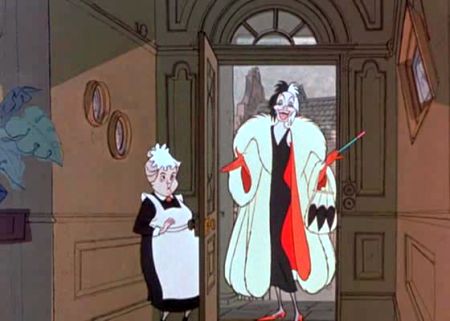
Correct me if I’m wrong, but at times I think Cruella de Vil is severely underrated as a Disney villain. Granted she doesn’t have any magic powers or an army of minions to do her bidding (Jasper and Horace are bumbling nimrods at best), but she DOES have one of the more disturbing plots to ever take place in a Disney film. And she nearly gets away with it too!
One thing that must be understood about Cruella is that she is obsessed with fur (remember they made this film back in 1961 when real fur coats were very much a common thing) of all kinds, it is all she lives for. Cruella also comes from a great deal of money (considering there’s a huge dilapidated mansion that belongs to her) and is obviously used to getting whatever she wants, whenever she wants. Therefore, when Roger and Anita refuse to sell her their dog’s newborn litter of puppies, Cruella explodes into a rage, declaring that she will “get even” with them. So when the puppies are stolen several months later, it doesn’t take much to make the connection that Cruella had everything to do with it.
You have to be evil to want to hurt puppies
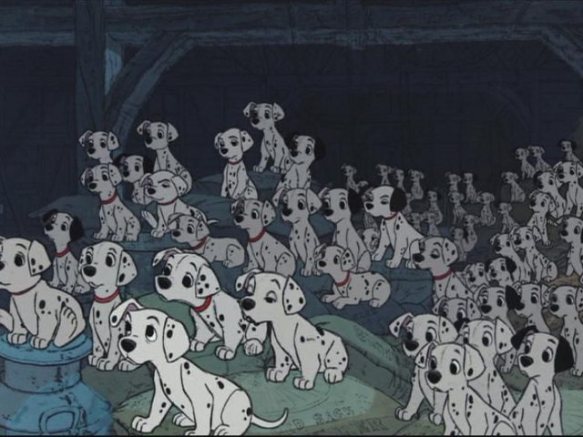
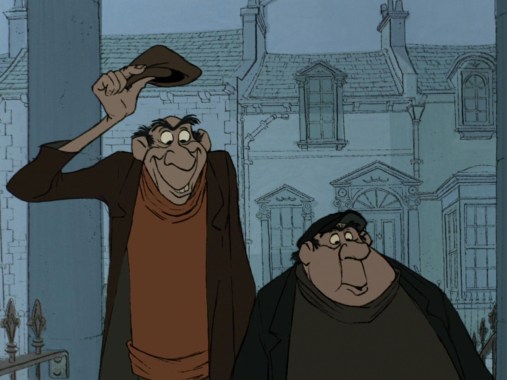
But why? What does a spoiled heiress need with Dalmatian puppies? In fact, what does she need with 99 Dalmatian puppies? The truth is horrifying: Cruella wants to make COATS out of the puppies! Let that sink in for a minute: this nasty woman wants to have 99 adorable puppies killed, skinned and turned into spotted coats that she can wear. This isn’t merely disturbing; this borders on the sociopathic!! And what’s worse, she wants Jasper and Horace to do the deed. Look at Jasper and Horace for a second:
I give you the original Dumb and Dumber
Do those idiots look capable of skinning ANYTHING, let alone 99 puppies? Sure, they talk about killing the puppies first by “knocking them on the head” but I have severe doubts in their ability to do it properly. And speaking of, the villains get THIS close to actually starting the process. Just before Pongo and Perdita literally crash into the room, Jasper and Horace have the puppies (plus Sgt. Tibbs the cat) cornered, ready to begin striking them down.
Surprisingly, it wasn’t until about five years ago that I was struck by the full magnitude of what Cruella wanted to do. I’m not sure why that is, except to say that it’s one thing to hear the words “She’s going to make coats out of us” and quite another to understand exactly what those words mean. And this is in a children’s film!! I wonder how kids watching this film in 1961 reacted if/when they figured out what Cruella was trying to do (I bet it wasn’t pretty).
Cruella’s plot to murder a lot of puppies is dark and disturbing and rightly deserves a place in this series. What do you think of Cruella’s twisted plot? Let me know in the comments below, and have a great rest of the day 🙂
The final act of Bambi does not lack for ‘disturbing moments’ especially when you consider that in short order: Man attacks the forest en masse, causing total hysteria among the animals; Bambi gets shot; and the entire forest is set on fire, compelling the surviving forest creatures to run for their lives. But the moment I would like to focus on happens in the midst of all this, during Man’s attack, but before the forest is set on fire.
Due to a series of events, Bambi and Faline have become separated and in the chaos are frantically searching for each other. And during a sudden lull in the shooting (which in retrospect is a sign that things are about to get worse), Faline bounds over a hill only to discover…the dogs. And just calling them ‘dogs’ alone is an understatement, these are killers!! I mean look at them: fangs bared, angry eyes, these dogs will rip apart anything they can catch, including Faline!! What makes this moment disturbing for me is that regular dogs have been turned into savage monsters by the studio. This, combined with the heart-pounding accompaniment of chase music, adds up to a scene that had me simultaneously engrossed and terrified.
The scariest (and most disturbing part) comes when the dogs have Faline cornered on a tiny ledge:
It’s a terrifying scene: only a few inches of rock are keeping Faline from those dogs and they’re not giving up! I’m very thankful this scene did not traumatize me for life in regards to dogs (because it could very easily do that).
Thankfully, Bambi comes to rescue Faline and the danger passes. And yet…the image of those dogs lunging up at Faline has stayed with me for a very long time. What do you think of the scene where the dogs hunt and chase Faline? Let me know in the comments below 🙂
War is a film that I have not seen but I’m sure I would like, given that it stars Jet Li and Jason Statham. The film is the directorial debut of Philip G. Atwell and tells the story of FBI agent John Crawford (Statham) who becomes obsessed with hunting down an assassin named Rogue (Li) after he brutally murders his partner. But, as it turns out, the story isn’t nearly as straightforward as it seems, there are some mind-blowing twists involved.
Unbelievably, it comes out that the assassin Crawford has been hunting down is none other than his supposed-to-be-dead partner! It turns out that after being supposedly killed, he tracked down and murdered the real Rogue in order to work his way into the Yakuza to find out who ordered the assassin to take out his family. But there’s another twist: it comes out that Crawford is the one responsible for giving out his partner’s address to Rogue (albeit under heavy duress) because he’s been in the Yakuza’s pocket for quite some time. Talk about twists upon twists!
The film was produced under the working title of Rogue (named for Jet Li’s character) but it was changed to avoid conflicting with an Australian horror film of the same name that was released the same year.
In the interview (which can be accessed in the link above), Tyler explains that he was approached to work on War after the premiere of The Fast and the Furious: Tokyo Drift (2006), and after watching some footage from the film-in-progress, he begged for the chance to score the film. Additional music for the film was provided by RZA, Mark Batson and Machines of Loving Grace.
A major element of the story involves the Chinese Triad going to war with the Japanese Yakuza. As a result, Tyler created a musical blend using Chinese and Japanese instruments against one another to symbolize the growing conflict between the two groups.
I have to say, looking at Brian Tyler’s work has given me a completely new appreciation for action films and their music. A lot of people write off action films as being “mindless” or somehow “less than” bigger dramatic films, but I think action films can be just as good as any other film genre if they’re done properly.
It was really exciting learning how Brian Tyler created the score for War and I hope you enjoy the interview too.
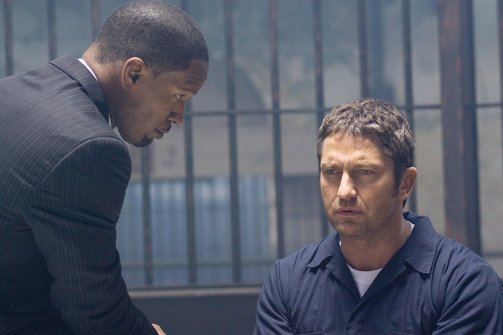
I actually remember seeing trailers for Law Abiding Citizen (2009), it caught my attention as it had Gerard Butler in it. For the life of me, I could not tell you what the movie was actually about until I looked the summary up. Law Abiding Citizen tells the story of the lengths Clyde Shelton (Butler), a hitherto ordinary citizen, will go to avenge his murdered wife and daughter when the justice system fails to dispense an appropriate punishment to their killer.
After subsequently murdering the killer himself (ten years after the fact) and being locked up in prison, it turns out that Clyde formerly worked for the CIA and created highly imaginative assassination devices which make him capable of killing anyone, anywhere, at any time (even while locked up in prison). He proceeds to kill the judge, district attorney and several other people associated with the case, but the prosecuter Nick Rice (Jamie Foxx) proves to be his undoing.
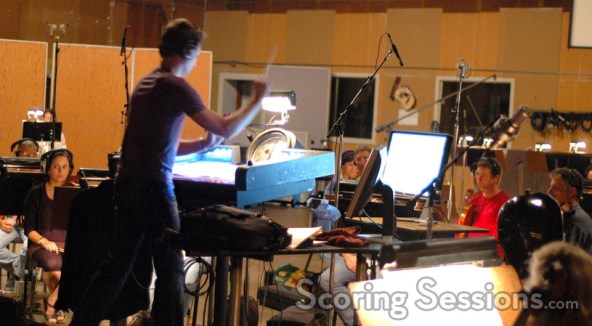
I have found two scoring sessions for this particular film. The first (above) is entitled “Methodology” while the second piece(below) is entitled “Mechanical Mind.” I actually like the second piece better because you can see more of the set-up in the recording studio. Tyler is surrounded by a bank of monitors that show the musical beat, the score and also a working print of the film (watch the monitors on the conductor’s right). There is also a large screen playing footage from the film which is occasionally reflected in the glass behind the conductor.
The 52-piece ensemble that Brian Tyler is conducting comes from the Hollywood Studio Symphony, an orchestra that has worked in the production of many film soundtracks (including Jurassic Park 3, The Last Samurai, Sucker Punch and The Bourne Supremacy.)
I really think you will enjoy listening to these two pieces; they are both prime examples of the fact that an average film can still contain fantastic music. Let me know what you think of the music in the comments below 🙂
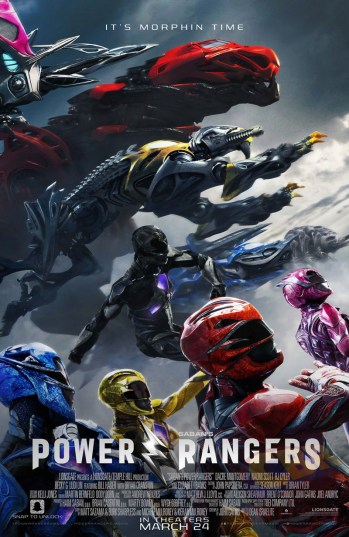
This may be the fastest I’ve ever released a scoring session of a film relative to the film’s premiere (the film came out five days ago). In the hype leading up to the release of Power Rangers, and the endless debate of “will this be any good?”, I somehow missed that Brian Tyler would be composing the score for this film. Tyler has been a rising force in the world of film music for the last decade and I was immediately curious to hear what his work for this film sounded like.
Lo and behold….I found a scoring session for the film. It’s tantalizingly short, only sixty seconds in length, but what I can hear is beautiful! I have no idea where in the film this music comes from, but it is very well-crafted and it is clear that Tyler is in his element as a composer and conductor.
Despite this, I still don’t think I will see Power Rangers anytime soon. Of course, I grew up watching Mighty Morphin’ Power Rangers way back in the 90s, and I saw a few of the later series on occasion (Mystic Force is still my favorite), but my tastes have greatly changed since then and the film simply holds no interest for me (though I AM pleased that one of the rangers is on the autistic spectrum). However, I may have to get my hands on the soundtrack to hear the rest of this gorgeous music.
I hope you enjoy watching Brian Tyler score a section of Power Rangers, and get ready: this is only the first of many Brian Tyler sessions that I’ve found (I really think you’re going to like them too).
If you ask most of the young adults in my generation when and how they first learned about death in film; the answer is more than likely to be Mufasa’s death in The Lion King (1994). But 52 years before that tragic event, Disney set the bar for the disturbing and upsetting when it came to the death of Bambi’s mother in Bambi (1942). In fact, my grandmother, who saw Bambi in the theater at a very young age, recounted to me once that this scene had all the young children in the theater in tears (and I don’t blame them at all). Because it is so upsetting and so blunt in how it presents death, I have made this scene part of the list of Disturbing Disney moments.
Prior to this scene, Bambi has been experiencing his very first winter and it hasn’t been going well. There’s hardly any food to eat; and after the initial fun of playing in the snow, Bambi finds himself longing for the warmth and greenery to return. Bambi’s mother promises that spring will come soon and sure enough, one day they arrive at the meadow to find the first shoots of spring grass peeking up through the snow.
So far so good right? Well no sooner do they start eating then the ominous “Man is coming” music starts. This theme is the only musical hint we ever have that Man is coming (he is never seen onscreen). Bambi doesn’t notice the danger, but his mother does and she quickly tells her son to run for safety!
This is where the scene begins to enter the disturbing. As Bambi runs for it, he turns to look back at his mother and hears these last words “Faster, faster Bambi! Don’t look back! Keep running, KEEP RUNNING!” Right before these words, the pair has already dodged one gunshot, and just after Bambi’s mother disappears offscreen, you hear it: a solid gunshot indicating a hit. But Bambi keeps running, not realizing anything has happened until he reaches the thicket, turns around and realizes…his mother isn’t there. The pain in the moment when Bambi goes from happiness (“We made it mother!”) to questioning (“Mother?!”) is heartwrenching. When I was younger, I had a very hard time watching this part of the movie. In fact, I can dimly recall being young enough to not quite understand what had happened to Bambi’s mother (and when I asked my mother all she would tell me was “keep watching”).
Disney does provide one moment of hope at the end of this scene: after a long search through the forest, Bambi encounters his father, the Great Prince of the Forest, who solemnly tells him “your mother can’t be with you anymore” and formally takes his son under his wing. This is the last time we see Bambi as a young fawn; he’ll next appear as a young buck (antlers and all).
As sad and messed up as this scene is (keep in mind, Bambi right now is the equivalent of a 5- year-old human child), it was originally going to be ten times worse. In an earlier version of the script, Bambi was supposed to notice the shot, double back and find his mother lying in a pool of her own blood (whether she was already dead or dying is not specified). Walt Disney vetoed the idea on the grounds that would be going too far and the moment was cut (which is good, because otherwise, this scene would’ve been #1 in the series).
I suppose it could be argued that this scene is more sad than disturbing, but I felt it needed to be added to this series. What do you think of the death of Bambi’s mother? Did it greatly upset you, were you old enough to understand what had happened? Let me know in the comments below! I’m glad everyone is enjoying this series 🙂 The next installment will also be from Bambi and covers a small moment that always had me on the edge of my seat. Until then, have a good rest of the day!
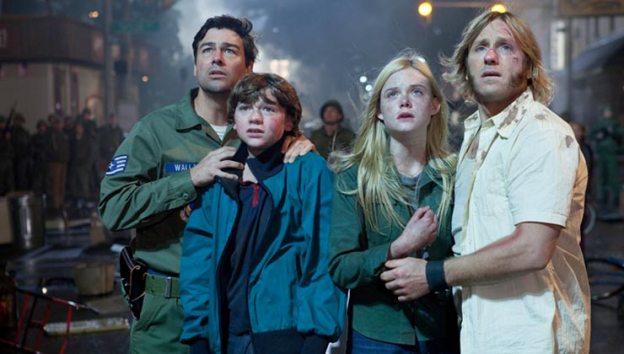
What do you get when J.J. Abrams and Steven Spielberg collaborate together on a film? In the case of Super 8, we got a science-fiction thriller film about a strange alien invading a town in Ohio while a group of kids are shooting a movie on Super 8 film. The film did well (despite some comparisons to E.T.), though I didn’t watch it myself (I was distracted by graduating from college at the time). As with all J.J. Abrams films (except for The Force Awakens), the score was composed by Michael Giacchino, who talks with us in the behind-the-scenes clip for the making of the score of Super 8.
What’s cool about this clip is that we get to hear Giacchino talking about his memories of shooting home movies on Super 8 film back in the day, and we even get to see a few clips from said films.
It’s always great to listen to Michael Giacchino discussing his work, and I hope you enjoy his talk about Super 8.
I know this is shorter than what I usually do, but I’m still recovering from a really busy weekend and I really wanted to give you something to enjoy until tomorrow 🙂
And speaking of…Disturbing Disney returns tomorrow with my first entry from Bambi (1942), a film that pioneered the “horrifying death of a parent” decades before The Lion King ripped our hearts out with the death of Mufasa.
Also, I wanted to share that Film Music Central has gained 2,000+ hits in a month for the first time ever and I wanted to say thank you to everyone who comes to visit the blog, this is a milestone I’ve been hoping to hit for a long time 🙂
Sequels are always a risky business; no matter how successful the original, there’s always the chance that a follow-up story will fall totally flat and ruin the story forever. Thankfully, such was not the case with Hannibal (2001), the follow-up to The Silence of the Lambs (1991). Set ten years after the original story, Clarice Starling (now played by Julianne Moore) must locate Hannibal Lecter before a surviving victim (played brilliantly by Gary Oldman) tracks down the serial killer to exact his gruesome revenge. While it’s true that this film was met with mixed reviews by the critics, I found Hannibal to be a very thrilling story, especially the last third. Anthony Hopkins is such a compelling presence when he’s onscreen, and he plays the role with so many layers that you can watch the film multiple times and see a new interpretation each time.
Of course the film wouldn’t be nearly as good without its musical score, which was composed by Hans Zimmer. In this wonderful interview, both Zimmer and director Ridley Scott talk about the music and how it came together. Scott believes that the music is just as important as the dialogue and so the score is crafted accordingly. Hannibal marked the fourth time that the director and composer collaborated on the same project, and you can tell that they’ve developed a good working relationship with each other.
Zimmer describes Hannibal as a “haunting story” and that the music must be haunting as well to match it, and I believe he totally succeeded in accomplishing this. One thing about Hannibal (the character) that always fascinated me is his love of the classical, be it art, poetry or music. The score reflects this to a large degree, as Hans Zimmer wrote several choral pieces in an early classical style for certain scenes involving the titular character. It was amazing to learn about the score for this haunting film, and I hope you enjoy it as well.

















 Film Music Central