Tag Archives: film

Pinocchio “Hi Diddle Dee Dee (reprise)” (1940)

what-do-you-see

Having been rescued from Stromboli with the timely assistance of the Blue Fairy (who also warned that this was the last time she could directly help), Pinocchio is heading straight for home, determined to be a good boy and go to school. Jiminy Cricket is very happy too, as this time Pinocchio seems to thoroughly mean what he says. Unfortunately, who does the young puppet run into on the way home but Honest John and Gideon (again!! Honestly those two seem to be everywhere don’t they?) Having received orders from the Coachman to round up every naughty boy they can find (as detailed in the beginning of my Disturbing Disney series), the wily con men see Pinocchio as the perfect target.

Stopping Pinocchio, Honest John insists that the puppet looks deathly ill and that he simply must have an examination (so apparently Honest John is a doctor too, amazing for a talking fox who can’t read).

Pinocchio “Examination and Hi Diddle Dee Dee (reprise)” (1940)

While Gideon literally scribbles down a “report,” Honest John gives Pinocchio a thorough “examination” including this “diagnosis” of his heart:

“Now that heart. Ooh, my goodness! A palpitating syncopation of the killer diller with the wicky wacky stomping of the floy joy.”

i-m-giving-you-my-ticket

Honest John solemnly pronounces the results: “My boy…you are allergic.” It’s hysterical how he pronounces the word like it’s the most terrible disease in the world, when that’s not even close to how it works (as we all know, you’re allergic to something, it’s not just a case of being “allergic.”) Of course Pinocchio has no way of knowing that, but even so, when Honest John pronounces that the only cure is a holiday on Pleasure Island, the puppet weakly insists that he can’t go. But that’s no problem as Honest John gives Pinocchio his very own “ticket” (the Ace of Spades, otherwise known as the Death card) and lead the puppet away with a stirring reprise of “Hi Diddle Dee Dee” :

Hi Diddle Dee Dee, it’s Pleasure Isle for me!

Where every day is a holiday, and kids have nothing to do but play

Hi Diddle Dee Doo, if what I hear is true,

At noon each day there’s a big parade, the river’s flowing with lemonade,

A land of pudding and marmalade, it’s Pleasure Isle for me!

Jiminy Cricket (who had walked on ahead), realizes that Pinocchio is going the wrong way (again) and chases after the group as they lead Pinocchio to the carriage that will be departing at midnight for Pleasure Island!

And that’s the reprise of “Hi Diddle Dee Dee!” Let me know what you thought about it in the comments below!

You can become a patron of the blog at: patreon.com/musicgamer460

See also:

Pinocchio “When You Wish Upon a Star” (1940)

Pinocchio “Little Wooden Head” (1940)

Pinocchio “Hi Diddle Dee Dee (An Actor’s Life for Me!)” (1940)

Pinocchio “I’ve Got No Strings” (1940)

For more the more disturbing aspects of Pinocchio, see also:

Disturbing Disney #1: The Coachman in Pinocchio (1940)

Disturbing Disney #2: The truth of Pleasure Island in Pinocchio (1940)

Disturbing Disney #3: Escaping Monstro from Pinocchio (1940)

Don’t forget to like Film Music Central on Facebook 🙂

Soundtrack Review: Red Sparrow (2018)

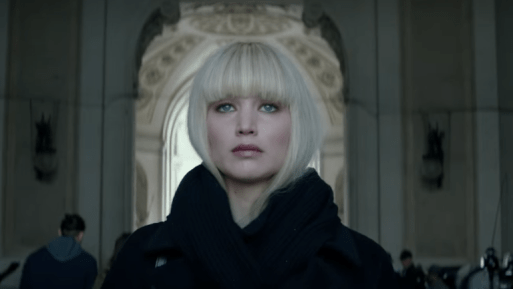
Red Sparrow is an American spy thriller film directed by Francis Lawrence and based on the 2013 novel of the same name by Jason Matthews. The film tells the story of a Russian intelligence officer, Dominika Egorova (Jennifer Lawrence), who is sent to make contact with a CIA agent and possible mole. The film also stars Joel Edgerton, Charlotte Rampling, Mary-Louise Parker and Jeremy Irons. It released to theaters on March 2nd, 2018.
The score for Red Sparrow was composed by James Newton Howard, one of the film industry’s most versatile and honored composers, with a career spanning over thirty years and encompassing more than 130 film and television projects. His myriad film credits include the Oscar®-nominated scores for Defiance, Michael Clayton, The Village, The Fugitive, The Prince of Tides, and My Best Friend’s Wedding, as well as Oscar® nominated songs for Junior and One Fine Day. Howard also received Golden Globe nominations for his scores for Peter Jackson’s blockbuster remake of King Kong and Defiance, as well as the aforementioned songs.

James Newton Howard’s score for Red Sparrow is, in a word, beautiful. Howard’s scores have always been among my favorites, but this one might just be one of his best. For a start, the score begins with a proper overture which came as a very pleasant surprise to me. Overtures in film music are typically, in my experience, associated with the golden age of cinema, when many films contained an overture and an intermission like a stage play or an opera. And like those overtures, Howard’s overture sets the tone for the entire soundtrack: it’s a haunting string melody, mixed with woodwinds, that gently draws you into itself until you’re lost in the rising and falling sounds. Appropriately enough, there are faint overtones of Russian-styled music in the melody, which makes sense given where the film is set. However, this sound does not dominate the overture, it is a hint of “Russian-ness” and nothing more.

Most of the score follows the lyrical example of the overture, especially the last track before the end titles which is listed as “Didn’t I Do Well.” This last piece is more upbeat than the overture and actually put me in mind of a ballet number, which may be deliberate since Jennifer Lawrence’s character is *minor spoiler* a former ballerina. I say it reminds me of ballet because the leaps and quick changes in the melody are reminiscent of the steps a ballet dancer takes.

Red-Sparrow

However, some of the tracks in the score depart from the style featured in the overture and “Didn’t I Do Well” and lean closer to a more modern feel, with electronic sounds and a faster paced, more “jagged” melody. Examples of this include “Take Off Your Dress” and “The Steam Room.” The latter especially could be considered the most “violent” sounding piece in the entire soundtrack (I have my theories as to why but I’ll need to see the film to know for certain) but I enjoyed listening to it because it stood in marked contrast to the other pieces surrounding it in the score.

In conclusion, Howard’s score for Red Sparrow is a gorgeous listening experience and I can already tell it will be the highlight of the film (even if the rest of the film disappoints, which I hope it doesn’t). I think you will definitely enjoy it.

Let me know what you thought of Red Sparrow’s soundtrack in the comments below. 🙂

You can become a patron of the blog at: patreon.com/musicgamer460

Check out the YouTube channel (and consider hitting the subscribe button)

See also: Film Soundtracks A-W

My thoughts on: Red Sparrow (2018)

Don’t forget to like Film Music Central on Facebook 🙂

My thoughts on: Jurassic Park (1993)

61RLRZnbc+L._SY550_

Given my well-known aversion to scary films, it often surprises my friends when they find out I enjoy watching Jurassic Park. While it’s true that this film has its own fair share of insanely terrifying moments (including one in particular that still scares me quite a bit), my lifelong love of dinosaurs as well as my appreciation of Spielberg’s storytelling abilities overrides my fear (John William’s excellent score helps as well). I dimly remember seeing advertisements for this film on TV and being super excited that there was a “dinosaur movie” being made.

And given I was all of 5 years old when the film came out, I couldn’t understand why my parents wouldn’t let me see the movie with the dinosaurs in it (dinosaurs were my first obsession, I couldn’t read enough about them). Of course now I understand that they kept me far away from this film because it was full of scenes that were not appropriate for a 5 year old kid, but unfortunately for my psyche, I didn’t know that when I was 9 and finally managed to see the movie for the first time at my best friend’s house.

10007883794_c90e20625f_b

“Welcome to Jurassic Park”

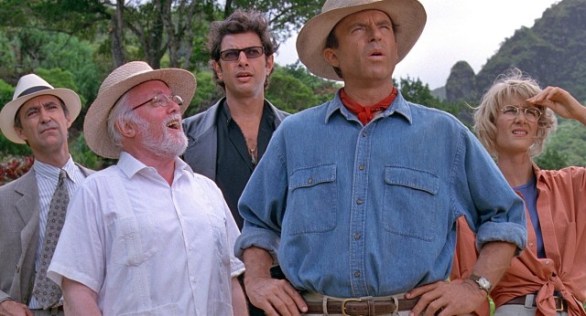
If you haven’t seen the film, Jurassic Park is adapted from Michael Crichton’s 1990 novel of the same name and follows the development of a theme park being built on (fictional) Isla Nublar off Costa Rica that is filled with genetically engineered dinosaurs resurrected from ancient DNA samples. After a deadly accident, the park’s creator John Hammond (Richard Attenborough) needs a group of experts to sign off on the park before the investors will fully commit to opening the island to the public. To that end, the following group is invited to the island to tour the facility:

  • Dr. Alan Grant (Sam Neil): an archaeologist who focuses on velociraptors and also subscribes to the (then-new) belief that dinosaurs were the direct ancestors of modern birds.
  • Dr. Ellie Sattler (Laura Dern): a graduate student studying with Dr. Grant (and also his girlfriend). She specializes in paleobotany.
  • Dr. Ian Malcolm (Jeff Goldblum): a mathematician who specializes in chaos theory. He’s firmly against the entire concept of Jurassic Park, correctly predicting that they will be unable to control the dinosaurs they have created, insisting that “life finds a way.”
  • Donald Gennaro (Martin Ferrero): a lawyer working on behalf of Jurassic Park’s investors. He’s initially skeptical of the project but quickly changes his mind once he first sees the dinosaurs in person.

This group is also joined by Lex and Tim Murphy (Ariana Richards and Joseph Mazzello respectively), Hammond’s grandchildren. Tim is obsessed with dinosaurs (and is a big fan of Dr. Grant’s work), while Lex is a tomboy and a would-be computer hacker.

jurassicpark3d-02

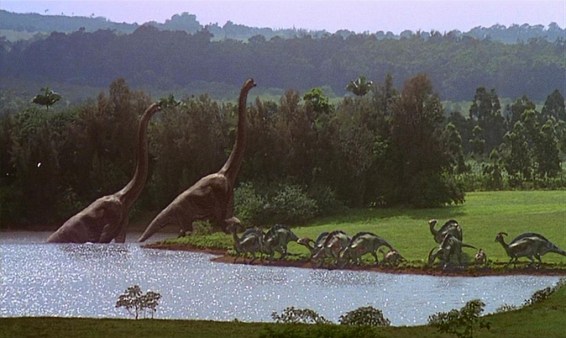
This first part of the film shows the dinosaurs in all of their positive glory: we see a giant herd of dinosaurs gathered around a lake, feeding from the trees, even a triceratops (albeit one that’s in pain). But things start to become menacing almost straight away: we see the velociraptor enclosure and how they have to be fed by lowering whole (Live!!) cows into a brush-filled space, the only sign of their presence being the rustling of the branches. And then there’s the threat of a hurricane moving onto the island that threatens to cut the tour of the park short and oh yes, there’s also the sub-plot of programmer Dennis Nedry (Wayne Knight) plotting to steal various DNA samples for a rival company.

One part of this film I like is how Hammond and most of his staff are in complete denial of how completely in-over-their-heads they are in regards to the dinosaurs they’ve created. The more you hear them talk, the more you just know something is going to go terribly wrong and does it ever! Due to a series of events, the power is cut to the electric fences surrounding each enclosure and the T-Rex is among the first to get out (and did I mention the group touring the park is right in front of that area??)

Jurassic-park-t-rex-600x318

“The T-Rex Attacks”

The T-Rex is a masterpiece of early-90s CGI that has held up surprisingly well over the last 25 years. Originally, the dinosaurs were going to be realized with traditional stop-motion animation until a computer test demonstrated that the dinosaurs could be almost fully created with CGI. But what really puts the T-Rex over the top is the real-life component of the creature. For the epic sequence where the dinosaur stalks the human characters, a full-size animatronic head, arm and two feet were created. Shots of these components were interspersed with the CGI creation to create a spine-tingling moment.

But as scary as the T-Rex scene is, it’s nothing compared to the kitchen scene. You know the one I’m talking about: it’s late in the story, most of the surviving characters have made their way back to the main park building…but so have the velociraptors, who begin stalking Tim and Lex as they run and hide in the kitchen. This sequence terrified me as a kid because I was about the same age as Tim and Lex (give or take a few years) so I could completely identify with them as they hid from the velociraptors. Like the earlier T-Rex scene, the footage of the raptors is a combination of animatronics, live-action puppets (with human performers) and CGI. In fact, there were so many wires required to make the puppet and animatronic components work, that Tim and Lex had to repeatedly jump over them to keep from tripping on them (it’s a wonder they filmed that scene without any of that becoming visible). This scene is so well done that, even though I know it’s all part of a movie and no one is in any actual danger, I still feel terrified that the raptors are going to find and eat the kids!

And then there’s John William’s beautiful score for this film. When you run through a list of Williams’ most recognized pieces, the main theme form Jurassic Park is almost always included and rightfully so. It was the composer’s intention to create music that embodied the sense of awe a person would feel if they really did see dinosaurs walking in front of them as the characters in the film do and the score definitely succeeds with this.

And now for some random thoughts and trivia:

  • Wayne Knight gives an absolutely hysterical performance as Dennis Nedry, it’s almost a shame he gets his comeuppance so early in the story. That being said, his scene with the Dilophosaurus is so funny because he’s talking to a dinosaur and saying “I don’t have any food for you” when it’s patently obvious that the dinosaur considers him to be the food!
  • The T-Rex animatronic was the biggest creation of its time (even bigger than the Alien Queen created for Aliens which gives you an idea of its size).
  • When the T-Rex charges through the sunroof of the Jeep, the glass was supposed to come out, but it was NOT supposed to crack (so note carefully how Tim and Lex’s screams jump up about an octave as they suffer a genuine and unexpected scare).
  • Exactly who was going to die or not changed several times throughout filming. At one point, Mr. Albert (Samuel L. Jackson) was going to live, the lawyer was going to live, but Hammond was going to die (as his counterpart in the book does).
  • When the group has sat down for lunch after arriving on the island, watch the images playing in the background carefully. One of the “concept art” images is an exact match for the Mosasaurus enclosure seen in Jurassic World (2015)

And those are my thoughts on Jurassic Park! I still like watching it from time to time when I want to have a day to myself (usually during a weekend). What do you think of Jurassic Park? Let me know your thoughts in the comments below!

For more film reviews see also: Film/TV Reviews

Become a Patron of the blog at patreon.com/musicgamer460

Check out the YouTube channel (and consider hitting the subscribe button)

Don’t forget to like Film Music Central on Facebook 🙂

My thoughts on: Annihilation (2018)

*warning: this review will contain a number of spoilers, so please stop here if you haven’t seen the film yet!

It’s been just over 12 hours since I saw Annihilation and I still have an intense feeling of awe. I don’t think I’m exaggerating when I say this film could be the 2001: A Space Odyssey for my generation, it has that exact same feeling of “I just saw something beautiful but it’s going to take  multiple viewings to better understand it.” Nevertheless, I believe I understand the gist of what director Alex Garland was trying to show us, so I’ll make my way as best I can.

Three years before our story begins, a meteorite crashed into a lighthouse inside a national park and immediately began emitting something dubbed the Shimmer. Imagine the iridescent surface of a bubble and combine it with endless flows and ripples. Now grow that bubble to gigantic proportions and you have a pretty good idea of what the border of the Shimmer looks like. Scientists have sent multiple teams in to explore this phenomenon, but no one has ever returned…until now.

22-annihilation-2.w710.h473

I should mention the proper story actually begins with Lena (Natalie Portman), a former soldier and professor in cellular biology, being debriefed in an isolation chamber after the story is already over (dialogue implies she is the lone survivor). Apparently, she was inside the Shimmer for 4 months, even though Lena can’t recall that much time passing. The story then flashes back and reveals her husband, Sgt. Kane (Oscar Isaac), has been missing for a year. It turns out he was part of the last team sent into the Shimmer. Out of nowhere, Kane appears outside the bedroom, but something is off about him. He doesn’t remember anything and he suddenly gets really sick. Lena and Kane are taken to the facility studying the Shimmer and while Kane falls into a coma, Lena decides to join the next team going in (all-female as it turns out) to see if there’s some way to reverse what’s happening to her husband.

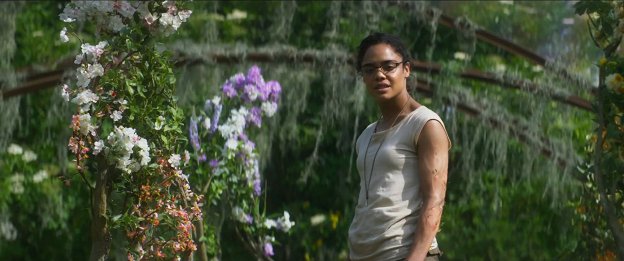
The team consists of Lena, Anya Thorensen (a paramedic), Josie Radek (a physicist), Tuva Novotny as Cass Shepherd, a surveyor and geologist, and all are led by Dr. Ventress (a psychologist who secretly has cancer and wants to know the secret of the Shimmer before she dies). I need to stop and highlight Dr. Ventress for a moment because she’s the closest we come to a human antagonist in the entire story (and I’m still debating whether the Shimmer is an antagonist or not). From the moment you meet her, at least in my experience, you instantly start to hate her. There’s something unnatural in her behavior even before entering the Shimmer, I’d almost go so far as to say she was exhibiting sociopathic behavior.

annihilation_deer

One great thing about this film is it doesn’t take too long to get to the action inside the Shimmer, but you should know that once the team is inside things get really weird really fast. For example, Lena wakes up in a tent, having no memory of making camp, and it turns out that somehow three or four days have passed and no one in the team remembers any of it. Then there’s the mutations: as Lena recounts, they start subtly. First they find strange new flowers that seem to be crossbreeds of different species (that shouldn’t be possible). Then Josie is attacked by a huge crocodile that has strange mutations in its teeth. Some of the mutations are beautiful: Lena comes across a pair of deer that have mutated into strange beings with flowering branches where their antlers should be, but some are absolutely terrifying. The hardest scene for me to get through was one where the group is twice attacked by a monstrous bear that somehow has part of its skull exposed. But that’s not the worst part of it: after attacking and killing Cass, it somehow absorbed part of Cass’ consciousness as she died (Josie speculates that the Shimmer is acting like a genetic prism that is causing the DNA of everything inside it to actively combine together) and now can use her final screams of help as a lure. What I mean is, every time the bear roars, you can hear Cass screaming and it was absolutely terrifying.

Of course, as in any horror film, one by one the team is picked off:

  • Cass is killed when her throat is ripped out by the bear
  • Anya is mauled to death by the same bear after suffering a psychotic episode
  • Josie’s fate is….interesting. After Cass and Anya die, Josie is seen sitting outside, seemingly at peace. As she tells Lena “She (Ventress) wants to face it (the Shimmer) and you want to fight it. But I don’t want either of those things.” And as Josie talks and walks away, she begins to sprout leaves and branches and suddenly disappears altogether. I think she transforms into one of the people-shaped flower growths that have begun appearing. And I don’t think she died either; if anything, I feel like Josie transcended into…something else.
  • Ventress makes it to the lighthouse before Lena, but something strange happens to her that I cannot adequately put into words (but I’ll address a theory I have when I wrap this up).

annihilation-plant-evolution-elements

Lena finally arrives at the lighthouse, ground zero of the Shimmer and discovers a strange growth surrounding a dark hole and also an incinerated body sitting in front of a video camera. And this is when things go beyond “this is weird” to “what the f*ck just happened??” Because, as the footage reveals, Lena’s husband went inside the Shimmer and committed suicide with a phosphorous grenade while talking to…a doppelganger. It’s one of those situations where your brain races like “If that’s Lena’s husband sitting dead on the floor, then who or WHAT is lying in a coma back at the base??”

The next sequence is one of the most beautiful I’ve ever seen, but I simply can’t put it into words. I’ve tried several times and it simply doesn’t do the moment justice. Suffice it to say that Lena is confronted by her own double, or at least something that is morphing into her double. But just as it gain’s Lena’s face, the real Lena puts another phosphorous grenade into its hands and triggers it, running out the door as it goes off. This incinerates the root of the Shimmer and causes the entire phenomenon to collapse.

Apparently, the Shimmer was some kind of alien life, but Lena can’t say what it wanted, if indeed it wanted anything at all. All she wants is her husband (and it’s interesting that she apparently neglects to mention that the man now recovered from his coma is NOT her husband but an alien duplicate). “Kane” confirms to Lena that he is not her husband, but upon ascertaining that she is the one the real Kane told him about, he embraces her and then something strange happens: his eyes begin to shimmer with a certain familiar iridescence. And after a moment, Lena’s eyes “Shimmer” too. And that’s where the story ends!

What does it all mean? I believe, that even though the phenomenon has collapsed, the Shimmer is still here, it’s just internalized inside two people now. Just like a pair of cells. As Lena told a class at the beginning: two become four, become eight, become sixteen…I think this is only the beginning before the Shimmer spreads through humanity, though what it will ultimately do I cannot say (though if you have a theory I’d love to hear it in the comments below).

Now as to the fate of Ventress, here is my theory: I think Lena was talking to her double the entire time and here’s why: when we first see Ventress in the chamber, you can clearly see that she has no eyes, but when she turns to face Lena, she suddenly has them. When Lena’s double is being made, the last thing to emerge are the eyes. So I think the real Ventress died, was absorbed by the Shimmer and now her double is here, but it can’t sustain itself because of the cancer in the original Ventress. That’s my theory anyway.

Annihilation22

I wish I could explain certain parts better, but Annihilation is one of those films that needs to be experienced to be understood. Is it, as some say, too “intellectual”? Maybe…but I don’t think there’s anything wrong with a movie that makes you think about what it’s trying to tell you.

One more brief note: in the middle of the film, there’s an extremely graphic scene involving some found footage (you’ll know when you come to it). I just wanted you to be aware that such a scene exists because it deeply disturbed me while I watched it.

Final thoughts: Annihilation is a brilliant film from Alex Garland and a must-see for fans of the science fiction genre.

What did you think of Annihilation? Let me know your thoughts in the comments below. Have a great day!

See also: Soundtrack Review: Annihilation (2018)

And for more film reviews: Live-Action Films/TV

Become a Patron of the blog at patreon.com/musicgamer460

Check out the YouTube channel (and consider hitting the subscribe button)

Don’t forget to like Film Music Central on Facebook 🙂

My thoughts on: Yojimbo (1961)

Ever since I first saw Throne of Blood on Hulu (back when the Criterion Collection streamed their films on that site), there has been a special place in my heart for Kurosawa’s jidaigeki films (a jidaigeki film is literally a “period drama” usually set during the Edo period of Japan from 1603-1868, though some can be set earlier). And one of my favorite jidaigeki films is Yojimbo (1961), a film that may sound familiar to fans of Western films. Why would that be? Well, listen to the brief summary first:

A nameless samurai (Toshiro Mifune) comes to a small town that is the center of a feud between two families, both engaged in underworld crime. The nameless samurai plots to save the town by pitting the two families against one another by pretending to be a bodyguard (yojimbo) for each side until they destroy each other.

If that sounds like the plot of A Fistful of Dollars (1964) starring Clint Eastwood as The Man With No Name then you would be correct. What I never knew until I saw Yojimbo is that director Sergio Leone “borrowed” the plot of this film from Kurosawa’s work and repeated it wholesale for his spaghetti Western. Kurosawa filed a lawsuit when the film came to his attention, stating that while Leone had made “a fine movie, but it was my movie!” Ultimately the lawsuit was settled out of court for a certain percentage of the profits made from A Fistful of Dollars.

As stated in the brief summary, the nameless samurai comes to a rural town that is slowly being suffocated by two families. It was originally ruled (more or less) by Seibei    (Seizaburo Kawazu) and his gang. But when Seibei sought to retire and announced that he would be giving all of his territory to his inexperienced son, his right-hand man Ushitora (Kyū Sazanka) balked and started his own gang in retaliation. The two have been trying to eliminate each other for quite some time but remain locked in a stalemate. Seeing how the town is suffering from the two gangs, the nameless samurai (who later gives himself the name Sanjuro Kuwabatake) determines to eliminate them.

yojimbo-1961-movie-review-gang-unosuke-tatsuya-nakadai

Ushitora (left) and his brothers: Unosuke (center) and Inokichi (right)

Part of what makes Yojimbo such an excellent film is that it turns the traditional depiction of a samurai on its head. As a general rule, samurai were depicted as these noble beings, not a hair out of place and they wouldn’t dream of killing anyone for something as base as money. Sanjuro is the complete opposite of all of these ideals: he’s visibly scruffy; his clothes have seen better days; and his whole world apparently revolves around profit (though this is later tempered when he secretly gives his ill-gotten gains to a peasant family to help them start a new life). Toshiro Mifune completely owns this role for certain. In fact, this film did so well that Mifune reprised the role the following year in Sanjuro (1962).

My favorite part of this film is the middle act where Sanjuro plays each gang off of the other, with both sides completely oblivious to the manipulation. For example, Sanjuro overhears one of Ushitora’s men drunkenly spouting off to a friend about how they murdered a government official. After capturing them and taking the pair to Seibei, Sanjuro goes back to Ushitora and tells them that Seibei’s men captured the pair (leaving out the fact that he made the capture himself).

0seibei

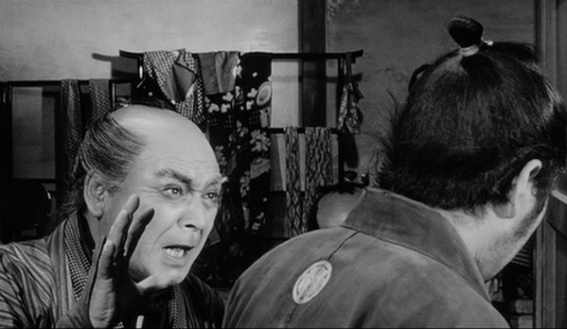
Seibei (left) begs Sanjuro to work for him

The plan nearly goes off without a hitch but there are some complications: right in the middle of Sanjuro’s scheming, Ushitora’s younger brother Unosuke (Tatsuya Nakadai) returns after a trip abroad. And the semi-deranged Unosuke brought back a present: a pistol (that he knows how to use very well thank you very much). On top of this, Sanjuro’s good deed of helping a peasant family escape (including the wife who had been forcibly given to one of Ushitora’s associates as a concubine) is found out by Unosuke, who drags him back to his brother’s gang to be beaten unmercifully until he gives up where the family went. Sanjuro manages to escape, naturally, and he makes sure his only friend in the town, Gonji (Eijirō Tōno) the tavern owner, tells Ushitora’s men that the samurai went back to Seibei’s place to hide.

yojimbo-1961-sanjuro-gangsters-ushitora-kyu-sazanka-toshiro-mifune-seibei-seizaburo-kawazu

This proves to be the final straw: Ushitora and his men set fire to the rival gang’s base (a brothel) and slaughter them all as they come running out to fight, though they do spare the brothel girls as they run for their lives. After killing Seibei’s son and his scheming wife, Unosuke shoots Seibei and the war for the town is seemingly over. Gonji sneaks Sanjuro out of town to help him recover, but is caught taking supplies to him and is captured. Sanjuro won’t stand to see his friend hurt, so he returns to town to dispatch Ushitora and his gang. In relatively short order he kills them all, only sparing a young farm boy that he saw at the beginning of the story running away from the family farm, ordering him to go back to his parents and enjoy “a long life sipping gruel.”

With the gangs eliminated, Sanjuro frees Gonji and with a simple “See you around!” heads off for the road.

The film is made even better by Masaru Sato’s excellent, almost jazz-like score for this film. It doesn’t seem like the kind of music you should hear in a period film like Yojimbo, but it absolutely works. One of my favorite musical moments is, when Sanjuro is stalking Ushitora’s gang for the last time, all you really hear for a minute is a soft tap on a high-hat cymbal.

Have you seen Yojimbo or Sanjuro the sequel? If so, what did you think about them? Let me know your thoughts in the comments below! Thank you so much for coming by and checking out the blog, your support means everything to me!

For more of my thoughts on Kurosawa, see also: My Thoughts on Throne of Blood (1957)

And also see: Live-Action Films/TV for the rest of my film reviews 🙂

Become a Patron of the blog at patreon.com/musicgamer460

Check out the YouTube channel (and consider hitting the subscribe button)

Don’t forget to like Film Music Central on Facebook 🙂

Disturbing Disney #18: The Queen’s assignment for her Huntsman

Evolution of Disney : Snow White and the Seven Dwarfs Part 1

In the time leading up to its release, Snow White and the Seven Dwarfs was derided as “Disney’s Folly.” It seemed ludicrous that anyone would be willing to sit through a full-length animated feature film, let alone enjoy it. But upon its release in 1937, Snow White and the Seven Dwarfs was acclaimed as a masterpiece, a title it rightly deserves to this very day.

Based on Grimm’s fairy tale Schneewittchen, the film tells the story of a beautiful princess named Snow White who must flee for her life when her wicked stepmother the Queen learns through her magic mirror that Snow White is now “the fairest in the land.” The princes is taken in by seven dwarfs and dreams of reuniting with a handsome prince, but the Queen is on the prowl to ensure that she, not Snow White, is the fairest one of all. And it is due to the Queen’s wicked plots that the film possesses its own share of disturbing moments.

Humbert.png

While holding court on her peacock throne, the Queen informs her loyal huntsman that he is to take young Snow White deep into the forest to collect wildflowers. And once there, he is to kill her! Considering how calmly the Queen gives these orders, it is safe to presume that she’s had beautiful rivals murdered before, but the Huntsman objects in this case because Snow White is a royal princess, the Queen’s daughter by marriage! Not only will the Queen brook no argument, she even has a way to make sure that the Huntsman completes his mission. Once Snow White is dead, he must cut out her heart and bring it back to the Queen in a special box.

Just think about how sociopathic that request is: the Queen is so obsessed with being the most beautiful woman alive that she will have her own step-daughter murdered and have her heart brutally cut out just to satisfy her own vanity. Not only that, but she has a special chest made for the sole purpose of bringing back the heart so she can gloat. This is disturbing behavior coming from a Queen, and I believe that the vain monarch is so full of herself that she believes she can get away with this forever. Fortunately for our heroine, the Huntsman has a conscience and can’t go through with it, no matter the consequences.

image_21459143.png
This scene has become more disturbing for me the older I have become. Of course I was always scared because the Queen wanted to kill Snow White, but as the passage of time allowed me to better understand the motives behind what was happening, the more I became disturbed by the entire scene. However, the Huntsman’s mission is nothing compared to Snow White’s flight through the forest, which has terrified and disturbed children for the last eighty years.

What do you think of this disturbing moment? Let me know your thoughts in the comments below 🙂 Have a great day!

Become a Patron of the blog at patreon.com/musicgamer460

Check out the YouTube channel (and consider hitting the subscribe button)

Don’t forget to like Film Music Central on Facebook 🙂

See also:

Disturbing Disney #1: The Coachman in Pinocchio (1940)

Disturbing Disney #2: The truth of Pleasure Island in Pinocchio (1940)

Disturbing Disney #3: Escaping Monstro from Pinocchio (1940)

Disturbing Disney #4: Dumbo loses his mother (1941)

Disturbing Disney #5 The death of Bambi’s Mother

Disturbing Disney #6: Faline vs. the dogs (1942)

Disturbing Disney #7: Cruella wants to do WHAT??

Disturbing Disney #8: The Whale Who Wanted to Sing at the Met (from Make Mine Music, 1946)

Disturbing Disney #9: Dr. Facilier’s Fate (The Princess and the Frog, 2009)

Disturbing Disney #10: The rat in Lady and the Tramp (1955)

Disturbing Disney #11: Clayton’s Death in Tarzan (1999)

Disturbing Disney #12: The Bear from The Fox and the Hound (1981)

Disturbing Disney #13: “Smoking them out” in The Fox and the Hound (1981)

Disturbing Disney #14: The Salt Trap in The Jungle Book (1994)

Disturbing Disney #15: Night on Bald Mountain from Fantasia (1940)

Disturbing Disney #16: King Triton destroys Ariel’s grotto

Disturbing Disney #17: Ratigan becomes a monster in The Great Mouse Detective

Disturbing Disney #19: Cinderella’s dress is destroyed (1950)

Disturbing Disney #20: Quasimodo is crowned ‘King of Fools’ (1996)


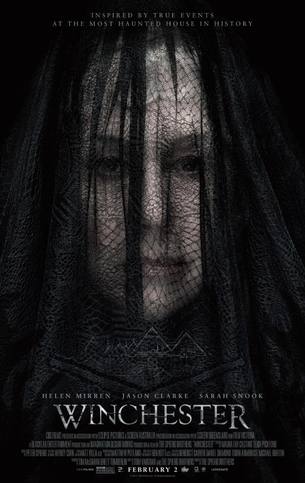
Soundtrack Review: Winchester (2018)

642b79c5be902241b628ae5ec4a9dab7

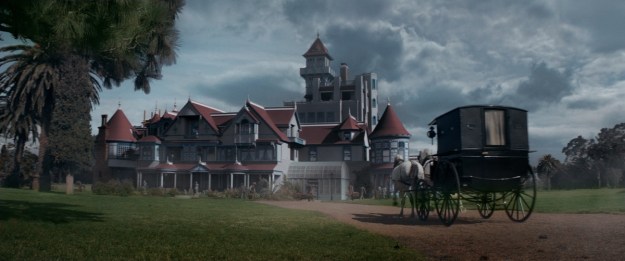
Winchester is a 2018 American supernatural horror film directed by Michael and Peter Spierig. It follows the widowed Sarah Winchester (Helen Mirren) as she seeks to help what she believes are spirits killed by Winchester rifles by continually expanding the mansion she lives in (what is now known as the Winchester Mystery House). Due to Sarah’s obsession with spirits, a doctor named Eric Price (Jason Clarke) is summoned to the mansion to determine whether Sarah is mentally capable of running the Winchester Company. The doctor, who does not initially believe in ghosts, soon finds that there are indeed spirits residing in the Winchester mansion. Winchester was released to theaters on February 2nd, 2018.

The score for Winchester was composed by co-director Peter Spierig in his second outing as a film composer. Peter collaborates with his twin brother Michael and collectively they work as The Spierig Brothers. Their critically acclaimed sci-fi thriller Predestination, based on Robert A. Heinlein’s short story “All You Zombies”, was nominated for nine Australian Academy of Cinema and Television Arts (AACTA) Awards, including Best Director, Best Adapted Screenplay, and Best Score for Peter. The film also won four AACTA Awards including Best Actress for Sarah Snook, who stars in Winchester. The Spierig Brothers won the Toronto After Dark Film Festival Special Award for Best Sci-Fi Film and Best Screenplay for Predestination, which also took a second place Audience Award for Best Feature Film.

v1.bjsxODEwMjk5O2o7MTc2NjA7MTIwMDsyMDAwOzgzOA

Listening to the soundtrack, some moments definitely stood out to me, but overall one thing became pointedly clear: the Winchester score succumbs to the age-old trope of using shock chords in a horror film. It’s a practice that dates back many decades and in my opinion it’s completely over done. It’s true that horror films should have that “scare factor” to them, especially in the music whenever possible, but there’s more than one way to elicit scares through the music.

However as I said there were a few moments that stood out to me in a good way. One of these was “Marion,” referring to a relative of Sarah’s that also lives in the mansion with her son Henry. In contrast to the “Winchester House” track which is fairly typical horror movie score fare (loaded with shock chords, grinding metal sounds and various eerie noises), “Marion” is a relatively calm piano track that possibly signifies how “normal” the character is compared to Sarah Winchester with her belief in spirits and the paranormal. “Employment” also ran along similar veins to this piece.

112815777-e7dfff4a-b5cb-470f-b9ed-0f35b62da75e

“Poisoned Mind” was another track filled with shock chords, far too much for my liking to be honest, as was “You’re A Fraud.”

In brief, Winchester doesn’t have the worst soundtrack in the world (for those curious, Van Helsing (2004) still holds that dubious distinction for me), but it is not one of my favorites.

Did you watch Winchester? If you did, what did you think of the film and the soundtrack? Let me know your thoughts in the comments below. Have a good day!

See also: Film Soundtracks A-W

Become a Patron of the blog at patreon.com/musicgamer460

Check out the YouTube channel (and consider hitting the subscribe button)

Don’t forget to like Film Music Central on Facebook 🙂

My Thoughts on Throne of Blood (1957)

Have you ever wondered what Macbeth would look like if William Shakespeare had been a Japanese playwright living in 17th century feudal Japan? Legendary director Akira Kurosawa pondered the exact same question and as a result created Throne of Blood (known as Kumonosu-jō or Spider-Web’s Castle in its original Japanese title). The plot is largely faithful to Shakespeare, but the characters have undergone some changes, so first I’ll list the main characters and their Shakespearean counterparts:

  • Washizu/Macbeth: a loyal retainer of the Great Lord who is unexpectedly promoted to commander of the North Garrison after helping subdue a rebellion.
  • Miki/Banquo: Washizu’s best friend since childhood. He also meets the Witch in Spider-Web Forest
  • Lady Asaji/Lady Macbeth: Washizu’s scheming wife who continually pushes her husband to fulfill his “destiny” as laid out by the Witch.
  • The Great Lord/King Duncan: Ruler of a large territory who places great trust in Washizu and Miki.
  • The Witch of Spider-Web Forest/The Three Witches: Instead of three witches, Washizu and Miki meet only one, who, after singing a morbid song about how all life is connected to the corruption of death, foretells that Washizu will be promoted and shortly thereafter become Great Lord of Spider-Web’s Castle.


As I said before, the film is largely faithful to Shakespeare’s plot: After defeating a rogue lord in battle, Washizu and his friend Miki are on their way to meet the Great Lord when they come across a strange witch in the forest. The witch foretells that Washizu will shortly be named lord of the North Garrison and become ruler of Spider-Web’s Castle thereafter. Miki asks his fortune, and the witch replies that while his son will one day rule, he (Miki) will not. The friends attempt to laugh off the encounter, but when the first set of predictions come true (both are rewarded as the witch said they would be), they begin to wonder if the second prediction will also come true (because the Great Lord has a son of his own).

7be7ada2007e4a5855e4f3c9f40bc645_400

Behind the scene with the arrows in Throne of Blood

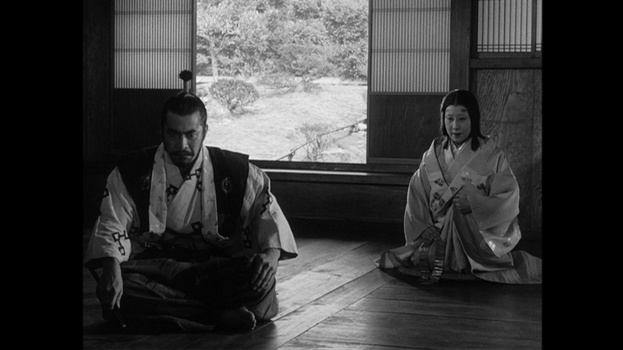
Washizu (to me) makes the great mistake of telling Lady Asaji about the prophecy and everything that’s happened and from that point on she can’t let it go; Washizu MUST fulfill the rest of the prophecy or he is no man at all. I have to say that Isuzu Yamada’s performance as Lady Asaji is one of the most chilling renditions of the Lady Macbeth character that I have ever seen. Part of the eeriness comes from Kurosawa instructing the actress to never blink on-camera. This gives her a not-quite-human affect and makes it like she’s wearing a mask (which is a reference to traditional Japanese theater, where the actors wore masks to denote their character). Asaji is near-sociopathic when it comes to getting what she wants, especially when she speaks of killing the Great Lord (which, as Washizu points out, would be an act of treason).

TOB - 9

Great Lord Washizu sees Miki’s ghost at a feast

Despite Washizu’s doubts, he finally gives in and murders the Great Lord off-camera when the latter comes to stay at the garrison for a night (Asaji having convinced him that all of this is a ploy that will eventually lead to Washizu’s execution). Despite successfully becoming the next Great Lord, Washizu is far from happy. But he at least sees one happy ending for his story: his dear friend Miki will be named his heir, as will Miki’s son, since Washizu has no children to succeed him. But while Washizu is content to reign and then turn the castle over to someone else, Lady Asaji is not. In a twist specificially created by Kurosawa, the devious wife drops a bombshell on her husband:

Asaji: “I am….with child.”

Washizu: “Truly?!”

Asaji: “….yes.”

The revelation that Asaji is pregnant (and she truly is, it’s not a lie) changes everything and gives Washizu a true motivation to eliminate Miki and his son from the picture. This is done, though Miki’s son escapes. At a feast later that night, Washizu sees Miki’s ghost sitting at his usual place in the hall, which terrifies the guilty lord who nearly reveals the whole truth to his entire court! I love Mifune’s performance in this scene, he is clearly wrestling with his fear and guilt and a part of him wants to badly to scream his sins in front of the world. But there’s still the child…isn’t there? Well, when the time to give birth arrives, a maid delivers the news: Asaji delivered a stillborn child, one that had been dead in the womb for some time, meaning Washizu ordered his best friend murdered for nothing. The loss of the child and the weight of her guilt combine to drive Asaji mad, and we last see her frantically trying to clean the phantom blood from her hands.

Vlcsnap-165532

Washizu with the fatal arrow in his neck

Washizu dies just like Macbeth at the conclusion of the story, but it’s the manner of his death that I’d like to talk about. Just like in Shakespeare, Washizu receives a final prophecy from the witch: he will not be overthrown until Spider Web’s Forest marches up to the castle. Since forests can’t walk of their own accord, Washizu assumes this means he’s invincible and he tells his men as much. But then, one night, an army organized by the son of the murdered Great Lord arrives and strange noises are heard in the forest. In the morning, the soldiers keeping watch cry out in panic, for there is Spider-Web’s Forest walking up to the castle!

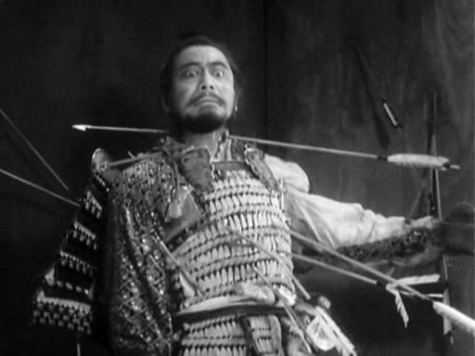
In actuality, the invading soldiers had chopped down the trees to 1) make it easier to reach the castle and 2) disguise how many soldiers and wagons they had with them. Seeing the prophecy come true, Washizu’s men turn on him and suddenly a few arrows are shot at the terrified lord. When he calls them out that killing the Great Lord is treason, a soldier yells back “And who killed our last lord??” Dozens of arrows pursue Washizu as he runs for his life, but every way is cut off by arrows. He’s pierced dozens of times, but he still struggles to get away until suddenly (in one of the best executed jump-cuts you’ll ever see), an arrow pierces his neck, killing him, and bringing an end to the tragedy of Washizu.

throne-of-blood-8

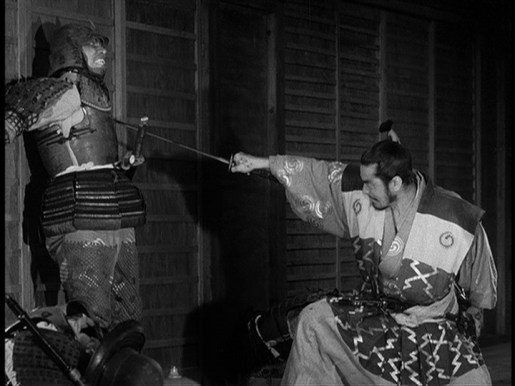
An interesting note about the final scene with the arrows: Toshiro Mifune was really being shot at by live arrows (for the most part, a few are guided by wires which can be seen if you watch for them). His frantic arm movements are actually directing the archers as to which direction they need to shoot in next. This is why Washizu looks so terrified: because Mifune is genuinely terrified!

I would also like to give a quick mention to the wonderful score composed by Masaru Sato (1928-1999), who composed music for Kurosawa’s films for over a decade. He created music that highlights both the good and bad moments in Washizu’s life, and it really adds to the quality of this film.

If you’d like to watch Throne of Blood (which I highly recommend), the Criterion Collection has a restored copy on DVD/Blu Ray. It can also be streamed via FilmStruck. If you’ve seen Throne of Blood, what did you think of it? Let me know your thoughts in the comments below. Have a good day!

See also:

My thoughts on: Yojimbo (1961)

Live-Action Films/TV

Become a Patron of the blog at patreon.com/musicgamer460

Check out the YouTube channel (and consider hitting the subscribe button)

Don’t forget to like Film Music Central on Facebook 🙂

Film 101: Deus ex machina

Literally translating to “god from the machine,” deus ex machina refers to a plot device in which a seemingly unsolvable problem is suddenly and abruptly resolved by the inspired and unexpected intervention of some new event, character, ability, or object. The phrase originates in ancient Greek drama, where the mortal heroes would be rescued from their dilemma by the direct intervention of the gods (usually wheeled onto stage with some kind of machine, hence “god from the machine”).

With the invention of film, naturally examples of deus ex machina abound, though usually they’re the source of great scorn from the audience, as resorting to deus ex machina is usually perceived as “taking the easy way out” when it comes to telling a story.

Some notable examples include (but are by no means limited to):

  • The Eagles in The Hobbit/The Lord of the Rings: The Great Eagles of Middle-Earth actually serve this purpose on multiple occasions: Eagles rescue Bilbo, Gandalf and the Dwarves in The Hobbit; Eagles show up out of nowhere to save the day in The Battle of the Five Armies; Eagles show up out of nowhere to save the day in The Return of the King (I sense a pattern here); an Eagle rescues Gandalf from Isengard; an Eagle rescues Gandalf from Moria (though to be fair, that’s more explicitly stated in the book than in the film); and of course, Eagles rescue Frodo and Sam from the exploding Mount Doom after the Ring was destroyed. So much of this story would not have happened without the Eagles (often unexpected) intervention.

Vizzini_battle_of_the_wits

  • Immunity to Iocane powder in The Princess Bride: So in order to save Buttercup, Wesley challenges Vizzini to a “battle of wits” where the latter has to determine which cup of wine has been poisoned with deadly iocane powder. Only after Vizzini is dead does it come out that both cups were poisoned because (conveniently), Wesley spent several years building up an immunity to the substance.
  • Fawkes and Gryffindor’s sword in Harry Potter and the Chamber of Secrets: Things get pretty dark for Harry by the end of this film: he’s been poisoned by a basilisk, he’s isolated in the Chamber of Secrets deep below Hogwarts, there’s no way he can possibly survive, right? Well…out of nowhere, here comes Fawkes, a magical phoenix whose tears can cure any poison! Fawkes also has the Sorting Hat, which, oh how convenient, produces the legendary sword of Godric Gryffindor, giving Harry the means to kill the basilisk once and for all.

Kylo_Ren_Interrogates_Rey.0

  • Rey’s mind-reading abilities in The Force Awakens: If this is not a deus ex machina moment then it treads dangerously close to being one. Doesn’t it seem particularly odd that, when Kylo is attempting to read her mind to find the information about the map piece, that Rey is suddenly able to turn it around and read Kylo’s mind, just like that? And on a related note, how did she know to use the Jedi mind trick on that stormtrooper?
  • The Martians in The War of the Worlds: This has to be one of the biggest examples of deus ex machina ever made, and no matter how it’s spun for a film, it always sounds really stupid. Consider: Earth has been overwhelmed by a fleet of Martian ships that slaughter and destroy all in their path. Nothing the Earth has can stop them, it’s only a matter of time before everything is wiped out. And then suddenly, all the Martians begin dropping dead. It turns out these unstoppable aliens were brought down by…germs? That’s right, all the military might in the world couldn’t get the job done, but microscopic germs could (it just took time for the Martians to be affected by them). Independence Day somewhat parodies this when David uploads a computer “virus” to the mother ship, bringing down the shields of the invading ships.

I would also like to point out that The Matrix Revolutions somewhat parodies this concept when Neo meets the central interface of Machine City, known as The Deus Ex Machina.

So there are five examples of deus ex machina in film. Let me know what you think of these examples in the comments below and also feel free to share any examples you can think of that I didn’t mention. Have a good day!

Become a Patron of the blog at patreon.com/musicgamer460

Check out the YouTube channel (and consider hitting the subscribe button)

See also:

Film 101: Archetypes

Film 101: The MacGuffin

Don’t forget to like Film Music Central on Facebook 🙂
Soundtrack Review: Maze Runner-The Death Cure (2018)

images

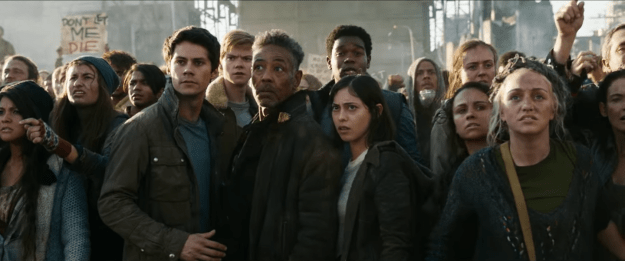
Maze Runner: The Death Cure is a 2018 American dystopian science fiction film based on the third novel in the Maze Runner trilogy written by James Dashner. It was originally meant to be released in 2017 but had to be delayed when series star Dylan O’Brien suffered injuries while filming and required extensive time to recover. In The Death Cure, the surviving “Gladers” must infiltrate WCKD headquarters in order to rescue their friend Minho who is being tortured by WCKD in hopes of developing a cure for the Flare virus that has turned most of the population into “Cranks” (zombie-like beings that have an overwhelming urge to kill anyone who isn’t a Crank). The film and soundtrack released on January 26th, 2018.

The score for The Death Cure was composed by John Paesano, a composer with a lengthy list of film credits to his name. Paesano received an Annie Award for Best Music for his work on DreamWorks’ animated series Dragons: Riders of Berk, which is based on the Academy Award® winning film How To Train Your Dragon. He won a World Soundtrack Award for his score to the hugely successful young adult adaptation, The Maze Runner.

He has now completed the trilogy, which includes The Scorch Trials and The Death Cure. His other credits include Universal Picture’s Almost Christmas and Sony Animation’s The Star. He’s currently scoring both Marvel’s hit series Daredevil and Defenders. Forthcoming in 2018 is Spider-Man PS4, which will be released featuring John’s huge orchestral score.

maze-runner-the-death-cure-clips

Listening to Maze Runner: The Death Cure was a refreshing change of pace compared to the other science fiction works I’ve been listening to as of late (i.e. Annihilation and Altered Carbon). Unlike those works, The Death Cure’s score uses a more traditional orchestra, mostly strings, though there is a healthy dose of synthesizer used as well (in the 21st century, it’s next-to-impossible to find a film score that doesn’t use synthesized music at some point).

Two tracks that stood out to me were “The Virus” and “The Last City.” With “The Virus,” it was very interesting, given the track’s title, how it actually sounded. I was expecting to hear something sinister and dark, but it actually sounded very pleasant. With layered orchestral chords and synthetic drones, the music is actually rather serene at times, which makes me wonder what part of the film this music is attached to with a title like “The Virus.” I really do enjoy listening to this track, it’s simple and direct and hopefully gets its point across in the film.

Last_City

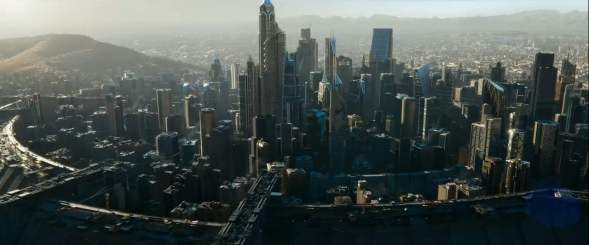
“The Last City” can only be referring to the city that holds WCKD headquarters (and is presumed to be the last functioning city of its kind on Earth). Appropriately enough, given the post-apocalyptic setting, the music for this track is sad, with a mournful horn melody accompanied by strings. I have to imagine that even for those living inside the city things must seem completely hopeless, given how close humanity is to extinction, no wonder the music is so sad. I like how Paesano has written this piece, especially how the strings swell up with a theme of their own and weave in and out with the horn. Like “The Virus,” this track is relatively simple but effective.

And those are my thoughts on the soundtrack of Maze Runner: The Death Cure. Reviews of the film have been mixed, but I think Paesano’s soundtrack is good, and I hope you enjoy listening to it. My thanks to The Krakower Group for making this soundtrack available for review. The soundtrack is available via Sony Classical.

Don’t forget to like Film Music Central on Facebook 🙂

Become a Patron of the blog at patreon.com/musicgamer460

Check out the YouTube channel (and consider hitting the subscribe button)

See also: Film Soundtracks A-W