Tag Archives: film

My thoughts on Alien: Covenant (2017)

Oh my. Oh my oh my oh my…..well, I finally worked up the courage to go see an Alien film in the theater, and the experience was exactly what I suspected it would be: I.Was.TERRIFIED!!!! Not all the time, but enough that I was thoroughly weirded out by the time the movie ended.

And every time I relate my fright to someone, the first thing they ask is: but did you LIKE it? And…well….I’m actually not sure. I THINK I liked it, I mean if the goal of the film was to scare it’s audience half to death (and gross out the other half) than I think it succeeded).

The story is eerily similar to the original Alien film (which I believe was the idea): the colony ship Covenant is en route to Origae-6 with 2000 colonists (and 1000+ human embryos) in hypersleep and cryo-storage. With seven years and four months left in the voyage, the ship is overseen by the synthetic Walter, who is a physical duplicate of David, the android we met in Prometheus (the events of which are revealed to have occurred ten years before this film). Everything is fine until a random neutrino storm damages the ship. The crew is woken to deal with the problem, but the captain’s pod malfunctions and Branson (James Franco!!) burns to death trapped inside his pod (in the first majorly disturbing scene of the film).

From that point, through pretty much the rest of the film, the crew makes one bad decision after another, and the only one who speaks any degree of sense is Daniels (Covenant’s version of Ripley), who vehemently protests departing their original course to pursue a mystery planet that was previously undetected. This planet turns out to be where David and Shaw ended up after departing at the end of Prometheus. The Covenant crew lands to explore (leaving the main colony ship and a few crew members in orbit) and finds a gorgeous planet, fertile and perfectly habitable (bad weather notwithstanding) but no animals of any kind. Still, there’s no apparent danger until one crew member steps on a pile of half buried jars that release the same pesky pathogen from Prometheus. And a little while later, a second crew member ingests the same pathogen at the site of Shaw’s crashed ship.
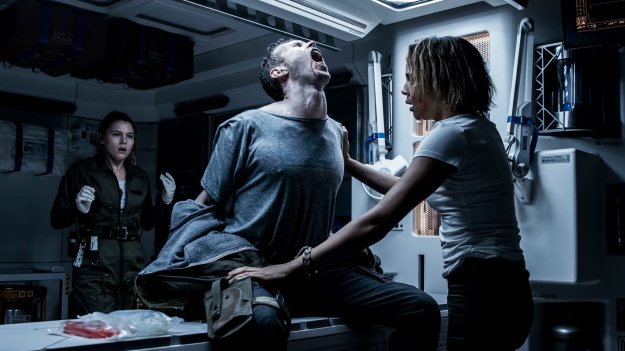
alien-covenant-backburster

Well, you can guess what happens: chaos!! The first crew member becomes host to a “back-burster” because, well, it claws its way out of the poor guy’s back in a terrifying scene. And, I have to admit that the one critic was right; these crew members act really really dumb. I mean, the one is trying to fend off this newborn Alien with a KNIFE, like that is going to do ANYTHING!! And the one crewmember who DOES go for a gun, misses at point blank range!! *facepalms* As bad as all of that was, it’s nothing compared to the “mouth-burster” that appears from the other crew member. I can’t describe it to you without feeling nauseous, but you can imagine what it looked like.

(Un)Fortunately the crew is “rescued” by David, who has been living alone on the planet for the last 10 years. Claiming that Shaw was killed in the crash and the planet’s population wiped out accidentally, David takes them to the heart of a city that is now a necropolis, literally. The square is full of thousands of blackened corpses, all twisted up in terror from the pathogen that killed them.

The truth about what David has done is absolutely horrifying (especially given that Shaw rescued him and put him back together). Not only did Shaw not die in the crash, she was systematically tortured as David experimented with what the pathogen would do to a human body. It is further revealed that David deliberately released the pathogen on the planet, knowing what it would do to the people living there. It seems that from the beginning David has had nothing but contempt for the humans who created them, deriding them to Walter as “a dying species” who are not worthy to start a new life elsewhere. It seemed to me that David hoped to sway Walter to his side, and I couldn’t help but be reminded of the dynamic between Data and Lore in Star Trek: The Next Generation. David refers to Walter as “brother”, and like Lore, he possesses advanced emotional capabilities that Walter does not have. In fact, Walter informs David that others were afraid of him for that reason, which is why subsequent models were made with less emotions (almost the identical reasoning for why Data was made without emotions). Seeing that Walter will not join him, David attempts to kill him, but Walter has a secret: his body is capable of self-repair (something David is unaware of). The first climax involves a tremendous fight between Walter and David (essentially Michael Fassbender is fighting himself and it’s great!!) but the outcome is left unresolved, we only see “Walter” running out after the few surviving crewmembers when pilot Tennessee brings another ship down to rescue them.

ALIEN: COVENANT

It should be mentioned that before all this, David revealed to the captain that he has created eggs, yes THOSE eggs, facehuggers and all. The captain is lured into peeking into an open egg in one of the stupidest moments I’ve ever seen (I mean seriously, looking into the scary alien egg because the untrustworthy android told you to? Seriously?) Revealing David to be the creator of the traditional xenomorph to me turns the history of Alien on its head. Because, it now comes out that the most deadly creature in history was created by one of our own androids for the express purpose of wiping out the human race. But then again, if THAT is true, how is it possible that Predators have been hunting Aliens for thousands of years (per the events of Alien vs Predator and Alien vs. Predator Requiem)? Ah plot holes…don’t you just love them?

Returning to the story, there’s one last fight between Daniels and the xenomorph who is clinging to the ship, but it is disposed of. The fight is over, good guys won, but just as we all breathe a deep sigh of relief…it turns out it’s not over at all. See, the one surviving crewmember, turns out he was already infected with a chestburster (when or how that happened, I’m still not sure, though I have my suspicions. And don’t even ask me why it took longer for this one to gestate). Now there’s a fully formed Alien loose on board the Covenant. It takes out two more crew members (who are too busy getting “busy” in the shower to hear the alarm bells) and it takes the combined efforts of Daniels and Tennessee (“Walter” is watching in fascination) to eject the Alien from the ship.

NOW the crisis seems to be over and Daniels and Tennessee can return to their sleep pods for the remainder of their trip. But just before she goes to sleep, Daniels asks “Walter” if he will help her build the cabin she talked about at the beginning of the film. But the android doesn’t answer…because he isn’t Walter. He’s David…and now he has control of everything on the ship. The last scene with Daniels is the most horrifying at all because she knows exactly what David plans to do with her (the same that he did to Shaw) and watching her futilely bang and scream inside her sleep pod before she is yanked into cryo-sleep is terrifying to watch. And that’s where the film ends, with David in control, looking over the 2000 colonists that are now his unwitting test subjects. A final transmission reveals that any news of this “incident” won’t be relayed to Earth for at least 18 months. It’s a dark ending, and a terribly dark film, one that I’m not sure I’ll ever be able to watch again because it was just that terrifying.

But one detail in the film intrigued me to no end: at least half of the film uses Jerry Goldsmith’s original Alien score to the exclusion of any other type of music. Even the opening titles (where and how the main title appears) is done in the same way as the original Alien title. It’s an interesting decision that makes sense to a certain degree. Ridley Scott is determined to have Covenant (and the films that follow) set squarely in the Alien universe (no confusion like what happened in Prometheus). What better way to do that than using the original Alien music? When in doubt, set the world with music.

Having watched Alien, Aliens and Prometheus (along with Alien vs Predator), I thought I had some idea of what to expect from this film. I knew there would be blood and gore, that goes without saying for an Alien film, but I was not prepared for what I saw in the film, not even close to prepared.

Contrary to what some people perceive, I am not scared of seeing blood in and of itself. What gets to me is when it’s a LOT of blood, and especially when it’s right up front, no getting away from it. And when you compare Alien: Covenant to its predecessors, one thing stands out right away: the amount of blood actually visible during the violent sequences. Oh sure, there’s the iconic “chestburster” scene with its violent spurt of blood; the pilot Ferro meets a bloody end in Aliens, but really, most of the deaths happen so fast there isn’t any blood at all. But in Alien: Covenant, it seems like every other death scene is an excuse to let loose a torrent of blood and guts. While the “back-burster” scene was gross, I could (mostly) watch because it was really just a chest-burster in reverse. However, the scene that will always bother me is the “mouth-burster.” As soon as I realized what was happening, I had to look away, I could not watch it happen, because I felt physically ill at the thought of it. I know the Alien films are firmly set in the horror genre, but I really feel like that scene took it too far (unless your goal is to make the audience want to throw up).

One detail I’m glad for is that they kept Shaw’s torture and death offscreen, only showing us a few details via David’s drawings. And thankfully, by the time they showed those pictures in detail, my mind was so weirded out that I didn’t really process the images (I didn’t even realize it was Shaw until the last picture) or what they were all about. And speaking of David’s “experiments”, something has been bugging me: in the flashback, the pathogen turned all the Engineers into blackened corpses, right? In that case, where did David get that dissected corpse that was laying on the table? It had an Engineer’s physique, so where did it come from?

These are my excess thoughts on Alien: Covenant; despite the fact that I was royally grossed out and freaked out, I’ll probably be lining up to see the sequel whenever it gets here, if only because now I have to see how this prequel series will line up with the original Alien (that is, if there IS another sequel).

See also:

My Thoughts on: Alien (1979)

My Thoughts on: Aliens (1986)

Become a Patron of the blog at patreon.com/musicgamer460

Check out the YouTube channel (and consider hitting the subscribe button)

Film Reviews

Don’t forget to like Film Music Central on Facebook 🙂

Star Trek II: “Inside Regula I” (1982)

One doesn’t normally associate the horror genre with Star Trek in any way, shape or form (though the infamous “Genesis” episode in Star Trek: The Next Generation comes awfully close in my opinion), and yet there is a scene midway through Star Trek II: The Wrath of Khan that could be straight out of a horror film.

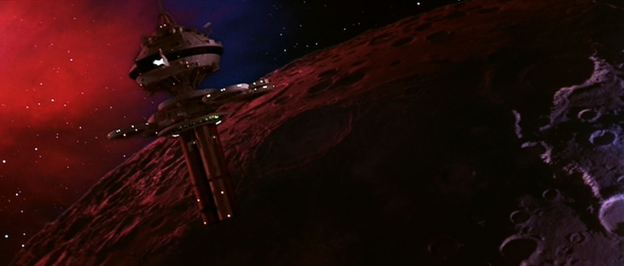
The Enterprise is diverted from a routine training mission by an emergency call from space station Regula One and along the way are ambushed by Khan Noonien Singh, who seeks revenge against Admiral Kirk for stranding him and his followers on Ceti Alpha V fifteen years previously. Barely surviving this attack, the Enterprise limps to the space station, knowing Khan has been there and gone, not sure what they’ll find. Kirk, McCoy and Lieutenant Saavik beam over to see what, if anything, remains on the space station.


From the moment they transport down, the music is like something straight out of a horror film. The space station appears totally abandoned, and the music is dark and ominous. Even though Khan has left, there’s still no way of knowing if he’s left any “surprises” for Kirk and his crew.

Kirk, Saavik and McCoy walk through the empty corridors of the station, and the air is thick with tension. But it isn’t until we go back to a last shot of McCoy that we get the big “horror film” moment. He’s about to cross into a new section when he’s suddenly startled by a rat (because of course there are rats on space stations). And just when he thinks it is safe to keep going….WHAM!! He walks headfirst into the arms of a dead crew member, hanging upside down from a balcony.

It’s a truly horrifying moment, and one that I think is slightly underrated, due to the space battle that happens before and after this segment of the film. But this music is beautiful foretaste of what will come when Horner scores Aliens a few years after this film. I hope you enjoy a look at the scene “Inside Regula One.”

Become a patron of the blog at: patreon.com/musicgamer460

Check out the YouTube channel (and consider hitting the subscribe button)

See also: Film Soundtracks A-W

Don’t forget to like Film Music Central on Facebook 🙂

Disturbing Disney #14: The Salt Trap in The Jungle Book (1994)

When Disney released a live-action adaptation of The Jungle Book last year, many seemed to have forgotten that this was the second live-action version of the story that Disney had ever made. The first was released in 1994 and stars Jason Scott Lee as Mowgli, Lena Headey (aka Cersei in Game of Thrones) as Katherine and Cary Elwes as Boone. I for one, can never wholly forget this film because it has a number of disturbing moments in the second half, one of the most disturbing coming in the Monkey City.

Unlike the animated film, where the Monkey City is just a pile of crumbling ruins, this version is not only loaded with treasure, but is also filled with booby traps of all kinds. Mowgli is forced by Boone and his compatriots to lead them to Monkey City so they can help themselves to the treasure (despite Mowgli’s warnings that the city is dangerous). By the time they get inside the city, most of Boone’s henchmen are dead, but a hunter named Buldeo (who incidentally left Mowgli’s father to die at the beginning of the film) is still alive and he is relentlessly pursuing Mowgli, intent on killing him. But this is complicated because Wilkins (another associate), accidentally shot him in the leg shortly before he was mauled to death by Shere Khan.

Limping all the way, Buldeo seemingly has Mowgli cornered in a sunken pavilion, when a stray shot unexpectedly causes a decoration to burst out of the wall, pouring salt out on the floor. This trips a chain reaction, where more and more decorations burst out, spilling more and more salt, and the reason why becomes clear; as the salt spills out, the roof of the pavilion is slowly lowering, meaning Mowgli and Buldeo are caught in a trap! Mowgli is able to leap out of the pit to safety, but Buldeo is hampered by his wounded leg and must hobble for the stairs, but he is caught in the growing streams of salt.

I’m convinced it is salt and not sand because the material causes Buldeo intense pain in his wounded leg (and salt is very bad for open wounds). Also, this was supposed to be a fantastically wealthy city, so it makes sense to me that the people who built these traps could afford the luxury of using salt as part of the mechanism. All this time the ceiling is slowly but surely descending, to Buldeo’s mounting panic as it becomes clear he will NOT be able to get out in time. By the end, he is futilely pressing against the ceiling in an attempt to stop the inevitable…with a final scream the ceiling clamps down on the floor, entombing Buldeo forever in that small pit, where he will quickly suffocate (unless that salt fills up the space first).

tumblr_inline_ov3974JTG91qdawwj_1280

This scene terrified me as a child, because I would have nightmares of being trapped in that kind of a situation. To this day I can’t believe this film is ONLY rated PG because, in no particular order, we have: a man drowning in quicksand; a man being mauled to death by a tiger, people being shot, falling to their deaths, etc. But of all the deaths, Buldeo being buried alive in the Salt Trap is by far the most disturbing of all. I’d actually nearly put this scene out of my mind but I’m glad I remembered it so I could share it with all of you.

What do you think of the Salt Trap in this film? Does it disturb you? Can you believe they put this in a movie for kids? Let me know your thoughts in the comments below, I’d love to hear about it.

Become a Patron of the blog at patreon.com/musicgamer460

Check out the YouTube channel (and consider hitting the subscribe button)

For more Disturbing Disney see also:

Disturbing Disney #1: The Coachman in Pinocchio (1940)

Disturbing Disney #2: The truth of Pleasure Island in Pinocchio (1940)

Disturbing Disney #3: Escaping Monstro from Pinocchio (1940)

Disturbing Disney #4: Dumbo loses his mother (1941)

Disturbing Disney #5 The death of Bambi’s Mother

Disturbing Disney #6: Faline vs. the dogs (1942)

Disturbing Disney #7: Cruella wants to do WHAT??

Disturbing Disney #8: The Whale Who Wanted to Sing at the Met (from Make Mine Music, 1946)

Disturbing Disney #9: Dr. Facilier’s Fate (The Princess and the Frog, 2009)

Disturbing Disney #10: The rat in Lady and the Tramp (1955)

Disturbing Disney #11: Clayton’s Death in Tarzan (1999)

Disturbing Disney #12: The Bear from The Fox and the Hound (1981)

Disturbing Disney #13: “Smoking them out” in The Fox and the Hound (1981)

Disturbing Disney #15: Night on Bald Mountain from Fantasia (1940)

Disturbing Disney #16: King Triton destroys Ariel’s grotto

Disturbing Disney #17: Ratigan becomes a monster in The Great Mouse Detective

Disturbing Disney #18: The Queen’s assignment for her Huntsman

Disturbing Disney #19: Cinderella’s dress is destroyed (1950)

Disturbing Disney #20: Quasimodo is crowned ‘King of Fools’ (1996)

Don’t forget to like Film Music Central on Facebook 🙂

Disturbing Disney #13: “Smoking them out” in The Fox and the Hound (1981)

So yesterday I shared with you the disturbing sequence involving a monstrous bear in the 1981 film The Fox and the Hound. But before we got to that point, there’s actually another equally disturbing moment that gave me chills as a kid.

After Todd is nearly lured into a steel trap, he makes a run for it along with his newfound mate Vixie. They run to their burrow and hide but are quickly cornered by the hunter and Copper. As there’s no way for the hunter to get a clean shot (and Copper is unable to dig his way in), the hunter gets an idea: he’ll “smoke” them out of their burrow by setting a clump of dried grass on fire and fanning the flames so that they roar INTO the burrow.

With one exit blocked by flames, the hunter and Copper stand poised at the main entrance, ready to kill the foxes the moment they come out. Inside Todd and Vixie are cornered by a growing inferno and finding it hard to breathe with all the smoke. This moment scared me half to death because, as a kid, I had a fear of being trapped by fire, so this scene was somewhat traumatic for me.

Even how Todd and Vixie escape this trap is somewhat disturbing. They can’t go out the main way because they’ll be killed instantly. So the only other way out is the back entrance (which is currently surrounded by scorching flames). But since it’s their only option…the two foxes run THROUGH the flames and make it out, to the shock and amazement of the hunter, who resumes the chase that will lead him straight to the crazy huge bear.

The whole scenario is disturbing for me, but at least Todd and Vixie aren’t burned to death, and to be fair, it doesn’t look like they were burned at all (which is totally possible in the world of Disney). So while this is a disturbing moment, it’s not as disturbing as it could have been.

What do YOU think of this disturbing moment in The Fox and the Hound? Let me know what you think in the comments below, I’d love to hear about it 🙂

For more Disturbing Disney, see here

Become a Patron of the blog at patreon.com/musicgamer460
Check out the YouTube channel (and consider hitting the subscribe button)

See also:

Disturbing Disney #1: The Coachman in Pinocchio (1940)

Disturbing Disney #2: The truth of Pleasure Island in Pinocchio (1940)

Disturbing Disney #3: Escaping Monstro from Pinocchio (1940)

Disturbing Disney #4: Dumbo loses his mother (1941)

Disturbing Disney #5 The death of Bambi’s Mother

Disturbing Disney #6: Faline vs. the dogs (1942)

Disturbing Disney #7: Cruella wants to do WHAT??

Disturbing Disney #8: The Whale Who Wanted to Sing at the Met (from Make Mine Music, 1946)

Disturbing Disney #9: Dr. Facilier’s Fate (The Princess and the Frog, 2009)

Disturbing Disney #10: The rat in Lady and the Tramp (1955)

Disturbing Disney #11: Clayton’s Death in Tarzan (1999)

Disturbing Disney #12: The Bear from The Fox and the Hound (1981)

Disturbing Disney #14: The Salt Trap in The Jungle Book (1994)

Disturbing Disney #15: Night on Bald Mountain from Fantasia (1940)

Disturbing Disney #16: King Triton destroys Ariel’s grotto

Disturbing Disney #17: Ratigan becomes a monster in The Great Mouse Detective

Disturbing Disney #18: The Queen’s assignment for her Huntsman

Disturbing Disney #19: Cinderella’s dress is destroyed (1950)

Disturbing Disney #20: Quasimodo is crowned ‘King of Fools’ (1996)

Don’t forget to like Film Music Central on Facebook 🙂

Disturbing Disney #12: The Bear from The Fox and the Hound (1981)

I think I’ve mentioned before that the Disney films made between Sleeping Beauty in 1959 (the end of Disney’s Golden Age) and The Little Mermaid in 1989 (the start of the Disney Renaissance) often get overlooked or underrated because they’re not quite up to the standards of either era (or at least that’s the perception). A classic example of this is 1981’s The Fox and the Hound, a good film that is criminally neglected and yet it has one of the most disturbing sequences I’ve ever seen.

In summary: The Fox and the Hound is about…you guessed it…a fox and a hound who become friends (despite being natural enemies). The fox, named Todd, is eventually set loose in a game preserve to keep him safe from a gruff hunter and his hound Copper (formerly Todd’s friend). But the hunter wants to kill Todd for nearly getting his other hunting dog Chief killed and so he trespasses onto the preserve to hunt the fox down, laying a series of steel traps by a secluded watering area.

The trap nearly works, but at the last moment Todd senses the danger and runs for it. In the ensuing chase (including another disturbing moment I’ll cover next time), the hunter believes he has Todd cornered in some bushes, but he is so very wrong. Instead of the fox, the hunter has cornered THIS:

Even referring to this bear as “a bear” is an understatement; he’s practically a monster in the way he’s presented as this huge snarling mass of muscle and teeth (the demonic red eyes add to the monstrous impression). And then there’s the SIZE of this beast; even though the bear is colored black, in size he’s really more like a grizzly bear (which doesn’t make sense as I believe this story is supposed to be set in Appalachia).

MCDFOAN EC008

The sheer viciousness of the bear’s assault is terrifying, and also not surprising, considering he’s been disturbed by this raucous hunter (and also shot). But the disturbing part comes when the hunter’s foot gets caught in one of his own traps and the bear comes closer and closer for the kill. Even though he’s an antagonist, this hunter is facing a pretty agonizing way to die and he can’t do a thing about it.

And then there’s the fight between Todd, Copper and the bear. This huge bear is just THROWING these two around like nothing, and it’s painful to watch. The entire sequence has me on the edge of my seat from beginning to end, especially when the bear has Todd cornered on a fallen tree perched halfway up a huge waterfall (the ominous music tells you this will end badly). This bear is an excellent example of Disturbing Disney (I hope you enjoy the full scene up above).

What do you think of the bear in The Fox and the Hound? Let me know in the comments below, I’d love to hear about it 🙂

Become a Patron of the blog at patreon.com/musicgamer460
Check out the YouTube channel (and consider hitting the subscribe button)

For more Disturbing Disney, see here

See also:

Disturbing Disney #1: The Coachman in Pinocchio (1940)

Disturbing Disney #2: The truth of Pleasure Island in Pinocchio (1940)

Disturbing Disney #3: Escaping Monstro from Pinocchio (1940)

Disturbing Disney #4: Dumbo loses his mother (1941)

Disturbing Disney #5 The death of Bambi’s Mother

Disturbing Disney #6: Faline vs. the dogs (1942)

Disturbing Disney #7: Cruella wants to do WHAT??

Disturbing Disney #8: The Whale Who Wanted to Sing at the Met (from Make Mine Music, 1946)

Disturbing Disney #9: Dr. Facilier’s Fate (The Princess and the Frog, 2009)

Disturbing Disney #10: The rat in Lady and the Tramp (1955)

Disturbing Disney #11: Clayton’s Death in Tarzan (1999)

Disturbing Disney #13: “Smoking them out” in The Fox and the Hound (1981)

Disturbing Disney #14: The Salt Trap in The Jungle Book (1994)

Disturbing Disney #15: Night on Bald Mountain from Fantasia (1940)

Disturbing Disney #16: King Triton destroys Ariel’s grotto

Disturbing Disney #17: Ratigan becomes a monster in The Great Mouse Detective

Disturbing Disney #18: The Queen’s assignment for her Huntsman

Disturbing Disney #19: Cinderella’s dress is destroyed (1950)

Disturbing Disney #20: Quasimodo is crowned ‘King of Fools’ (1996)

Don’t forget to like Film Music Central on Facebook 🙂

My thoughts on: Guardians of the Galaxy Vol. 2 (2017)

WARNING: Spoilers of varying sizes will be found in this review. DO NOT read until you’ve seen the film (unless you don’t care if some epic plot twists are spoiled, in which case, carry on).

It’s been a long three years since I saw Guardians of the Galaxy (2014) and for a while it felt like the sequel would NEVER get here. But finally the great day arrived and it was totally worth the wait!

Guardians of the Galaxy Vol. 2 was everything I dreamed it would be, an epic return to the zany world of blue space pirates, trigger-happy raccoons and talking baby trees. And speaking of….HOW ADORABLE IS BABY GROOT???? Seriously, that little guy practically stole the film! He was almost too cute for his own good (even the minor villains were commenting on his cuteness at one point), but it added some levity to some pretty dark moments (like when half of Yondu’s crew was ejected into the vacuum of space, yeah, you read that right). And the post-credits scene featuring Teenage Groot was just hilarious. It literally consists of Groot sitting in his messy room (messy with tree vines) playing video games while Star-Lord admonishes him to clean up his room.

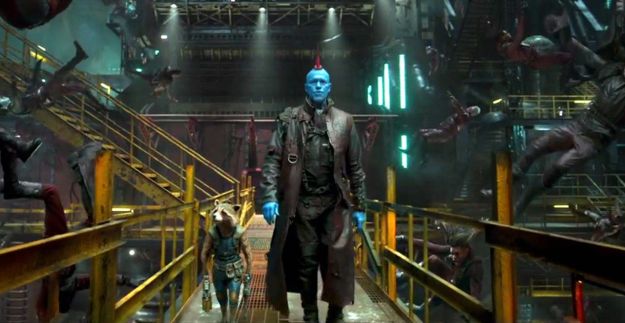
It was great to see Yondu back, even if I was slightly confused about his situation at first. When we first see the space pirate again (after he was tricked out of an Infinity Stone by Quill), he has (apparently) been exiled from the Ravagers for breaking their code, something involving the trafficking of children. I assumed they were referring to Yondu kidnapping Peter all those years ago, but it turns out that was only the tip of the iceberg (more on that later). Yondu has a pretty up and down time in this film: he starts off being an exiled captain, is taken prisoner by mutineers, and then retakes his ship with the help of Baby Groot, Rocket and one loyal crewmember in one of the most epic montage scenes I’ve seen in YEARS (lets just say his telekinetic arrow has a starring role).

Star-Lord’s team is as hilarious as ever (though I do feel like Drax burst into laughter one time too many, but that’s nitpicking). The tension between Gamora and Peter is beginning to grow palpable (she totally digs him even if she won’t quite admit it, but he definitely knows he loves her, or at least has very strong feelings for her). I wouldn’t be surprised if those two are together by the end of Vol. 3.

Guardians-of-the-Galaxy-Vol.-2-Sneak-Peek-11

Now let’s move on to Ego, The Living Planet, aka Star-Lord’s long-lost father. When I first heard that this character would be in the film, I was totally confused (I’ve never read the comics), and could not visualize what a living planet would look like. Actually, at first I thought Peter would just be talking to a giant planet for most of the time. But I have to say, the film did a great job of explaining how Ego is able to appear and travel as he does. And Kurt Russell was totally the best choice to play Star-Lord’s father, they totally act just the same way!! It explains so much about Peter, it really does. And the surface of Ego was so beautiful, perfect and so Eden-like…that I really should have figured out that much sooner that something was terribly wrong (like, before Mantis dropped the hint by nearly spilling the beans to Drax the first time).

There’s an old saying, that if something seems too good to be true, it probably is. And while it IS true that Ego is Peter’s father (the opening scene set in 1980 establishes that), he is hardly an ideal parent. The way Ego presents his story, he’s spent the last 30 years or so searching for his son, his ONLY son, so they can finally be together as father and son. It sounds nice, but considering he’s lived for millions of years I should’ve considered there was more to it than that. One of the first things they do together is see if Peter can connect to Ego’s essence, referred to as “The Light”, which resides at the core of the planet. Peter can do it, which makes Ego really happy, but not because it proves beyond a doubt that Peter is his son, but because it now gives him a means to an end.

Star-Lord-meets-Ego-in-Guardians-of-the-Galaxy-Vol-2

(WARNING, I’m about to spoil the big plot twist of the film): See, Ego isn’t this benevolent immortal looking to play catch-up with his son. He’s actually a little (lot) crazy and has come to the belief that his purpose in life is to fill the universe (or at least the galaxy) with replicas of himself. To this end, he’s spent the last million years or so planting essences of himself on every planet he’s ever come across (we see Earth’s at the beginning of the film, though we don’t know exactly what it is then). And on each of those planets, he made sure to sire a child, because, though he has the ability to plant these essences, he can’t activate them without the help of a second Celestial. But until Peter, none of this children, none of his MILLIONS of children, have possessed the right genes. So what did Ego do? He KILLED them!! Gamora and Nebula discover a series of caves below the surface that are filled to the brim with bones, millions of bones. And every last one belongs to Ego’s children, many of whom were brought to the planet by Yondu and his pirates (this is why the Ravagers exiled him). Yondu was paid handsomely to turn a blind eye to what was happening, but when he was sent to fetch Peter, he couldn’t bring himself to take the boy, because he figured he would die like the others. Now, all of this is bad enough, but then Ego admits one of the most shocking statements I’ve ever heard. In describing the glories of being a Celestial, Ego tells him (Peter) that they are “above mortals.” But then, what about Peter’s mother? “You said you loved my mother” Peter reminds him, and Ego admits that he really did love Meredith Quill, so much so that had he visited her on Earth a 4th time, he would have stayed on the planet and never left.

“It really broke my heart…” he says “When I had to put that tumor in her head.”

WHAT?? (I swear you could’ve heard the gasp all throughout the theater). Crazy Ego god-planet guy say WHAT???

As the opening of the first film established, Peter’s mother died of brain cancer, a long and tortuous way to die. NOW we learn that Ego PUT the cancer there in the first place!!!!! This knowledge pushes Peter over the edge (he loved his mother more than anyone) and leads into the climactic battle between father and son.

guardians-of-the-galaxy-2-ayesha

Of course the big lesson of this film is that family isn’t defined just by blood, it’s also who raised you, who forms actual bonds with you. The Guardians are more Peter’s family than Ego ever could have been. And as for Peter’s father…well, it was Yondu who really raised him, a fact that neither really admits to themselves until nearly the end of the film when….*gulps* when Yondu sacrifices his life to save Peter’s. Oh, that moment about broke my heart. Yondu tells Peter that “He (Ego) may have been your father, but he wasn’t your daddy!” And then he put the last spacesuit capsule-thing on Peter so he would be safe when they entered the vacuum on space, and all Peter can do is cry and scream in denial as Yondu dies right in front of him (that has to be one of the saddest moments ever in the MCU).

I’m so excited to see where the Guardians go from here, as we’ll next see them in Avengers: Infinity War (I sincerely hope Peter and Iron Man bump heads figuratively, I just know those two won’t get along at first). I also hope that Nebula gets the chance to exact vengeance on Thanos for everything he did to her as a child. I knew Thanos was cruel, but to do all of THAT to his own child…

I could probably keep going for another 1000 words, but these are the bulk of my thoughts on Guardians of the Galaxy vol. 2. Final verdict: it is definitely a film worth seeing and it totally lives up to the hype.

What did YOU think of Guardians of the Galaxy Vol. 2? Did you like it, not like it, prefer the original instead? Let me know in the comments below, I’d love to hear about it 🙂

Become a Patron of the blog at patreon.com/musicgamer460

Check out the YouTube channel (and consider hitting the subscribe button)

See also: Film/TV Reviews

My thoughts on: Black Panther (2018)

Avengers: Infinity War-Review (no spoilers)

My (spoiler-free) Thoughts on: Avengers: Endgame (2019)

Don’t forget to like Film Music Central on Facebook 🙂

Bernard Herrmann talks The Bride Wore Black (1968)

the-bride-wore-black-movie-poster-1968-1020216282

Normally when I share composer interviews, it’s for a relatively current film. But when I found an interview for the 1968 film The Bride Wore Black that was given by composer Bernard Herrmann, I just knew I had to share it with you.

The Bride wore Black (released in France as  La Mariée était en noir) is a revenge film directed by Francois Truffaut. It tells the story of a woman named Julie Kohler, whose husband is killed on her wedding day as they’re leaving the church. The crime occurred because five men were horsing around with a loaded rifle in a building across the street and it went off, fatally striking the newly married groom. After learning the identities of the men responsible, Kohler sets out to kill every last man responsible.

The new widow is completely ruthless in her pursuit of vengeance:


  • victim #1 is pushed off a balcony
  • victim #2 is poisoned
  • victim #3 is locked in a small closet where he suffocates to death (she sealed the door shut with duct tape
  • victim #4 would’ve been killed with a handgun but the police arrested him before she could get him
  • victim #5 is shot in the back (fatally) with an arrow as she posed for a painting of Diana, Goddess of the Hunt. After noticing that he’s painted her on the wall in a mural, Julie decides to leave the painting as is, knowing the evidence will lead to her arrest. After arriving at jail (where still-alive victim #4 is also serving time), she ends up working in the kitchen where she is last seen taking a food cart towards the men’s side of the prison (a scream implying she’s completed her task of vengeance).

The music for this film was written by the legendary composer Bernard Herrmann (perhaps best known for his collaborations with Alfred Hitchcock on four of his films, including Psycho). I haven’t found many interviews with Herrmann thus far, so it is fascinating to hear him talking about his work with any film. I admit I haven’t actually seen The Bride Wore Black (not yet anyway), but after watching this interview and reading more about the plot, I definitely need to check this film out.

What do you think of Bernard Herrmann talking about The Bride Wore Black? Have you seen the film? And if you have, what did you think of it? I’d love to hear about it in the comments below!

See also:

Film Composer Interviews A-H

Film Composer Interviews K-Z

Check out the YouTube channel (and consider hitting the subscribe button)

Don’t forget to like Film Music Central on Facebook 🙂

Brian Tyler scoring Partition (2007)

Partition is a very sad story, set in 1947 during the partition of India (when Pakistan was created as a Muslim nation). It is based on the Romeo and Juliet story type, where two people fall in love even though it is forbidden. In this case, a Hindu man, Gian Singh, slowly falls for Naseem, a Muslim girl, even though all the rules of their respective religions forbid this.

partition460

With Naseem separated from her parents and Gian finding himself responsible for her, the pair end up bonding over their mutually traumatic pasts and get married, having a son named Vijay. Things become complicated when word arrives that Naseem’s family is actually in a certain village in the newly formed Pakistan. Naseem leaves to visit, promising to return in a month, but her family is so infuriated that she’s married a Sikh that they lock her in a room and forbid her from returning to India. Gian is determined to rescue his wife, so he disguises himself as a Muslim and crosses into Pakistan.

After a disastrous attempt to rescue her, Naseem’s mother recognizes that her daughter really does love Gian and she lets her out so she can catch her husband at the train station. But just as the couple is able to reunite, Naseem’s brother Akbar pushes Gian onto the train tracks and he is killed by the approaching train, to the horror of Naseem. While the police arrest Akbar for murder, Naseem and Vijay are able to escape to England and make a new life.

MV5BNGM4MGI5YTgtZjk5Yy00Y2YxLTlhN2ItNTEyNmZiZmQ2YmYyXkEyXkFqcGdeQXVyNzg3Mzk0Nw@@._V1_

What makes this film notable for me is that it features a score by Brian Tyler, who is rapidly becoming one of my favorite film composers. This behind the scenes video shows Tyler at work in the studio, annotating his score and recording with a rough cut of the film playing on a screen in front of him. He also worked with the Hollywood Studio Symphony for recording the score as well.

One big thing with the music that Tyler wanted to create is, that while there is a sense of Western music in the score, there is also a frequent callback to the sound of India as well. He wanted to create the feeling that you (the audience) have been transported through time to this very traumatic period in the history of India and Pakistan.

There is something magical about watching Brian Tyler on the podium conducting his music, I definitely need to hear more of this score now. If you’ve seen Partition, I would love to know your thoughts on the film and the score in the comments below.

Become a patron of the blog at: patreon.com/musicgamer460

Check out the YouTube channel (and consider hitting the subscribe button)

See also:

Film Composer Interviews A-H

Film Composer Interviews K-Z

See also:

Brian Tyler conducts The Mummy (2017)

Brian Tyler talks Rambo (2008)

Brian Tyler talks The Expendables (2010)

Brian Tyler conducting and scoring Now You See Me 2 (2016)

Brian Tyler talks War (2007)

Brian Tyler “Alien vs. Predator: Requiem” scoring session (2007)

Brian Tyler “Law Abiding Citizen” scoring sessions (2009)

Brian Tyler “Dragonball Evolution” scoring session (2009)

Brian Tyler talks Fast Five (2011)

Brian Tyler “Battle: Los Angeles” (2011) scoring session

Brian Tyler scoring session for Iron Man 3 (2013)

Brian Tyler “Teenage Mutant Ninja Turtles” (2014) scoring session

Brian Tyler “Power Rangers” scoring session (2017)

Don’t forget to like Film Music Central on Facebook 🙂

Disturbing Disney #11: Clayton’s Death in Tarzan (1999)

You know, it sure seems to me like a lot of “disturbing” moments in Disney films happen to coincide with a villain’s death.

Tarzan (1999) is considered to be the end of the 1st Disney Renaissance, and for this reason I think the film has become totally underrated. Which is really a shame because the animation is incredible, particularly the scenes where Tarzan is “surfing” through the trees. The (real) villain is pretty awesome too. For most of the film, the “enemy” has been presented as Kerchak, the leader of the gorilla troop that raised Tarzan, and the gorilla that should have been Tarzan’s foster father, as it is Kerchak’s mate Kaala that  took the young man in when he was a baby, but Kerchak could never bring himself to accept the human as his son. However, the actual villain of this story is the bloodthirsty and devious Clayton (Brian Blessed), who has hitherto been working as a bodyguard for the expedition of Professor Porter and Jane. But in reality, Clayton has come because he wants to capture the gorillas for the handsome price they will fetch back in England.

Clayton

Behold the villainous Clayton, even before he’s revealed he kind of looks like a villain already

At the last minute, Tarzan is able to thwart Clayton’s attempt to kidnap all of the gorillas, but Clayton is not giving up just yet. After fatally wounding Kerchak, Clayton chases Tarzan up into the trees, figuring that if he can get Tarzan out of the way, rounding the gorillas back up should be easy. But despite his injuries (Clayton shot him in the arm), Tarzan has a distinct advantage: he was raised in this jungle, he knows how to navigate the trees with his eyes closed, Clayton is like a fish out of water.

Despite this, he continues to chase Tarzan until the latter is cornered against a tree trunk. But then Tarzan uses the jungle to his advantage, ensnaring Clayton’s limbs in a tangle of jungle vines (to his mounting fury). At this point, Clayton fully snaps and begins to furiously hack at the vines holding him up, and a single shot forewarns what is about to happen: as the vines are cut away, one loop slips up to tighten around Clayton’s neck.

The first time I saw this film in theaters, I didn’t realize what was going to happen, but my parents did. To this day I remember my mom gasping at the shot and wondering what she was reacting to. I realize now that Clayton has a particularly gruesome and disturbing death scene, one that is pretty graphic if you think it through.

As I’d said, Clayton is hacking away at the vines that are holding him up, not noticing one loop remains coiled around his neck. He is so frantic to get loose to kill Tarzan that he doesn’t notice there are fewer and fewer vines holding him up. Even Tarzan sees what is about to happen and tries to warn him, but Clayton doesn’t listen…and then it’s too late. Down to two vines (the one around his neck and the one his hand is clenching), Clayton hacks the wrong vine and begins to fall screaming, the vine still looped around his neck. This moment is terribly disturbing: not only is Clayton falling to his death, but he has enough time to know it and try desperately to avert the inevitable (see, as he falls, you can see Clayton’s hands trying to remove the loop before he runs out of slack). Maybe Tarzan could have saved himself, but Clayton is no Tarzan and in no time we see the vine go taught with an audible *SNAP* and then we see the shadowy profile of Clayton hanging by his neck…DEAD.

I’ll give Disney credit for one thing: at least they kept the actual moment of death off-screen and only showed Clayton’s dead body in silhouette. Still…watching a villain die via a broken neck is pretty disturbing, and thus it is here on the list of Disturbing Disney.

But I would like to know what YOU think of Clayton’s death; does it disturb you? Do you find it gruesome? Let me know in the comments below, I would love to hear about it.

Become a Patron of the blog at patreon.com/musicgamer460

Check out the YouTube channel (and consider hitting the subscribe button)

For more Disturbing Disney, see also:

Disturbing Disney #1: The Coachman in Pinocchio (1940)

Disturbing Disney #2: The truth of Pleasure Island in Pinocchio (1940)

Disturbing Disney #3: Escaping Monstro from Pinocchio (1940)

Disturbing Disney #4: Dumbo loses his mother (1941)

Disturbing Disney #5 The death of Bambi’s Mother

Disturbing Disney #6: Faline vs. the dogs (1942)

Disturbing Disney #7: Cruella wants to do WHAT??

Disturbing Disney #8: The Whale Who Wanted to Sing at the Met (from Make Mine Music, 1946)

Disturbing Disney #9: Dr. Facilier’s Fate (The Princess and the Frog, 2009)

Disturbing Disney #10: The rat in Lady and the Tramp (1955)

Disturbing Disney #12: The Bear from The Fox and the Hound (1981)

Disturbing Disney #13: “Smoking them out” in The Fox and the Hound (1981)

Disturbing Disney #14: The Salt Trap in The Jungle Book (1994)

Disturbing Disney #15: Night on Bald Mountain from Fantasia (1940)

Disturbing Disney #16: King Triton destroys Ariel’s grotto

Disturbing Disney #17: Ratigan becomes a monster in The Great Mouse Detective

Disturbing Disney #18: The Queen’s assignment for her Huntsman

Disturbing Disney #19: Cinderella’s dress is destroyed (1950)

Disturbing Disney #20: Quasimodo is crowned ‘King of Fools’ (1996)

And don’t forget to like Film Music Central on Facebook 🙂
Hans Zimmer talks Inception (2010)

I have watched a lot of movies, but few have bent my brain more than Inception (2010), a film set in a world where it is possible to enter the subconscious and “extract” information. Cobb, a “dream thief”, is tasked by a wealthy businessman named Saito to perform “inception” on the son of a rival, which is planting an idea in the subconscious mind, and it is supposed to be an impossible task.

The stakes for Cobb are pretty high: he’s been on the run for years after being framed for the murder of his wife (she actually committed suicide believing she was still in the dream world), and if he succeeds, Saito will make the charges go away so he can return home to his two children. But…in a world where we enter dreams within dreams within dreams, how do we know any of this is even real to begin with? (That question is never really answered by the way, we’re meant to make our own conclusions).

image-w1280

The visuals in this film are like nothing you’ve ever seen before: the scene where Ariadne and Cobb visit the dream world and bend the landscape around them is spectacular beyond words. Even if you’re paying attention to which level of consciousness the characters are on, it’s very easy to get lost and wonder “what is actually real here?” This is especially true when the film gets into the question of what really happened to Cobb’s wife (and why apparitions of her keep appearing in Cobb’s mind).

inception-2

The score for this reality-bending film was composed by the legendary Hans Zimmer, who returned to collaborate again with director Christopher Nolan on this project (Inception marked their third collaboration together). This brief “making of” video shows how Nolan and Zimmer brought this score into existence. Zimmer described the music of Inception as “a very electronic, dense score, filled with nostalgia and sadness.” What I love best about the score is how it changes as the characters move deeper and deeper into the “dream within a dream.” The deeper they go, the more “unreal” the music becomes; this all reaches a head when Cobb and Ariadne are in Limbo (the bottom level) while the other members of his group are moving through three separate dream levels above them.

If you’ve seen Inception, what did you think of the story? And what did you think of the film’s soundtrack? Let me know in the comments below 🙂 And I hope you enjoy this behind the scenes look at the making of the film score for this film 🙂

You can become a patron of the blog at patreon.com/musicgamer460

Check out the YouTube channel (and consider hitting the subscribe button)

See also:

Film Composer Interviews A-H

Film Composer Interviews K-Z

Hans Zimmer talks The Road to El Dorado (2000)

Hans Zimmer talks Hannibal (2001)

Hans Zimmer talks The Dark Knight (2008)

Hans Zimmer talks Sherlock Holmes (2009) and Sherlock Holmes: A Game of Shadows (2011)

Hans Zimmer (and Richard King) talk The Dark Knight Rises (2012)

Hans Zimmer talks Man of Steel (2013)

Hans Zimmer talks Interstellar (2014)

And don’t forget to like Film Music Central on Facebook (your support means everything to me) 🙂