Brian Tyler scoring session for Iron Man 3 (2013)

maxresdefault

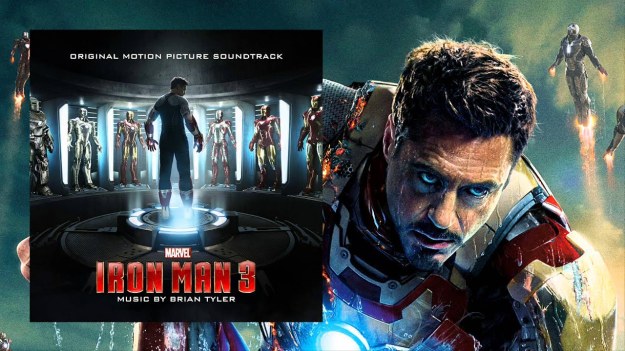
The Marvel Cinematic Universe has featured musical scores from a number of composers, but some of my favorite work comes from Brian Tyler, who to date has scored three films in the MCU: Thor: The Dark World, Avengers: Age of Ultron and Iron Man 3.

The thrilling conclusion to the Iron Man trilogy features some dark and stirring music that’s on full display in this recording (to be completely honest, I’m not sure if this is from an actual scoring session or a later re-recording for a soundtrack, but it’s pretty much the same setup as a scoring session so that’s what I’m calling it). Brian Tyler is one of those composers who also conducts and it’s always fun to watch him at work. From the moment the music starts you can tell he is completely into what he’s doing.


I love sharing these recording videos with you because I feel like it’s only once you see and hear the music being performed separate from the film that you can truly appreciate just how much work goes into putting the score together. Action scores (and often superhero scores) can get a bad rap but I really feel like the MCU has changed what a superhero film score can be in the 21st century. These scores are organic, breathing things, and I think this clip really shows that.

At any rate, I hope you enjoy watching Brian Tyler at work with Iron Man 3. Let me know what you think of the clip in the comments below and have a great day!

See also:

Brian Tyler “Alien vs. Predator: Requiem” scoring session (2007)

Brian Tyler scoring Partition (2007)

Brian Tyler talks War (2007)

Brian Tyler talks Rambo (2008)

Brian Tyler “Law Abiding Citizen” scoring sessions (2009)

Brian Tyler “Dragonball Evolution” scoring session (2009)

Brian Tyler talks The Expendables (2010) 

Brian Tyler talks Fast Five (2011)

Brian Tyler “Battle: Los Angeles” (2011) scoring session

Brian Tyler “Teenage Mutant Ninja Turtles” (2014) scoring session

Brian Tyler conducting and scoring Now You See Me 2 (2016)

Brian Tyler “Power Rangers” scoring session (2017)

Brian Tyler conducts The Mummy (2017)

Film Composer Interviews A-H

Film Composer Interviews K-Z

Become a Patron of the blog at patreon.com/musicgamer460

Check out the YouTube channel (and consider hitting the subscribe button)

Don’t forget to like Film Music Central on Facebook

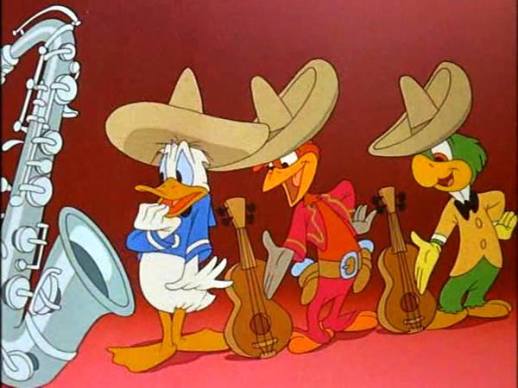
The Three Caballeros “The Three Caballeros” (1944)

*note: in the context of this song “gay” means happy/carefree

the-three-caballeros.jpg

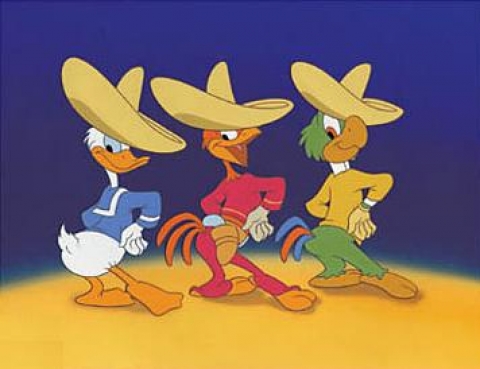
I’m not sure if I’ve mentioned it before, but during the 1940s Disney released a lot of what were called “package films.” While ostensibly released as a single feature, package films actually contained a series of separate animated shorts connected by a plot line. This happened because Disney found themselves with a lot of material that was too long to be regular cartoons and too short to be standalone features. This is how The Three Caballeros came into being. The common thread is that Donald Duck is celebrating his birthday and while opening his presents he learns about Mexico and South America via his friends José Carioca (a Brazilian parrot) and Panchito Romero Miguel Junipero Francisco Quintero González III (a Mexican rooster).

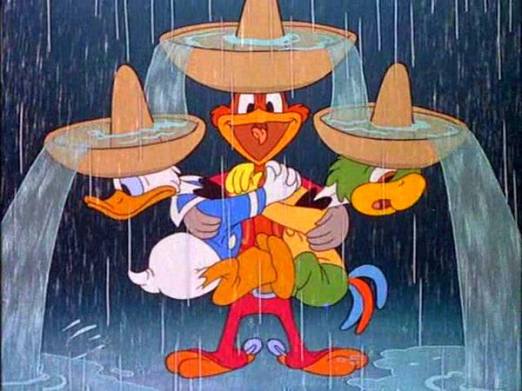
Once Panchito joins the party, he leads his friends in singing “The Three Caballeros.” In this song, Panchito praises the life of a caballero and how he is always loyal to his friends (unless there’s a girl involved, in which case forget it!) The rhythm and last verse of this song come from Ay, Jalisco, no te rajes!, a popular Mexican ranchera song released in 1941.

A running gag throughout the song is Donald trying (and failing) to imitate José and Panchito. For example, he flops to the ground when the others fly, and he can’t summon a guitar out of thin air (instead he gets a saxophone, a trumpet, and a double bass).

We’re three caballeros
Three gay caballeros
They say we are birds of a feather
We’re happy amigos
No matter where he goes
The one, two, and three goes
We’re always together

We’re three happy chappies
With snappy serapes
You’ll find us beneath our sombreros
We’re brave and we’ll stay so
We’re bright as a peso
Who says so?
We say so!
The three caballeros

04.jpg

Ooooh!
We have the stars to guide us
Guitars here beside us
To play as we go
We sing and we samba
We shout, ¡Ay caramba!
What means “Ay caramba”?
Oh, yes! I don’t know

Ooooh!
Through fair and stormy weather
We stand close together
Like books on a shelf
And pals though we may be
When some Latin baby
Says yes, no, or maybe
(wolf whistle)
Each man is for himself!

03.jpg

¡Ay, Jalisco no te rajes!
Me sale del alma
Gritar con color
Abrir todo el pecho
Pa’ echar este grito
¡Qué lindo es Jalisco!
Palabra de honor!

The end of the song made me laugh for years when I was growing up. At the end, when the song has supposedly finished, Panchito keeps right on holding that last note (and truthfully, a well-trained singer can theoretically hold a note indefinitely). José and Donald try everything to make Panchito stop, but nothing affects the rooster, until he appears to shrink away and disappear. Just when the pair think he’s gone though, the rooster reappears with a gigantic piñata!

What do you think about “The Three Caballeros”? Let me know your thoughts in the comments below and have a great day!

See also:

Disney/Dreamworks/Pixar/etc. Soundtracks A-Z

Become a Patron of the blog at patreon.com/musicgamer460

Check out the YouTube channel (and consider hitting the subscribe button)

Don’t forget to like Film Music Central on Facebook
Pinocchio “When You Wish Upon a Star” (1940)

Pinocchio003

Pinocchio “When You Wish Upon a Star” (1940)

As Disney’s second animated feature film, Pinocchio is responsible for creating one of the company’s most memorable songs. Since its release, “When You Wish Upon a Star” has become the official anthem for the Walt Disney Company (a snippet plays right before the start of every Disney movie) and has been covered numerous times. But the original version was performed by Cliff Edwards (the voice of Jiminy Cricket) and became an instant hit. In fact, “When You Wish Upon a Star” was the first Disney song to win an Academy Award, taking home the Oscar for Best Song.

The song arrives at the start of the film and takes us through the opening credits until we come to Jiminy Cricket himself, singing the last part of the song by the Pinocchio storybook.

When you wish upon a star
Makes no difference who you are
Anything your heart desires
Will come to you

If your heart is in your dream
No request is too extreme
When you wish upon a star
As dreamers do

Fate is kind
She brings to those who love
The sweet fulfillment of
Their secret longing

Like a bolt out of the blue
Fate steps in and sees you through
When you wish upon a star
Your dreams come true

The song is also reprised at the end of the film while everyone is celebrating Pinocchio’s transformation into a real boy. To be perfectly honest, this song always makes me cry every time I hear it, so much so that there are times I have to skip over it so I can watch the film without bawling.

Here’s an interesting piece of trivia: if you look closely at the background of the picture with Pinocchio’s book, you’ll see two books titled Alice in Wonderland and Peter Pan. Both of these stories would be released as Disney films in the following decade (1951 and 1953 respectively).

What do you think of “When You Wish Upon a Star”? Let me know your thoughts in the comments below and have a great day!

See also:

Pinocchio “Little Wooden Head” (1940)

Pinocchio “Hi Diddle Dee Dee (An Actor’s Life for Me!)” (1940)

Pinocchio “I’ve Got No Strings” (1940)

Pinocchio “Hi Diddle Dee Dee (reprise)” (1940)

Disney/Dreamworks/Pixar/etc. Soundtracks A-Z

Disturbing Disney #1: The Coachman in Pinocchio (1940)

Disturbing Disney #2: The truth of Pleasure Island in Pinocchio (1940)

Become a Patron of the blog at patreon.com/musicgamer460

Check out the YouTube channel (and consider hitting the subscribe button)

Don’t forget to like Film Music Central on Facebook
Pinocchio “Little Wooden Head” (1940)

Pinocchio047

When we first meet Geppetto the toymaker, it’s through the eyes of Jiminy Cricket, who is stopping by the toymaker’s shop/home for theDisturbing Disney #1: The Coachman in Pinocchio (1940) night. The elderly toymaker has just finished his latest creation, a wooden marionette he dubs Pinocchio (which means “pine eye” because he was carved from a block of pine wood).

Delighted with how Pinocchio has turned out, Geppetto winds up a music box and dances with the little puppet while singing “Little Wooden Head.”

Little wooden head, go play your part
Bring a little joy to every heart
Little do you know and yet it’s true
That I’m mighty proud of you
Little wooden feet and best of all
Little wooden seat in case you fall
(How graceful!)
My little wooden head!

Geppetto then introduces Pinocchio to his two pets, Cleo the goldfish and Figaro the cat. While Cleo is delighted, Figaro is quite jealous (it doesn’t help that Geppetto uses the puppet to have some fun at the cat’s expense).

Little does Geppetto suspect that the little puppet he loves so much will soon be brought to life by the Blue Fairy after he makes a wish on the Wishing Star. This is a very short song but it quickly establishes that Geppetto is a good and kindly man who loves to bring joy to others through the toys he makes (this is why the Blue Fairy grants his wish).

What do you think of “Little Wooden Head”? Let me know your thoughts in the comments below and have a great day!

See also:

Pinocchio “When You Wish Upon a Star” (1940)

Pinocchio “Hi Diddle Dee Dee (An Actor’s Life for Me!)” (1940)

Pinocchio “I’ve Got No Strings” (1940)

Pinocchio “Hi Diddle Dee Dee (reprise)” (1940)

Disney/Dreamworks/Pixar/etc. Soundtracks A-Z

Disturbing Disney #1: The Coachman in Pinocchio (1940)

Disturbing Disney #2: The truth of Pleasure Island in Pinocchio (1940)

Become a Patron of the blog at patreon.com/musicgamer460

Check out the YouTube channel (and consider hitting the subscribe button)

Don’t forget to like Film Music Central on Facebook
My Thoughts on: The Golden Voyage of Sinbad (1973)

tumblr_mmfwn3314s1snwsxio2_1280

I have always been a fan of Ray Harryhausen’s stop-motion animation and his three Sinbad films are among my favorites. I particularly enjoy The Golden Voyage of Sinbad, the second Sinbad film that Harryhausen worked on. The film follows the legendary sailor (John Phillip Law) as he discovers a mysterious gold tablet before finding himself driven to the country of Marabia. There he meets the Grand Vizier (Douglas Wilmer) (who wears a golden mask to hide his burned face) and finds a second gold tablet that interlocks with the first. It turns out the tablets are a map to the lost island of Lemuria and Sinbad organizes his crew to sail there. But Sinbad and the Vizier aren’t the only ones interested in finding Lemuria: this place is also sought by Prince Koura (Tom Baker), an evil sorcerer who is angry that Sinbad has taken the gold tablet that a magical servant was bringing to him. Both sides race to find Lemuria and the secrets it contains.

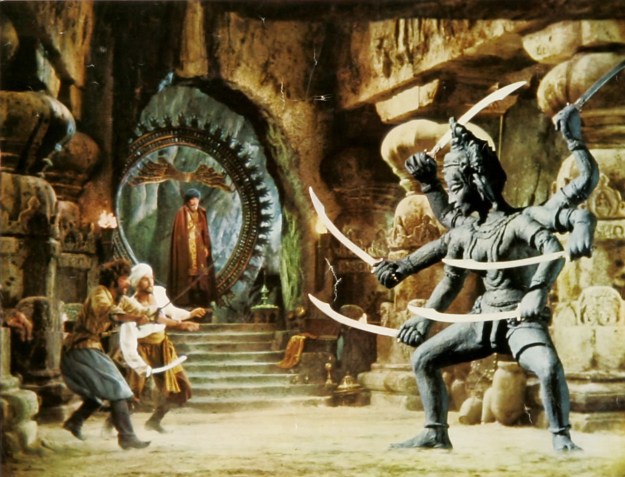
Kali dances for Koura

As with any Ray Harryhausen film, there are a number of stop-motion creations in this story. These include:

  • the homunculus: a tiny winged creature that Koura uses as a spy
  • the Siren: Koura uses his magic to bring the wooden figurehead of Sinbad’s ship to life.
  • the one-eyed centaur
  • a griffin

All of these creations are amazing to watch, but my favorite out of all of them is Harryhausen’s work on “Kali” a six-armed statue that Koura brings to life in a Lemurian temple. While named Kali, the statue bears more resemblance to the Hindu god Shiva (particularly in its initial pose before it comes to life). There is a beautiful scene where Koura orders Kali to dance and the statue obeys, all six arms moving throughout. Given how much care needs to be taken in stop-motion animation, I always find myself wondering just how long it took to animate the statue.

Centaur vs. Griffin

While the film is enjoyable, it also has several flaws. The one that bothers me the most is how Margiana (a slave girl that Sinbad frees after seeing her in a vision connected to the tablet) received a tattoo of an eye on her palm. It is revealed late in the film that this tattoo marks her as sacred to one of Lemuria’s gods but this revelation is extremely problematic because if Lemuria is a lost island that no one has found in centuries, then how did Margiana receive the tattoo for one of their gods? It seems awfully convenient to the plot that a mysterious tattoo just happens to coincide with the place Sinbad and company are trying to reach.

Time for some interesting trivia!

-That is indeed the same Tom Baker who played the Fourth Doctor in Doctor Who. In fact, Baker got the role of the Doctor because of his performance in this film.

-Christopher Lee was a front runner to play Prince Koura

-Miklos Rozsa scores this film and parts of the score are very similar to segments in Ben-Hur (1959)

One thing is for sure, they definitely don’t make films like The Golden Voyage of Sinbad anymore, which is a real shame since it is so much fun to watch. Let me know what you think of The Golden Voyage of Sinbad in the comments below and have a great day!

See also:

Film Reviews

Become a Patron of the blog at patreon.com/musicgamer460

Check out the YouTube channel (and consider hitting the subscribe button)

Don’t forget to like Film Music Central on Facebook

My Thoughts on: Slayers NEXT (Season 2) (1996)

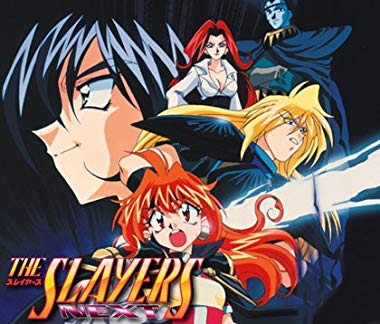
While Slayers has a great start in season 1, it gets even better in season 2 with Slayers NEXT. All of our heroes return for more adventures and we’re introduced to even more interesting characters as Lina, Gourry and company go on more exciting (and dangerous) adventures! These new characters include:

Princess Martina of Zoana: Oh Martina, Martina…let me tell you something about Martina…she’s absolutely 100% crazy!! How so? Well, just as an example, Martina is a fervent devotee of the monster Zoamelgustar. There’s just one little problem with that…Martina made him up out of her own imagination, not that this impedes her devotion in the slightest. In fact, in one hilarious episode, Martina successfully invokes Zoamelgustar’s power to curse Lina through sheer willpower (not bad for a non-existent monster). She hates Lina with a passion for destroying her kingdom (even though it was Martina who started the trouble) and also has a habit in falling in love with every handsome man who crosses her path. Despite trying really hard to be a villain, Martina is more of a nuisance than anything else.

Xellos: This is one of the most frustrating characters you’ll meet in the series, because for most of the time he appears you’re never really sure what he’s up to or whose side he’s really on! He claims to be a traveling monk but hints are dropped repeatedly that this is far from the truth. Xellos also has an annoying habit of leading people in conversation up to a critical point and when they demand to know something important he’ll just smile and say “That…is a secret.” I’ll admit, the true identity of Xellos shocked me (though I won’t spoil it here).

Hellmaster Fibrizo: I’m pretty sure it goes without saying that if you have “Hellmaster” in your name than you are not a good person. Hellmaster Fibrizo might be one of the most sadistic characters I’ve ever seen. This is one of those characters who kills on a whim, all to get what he wants. Truthfully, you will not see this character coming, it’s one of the best villain introductions I’ve ever seen.

maxresdefault (5).jpg

A lot of the plot revolves around our heroes searching for the Claire Bible (a text containing powerful magical secrets) in the hopes that it contains some spell that can cure Zelgadis and make him human again. During this search, Lina and her friends stumble on a plot brewing among the monsters. It seems that the destruction of Ruby Eye Shabranigdu in season 1 had some far-reaching consequences and it’s up to Lina to deal with the fallout…if she can survive that is. Like season 1, Slayers NEXT gets pretty bloody in the last part of the season (not enough to be considered “gory” but there are still some fairly shocking moments).

If you enjoy season 1 of Slayers then you will absolutely love Slayers NEXT. I hope you get the chance to check it out someday. Unfortunately it’s not streaming on Hulu currently but you can get seasons of Slayers for a reasonable price on the Internet. Let me know what you think of Slayers NEXT in the comments below and have a great day!

See also:

My Thoughts on: Slayers (season 1) (1995)

My Thoughts on: Slayers TRY (season 3) (1997)

My Thoughts on: Slayers Return (1996)

My Thoughts on: Slayers Great (1997)

Animated Film Reviews

Become a Patron of the blog at patreon.com/musicgamer460

Check out the YouTube channel (and consider hitting the subscribe button)

Don’t forget to like Film Music Central on Facebook

My Thoughts on: Slayers (season 1) (1995)

*Note: It should go without saying that there are plot spoilers to be found below

Last summer some of my friends introduced me to a wonderful anime called Slayers which I’d never heard of before (my access to anime was severely limited growing up so for a long time the only shows I knew anything about were Sailor Moon and Dragon Ball Z). I quickly fell in love with the series and it’s been one of my favorites ever since.

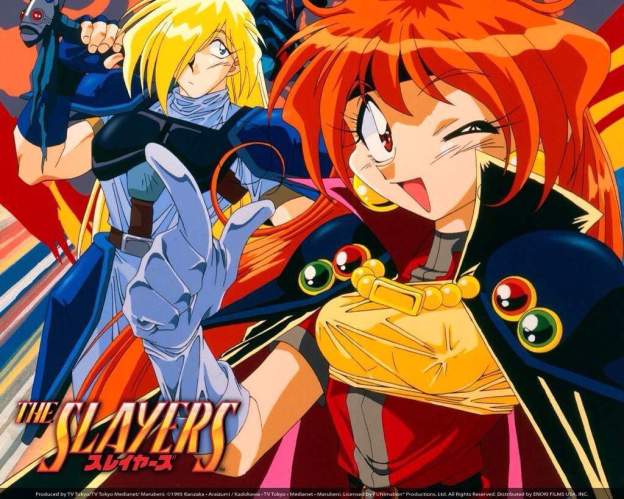
In season one of Slayers we are introduced to a quirky cast of characters:

  • Lina Inverse (Lisa Ortiz): A very young and extremely powerful sorceress. Lina loves to travel the world and gather treasure. She also loves food.
  • Gourry Gabriev (Eric Stuart): Lina’s self-proclaimed guardian. Gourry is almost a pure iteration of the “dumb blonde” trope but he does have his moments (which I won’t tell you because that would spoil some wicked awesome moments).
  • Zelgadis (Crispin Freeman for most of the series): an equally powerful sorcerer who is continually seeking a way to restore his body to human form (for plot reasons he currently exists as a chimera with a body of stone).
  • Amelia (Veronica Taylor): This young princess and a would-be mage is the living embodiment of a crit fail in D&D (case in point: Amelia loves to make dramatic entrances but typically fails to stick the landing).
  • Sylphiel (Stacia Crawford): a priestess who refers to Gourry as “Gourry Dear” a lot.

vlcsnap-2009-09-13-00h30m27s161.png

The plot of season 1 finds our heroes fighting against Rezo the Red Priest. It eventually comes out that Rezo is trying to summon Ruby Eye Shabranigdu (a powerful demon) in the belief that doing so will finally cure his blindness. However, when this plan backfires, our heroes must fight Shabranigdu and save the world! Actually, they end up saving the world several times over by the end of season 1, with some plot twists that I genuinely didn’t see coming.

One of my favorite things about Slayers are the ornate incantations used to create spells. For example, here is how Lina casts Dragon Slave, one of her most powerful spells:

Darkness beyond twilight
Crimson beyond blood that flows
Buried in the stream of time is where your power grows
I pledge myself to conquer all the foes who stand
before the mighty gift bestowed in my unworthy hand
Let the fools who stand before me be destroyed
by the power you and I possess…
DRAGON SLAVE!

To make a long story short, Slayers is a really fun anime and you should definitely check out the first season if you get the chance (the subtitled version is currently streaming on Hulu but I highly recommend the dubbed version as well).

Let me know what you think about season 1 of Slayers in the comments below and have a great day!

See also:

My Thoughts on: Slayers NEXT (Season 2) (1996)

My Thoughts on: Slayers TRY (season 3) (1997)

My Thoughts on: Slayers Return (1996)

My Thoughts on: Slayers Great (1997)

Animated Film Reviews

Become a Patron of the blog at patreon.com/musicgamer460

Check out the YouTube channel (and consider hitting the subscribe button)

Don’t forget to like Film Music Central on Facebook

My Thoughts on: The LEGO Movie 2-The Second Part (2019)

*note: I’m trying to keep spoilers to a minimum but a few are going to leak out. So keep that in mind as you read my review!

One of the fears with sequels is that they won’t live up to the bar set by the first film, particularly when it’s a film as funny as the The LEGO Movie. Happily, The LEGO Movie 2: The Second Part proves to be a fun and entertaining story, though it is not without its fair share of weak moments.

The sequel picks up immediately where the first film left off, with Bricksburg invaded by “aliens” from the planet Duplo. The story then flashes forward five years and sees Bricksburg transformed into a post-apocalyptic wasteland. Honestly, I was unsure about the post-apocalyptic vibe, but it really does work. My biggest complaint is that we don’t see enough of this new Bricksburg. Most of the story takes place in and around the “Systar System,” where Emmet must go to rescue his kidnapped friends. I will say it is very funny to see Emmet (Chris Pratt) retaining his “Everything is Awesome” personality while everyone else goes hardcore.

lego-movie-2-620x370

There are a number of catchy songs in The LEGO Movie 2, all of which I loved. My favorites that I want to highlight include:

-“Not Evil” -Sung by the ruler of the Systar System, Queen Watevra Wa’Nabi (Tiffany Haddish), it’s a great song where the alien queen sings about all the ways she’s NOT evil (it’s as great as it sounds).

-“Catchy Song”- All I can say is “this song’s gonna get stuck inside your head.” You’ve been warned.

-“Gotham City Guys”-I can’t really give too much context for this song because that would spoiler a lot of the plot but this might be my absolute favorite song in the entire film.

-“Everything’s NOT Awesome”-The title speaks for itself.

8978fd87652851c61a79f75532408dd36dde769d

Aside from the awesome songs, mostly great plot and what I’m pretty sure is a wicked funny Twilight joke, I do have a problem with the last act of the film. It involves Emmet and his new friend Rex Dangervest (also played by Chris Pratt). Rex’s backstory involves a lot of time spent in live-action and it is by far the weakest part of the film. I’m pretty sure this sequence is meant to be funny in a roundabout sort of way, but to me it came across as awkward and incredibly fake (I couldn’t quite suspend my disbelief watching it). I also feel like the story relies a little too much on Finn (the kid from the first film) and his family for the plot to make sense. It’s not that the segments are bad (they’re not), I just feel like there’s too many of them. The good news is the story comes back together by the end and provides a satisfactory ending.

However, I really do think that this should be the end of the story and there should not be a LEGO Movie 3. I think that because the story, while funny, relied a bit too much on jokes it introduced in the first film. I can only imagine a third film would do that even more and thus lessen the humor.

In conclusion, The LEGO Movie 2 is a lot of fun, and if you liked the first film, you’re going to enjoy this one. It’s not quite as strong as the first film, but its weaknesses aren’t enough to derail the story. Let me know what you think about The LEGO Movie 2 in the comments below and have a great day!

See also:

Thinking about The LEGO Batman Movie (2017)

Thinking about: The LEGO Movie (2014)

Animated Film Reviews

Become a Patron of the blog at patreon.com/musicgamer460

Check out the YouTube channel (and consider hitting the subscribe button)

Don’t forget to like Film Music Central on Facebook

The Two Towers “Forth Eorlingas!” (2002)

forth.jpg

As the battle of Helm’s Deep draws to a close, all seems lost for our heroes. The Uruk-Hai have overrun the outer defenses and what forces remain are holed up inside the great hall. Theoden seems almost suicidal in his despondency (“So much death. What can man do against such reckless hate?”) but even as the enemy begins breaking through, Aragorn remembers that this is the day Gandalf promised to return with help. With this in mind, he encourages Theoden to ride out and take the Uruk-Hai head on. Eager to go down fighting (that’s certainly how it appears to me), Theoden agrees, proclaiming that “the horn of Helm Hammerhand shall sound in the Deep. One last time.”

The Two Towers “Forth Eorlingas!” (2002)

Interestingly, the music that starts this moment (beginning when Aragorn remembers Gandalf’s promise) is a soft rendition of the music heard in “The Last March of the Ents.” It might just be a coincidence, but it could also be a musical clue that the trees of Fangorn Forest have also arrived to take revenge on the Uruk-Hai for attacking them in the past.

As Theoden and the others get ready to charge out, Gimli runs up to a tower where a massive horn can be seen. If you haven’t read the books, this is the legendary horn of King Helm Hammerhand, a great king of Rohan who saved his people from destruction. He used to sound that horn every time he went into battle, and even after he died people would swear they could hear the horn sounding on certain nights. The sound of this horn was said to terrify all who heard it, so maybe Theoden is hoping to psych out the Uruk-Hai (even a little) when the moment comes.

I love the moment the charge begins. The music has remained relatively soft and steady all this time, even as Theoden utters these last lines and the doors threaten to give way:

Fell deeds awake. Now for wrath, now for ruin, and the red dawn!

At that moment, Gimli sounds the Horn of Helm and it’s this spine-tingling roar that instantly gives you goosebumps. In the next second, the door crashes down and Theoden leads a wild charge as the horn spurs them on. The music restarts as the king rides out into the morning light (a fanfare version of Rohan’s theme), but that glorious moment when all you hear is the horn is what sticks with me the most.

What do you think of this moment in “Forth Eorlingas”? Let me know your thoughts in the comments below and have a great day!

See also:

Become a Patron of the blog at patreon.com/musicgamer460

Check out the YouTube channel (and consider hitting the subscribe button)

Don’t forget to like Film Music Central on Facebook

The Return of the King “Lighting the Beacons” (2003)

The Return of the King “Ride of the Rohirrim” (2003)

The Return of The King “The Haradrim Arrive” (2003)

The Fellowship of the Ring “The Shire” (2001)

The Fellowship of the Ring “Shadow of the Past” (2001)

The Fellowship of the Ring “The Wood Elves/Passing of the Elves” (2001)

The Fellowship of the Ring “The Treason of Isengard” (2001)

The Fellowship of the Ring “A Knife in the Dark” (2001)

The Fellowship of the Ring “Flight to the Ford” (2001)

The Fellowship of the Ring “The Bridge of Khazad-Dum” (2001)

The Fellowship of the Ring “Many Meetings” (2001)

The Fellowship of the Ring “The Ring Goes South/Fellowship Main Theme” (2001)

The Fellowship of the Ring “In Dreams” (2001)

The Two Towers “Lament for Theodred” (2002)

The Two Towers “Last March of the Ents” (2002)


The Return of The King “The Haradrim Arrive” (2003)

download.png

The Return of the King “The Haradrim Arrive” (2003)

Yesterday I talked about “Ride of the Rohirrim” and how the riders crashed into the armies of Mordor. For a few glorious minutes it looks like the battle is definitively won, with Eomer eager to drive the orcs all the way to the river, while Theoden wants to make sure the city is secured. But suddenly, everything comes to a halt and we hear a strange booming in the distance along with shouting. The Haradrim (glimpsed in The Two Towers by Frodo, Sam, and Gollum) have arrived, mounted on enormous oliphaunts. The riders of Rohan are frozen by this sight (and if you listen closely, before the camera closes in on the oliphaunts, you can hear some of them say they’ve never seen anything like this). I’m not sure if this is actually a separate cue or not, but it is one of my favorite musical moments in The Return of the King.

What’s great about the Haradrim’s introduction to the scene is that all of the orchestral music has stopped (just moments before we had a rousing fanfare as the Rohirrim routed orcs left and right). Aside from the booming steps of the oliphaunts, all you hear for a few moments is the leering horn sounded by one of the Harad riders along with the war shouts of their fighters. I’m fascinated by the sound of this horn, as it helps to establish just how different the men of Harad are from anyone we’ve met before. Everything about it just sounds foreign. When the camera finally pans downward to capture an oliphaunt in all of its glory, the score finally returns with an ominous chord, to emphasize that the Haradrim are just as much a threat as the orcs. This impression is helped by the reveal that the oliphaunt’s tusks and feet are bound with metal spikes and razor sharp wire, ready to obliterate anything in their path (like horses, for example).

Theoden is not daunted, however, and quickly orders the riders to reform into a line, ready to charge. However, unlike the first charge, this one feels different. It’s understandably rushed given the Haradrim are swiftly approaching, but it also feels like more of a desperate gamble compared to the first charge (especially when you hear Theoden’s command to take them head-on). Given the ominous sounds in the score, it’s no surprise that this second charge is swiftly crushed by the oliphaunts, who literally sweep horses and riders from their path with their tusks (while archers and spear men have free reign to take out as many as they can).

What do you think about the arrival of the Haradrim? Let me know your thoughts in the comments below and have a great day!

See also:

Become a Patron of the blog at patreon.com/musicgamer460

Check out the YouTube channel (and consider hitting the subscribe button)

Don’t forget to like Film Music Central on Facebook 🙂
The Return of the King “Lighting the Beacons” (2003)

The Return of the King “Ride of the Rohirrim” (2003)

The Fellowship of the Ring “The Shire” (2001)

The Fellowship of the Ring “Shadow of the Past” (2001)

The Fellowship of the Ring “The Wood Elves/Passing of the Elves” (2001)

The Fellowship of the Ring “The Treason of Isengard” (2001)

The Fellowship of the Ring “A Knife in the Dark” (2001)

The Fellowship of the Ring “Flight to the Ford” (2001)

The Fellowship of the Ring “The Bridge of Khazad-Dum” (2001)

The Fellowship of the Ring “Many Meetings” (2001)

The Fellowship of the Ring “The Ring Goes South/Fellowship Main Theme” (2001)

The Fellowship of the Ring “In Dreams” (2001)

The Two Towers “Lament for Theodred” (2002)

The Two Towers “Last March of the Ents” (2002)