Steve Jobs (2015) marked the first collaboration between director Danny Boyle and composer Daniel Pemberton (their second team-up, Yesterday, comes out in June). In this behind-the-scenes video, the composer discusses how he divided the film’s score into three distinct parts, each one corresponding to one of the three acts of the film. The first act (he explains) is full of synthesizers to match the vibe of 1984. The second act (and the one I like best) is purely orchestral. Not just orchestral, it’s more of a miniature opera (complete with singers). And the third act is squarely placed in the digital medium, referencing how just about everything in our lives has gone digital, thanks in large part to the real Steve Jobs.
I’m fascinated at how Pemberton essentially created three different scores for this film, that’s not something you come across very often (in fact I’m hard pressed to name another example). Daniel Pemberton is very quickly becoming one of my favorite film composers and I for one am excited to learn more about him. I hope you enjoyed the video! Let me know what you think about Steve Jobs (and it’s score) in the comments below and have a great day!
While it’s no secret that Guy Ritchie’s retelling of the King Arthur legend was a colossal flop at the box office, that shouldn’t stop you from learning about what went into making the film’s soundtrack. King Arthur: Legend of the Sword marked the second collaboration between Guy Ritchie and Daniel Pemberton and just like he did with The Man from U.N.C.L.E, the composer went all out in putting the music together.
Daniel Pemberton employed a variety of musical instruments both ancient and modern. As he says in the video, he sought to make the score visceral and gritty, something that felt distinctly unpolished. If the excerpts heard in this video are any indication, I think the composer succeeded in that aspect. It’s a shame the film flopped so badly, it sounds like Pemberton’s score for the film is really good (and it’s not that uncommon to find a great score hiding in a terrible film). I find myself hoping that Ritchie and Pemberton will collaborate again (hopefully on The Man from U.N.C.L.E 2), though hopefully the resulting film will do much better than this one did.
Let me know what you think of this behind the scenes look at the music for King Arthur: Legend of the Sword in the comments below and have a great day!
I’m fairly certain that The Man from U.N.C.L.E served as my introduction to the film music of Daniel Pemberton. I first watched the film about three years ago and while the story took some time to grow on me, the score immediately grabbed my attention. Pemberton (I’ve since discovered), has this talent for creating quirky and memorable scores that stick in your mind. Such is the case with the score for The Man from U.N.C.L.E.
In the making of featurette which you can access above, Daniel explains that director Guy Ritchie requested a score in which every cue feels iconic. And on that point alone I think the composer succeeded, because none of the music in this film feels “throwaway,” it all feels very necessary. You’ll also learn that Pemberton employed a lot of unique instruments to create the film’s distinctive 1960s-like sound. While there are traditional orchestral elements in certain places, the lion’s share of the music comes from non-traditional instruments, which is really cool.
I hope watching this behind-the-scenes video gives you an even deeper appreciation of Daniel Pemberton’s score for what I consider a highly underrated film. Let me know what you think of the music for The Man from U.N.C.L.E in the comments below and have a great day!
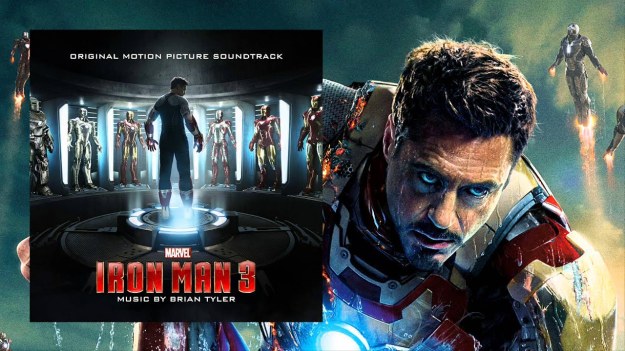
The Marvel Cinematic Universe has featured musical scores from a number of composers, but some of my favorite work comes from Brian Tyler, who to date has scored three films in the MCU: Thor: The Dark World, Avengers: Age of Ultron and Iron Man 3.
The thrilling conclusion to the Iron Man trilogy features some dark and stirring music that’s on full display in this recording (to be completely honest, I’m not sure if this is from an actual scoring session or a later re-recording for a soundtrack, but it’s pretty much the same setup as a scoring session so that’s what I’m calling it). Brian Tyler is one of those composers who also conducts and it’s always fun to watch him at work. From the moment the music starts you can tell he is completely into what he’s doing.
I love sharing these recording videos with you because I feel like it’s only once you see and hear the music being performed separate from the film that you can truly appreciate just how much work goes into putting the score together. Action scores (and often superhero scores) can get a bad rap but I really feel like the MCU has changed what a superhero film score can be in the 21st century. These scores are organic, breathing things, and I think this clip really shows that.
At any rate, I hope you enjoy watching Brian Tyler at work with Iron Man 3. Let me know what you think of the clip in the comments below and have a great day!
While Justin Hurwitz (whose recent works include First Man) does talk about the scory of La La Land, this is less of a one-on-one interview and more of a group discussion where cast (like Ryan Gosling), crew, directors and etc. talk about the qualities of the La La Land score.
As stated in the video, the music for La La Land does call back to an earlier time in Hollywood when film music focused on melody most or all of the time. That’s not to say that today’s film scores don’t have melody, but it’s not nearly to the same extent (and many action scores don’t feature proper melody at all).
Seeing the depth of music in La La Land‘s score really drives home just how talented Justin Hurwitz is (I can see now why the film took home the Oscar for Best Original score).
I hope you enjoy this behind the scenes look at the score for La La Land. Let me know what you think of the score in the comments below and have a great day!
*note: in the context of this song “gay” means happy/carefree
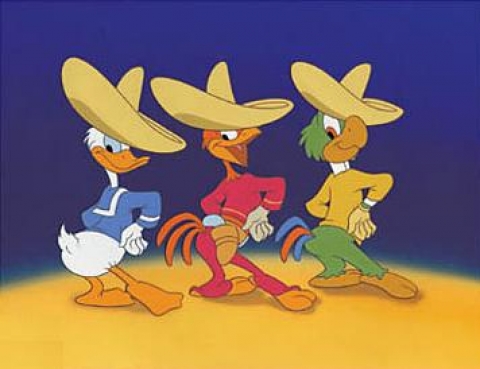
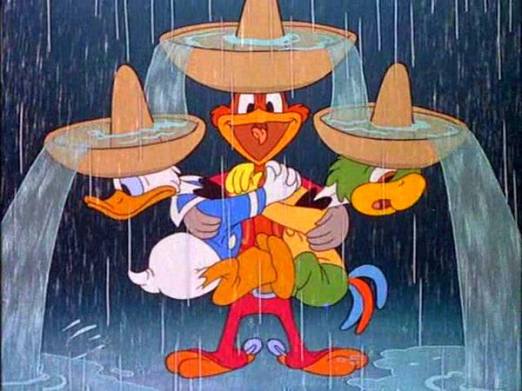
I’m not sure if I’ve mentioned it before, but during the 1940s Disney released a lot of what were called “package films.” While ostensibly released as a single feature, package films actually contained a series of separate animated shorts connected by a plot line. This happened because Disney found themselves with a lot of material that was too long to be regular cartoons and too short to be standalone features. This is how The Three Caballeros came into being. The common thread is that Donald Duck is celebrating his birthday and while opening his presents he learns about Mexico and South America via his friends José Carioca (a Brazilian parrot) and Panchito Romero Miguel Junipero Francisco Quintero González III (a Mexican rooster).
Once Panchito joins the party, he leads his friends in singing “The Three Caballeros.” In this song, Panchito praises the life of a caballero and how he is always loyal to his friends (unless there’s a girl involved, in which case forget it!) The rhythm and last verse of this song come from Ay, Jalisco, no te rajes!, a popular Mexican ranchera song released in 1941.
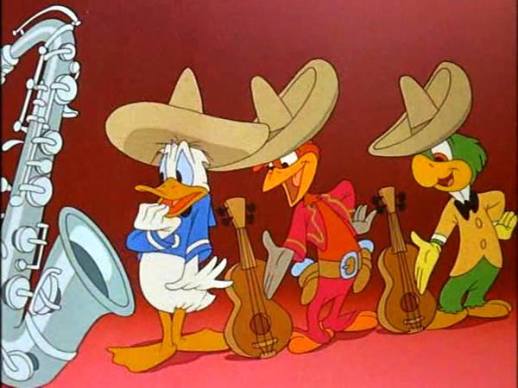
A running gag throughout the song is Donald trying (and failing) to imitate José and Panchito. For example, he flops to the ground when the others fly, and he can’t summon a guitar out of thin air (instead he gets a saxophone, a trumpet, and a double bass).
We’re three caballeros Three gay caballeros They say we are birds of a feather We’re happy amigos No matter where he goes The one, two, and three goes We’re always together
We’re three happy chappies With snappy serapes You’ll find us beneath our sombreros We’re brave and we’ll stay so We’re bright as a peso Who says so? We say so! The three caballeros
Ooooh! We have the stars to guide us Guitars here beside us To play as we go We sing and we samba We shout, ¡Ay caramba! What means “Ay caramba”? Oh, yes! I don’t know
Ooooh! Through fair and stormy weather We stand close together Like books on a shelf And pals though we may be When some Latin baby Says yes, no, or maybe (wolf whistle) Each man is for himself!
¡Ay, Jalisco no te rajes! Me sale del alma Gritar con color Abrir todo el pecho Pa’ echar este grito ¡Qué lindo es Jalisco! Palabra de honor!
The end of the song made me laugh for years when I was growing up. At the end, when the song has supposedly finished, Panchito keeps right on holding that last note (and truthfully, a well-trained singer can theoretically hold a note indefinitely). José and Donald try everything to make Panchito stop, but nothing affects the rooster, until he appears to shrink away and disappear. Just when the pair think he’s gone though, the rooster reappears with a gigantic piñata!
What do you think about “The Three Caballeros”? Let me know your thoughts in the comments below and have a great day!
As Disney’s second animated feature film, Pinocchio is responsible for creating one of the company’s most memorable songs. Since its release, “When You Wish Upon a Star” has become the official anthem for the Walt Disney Company (a snippet plays right before the start of every Disney movie) and has been covered numerous times. But the original version was performed by Cliff Edwards (the voice of Jiminy Cricket) and became an instant hit. In fact, “When You Wish Upon a Star” was the first Disney song to win an Academy Award, taking home the Oscar for Best Song.
The song arrives at the start of the film and takes us through the opening credits until we come to Jiminy Cricket himself, singing the last part of the song by the Pinocchio storybook.
When you wish upon a star Makes no difference who you are Anything your heart desires Will come to you
If your heart is in your dream No request is too extreme When you wish upon a star As dreamers do
Fate is kind She brings to those who love The sweet fulfillment of Their secret longing
Like a bolt out of the blue Fate steps in and sees you through When you wish upon a star Your dreams come true
The song is also reprised at the end of the film while everyone is celebrating Pinocchio’s transformation into a real boy. To be perfectly honest, this song always makes me cry every time I hear it, so much so that there are times I have to skip over it so I can watch the film without bawling.
Here’s an interesting piece of trivia: if you look closely at the background of the picture with Pinocchio’s book, you’ll see two books titled Alice in Wonderland and Peter Pan. Both of these stories would be released as Disney films in the following decade (1951 and 1953 respectively).
What do you think of “When You Wish Upon a Star”? Let me know your thoughts in the comments below and have a great day!
When we first meet Geppetto the toymaker, it’s through the eyes of Jiminy Cricket, who is stopping by the toymaker’s shop/home for theDisturbing Disney #1: The Coachman in Pinocchio (1940) night. The elderly toymaker has just finished his latest creation, a wooden marionette he dubs Pinocchio (which means “pine eye” because he was carved from a block of pine wood).
Delighted with how Pinocchio has turned out, Geppetto winds up a music box and dances with the little puppet while singing “Little Wooden Head.”
Little wooden head, go play your part Bring a little joy to every heart Little do you know and yet it’s true That I’m mighty proud of you Little wooden feet and best of all Little wooden seat in case you fall (How graceful!) My little wooden head!
Geppetto then introduces Pinocchio to his two pets, Cleo the goldfish and Figaro the cat. While Cleo is delighted, Figaro is quite jealous (it doesn’t help that Geppetto uses the puppet to have some fun at the cat’s expense).
Little does Geppetto suspect that the little puppet he loves so much will soon be brought to life by the Blue Fairy after he makes a wish on the Wishing Star. This is a very short song but it quickly establishes that Geppetto is a good and kindly man who loves to bring joy to others through the toys he makes (this is why the Blue Fairy grants his wish).
What do you think of “Little Wooden Head”? Let me know your thoughts in the comments below and have a great day!
I have always been a fan of Ray Harryhausen’s stop-motion animation and his three Sinbad films are among my favorites. I particularly enjoy The Golden Voyage of Sinbad, the second Sinbad film that Harryhausen worked on. The film follows the legendary sailor (John Phillip Law) as he discovers a mysterious gold tablet before finding himself driven to the country of Marabia. There he meets the Grand Vizier (Douglas Wilmer) (who wears a golden mask to hide his burned face) and finds a second gold tablet that interlocks with the first. It turns out the tablets are a map to the lost island of Lemuria and Sinbad organizes his crew to sail there. But Sinbad and the Vizier aren’t the only ones interested in finding Lemuria: this place is also sought by Prince Koura (Tom Baker), an evil sorcerer who is angry that Sinbad has taken the gold tablet that a magical servant was bringing to him. Both sides race to find Lemuria and the secrets it contains.
As with any Ray Harryhausen film, there are a number of stop-motion creations in this story. These include:
the homunculus: a tiny winged creature that Koura uses as a spy
the Siren: Koura uses his magic to bring the wooden figurehead of Sinbad’s ship to life.
the one-eyed centaur
a griffin
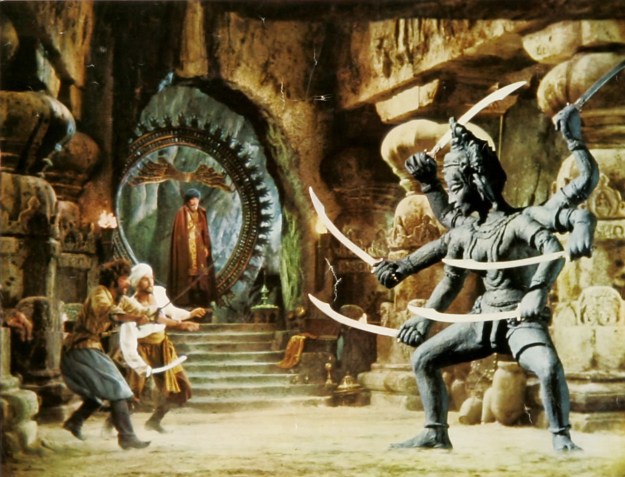
All of these creations are amazing to watch, but my favorite out of all of them is Harryhausen’s work on “Kali” a six-armed statue that Koura brings to life in a Lemurian temple. While named Kali, the statue bears more resemblance to the Hindu god Shiva (particularly in its initial pose before it comes to life). There is a beautiful scene where Koura orders Kali to dance and the statue obeys, all six arms moving throughout. Given how much care needs to be taken in stop-motion animation, I always find myself wondering just how long it took to animate the statue.
While the film is enjoyable, it also has several flaws. The one that bothers me the most is how Margiana (a slave girl that Sinbad frees after seeing her in a vision connected to the tablet) received a tattoo of an eye on her palm. It is revealed late in the film that this tattoo marks her as sacred to one of Lemuria’s gods but this revelation is extremely problematic because if Lemuria is a lost island that no one has found in centuries, then how did Margiana receive the tattoo for one of their gods? It seems awfully convenient to the plot that a mysterious tattoo just happens to coincide with the place Sinbad and company are trying to reach.
Time for some interesting trivia!
-That is indeed the same Tom Baker who played the Fourth Doctor in Doctor Who. In fact, Baker got the role of the Doctor because of his performance in this film.
-Christopher Lee was a front runner to play Prince Koura
-Miklos Rozsa scores this film and parts of the score are very similar to segments in Ben-Hur (1959)
One thing is for sure, they definitely don’t make films like The Golden Voyage of Sinbad anymore, which is a real shame since it is so much fun to watch. Let me know what you think of The Golden Voyage of Sinbad in the comments below and have a great day!
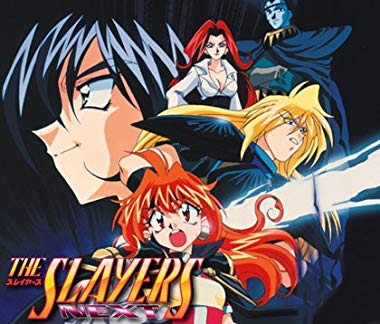
While Slayers has a great start in season 1, it gets even better in season 2 with Slayers NEXT. All of our heroes return for more adventures and we’re introduced to even more interesting characters as Lina, Gourry and company go on more exciting (and dangerous) adventures! These new characters include:
Princess Martina of Zoana: Oh Martina, Martina…let me tell you something about Martina…she’s absolutely 100% crazy!! How so? Well, just as an example, Martina is a fervent devotee of the monster Zoamelgustar. There’s just one little problem with that…Martina made him up out of her own imagination, not that this impedes her devotion in the slightest. In fact, in one hilarious episode, Martina successfully invokes Zoamelgustar’s power to curse Lina through sheer willpower (not bad for a non-existent monster). She hates Lina with a passion for destroying her kingdom (even though it was Martina who started the trouble) and also has a habit in falling in love with every handsome man who crosses her path. Despite trying really hard to be a villain, Martina is more of a nuisance than anything else.
Xellos: This is one of the most frustrating characters you’ll meet in the series, because for most of the time he appears you’re never really sure what he’s up to or whose side he’s really on! He claims to be a traveling monk but hints are dropped repeatedly that this is far from the truth. Xellos also has an annoying habit of leading people in conversation up to a critical point and when they demand to know something important he’ll just smile and say “That…is a secret.” I’ll admit, the true identity of Xellos shocked me (though I won’t spoil it here).
Hellmaster Fibrizo: I’m pretty sure it goes without saying that if you have “Hellmaster” in your name than you are not a good person. Hellmaster Fibrizo might be one of the most sadistic characters I’ve ever seen. This is one of those characters who kills on a whim, all to get what he wants. Truthfully, you will not see this character coming, it’s one of the best villain introductions I’ve ever seen.
A lot of the plot revolves around our heroes searching for the Claire Bible (a text containing powerful magical secrets) in the hopes that it contains some spell that can cure Zelgadis and make him human again. During this search, Lina and her friends stumble on a plot brewing among the monsters. It seems that the destruction of Ruby Eye Shabranigdu in season 1 had some far-reaching consequences and it’s up to Lina to deal with the fallout…if she can survive that is. Like season 1, Slayers NEXT gets pretty bloody in the last part of the season (not enough to be considered “gory” but there are still some fairly shocking moments).
If you enjoy season 1 of Slayers then you will absolutely love Slayers NEXT. I hope you get the chance to check it out someday. Unfortunately it’s not streaming on Hulu currently but you can get seasons of Slayers for a reasonable price on the Internet. Let me know what you think of Slayers NEXT in the comments below and have a great day!










 Film Music Central